
AS Revision 2 Based on previous questions and
AS Revision - 2 Based on previous questions, and • potential answers to those questions • ©Subject Support 2012
Revision topics – chosen by your teachers Physiology: � Cardiac cycle with conduction system � Oxyhaemoglobin dissociation curve Skill: � Open and closed loop control � Learning Theories Opportunities for Participation: � Factors affecting a pupils experience of school sports � Inequality in sport ©Subject Support 2012
Typical question – cardiac cycle May 11 Qu 2 (a) (ii) Explain how the heart controls the rate at which it beats. (4 marks) ©Subject Support 2012
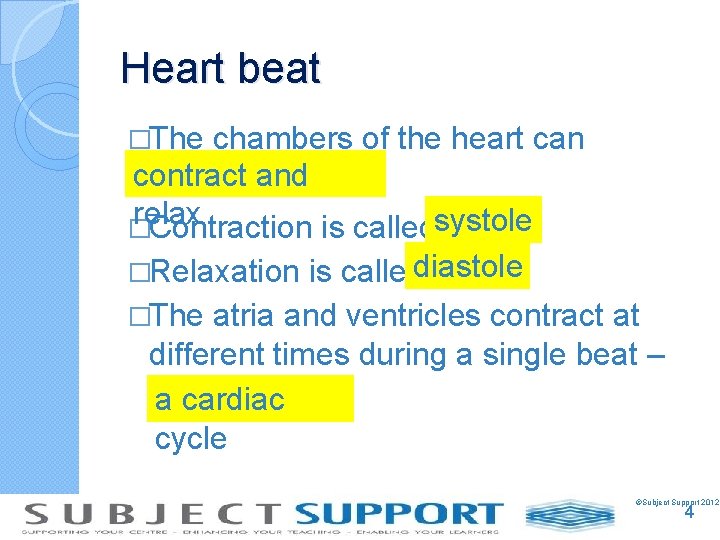
Heart beat �The chambers of the heart can contract and relax �Contraction is calledsystole �Relaxation is calleddiastole �The atria and ventricles contract at different times during a single beat – a cardiac cycle ©Subject Support 2012 4
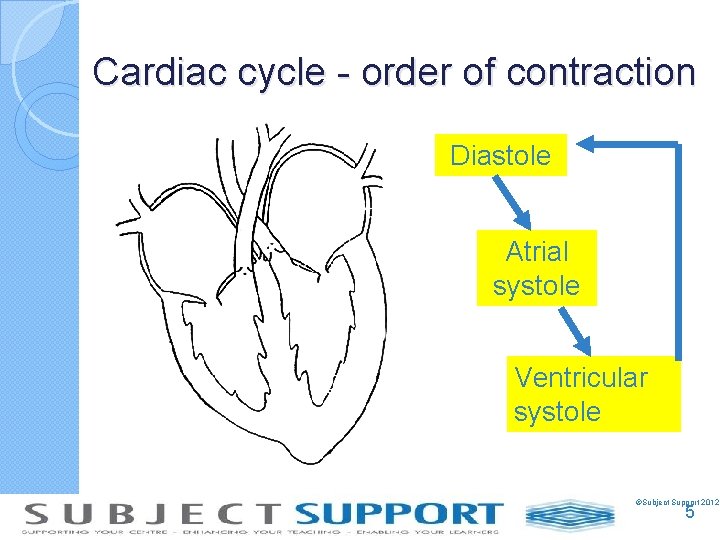
Cardiac cycle - order of contraction Diastole Atrial systole Ventricular systole ©Subject Support 2012 5
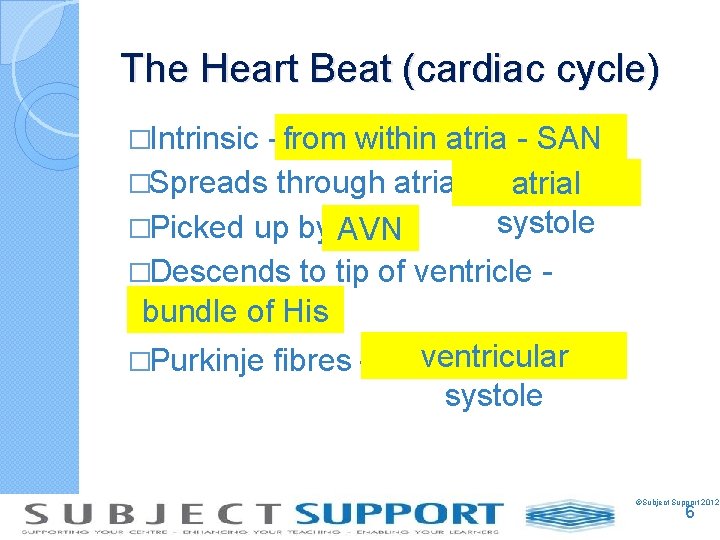
The Heart Beat (cardiac cycle) �Intrinsic - from within atria - SAN �Spreads through atria – �Picked up by AVN atrial systole �Descends to tip of ventricle - bundle of His �Purkinje fibres – ventricular systole ©Subject Support 2012 6
Typical Question Jun 07 Qu 4 During a demanding practice session, carbon dioxide is transported by the blood. (c)(i) State two ways in which carbon dioxide is transported by the blood. (2 marks) May 10 Qu 2 (a) (ii) Explain how oxygen is taken up by haemoglobin from the lungs and released at the muscle site. (3 marks) ©Subject Support 2012
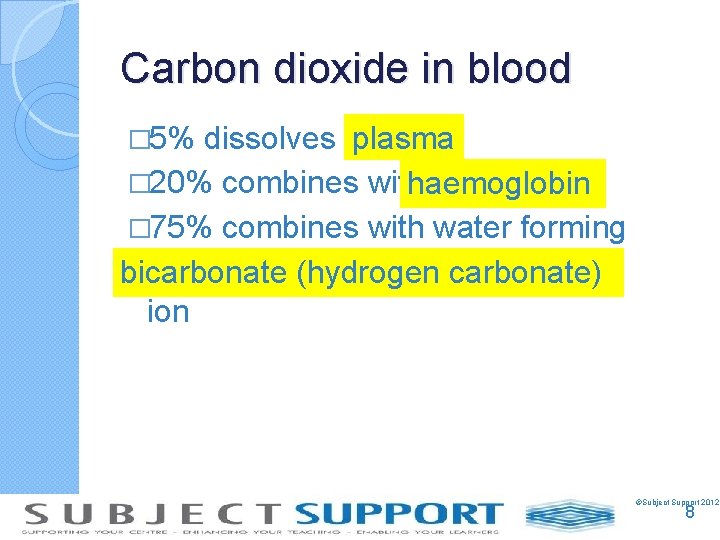
Carbon dioxide in blood plasma � 5% dissolves in � 20% combines with haemoglobin � 75% combines with water forming bicarbonate (hydrogen carbonate) ion ©Subject Support 2012 8
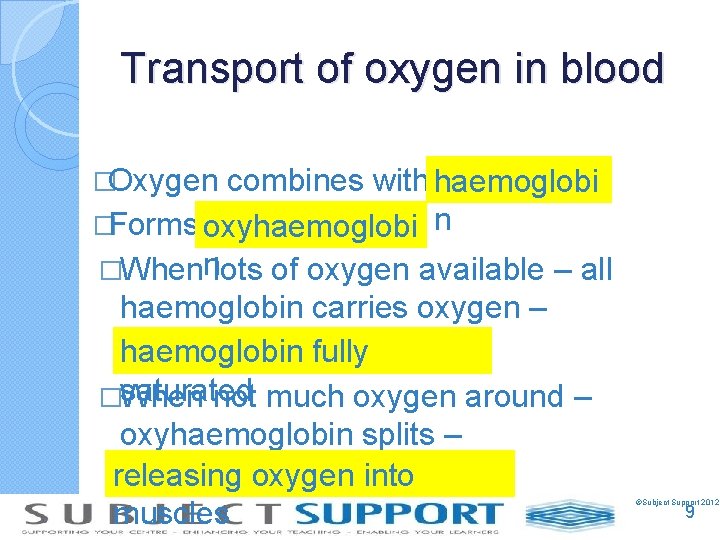
Transport of oxygen in blood � Oxygen combines with haemoglobi � Forms oxyhaemoglobi n n �When lots of oxygen available – all haemoglobin carries oxygen – haemoglobin fully �saturated When not much oxygen around – oxyhaemoglobin splits – releasing oxygen into muscles ©Subject Support 2012 9
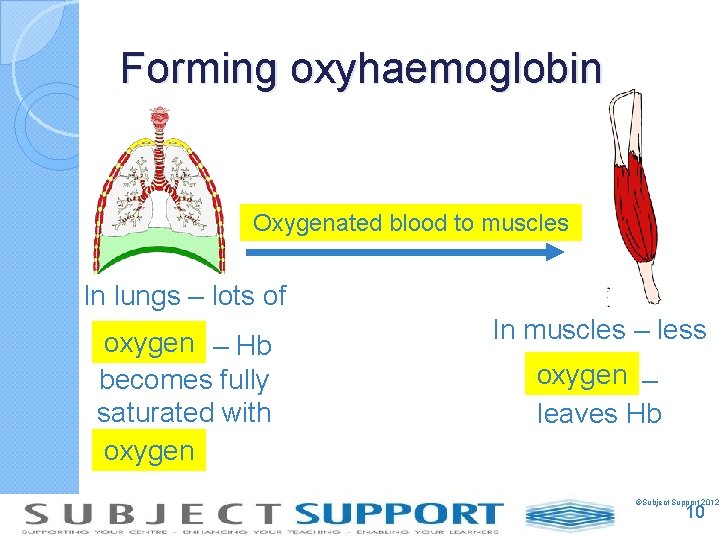
Forming oxyhaemoglobin Oxygenated blood to muscles In lungs – lots of oxygen – Hb becomes fully saturated with oxygen In muscles – less oxygen – leaves Hb ©Subject Support 2012 10
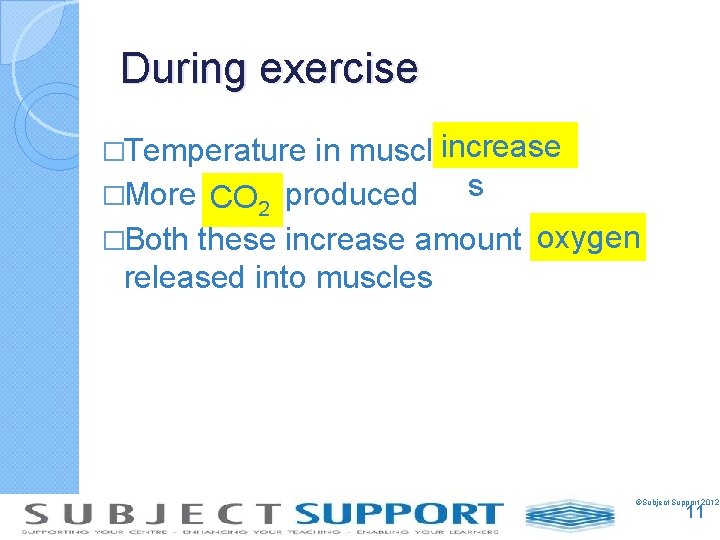
During exercise �Temperature in muscleincrease �More produced CO 2 s oxygen �Both these increase amount of released into muscles ©Subject Support 2012 11
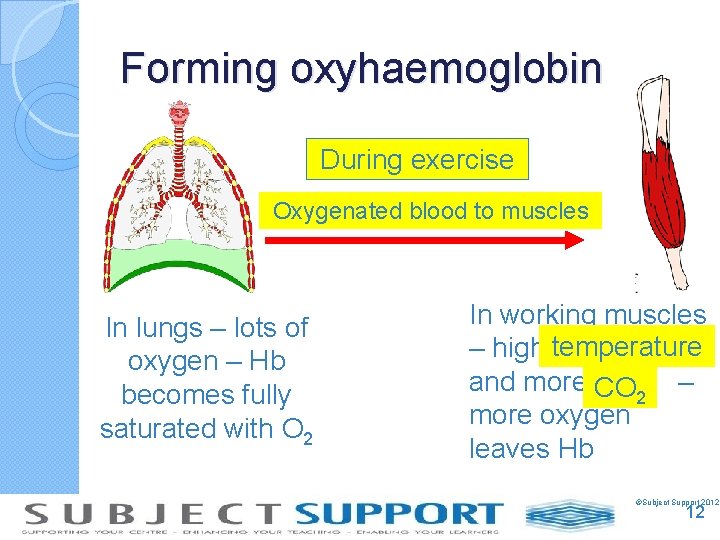
Forming oxyhaemoglobin During exercise Oxygenated blood to muscles In lungs – lots of oxygen – Hb becomes fully saturated with O 2 In working muscles temperature – higher and more CO 2 – more oxygen leaves Hb ©Subject Support 2012 12
Typical Question – venous return May 11 Qu 2 (b) Running helps the ‘venous return’ mechanism. Explain how the venous return mechanism works. (3 marks) ©Subject Support 2012
Venous return – blood back to heart �Valves inveins heart �Blood only flows one way – towards �Contraction of skeletal muscles during movements – muscle pump �Constriction of chest veins during inspiration – respiratory pump �Suction pressure ofheart ©Subject Support 2012 14
Operant conditioning - Typical Question Jan 10 Qu 4. (c)(i) Explain what you understand by the term operant conditioning. (2 marks) (ii) How can a coach use operant conditioning to develop a gymnast’s skills? (3 marks) ©Subject Support 2012
Operant conditioning conditioned � S-R theories – become respons to produce a particular to a stimulus particular e � - show Trial and error performer what is required and allow learning to try Shapin � - adjust environment to strengthen chance of correct g response ©Subject Support 2012 16
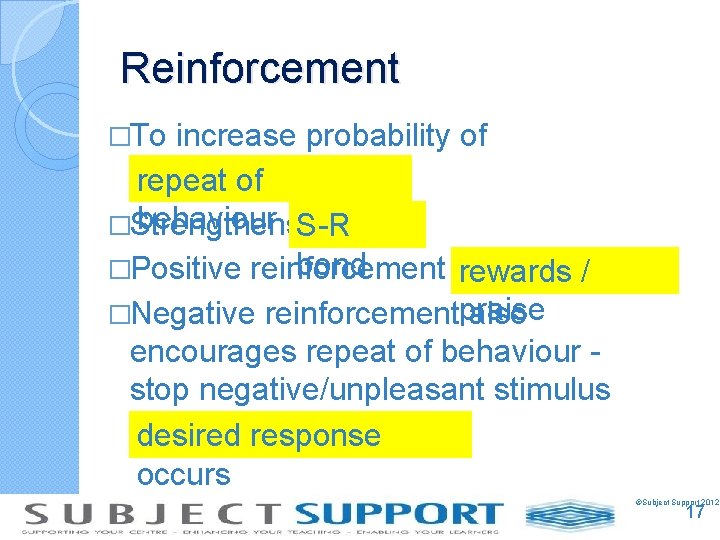
Reinforcement �To increase probability of repeat of behaviour S-R �Strengthens bond �Positive reinforcement rewards / praise �Negative reinforcement also encourages repeat of behaviour - stop negative/unpleasant stimulus when desired response occurs ©Subject Support 2012 17
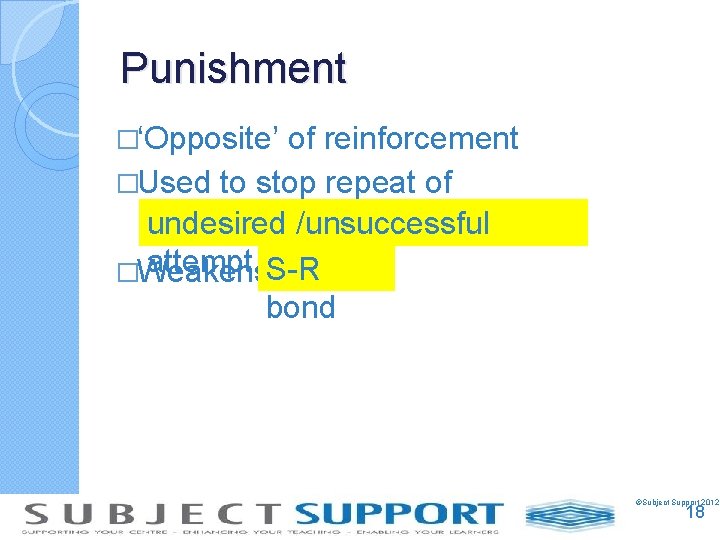
Punishment �‘Opposite’ of reinforcement �Used to stop repeat of undesired /unsuccessful attempt S-R �Weakens bond ©Subject Support 2012 18
Typical question - motivation Jan 10 Qu 3. In order to improve their performance, badminton players need to be motivated. (b) (i) Explain what do you understand by the term motivation? (2 marks) (ii) How could a coach motivate a badminton player to improve? (3 marks) ©Subject Support 2012
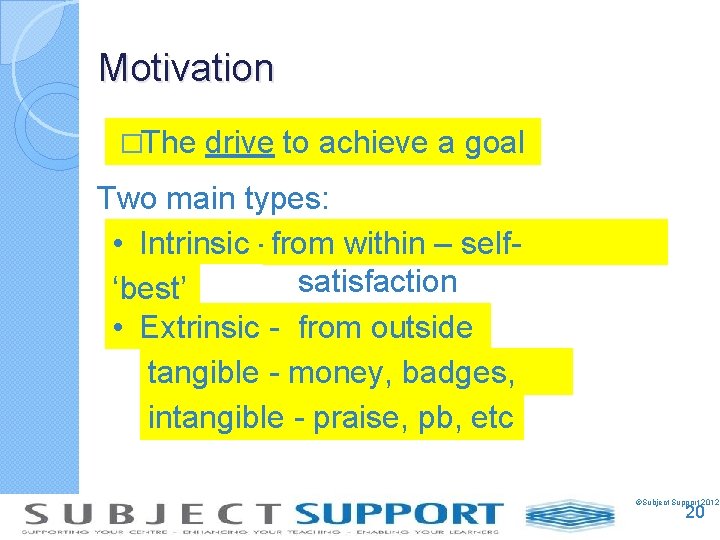
Motivation �The drive to achieve a goal Two main types: • Intrinsic - from within – selfsatisfaction ‘best’ • Extrinsic - from outside tangible - money, badges, etc intangible - praise, pb, etc ©Subject Support 2012 20
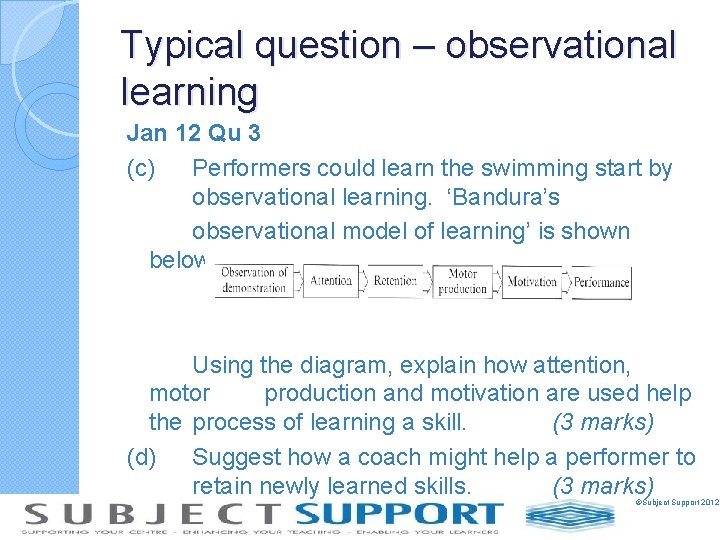
Typical question – observational learning Jan 12 Qu 3 (c) Performers could learn the swimming start by observational learning. ‘Bandura’s observational model of learning’ is shown below. Using the diagram, explain how attention, motor production and motivation are used help the process of learning a skill. (3 marks) (d) Suggest how a coach might help a performer to retain newly learned skills. (3 marks) ©Subject Support 2012
Observational Learning �Copying/mimicing an action/behaviour Requires learner to be: • Attentive (attention) • Capable of remembering (retention) • Capable of performing (motor production) • Willing to learn (motivation) ©Subject Support 2012 22
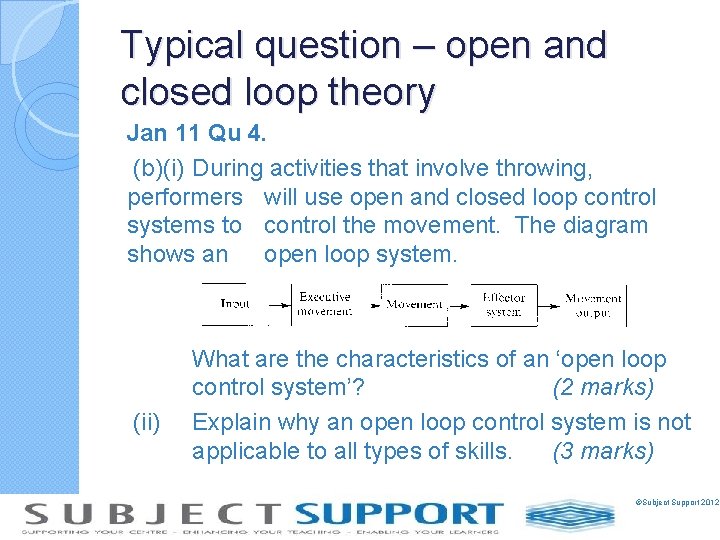
Typical question – open and closed loop theory Jan 11 Qu 4. (b)(i) During activities that involve throwing, performers will use open and closed loop control systems to control the movement. The diagram shows an open loop system. (ii) What are the characteristics of an ‘open loop control system’? (2 marks) Explain why an open loop control system is not applicable to all types of skills. (3 marks) ©Subject Support 2012
Open loop theory modifications feedback �No – no �No control conscious � movements Rapid/ballistic �Doesn’t explain: Limits of memory � � or skills Novel open ©Subject Support 2012 24
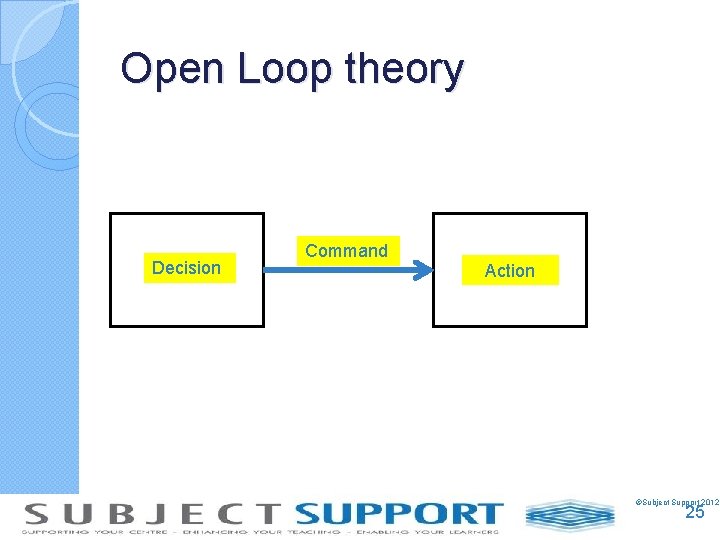
Open Loop theory Decision Command Action ©Subject Support 2012 25
Adam’s Closed loop theory Involvesfeedback memory trace �Movement initiated by – motor programme - experienc e �Action controlled by perceptual trace used as model of correctness - adjusted and strengthened through practice �Does not account for actions too fast for feedback or limitations of memory ©Subject Support 2012 26
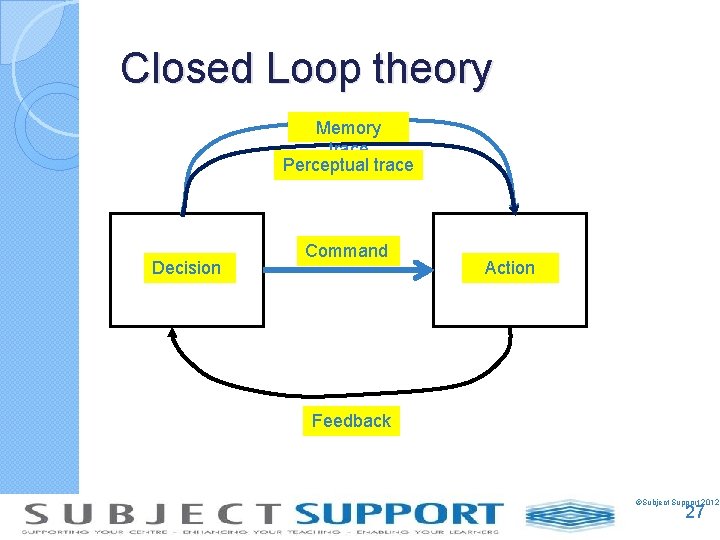
Closed Loop theory Memory trace Perceptual trace Decision Command Action Feedback ©Subject Support 2012 27
Typical question – schema theory Jan 10 Qu 3. (c) One form of learning is through schema. Schmidt's schema theory (1975) is based on the concept that every time a movement is conducted, information from four sources is gathered. Explain how these four sources of information are used to produce a movement. (4 marks) ©Subject Support 2012
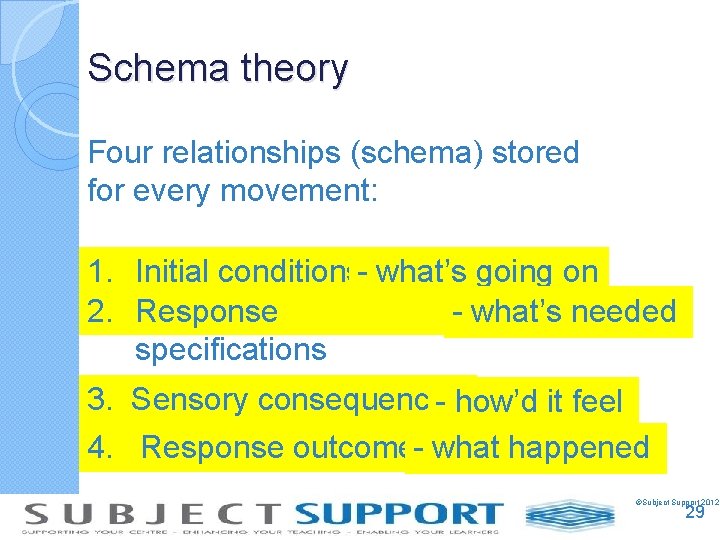
Schema theory Four relationships (schema) stored for every movement: 1. Initial conditions- what’s going on 2. Response - what’s needed specifications 3. Sensory consequences - how’d it feel 4. Response outcomes - what happened ©Subject Support 2012 29
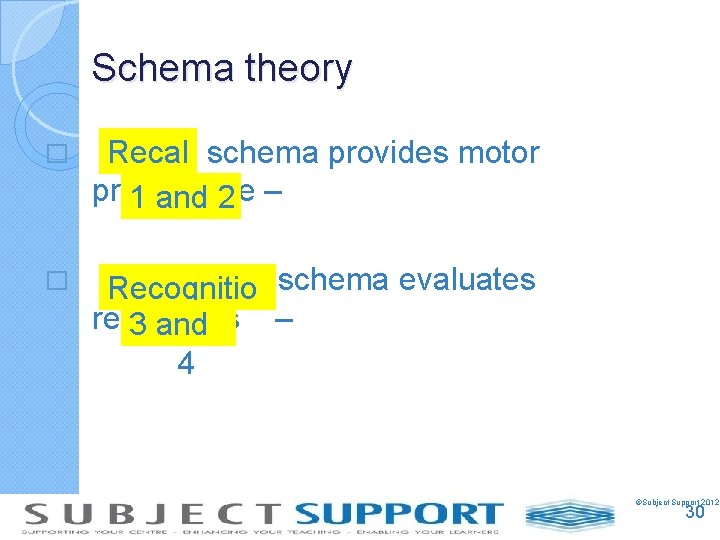
Schema theory � schema provides motor Recal programme – l 1 and 2 � schema evaluates Recognitio responses – 3 and n 4 ©Subject Support 2012 30

Typical question – school provision Jan 10 Qu 6. (b)(ii) Describe how schools can provide extracurricular opportunities to increase participation rates for their pupils (4 marks) ©Subject Support 2012
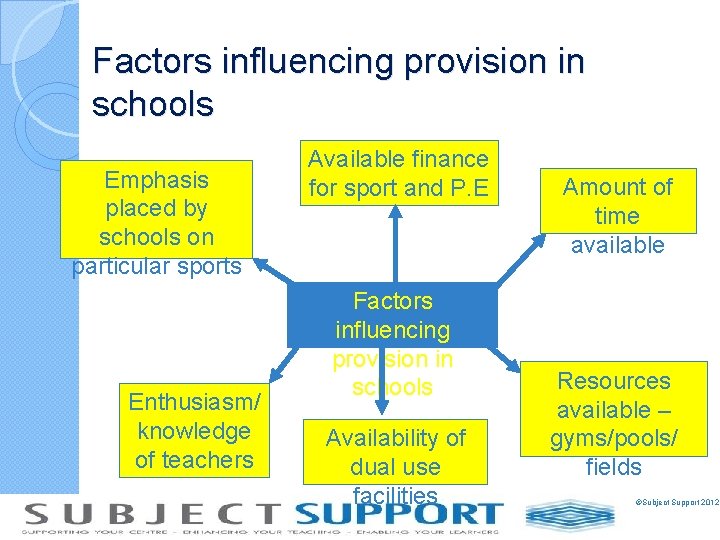
Factors influencing provision in schools Emphasis placed by schools on particular sports Enthusiasm/ knowledge of teachers Available finance for sport and P. E Factors influencing provision in schools Availability of dual use facilities Amount of time available Resources available – gyms/pools/ fields ©Subject Support 2012
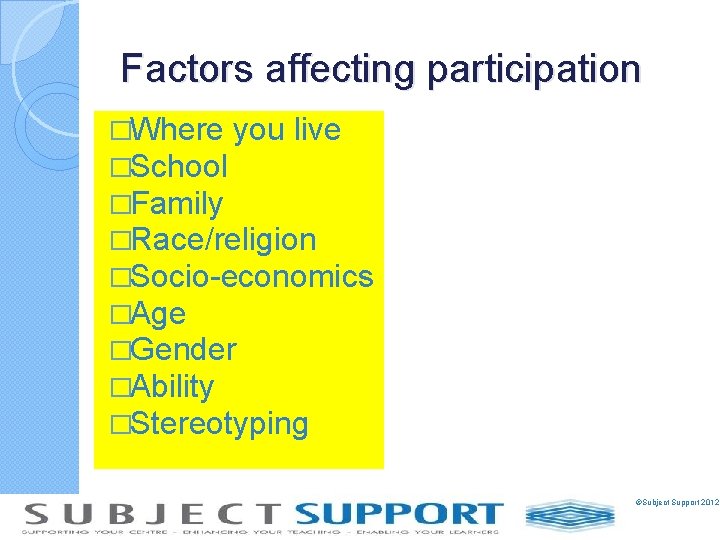
Factors affecting participation �Where you live �School �Family �Race/religion �Socio-economics �Age �Gender �Ability �Stereotyping ©Subject Support 2012
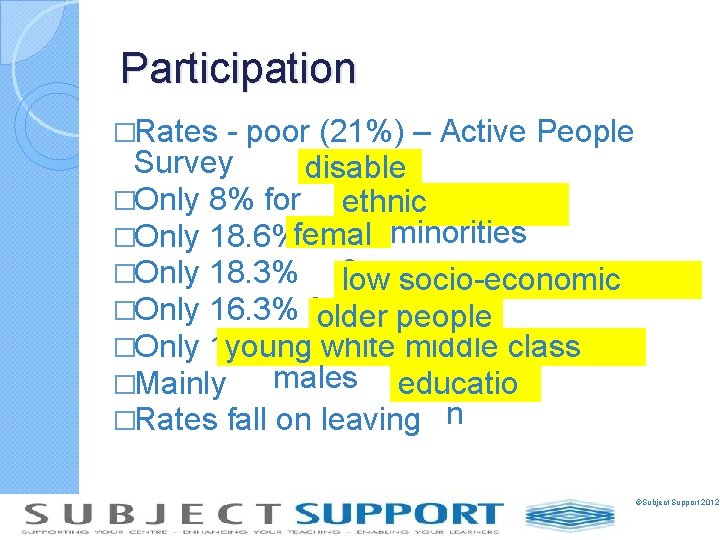
Participation �Rates - poor (21%) – Active People Survey disable d �Only 8% for ethnic femal minorities �Only 18. 6% for �Only 18. 3% e low socio-economic �Only 16. 3% for group older people �Only 16% for young white middle class �Mainly males educatio �Rates fall on leaving n ©Subject Support 2012
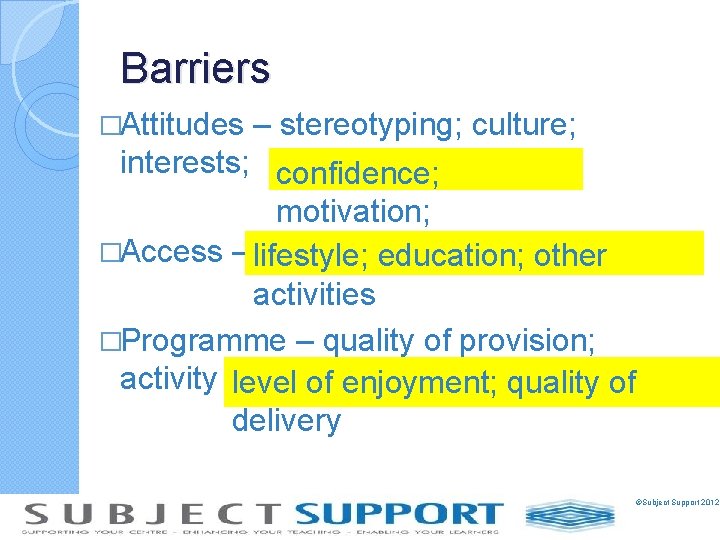
Barriers �Attitudes – stereotyping; culture; interests; confidence; motivation; �Access – facilities; transport; finance; lifestyle; education; other activities �Programme – quality of provision; activity level of enjoyment; quality of range; ability; delivery ©Subject Support 2012
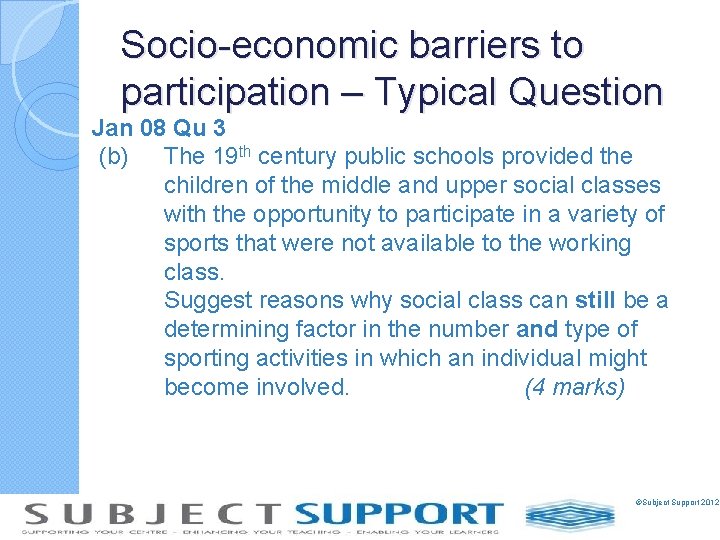
Socio-economic barriers to participation – Typical Question Jan 08 Qu 3 (b) The 19 th century public schools provided the children of the middle and upper social classes with the opportunity to participate in a variety of sports that were not available to the working class. Suggest reasons why social class can still be a determining factor in the number and type of sporting activities in which an individual might become involved. (4 marks) ©Subject Support 2012
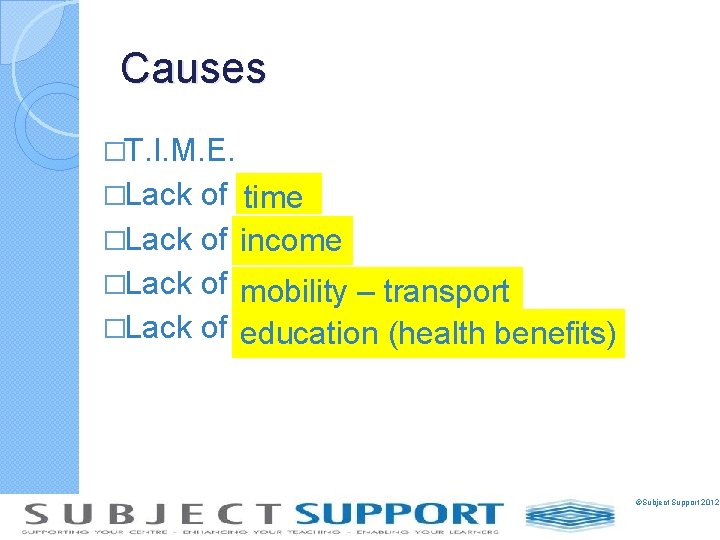
Causes �T. I. M. E. �Lack of time �Lack of income �Lack of mobility – transport �Lack of education (health benefits) ©Subject Support 2012
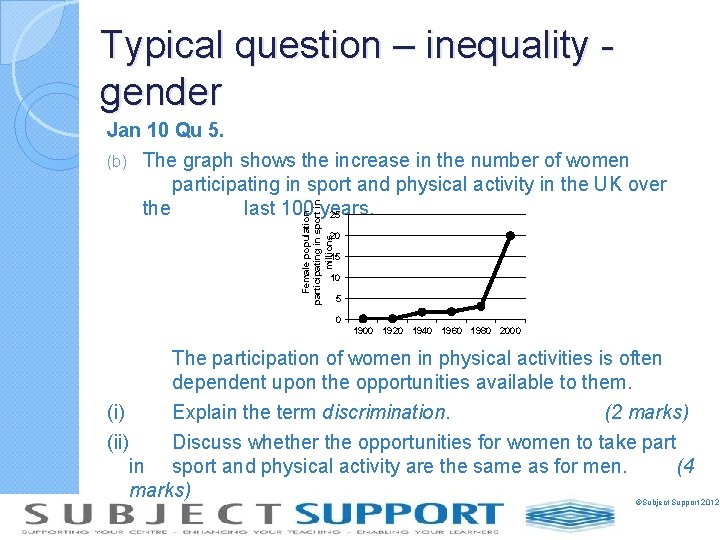
Typical question – inequality - gender Female population participating in sport in millions Jan 10 Qu 5. (b) The graph shows the increase in the number of women participating in sport and physical activity in the UK over the last 100 years. 25 20 15 10 5 0 1900 1920 1940 1960 1980 2000 The participation of women in physical activities is often dependent upon the opportunities available to them. (i) Explain the term discrimination. (2 marks) (ii) Discuss whether the opportunities for women to take part in sport and physical activity are the same as for men. (4 marks) ©Subject Support 2012
Factors affecting women’s participation in sport �Socialisation into role �Family commitment �School/tradition �Lack of media coverage �Male dominated �T. I. M. E. ©Subject Support 2012
Female sport in schools �Supposed to be ‘equal opportunities’ �Resistance to compulsory nature of PE – compulsory kit, sweat, showers female �More success where activities geared towards accepted role continuing post �Lack of preparation for 16 ©Subject Support 2012
Counteracting gender effects �Provide equal access coachin �Ensure good quality g �Promote achievements �Adopt women as a target group ©Subject Support 2012
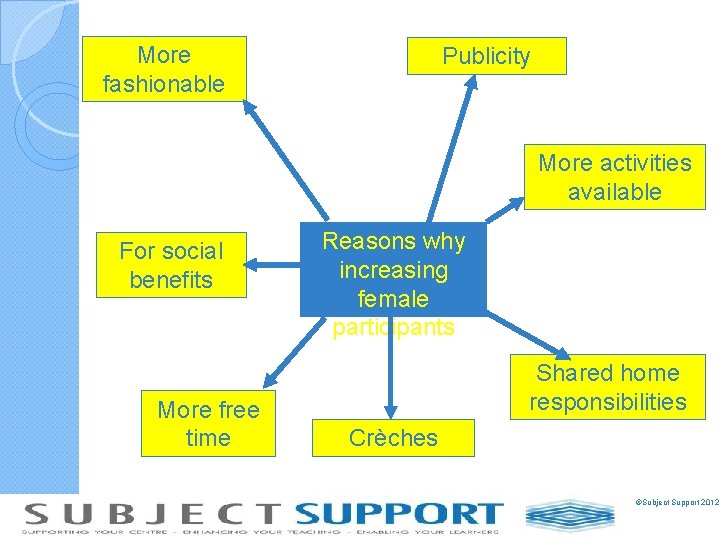
More fashionable Publicity More activities available For social benefits More free time Reasons why increasing female participants Shared home responsibilities Crèches ©Subject Support 2012
Typical question – inequalities ethnicity May 10 Qu 5 The Sport England Active People Survey of 2006 showed that approximately 9% of people with a disability participate regularly in sport compare to 23% of the rest of the population. (c) (i) Suggest reasons for this lower participation rate for people with a disability. (4 marks) Jan 11 Qu 6. Some groups in society are less involved in sport and physical activity than other groups. (c) Give three reasons for the lower participation rates among some ethnic minority groups. (3 marks) ©Subject Support 2012
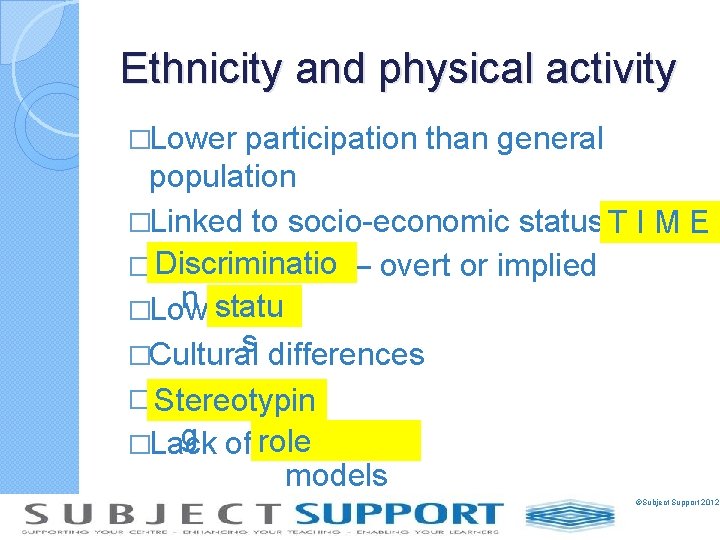
Ethnicity and physical activity �Lower participation than general population �Linked to socio-economic status T I M E Discriminatio � – overt or implied n statu �Low s �Cultural differences � Stereotypin g role �Lack of models ©Subject Support 2012
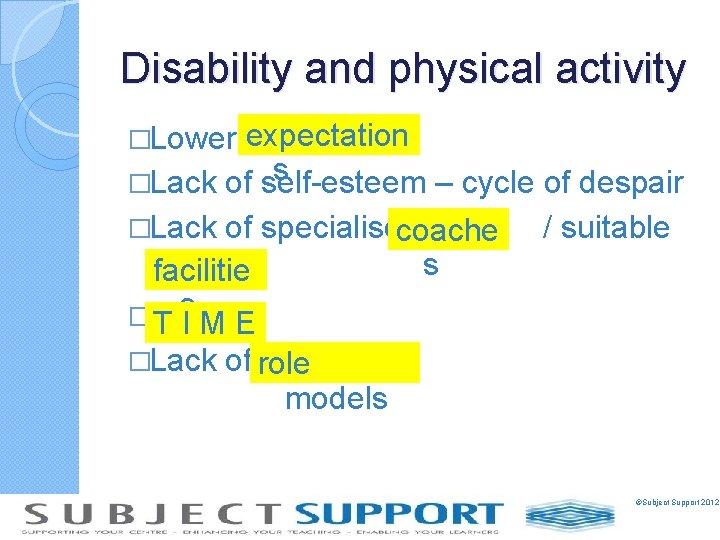
Disability and physical activity �Lower expectation s �Lack of self-esteem – cycle of despair �Lack of specialised / suitable coache facilitie s � T I M E �Lack of role models s ©Subject Support 2012
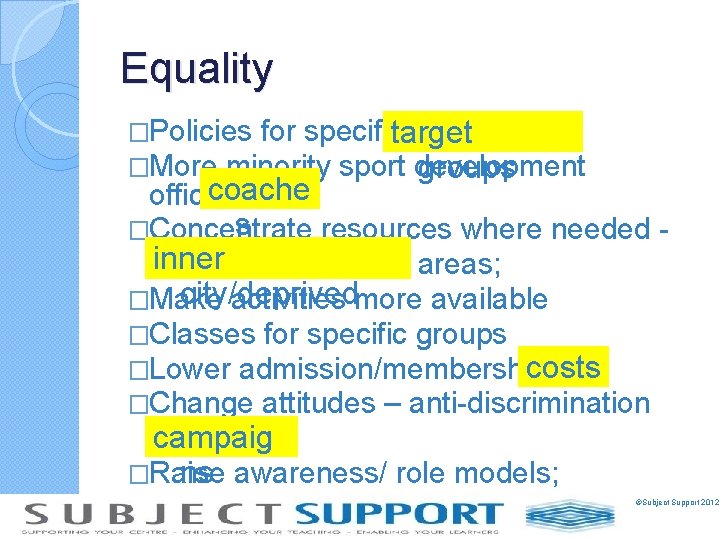
Equality �Policies for specific target �More minority sport development groups coache officers and s �Concentrate resources where needed - inner areas; city/deprived �Make activities more available �Classes for specific groups costs �Lower admission/membership �Change attitudes – anti-discrimination campaig ns �Raise awareness/ role models; ©Subject Support 2012
- Slides: 46