
As Open as Possible As Closed as Necessary
As Open as Possible, As Closed as Necessary: Empowering Transparency in Publications Based on Sensitive Research Data The fifth workshop in a series on "Developing and Implementing Data Policies: Conversations Between Journals and Data Repositories" Colin Elman QDR, Syracuse University
Agenda • 11: 05 - 11: 30 am: Welcome and Overview • 11: 30 am - 12: 15 pm: Break-Out Session #1: Policies and Guidelines for Sensitive Research Data • 12: 15 pm – 12. 30 pm break • 12: 30 pm - 1: 15 pm Lightning Introductions to Mechanisms for Protecting SRD • 1. 15 pm – 2. 00 pm Break-Out Session #2: Costs and Logistics of Incorporating SRD • 2: 00 pm – 2. 15 pm break • 2: 15 pm – 2. 45 pm Closing Session Looking forward and next steps
Workshop goals • Spark a conversation about relationship between scholars’ obligations to be both ethical and open. • Familiarize journal editors with recent and forthcoming developments at repositories to host data for which open access would present a risk to human subjects. • Discuss whether (and if so how) to include language in authors guidelines to encourage authors to use privacy protective mechanisms that can safeguard sensitive data. • Introduce JEDI, opportunity for continuing this and other conversations.
Data. PASS partnership of 11 data repositories • Databrary, based at New York University and at Pennsylvania State University • Institute for Quantitative Social Science at Harvard University • Howard W. Odum Institute for Research in Social Science at the University of North Carolina-Chapel Hill • Inter-university Consortium for Political and Social Research (ICPSR) at the University of Michigan • Qualitative Data Repository (QDR) at Syracuse University • Center for Data Science at American University • Cornell Institute for Social and Economic Research (CISER) at Cornell University • Electronic and Special Media Records Service Division, National Archives and Records Administration • IPUMS Center for Data Integration at the University of Minnesota • Roper Center for Public Opinion Research • Social Science Data Archive at the University of California, Los Angeles (UCLA)
Data-PASS goals include: • Archiving social science data collections at-risk of being lost • Cataloging and promoting access to archived collections in the Data. PASS shared catalog • Replicated preservation of archived collections • Expressing mutual positions on data management issues • Sharing information with other stakeholders about practices in digital preservation
Journals and Editors at the Workshop • 72 editors RSVP’d, representing roughly 60 journals • Wide variation in data policies • 19 journals have no explicit data policy • 17 journals require data access • Most of the remainder have a data policy that encourage or advises authors to provide data access
Why have a data policy? • Not always the case that doing more is better. Editors are the best judge of their own research community’s aspirations and their journal’s resources. • But whatever level of engagement editors choose, better to say it out loud. • Specify procedures for standard scenarios and rarer events • Only have to answer questions once • Provide clarity for editorial team • Guidance for authors on citation and other policies • Lots of journals are in this conversation, and editors can learn from each other about their mutual experiences. • In addition, editors can benefit from stakeholder specialization. Repositories can help journals with some of the functions that access requires, including balancing openness and the protection of human subjects.
Journal Data Policies • Have a written policy • Require data citation in bibliography, and that citations to digital data include a permanent identifier like a DOI • Have a standard for data availability statements and provide authors with an example statement • Encourage authors to provide data access • Encourage authors to provide method-specific information relevant for kinds of research typically published in the journal. For example, evidence of preregistration of experimental designs, or use of annotation for transparent inquiry (ATI) for qualitative research.
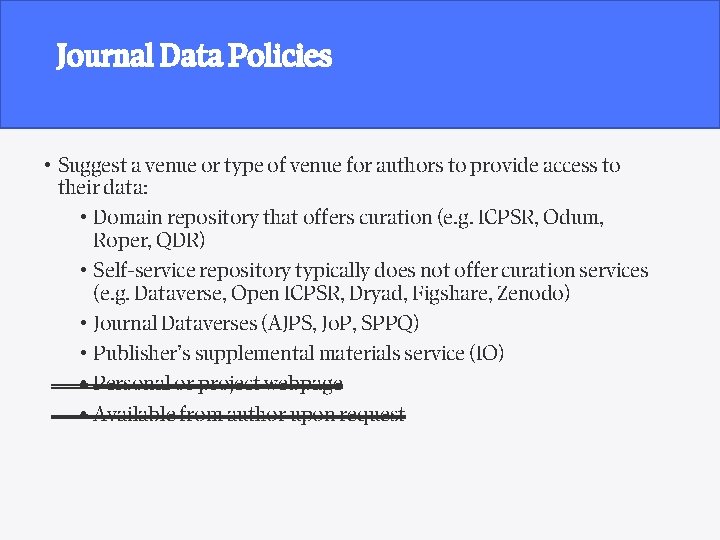
Journal Data Policies • Suggest a venue or type of venue for authors to provide access to their data: • Domain repository that offers curation (e. g. ICPSR, Odum, Roper, QDR) • Self-service repository typically does not offer curation services (e. g. Dataverse, Open ICPSR, Dryad, Figshare, Zenodo) • Journal Dataverses (AJPS, Jo. P, SPPQ) • Publisher’s supplemental materials service (IO) • Personal or project webpage • Available from author upon request
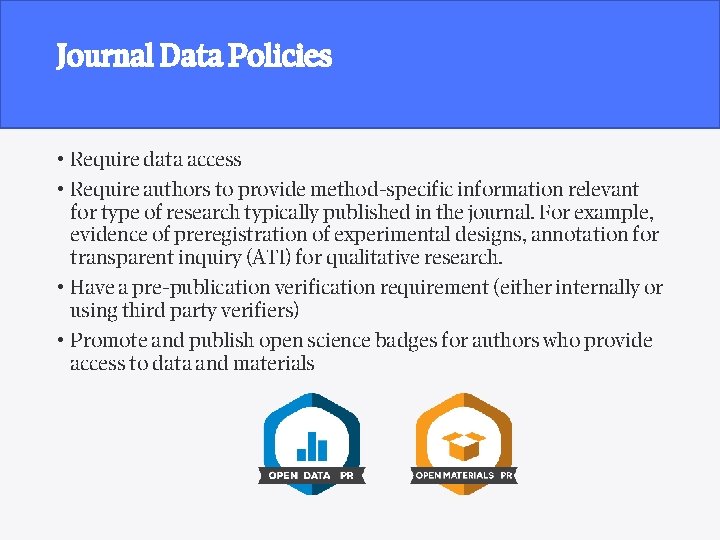
Journal Data Policies • Require data access • Require authors to provide method-specific information relevant for type of research typically published in the journal. For example, evidence of preregistration of experimental designs, annotation for transparent inquiry (ATI) for qualitative research. • Have a pre-publication verification requirement (either internally or using third party verifiers) • Promote and publish open science badges for authors who provide access to data and materials
Journals, research transparency, and sensitive data • Journals should choose data policy that matches their respective research communities’ aspirations, as well as logistical feasibility and journal budget. • Policies often encourage or require authors to provide data access. • Journals developing and employing new capacities to consider whether and how to build data access into workflows. • Workshop today is about sensitive research data, and privacy protecting mechanisms that allow safe access. • Incremental to your current data policies. So how they interact will depend on what you are currently doing.
“As open as possible” Making research transparent involves: • Data access • What data were used, where are they, are they available? • If author generated their own data, they should provide access or say why they cannot. • Production transparency • If author collected and used their own data, how were they produced? • Requires providing documentation describing how the data were generated/collected • Analytic transparency • How were data analyzed to arrive at the conclusion? • How are the author’s evidence and claims are connected?
“As closed as necessary” • Scholars have an ethical obligation to protect the people whom they involve in their research. Consequently, data generated through interaction with human participants should only be shared in ways to which those participants have actively “consented, ” and that keep them from harm. • Providing access is challenging when data are sensitive, i. e. , when unauthorized access could produce harm. Risk is a function of the severity of the harm to which unauthorized access could lead and the probability that such harm will occur. • Recognizing the sensitivity of research data, evaluating the risk that attends sharing those data, and taking appropriate steps to mitigate that risk, are all important parts of ethical research. Scholars’ obligation to protect human participants extends beyond the lifecycle of a research project, shaping the long-term preservation and potential re-use of data.
Not “all or nothing” • Not a simple dichotomy between data that can and cannot be shared. • Researchers have some agency in making choices that can render sensitive data more shareable. • Repositories provide infrastructure that can expand available choices, and empower researchers to satisfy ethical and legal constraints and share their data.
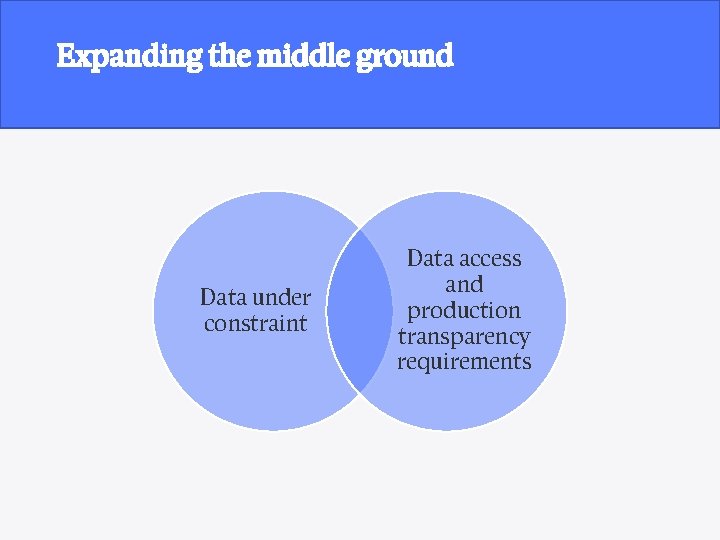
Expanding the middle ground Data under constraint Data access and production transparency requirements
Security and Privacy Controls • Security and privacy controls can be procedural, economic, legal, educational, and technical. • They restrict access to data or limit the potential for harm if access is permitted. • Examples include secure multiparty computation, differentially private statistics, aggregation, noise addition, the removal of direct and indirect identifiers, secure data enclaves, and data use agreements. • Stringency of protective measures will vary with level of risk.
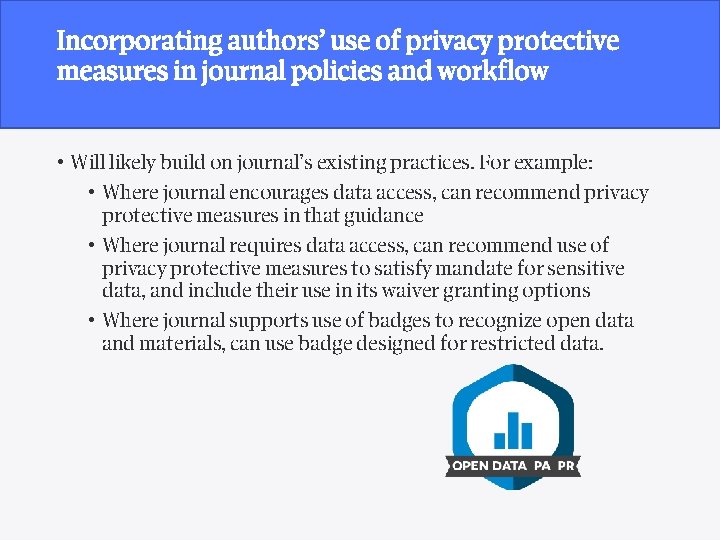
Incorporating authors’ use of privacy protective measures in journal policies and workflow • Will likely build on journal’s existing practices. For example: • Where journal encourages data access, can recommend privacy protective measures in that guidance • Where journal requires data access, can recommend use of privacy protective measures to satisfy mandate for sensitive data, and include their use in its waiver granting options • Where journal supports use of badges to recognize open data and materials, can use badge designed for restricted data.
Other types of constraint • Risk to human subjects is not the only reason data may be under constraint. For example: • Proprietary – data that author uses under a license granted by an owner, but to which other users do not have access without obtaining their own license. • Copyright - an intellectual property right assigned automatically to the creators of “original works of authorship” (title 17, U. S. Code), which prevents unauthorized copying and publishing of an original product. Particularly relevant for qualitative research. • Not main focus of today’s workshop, but we should keep them in mind, to remind ourselves (a) that there are other constraints; and (b) some of the solutions may have some overlap (e. g. data capsules for non-consumptive research).
Data-PASS JEDI • Journal Editors’ Discussion Interface (JEDI) • Can be found here: https: //dpjedi. org/ • Where we will be placing all the workshop materials for you to access later • Listserv so you can be notified of materials as they are posted, and so you can be aware of any further developments and conversations
- Slides: 19