
AS Mathematics Algebra Quadratic equations the discriminant Objectives
AS Mathematics Algebra – Quadratic equations - the discriminant
Objectives • Be able to find the discriminant in a quadratic equation • Understand the relevance of positive , negative and zero discriminants when solving quadratic equations
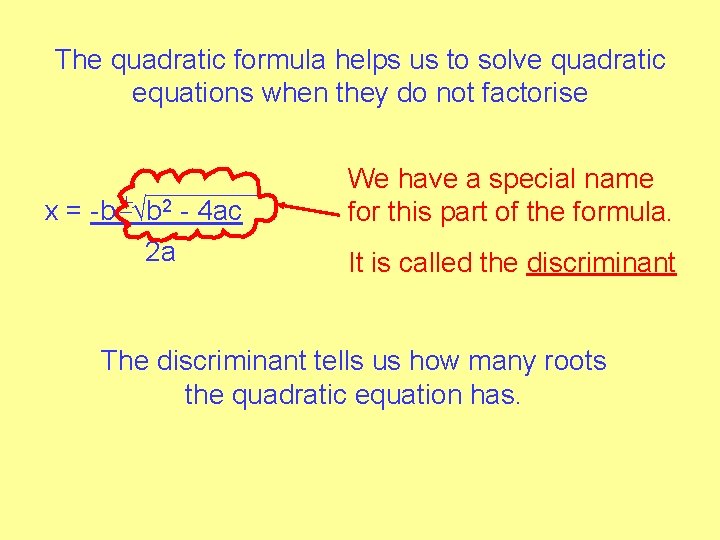
The quadratic formula helps us to solve quadratic equations when they do not factorise x = -b √b 2 - 4 ac 2 a We have a special name for this part of the formula. It is called the discriminant The discriminant tells us how many roots the quadratic equation has.
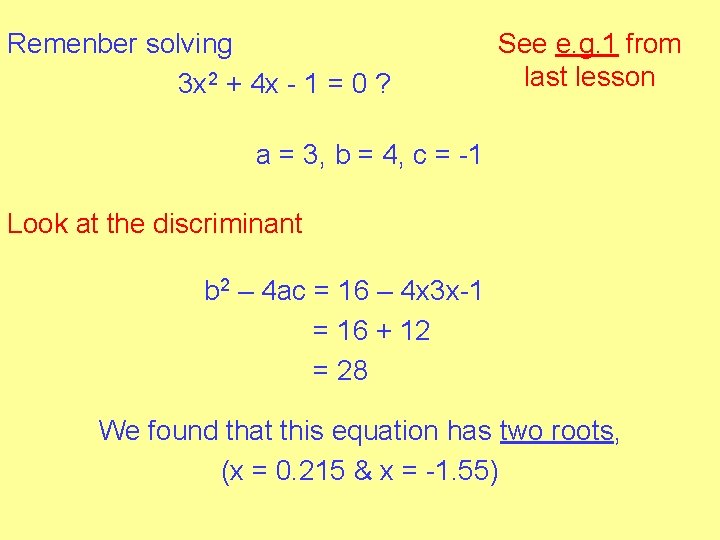
Remenber solving 3 x 2 + 4 x - 1 = 0 ? See e. g. 1 from last lesson a = 3, b = 4, c = -1 Look at the discriminant b 2 – 4 ac = 16 – 4 x 3 x-1 = 16 + 12 = 28 We found that this equation has two roots, (x = 0. 215 & x = -1. 55)
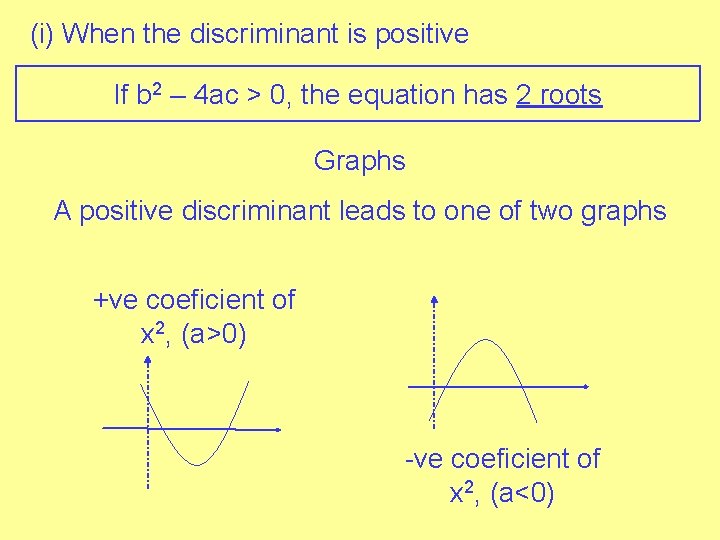
(i) When the discriminant is positive If b 2 – 4 ac > 0, the equation has 2 roots Graphs A positive discriminant leads to one of two graphs +ve coeficient of x 2, (a>0) -ve coeficient of x 2, (a<0)
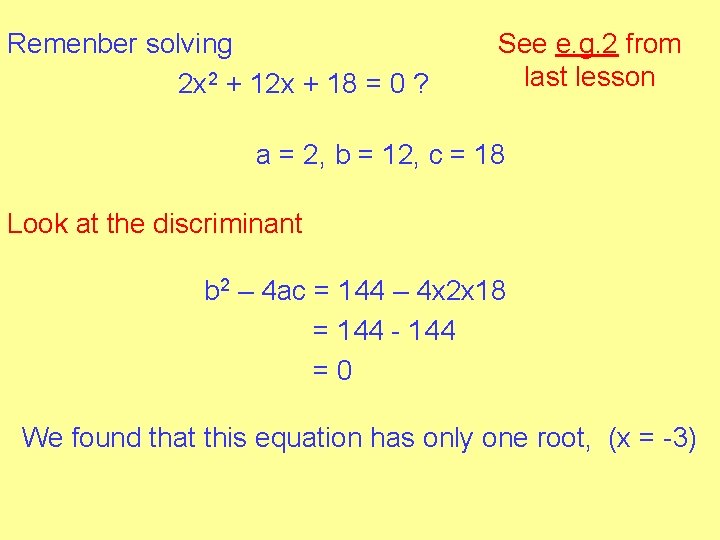
Remenber solving 2 x 2 + 12 x + 18 = 0 ? See e. g. 2 from last lesson a = 2, b = 12, c = 18 Look at the discriminant b 2 – 4 ac = 144 – 4 x 2 x 18 = 144 - 144 =0 We found that this equation has only one root, (x = -3)
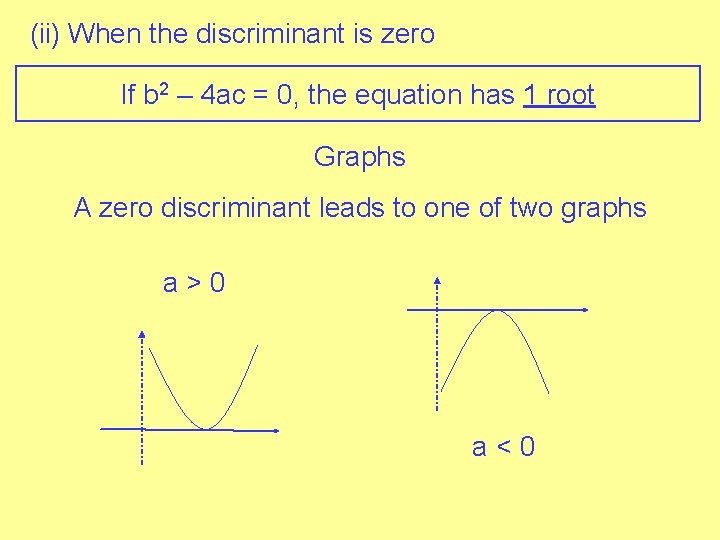
(ii) When the discriminant is zero If b 2 – 4 ac = 0, the equation has 1 root Graphs A zero discriminant leads to one of two graphs a>0 a<0
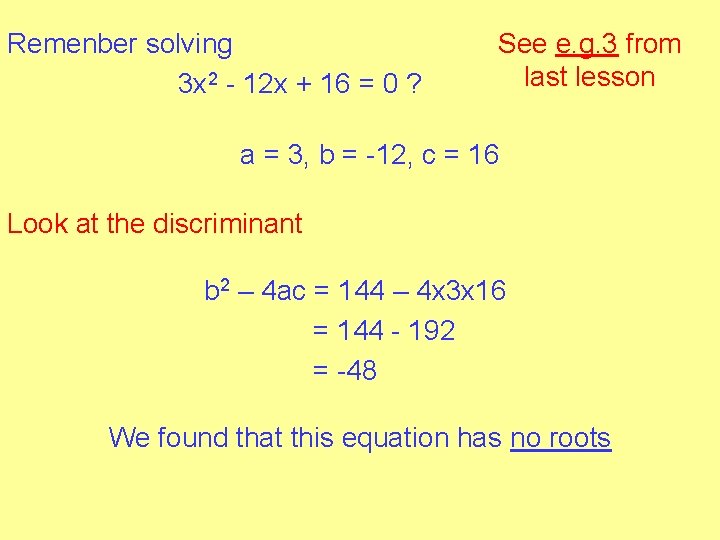
Remenber solving 3 x 2 - 12 x + 16 = 0 ? See e. g. 3 from last lesson a = 3, b = -12, c = 16 Look at the discriminant b 2 – 4 ac = 144 – 4 x 3 x 16 = 144 - 192 = -48 We found that this equation has no roots
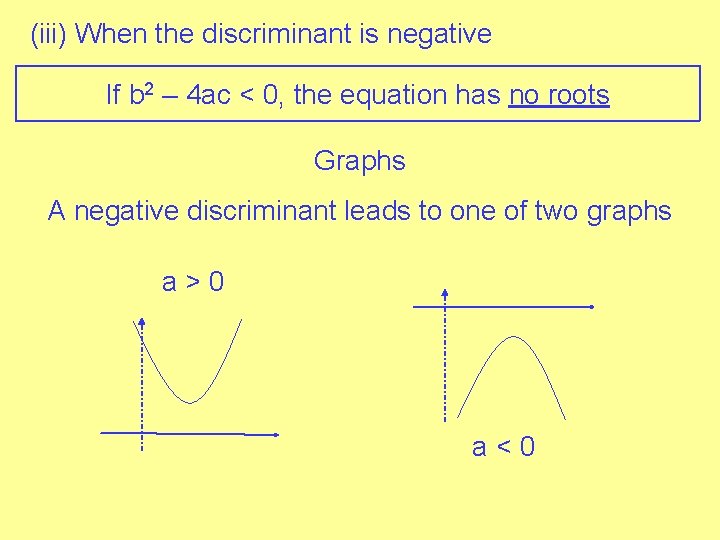
(iii) When the discriminant is negative If b 2 – 4 ac < 0, the equation has no roots Graphs A negative discriminant leads to one of two graphs a>0 a<0
- Slides: 9