
AS Level Fine Art Lecture 1 Overview 2
- Slides: 16
AS Level Fine Art. Lecture 1. • Overview. • 2 projects. 1 coursework chosen by you, 1 exam project set by AQA. The marks are divided 60% to 40%. • How do you succeed? . • 1. Approach your learning with enthusiasm. This means coming to lessons with new ideas, inspiration, questions and new work completed outside of lesson. • 2. Listen to feedback. How could you improve, what new idea could you explore, what experiments with materials will help, what new artist to study. • 3. Momentum. Start new work in lesson, complete it in your own time (homework) • 4. Thinking in between lessons is important, what was successful, what will you change, how will you improve, what further research do I need to do, what photographs shall I take to work from, how did that artist achieve that effect. Etc. • Meet the assessment objectives. Develop your ideas, record your observations, refine your work through experimentation.
What is your understanding of how to Develop an Art project? • Discussion.
Assessment Objective 1. Developing ideas. • AO 1: Develop ideas through sustained and focused investigations informed by contextual and other sources, demonstrating analytical and critical understanding • This means that throughout the project, from a starting point to a final piece, your work should be well developed. • It should not be repetitive. • Combining different elements together. • It should be inspired by other sources; artists, photographers, historical events, art movements, films, comics etc • By reflecting on your work (written analysis, evaluation), you should determine how to improve your next piece of work.
Your ideas, what type of project would you like to explore in AS Art? • Consider this as we go through a few examples of the development of other art students work. • Which genre interests you the most, broadly speaking Landscape, Portraiture, Still Life? • Is there a theme/material/technique that you have previously enjoyed at GCSE, not explored in enough detail, or have a real interest in? • Remember it should be quite a vague starting point so that you can develop it into a broad and deep project over the first term of year 12.
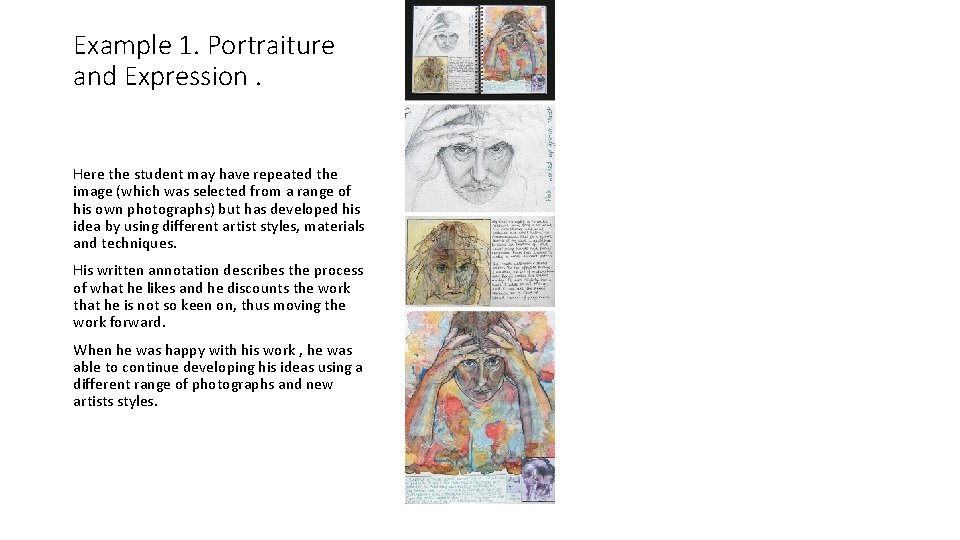
Example 1. Portraiture and Expression. Here the student may have repeated the image (which was selected from a range of his own photographs) but has developed his idea by using different artist styles, materials and techniques. His written annotation describes the process of what he likes and he discounts the work that he is not so keen on, thus moving the work forward. When he was happy with his work , he was able to continue developing his ideas using a different range of photographs and new artists styles.
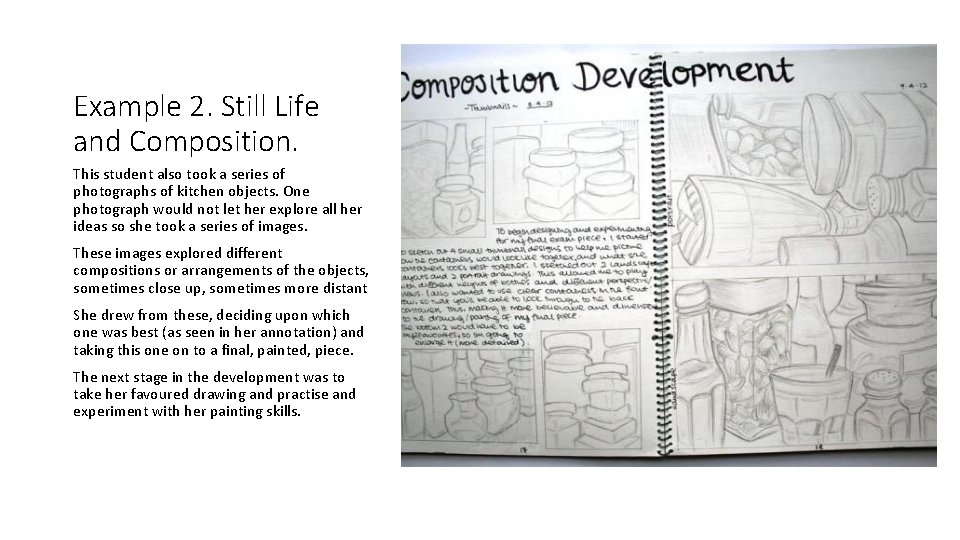
Example 2. Still Life and Composition. This student also took a series of photographs of kitchen objects. One photograph would not let her explore all her ideas so she took a series of images. These images explored different compositions or arrangements of the objects, sometimes close up, sometimes more distant She drew from these, deciding upon which one was best (as seen in her annotation) and taking this one on to a final, painted, piece. The next stage in the development was to take her favoured drawing and practise and experiment with her painting skills.
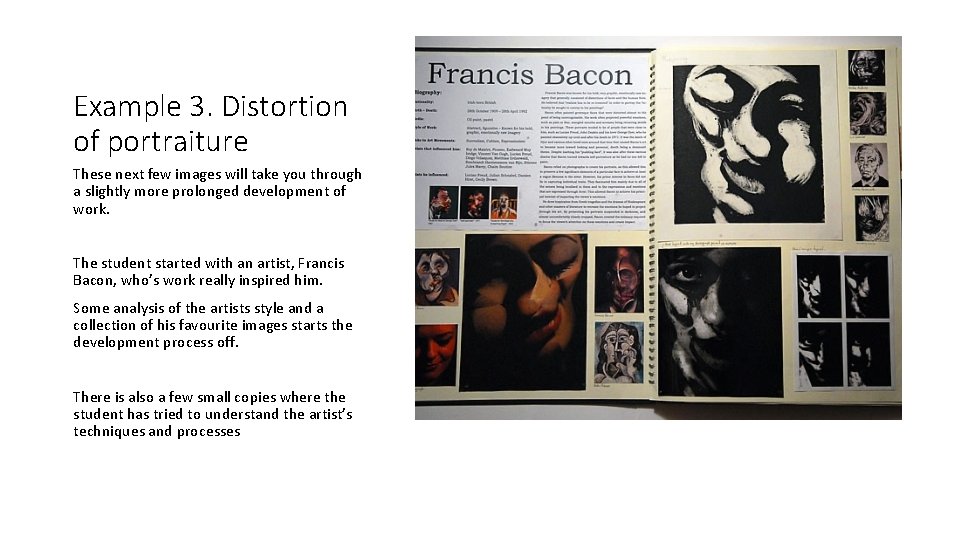
Example 3. Distortion of portraiture These next few images will take you through a slightly more prolonged development of work. The student started with an artist, Francis Bacon, who’s work really inspired him. Some analysis of the artists style and a collection of his favourite images starts the development process off. There is also a few small copies where the student has tried to understand the artist’s techniques and processes
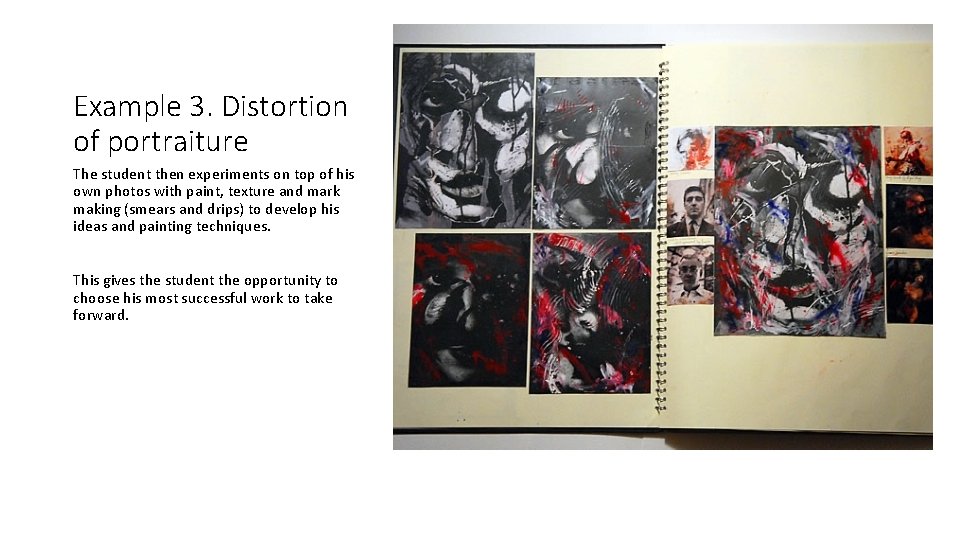
Example 3. Distortion of portraiture The student then experiments on top of his own photos with paint, texture and mark making (smears and drips) to develop his ideas and painting techniques. This gives the student the opportunity to choose his most successful work to take forward.
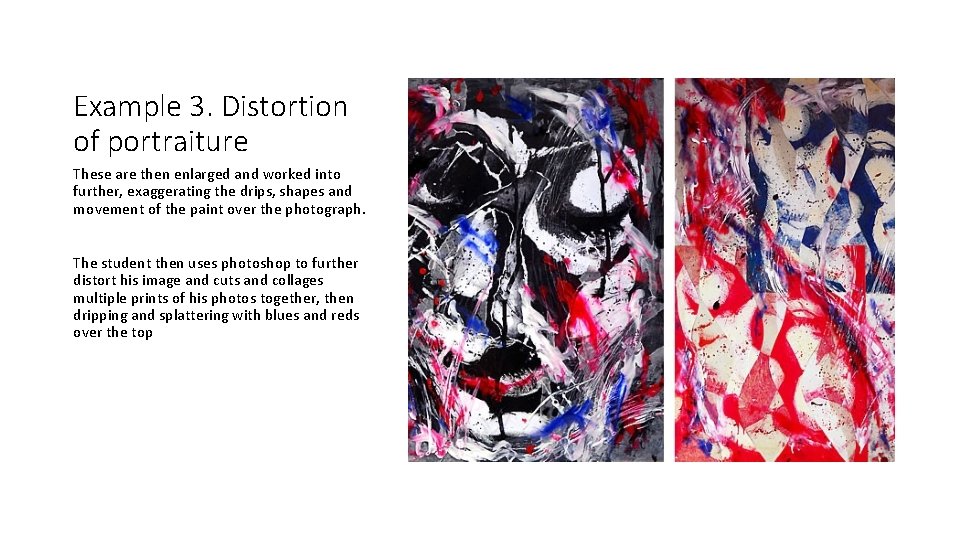
Example 3. Distortion of portraiture These are then enlarged and worked into further, exaggerating the drips, shapes and movement of the paint over the photograph. The student then uses photoshop to further distort his image and cuts and collages multiple prints of his photos together, then dripping and splattering with blues and reds over the top
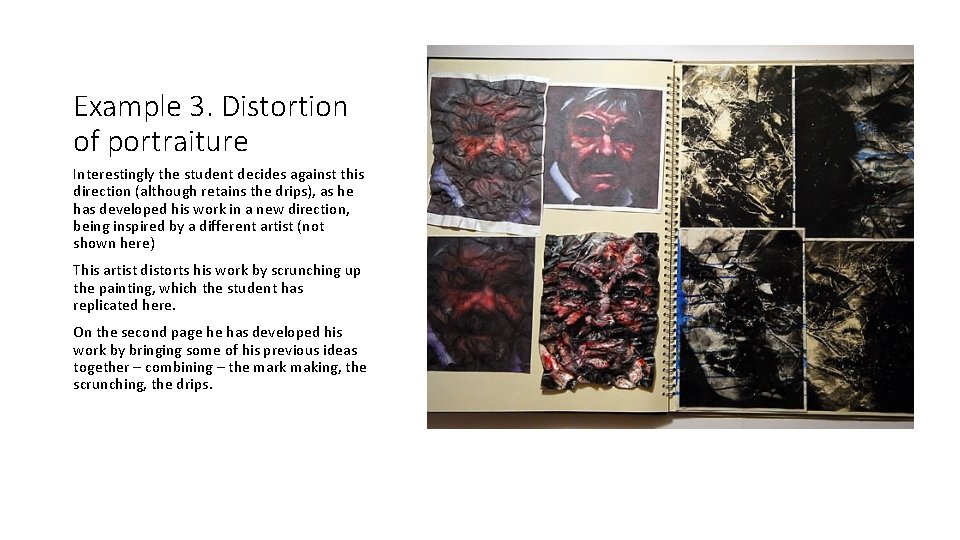
Example 3. Distortion of portraiture Interestingly the student decides against this direction (although retains the drips), as he has developed his work in a new direction, being inspired by a different artist (not shown here) This artist distorts his work by scrunching up the painting, which the student has replicated here. On the second page he has developed his work by bringing some of his previous ideas together – combining – the mark making, the scrunching, the drips.
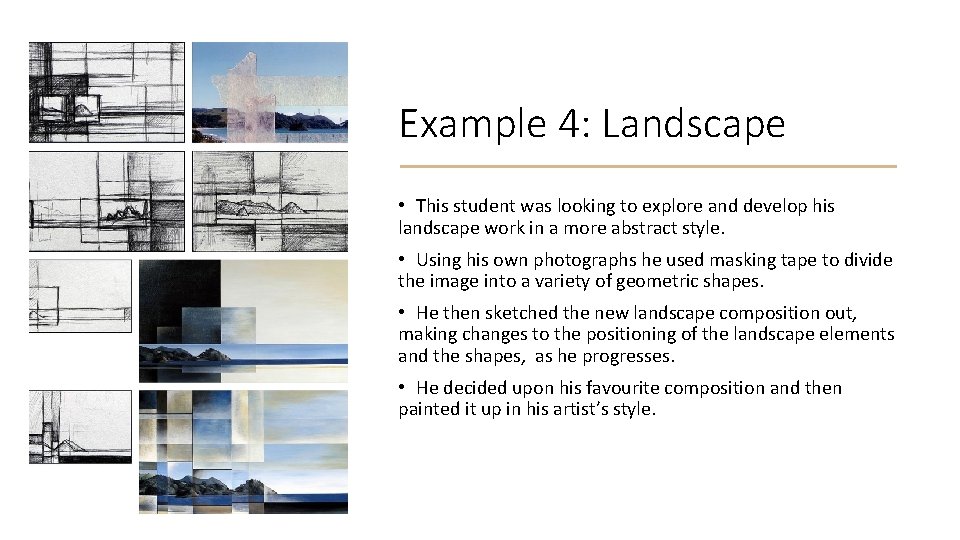
Example 4: Landscape • This student was looking to explore and develop his landscape work in a more abstract style. • Using his own photographs he used masking tape to divide the image into a variety of geometric shapes. • He then sketched the new landscape composition out, making changes to the positioning of the landscape elements and the shapes, as he progresses. • He decided upon his favourite composition and then painted it up in his artist’s style.
The key things to include when developing a project successfully • Momentum, always look to move your work forwards. • Evaluation, reflect upon your work, what was successful and unsuccessful, what would you do to improve? • Photography, a quick way to record new ideas that you can work from • Editing, making changes to your photographs can provide you with a new direction and impetus • Artist research, the best way to be inspired in terms of a new style, technique, idea • Sketching, enabling you to express your ideas, make changes, plan new developments. • Research, what other influences (other than artists) can you find. Historical, popular culture etc
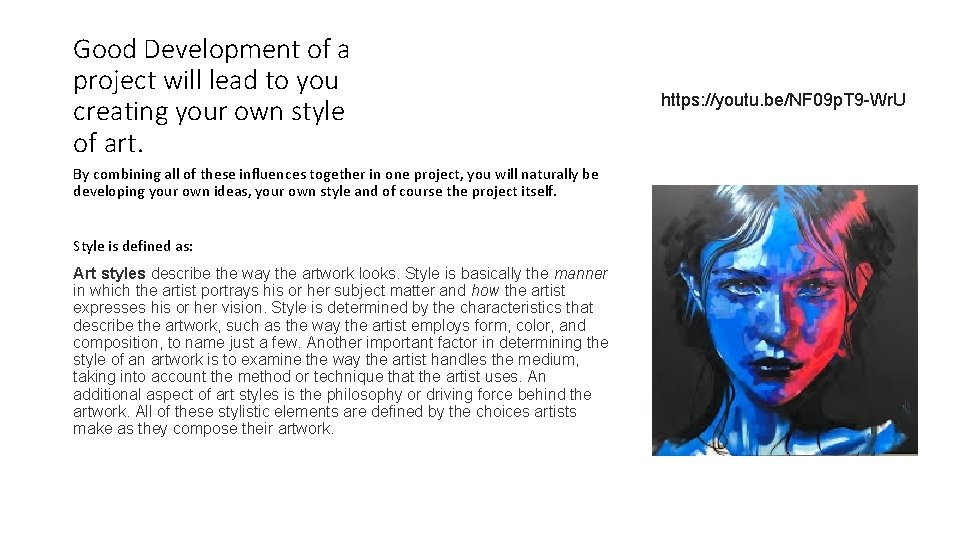
Good Development of a project will lead to you creating your own style of art. By combining all of these influences together in one project, you will naturally be developing your own ideas, your own style and of course the project itself. Style is defined as: Art styles describe the way the artwork looks. Style is basically the manner in which the artist portrays his or her subject matter and how the artist expresses his or her vision. Style is determined by the characteristics that describe the artwork, such as the way the artist employs form, color, and composition, to name just a few. Another important factor in determining the style of an artwork is to examine the way the artist handles the medium, taking into account the method or technique that the artist uses. An additional aspect of art styles is the philosophy or driving force behind the artwork. All of these stylistic elements are defined by the choices artists make as they compose their artwork. https: //youtu. be/NF 09 p. T 9 -Wr. U
Student testimony
Discussion: what project will you develop? Task for next week. Complete two, one hour pieces of work. The second piece should be a clear development of the first, demonstrating some of the influences we have explored today. Be prepared to share your work next week and discuss how you have developed the second piece from the first.
AO 1 Develop and the other assessment objectives AQA are clear that all the Assessment Objectives should feed into each other and this is the hallmark of a good project anyway. AO 2. Experimenting. Through experimenting with a range of different materials and techniques, to determine what works best for what you are trying to achieve, you will automatically be developing your work forward. For example; a project on close ups of leaves, a watercolour study may not allow you to create the texture which you desire, perhaps oil or acrylic paint would be better. Perhaps paint isn’t the best material by itself, how about a collage of different textured materials and then painting over the top. AO 3. Recording. Taking your own photographs, drawing from and observation and copying other artists work are three key ways to show your skill in recording. All of these methods though also help develop your work forward, each new image showing a new direction you could take your work.