
AS 9145 Advanced Product Quality Planning APQP and
- Slides: 44
AS 9145 Advanced Product Quality Planning (APQP) and Production Part Approval Process (PPAP) ASA Webinar The Aerospace Version of the Automotive Core Tools by Jim Lee simple. Qu. E 1
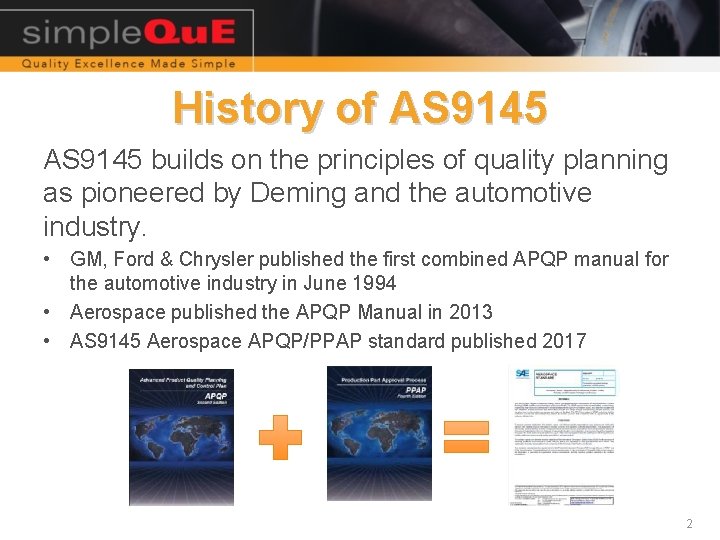
History of AS 9145 builds on the principles of quality planning as pioneered by Deming and the automotive industry. • GM, Ford & Chrysler published the first combined APQP manual for the automotive industry in June 1994 • Aerospace published the APQP Manual in 2013 • AS 9145 Aerospace APQP/PPAP standard published 2017 2
History of AS 9145 Progressive companies utilize APQP for their product development and manufacturing process design. Why deviate from automotive & other industries? Aviation, Space & Defense industry is different • Low volumes • Long life cycles • High levels of regulation 3
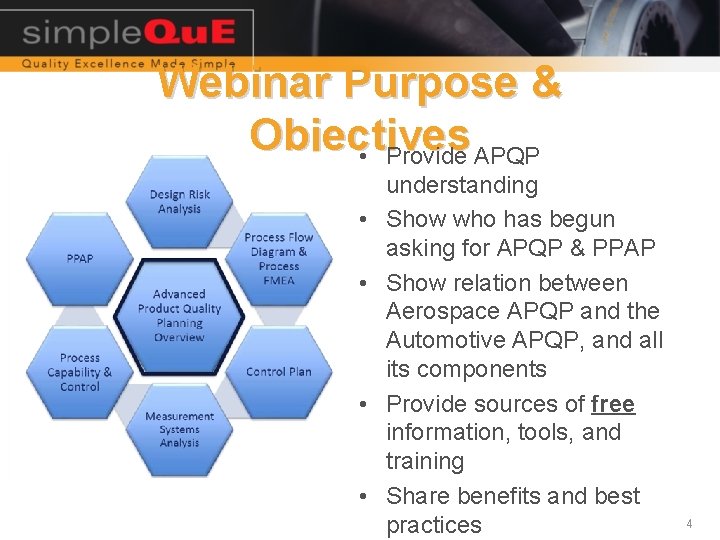
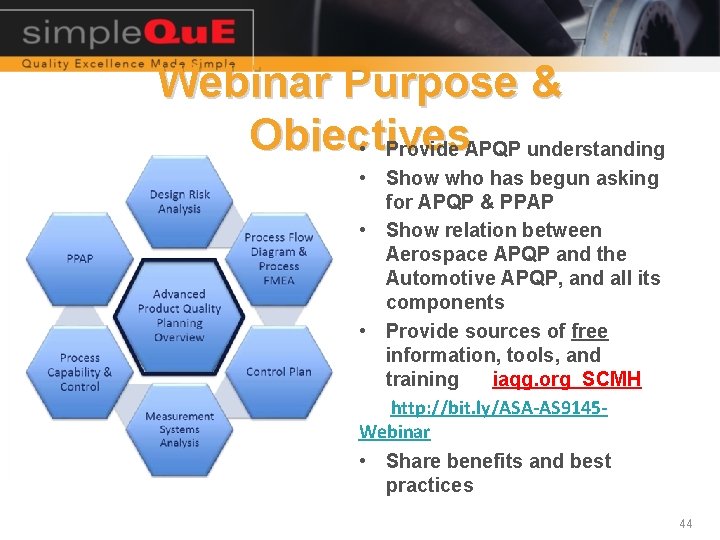
Webinar Purpose & Objectives • Provide APQP • • understanding Show who has begun asking for APQP & PPAP Show relation between Aerospace APQP and the Automotive APQP, and all its components Provide sources of free information, tools, and training Share benefits and best practices 4
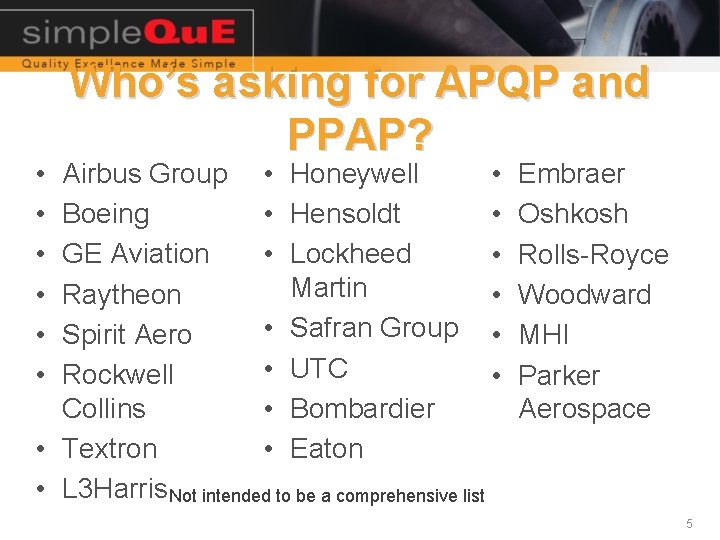
Who’s asking for APQP and PPAP? Airbus Group • Honeywell • • Hensoldt Boeing • • Lockheed GE Aviation • Martin Raytheon • • Safran Group • Spirit Aero • UTC Rockwell • • Bombardier Collins • Eaton • Textron • L 3 Harris Not intended to be a comprehensive list • • • Embraer Oshkosh Rolls-Royce Woodward MHI Parker Aerospace 5
Purpose of AS 9145 and APQP • Proven, structured method with defined outputs to assure new products satisfy customer wants and needs • Establishes proactive and preventative mindset • Uses project management to drive on-time and on-quality delivery of the product by monitoring key project deliverables • Employs a cross-functional approach to support commitment and effective communication 6
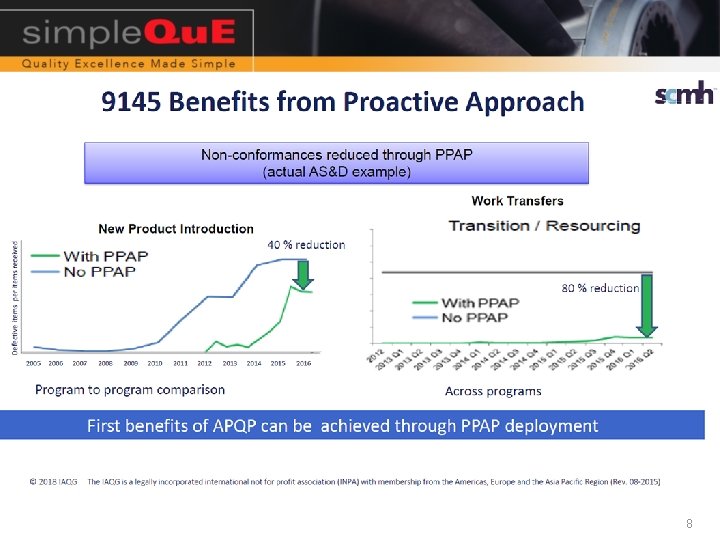
8
Benefits of APQP • Successful product launches • The APQP approach helps satisfy the customer with: – Improved product quality by anticipating and mitigating risks, eliminating defects and reducing process variation – Shorter lead time by reducing waste and rework and better manage capacity – Lower total costs 9
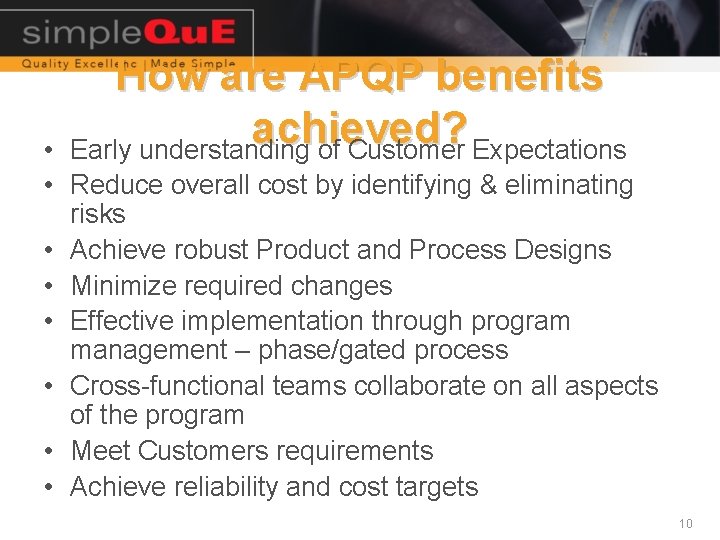
How are APQP benefits achieved? Early understanding of Customer Expectations • • Reduce overall cost by identifying & eliminating risks • Achieve robust Product and Process Designs • Minimize required changes • Effective implementation through program management – phase/gated process • Cross-functional teams collaborate on all aspects of the program • Meet Customers requirements • Achieve reliability and cost targets 10
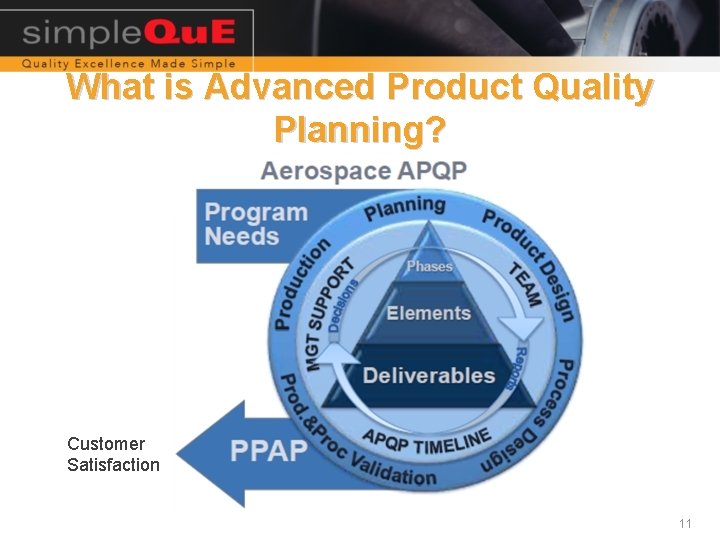
What is Advanced Product Quality Planning? Customer Satisfaction 11
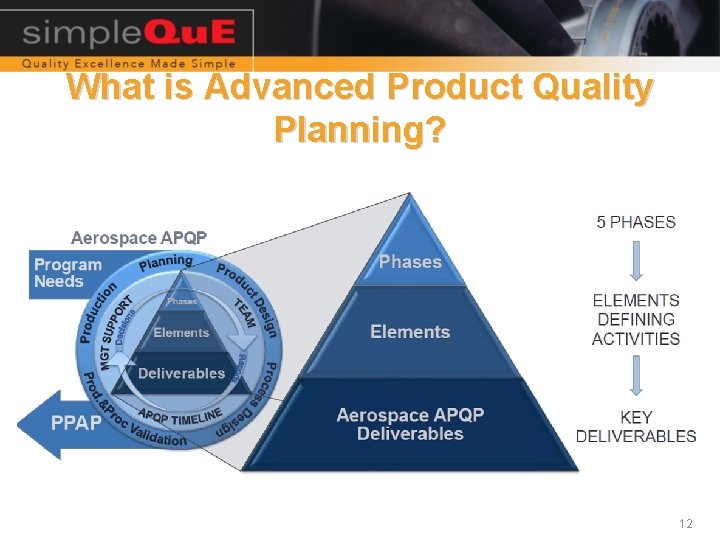
What is Advanced Product Quality Planning? 12
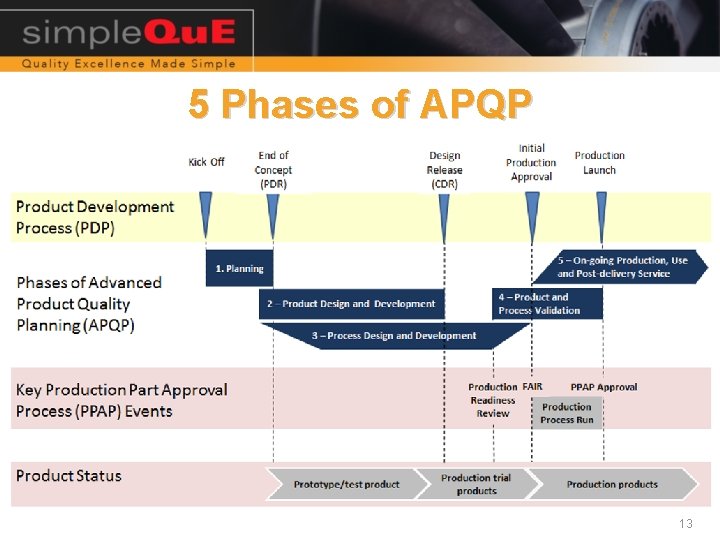
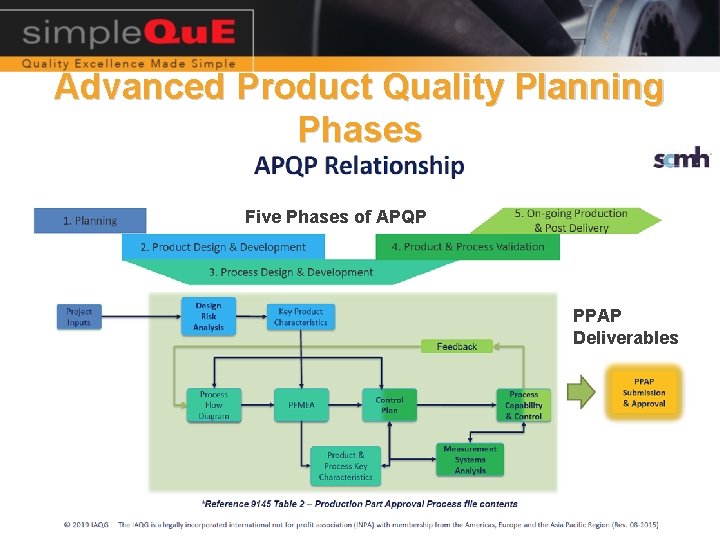
5 Phases of APQP 13
© 2020 simple. Qu. E – All Rights Reserved 14
15
16
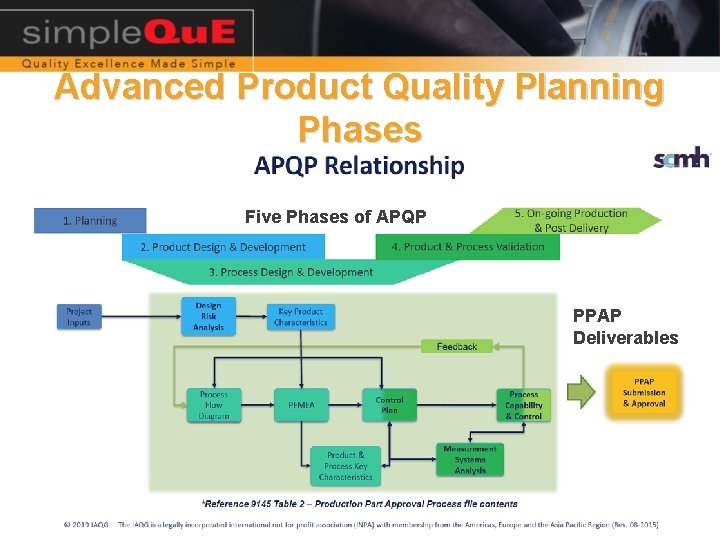
Advanced Product Quality Planning Phases Five Phases of APQP PPAP Deliverables 17
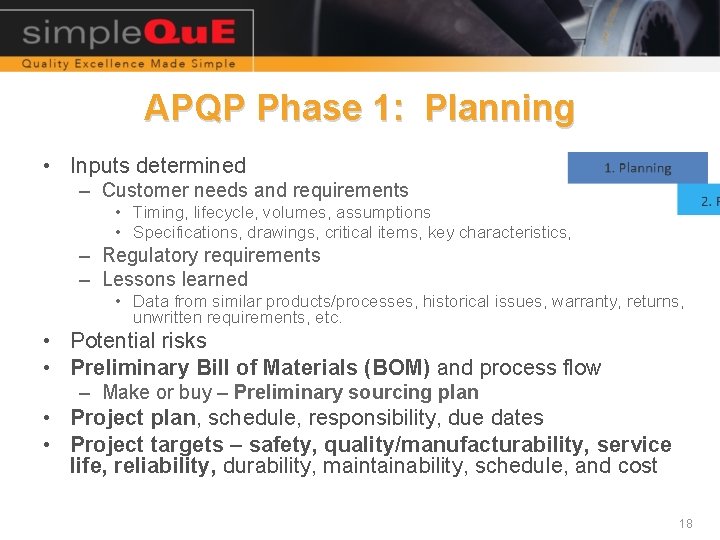
APQP Phase 1: Planning • Inputs determined – Customer needs and requirements • Timing, lifecycle, volumes, assumptions • Specifications, drawings, critical items, key characteristics, – Regulatory requirements – Lessons learned • Data from similar products/processes, historical issues, warranty, returns, unwritten requirements, etc. • Potential risks • Preliminary Bill of Materials (BOM) and process flow – Make or buy – Preliminary sourcing plan • Project plan, schedule, responsibility, due dates • Project targets – safety, quality/manufacturability, service life, reliability, durability, maintainability, schedule, and cost 18
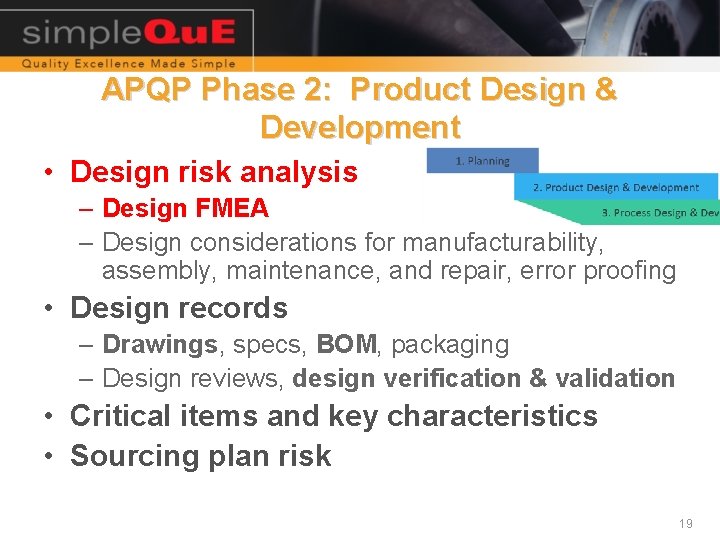
APQP Phase 2: Product Design & Development • Design risk analysis – Design FMEA – Design considerations for manufacturability, assembly, maintenance, and repair, error proofing • Design records – Drawings, specs, BOM, packaging – Design reviews, design verification & validation • Critical items and key characteristics • Sourcing plan risk 19
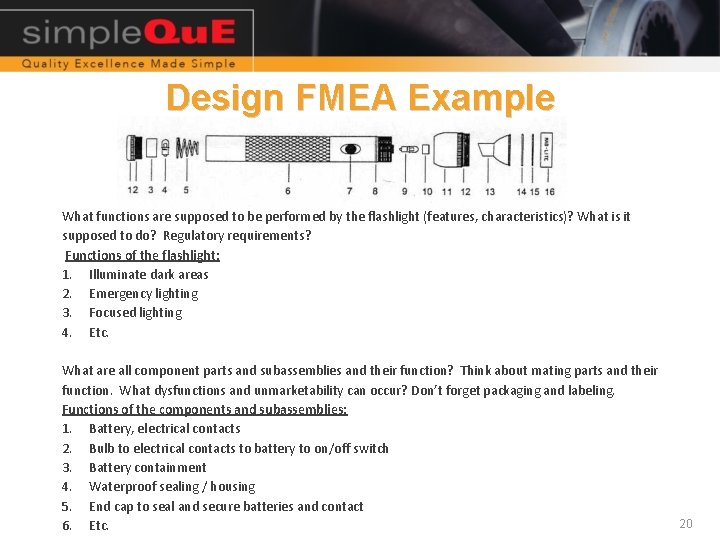
Design FMEA Example What functions are supposed to be performed by the flashlight (features, characteristics)? What is it supposed to do? Regulatory requirements? Functions of the flashlight: 1. Illuminate dark areas 2. Emergency lighting 3. Focused lighting 4. Etc. What are all component parts and subassemblies and their function? Think about mating parts and their function. What dysfunctions and unmarketability can occur? Don’t forget packaging and labeling. Functions of the components and subassemblies: 1. Battery, electrical contacts 2. Bulb to electrical contacts to battery to on/off switch 3. Battery containment 4. Waterproof sealing / housing 5. End cap to seal and secure batteries and contact 6. Etc. 20
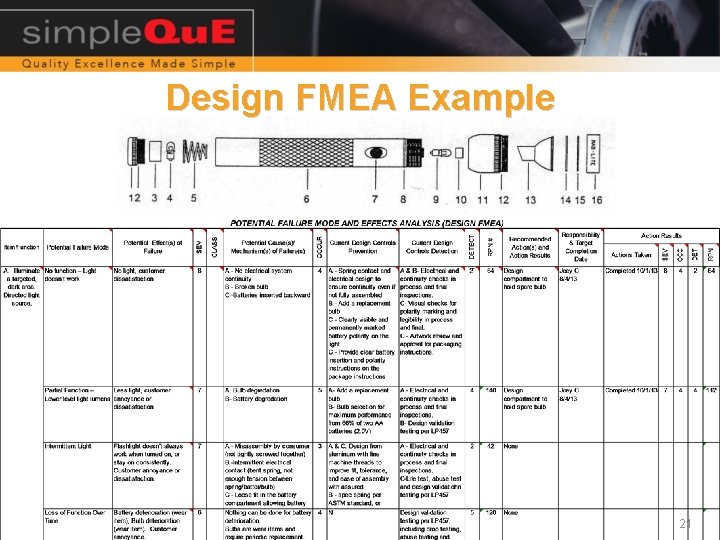
Design FMEA Example 21
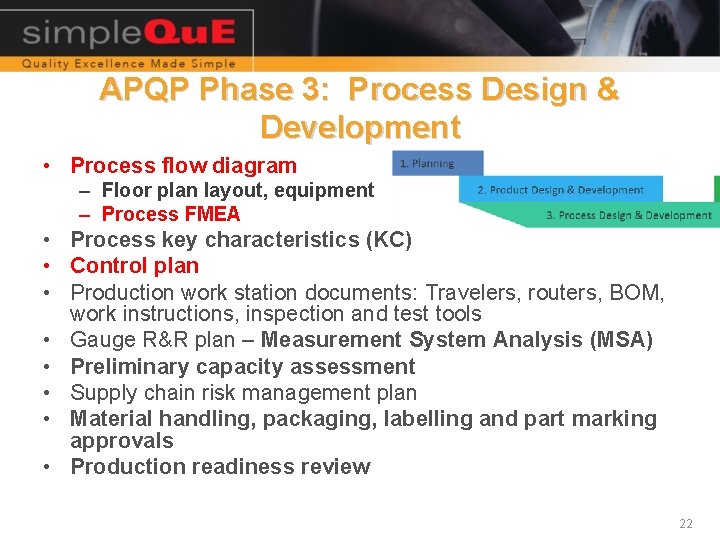
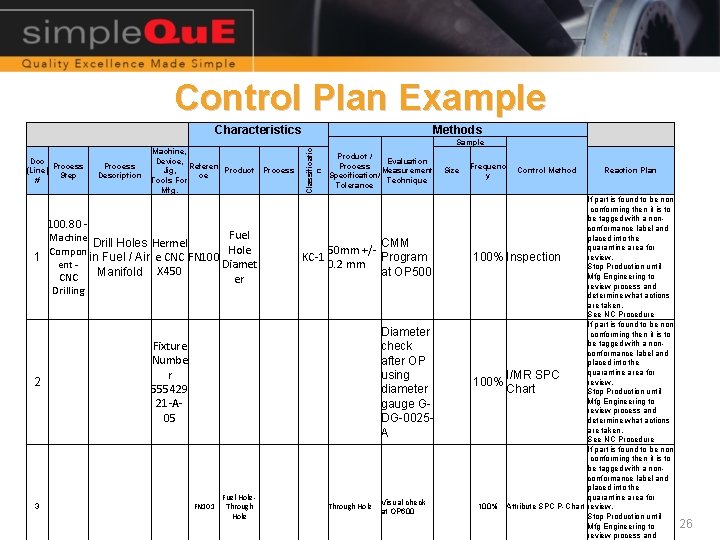
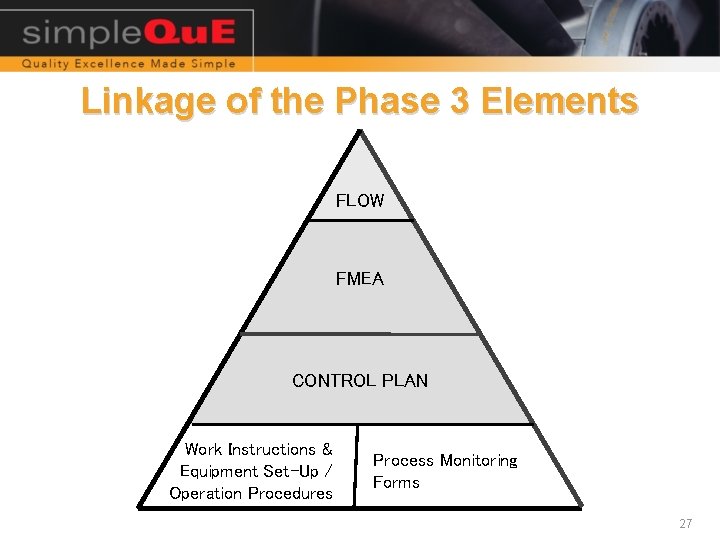
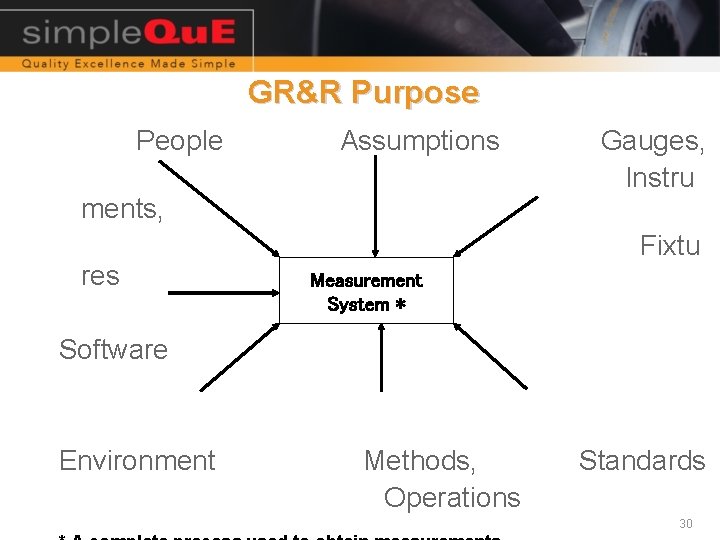
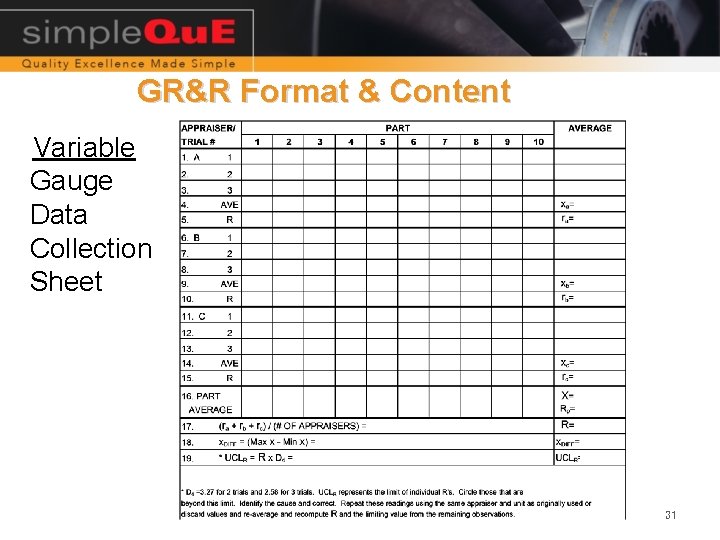
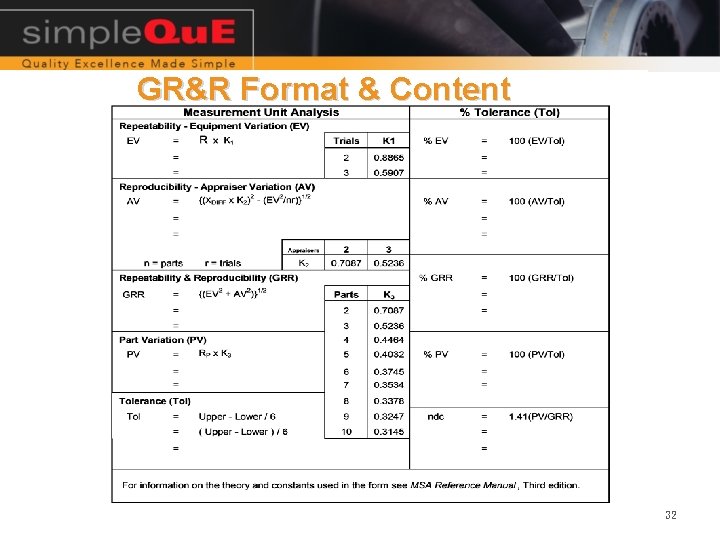
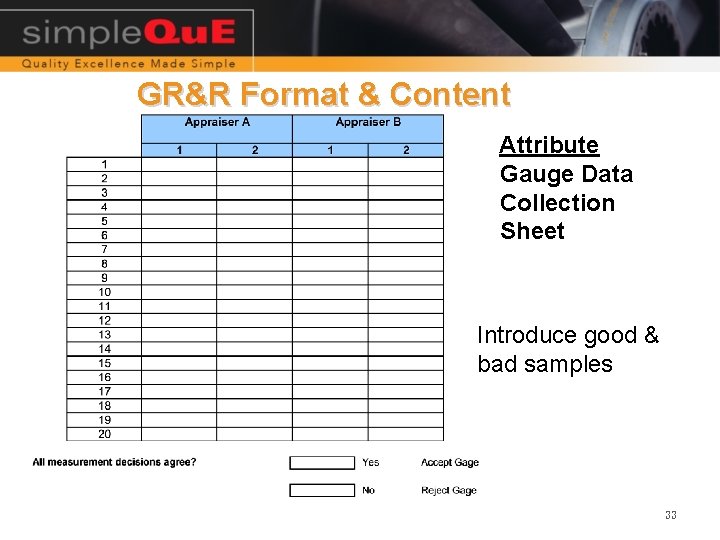
APQP Phase 3: Process Design & Development • Process flow diagram – Floor plan layout, equipment – Process FMEA • Process key characteristics (KC) • Control plan • Production work station documents: Travelers, routers, BOM, work instructions, inspection and test tools • Gauge R&R plan – Measurement System Analysis (MSA) • Preliminary capacity assessment • Supply chain risk management plan • Material handling, packaging, labelling and part marking approvals • Production readiness review 22
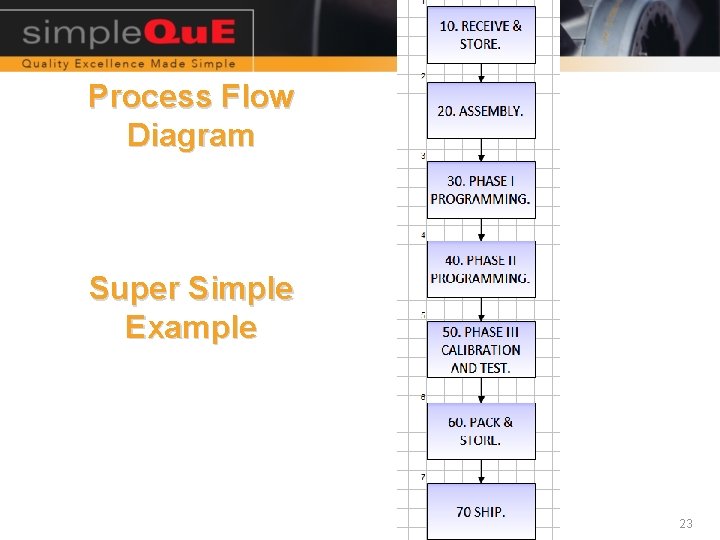
Process Flow Diagram Super Simple Example 23
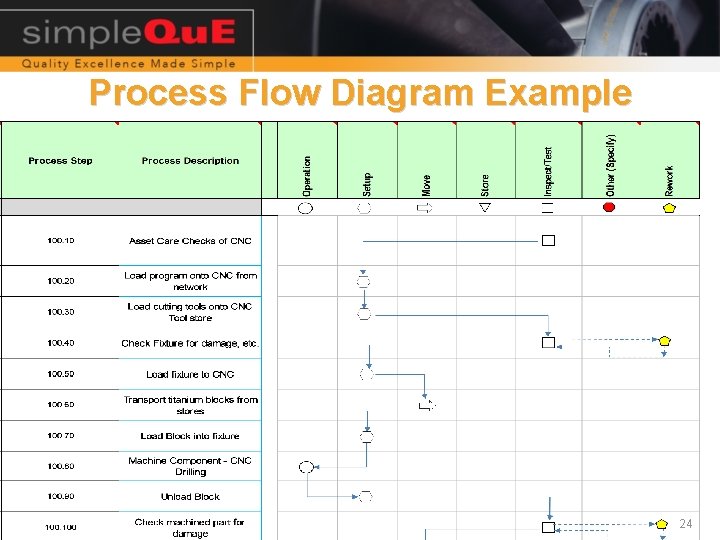
Process Flow Diagram Example 24
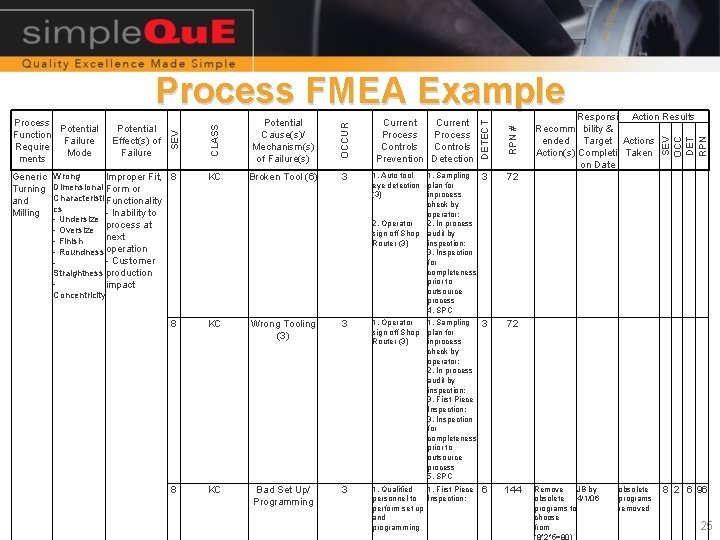
RPN # Current Process Controls Prevention Detection KC Broken Tool (6) 3 1. Auto tool 1. Sampling eye detection plan for (3) inprocess check by operator; 2. Operator 2. In process sign off Shop audit by Router (3) inspection; 3. Inspection for completeness prior to outsource process 4. SPC 3 72 8 KC Wrong Tooling (3) 3 1. Operator sign off Shop Router (3) 3 72 8 KC Bad Set Up/ Programming 3 1. Qualified 1. First Piece personnel to Inspection; perform set up and programming 6 144 1. Sampling plan for inprocess check by operator; 2. In process audit by inspection; 3. First Piece Inspection; 3. Inspection for completeness prior to outsource process 5. SPC Responsi Action Results Recomm bility & ended Target Actions Action(s) Completi Taken on Date SEV OCC DET RPN DETECT Wrong Improper Fit, 8 Dimensional Form or Characteristi Functionality cs - Inability to - Undersize process at - Oversize next - Finish - Roundness operation - Customer Straightness production impact Concentricity OCCUR Potential Cause(s)/ Mechanism(s) of Failure(s) Potential Effect(s) of Failure SEV Process Potential Function Failure Require Mode ments Generic Turning and Milling CLASS Process FMEA Example Remove JB by obsolete 4/1/06 programs to choose from (8*2*5=80) obsolete programs removed 8 2 6 96 25
Control Plan Example Characteristics Methods Doc Process (Line) Step # Process Description Process Classificatio n Sample Machine, Device, Referen Jig, Product ce Tools For Mfg. Product / Evaluation Process Measurement Specification/ Technique Tolerance Size Frequenc y 100. 80 - Fuel Machine Drill Holes Hermel Hole Compon 1 in Fuel / Air e CNC FN 100 ent Diamet Manifold X 450 CNC er Drilling 2 3 CMM 50 mm +/KC-1 Program 0. 2 mm at OP 500 100% Diameter check after OP using diameter gauge GDG-0025 A 100% Fixture Numbe r 555429 21 -A 05 FN 101 Fuel Hole Through Hole Visual check at OP 600 100% Control Method Reaction Plan If part is found to be non -conforming then it is to be tagged with a nonconformance label and placed into the quarantine area for review. Inspection Stop Production until Mfg Engineering to review process and determine what actions are taken. See NC Procedure If part is found to be non -conforming then it is to be tagged with a nonconformance label and placed into the quarantine area for I/MR SPC review. Chart Stop Production until Mfg Engineering to review process and determine what actions are taken. See NC Procedure If part is found to be non -conforming then it is to be tagged with a nonconformance label and placed into the quarantine area for Attribute SPC P-Chart review. Stop Production until Mfg Engineering to review process and 26
Linkage of the Phase 3 Elements FLOW FMEA CONTROL PLAN Work Instructions & Equipment Set-Up / Operation Procedures Process Monitoring Forms 27
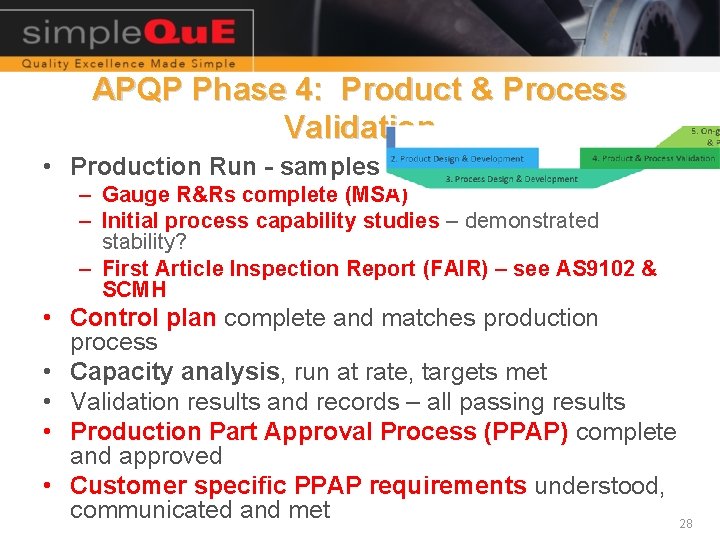
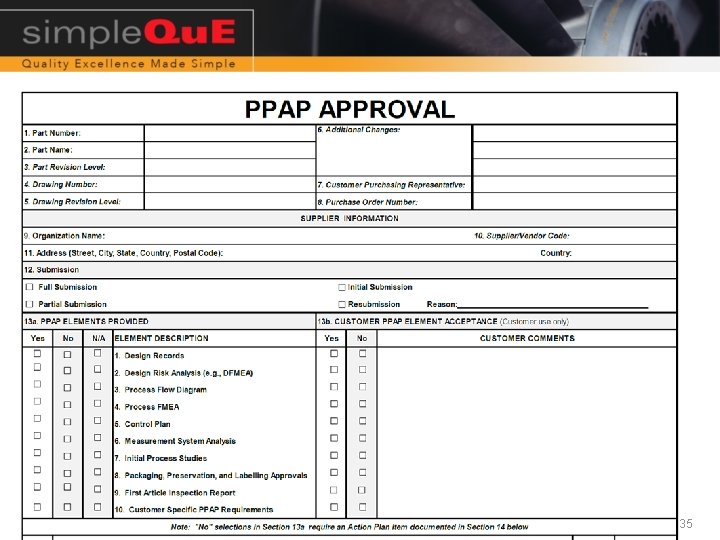
APQP Phase 4: Product & Process Validation • Production Run - samples – Gauge R&Rs complete (MSA) – Initial process capability studies – demonstrated stability? – First Article Inspection Report (FAIR) – see AS 9102 & SCMH • Control plan complete and matches production process • Capacity analysis, run at rate, targets met • Validation results and records – all passing results • Production Part Approval Process (PPAP) complete and approved • Customer specific PPAP requirements understood, communicated and met 28
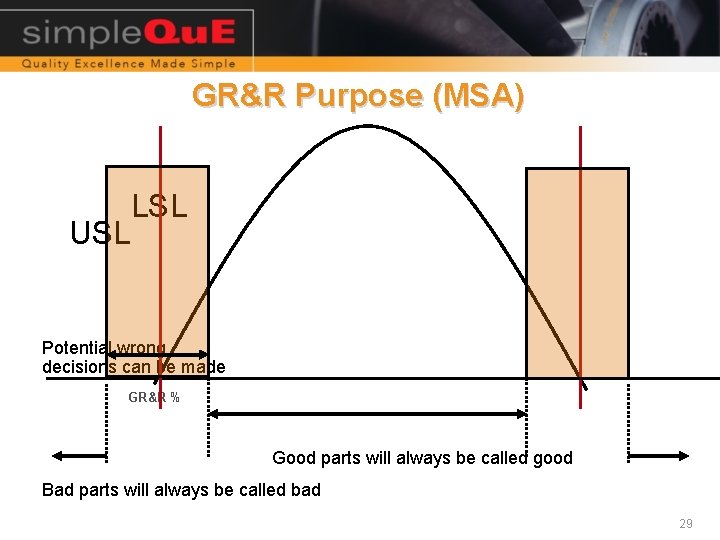
GR&R Purpose (MSA) LSL USL Potential wrong decisions can be made GR&R % Good parts will always be called good Bad parts will always be called bad 29
GR&R Purpose People Assumptions ments, res Gauges, Instru Fixtu Measurement System * Software Environment Methods, Operations Standards 30
GR&R Format & Content Variable Gauge Data Collection Sheet 31
GR&R Format & Content 32
GR&R Format & Content Attribute Gauge Data Collection Sheet Introduce good & bad samples 33
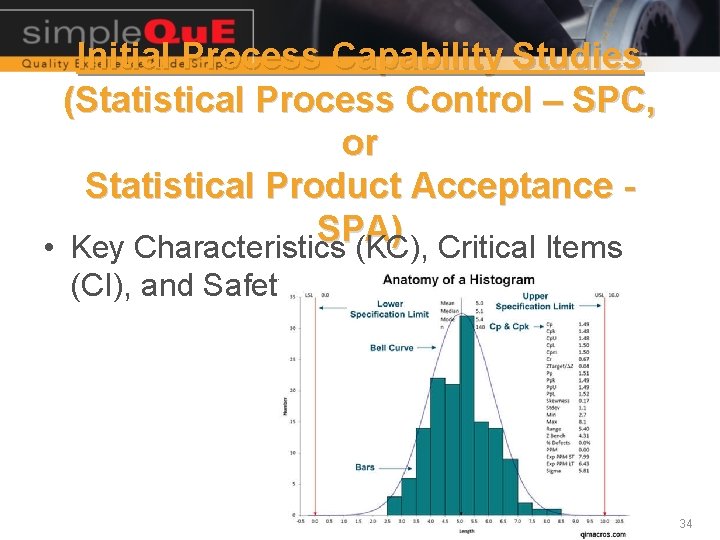
Initial Process Capability Studies (Statistical Process Control – SPC, or Statistical Product Acceptance SPA) • Key Characteristics (KC), Critical Items (CI), and Safety Items 34
35
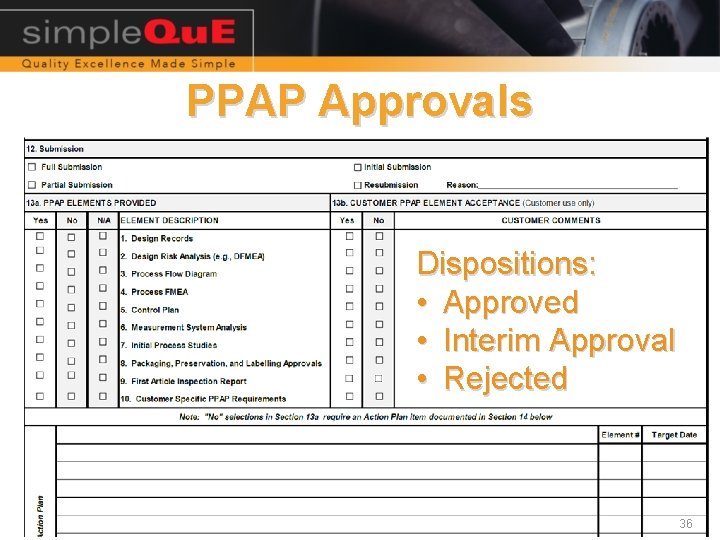
PPAP Approvals Dispositions: • Approved • Interim Approval • Rejected 36
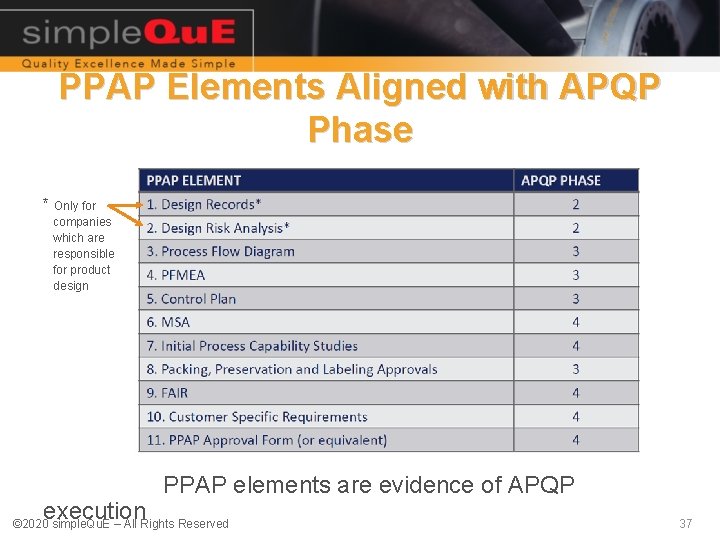
PPAP Elements Aligned with APQP Phase * Only for companies which are responsible for product design execution PPAP elements are evidence of APQP © 2020 simple. Qu. E – All Rights Reserved 37
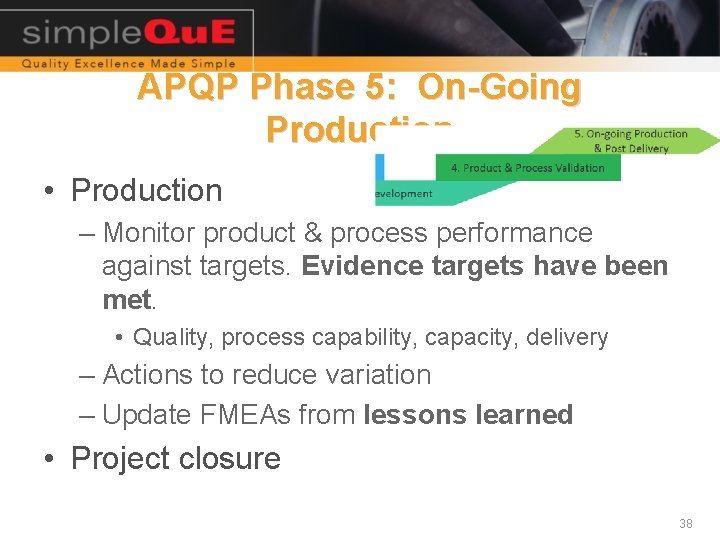
APQP Phase 5: On-Going Production • Production – Monitor product & process performance against targets. Evidence targets have been met. • Quality, process capability, capacity, delivery – Actions to reduce variation – Update FMEAs from lessons learned • Project closure 38
Advanced Product Quality Planning Phases Five Phases of APQP PPAP Deliverables 39
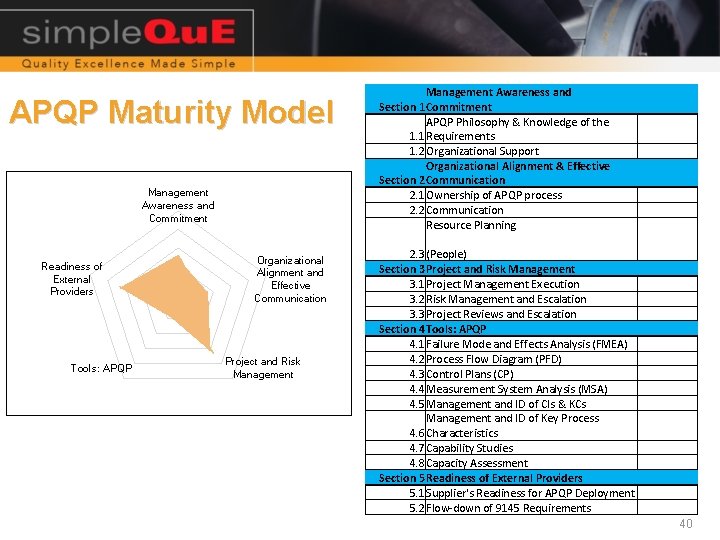
APQP Maturity Model Management Awareness and Commitment Readiness of External Providers Tools: APQP Organizational Alignment and Effective Communication Project and Risk Management Awareness and Section 1 Commitment APQP Philosophy & Knowledge of the 1. 1 Requirements 1. 2 Organizational Support Organizational Alignment & Effective Section 2 Communication 2. 1 Ownership of APQP process 2. 2 Communication Resource Planning 2. 3 (People) Section 3 Project and Risk Management 3. 1 Project Management Execution 3. 2 Risk Management and Escalation 3. 3 Project Reviews and Escalation Section 4 Tools: APQP 4. 1 Failure Mode and Effects Analysis (FMEA) 4. 2 Process Flow Diagram (PFD) 4. 3 Control Plans (CP) 4. 4 Measurement System Analysis (MSA) 4. 5 Management and ID of CIs & KCs Management and ID of Key Process 4. 6 Characteristics 4. 7 Capability Studies 4. 8 Capacity Assessment Section 5 Readiness of External Providers 5. 1 Supplier's Readiness for APQP Deployment 5. 2 Flow-down of 9145 Requirements 0 0 0 0 0 40
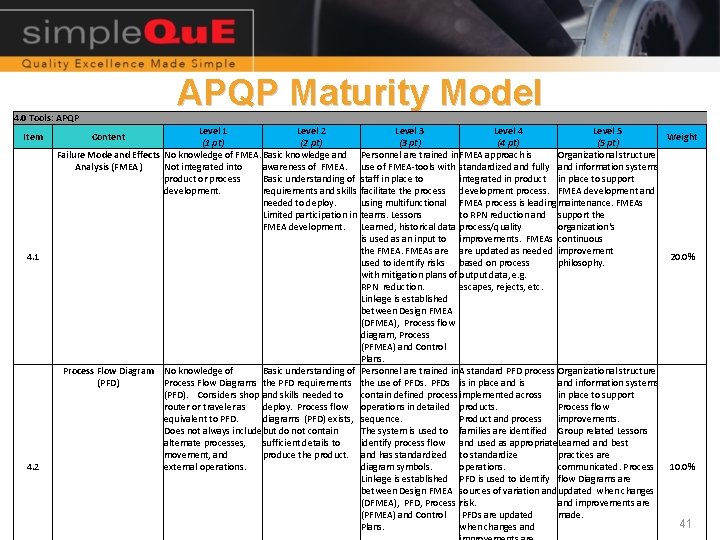
APQP Maturity Model 4. 0 Tools: APQP Item Level 1 Level 2 (1 pt) (2 pt) Failure Mode and Effects No knowledge of FMEA. Basic knowledge and Analysis (FMEA) Not integrated into awareness of FMEA. product or process Basic understanding of development. requirements and skills needed to deploy. Limited participation in FMEA development. Content 4. 1 Process Flow Diagram (PFD) 4. 2 Level 3 Level 4 Level 5 Weight (3 pt) (4 pt) (5 pt) Personnel are trained in FMEA approach is Organizational structure use of FMEA-tools with standardized and fully and information systems staff in place to integrated in product in place to support facilitate the process development process. FMEA development and using multifunctional FMEA process is leading maintenance. FMEAs teams. Lessons to RPN reduction and support the Learned, historical data process/quality organization's is used as an input to improvements. FMEAs continuous the FMEAs are updated as needed improvement 20. 0% used to identify risks based on process philosophy. with mitigation plans of output data, e. g. RPN reduction. escapes, rejects, etc. Linkage is established between Design FMEA (DFMEA), Process flow diagram, Process (PFMEA) and Control Plans. No knowledge of Basic understanding of Personnel are trained in A standard PFD process Organizational structure Process Flow Diagrams the PFD requirements the use of PFDs is in place and is and information systems (PFD). Considers shop and skills needed to contain defined process implemented across in place to support router or traveler as deploy. Process flow operations in detailed products. Process flow equivalent to PFD. diagrams (PFD) exists, sequence. Product and process improvements. Does not always include but do not contain The system is used to families are identified Group related Lessons alternate processes, sufficient details to identify process flow and used as appropriate. Learned and best movement, and produce the product. and has standardized to standardize practices are external operations. diagram symbols. operations. communicated. Process 10. 0% Linkage is established PFD is used to identify flow Diagrams are between Design FMEA sources of variation and updated when changes (DFMEA), PFD, Process risk. and improvements are (PFMEA) and Control PFDs are updated made. 41 Plans. when changes and
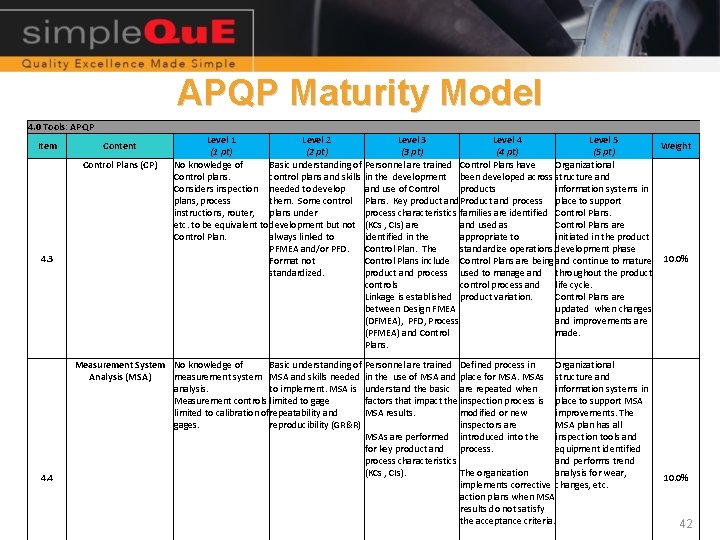
APQP Maturity Model 4. 0 Tools: APQP Item Content Control Plans (CP) 4. 3 4. 4 Level 1 Level 2 Level 3 Level 4 Level 5 Weight (1 pt) (2 pt) (3 pt) (4 pt) (5 pt) No knowledge of Basic understanding of Personnel are trained Control Plans have Organizational Control plans. control plans and skills in the development been developed across structure and Considers inspection needed to develop and use of Control products information systems in plans, process them. Some control Plans. Key product and Product and process place to support instructions, router, plans under process characteristics families are identified Control Plans. etc. to be equivalent to development but not (KCs , CIs) are and used as Control Plans are Control Plan. always linked to identified in the appropriate to initiated in the product PFMEA and/or PFD. Control Plan. The standardize operations. development phase Format not Control Plans include Control Plans are being and continue to mature 10. 0% standardized. product and process used to manage and throughout the product controls control process and life cycle. Linkage is established product variation. Control Plans are between Design FMEA updated when changes (DFMEA), PFD, Process and improvements are (PFMEA) and Control made. Plans. Measurement System No knowledge of Basic understanding of Personnel are trained Defined process in Organizational Analysis (MSA) measurement system MSA and skills needed in the use of MSA and place for MSAs structure and analysis. to implement. MSA is understand the basic are repeated when information systems in Measurement controls limited to gage factors that impact the inspection process is place to support MSA limited to calibration ofrepeatability and MSA results. modified or new improvements. The gages. reproducibility (GR&R) inspectors are MSA plan has all MSAs are performed introduced into the inspection tools and for key product and process. equipment identified process characteristics and performs trend (KCs , CIs). The organization analysis for wear, implements corrective changes, etc. action plans when MSA results do not satisfy the acceptance criteria. 10. 0% 42
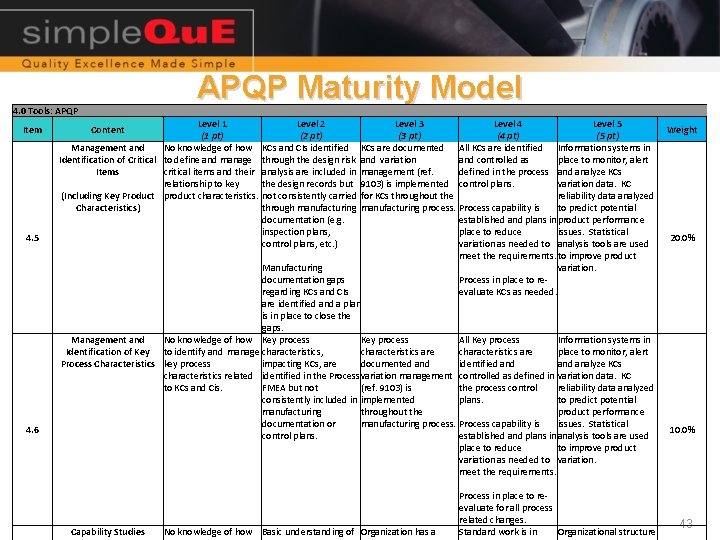
APQP Maturity Model 4. 0 Tools: APQP Item Level 1 (1 pt) Management and No knowledge of how Identification of Critical to define and manage Items critical items and their relationship to key (Including Key Product product characteristics. Characteristics) Content 4. 5 4. 6 Level 2 (2 pt) KCs and CIs identified through the design risk analysis are included in the design records but not consistently carried through manufacturing documentation (e. g. inspection plans, control plans, etc. ) Level 3 (3 pt) KCs are documented and variation management (ref. 9103) is implemented for KCs throughout the manufacturing process. Manufacturing documentation gaps regarding KCs and CIs are identified and a plan is in place to close the gaps. Management and No knowledge of how Key process Identification of Key to identify and manage characteristics, characteristics are Process Characteristics key process impacting KCs, are documented and characteristics related identified in the Process variation management to KCs and Cis. FMEA but not (ref. 9103) is consistently included in implemented manufacturing throughout the documentation or manufacturing process. control plans. Capability Studies No knowledge of how Basic understanding of Organization has a Level 4 (4 pt) All KCs are identified and controlled as defined in the process control plans. Level 5 (5 pt) Information systems in place to monitor, alert and analyze KCs variation data. KC reliability data analyzed Process capability is to predict potential established and plans in product performance place to reduce issues. Statistical variation as needed to analysis tools are used meet the requirements. to improve product variation. Process in place to reevaluate KCs as needed. All Key process Information systems in characteristics are place to monitor, alert identified and analyze KCs controlled as defined in variation data. KC the process control reliability data analyzed plans. to predict potential product performance Process capability is issues. Statistical established and plans in analysis tools are used place to reduce to improve product variation as needed to variation. meet the requirements. Process in place to reevaluate for all process related changes. Standard work is in Organizational structure Weight 20. 0% 10. 0% 43
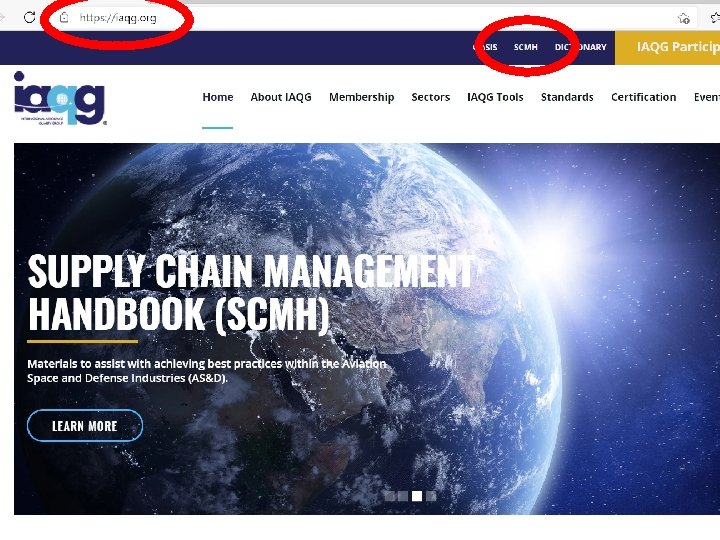
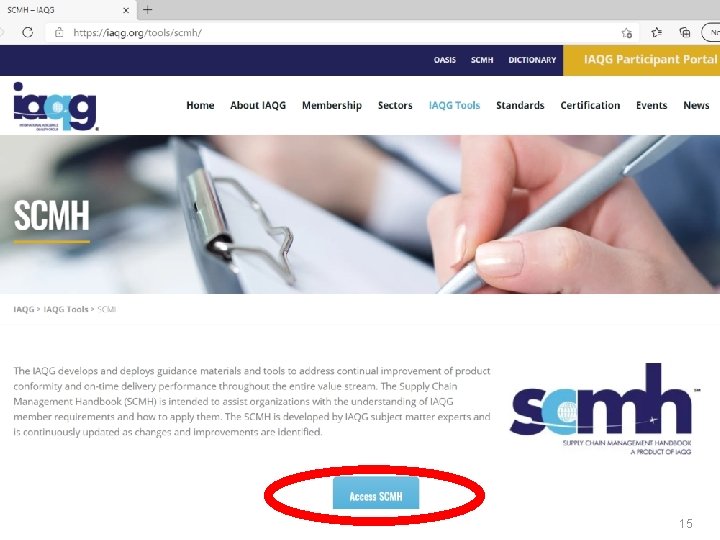
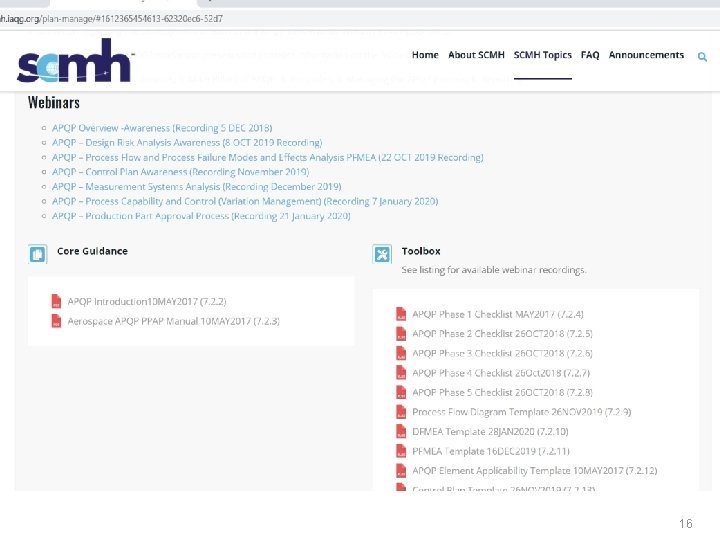
Webinar Purpose & Objectives • Provide APQP understanding • Show who has begun asking for APQP & PPAP • Show relation between Aerospace APQP and the Automotive APQP, and all its components • Provide sources of free information, tools, and training iaqg. org SCMH http: //bit. ly/ASA-AS 9145 Webinar • Share benefits and best practices 44
Questions? http: //bit. ly/ASA-AS 9145 -Webinar For templates and examples not on the SCMH site Phone • (740) 305 -0868 Email • jlee@simple. Qu. E. com Website • www. simple. Qu. E. com 45