
AS 90861 DEMONSTRATE UNDERSTANDING OF A DANCE PERFORMANCE


- Slides: 33
AS 90861 DEMONSTRATE UNDERSTANDING OF A DANCE PERFORMANCE EXTERNAL EXAM = 4 CREDITS
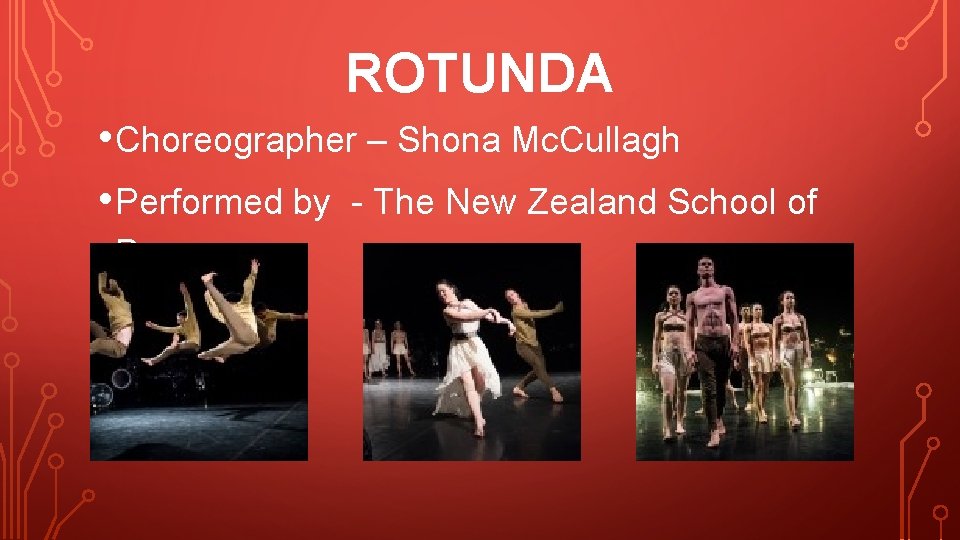
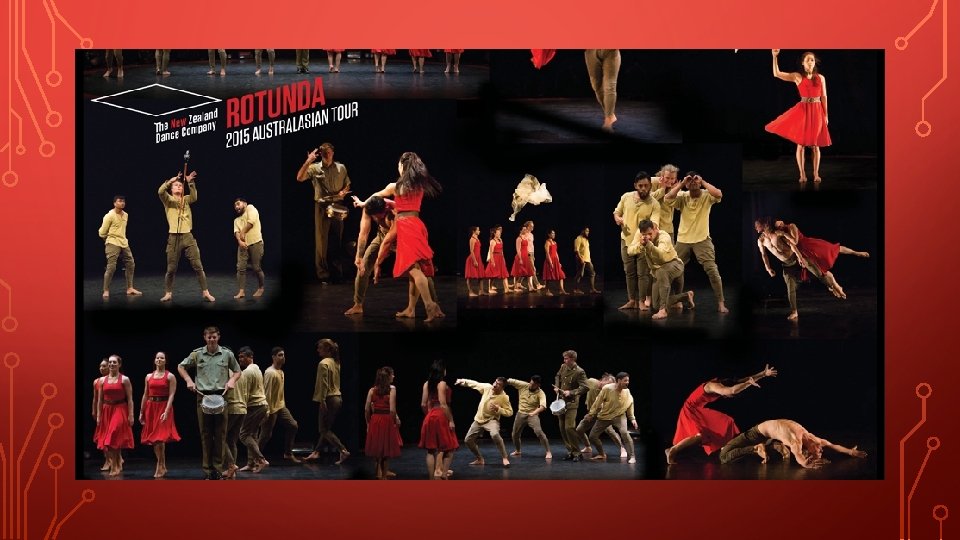
ROTUNDA • Choreographer – Shona Mc. Cullagh • Performed by - The New Zealand School of Dance
LINKS TO WEBSITES ABOUT WWI • https: //www. youtube. com/watch? v=-Tv 5 g. Ba 9 DQs • https: //www. youtube. com/watch? v=cc 7 ehb 8 ag. WY • https: //www. youtube. com/watch? v=Gal. JQY 3 Pa. Qk • https: //www. youtube. com/watch? v=d 7 Mu. Mnss 4 Rw • http: //www. teara. govt. nz/en/video/46404/great-war-stories-leonardhart
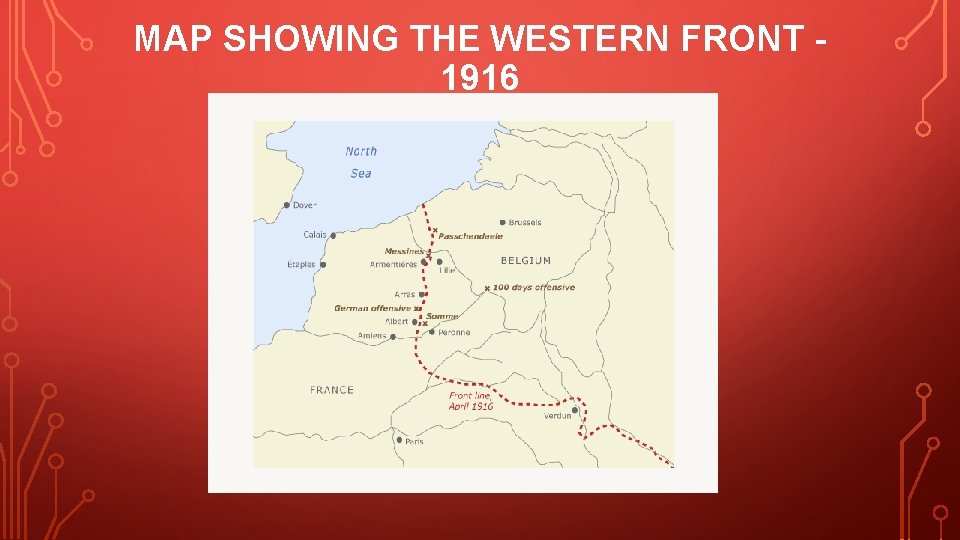
MAP SHOWING THE WESTERN FRONT 1916
IMPORTANT IDEAS IN ROTUNDA • Role of brass bands in NZ society since 1845 • Commemorates the loss of innocent, good young men • Rotundas as gathering places in early 20 th century • Power of community • Breath as a universal symbol of life • The Silent War – emotional damage – loss of innocence • Leads to hope that violence and bloodshed will one day end • Honours the enormous courage, bravery and sacrifice of NZ men • Honours the courageous, hard-working, stoic women • Emotional transformation of men and women
• “The work draws from the extraordinary courage and indomitable spirit of NZ men, and the women who set about running the country with aching hearts and dread that their men might not return. ” - Shona Mc. Cullagh (choreographer) • Innocence was lost on the battlefield as the young men witnessed death, destruction, injury, agony and gore. They experienced great trauma and grief at the loss of their comrades. Most returned home emotionally damaged, unable to communicate, connect with or trust their loved ones.
• WWI marked a “coming of age” for NZ. • It was a time of great social change but also of growing pridethat, despite being a small, young country at the bottom of the globe, we could contribute significantly on the world stage. • The war exposed NZ character traits that became renowned; humour, resilience, courage, ingenuity. • It was when Australians and New Zealanders fought side by side at Gallipoli that the term “Kiwis” was coined. • WWI is an important event which helped form our identity as an independent nation of Kiwis.
• Rotunda is a story of a small group of individuals who gradually become a community through the experience of a crisis. That crisis is WWI but can reference any threat or crisis that binds a group of individuals together. • Rotunda is a narrative that takes us from a time of innocence, to a time of excitement about the impending war, to a time of crisis – the war itself, to a time of grief and finally, to a time of healing and memoriam. The final images speak to us of the healing power of music and memory.
Read Shona’s Personal Story then with a partner discuss the following questions: 1. What emotions do you imagine Annie must have felt when she received the news her son had been killed? 2. Why do you think Fentori was screaming “the bayonets!” in his sleep? 3. How does Shona’s personal story help you understand the ideas in Rotunda? 4. What other ideas would you add now to the list of key ideas in the dance? 5. Which ideas do you consider to be the important ones? Be prepared to discuss your thoughts with the class
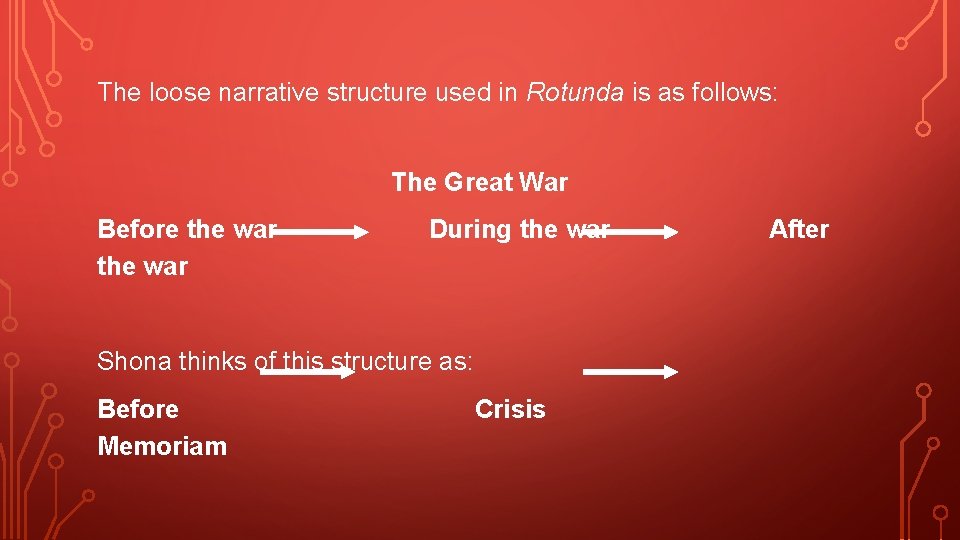
STRUCTURE OF ROTUNDA • Structure is the way movements and sections in a dance are ordered or organised. • Rotunda uses a loose narrative structure – the use of ‘Story’ helps to make the full-length work more accessible. • A narrative structure means the sections of the dance are organised in an order which roughly tells a story.
The loose narrative structure used in Rotunda is as follows: The Great War Before the war During the war Shona thinks of this structure as: Before Memoriam Crisis After
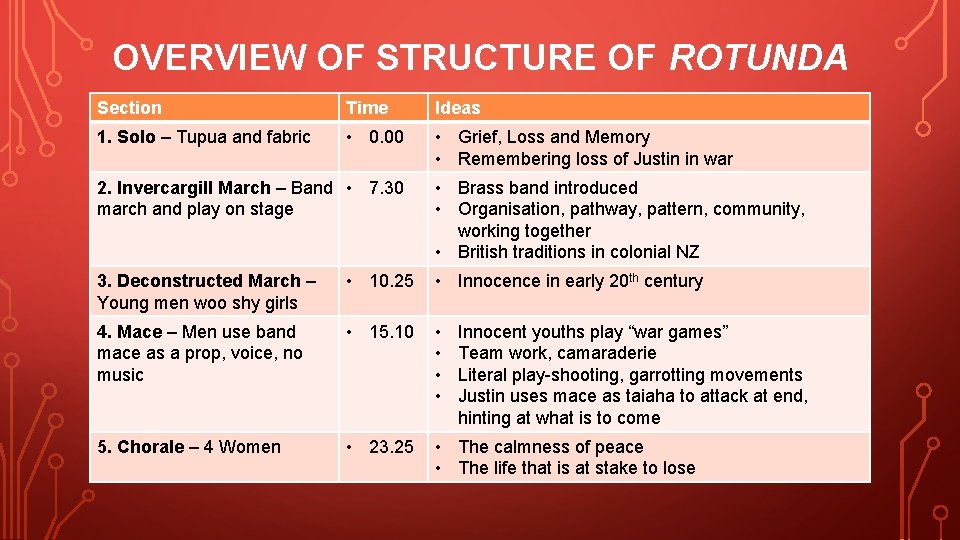
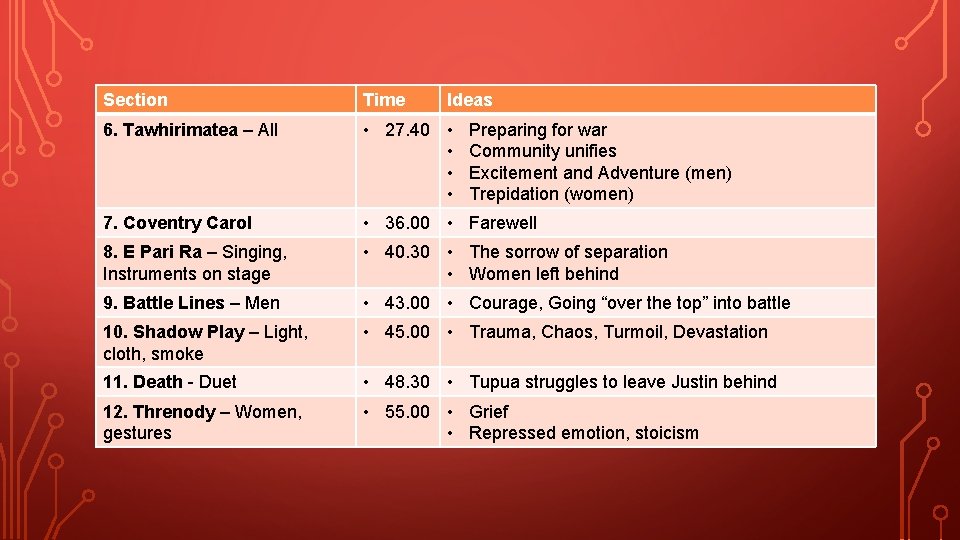
OVERVIEW OF STRUCTURE OF ROTUNDA Section Time Ideas 1. Solo – Tupua and fabric • 0. 00 • Grief, Loss and Memory • Remembering loss of Justin in war 2. Invercargill March – Band • 7. 30 march and play on stage • Brass band introduced • Organisation, pathway, pattern, community, working together • British traditions in colonial NZ 3. Deconstructed March – Young men woo shy girls • 10. 25 • Innocence in early 20 th century 4. Mace – Men use band mace as a prop, voice, no music • 15. 10 • • 5. Chorale – 4 Women • 23. 25 • The calmness of peace • The life that is at stake to lose Innocent youths play “war games” Team work, camaraderie Literal play-shooting, garrotting movements Justin uses mace as taiaha to attack at end, hinting at what is to come
Section Time Ideas 6. Tawhirimatea – All • 27. 40 • • 7. Coventry Carol • 36. 00 • Farewell 8. E Pari Ra – Singing, Instruments on stage • 40. 30 • The sorrow of separation • Women left behind 9. Battle Lines – Men • 43. 00 • Courage, Going “over the top” into battle 10. Shadow Play – Light, cloth, smoke • 45. 00 • Trauma, Chaos, Turmoil, Devastation 11. Death - Duet • 48. 30 • Tupua struggles to leave Justin behind 12. Threnody – Women, gestures • 55. 00 • Grief • Repressed emotion, stoicism Preparing for war Community unifies Excitement and Adventure (men) Trepidation (women)
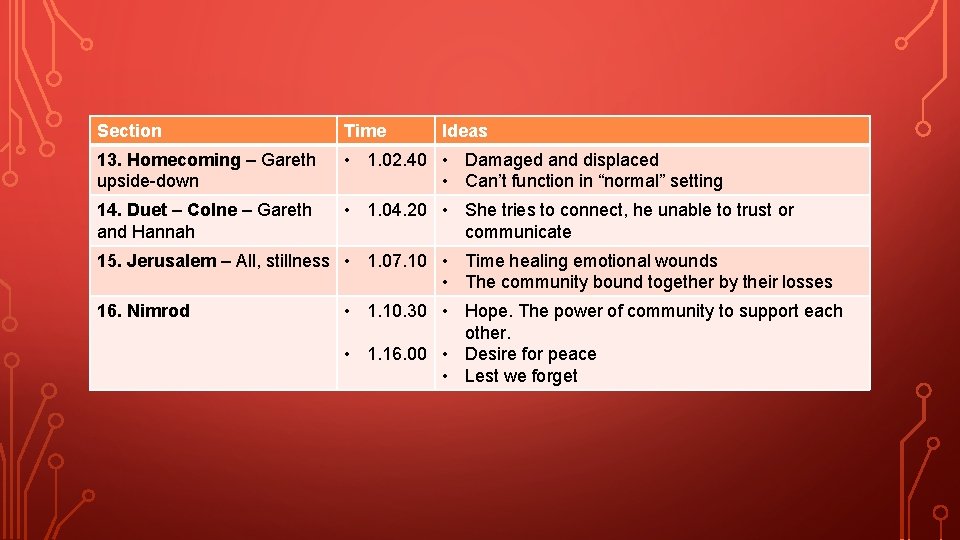
Section Time Ideas 13. Homecoming – Gareth upside-down • 1. 02. 40 • Damaged and displaced • Can’t function in “normal” setting 14. Duet – Colne – Gareth and Hannah • 1. 04. 20 • She tries to connect, he unable to trust or communicate 15. Jerusalem – All, stillness • 1. 07. 10 • Time healing emotional wounds • The community bound together by their losses 16. Nimrod • 1. 10. 30 • Hope. The power of community to support each other. • 1. 16. 00 • Desire for peace • Lest we forget
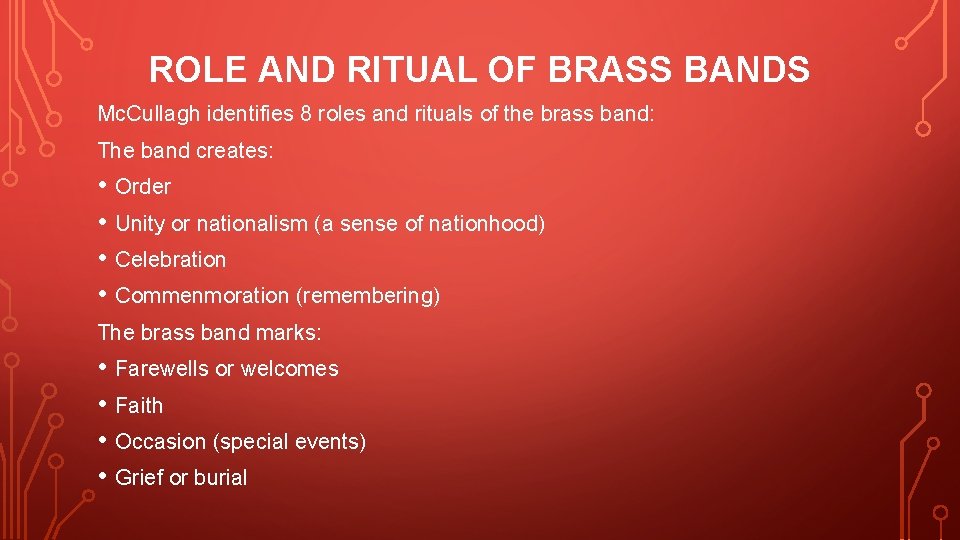
ROLE AND RITUAL OF BRASS BANDS Mc. Cullagh identifies 8 roles and rituals of the brass band: The band creates: • Order • Unity or nationalism (a sense of nationhood) • Celebration • Commenmoration (remembering) The brass band marks: • Farewells or welcomes • Faith • Occasion (special events) • Grief or burial
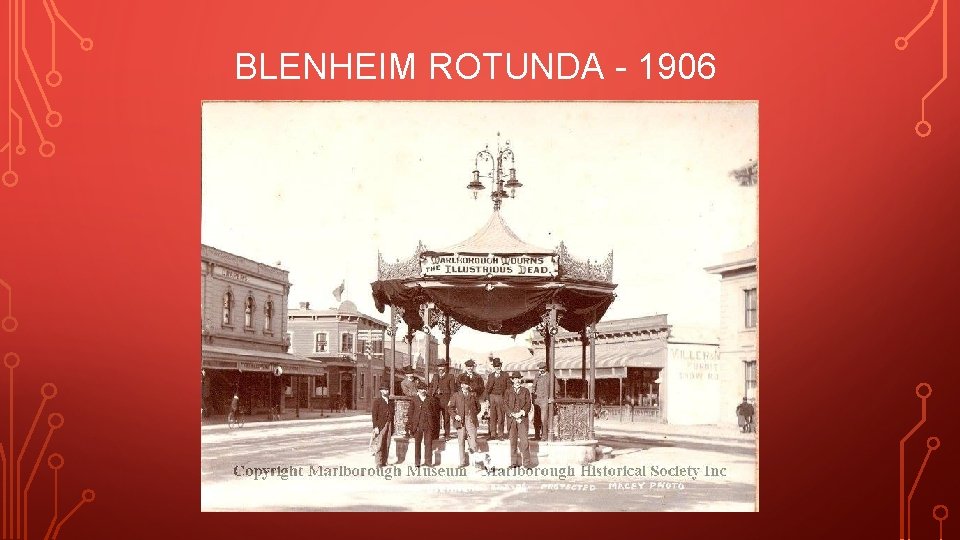
BLENHEIM ROTUNDA - 1906
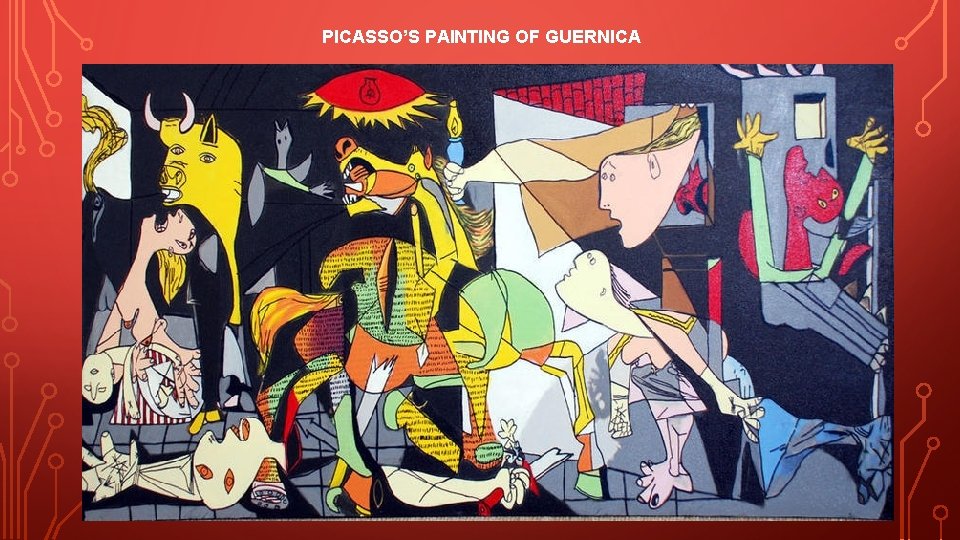
PICASSO’S PAINTING OF GUERNICA
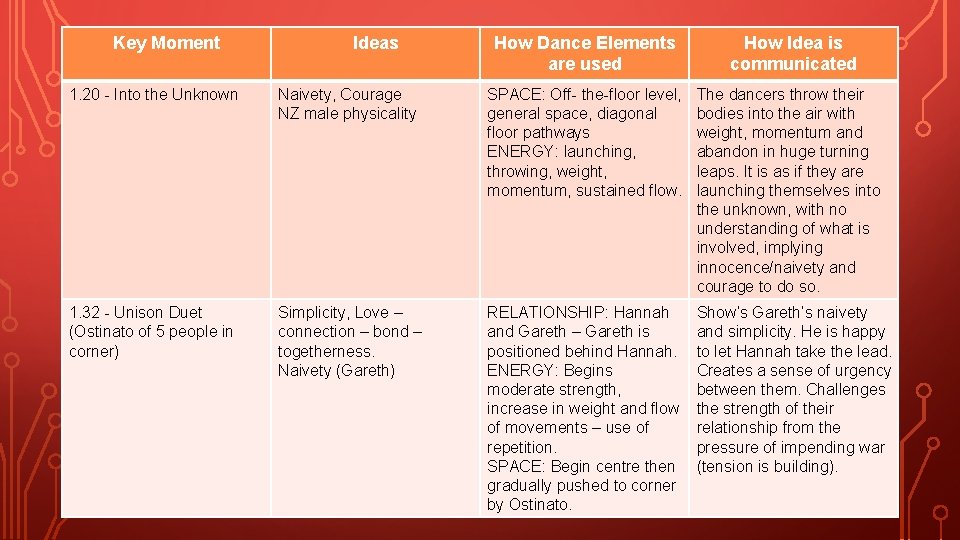
Key Moment Ideas How Dance Elements are used How Idea is communicated 1. 20 - Into the Unknown Naivety, Courage NZ male physicality SPACE: Off- the-floor level, general space, diagonal floor pathways ENERGY: launching, throwing, weight, momentum, sustained flow. The dancers throw their bodies into the air with weight, momentum and abandon in huge turning leaps. It is as if they are launching themselves into the unknown, with no understanding of what is involved, implying innocence/naivety and courage to do so. 1. 32 - Unison Duet (Ostinato of 5 people in corner) Simplicity, Love – connection – bond – togetherness. Naivety (Gareth) RELATIONSHIP: Hannah and Gareth – Gareth is positioned behind Hannah. ENERGY: Begins moderate strength, increase in weight and flow of movements – use of repetition. SPACE: Begin centre then gradually pushed to corner by Ostinato. Show’s Gareth’s naivety and simplicity. He is happy to let Hannah take the lead. Creates a sense of urgency between them. Challenges the strength of their relationship from the pressure of impending war (tension is building).
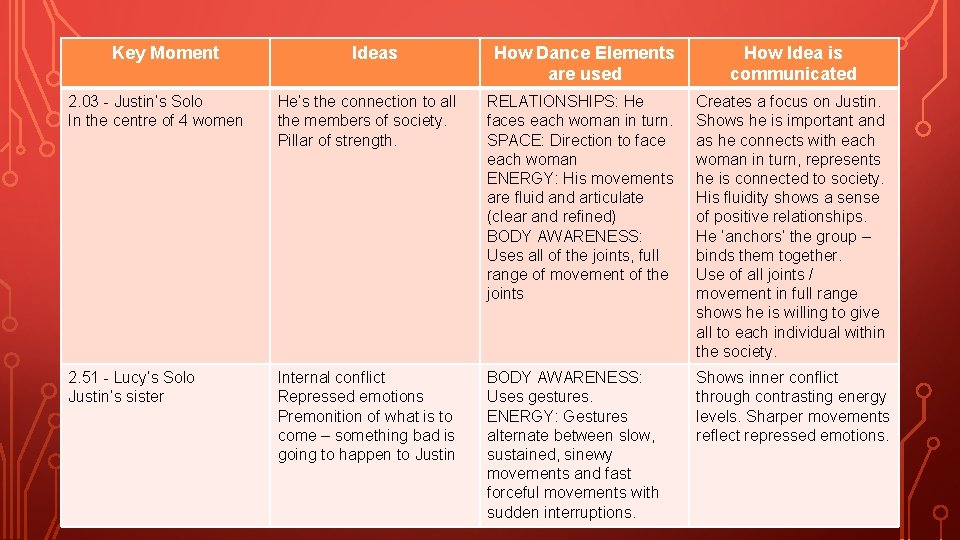
Key Moment Ideas How Dance Elements are used How Idea is communicated 2. 03 - Justin’s Solo In the centre of 4 women He’s the connection to all the members of society. Pillar of strength. RELATIONSHIPS: He faces each woman in turn. SPACE: Direction to face each woman ENERGY: His movements are fluid and articulate (clear and refined) BODY AWARENESS: Uses all of the joints, full range of movement of the joints Creates a focus on Justin. Shows he is important and as he connects with each woman in turn, represents he is connected to society. His fluidity shows a sense of positive relationships. He ‘anchors’ the group – binds them together. Use of all joints / movement in full range shows he is willing to give all to each individual within the society. 2. 51 - Lucy’s Solo Justin’s sister Internal conflict Repressed emotions Premonition of what is to come – something bad is going to happen to Justin BODY AWARENESS: Uses gestures. ENERGY: Gestures alternate between slow, sustained, sinewy movements and fast forceful movements with sudden interruptions. Shows inner conflict through contrasting energy levels. Sharper movements reflect repressed emotions.
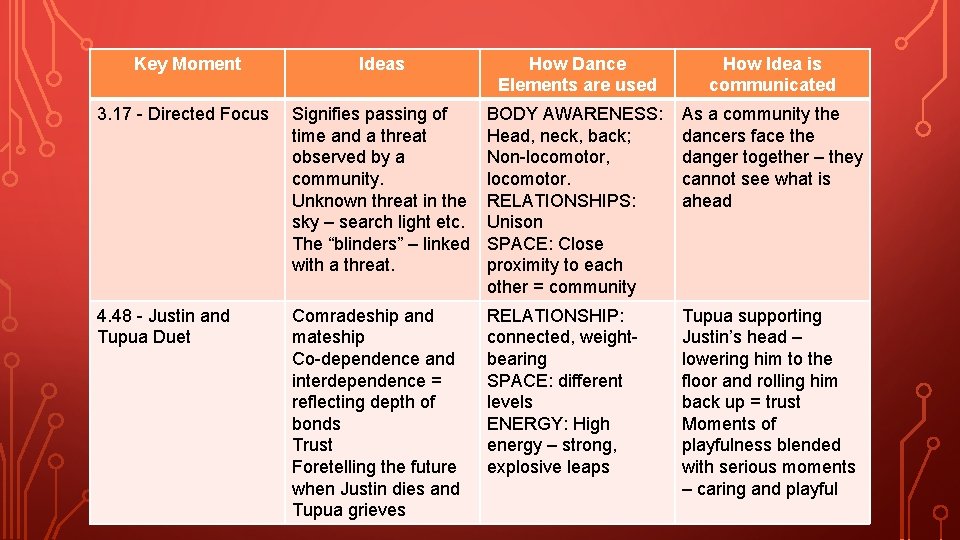
Key Moment Ideas How Dance Elements are used How Idea is communicated 3. 17 - Directed Focus Signifies passing of time and a threat observed by a community. Unknown threat in the sky – search light etc. The “blinders” – linked with a threat. BODY AWARENESS: Head, neck, back; Non-locomotor, locomotor. RELATIONSHIPS: Unison SPACE: Close proximity to each other = community As a community the dancers face the danger together – they cannot see what is ahead 4. 48 - Justin and Tupua Duet Comradeship and mateship Co-dependence and interdependence = reflecting depth of bonds Trust Foretelling the future when Justin dies and Tupua grieves RELATIONSHIP: connected, weightbearing SPACE: different levels ENERGY: High energy – strong, explosive leaps Tupua supporting Justin’s head – lowering him to the floor and rolling him back up = trust Moments of playfulness blended with serious moments – caring and playful
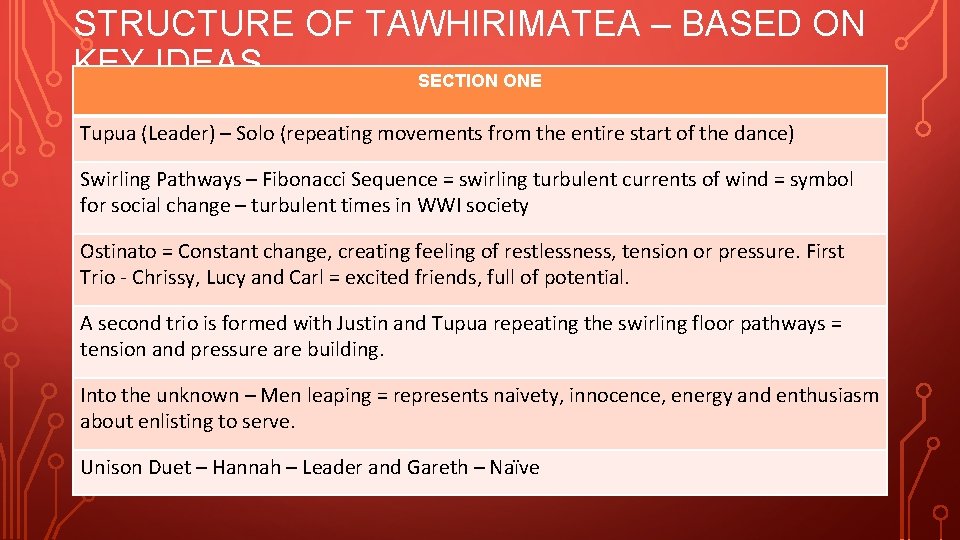
STRUCTURE OF TAWHIRIMATEA – BASED ON KEY IDEAS SECTION ONE Tupua (Leader) – Solo (repeating movements from the entire start of the dance) Swirling Pathways – Fibonacci Sequence = swirling turbulent currents of wind = symbol for social change – turbulent times in WWI society Ostinato = Constant change, creating feeling of restlessness, tension or pressure. First Trio - Chrissy, Lucy and Carl = excited friends, full of potential. A second trio is formed with Justin and Tupua repeating the swirling floor pathways = tension and pressure are building. Into the unknown – Men leaping = represents naivety, innocence, energy and enthusiasm about enlisting to serve. Unison Duet – Hannah – Leader and Gareth – Naïve
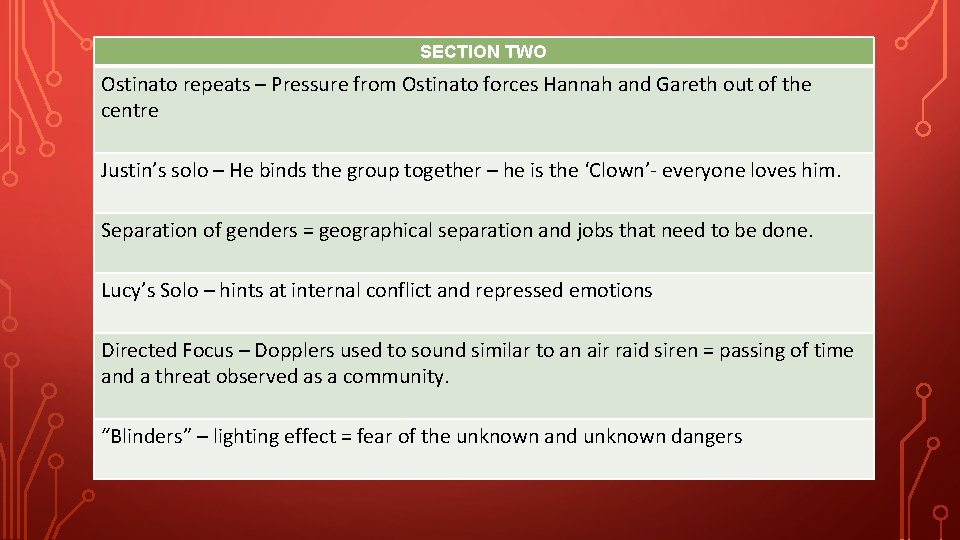
SECTION TWO Ostinato repeats – Pressure from Ostinato forces Hannah and Gareth out of the centre Justin’s solo – He binds the group together – he is the ‘Clown’- everyone loves him. Separation of genders = geographical separation and jobs that need to be done. Lucy’s Solo – hints at internal conflict and repressed emotions Directed Focus – Dopplers used to sound similar to an air raid siren = passing of time and a threat observed as a community. “Blinders” – lighting effect = fear of the unknown and unknown dangers
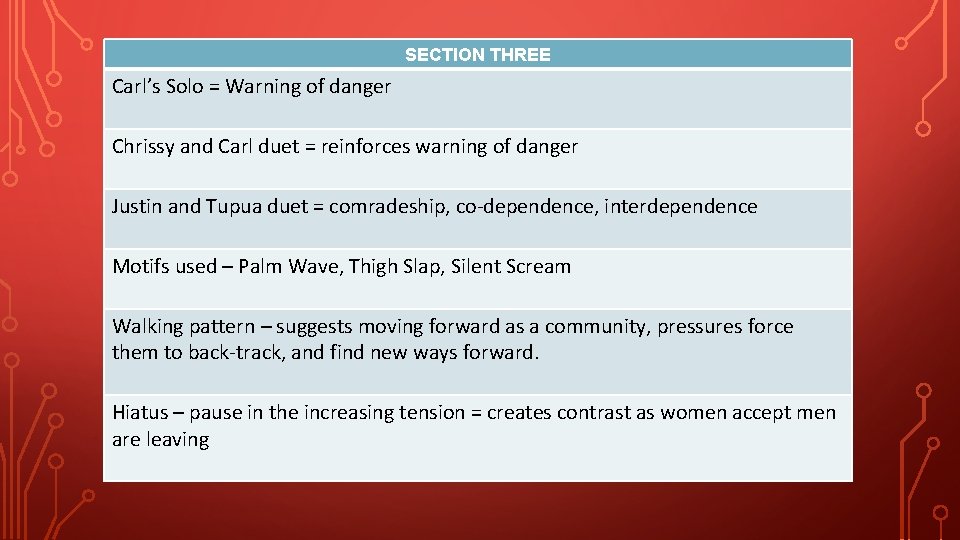
SECTION THREE Carl’s Solo = Warning of danger Chrissy and Carl duet = reinforces warning of danger Justin and Tupua duet = comradeship, co-dependence, interdependence Motifs used – Palm Wave, Thigh Slap, Silent Scream Walking pattern – suggests moving forward as a community, pressures force them to back-track, and find new ways forward. Hiatus – pause in the increasing tension = creates contrast as women accept men are leaving
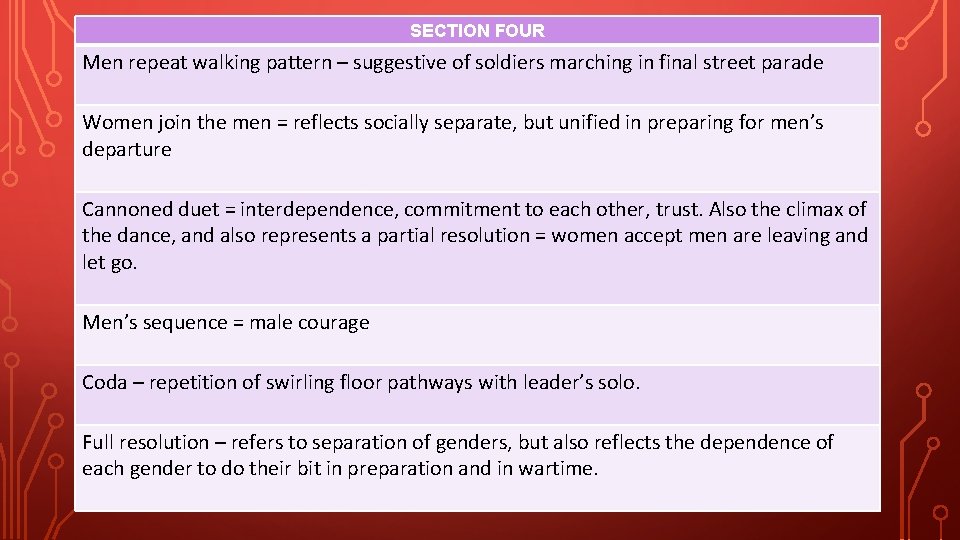
SECTION FOUR Men repeat walking pattern – suggestive of soldiers marching in final street parade Women join the men = reflects socially separate, but unified in preparing for men’s departure Cannoned duet = interdependence, commitment to each other, trust. Also the climax of the dance, and also represents a partial resolution = women accept men are leaving and let go. Men’s sequence = male courage Coda – repetition of swirling floor pathways with leader’s solo. Full resolution – refers to separation of genders, but also reflects the dependence of each gender to do their bit in preparation and in wartime.
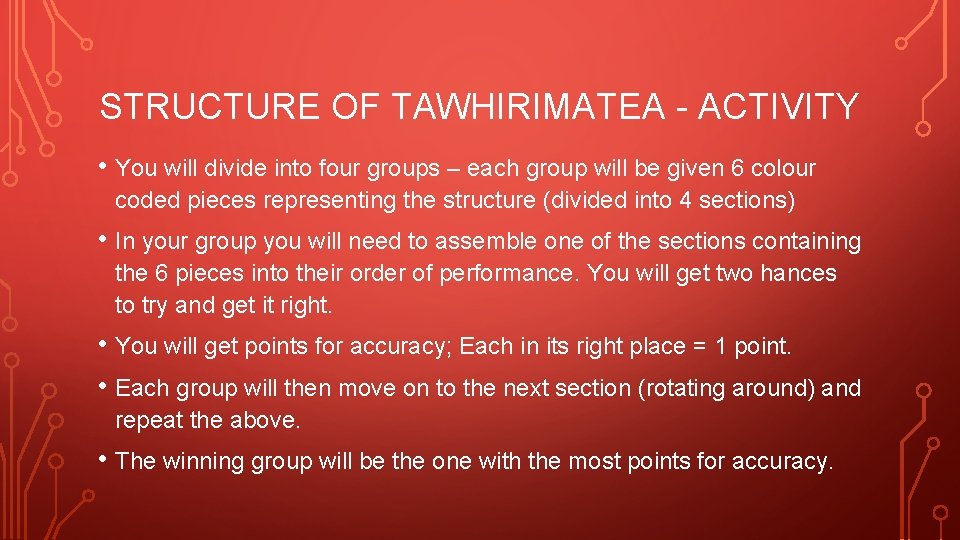
STRUCTURE OF TAWHIRIMATEA - ACTIVITY • You will divide into four groups – each group will be given 6 colour coded pieces representing the structure (divided into 4 sections) • In your group you will need to assemble one of the sections containing the 6 pieces into their order of performance. You will get two hances to try and get it right. • You will get points for accuracy; Each in its right place = 1 point. • Each group will then move on to the next section (rotating around) and repeat the above. • The winning group will be the one with the most points for accuracy.
KEY IDEAS – MIND MAP ACTIVITY • In your groups – choose ONE of the Key Ideas from each section of the structure list. Create four Mind Maps of ideas / thoughts / movement example / explanations based on your chosen Key Idea (you can use your notes to help you). Try to have as much detail as possible. • Be prepared to share these with the rest of the class. • I will take a photo of these to add the Freybergdance Blog for future reference.
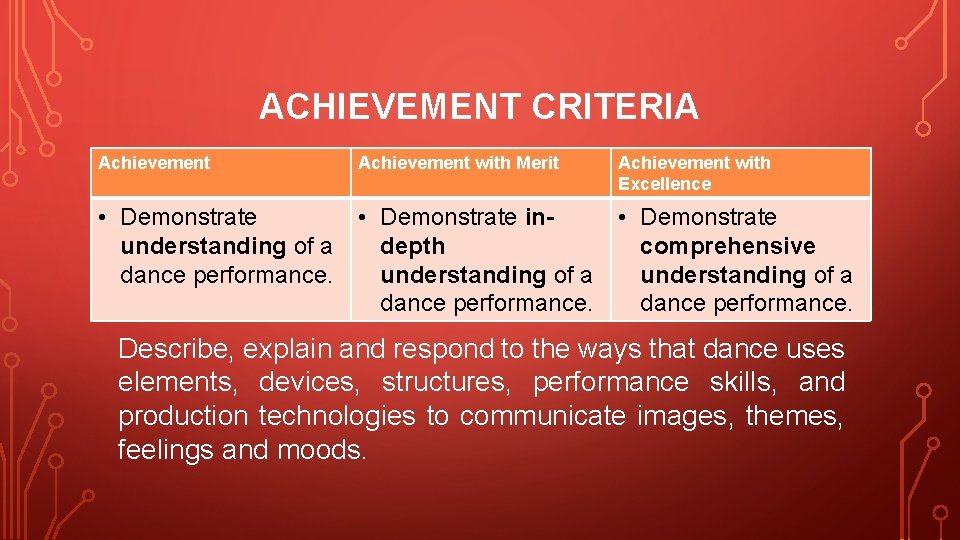
ACHIEVEMENT CRITERIA Achievement with Merit Achievement with Excellence • Demonstrate in • Demonstrate understanding of a depth comprehensive dance performance. understanding of a dance performance. Describe, explain and respond to the ways that dance uses elements, devices, structures, performance skills, and production technologies to communicate images, themes, feelings and moods.
Achieve - Demonstrate understanding of a dance performance involves identifying and describing key aspects of a dance performance. Merit - Demonstrate in-depth understanding of a dance performance involves describing in detail key aspects of a dance performance. For example: • A production technology (the fabric, style, features, colour and accessories of the costume). • The opening moment (the dancers’ entrance or opening shape, first movements, the appearance of the lighting etc).
Excellence - Demonstrate comprehensive understanding of a dance performance involves explaining the relationship between key aspects of a dance performance. For example: • The links between costume design and the movements. • The connection between the opening moment and the choreographic intention. • The way the dance relates to the title.
ASSESSMENT REQUIREMENTS • There will be THREE questions. In 2016, candidates must answer all three questions. • Each question may contain more than one part. Questions will be assessed holistically. • Candidates will be required to respond in in bullet-point form, paragraph form, diagrams, or sketches. • Diagrams or sketches will be assessed on the quality of information conveyed and not their artistic merit (i. e. simple stick figures are satisfactory). Candidates should label their diagrams or sketches to indicate features that may not be clear. • Questions may include bullet-pointed examples to provide guidance for candidates. These examples are not intended to limit candidates’ answers. • Candidates must use ink for both sketched and written answers.
FORMAT OF THE ASSESSMENT • Candidates will be given 5 minutes to read the questions. • A video of the dance performance (3– 6 minutes in duration) will then be shown, twice, with a pause of 10 minutes in between. • Candidates may start making notes or answering the questions at any time after the examination begins.
CONTEXT OF ASSESSMENT • Candidates will be required to answer questions on a number of key aspects of the dance performance. Candidates should be familiar with: • ideas and/or emotions communicated • two important production technologies • structure • important movements. • Candidates may refer to key aspects not shown in the recording to support their answers.