
Arts Background Information Purpose Time Question Resources Describe

Arts
• Background Information • Purpose • Time Question Resources • Describe and analyze the characteristics of a culture and its people to create personal art reflecting daily life and the environment. • 2 to 5 hours How can I use art to reflect the culture of my community? • “What is Culture? ” The Center for Advanced Research on Language Acquisition (CARLA). University of Minnesota. ( http: //www. carla. umn. edu/culture/definitions. html) • Wallach, L. , (2013, November). A cut-down history of collage. Art. Space. (http: //www. artspace. com/magazine/art_101_collage) • Supporting Documents: • Summary • �Community Culture Discussion Guide • �Discussion Reflection Questions • �Post-Project Reflection Questions • �Written Task Editing Checklist • �Cultural Collage Project Rubric • Create a work of art for a public space in your community, and write a dedication speech that explains how the work of art you created reflects the culture of your community. • Introduction • Artists who create community-oriented public art have a unique responsibility. In addition to expressing their own artistic styles and viewpoints, they must create art that will exist in relation to the values, physical space, history, and culture of the community. Public artists play a unique role in the cultural life of a community, reflecting the culture of that community even as they help to shape it. • Instructions • Step 1: Consider the meaning of “culture, ” and reflect on the culture of a community to which you belong. • a) The community you select may be your town or city, but it could also be an ethnic or religious group, a collection of people with whom you share a hobby or interest, or even an online community. • b) If you have not already completed the pre-project activity, read the definitions of “culture” in the “What is Culture? ” resource, and respond to the questions noted in the pre-project activity. • Student Guide (continued) • Step 2: Conduct an open discussion about the culture of your community with at least three other members of your community. • a) Use the Community Culture Discussion Guide to focus your discussion. b) After the discussion, complete the Discussion Reflection Questions.
• Instructions • Use this guide to frame a discussion about culture with at least three other members of your community. • Before the Discussion • Establish a time and place for the group to meet. Set aside at least 45 minutes for this conversation. • Define a clear purpose. In this case, the discussion will focus on helping all participants to gain a deeper and broader understanding of the elements that define the community’s shared culture. • Prepare for the discussion. Participants should complete the pre-project activity or consider the definition of culture. All participants should come to the conversation with some initial notes about his/her own perspective on the community culture, as well as questions for the group. • During the Discussion • As a group, determine ground rules for keeping the discussion civil, making decisions, and moving the conversation forward. You may wish to assign roles such as facilitator, note-taker, and timekeeper. • Together, discuss the following questions, as well as additional questions generated by the group: • o What is our shared definition of “culture”? o What social and organizational structures are present in our • community? • o What resources help to support the creation, expression, preservation, and sharing of art in our community? • o What traditions, customs, and rituals are common in our community? o What words might we use to define the culture of our community? o What is difficult about characterizing a culture of which we are a part? • As the group meets, focus on active listening, critical questioning, and using evidence to support your ideas and build on the ideas of others. • Close the discussion by summarizing key ideas and defining questions the group wants to explore in more detail. • After the Discussion • Consider what worked and what was challenging, as well as what you learned from your interactions with the other participants. • Complete the Discussion Reflection Questions.

Instructions After your group discussion, respond independently to the following reflection questions. 1. What did you learn from this conversation? 2. What did you contribute? 3. How did you prepare for this discussion? 4. What ground rules did you and the other participants establish? How did they work? 5. What is an example of a time during the discussion when you challenged or built on an idea shared by someone else? • 6. Did you disagree with a point raised during the discussion? How did you respond to it? • 7. How well did you and the other discussion participants support your ideas with evidence? • 8. How have your ideas about this topic changed as a result of this conversation? • •
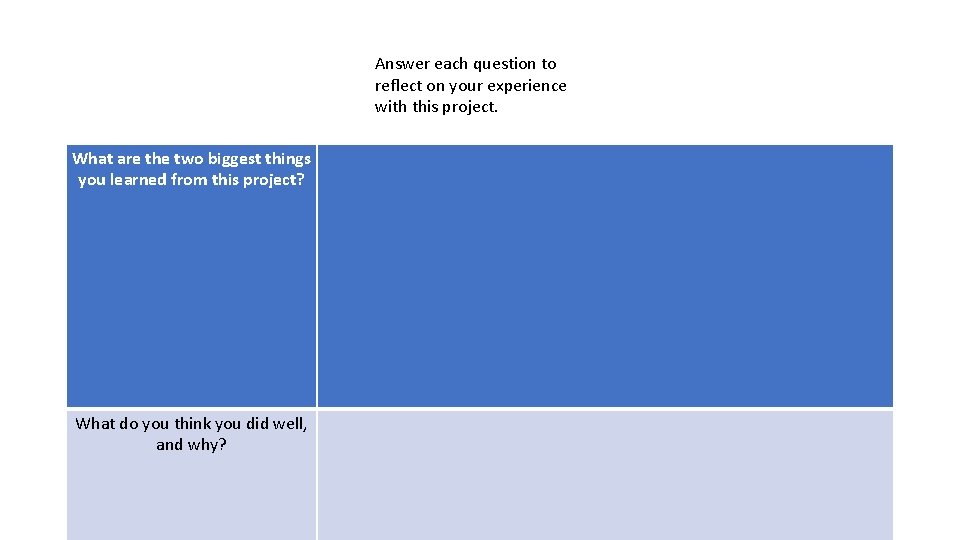
Answer each question to reflect on your experience with this project. What are the two biggest things you learned from this project? What do you think you did well, and why?
• Use this checklist as a guide to ensure that your work is free from technical errors. • �The written work begins with a clear introduction and a strong thesis statement. �Each body paragraph has a clear topic sentence, supported by details. �The conclusion summarizes key ideas and reinforces thesis. �Transitions between paragraphs are smooth. • �The written work is free of run-on sentences or fragments. �Subject-verb agreement and verb tense are correct throughout the paper. �Pronoun-antecedent agreement is correct throughout the paper. �Sentence structure is varied. �All words are used correctly. �Sources are consistently and accurately cited. �I have checked my work for accuracy in spelling, capitalization, and punctuation.
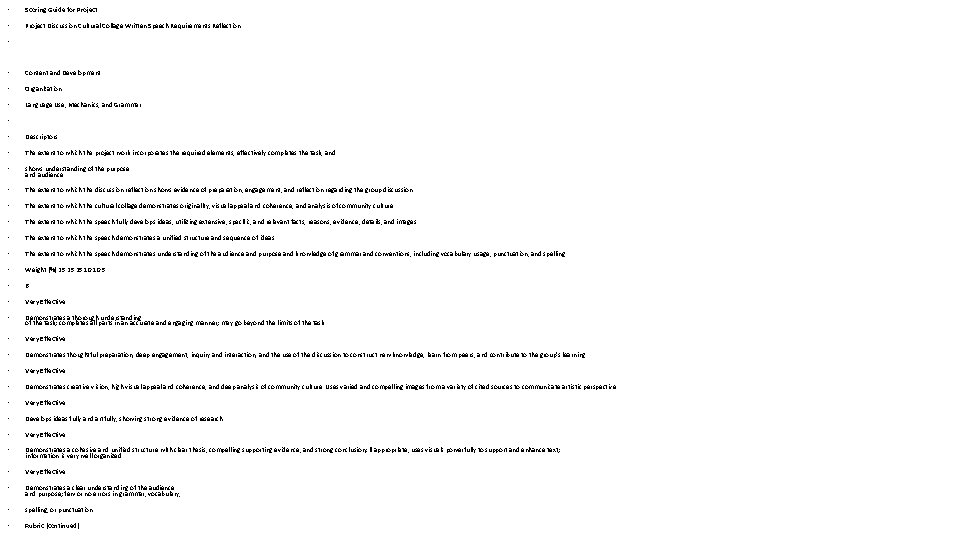
• Scoring Guide for Project • Project Discussion Cultural Collage Written Speech Requirements Reflection • • Content and Development • Organization • Language Use, Mechanics, and Grammar • • Descriptors • The extent to which the project work incorporates the required elements, effectively completes the task, and • shows understanding of the purpose and audience • The extent to which the discussion reflection shows evidence of preparation, engagement, and reflection regarding the group discussion • The extent to which the cultural collage demonstrates originality, visual appeal and coherence, and analysis of community culture. • The extent to which the speech fully develops ideas, utilizing extensive, specific, and relevant facts, reasons, evidence, details, and images • The extent to which the speech demonstrates a unified structure and sequence of ideas • The extent to which the speech demonstrates understanding of the audience and purpose and knowledge of grammar and conventions, including vocabulary usage, punctuation, and spelling • Weight (%) 25 25 25 10 10 5 • 6 • Very Effective • Demonstrates a thorough understanding of the task; completes all parts in an accurate and engaging manner; may go beyond the limits of the task • Very Effective • Demonstrates thoughtful preparation, deep engagement, inquiry and interaction, and the use of the discussion to construct new knowledge, learn from peers, and contribute to the group’s learning • Very Effective • Demonstrates creative vision, high visual appeal and coherence, and deep analysis of community culture. Uses varied and compelling images from a variety of cited sources to communicate artistic perspective. • Very Effective • Develops ideas fully and artfully, showing strong evidence of research • Very Effective • Demonstrates a cohesive and unified structure with clear thesis, compelling supporting evidence, and strong conclusion; if appropriate, uses visuals powerfully to support and enhance text; information is very well organized • Very Effective • Demonstrates a clear understanding of the audience and purpose; few or no errors in grammar, vocabulary, • spelling, or punctuation • Rubric (continued)
- Slides: 7