
ARTS 1301 Principles and Elements of Design Overview
- Slides: 26
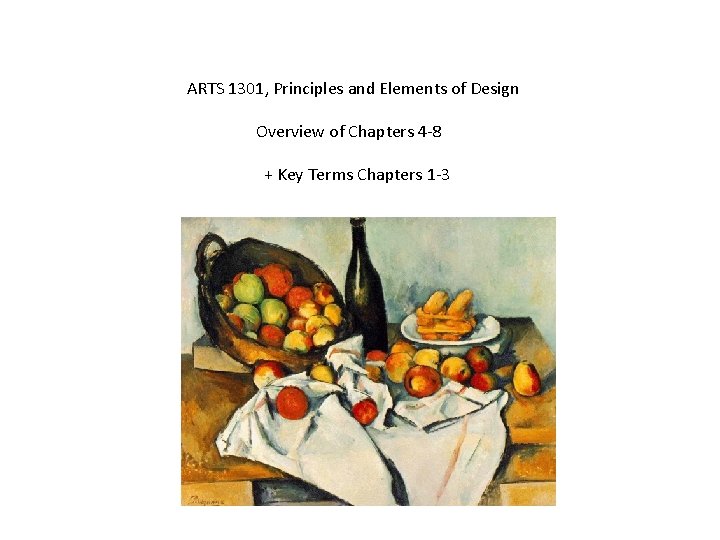
ARTS 1301, Principles and Elements of Design Overview of Chapters 4 -8 + Key Terms Chapters 1 -3
Basic Terms for understanding art 1) Form = the overall structure of the work 2) Subject matter = what is literally depicted 3) Content = What it means 4) Composition = how elements are organized Principles and Elements of Design – the building blocks to create a work of art Elements a) Line b) Space c) Light, Color and Value d) Texture e) Pattern f) Time and Motion Principles a) Balance b) Emphasis and Focal Point c) Scale and Proportion d) Repetition and Rhythm e) Unity and Variety
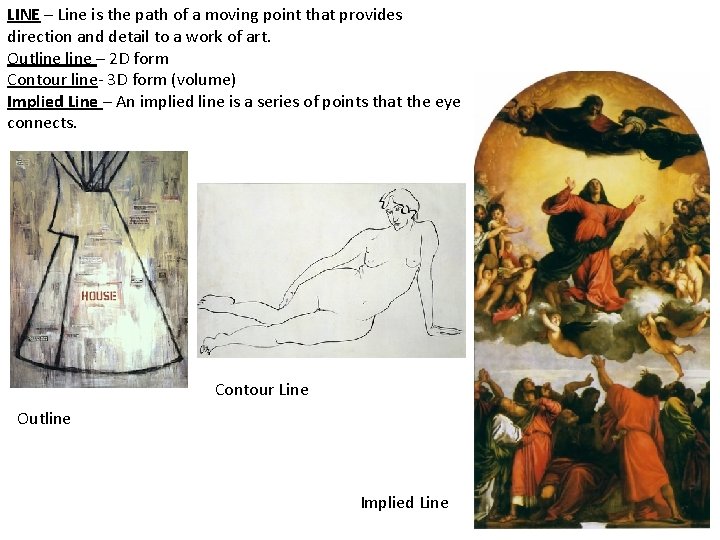
LINE – Line is the path of a moving point that provides direction and detail to a work of art. Outline – 2 D form Contour line- 3 D form (volume) Implied Line – An implied line is a series of points that the eye connects. Contour Line Outline Implied Line
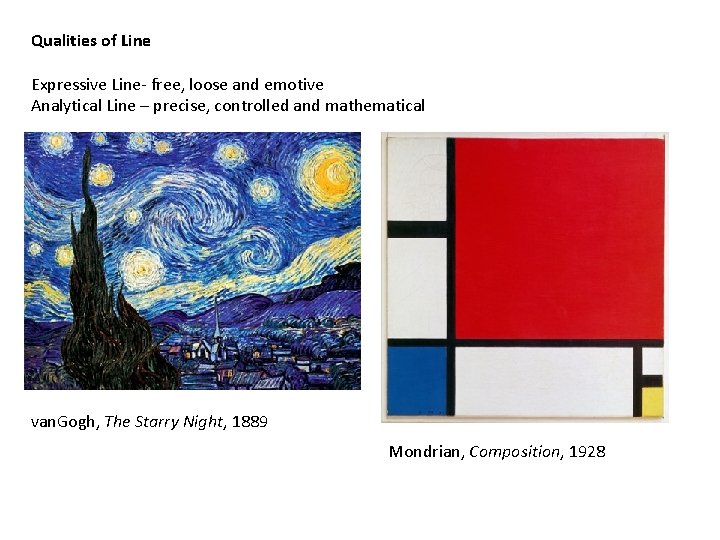
Qualities of Line Expressive Line- free, loose and emotive Analytical Line – precise, controlled and mathematical van. Gogh, The Starry Night, 1889 Mondrian, Composition, 1928
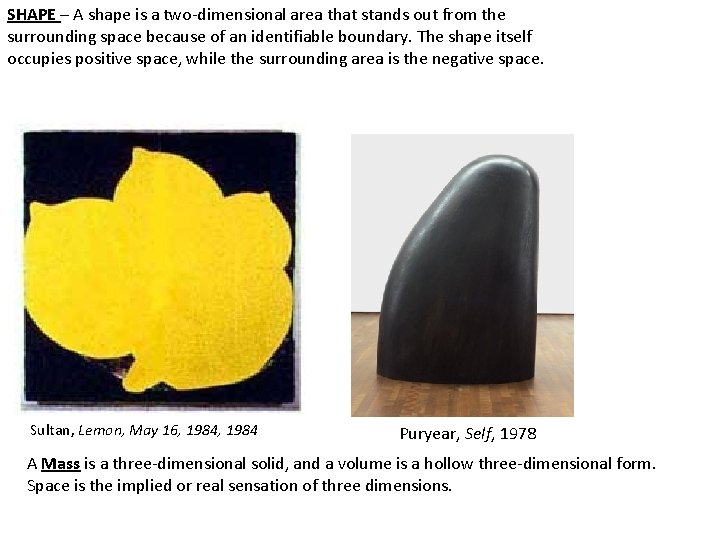
SHAPE – A shape is a two-dimensional area that stands out from the surrounding space because of an identifiable boundary. The shape itself occupies positive space, while the surrounding area is the negative space. Sultan, Lemon, May 16, 1984 Puryear, Self, 1978 A Mass is a three-dimensional solid, and a volume is a hollow three-dimensional form. Space is the implied or real sensation of three dimensions.
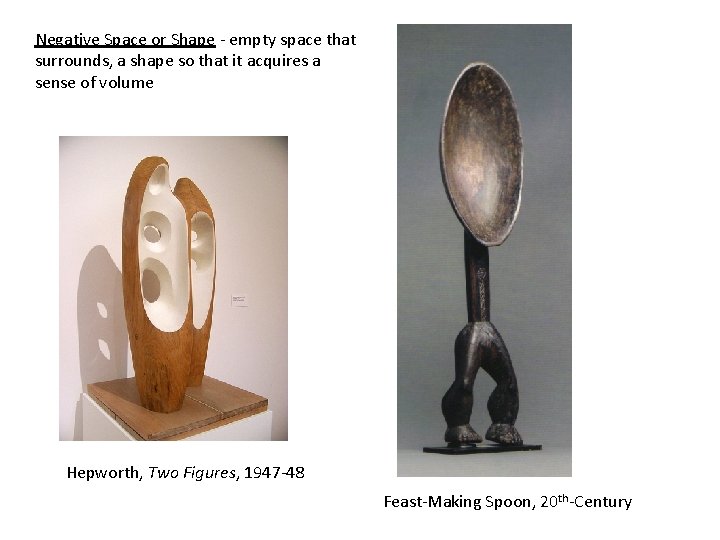
Negative Space or Shape - empty space that surrounds, a shape so that it acquires a sense of volume Hepworth, Two Figures, 1947 -48 Feast-Making Spoon, 20 th-Century
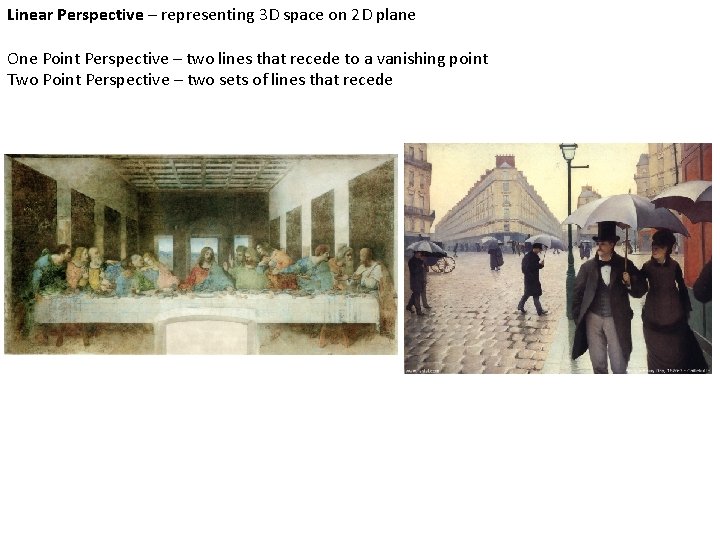
Linear Perspective – representing 3 D space on 2 D plane One Point Perspective – two lines that recede to a vanishing point Two Point Perspective – two sets of lines that recede
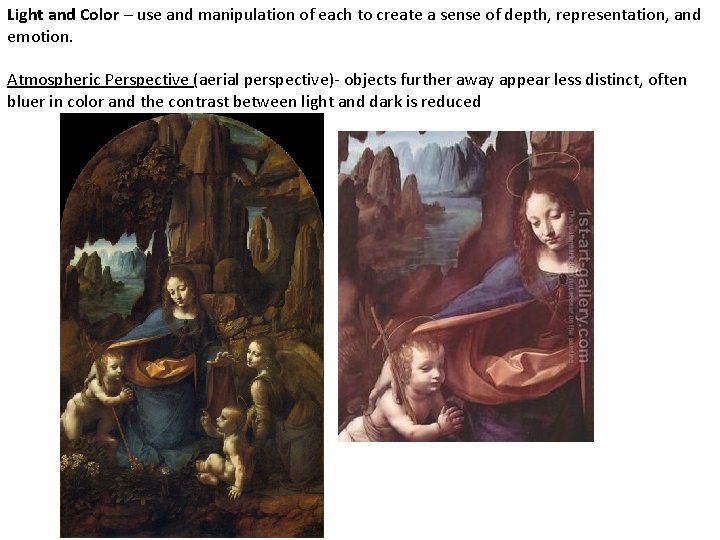
Light and Color – use and manipulation of each to create a sense of depth, representation, and emotion. Atmospheric Perspective (aerial perspective)- objects further away appear less distinct, often bluer in color and the contrast between light and dark is reduced
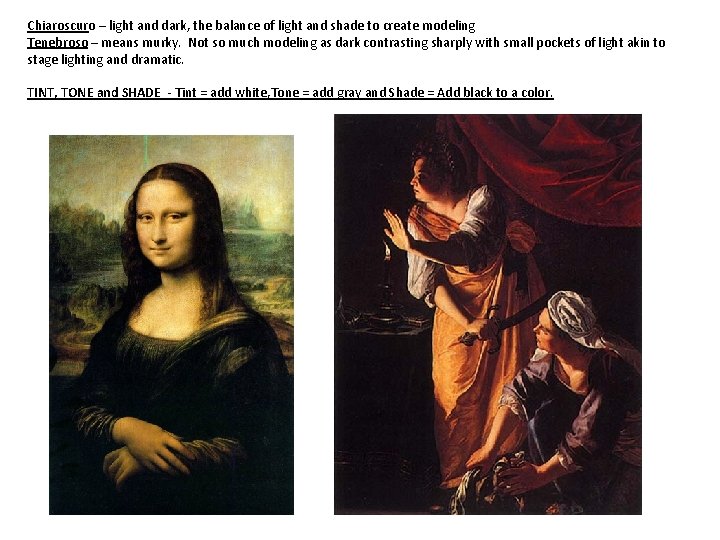
Chiaroscuro – light and dark, the balance of light and shade to create modeling Tenebroso – means murky. Not so much modeling as dark contrasting sharply with small pockets of light akin to stage lighting and dramatic. TINT, TONE and SHADE - Tint = add white, Tone = add gray and Shade = Add black to a color.
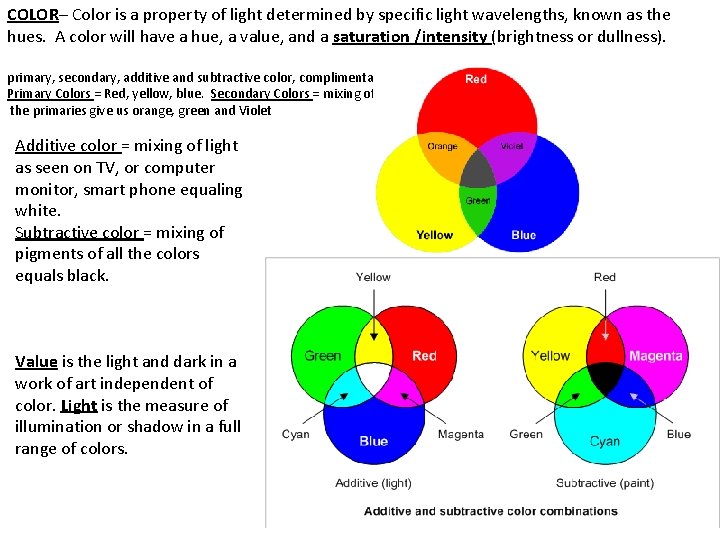
COLOR– Color is a property of light determined by specific light wavelengths, known as the hues. A color will have a hue, a value, and a saturation /intensity (brightness or dullness). primary, secondary, additive and subtractive color, complimentary, anologous and arbitrary Primary Colors = Red, yellow, blue. Secondary Colors = mixing of , purple(violet) the primaries give us orange, green and Violet Additive color = mixing of light as seen on TV, or computer monitor, smart phone equaling white. Subtractive color = mixing of pigments of all the colors equals black. Value is the light and dark in a work of art independent of color. Light is the measure of illumination or shadow in a full range of colors.
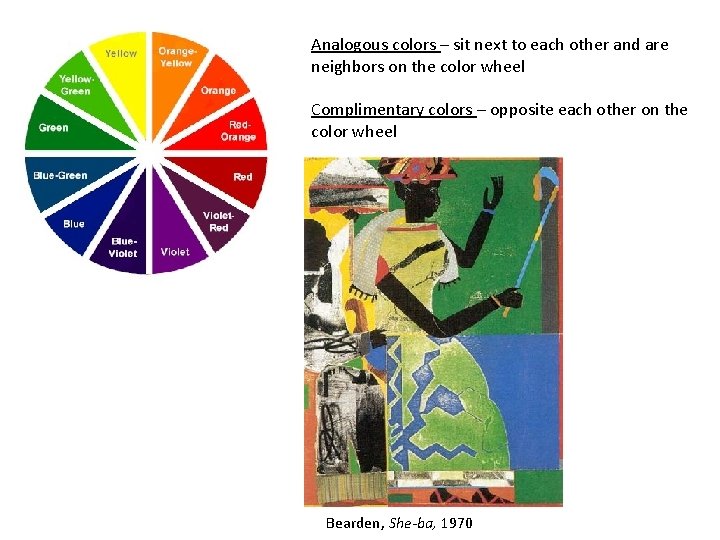
Analogous colors – sit next to each other and are neighbors on the color wheel Complimentary colors – opposite each other on the color wheel Bearden, She-ba, 1970
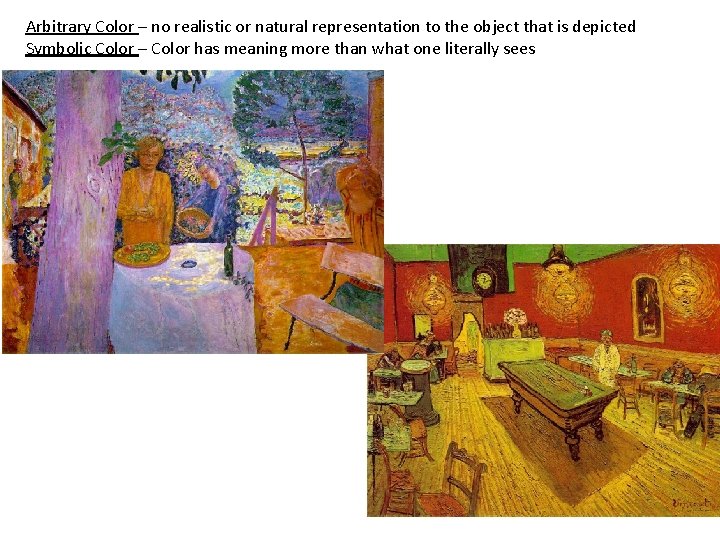
Arbitrary Color – no realistic or natural representation to the object that is depicted Symbolic Color – Color has meaning more than what one literally sees
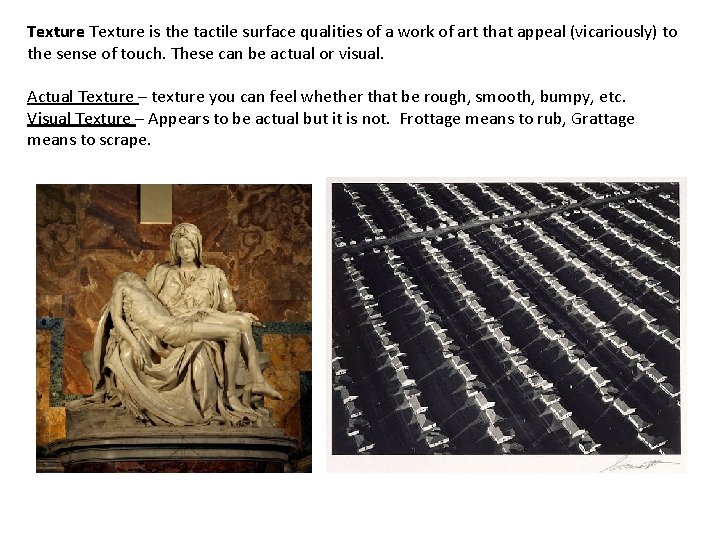
Texture is the tactile surface qualities of a work of art that appeal (vicariously) to the sense of touch. These can be actual or visual. Actual Texture – texture you can feel whether that be rough, smooth, bumpy, etc. Visual Texture – Appears to be actual but it is not. Frottage means to rub, Grattage means to scrape.
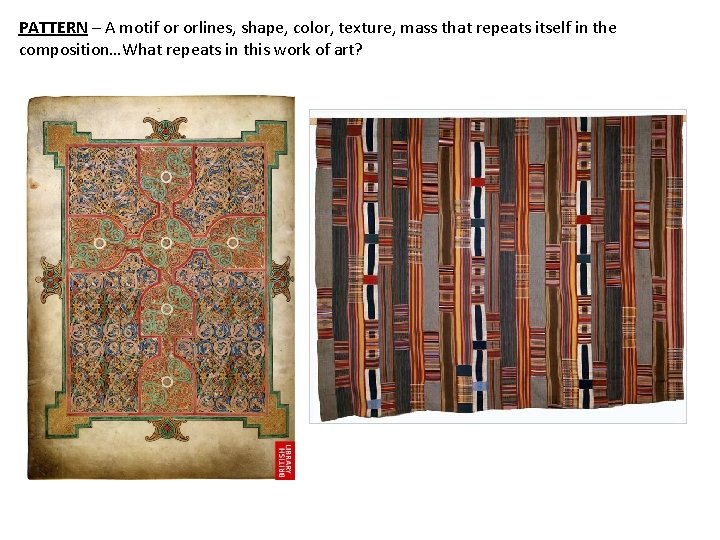
PATTERN – A motif or orlines, shape, color, texture, mass that repeats itself in the composition…What repeats in this work of art?
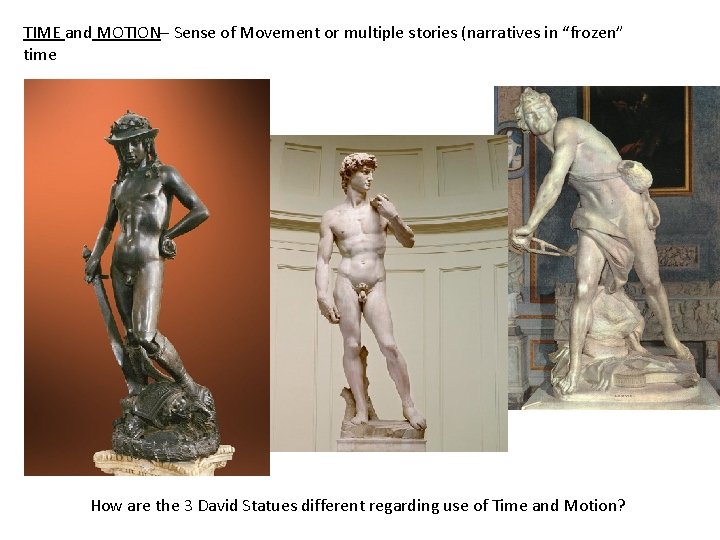
TIME and MOTION– Sense of Movement or multiple stories (narratives in “frozen” time How are the 3 David Statues different regarding use of Time and Motion?
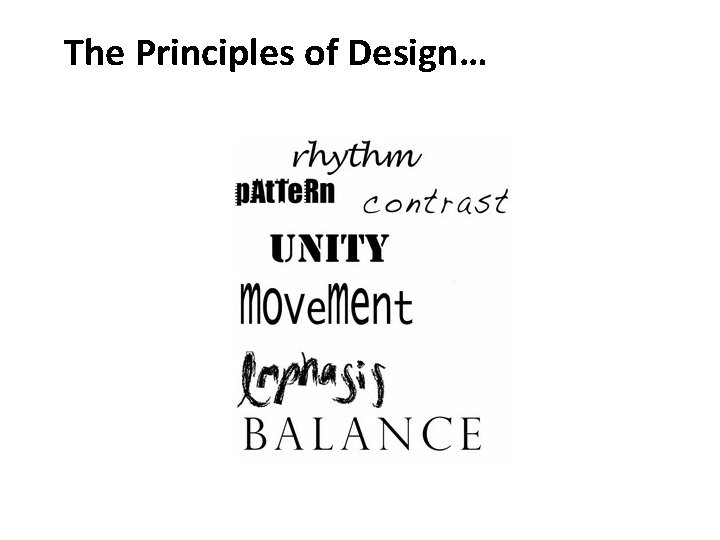
The Principles of Design…
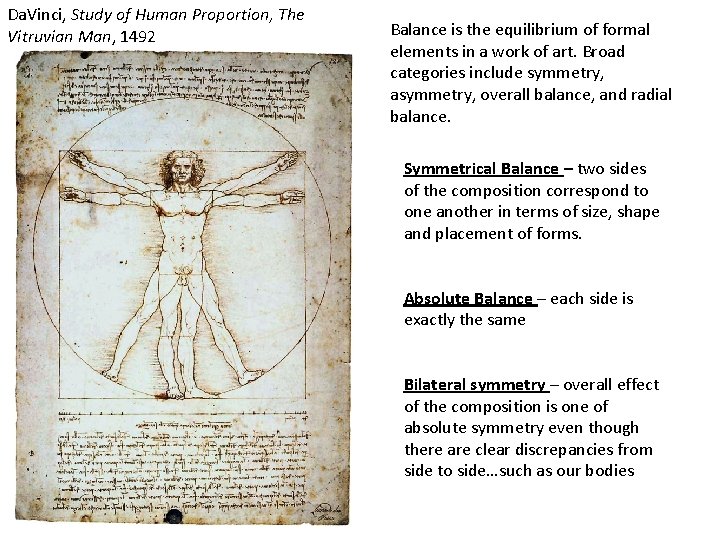
Da. Vinci, Study of Human Proportion, The Vitruvian Man, 1492 Balance is the equilibrium of formal elements in a work of art. Broad categories include symmetry, asymmetry, overall balance, and radial balance. Symmetrical Balance – two sides of the composition correspond to one another in terms of size, shape and placement of forms. Absolute Balance – each side is exactly the same Bilateral symmetry – overall effect of the composition is one of absolute symmetry even though there are clear discrepancies from side to side…such as our bodies
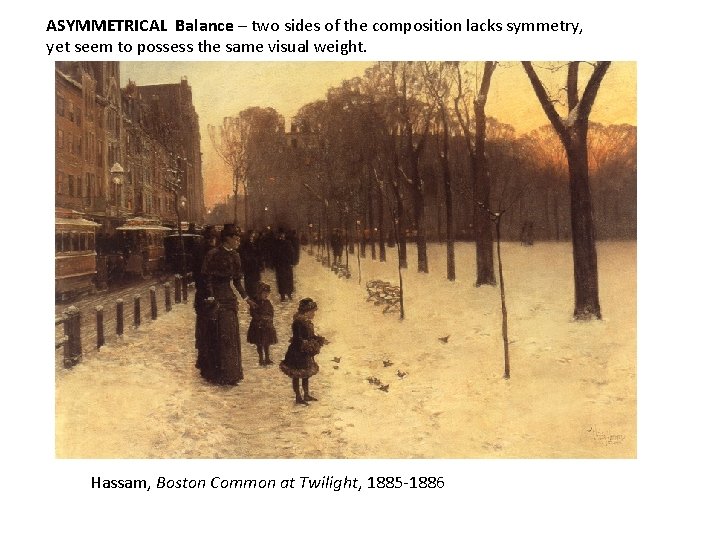
ASYMMETRICAL Balance – two sides of the composition lacks symmetry, yet seem to possess the same visual weight. Hassam, Boston Common at Twilight, 1885 -1886
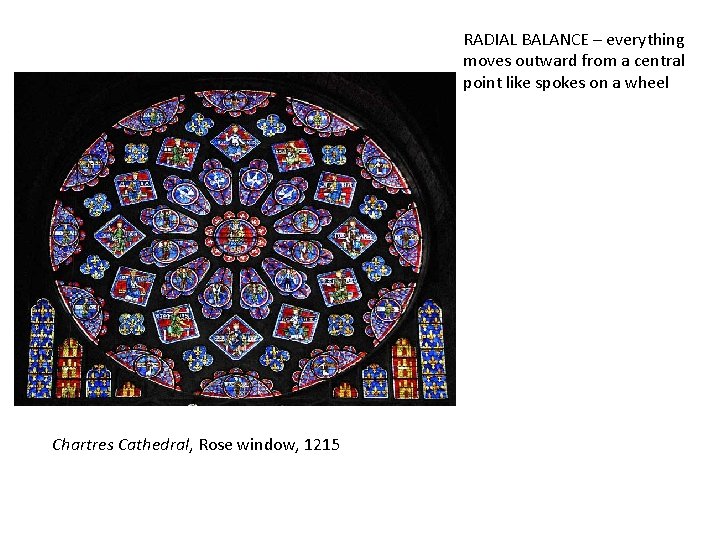
RADIAL BALANCE – everything moves outward from a central point like spokes on a wheel Chartres Cathedral, Rose window, 1215
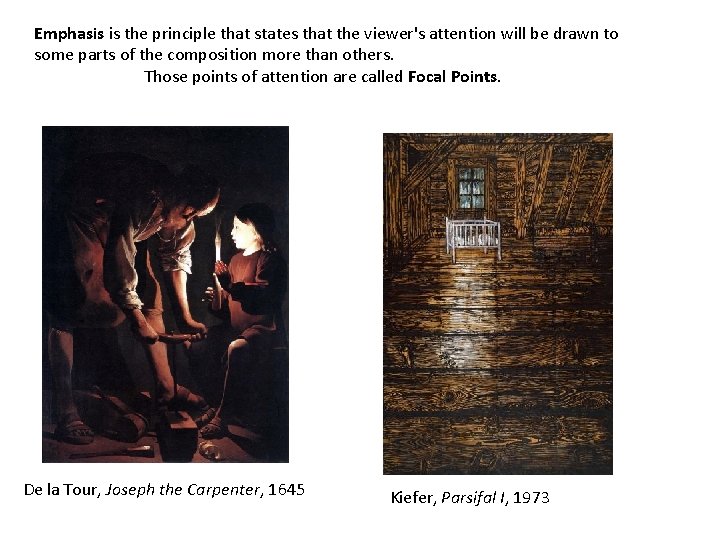
Emphasis is the principle that states that the viewer's attention will be drawn to some parts of the composition more than others. Those points of attention are called Focal Points. De la Tour, Joseph the Carpenter, 1645 Kiefer, Parsifal I, 1973
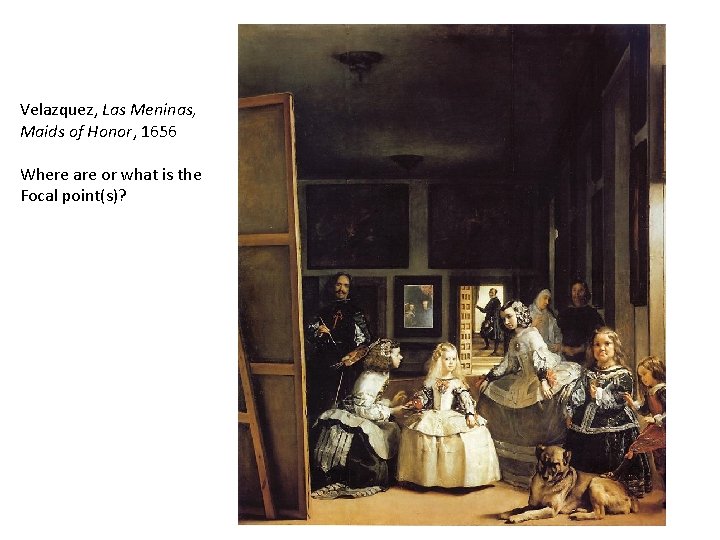
Velazquez, Las Meninas, Maids of Honor, 1656 Where are or what is the Focal point(s)?
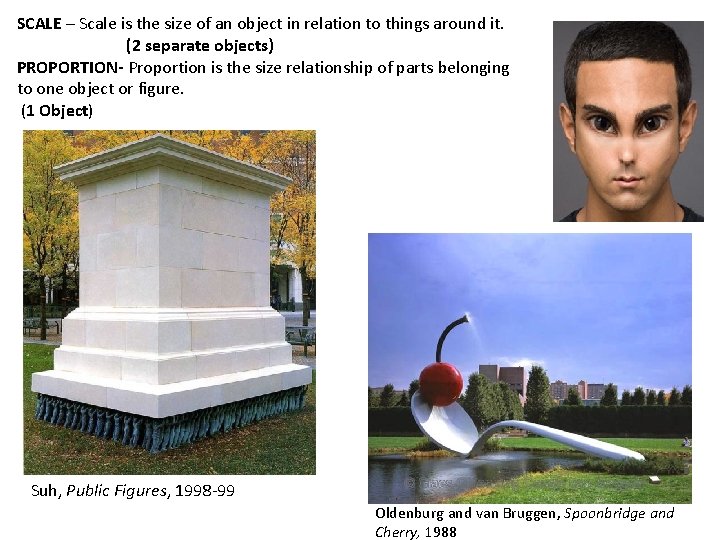
SCALE – Scale is the size of an object in relation to things around it. (2 separate objects) PROPORTION- Proportion is the size relationship of parts belonging to one object or figure. (1 Object) Suh, Public Figures, 1998 -99 Oldenburg and van Bruggen, Spoonbridge and Cherry, 1988
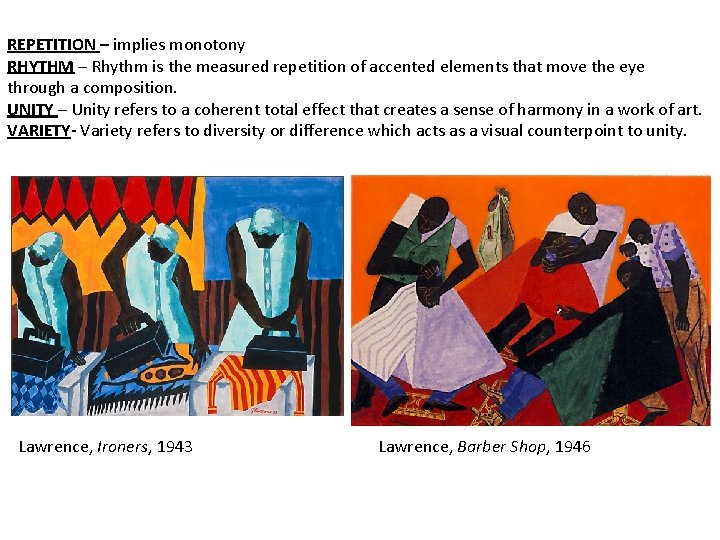
REPETITION – implies monotony RHYTHM – Rhythm is the measured repetition of accented elements that move the eye through a composition. UNITY – Unity refers to a coherent total effect that creates a sense of harmony in a work of art. VARIETY- Variety refers to diversity or difference which acts as a visual counterpoint to unity. Lawrence, Ironers, 1943 Lawrence, Barber Shop, 1946
Key Terms towards understanding ART
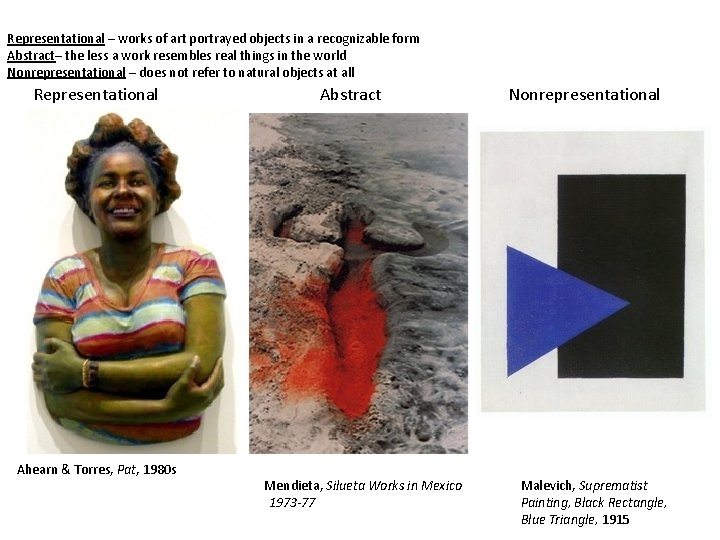
Representational – works of art portrayed objects in a recognizable form Abstract– the less a work resembles real things in the world Nonrepresentational – does not refer to natural objects at all Representational Ahearn & Torres, Pat, 1980 s Abstract Mendieta, Silueta Works in Mexico 1973 -77 Nonrepresentational Malevich, Suprematist Painting, Black Rectangle, Blue Triangle, 1915
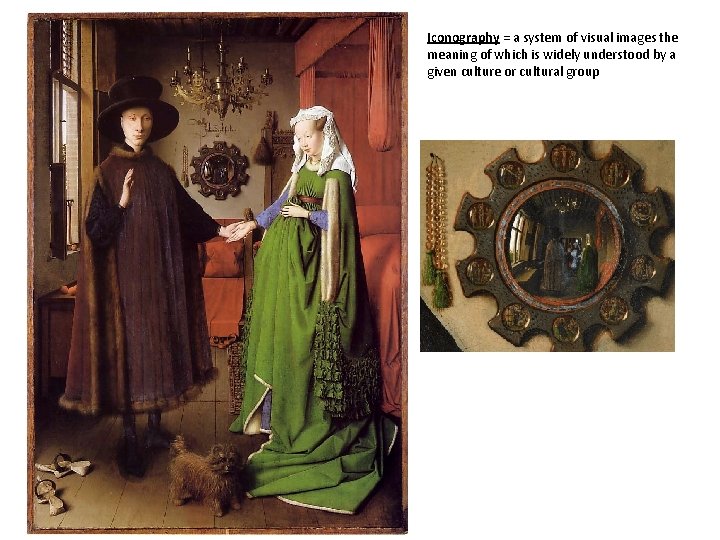
Iconography = a system of visual images the meaning of which is widely understood by a given culture or cultural group