
Artist designer Analysis Use this sheet when analysing

- Slides: 2
Artist/ designer Analysis Use this sheet when analysing the work of artists and designers to help you organise your thoughts and opinions into a piece of writing that is clear and accurate. Use these questions to help you structure your writing when analysing pieces of Art What is the work called? When was it made? Tell me a little bit about the Artist. What are your first thoughts about the work? What do you see in the image? What colours, shapes and textures do you see? Are there any unusual features that you notice? How do you think the work was made? What colours, shapes and/ or textures stand out the most? Is there a main focus in the work? Why/Why not? How does the work make you feel, or what feelings could it represent? Does the piece remind you of anything? What? Why? What is similar about the two pieces you have looked at? Are there any main differences between them? Do they show different ideas or meanings? Which of the two do you prefer the most? Why? How does the artist’s/ designers work link to theme/ subject you are looking at ? How could you use the artists/ designers ideas in your own work? When adding information use: Also, as well as, again, coupled with, likewise, similar, in addition, moreover, furthermore, including. When comparing and contrasting information use: In contrast, by comparison, instead, on the other hand, however, rather than, whereas, alternatively, in comparison with, even though, nevertheless When starting or continuing a sentence use: Firstly, to begin with, first of all, in the first place, secondly, at the same time, the next step, meanwhile, earlier, next, When showing similarities use: Equally, identically, likewise, coupled with, together with, similarly, When emphasising information use: Above all, with attention to, particularly, especially, in particular, most importantly When giving an example use: For example, such as, for instance, specifically, in particular, including, to illustrate this, to give an example. When making a conclusion or summarizing use: To sum up, in conclusion, to summarize, in summary, in final analysis, finally, all in all, on the whole, in brief.
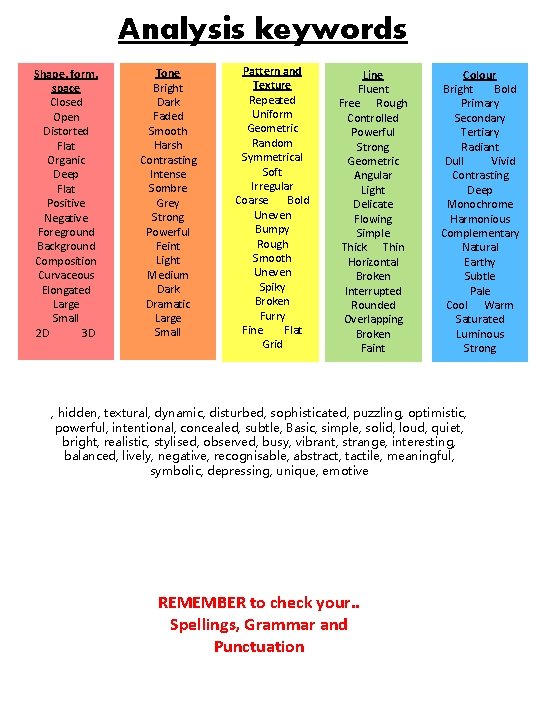
Analysis keywords Shape, form, space Closed Open Distorted Flat Organic Deep Flat Positive Negative Foreground Background Composition Curvaceous Elongated Large Small 2 D 3 D Tone Bright Dark Faded Smooth Harsh Contrasting Intense Sombre Grey Strong Powerful Feint Light Medium Dark Dramatic Large Small Pattern and Texture Repeated Uniform Geometric Random Symmetrical Soft Irregular Coarse Bold Uneven Bumpy Rough Smooth Uneven Spiky Broken Furry Fine Flat Grid Line Fluent Free Rough Controlled Powerful Strong Geometric Angular Light Delicate Flowing Simple Thick Thin Horizontal Broken Interrupted Rounded Overlapping Broken Faint Colour Bright Bold Primary Secondary Tertiary Radiant Dull Vivid Contrasting Deep Monochrome Harmonious Complementary Natural Earthy Subtle Pale Cool Warm Saturated Luminous Strong , hidden, textural, dynamic, disturbed, sophisticated, puzzling, optimistic, powerful, intentional, concealed, subtle, Basic, simple, solid, loud, quiet, bright, realistic, stylised, observed, busy, vibrant, strange, interesting, balanced, lively, negative, recognisable, abstract, tactile, meaningful, symbolic, depressing, unique, emotive REMEMBER to check your. . Spellings, Grammar and Punctuation