
Artificial Seedling Production of Seaweed Sargassum thunbergii in

Artificial Seedling Production of Seaweed Sargassum thunbergii in Yellow Sea, China LI Mei-zhen Shandong Mariculture Institute, Qingdao, China 266002
Outlines w Sporling collection w Nursery indoor w Nursery in the sea w Growth of seedling
Introduction w Sargassum thunbergii is a species of brown (Phaeophyta) macroalgae distributed widely in China Sea, which is of great economic and ecological value, and has potential of exploitation in the domains of medicine and mariculture as well as chemical and food industries.
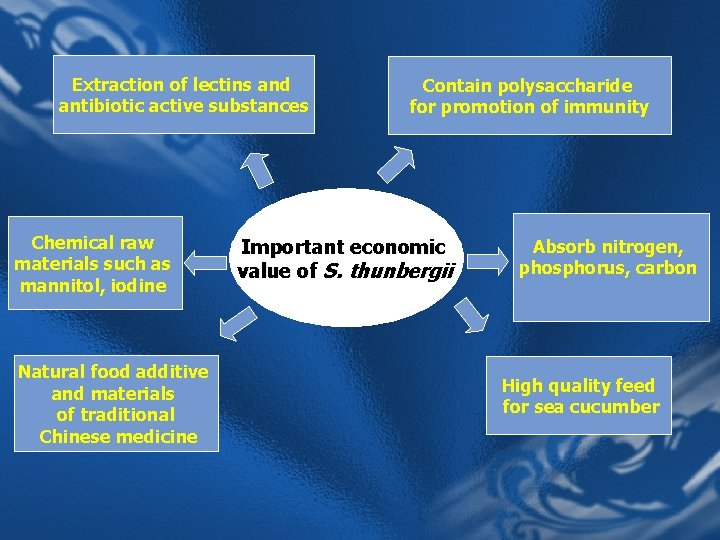
Extraction of lectins and antibiotic active substances Chemical raw materials such as mannitol, iodine Natural food additive and materials of traditional Chinese medicine Contain polysaccharide for promotion of immunity Important economic value of S. thunbergii Absorb nitrogen, phosphorus, carbon High quality feed for sea cucumber
Introduction • Currently several institutes have started researching on artificial breeding of S. thunbergii seedlings, while due to some unsolved crucial techniques, the shedding of small-sized seedlings after setting into the sea remains to be a problem that limits large-scale breeding and cultivation. • Aim to settle the technical problem stated above, An advance large-size Sargassum thunbergii seedling breeding method was developed and reported here.
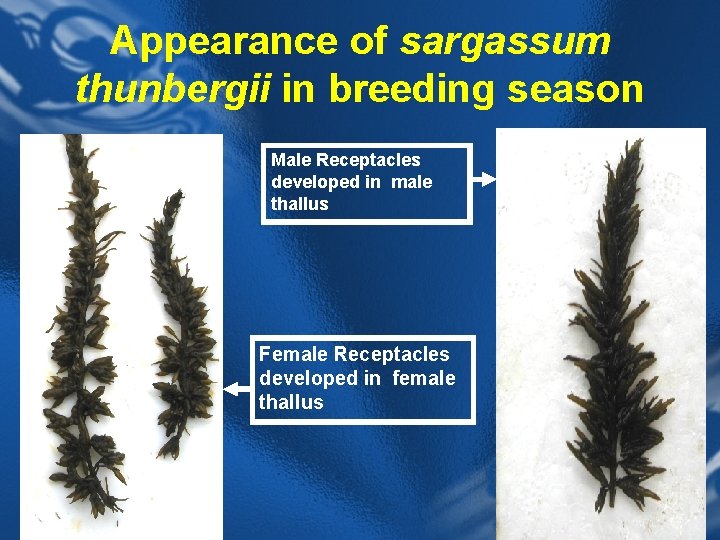
Appearance of sargassum thunbergii in breeding season Male Receptacles developed in male thallus Female Receptacles developed in female thallus
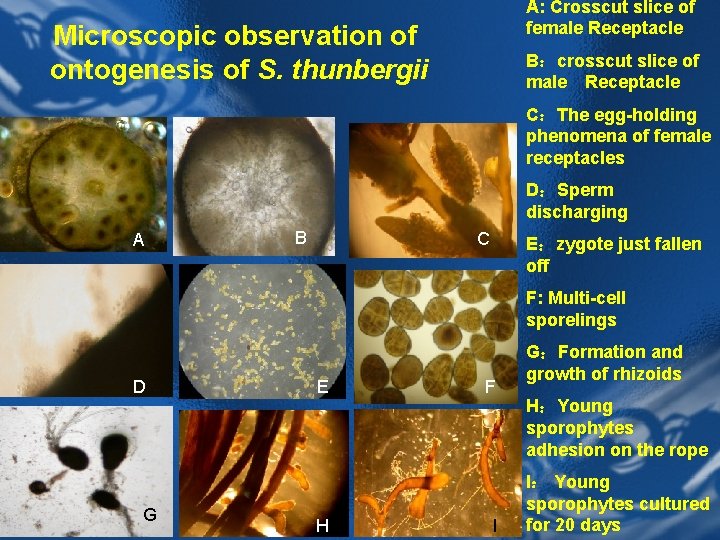
A: Crosscut slice of female Receptacle Microscopic observation of ontogenesis of S. thunbergii B:crosscut slice of male Receptacle C:The egg-holding phenomena of female receptacles D:Sperm discharging A B C E:zygote just fallen off F: Multi-cell sporelings D G E H F I G:Formation and growth of rhizoids H:Young sporophytes adhesion on the rope I: Young sporophytes cultured for 20 days
Sargassum thunbergii distributed widely in Intertidal Zones of China
Material and Method Source of parental thalli : w Cultured sargassum thunbergii in Luxi Island, Dongtou County, Zhejiang Province; w Wild sargassum thunbergii in Inter-tidal Rongcheng, Shandong Province; w Ripened sargassum thunbergii in local laboratory; Seedling substrata ªChemical fiber curtain( 2 m× 0. 4 m) ªpalm rope curtain(1 m× 0. 5 m) cement board(0. 5 m× 0. 25 m) ªscallop shell、stone、vinylon fiberglass rope
Collection of seedling method and step w Spread the well-prepared seedling collecting substrata in the pool (8× 1× 0. 8 m) which has been cleaned and disinfected. w Inpoure filtrated sea water to 30 cm scale. Sprinkle mature parental thallus onto the curtain to make the oosperm fall off naturely and clinged to it.
cultivation condition indoor w Cultivation pool (8× 1× 0. 8 m). w Bamboo and rope were mounted in the pool to let the seedling curtain tautly set up and suspended up the water surface. Cultivation sea water should be filtered after deposit for 24 hours. w The water temperature is kept 18~23℃. w Illumination is controlled less than 15000 lx.
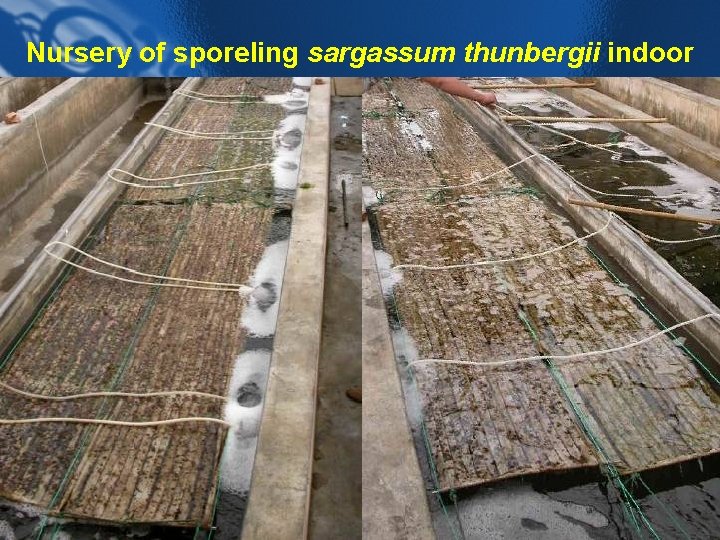
Nursery of sporeling sargassum thunbergii indoor
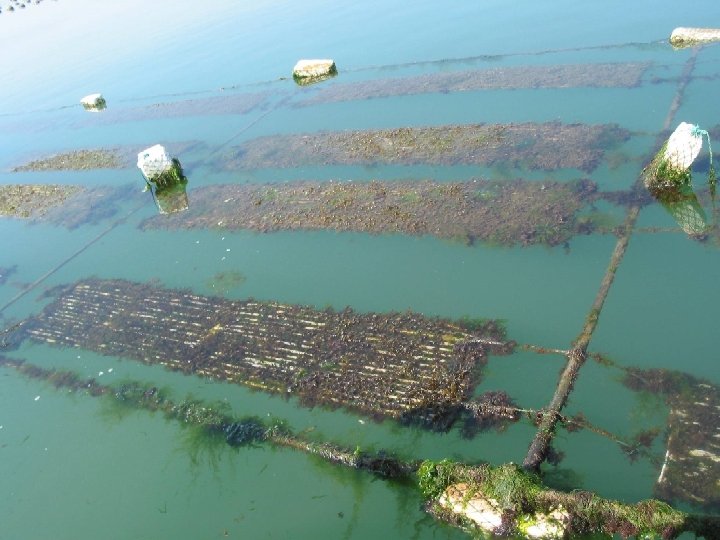
Seedling cultivation on the sea w Setting of rafts for seedling curtains ªBamboo poles(5 cm in diameter, 3 m in length) were set between two longlines at every 3 m interval to form the 3 m× 3 m frame ªEvery frame hang 4 chemical fiber cloth curtains. ªThe curtains is usually hanged on the surface of seawater.
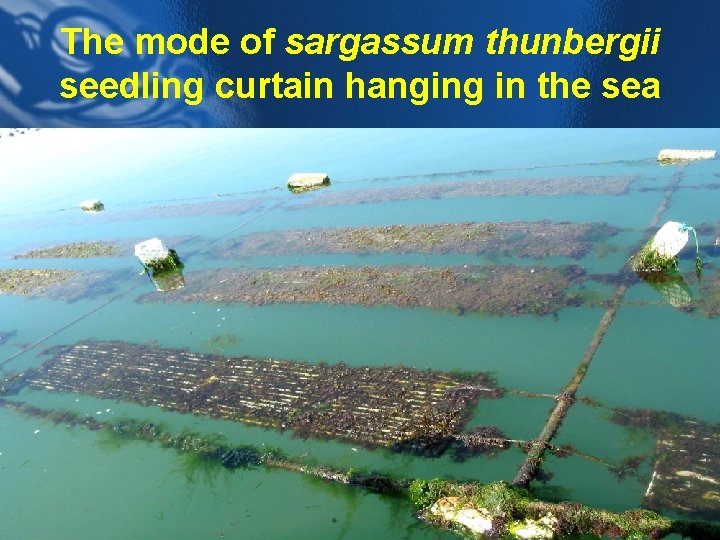
The mode of sargassum thunbergii seedling curtain hanging in the sea
Cleaning the Seedling Curtain w The curtain should be gently clapped 2 -3 days after collection of seedling indoor w One week later, electric pressure water washing device is used to wash the seedling curtain. w When the seedling transfer to the sea, Diesel- powered pressure water jet is used every another day to rinse the curtain so as to effectively remove sludge, spores of undesirable algae and larvae of invertebrate animals.
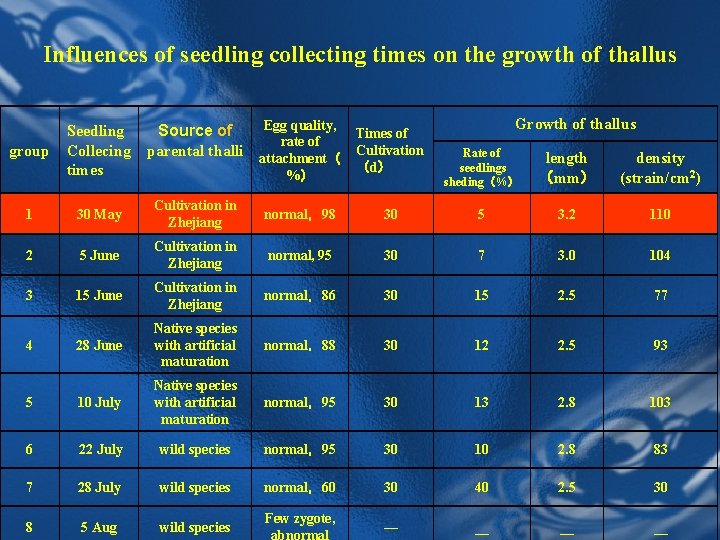
Influences of seedling collecting times on the growth of thallus group Seedling Collecing times Egg quality, Source of Times of rate of parental thalli attachment( Cultivation %) (d) Growth of thallus Rate of seedlings sheding(%) length (mm) density (strain/cm 2) 1 30 May Cultivation in Zhejiang normal,98 30 5 3. 2 110 2 5 June Cultivation in Zhejiang normal, 95 30 7 3. 0 104 3 15 June Cultivation in Zhejiang normal,86 30 15 2. 5 77 28 June Native species with artificial maturation normal,88 30 12 2. 5 93 5 10 July Native species with artificial maturation normal,95 30 13 2. 8 103 6 22 July wild species normal,95 30 10 2. 8 83 7 28 July wild species normal,60 30 40 2. 5 30 8 5 Aug wild species — __ __ __ 4 Few zygote,
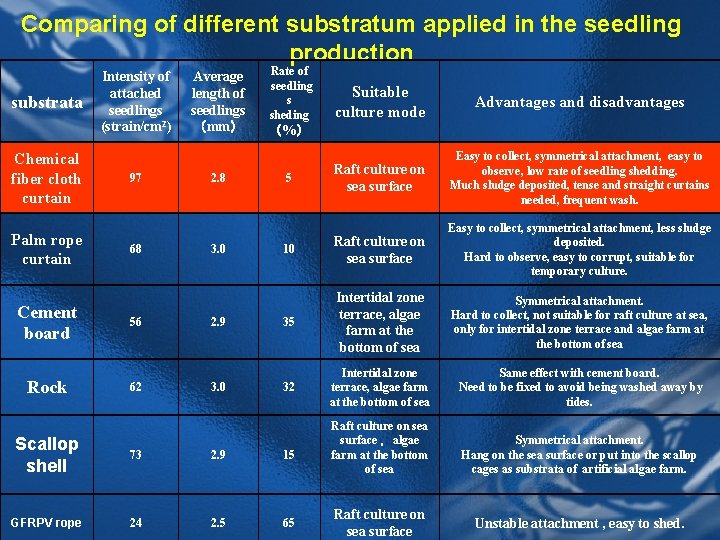
Comparing of different substratum applied in the seedling production substrata Chemical fiber cloth curtain Palm rope curtain Intensity of attached seedlings (strain/cm 2) 97 68 Average length of seedlings (mm) 2. 8 3. 0 Rate of seedling s sheding Suitable culture mode Advantages and disadvantages Raft culture on sea surface Easy to collect, symmetrical attachment, easy to observe, low rate of seedling shedding. Much sludge deposited, tense and straight curtains needed, frequent wash. 10 Raft culture on sea surface Easy to collect, symmetrical attachment, less sludge deposited. Hard to observe, easy to corrupt, suitable for temporary culture. Symmetrical attachment. Hard to collect, not suitable for raft culture at sea, only for intertidal zone terrace and algae farm at the bottom of sea (%) 5 Cement board 56 2. 9 35 Intertidal zone terrace, algae farm at the bottom of sea Rock 62 3. 0 32 Intertidal zone terrace, algae farm at the bottom of sea Same effect with cement board. Need to be fixed to avoid being washed away by tides. Raft culture on sea surface ,algae farm at the bottom of sea Symmetrical attachment. Hang on the sea surface or put into the scallop cages as substrata of artificial algae farm. Scallop shell 73 2. 9 15 GFRPV rope 24 2. 5 65 Raft culture on sea surface Unstable attachment , easy to shed.
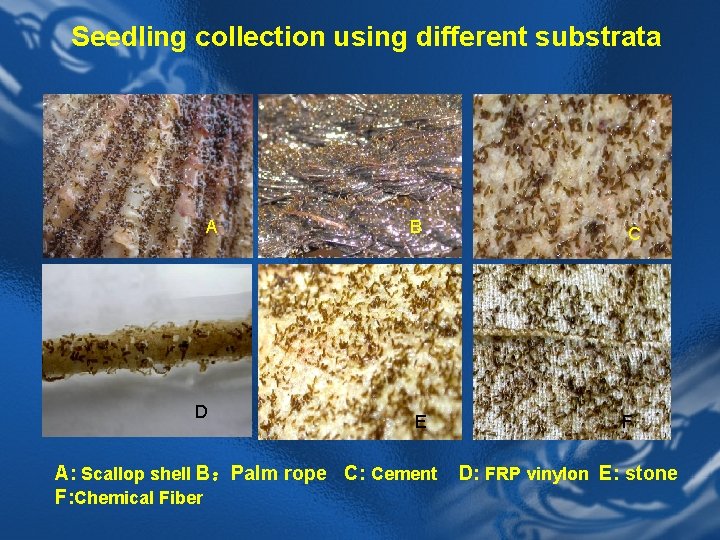
Seedling collection using different substrata A D B E A: Scallop shell B:Palm rope C: Cement F: Chemical Fiber C F D: FRP vinylon E: stone
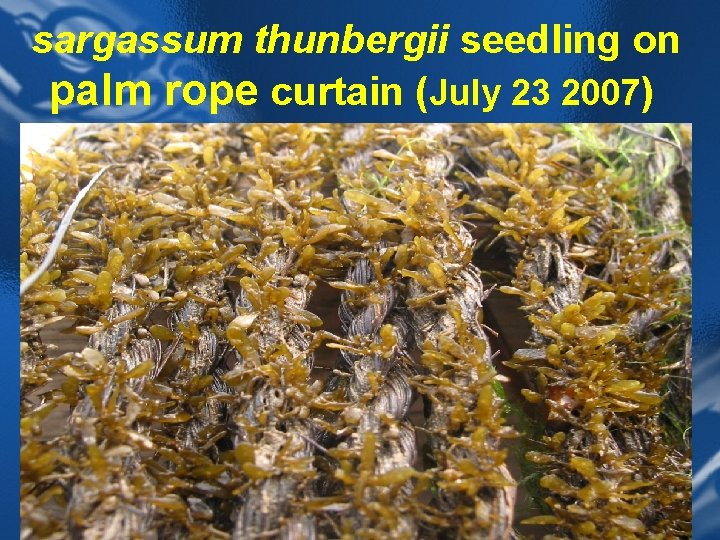
sargassum thunbergii seedling on palm rope curtain (July 23 2007)
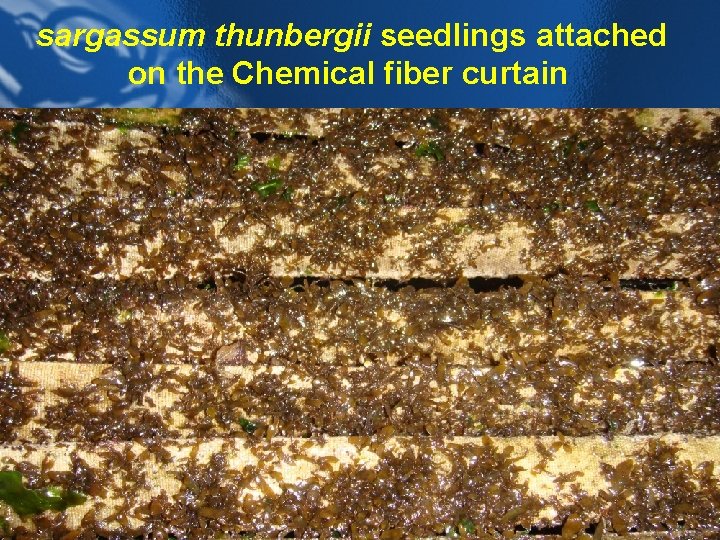
sargassum thunbergii seedlings attached on the Chemical fiber curtain
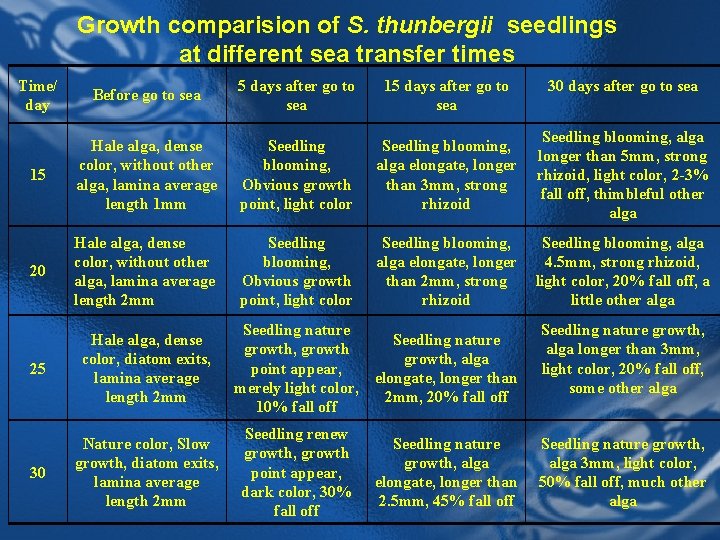
Growth comparision of S. thunbergii seedlings at different sea transfer times 30 days after go to sea Time/ day Before go to sea 5 days after go to sea 15 Hale alga, dense color, without other alga, lamina average length 1 mm Seedling blooming, Obvious growth point, light color Seedling blooming, alga elongate, longer than 3 mm, strong rhizoid Seedling blooming, alga longer than 5 mm, strong rhizoid, light color, 2 -3% fall off, thimbleful other alga 20 Hale alga, dense color, without other alga, lamina average length 2 mm Seedling blooming, Obvious growth point, light color Seedling blooming, alga elongate, longer than 2 mm, strong rhizoid Seedling blooming, alga 4. 5 mm, strong rhizoid, light color, 20% fall off, a little other alga 25 Hale alga, dense color, diatom exits, lamina average length 2 mm 30 Nature color, Slow growth, diatom exits, lamina average length 2 mm Seedling nature growth, alga point appear, elongate, longer than merely light color, 2 mm, 20% fall off 10% fall off Seedling renew growth, growth point appear, dark color, 30% fall off Seedling nature growth, alga elongate, longer than 2. 5 mm, 45% fall off Seedling nature growth, alga longer than 3 mm, light color, 20% fall off, some other alga Seedling nature growth, alga 3 mm, light color, 50% fall off, much other alga
Growth difference of seaweed cultivated on the sea Cultivation 15 days indoor and 75 days on the sea Cultivation 20 days indoor and 70 days on the sea Cultivation 30 days indoor and 60 days on the sea
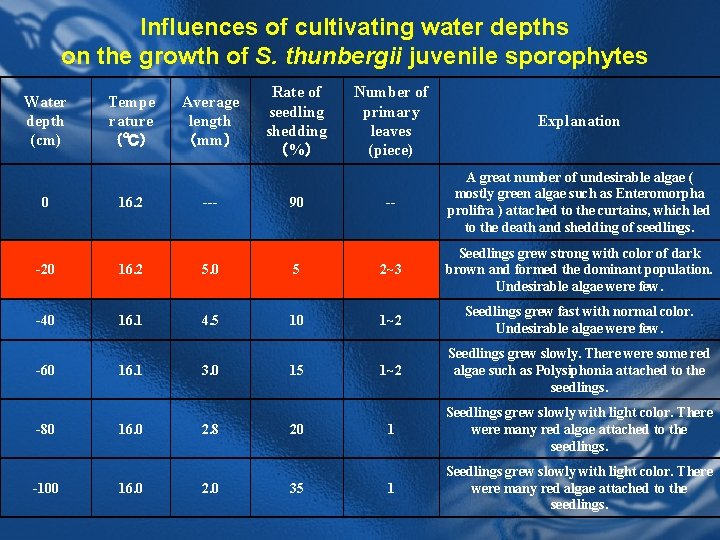
Influences of cultivating water depths on the growth of S. thunbergii juvenile sporophytes Water depth (cm) 0 Tempe rature (℃) 16. 2 Average length (mm) --- Rate of seedling shedding (%) 90 Number of primary leaves (piece) Explanation -- A great number of undesirable algae ( mostly green algae such as Enteromorpha prolifra ) attached to the curtains, which led to the death and shedding of seedlings. -20 16. 2 5. 0 5 2~3 Seedlings grew strong with color of dark brown and formed the dominant population. Undesirable algae were few. -40 16. 1 4. 5 10 1~2 Seedlings grew fast with normal color. Undesirable algae were few. 1~2 Seedlings grew slowly. There were some red algae such as Polysiphonia attached to the seedlings. 1 Seedlings grew slowly with light color. There were many red algae attached to the seedlings. -60 -80 -100 16. 1 16. 0 3. 0 2. 8 2. 0 15 20 35
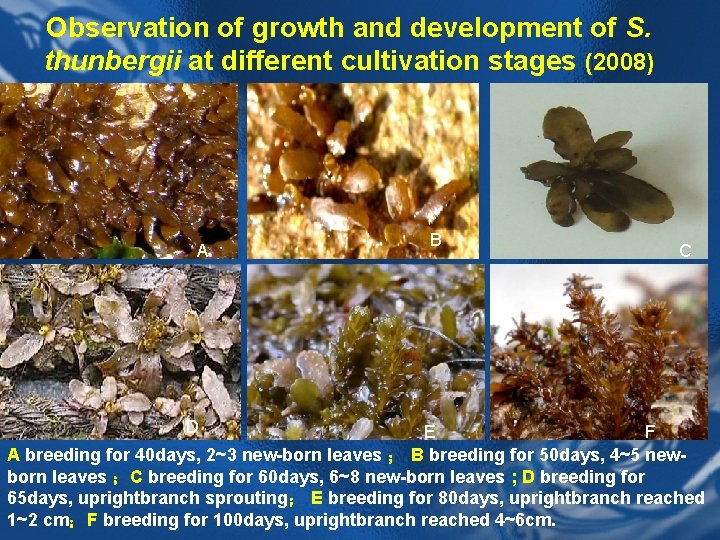
Observation of growth and development of S. thunbergii at different cultivation stages (2008) A D B C E F A breeding for 40 days, 2~3 new-born leaves ; B breeding for 50 days, 4~5 newborn leaves ;C breeding for 60 days, 6~8 new-born leaves ; D breeding for 65 days, uprightbranch sprouting; E breeding for 80 days, uprightbranch reached 1~2 cm;F breeding for 100 days, uprightbranch reached 4~6 cm.
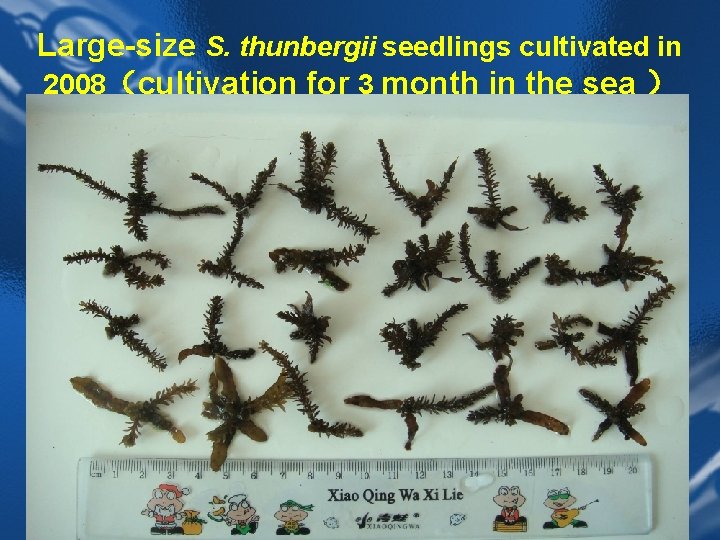
Large-size S. thunbergii seedlings cultivated in 2008(cultivation for 3 month in the sea )
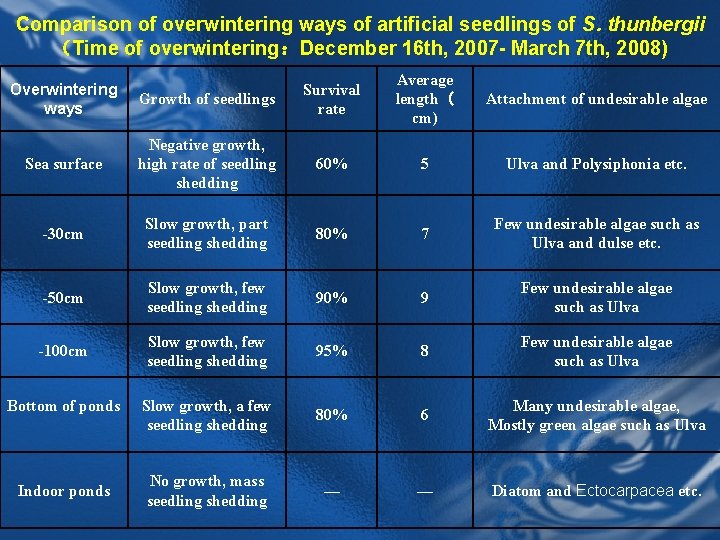
Comparison of overwintering ways of artificial seedlings of S. thunbergii (Time of overwintering:December 16 th, 2007 - March 7 th, 2008) Growth of seedlings Survival rate Average length( cm) Attachment of undesirable algae Sea surface Negative growth, high rate of seedling shedding 60% 5 Ulva and Polysiphonia etc. -30 cm Slow growth, part seedling shedding 80% 7 Few undesirable algae such as Ulva and dulse etc. -50 cm Slow growth, few seedling shedding 90% 9 Few undesirable algae such as Ulva -100 cm Slow growth, few seedling shedding 95% 8 Few undesirable algae such as Ulva Slow growth, a few seedling shedding 80% 6 Many undesirable algae, Mostly green algae such as Ulva No growth, mass seedling shedding — — Diatom and Ectocarpacea etc. Overwintering ways Bottom of ponds Indoor ponds
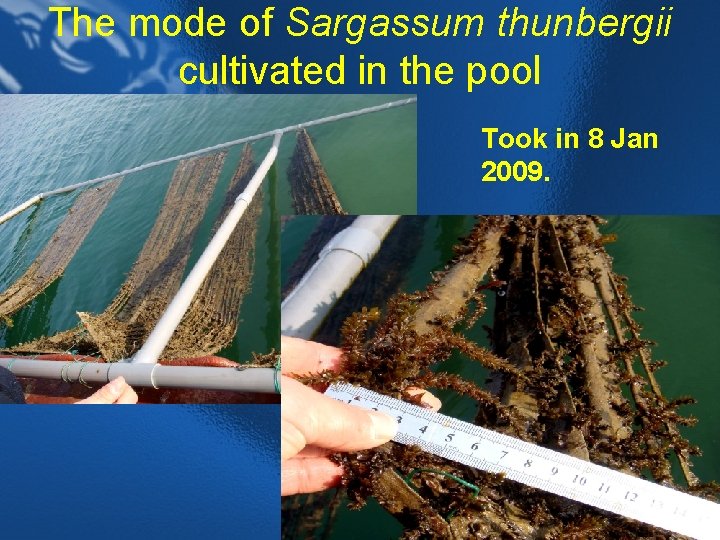
The mode of Sargassum thunbergii cultivated in the pool Took in 8 Jan 2009.
Present status of artificial cultivation of S. thunbergii in China w At present, large scale culture of S. thunbergii has not been developed. The small scale artificial culture has just begun, mostly using wild seedlings of S. thunbergii by raft culture mode on surface of sea. w S. thunbergii cultured in ponds was only benefit for the improvement of water quality, but the growth of S. thunbergii was slower than that of S. thunbergii cultured at sea.
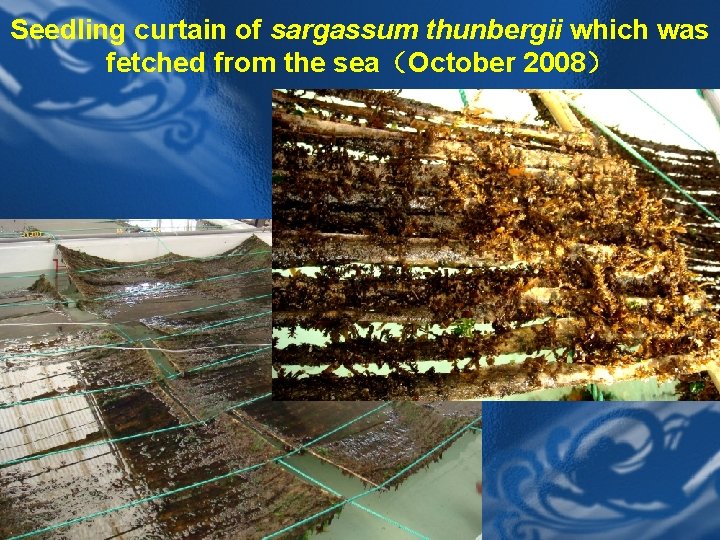
Seedling curtain of sargassum thunbergii which was fetched from the sea(October 2008)
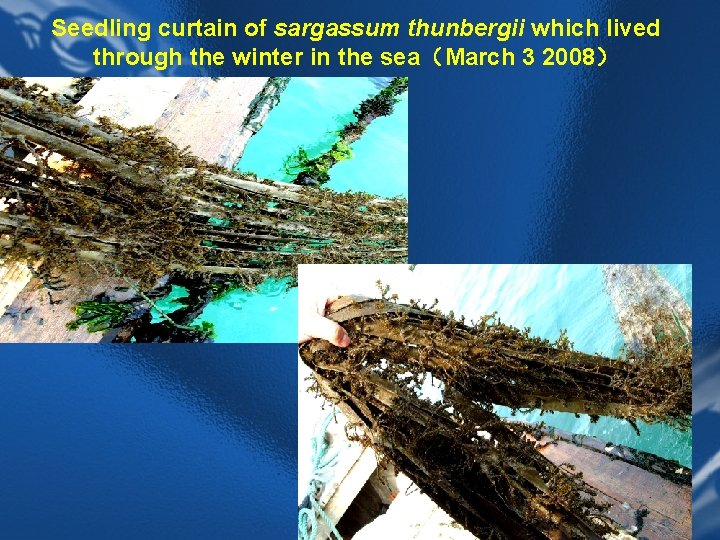
Seedling curtain of sargassum thunbergii which lived through the winter in the sea(March 3 2008)
artificial seedling curtain of sargassum thunbergii fetched from the sea (Apr. 2009. )
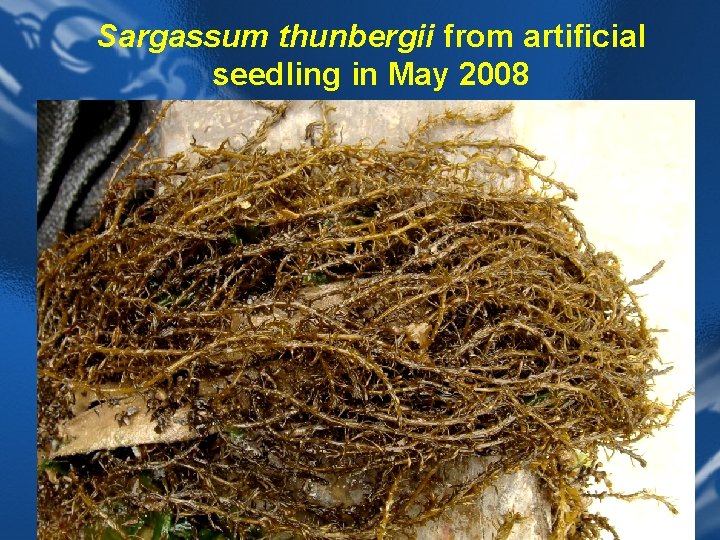
Sargassum thunbergii from artificial seedling in May 2008
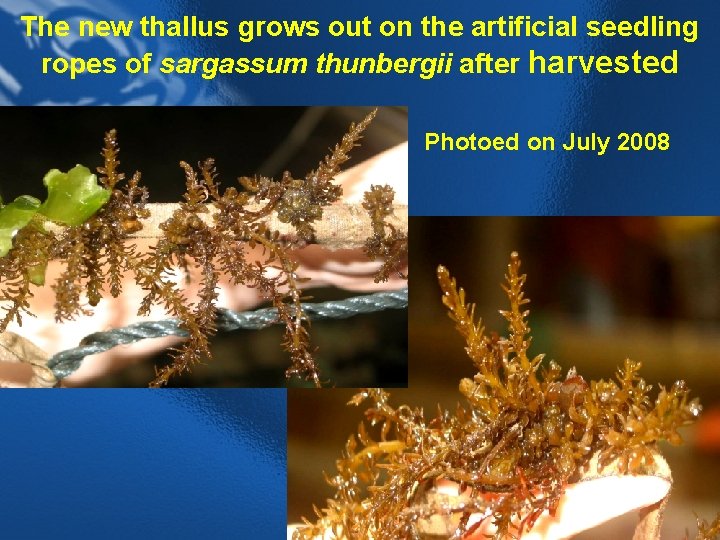
The new thallus grows out on the artificial seedling ropes of sargassum thunbergii after harvested Photoed on July 2008
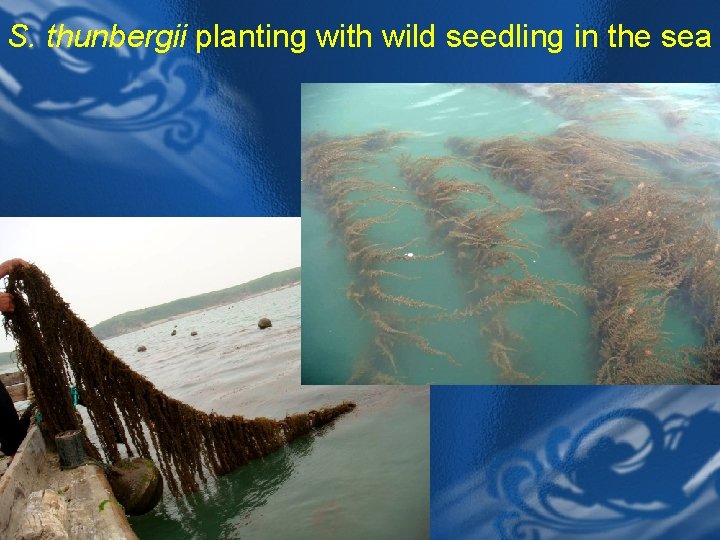
S. thunbergii planting with wild seedling in the sea
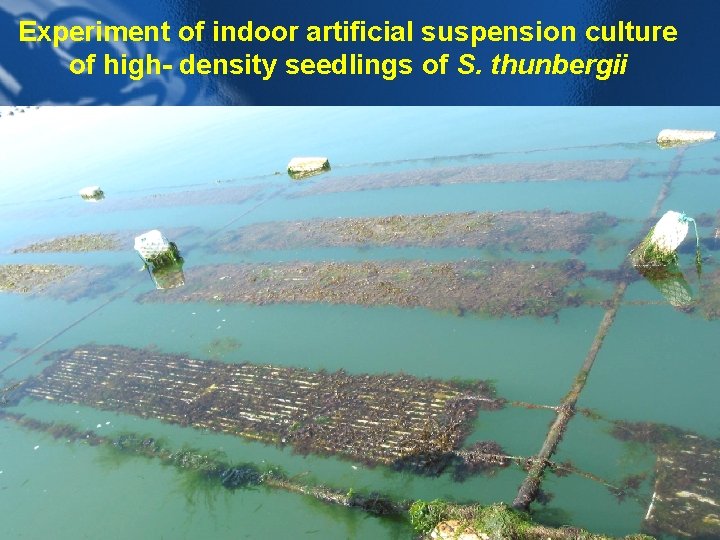
Experiment of indoor artificial suspension culture of high- density seedlings of S. thunbergii
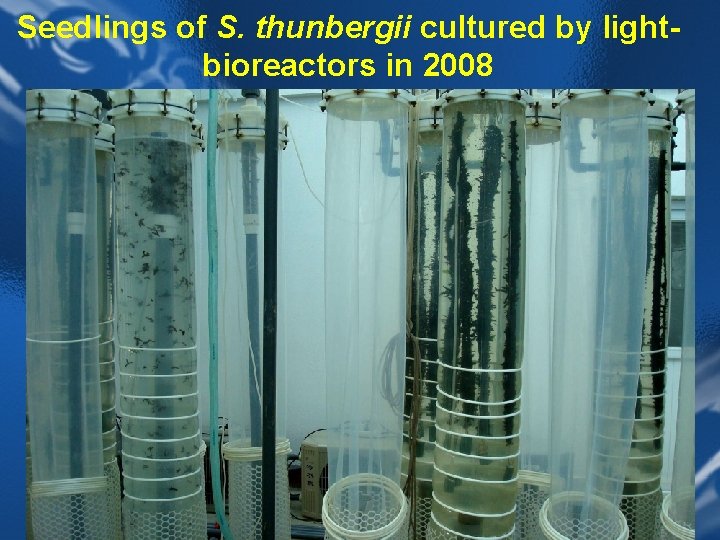
Seedlings of S. thunbergii cultured by lightbioreactors in 2008
Conclusion p Three years practical breeding experiences proved that using the parental thalli from south of China or artificially maturated parental thalli from north of China for S. thunbergii breeding could make seedling collection 50 days in advance and shorten the indoor culture for 10~15 days. p Transferring to sea earlier made the seedlings grow faster and larger under the suitable temperature of seawater. p These achievements provided available method and technique for large scale artificial breeding of S. thunbergii.
- Slides: 38