
Artificial Neural Networks Outline What are Neural Networks
- Slides: 45
Artificial Neural Networks
Outline • • • What are Neural Networks? Biological Neural Networks ANN – The basics Feed forward net Training Example – Voice recognition Applications – Feed forward nets Recurrency Elman nets Hopfield nets Central Pattern Generators Conclusion 2
What are Neural Networks? • Models of the brain and nervous system • Highly parallel – Process information much more like the brain than a serial computer • Learning • Very simple principles • Very complex behaviors • Applications – As powerful problem solvers – As biological models 3
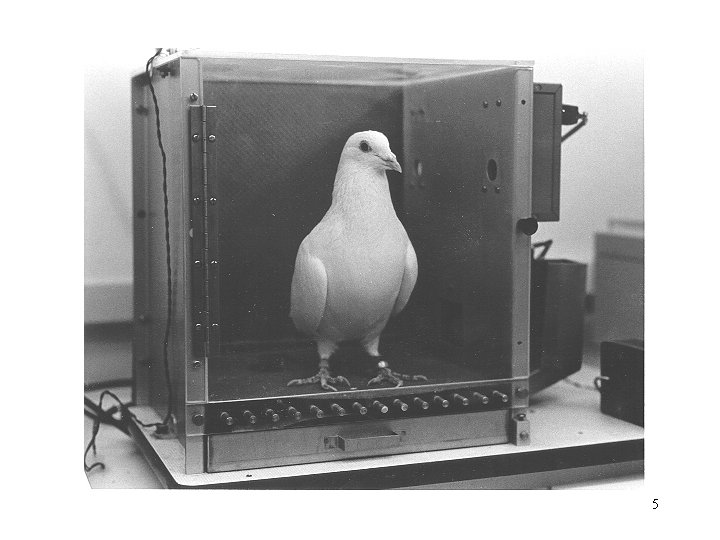
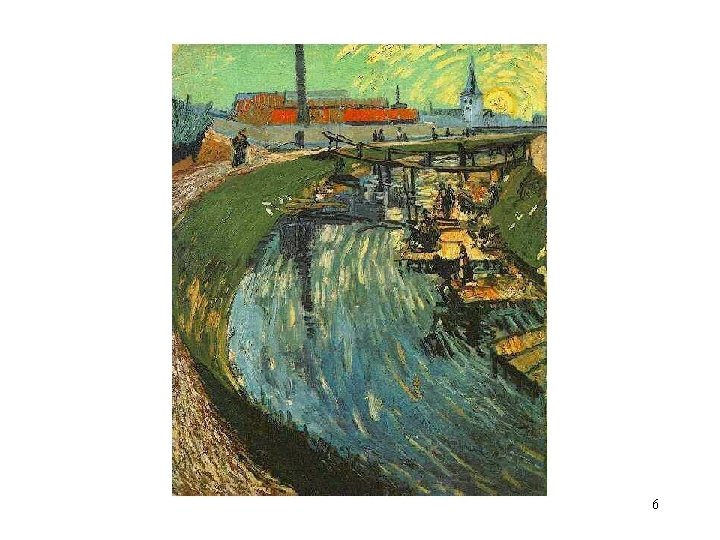
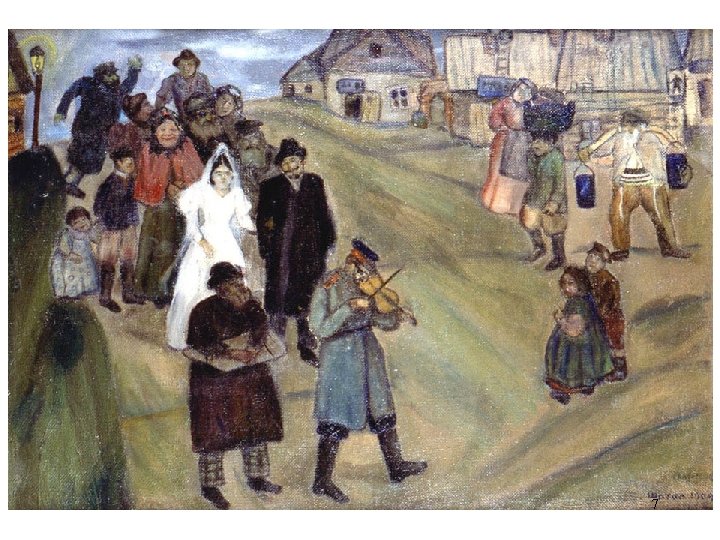
Biological Neural Nets • Pigeons as art experts (Watanabe et al. 1995) – Experiment: • Pigeon in Skinner box • Present paintings of two different artists (e. g. Chagall / Van Gogh) • Reward for pecking when presented a particular artist (e. g. Van Gogh) 4
5
6
7
• Pigeons were able to discriminate between Van Gogh and Chagall with 95% accuracy (when presented with pictures they had been trained on) • Discrimination still 85% successful for previously unseen paintings of the artists • Pigeons do not simply memorise the pictures • They can extract and recognise patterns (the ‘style’) • They generalise from the already seen to make predictions • This is what neural networks (biological and artificial) are good at (unlike conventional computer) 8
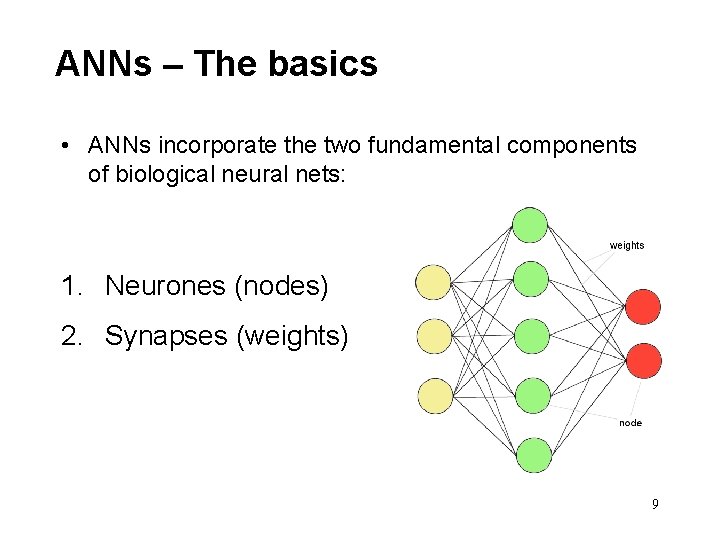
ANNs – The basics • ANNs incorporate the two fundamental components of biological neural nets: 1. Neurones (nodes) 2. Synapses (weights) 9
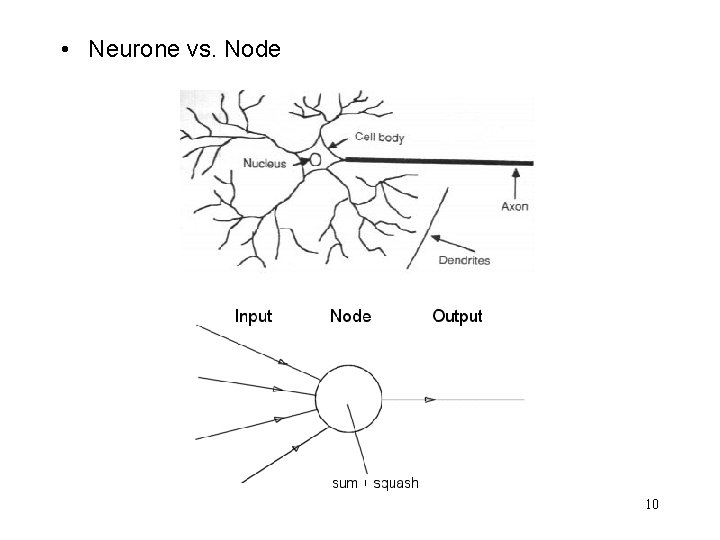
• Neurone vs. Node 10
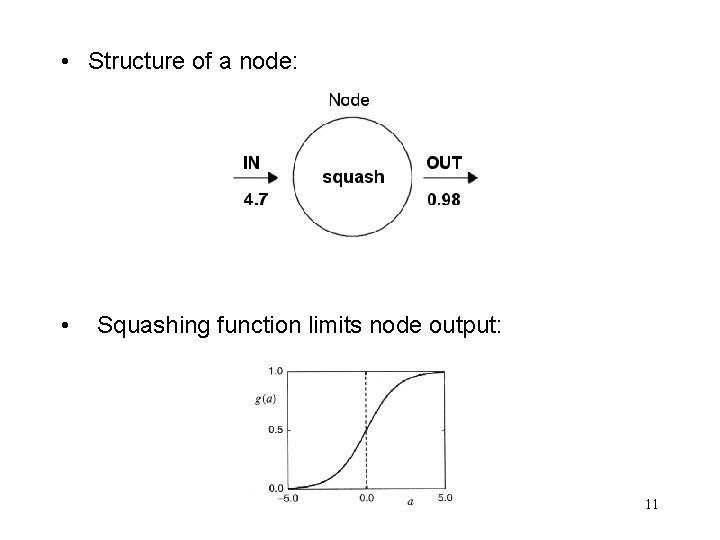
• Structure of a node: • Squashing function limits node output: 11
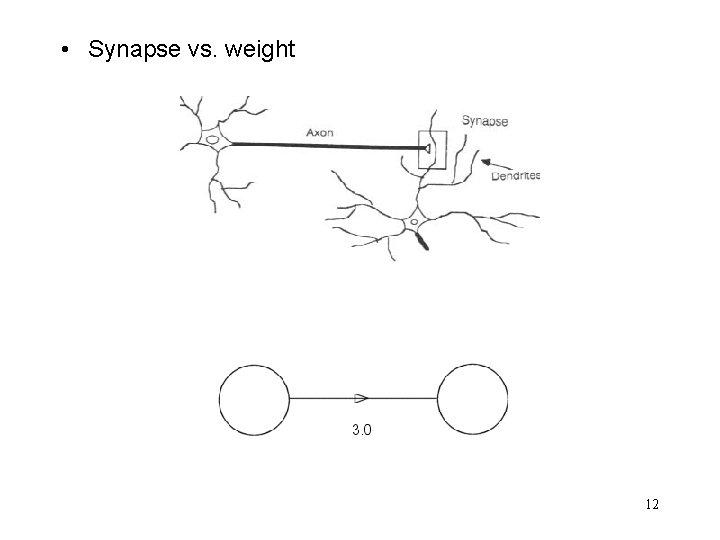
• Synapse vs. weight 12
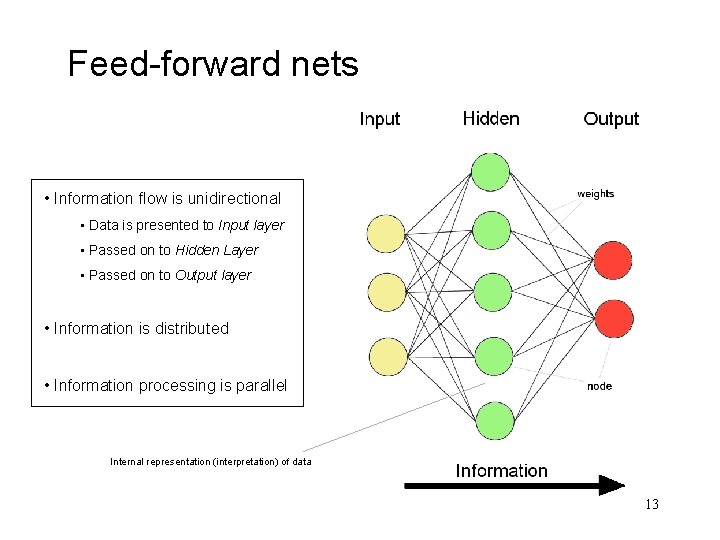
Feed-forward nets • Information flow is unidirectional • Data is presented to Input layer • Passed on to Hidden Layer • Passed on to Output layer • Information is distributed • Information processing is parallel Internal representation (interpretation) of data 13
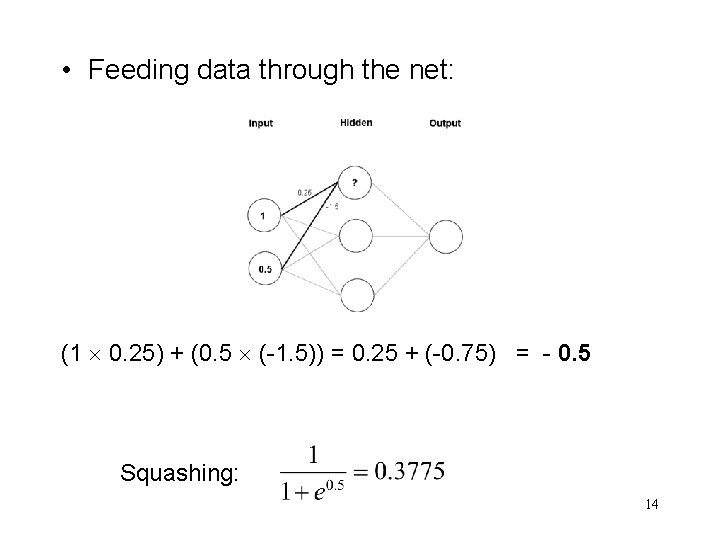
• Feeding data through the net: (1 0. 25) + (0. 5 (-1. 5)) = 0. 25 + (-0. 75) = - 0. 5 Squashing: 14
• Data is presented to the network in the form of activations in the input layer • Examples – Pixel intensity (for pictures) – Molecule concentrations (for artificial nose) – Share prices (for stock market prediction) • Data usually requires preprocessing – Analogous to senses in biology • How to represent more abstract data, e. g. a name? – Choose a pattern, e. g. • 0 -0 -1 for “Chris” • 0 -1 -0 for “Becky” 15
• Weight settings determine the behavior of a network How can we find the right weights? 16
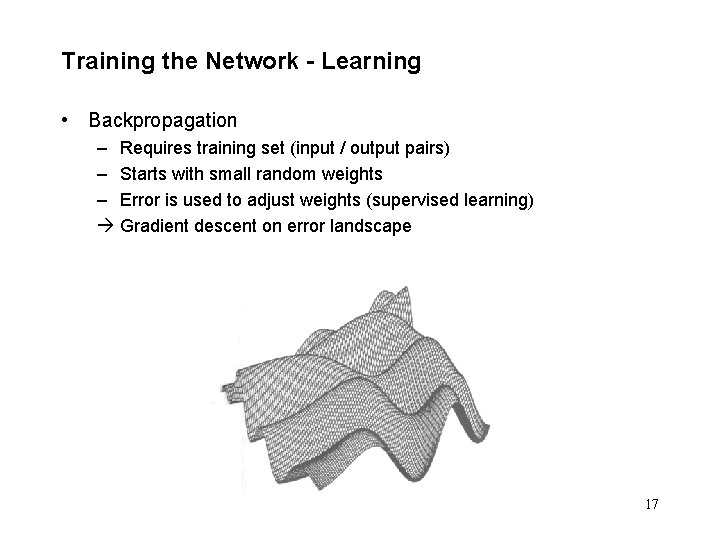
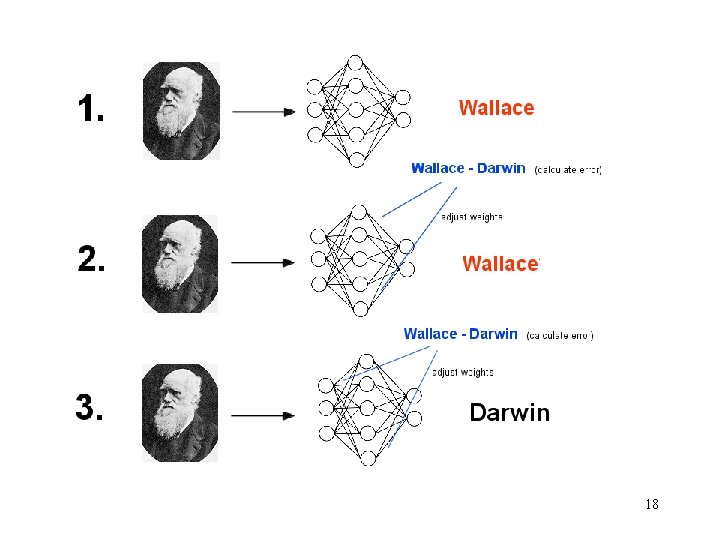
Training the Network - Learning • Backpropagation – Requires training set (input / output pairs) – Starts with small random weights – Error is used to adjust weights (supervised learning) Gradient descent on error landscape 17
18
• Advantages – It works! – Relatively fast • Downsides – Requires a training set – Can be slow – Probably not biologically realistic • Alternatives to Backpropagation – Hebbian learning • Not successful in feed-forward nets – Reinforcement learning • Only limited success – Artificial evolution • More general, but can be even slower than backprop 19
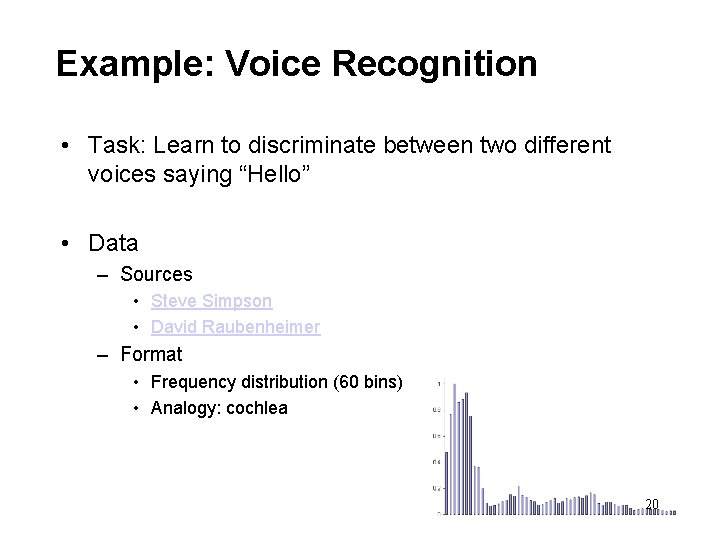
Example: Voice Recognition • Task: Learn to discriminate between two different voices saying “Hello” • Data – Sources • Steve Simpson • David Raubenheimer – Format • Frequency distribution (60 bins) • Analogy: cochlea 20
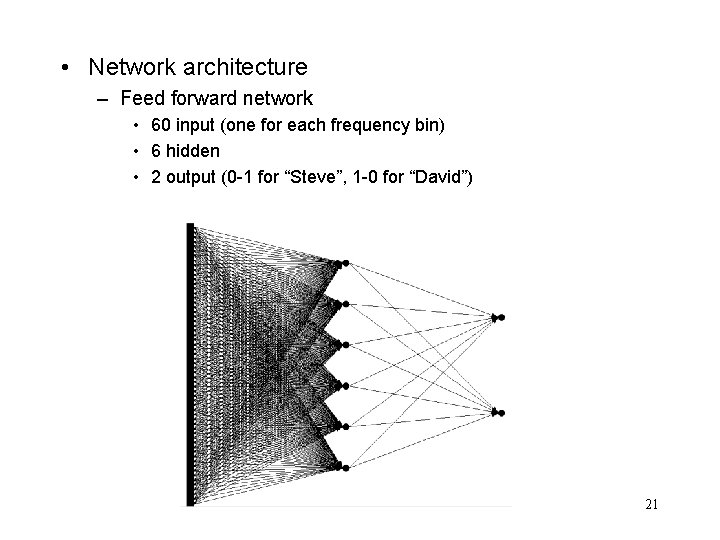
• Network architecture – Feed forward network • 60 input (one for each frequency bin) • 6 hidden • 2 output (0 -1 for “Steve”, 1 -0 for “David”) 21
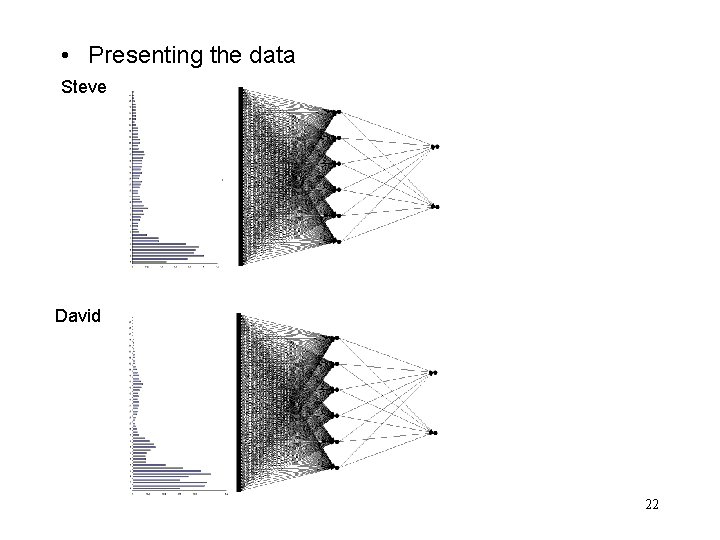
• Presenting the data Steve David 22
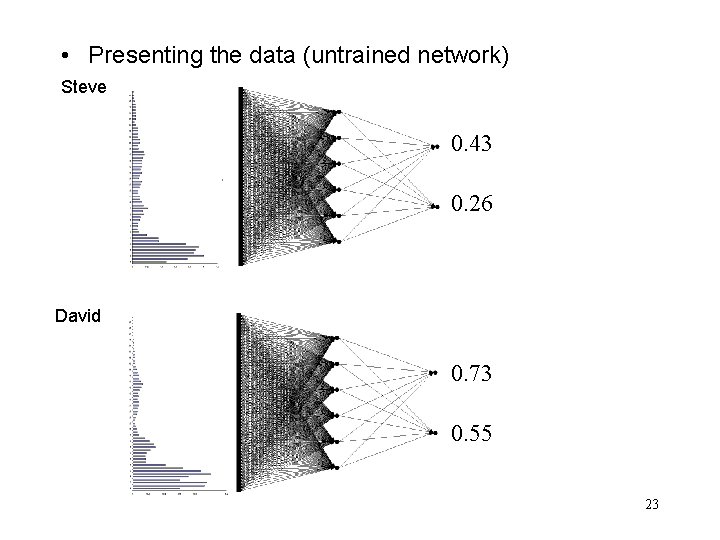
• Presenting the data (untrained network) Steve 0. 43 0. 26 David 0. 73 0. 55 23
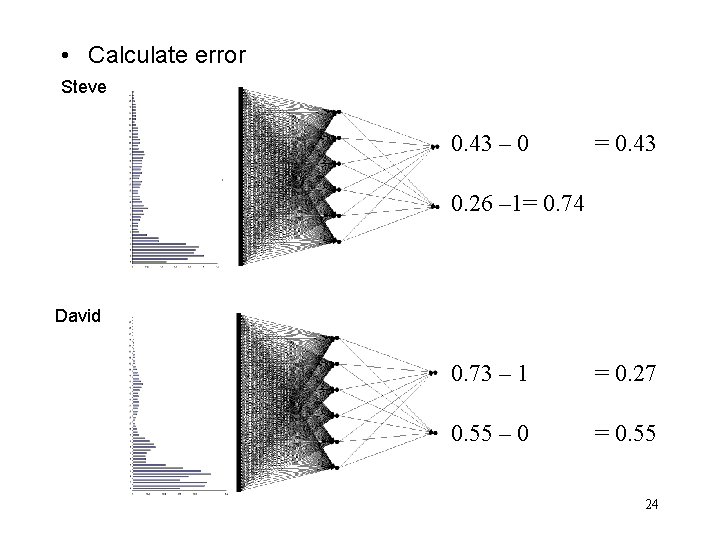
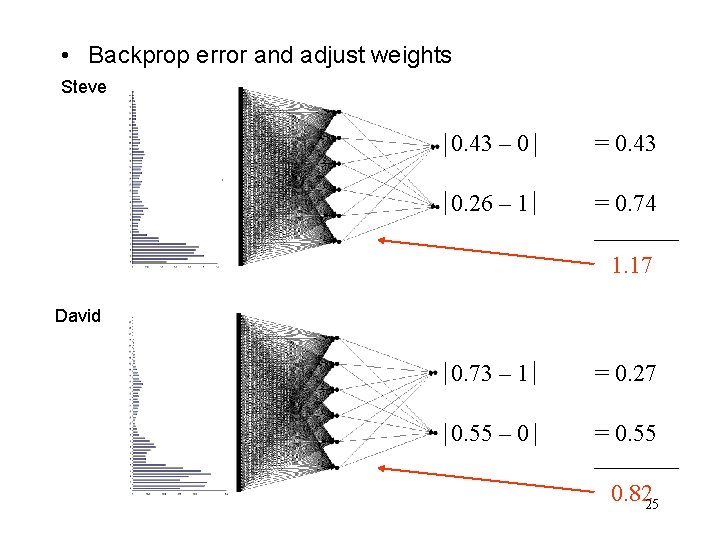
• Calculate error Steve 0. 43 – 0 = 0. 43 0. 26 – 1= 0. 74 David 0. 73 – 1 = 0. 27 0. 55 – 0 = 0. 55 24
• Backprop error and adjust weights Steve 0. 43 – 0 = 0. 43 0. 26 – 1 = 0. 74 1. 17 David 0. 73 – 1 = 0. 27 0. 55 – 0 = 0. 55 0. 8225
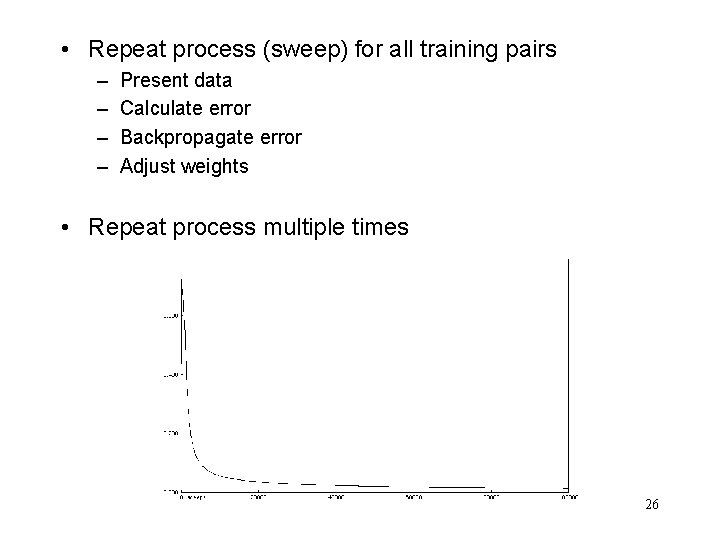
• Repeat process (sweep) for all training pairs – – Present data Calculate error Backpropagate error Adjust weights • Repeat process multiple times 26
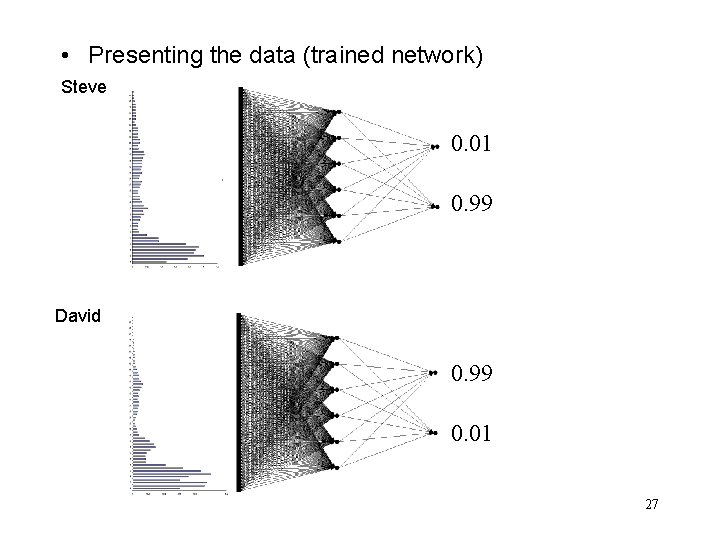
• Presenting the data (trained network) Steve 0. 01 0. 99 David 0. 99 0. 01 27
• Results – Voice Recognition – Performance of trained network • Discrimination accuracy between known “Hello”s – 100% • Discrimination accuracy between new “Hello”’s – 100% 28
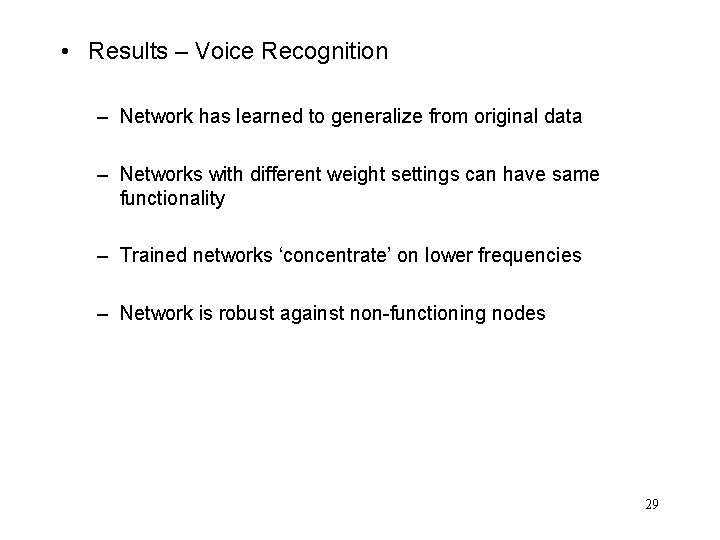
• Results – Voice Recognition – Network has learned to generalize from original data – Networks with different weight settings can have same functionality – Trained networks ‘concentrate’ on lower frequencies – Network is robust against non-functioning nodes 29
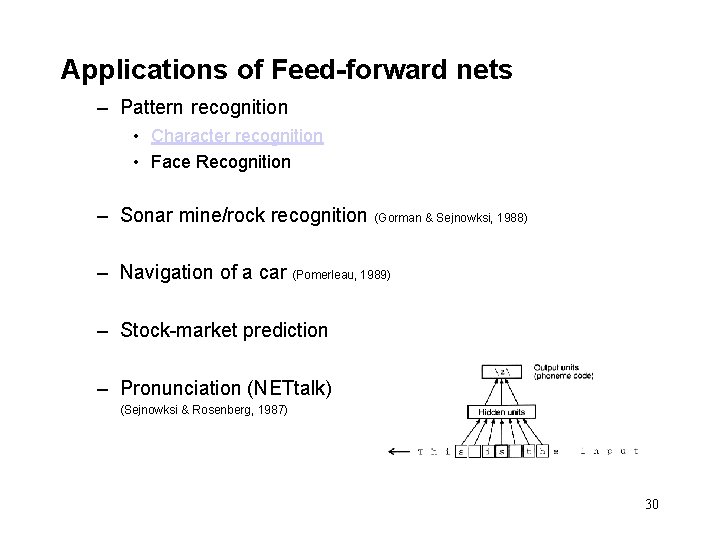
Applications of Feed-forward nets – Pattern recognition • Character recognition • Face Recognition – Sonar mine/rock recognition (Gorman & Sejnowksi, 1988) – Navigation of a car (Pomerleau, 1989) – Stock-market prediction – Pronunciation (NETtalk) (Sejnowksi & Rosenberg, 1987) 30
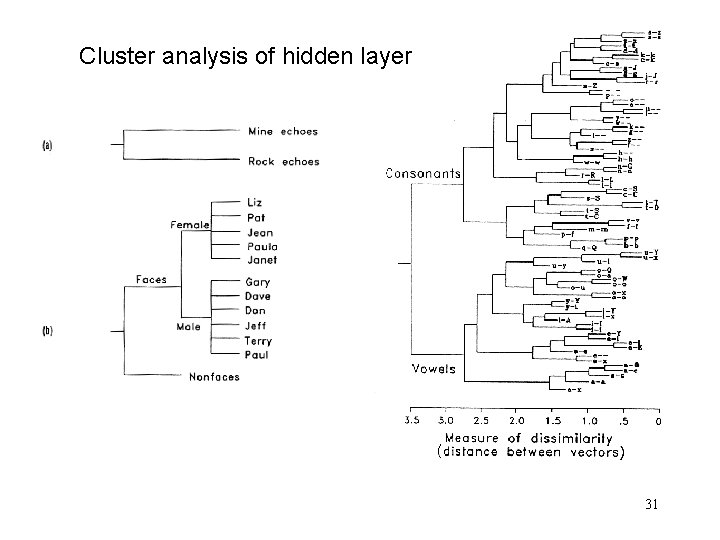
Cluster analysis of hidden layer 31
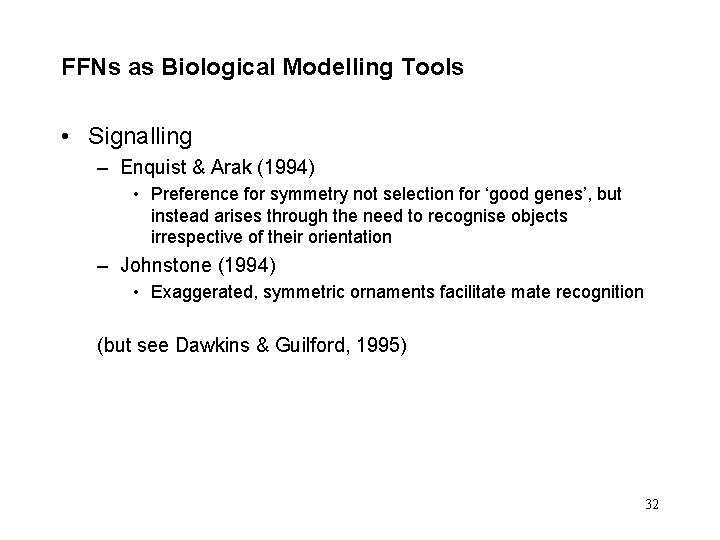
FFNs as Biological Modelling Tools • Signalling – Enquist & Arak (1994) • Preference for symmetry not selection for ‘good genes’, but instead arises through the need to recognise objects irrespective of their orientation – Johnstone (1994) • Exaggerated, symmetric ornaments facilitate mate recognition (but see Dawkins & Guilford, 1995) 32
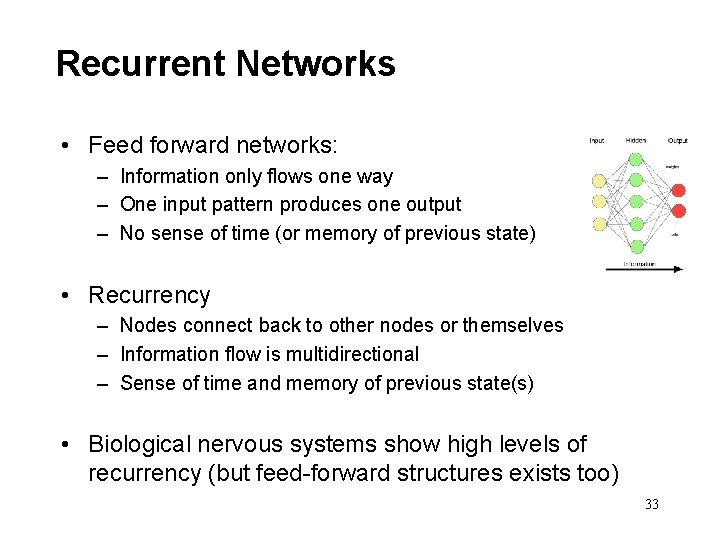
Recurrent Networks • Feed forward networks: – Information only flows one way – One input pattern produces one output – No sense of time (or memory of previous state) • Recurrency – Nodes connect back to other nodes or themselves – Information flow is multidirectional – Sense of time and memory of previous state(s) • Biological nervous systems show high levels of recurrency (but feed-forward structures exists too) 33
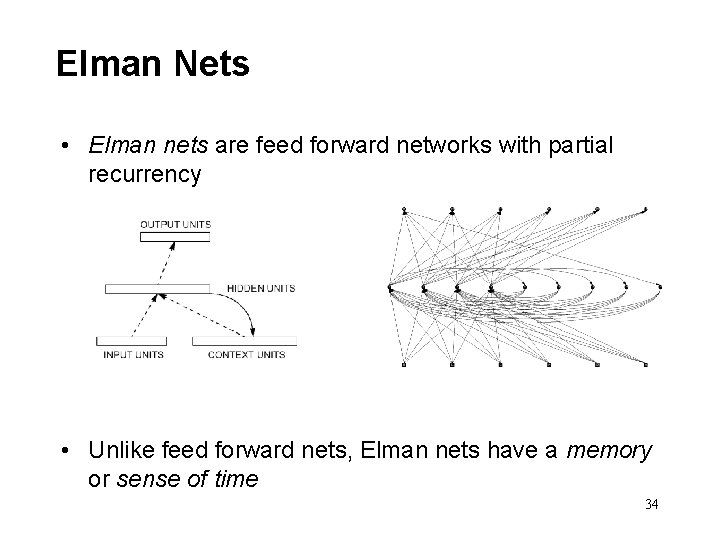
Elman Nets • Elman nets are feed forward networks with partial recurrency • Unlike feed forward nets, Elman nets have a memory or sense of time 34
Classic experiment on language acquisition and processing (Elman, 1990) • Task – Elman net to predict successive words in sentences. • Data – Suite of sentences, e. g. • “The boy catches the ball. ” • “The girl eats an apple. ” – Words are input one at a time • Representation – Binary representation for each word, e. g. • 0 -1 -0 -0 -0 for “girl” • Training method – Backpropagation 35
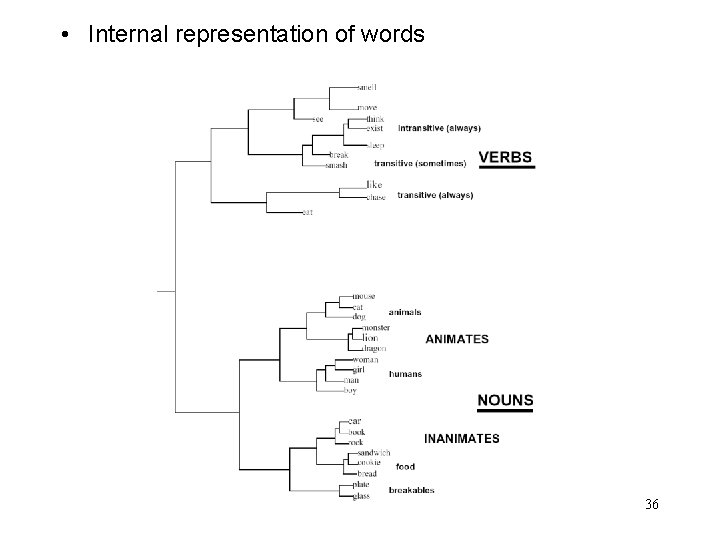
• Internal representation of words 36
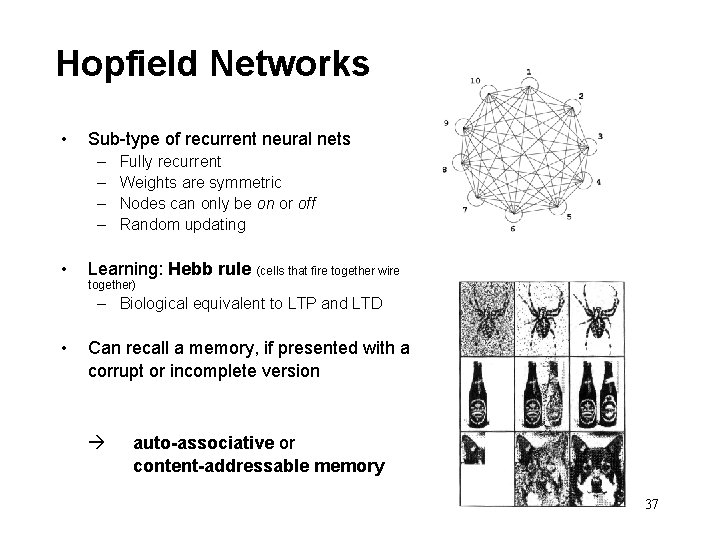
Hopfield Networks • Sub-type of recurrent neural nets – – • Fully recurrent Weights are symmetric Nodes can only be on or off Random updating Learning: Hebb rule (cells that fire together wire together) – Biological equivalent to LTP and LTD • Can recall a memory, if presented with a corrupt or incomplete version auto-associative or content-addressable memory 37
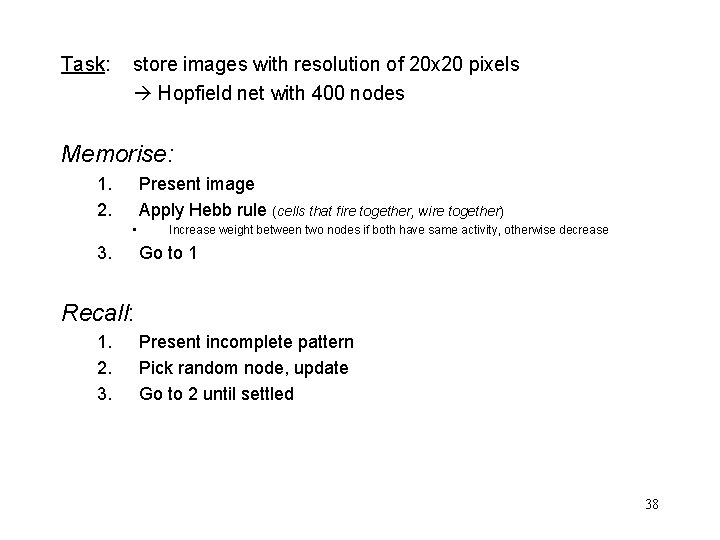
Task: store images with resolution of 20 x 20 pixels Hopfield net with 400 nodes Memorise: 1. 2. Present image Apply Hebb rule (cells that fire together, wire together) • 3. Increase weight between two nodes if both have same activity, otherwise decrease Go to 1 Recall: 1. 2. 3. Present incomplete pattern Pick random node, update Go to 2 until settled 38
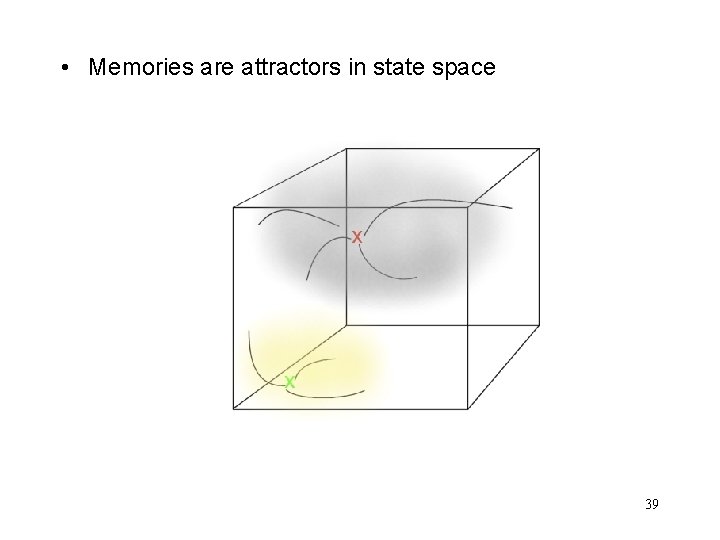
• Memories are attractors in state space 39
Catastrophic forgetting • Problem: memorising new patterns corrupts the memory of older ones Old memories cannot be recalled, or spurious memories arise • Solution: allow Hopfield net to sleep 40
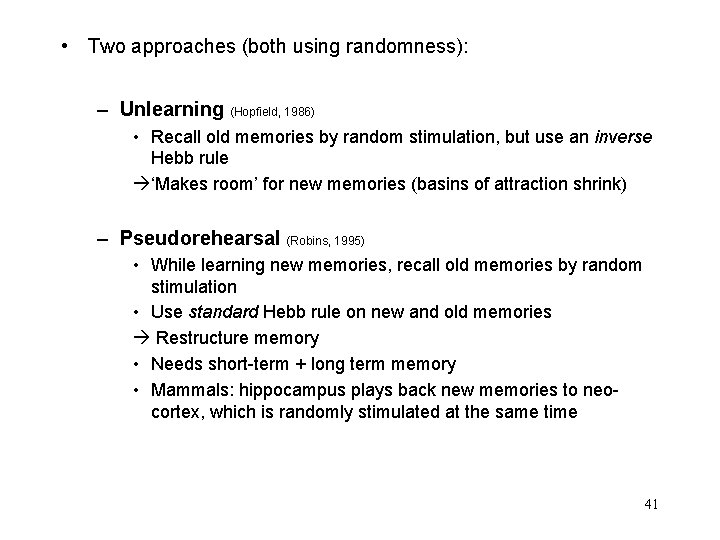
• Two approaches (both using randomness): – Unlearning (Hopfield, 1986) • Recall old memories by random stimulation, but use an inverse Hebb rule ‘Makes room’ for new memories (basins of attraction shrink) – Pseudorehearsal (Robins, 1995) • While learning new memories, recall old memories by random stimulation • Use standard Hebb rule on new and old memories Restructure memory • Needs short-term + long term memory • Mammals: hippocampus plays back new memories to neocortex, which is randomly stimulated at the same time 41
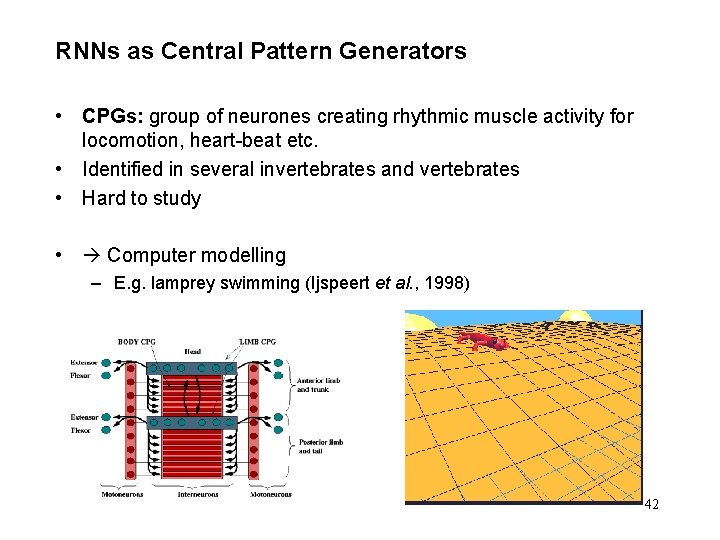
RNNs as Central Pattern Generators • CPGs: group of neurones creating rhythmic muscle activity for locomotion, heart-beat etc. • Identified in several invertebrates and vertebrates • Hard to study • Computer modelling – E. g. lamprey swimming (Ijspeert et al. , 1998) 42
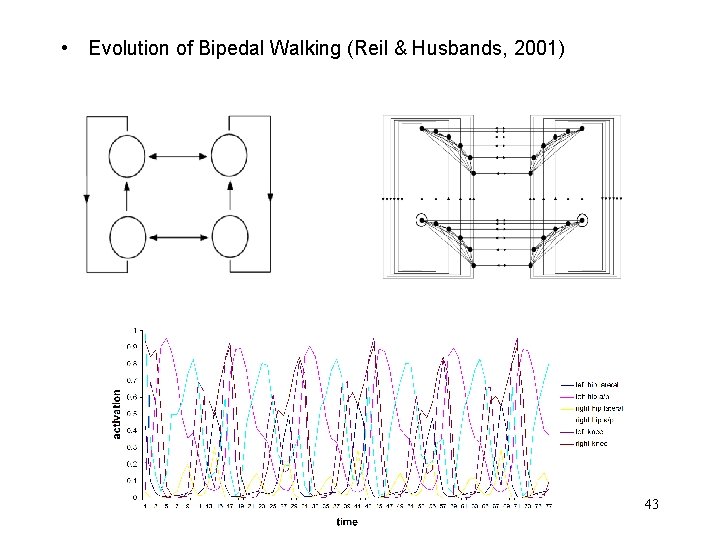
• Evolution of Bipedal Walking (Reil & Husbands, 2001) 43
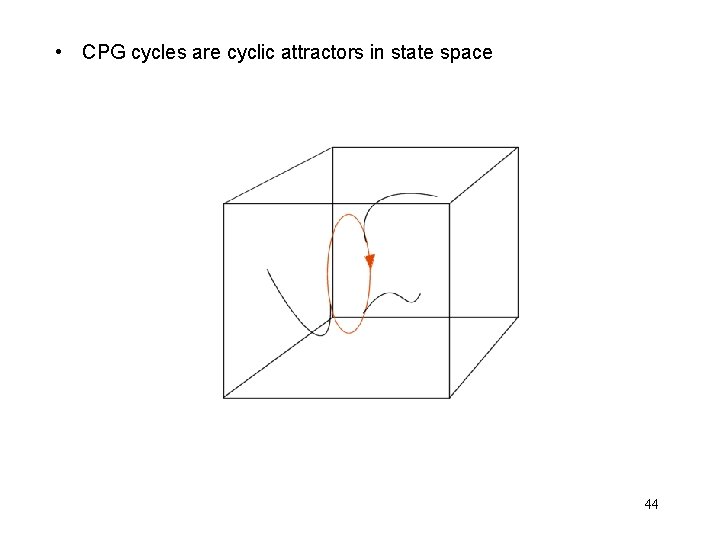
• CPG cycles are cyclic attractors in state space 44
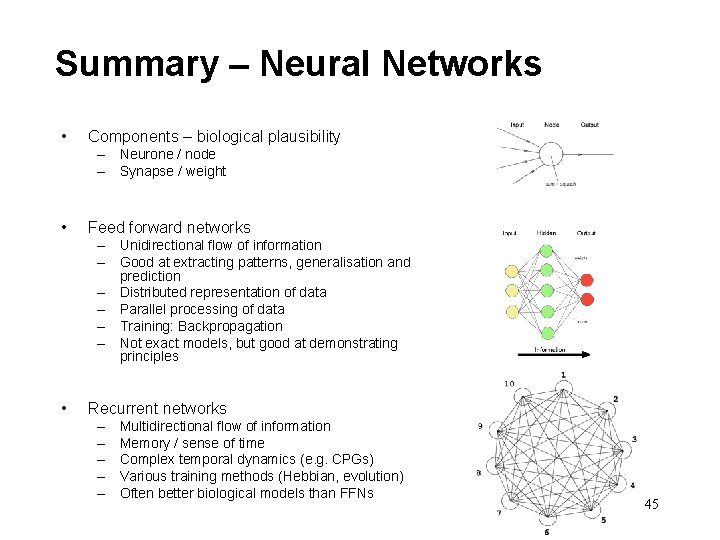
Summary – Neural Networks • Components – biological plausibility – Neurone / node – Synapse / weight • Feed forward networks – Unidirectional flow of information – Good at extracting patterns, generalisation and prediction – Distributed representation of data – Parallel processing of data – Training: Backpropagation – Not exact models, but good at demonstrating principles • Recurrent networks – – – Multidirectional flow of information Memory / sense of time Complex temporal dynamics (e. g. CPGs) Various training methods (Hebbian, evolution) Often better biological models than FFNs 45