
Artificial Neural Networks ANN Artificial Neural Networks ANN

- Slides: 10
Artificial Neural Networks (ANN)
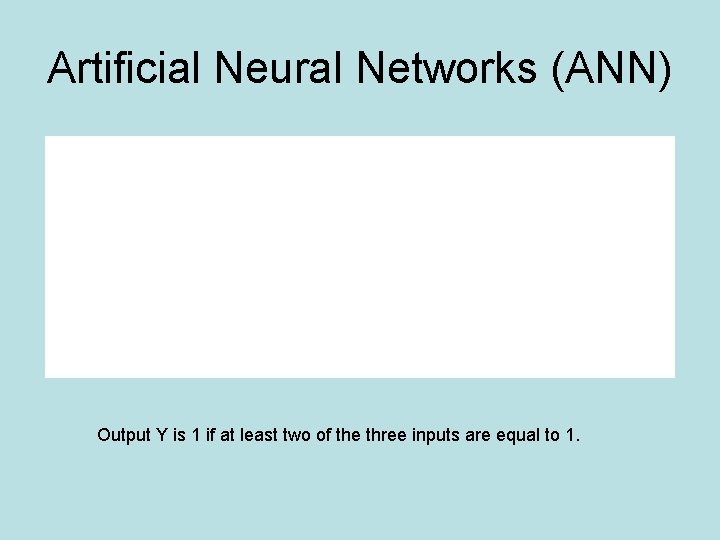
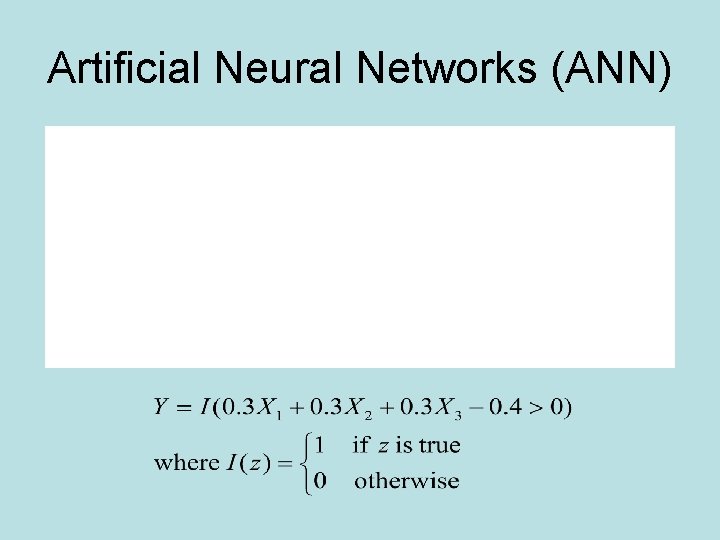
Artificial Neural Networks (ANN) Output Y is 1 if at least two of the three inputs are equal to 1.
Artificial Neural Networks (ANN)
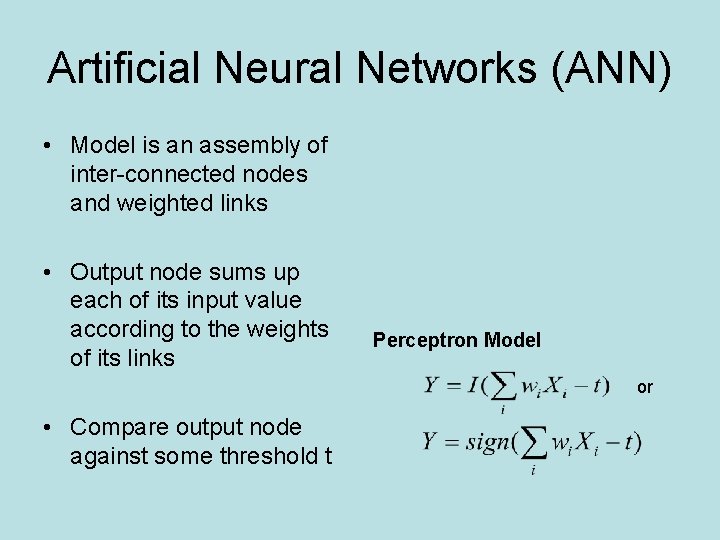
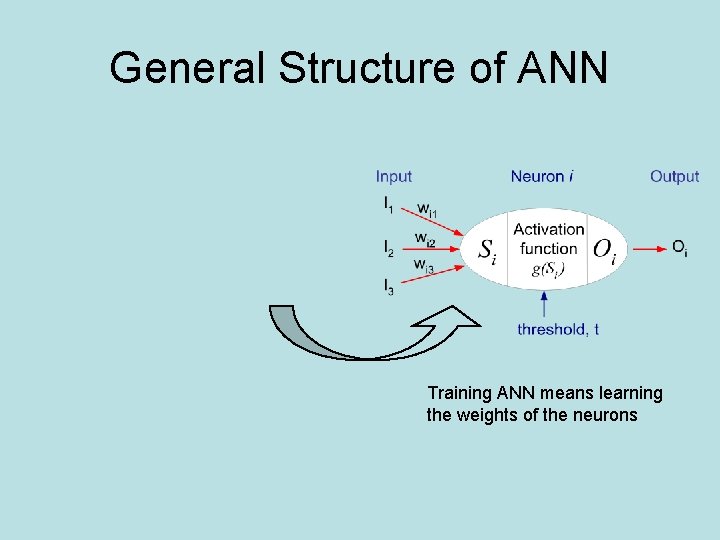
Artificial Neural Networks (ANN) • Model is an assembly of inter-connected nodes and weighted links • Output node sums up each of its input value according to the weights of its links Perceptron Model or • Compare output node against some threshold t
General Structure of ANN Training ANN means learning the weights of the neurons
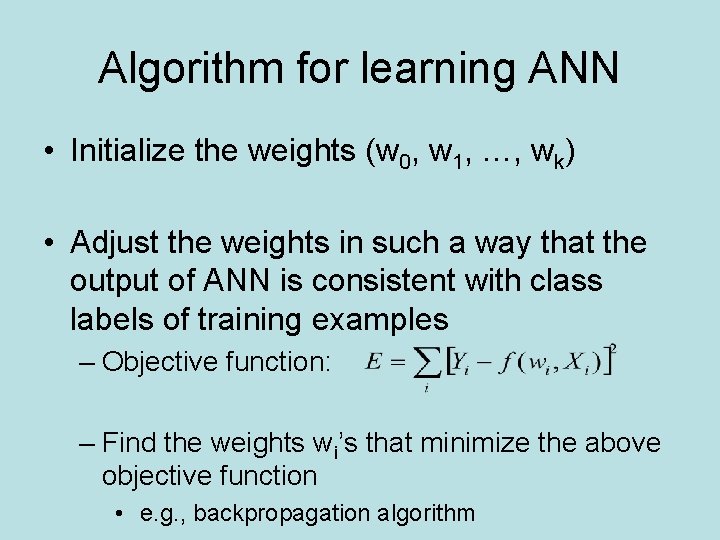
Algorithm for learning ANN • Initialize the weights (w 0, w 1, …, wk) • Adjust the weights in such a way that the output of ANN is consistent with class labels of training examples – Objective function: – Find the weights wi’s that minimize the above objective function • e. g. , backpropagation algorithm
Classification by Backpropagation • Backpropagation: A neural network learning algorithm • Started by psychologists and neurobiologists to develop and test computational analogues of neurons • A neural network: A set of connected input/output units where each connection has a weight associated with it • During the learning phase, the network learns by adjusting the weights so as to be able to predict the correct class label of the input tuples • Also referred to as connectionist learning due to the connections between units
Neural Network as a Classifier • Weakness – Long training time – Require a number of parameters typically best determined empirically, e. g. , the network topology or ``structure. " – Poor interpretability: Difficult to interpret the symbolic meaning behind the learned weights and of ``hidden units" in the network • Strength – – – High tolerance to noisy data Ability to classify untrained patterns Well-suited for continuous-valued inputs and outputs Successful on a wide array of real-world data Algorithms are inherently parallel Techniques have recently been developed for the extraction of rules from trained neural networks
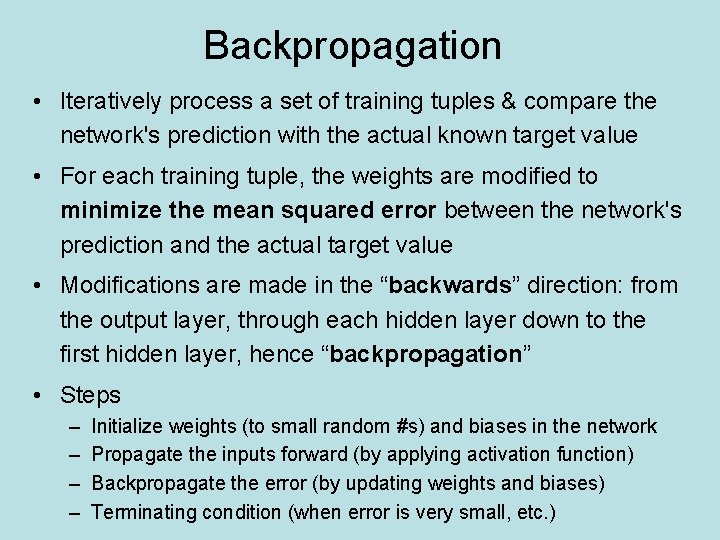
Backpropagation • Iteratively process a set of training tuples & compare the network's prediction with the actual known target value • For each training tuple, the weights are modified to minimize the mean squared error between the network's prediction and the actual target value • Modifications are made in the “backwards” direction: from the output layer, through each hidden layer down to the first hidden layer, hence “backpropagation” • Steps – – Initialize weights (to small random #s) and biases in the network Propagate the inputs forward (by applying activation function) Backpropagate the error (by updating weights and biases) Terminating condition (when error is very small, etc. )
Software • • • Excel + VBA SPSS Clementine SQL Server Programming Other Statistic Package …