
Artificial Neural NetworkANN Chapter 1 Introduction Question What

- Slides: 44
-Artificial Neural Network(ANN) Chapter 1 Introduction 朝陽科技大學 資訊管理系 李麗華 教授 朝陽科技大學 李麗華 博士
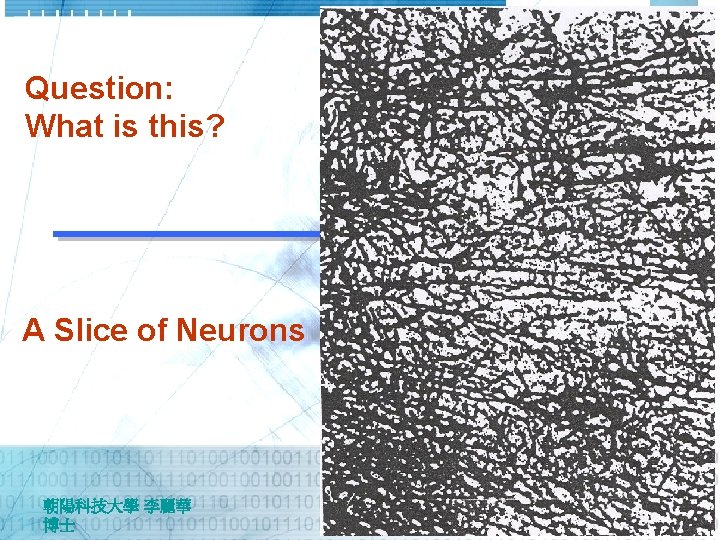
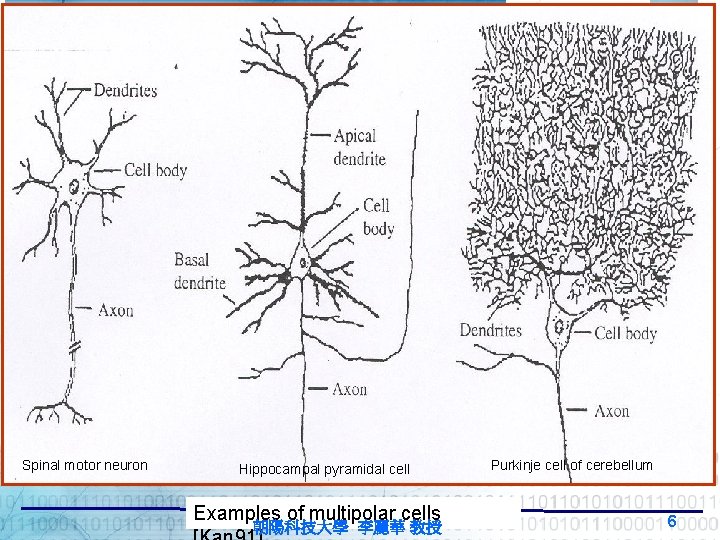
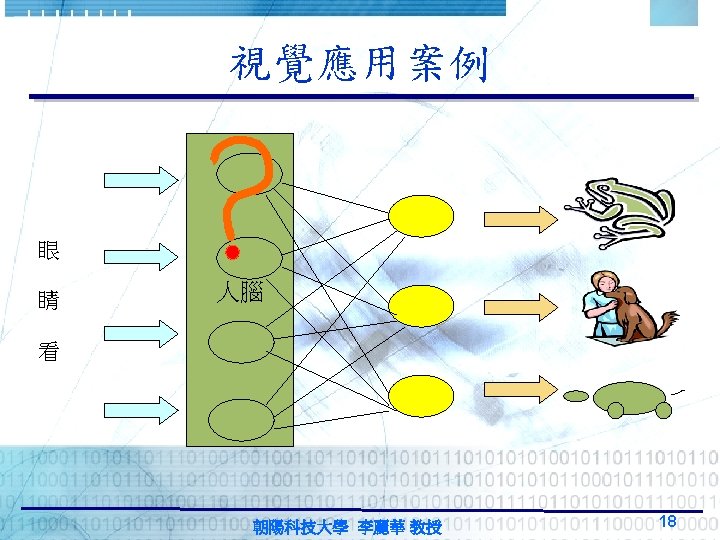
Question: What is this? A Slice of Neurons 朝陽科技大學 李麗華 博士
Spinal motor neuron Hippocampal pyramidal cell Examples of multipolar cells 朝陽科技大學 李麗華 教授 Purkinje cell of cerebellum 6
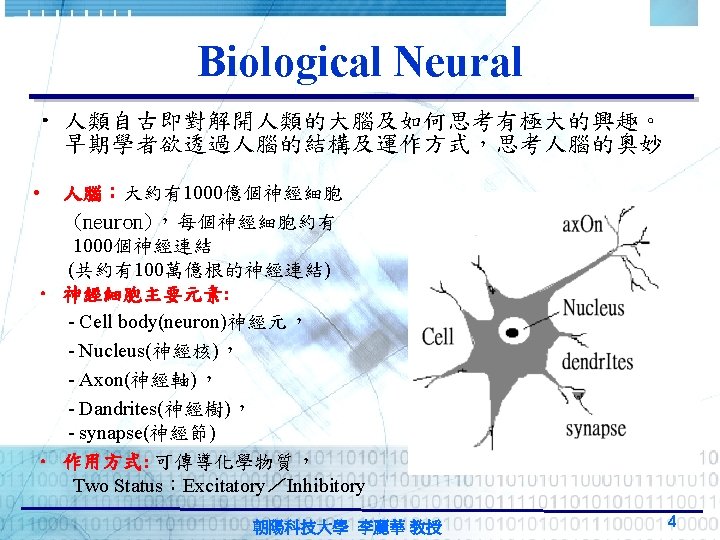
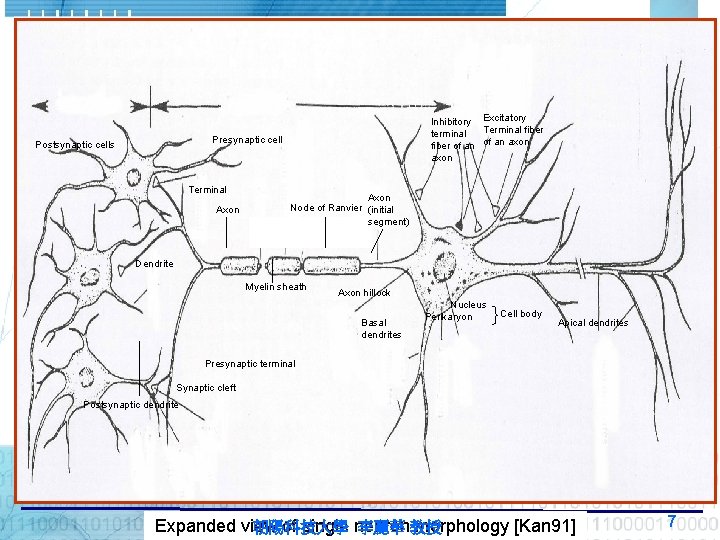
Inhibitory Excitatory Terminal fiber terminal fiber of an axon Presynaptic cell Postsynaptic cells Terminal Axon Node of Ranvier (initial segment) Dendrite Myelin sheath Axon hillock Basal dendrites Nucleus Perikaryon Cell body Apical dendrites Presynaptic terminal Synaptic cleft Postsynaptic dendrite 朝陽科技大學 李麗華 教授 Expanded view of single neuron morphology [Kan 91] 7
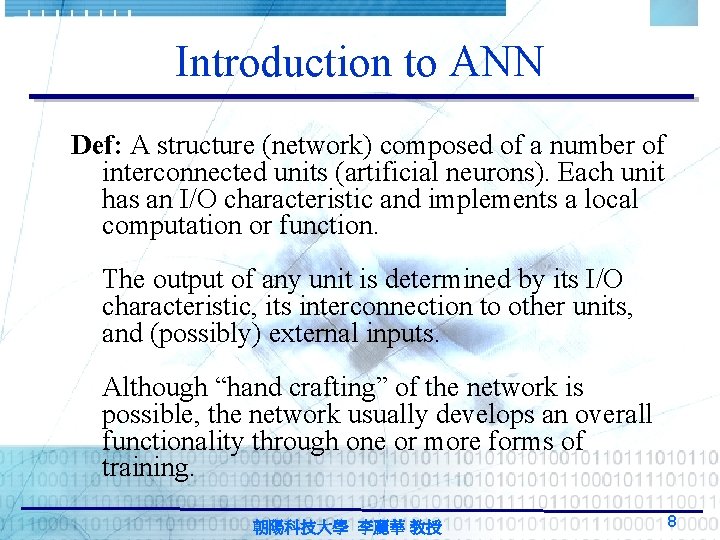
Introduction to ANN Def: A structure (network) composed of a number of interconnected units (artificial neurons). Each unit has an I/O characteristic and implements a local computation or function. The output of any unit is determined by its I/O characteristic, its interconnection to other units, and (possibly) external inputs. Although “hand crafting” of the network is possible, the network usually develops an overall functionality through one or more forms of training. 朝陽科技大學 李麗華 教授 8
ANN History 1. Creation Age(孕育期)(before 1956) 2. Birth Age(誕生期)(1957 -1968) 3. Dark Age(挫折期)(1969 -1981) 4. Reborn Age(重生期)(1982 -1986) 5. Mature Age(成熟期)(1987~present) 朝陽科技大學 李麗華 教授 10
Creation Age • In 1943, Mc. Culloch & Pitts first proposed the neural mathematical model, earlier than the first computer were created. Their premises(assumptions) are: 1. Neuron has two status, i. e. , all or none. (excitatory or inhibitory) 2. A neuron is triggered by certain amount of accumulated synapses and the trigger action has nothing to do with the previous status. 3. Only synapse can be delayed. 4. When under inhibitory status a neuron can not be trigged. 5. The neuron net structure is not changed. 朝陽科技大學 李麗華 教授 11
Creation Age • In 1949, Hebb proposed the Hebb learning rule: 1. 2. 3. 4. Information resides in Synapes learning rule symmetrical weights When a group of weak neurons is triggered, the strength of connection between them is increased. (即鄰近neuron的訊號可以累積增強weights的 值) 朝陽科技大學 李麗華 教授 12
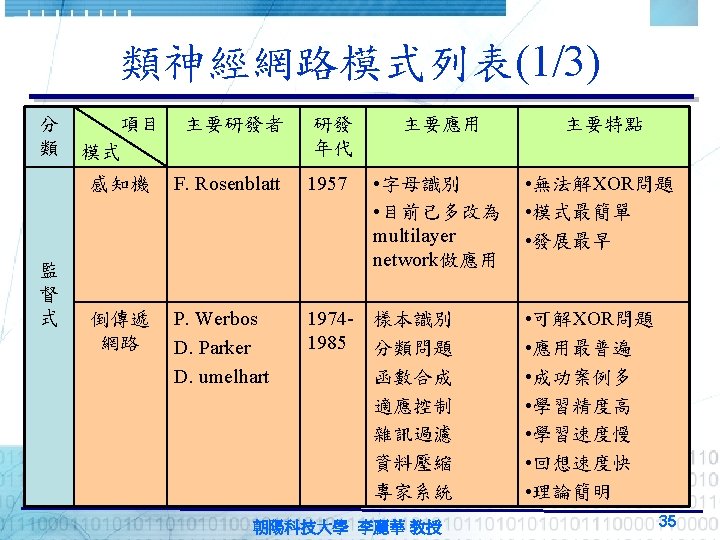
Birth Age • In 1957, Rosenblatt proposed the first network model, i. e. , perceptron. (即感知器; 當時僅有單層架構) • In 1960, Widrow porposed another model, i. e. , Adaline. (這是屬於連續值的線性網路, 己開始採用 learning rule與當時人 智慧邏輯推理很不同) 朝陽科技大學 李麗華 教授 13
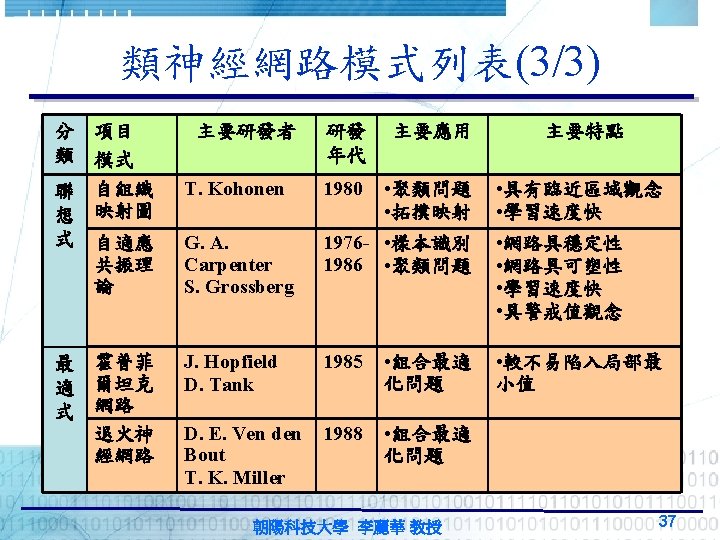
Dark Age • In 1969, Minsky & Papert proved that Perceptron has limited learning usage, because this model cannot solve the XOR problem. (註) 因當時AI較紅, 電腦速度慢, 由於被Minsky的證明 困住等原因,ANN研究因此而限於低潮) 但此 時期仍有: 芬蘭的Kohonen所提出的Self Organization Map(SOM)與 Grossberg學者等提出 Adaptive Resonance Theory(ART) model. 朝陽科技大學 李麗華 教授 14
Reborn Age • In 1982, Hopfield proposed the Hopfield Network and the Auto-associative Memory Models. Again, in 1985, Hopfield proposed another Hopfield & Tank Network to solve the Traveling Salesman Problem. After these researches, the ANN models were again treated as a promising research area. • In 1986, Rumelhart et al. introduced the BPN in their book: “Parallel Distributed Processing” in which generalized delta rule are explained. In addition, they explain how BPN can solve the XOR problem. Until 1990, BPN had become one of the most popular and highly utilized ANN model. 朝陽科技大學 李麗華 教授 15
Mature Age • Up to now, the ANN models has been widely studied and many models has been proposed. Conferences and Journals are created for ANN studies, such as ICNN(International Conference on NN, IJCNN( International Joint Conference on NN, held by IEEE & INNS). Besides, many tools and software,such as SNNS and Mat. Lab, are been developed for making applying NN easier. 朝陽科技大學 李麗華 教授 16
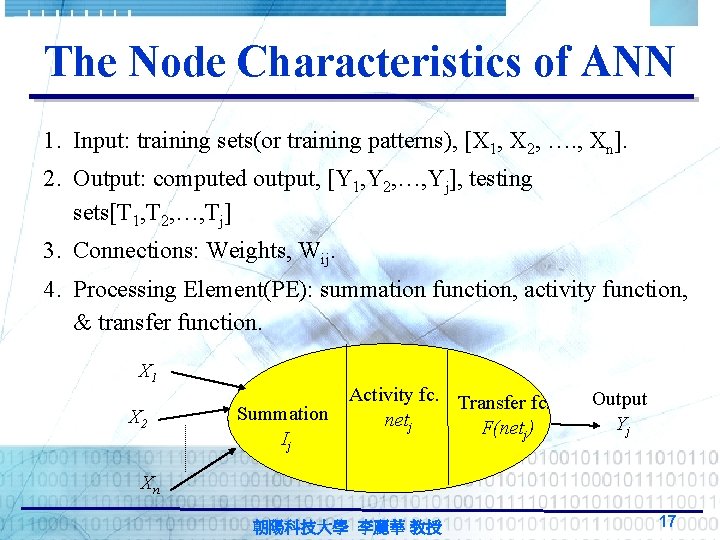
The Node Characteristics of ANN 1. Input: training sets(or training patterns), [X 1, X 2, …. , Xn]. 2. Output: computed output, [Y 1, Y 2, …, Yj], testing sets[T 1, T 2, …, Tj] 3. Connections: Weights, Wij. 4. Processing Element(PE): summation function, activity function, & transfer function. X 1 X 2 Activity fc. Transfer fc. Summation netj F(netj) Ij Output Yj Xn 朝陽科技大學 李麗華 教授 17
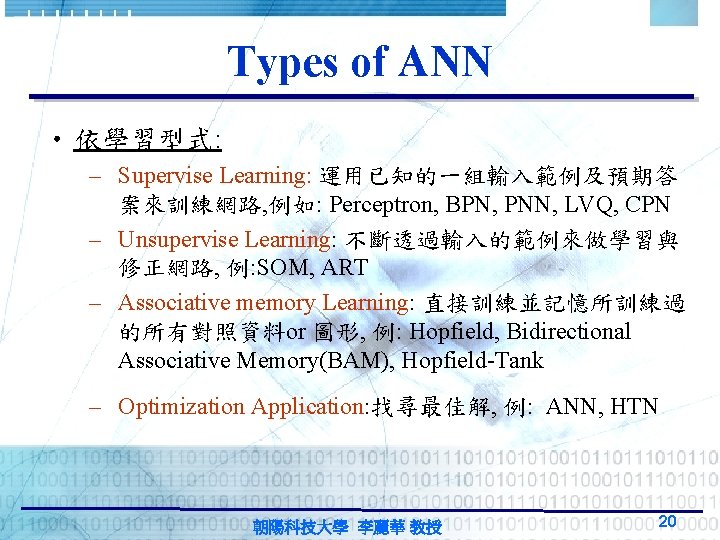
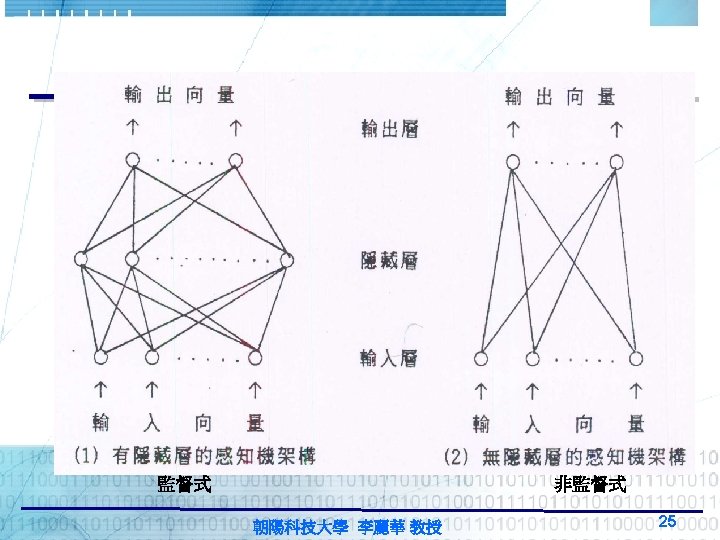
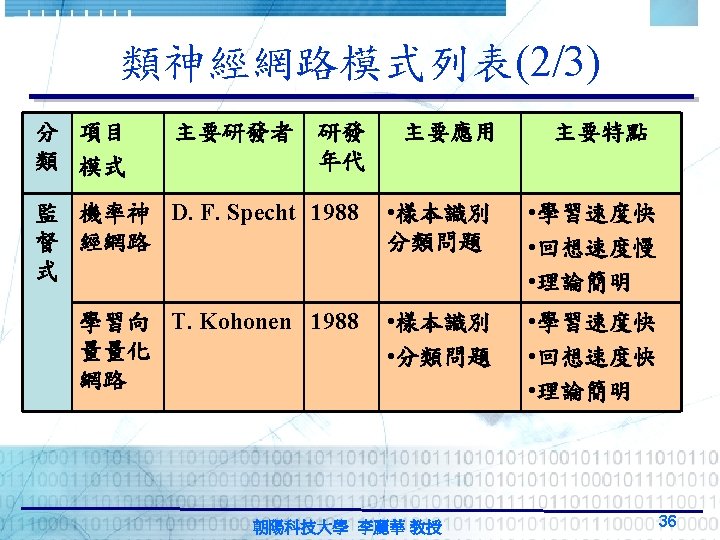
Types of ANN • 依學習型式: – Supervise Learning: 運用已知的一組輸入範例及預期答 案來訓練網路, 例如: Perceptron, BPN, PNN, LVQ, CPN – Unsupervise Learning: 不斷透過輸入的範例來做學習與 修正網路, 例: SOM, ART – Associative memory Learning: 直接訓練並記憶所訓練過 的所有對照資料or 圖形, 例: Hopfield, Bidirectional Associative Memory(BAM), Hopfield-Tank – Optimization Application: 找尋最佳解, 例: ANN, HTN 朝陽科技大學 李麗華 教授 20
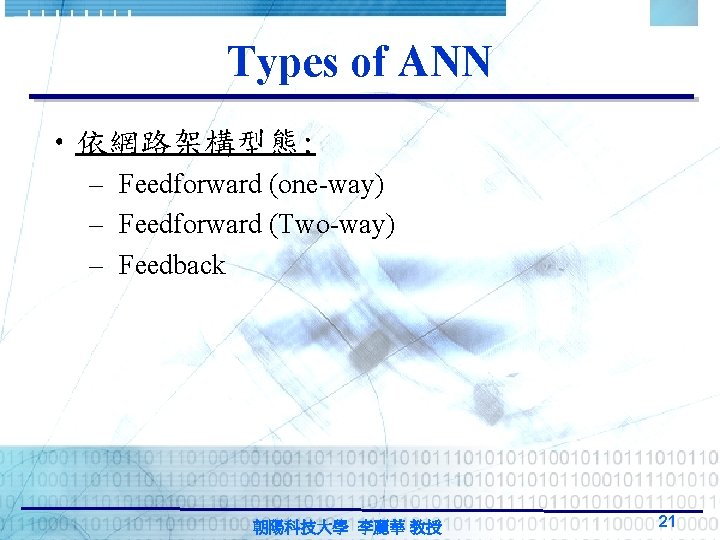
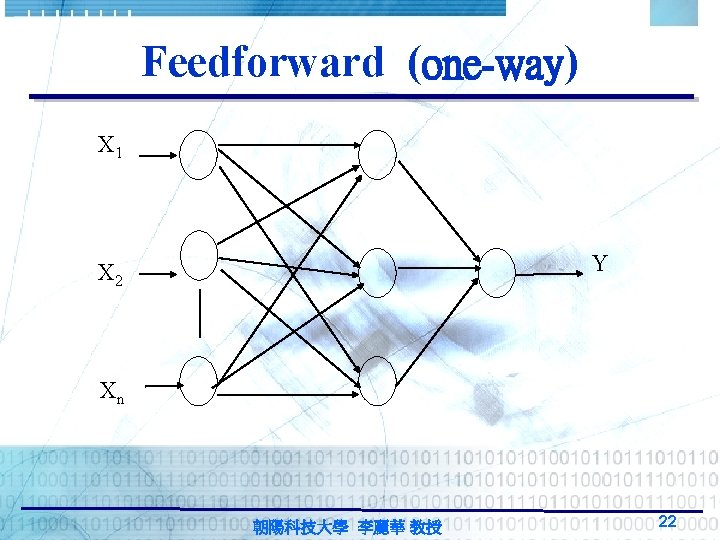
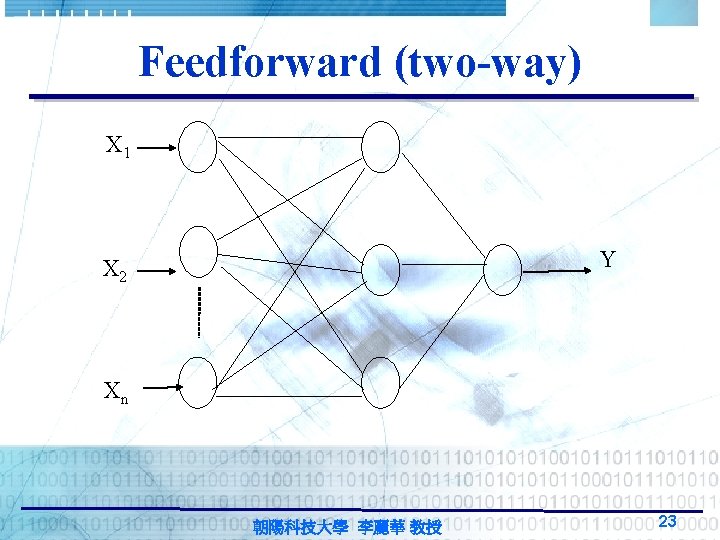
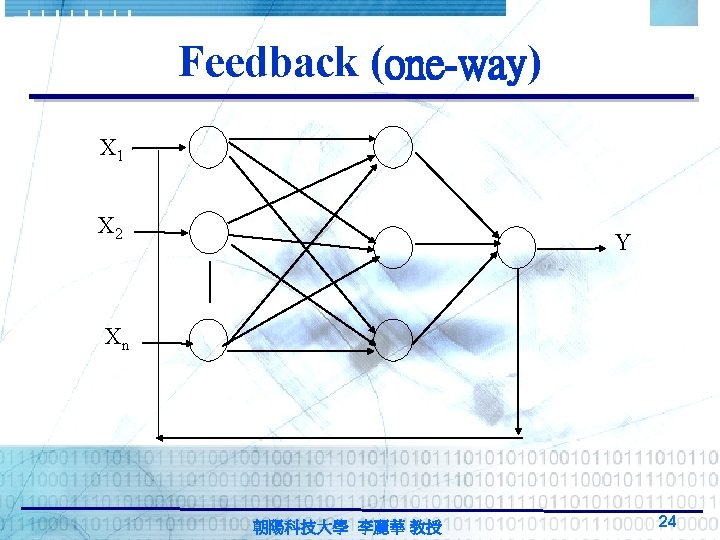
Types of ANN • 依網路架構型態: – Feedforward (one-way) – Feedforward (Two-way) – Feedback 朝陽科技大學 李麗華 教授 21
Feedforward (one-way) X 1 Y X 2 Xn 朝陽科技大學 李麗華 教授 22
Feedforward (two-way) X 1 Y X 2 Xn 朝陽科技大學 李麗華 教授 23
Feedback (one-way) X 1 X 2 Y Xn 朝陽科技大學 李麗華 教授 24
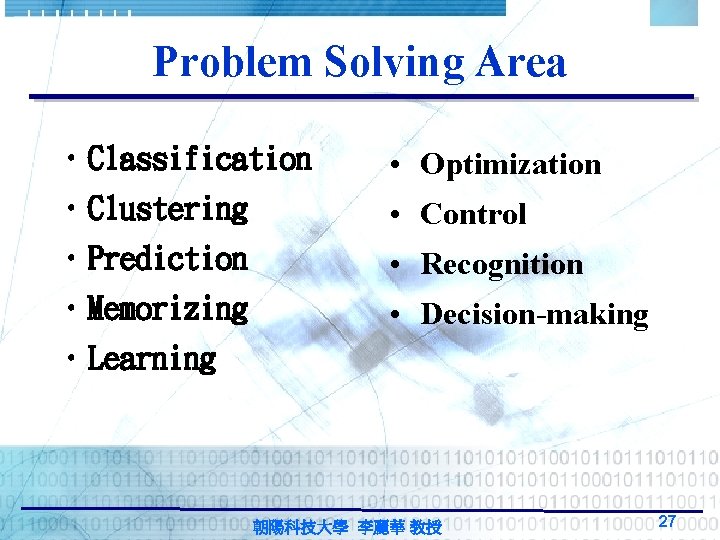
Problem Solving Area • Classification • Optimization • Clustering • Control • Prediction • Recognition • Memorizing • Decision-making • Learning 朝陽科技大學 李麗華 教授 27
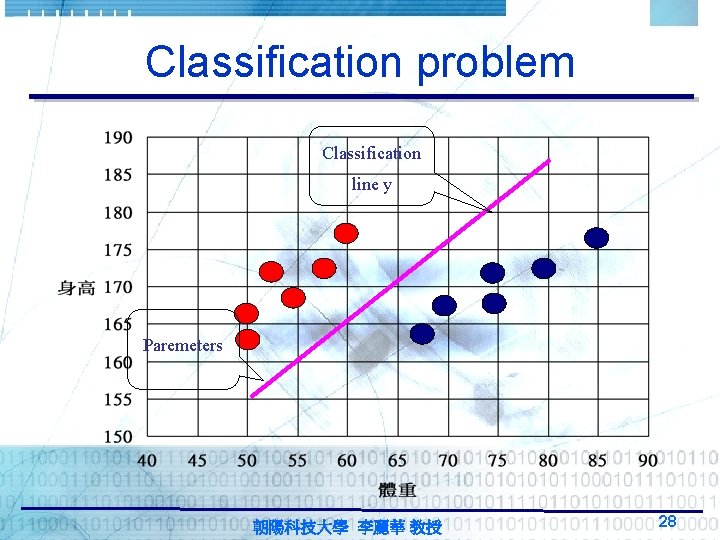
Classification problem Classification line y Paremeters 朝陽科技大學 李麗華 教授 28
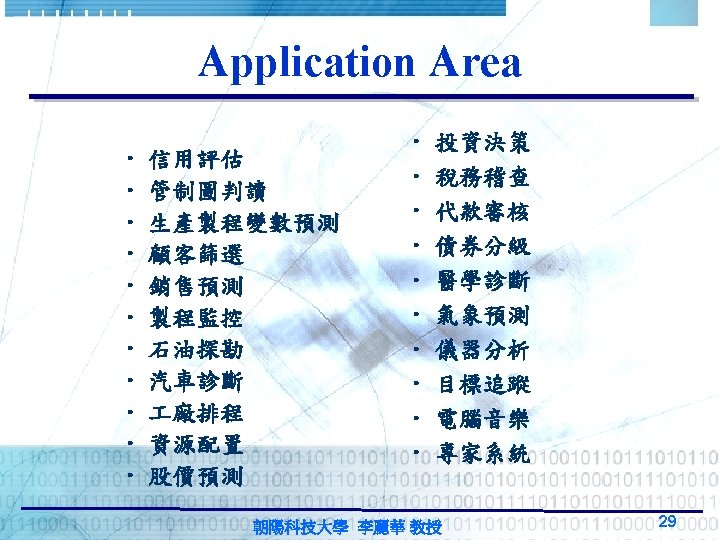
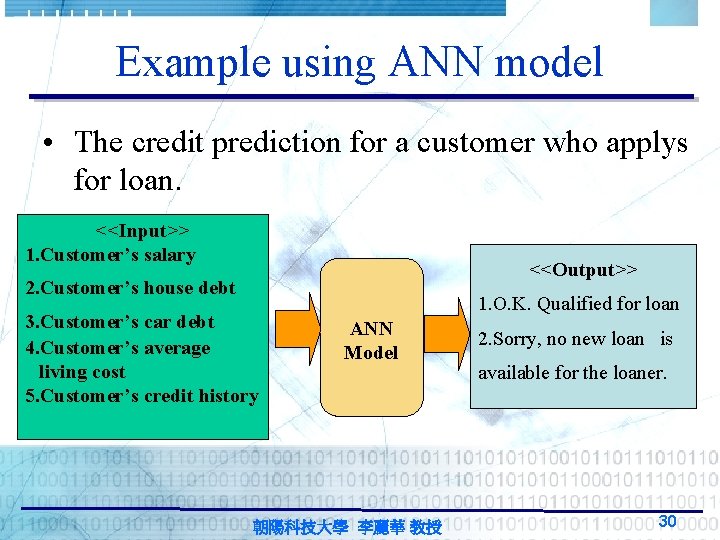
Example using ANN model • The credit prediction for a customer who applys for loan. <<Input>> 1. Customer’s salary <<Output>> 2. Customer’s house debt 3. Customer’s car debt 4. Customer’s average living cost 5. Customer’s credit history 1. O. K. Qualified for loan ANN Model 朝陽科技大學 李麗華 教授 2. Sorry, no new loan is available for the loaner. 30
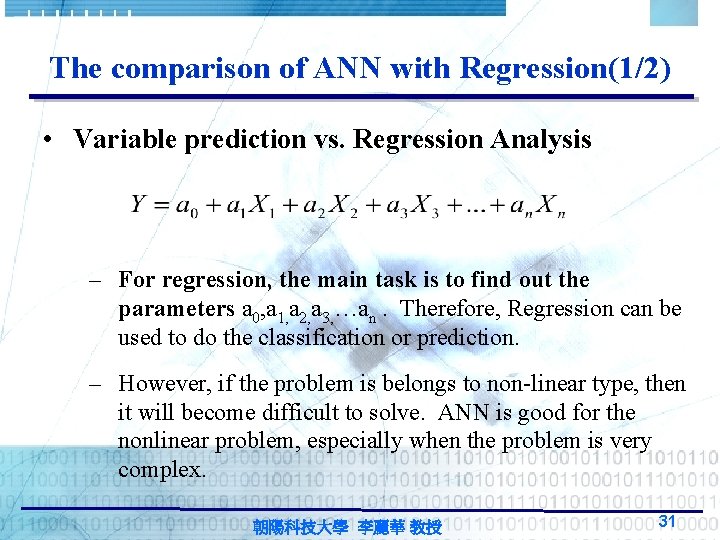
The comparison of ANN with Regression(1/2) • Variable prediction vs. Regression Analysis – For regression, the main task is to find out the parameters a 0, a 1, a 2, a 3, …an. Therefore, Regression can be used to do the classification or prediction. – However, if the problem is belongs to non-linear type, then it will become difficult to solve. ANN is good for the nonlinear problem, especially when the problem is very complex. 朝陽科技大學 李麗華 教授 31
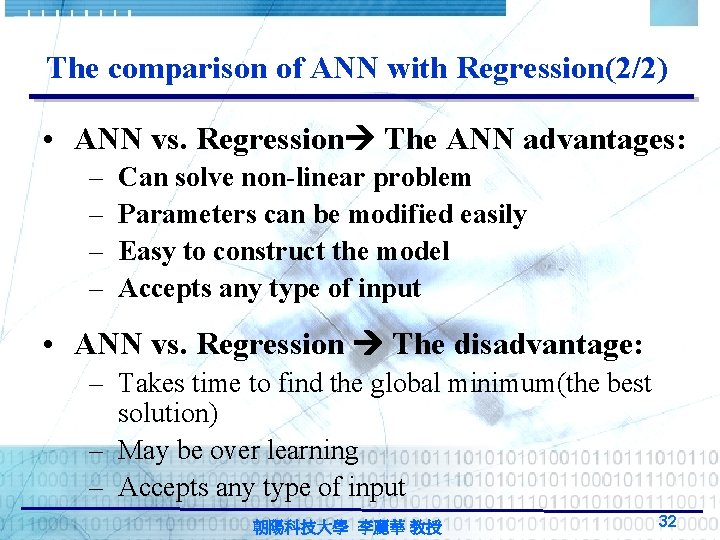
The comparison of ANN with Regression(2/2) • ANN vs. Regression The ANN advantages: – – Can solve non-linear problem Parameters can be modified easily Easy to construct the model Accepts any type of input • ANN vs. Regression The disadvantage: – Takes time to find the global minimum(the best solution) – May be over learning – Accepts any type of input 朝陽科技大學 李麗華 教授 32
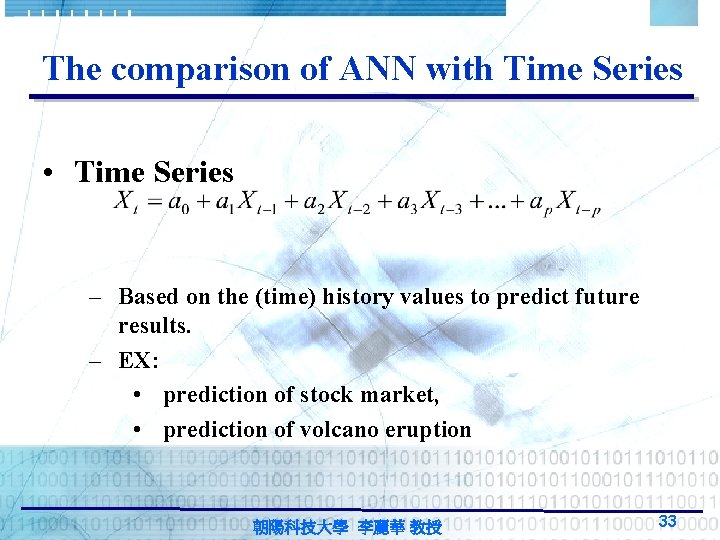
The comparison of ANN with Time Series • Time Series – Based on the (time) history values to predict future results. – EX: • prediction of stock market, • prediction of volcano eruption 朝陽科技大學 李麗華 教授 33
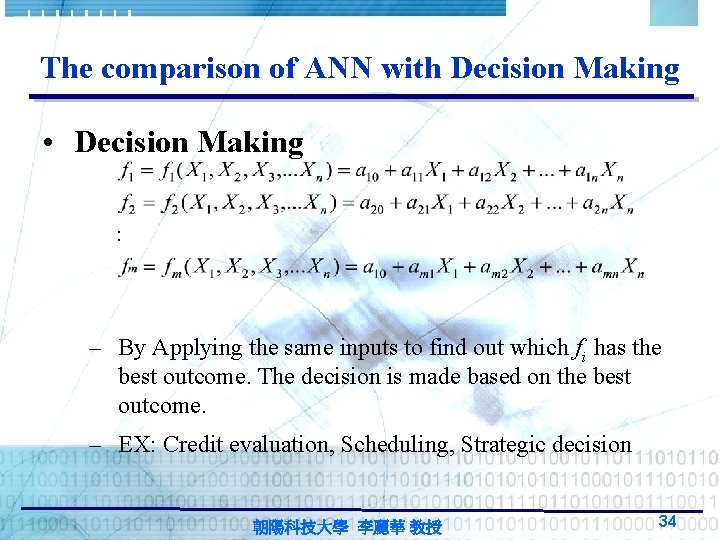
The comparison of ANN with Decision Making • Decision Making – By Applying the same inputs to find out which fi has the best outcome. The decision is made based on the best outcome. – EX: Credit evaluation, Scheduling, Strategic decision 朝陽科技大學 李麗華 教授 34
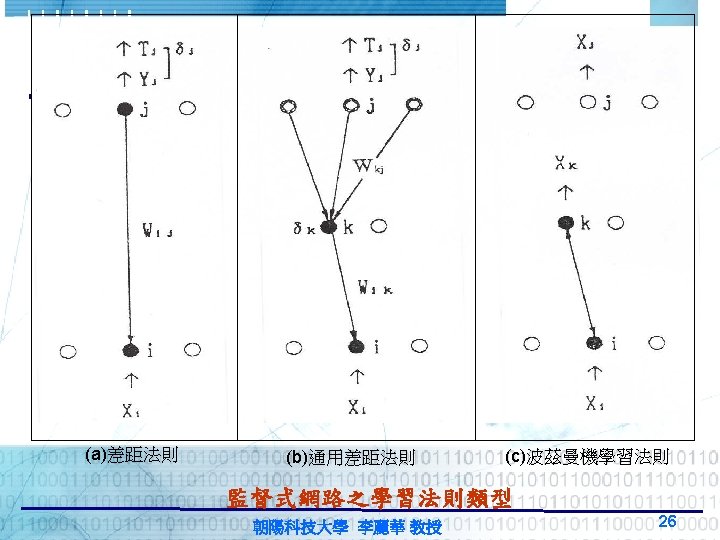
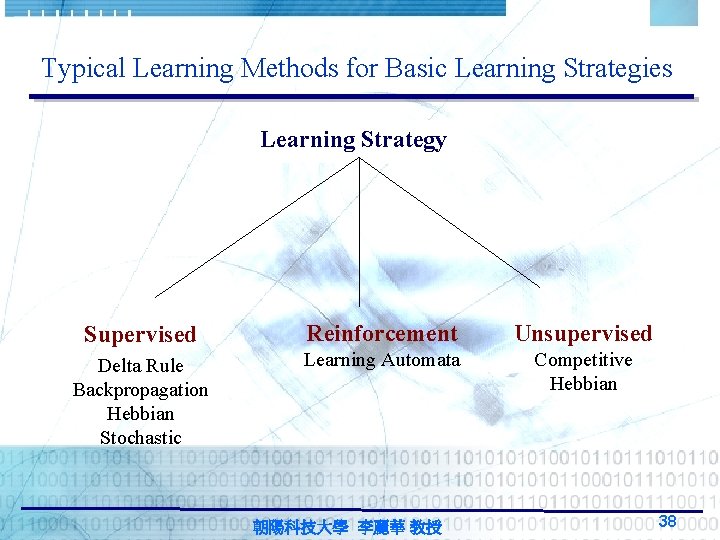
Typical Learning Methods for Basic Learning Strategies Learning Strategy Supervised Reinforcement Unsupervised Delta Rule Backpropagation Hebbian Stochastic Learning Automata Competitive Hebbian 朝陽科技大學 李麗華 教授 38
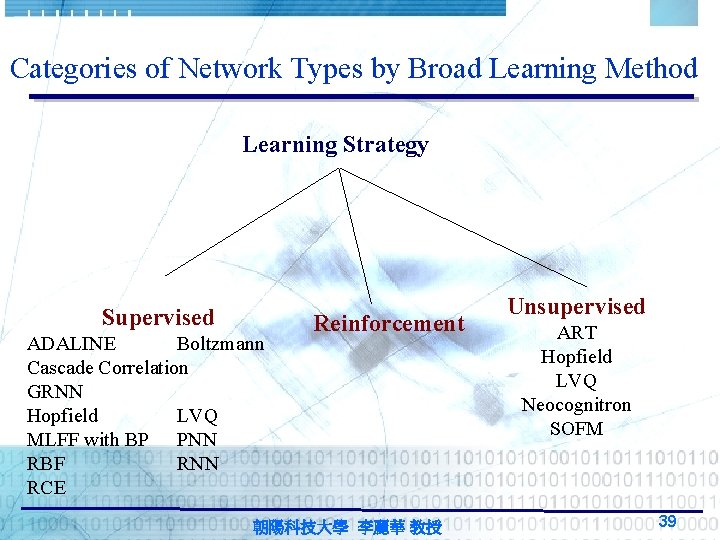
Categories of Network Types by Broad Learning Method Learning Strategy Supervised ADALINE Boltzmann Cascade Correlation GRNN Hopfield LVQ MLFF with BP PNN RBF RNN RCE Reinforcement 朝陽科技大學 李麗華 教授 Unsupervised ART Hopfield LVQ Neocognitron SOFM 39
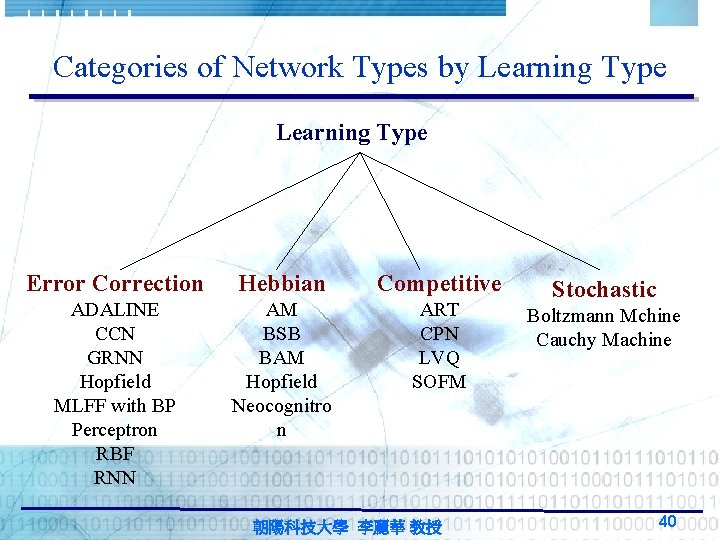
Categories of Network Types by Learning Type Error Correction Hebbian Competitive ADALINE CCN GRNN Hopfield MLFF with BP Perceptron RBF RNN AM BSB BAM Hopfield Neocognitro n ART CPN LVQ SOFM 朝陽科技大學 李麗華 教授 Stochastic Boltzmann Mchine Cauchy Machine 40
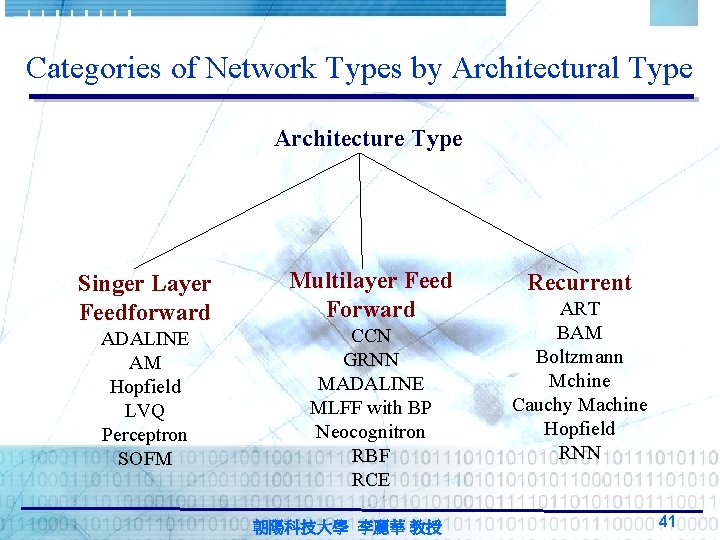
Categories of Network Types by Architectural Type Architecture Type Singer Layer Feedforward ADALINE AM Hopfield LVQ Perceptron SOFM Multilayer Feed Forward CCN GRNN MADALINE MLFF with BP Neocognitron RBF RCE 朝陽科技大學 李麗華 教授 Recurrent ART BAM Boltzmann Mchine Cauchy Machine Hopfield RNN 41
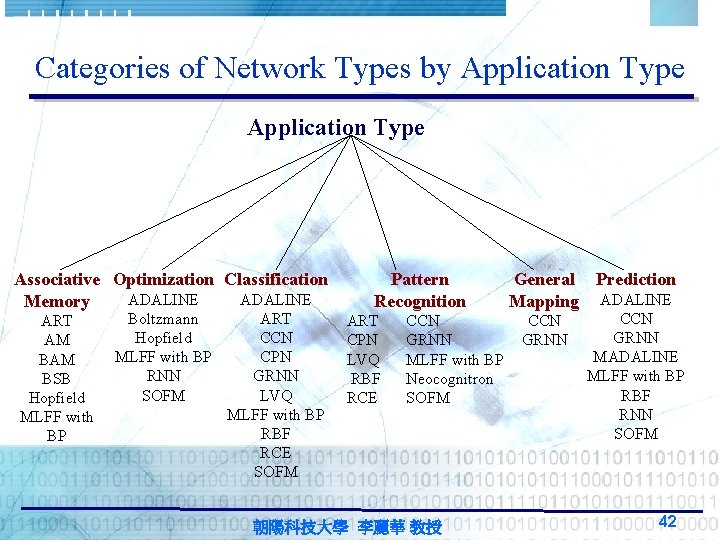
Categories of Network Types by Application Type Associative Optimization Classification ADALINE Memory ART AM BSB Hopfield MLFF with BP Boltzmann Hopfield MLFF with BP RNN SOFM ART CCN CPN GRNN LVQ MLFF with BP RBF RCE SOFM Pattern Recognition ART CPN LVQ RBF RCE CCN GRNN MLFF with BP Neocognitron SOFM 朝陽科技大學 李麗華 教授 General Prediction Mapping ADALINE CCN GRNN MADALINE MLFF with BP RBF RNN SOFM 42
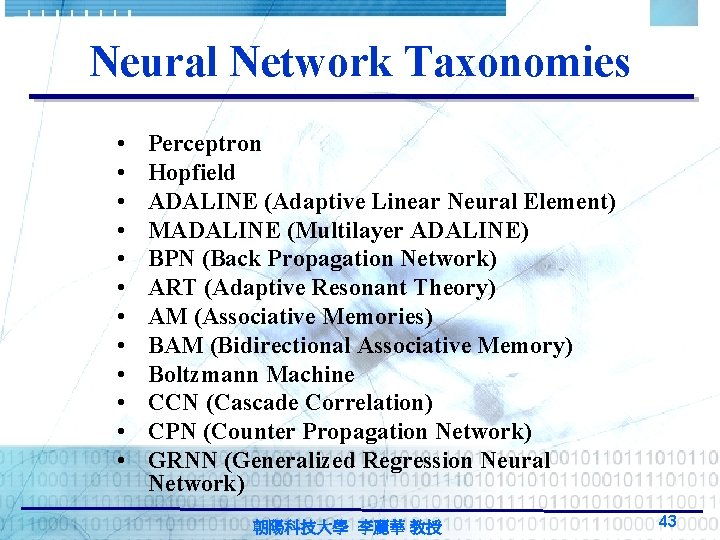
Neural Network Taxonomies • • • Perceptron Hopfield ADALINE (Adaptive Linear Neural Element) MADALINE (Multilayer ADALINE) BPN (Back Propagation Network) ART (Adaptive Resonant Theory) AM (Associative Memories) BAM (Bidirectional Associative Memory) Boltzmann Machine CCN (Cascade Correlation) CPN (Counter Propagation Network) GRNN (Generalized Regression Neural Network) 朝陽科技大學 李麗華 教授 43
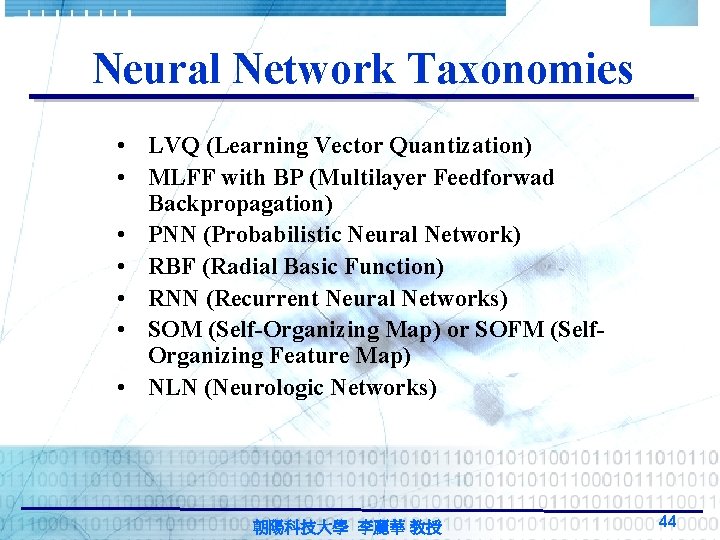
Neural Network Taxonomies • LVQ (Learning Vector Quantization) • MLFF with BP (Multilayer Feedforwad Backpropagation) • PNN (Probabilistic Neural Network) • RBF (Radial Basic Function) • RNN (Recurrent Neural Networks) • SOM (Self-Organizing Map) or SOFM (Self. Organizing Feature Map) • NLN (Neurologic Networks) 朝陽科技大學 李麗華 教授 44