
Artificial Intelligent Lecture 02 Perceptron By Nur Uddin
Artificial Intelligent Lecture 02: Perceptron By: Nur Uddin, Ph. D 1

History Artificial Intelligent - Lecture 2 2
History Pioneering work on neural network: • Mc. Culloch and Pitts (1943) for introducing the idea of neural networks as computing machines. • Hebb (1949) for postulating the first rule for self-organized learning. • Rosenblatt (1958) for proposing the perceptron as the first model for learning with a teacher (i. e. , supervised learning). Artificial Intelligent - Lecture 2 3
Perceptron • The perceptron is the simplest form of a neural network. • It is used to classify linearly separable patterns. • The learning algorithm was developed by Rosenblatt (1958, 1962) for his perceptron brain model. Artificial Intelligent - Lecture 2 4
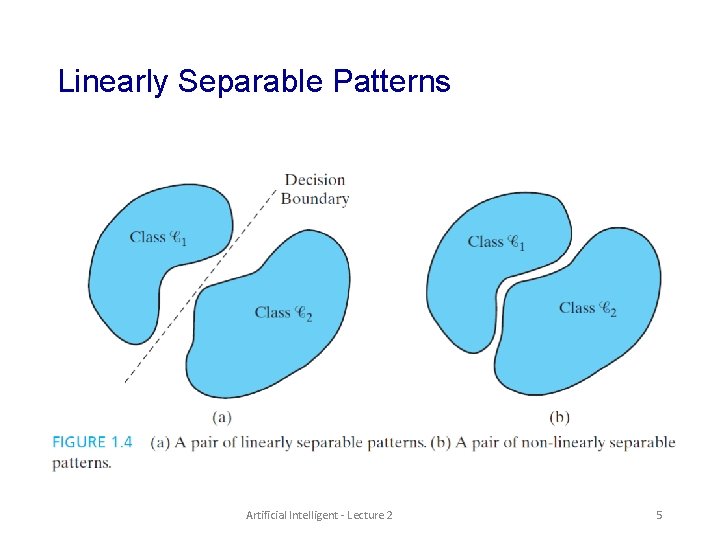
Linearly Separable Patterns Artificial Intelligent - Lecture 2 5
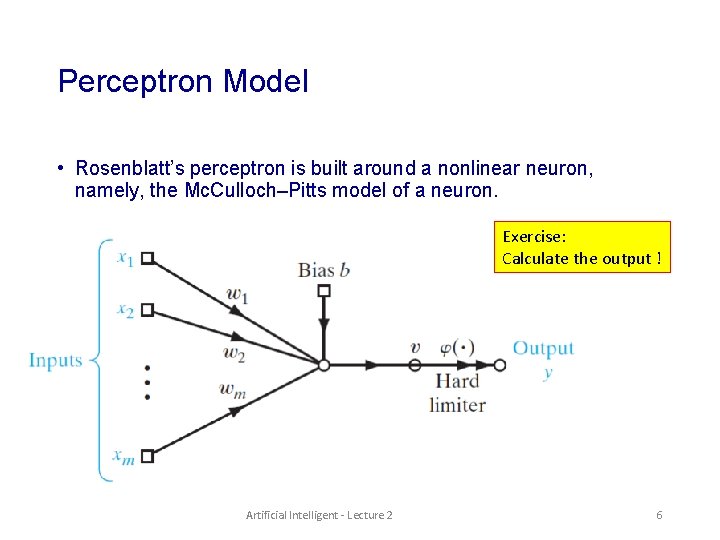
Perceptron Model • Rosenblatt’s perceptron is built around a nonlinear neuron, namely, the Mc. Culloch–Pitts model of a neuron. Exercise: Calculate the output ! Artificial Intelligent - Lecture 2 6
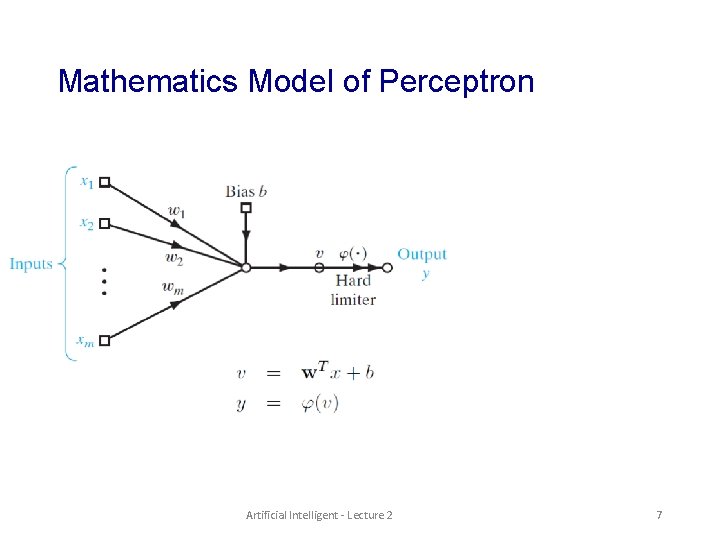
Mathematics Model of Perceptron Artificial Intelligent - Lecture 2 7
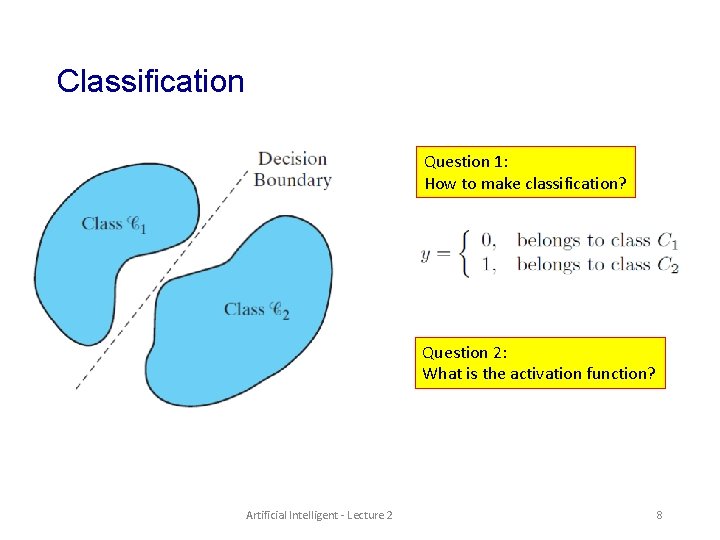
Classification Question 1: How to make classification? Question 2: What is the activation function? Artificial Intelligent - Lecture 2 8
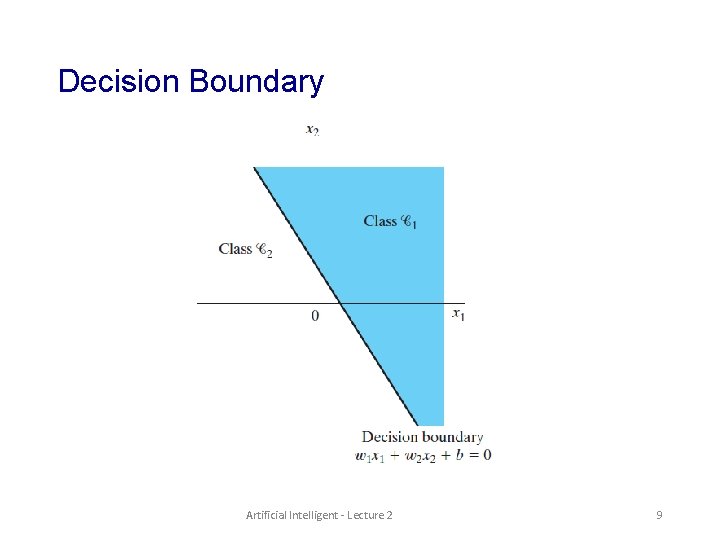
Decision Boundary Artificial Intelligent - Lecture 2 9
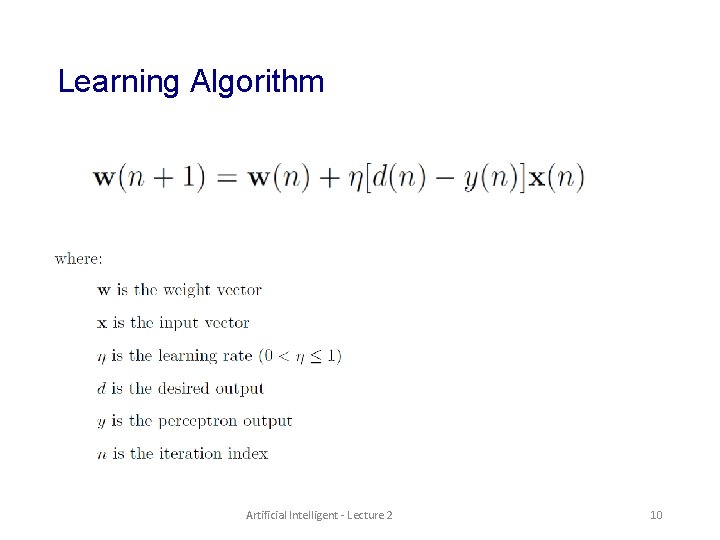
Learning Algorithm Artificial Intelligent - Lecture 2 10
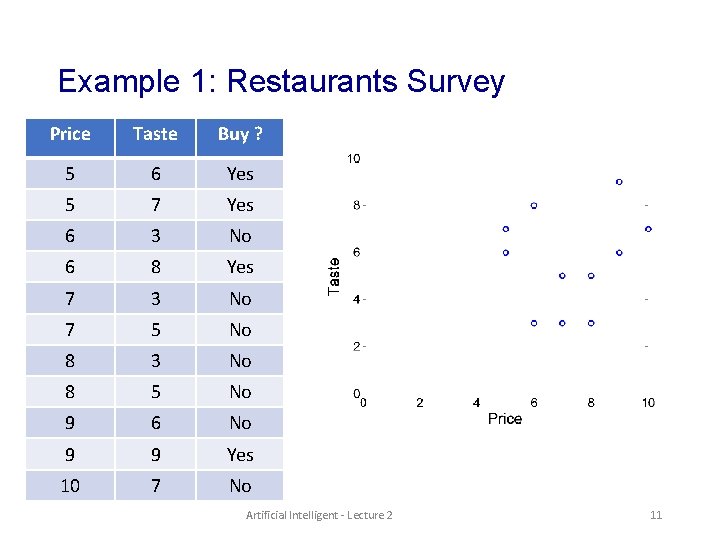
Example 1: Restaurants Survey Price Taste Buy ? 5 6 Yes 5 7 Yes 6 3 No 6 8 Yes 7 3 No 7 5 No 8 3 No 8 5 No 9 6 No 9 9 Yes 10 7 No Artificial Intelligent - Lecture 2 11
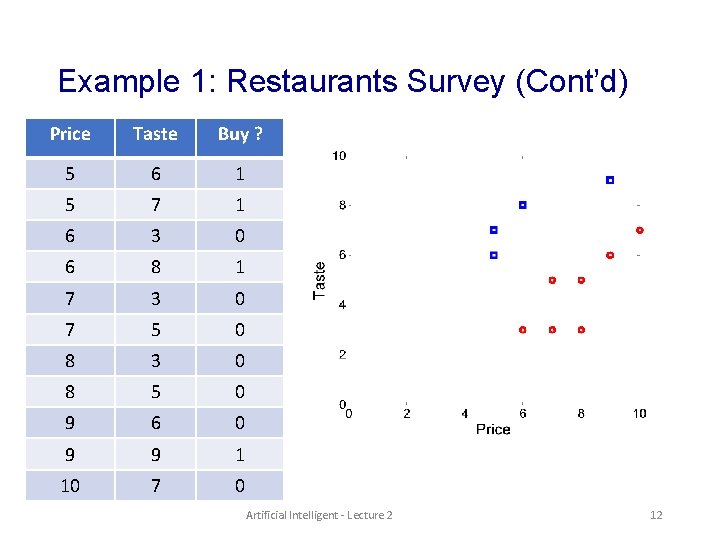
Example 1: Restaurants Survey (Cont’d) Price Taste Buy ? 5 6 1 5 7 1 6 3 0 6 8 1 7 3 0 7 5 0 8 3 0 8 5 0 9 6 0 9 9 1 10 7 0 Artificial Intelligent - Lecture 2 12
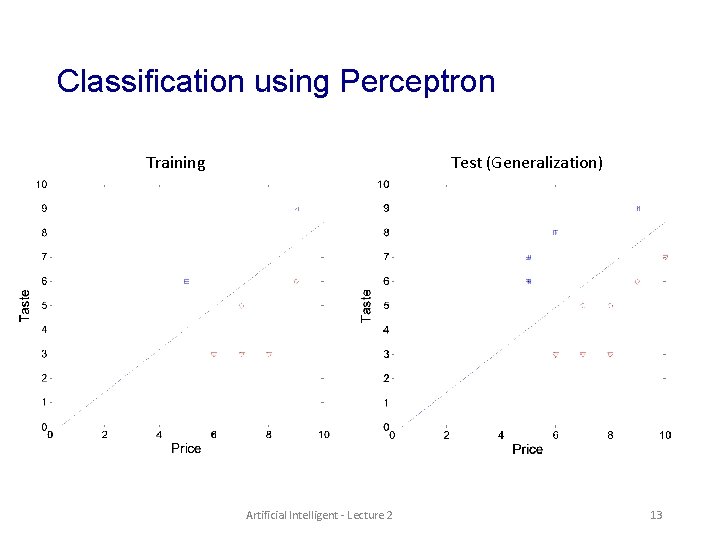
Classification using Perceptron Training Test (Generalization) Artificial Intelligent - Lecture 2 13
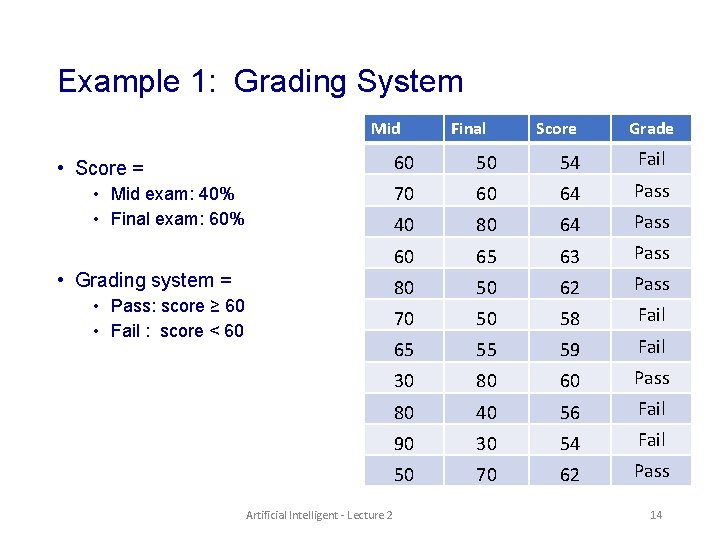
Example 1: Grading System Mid • Score = • Mid exam: 40% • Final exam: 60% • Grading system = • Pass: score ≥ 60 • Fail : score < 60 Artificial Intelligent - Lecture 2 Final Score Grade 60 50 54 Fail 70 60 64 Pass 40 80 64 Pass 60 65 63 Pass 80 50 62 Pass 70 50 58 Fail 65 55 59 Fail 30 80 60 Pass 80 40 56 Fail 90 30 54 Fail 50 70 62 Pass 14
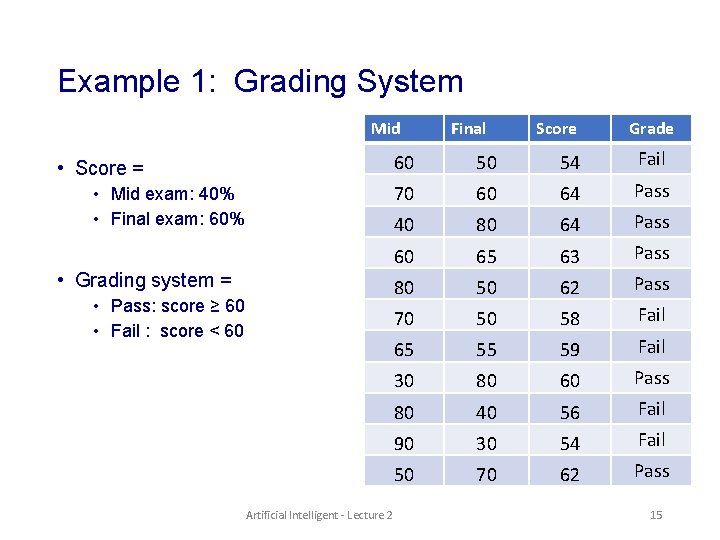
Example 1: Grading System Mid • Score = • Mid exam: 40% • Final exam: 60% • Grading system = • Pass: score ≥ 60 • Fail : score < 60 Artificial Intelligent - Lecture 2 Final Score Grade 60 50 54 Fail 70 60 64 Pass 40 80 64 Pass 60 65 63 Pass 80 50 62 Pass 70 50 58 Fail 65 55 59 Fail 30 80 60 Pass 80 40 56 Fail 90 30 54 Fail 50 70 62 Pass 15
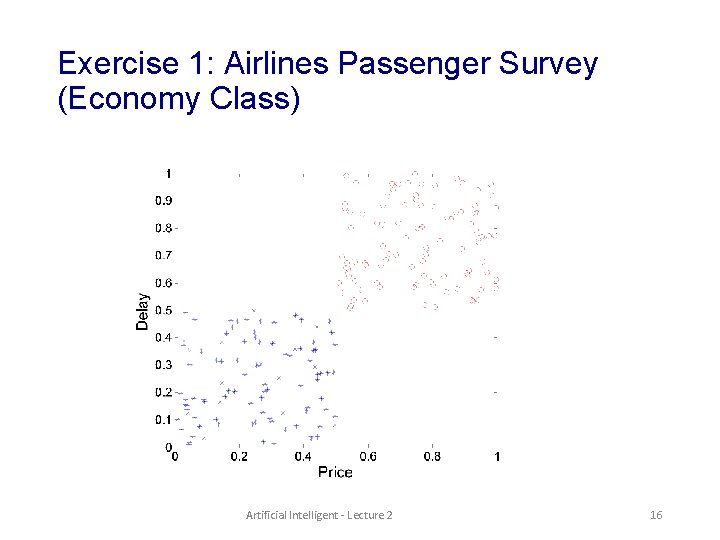
Exercise 1: Airlines Passenger Survey (Economy Class) Artificial Intelligent - Lecture 2 16
- Slides: 16