
Artificial Intelligence Tutorials 1 Tutorial 4 Q 1

![Trace greedy search Final Closed List [A I J] Solution path A I J](https://slidetodoc.com/presentation_image_h2/26a4f1461b8bf4e786bc5f817bc0d637/image-14.jpg "Trace greedy search Final Closed List [A I J] Solution path A I J")
![Trace A* search Final Closed List [A C I D E] Solution path A](https://slidetodoc.com/presentation_image_h2/26a4f1461b8bf4e786bc5f817bc0d637/image-15.jpg "Trace A* search Final Closed List [A C I D E] Solution path A")
- Slides: 15
Artificial Intelligence Tutorials 1
Tutorial #4
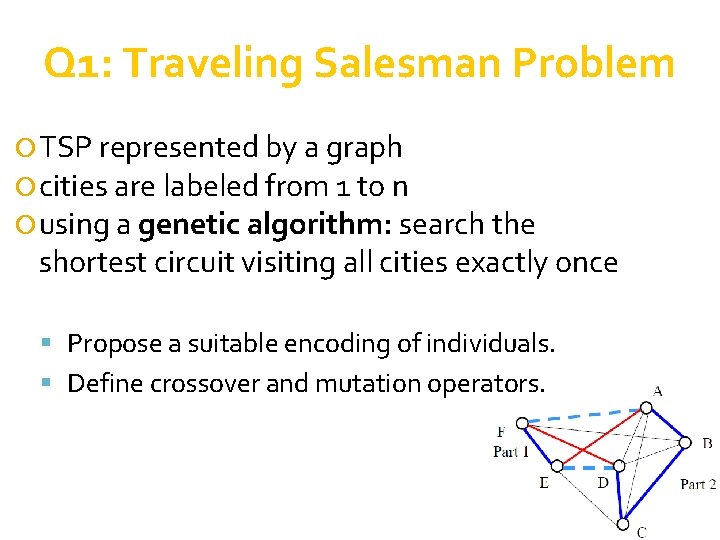
Q 1: Traveling Salesman Problem TSP represented by a graph cities are labeled from 1 to n using a genetic algorithm: search the shortest circuit visiting all cities exactly once Propose a suitable encoding of individuals. Define crossover and mutation operators.
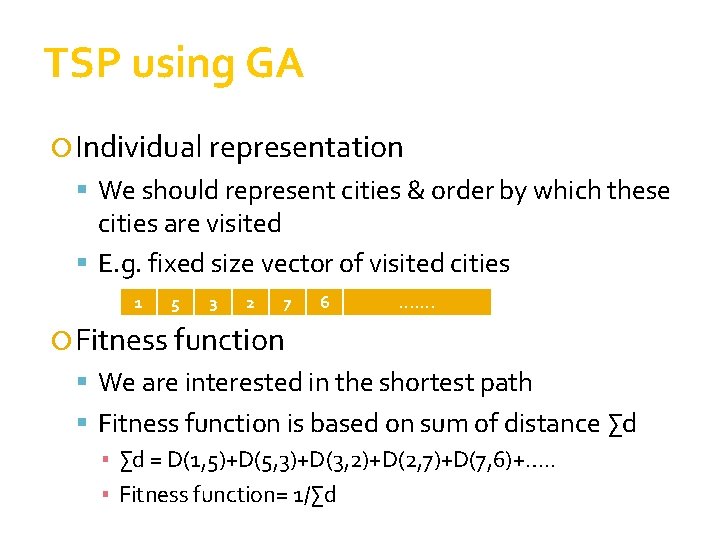
TSP using GA Individual representation We should represent cities & order by which these cities are visited E. g. fixed size vector of visited cities 1 5 3 2 7 6 . . . . Fitness function We are interested in the shortest path Fitness function is based on sum of distance ∑d ▪ ∑d = D(1, 5)+D(5, 3)+D(3, 2)+D(2, 7)+D(7, 6)+…. . ▪ Fitness function= 1/∑d
TSP using GA Individual selection Selection is done based on fitness function E. g. select the individuals with best fitness Reproduction: Using crossover and/or mutation Crossover operation ▪ Random selection of crossing point Mutation operation ▪ Calculate offspring probability , if probability <0. 001 ▪ Mutate the off spring by swapping randomly select two gens
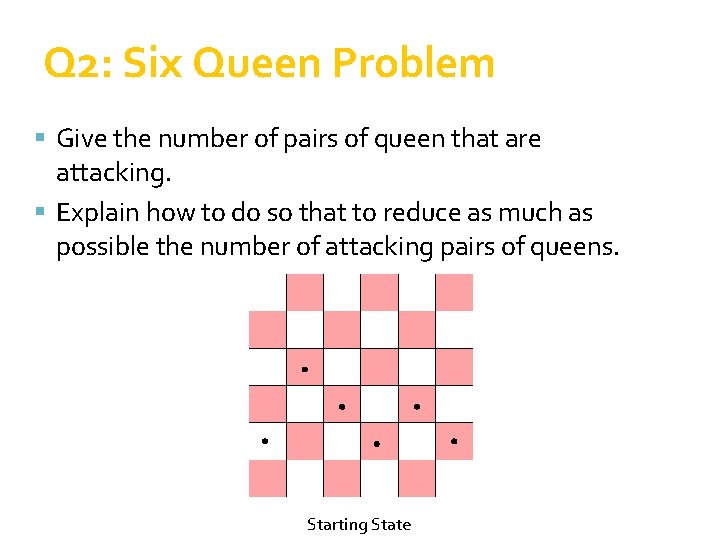
Q 2: Six Queen Problem Give the number of pairs of queen that are attacking. Explain how to do so that to reduce as much as possible the number of attacking pairs of queens. Starting State
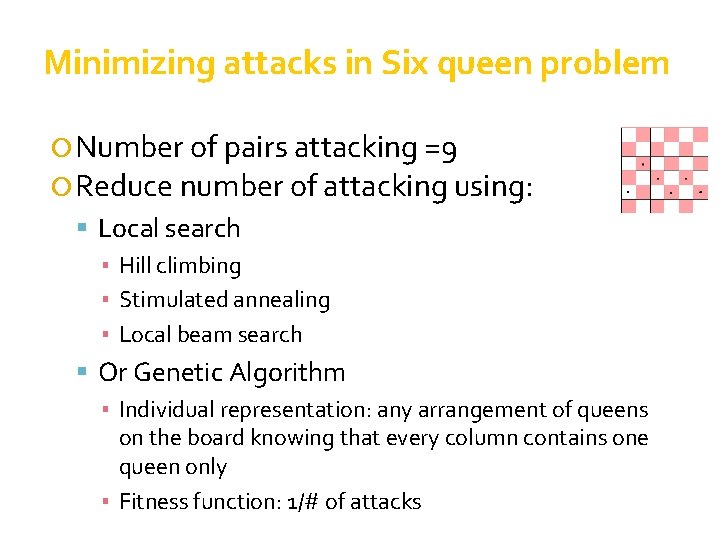
Minimizing attacks in Six queen problem Number of pairs attacking =9 Reduce number of attacking using: Local search ▪ Hill climbing ▪ Stimulated annealing ▪ Local beam search Or Genetic Algorithm ▪ Individual representation: any arrangement of queens on the board knowing that every column contains one queen only ▪ Fitness function: 1/# of attacks
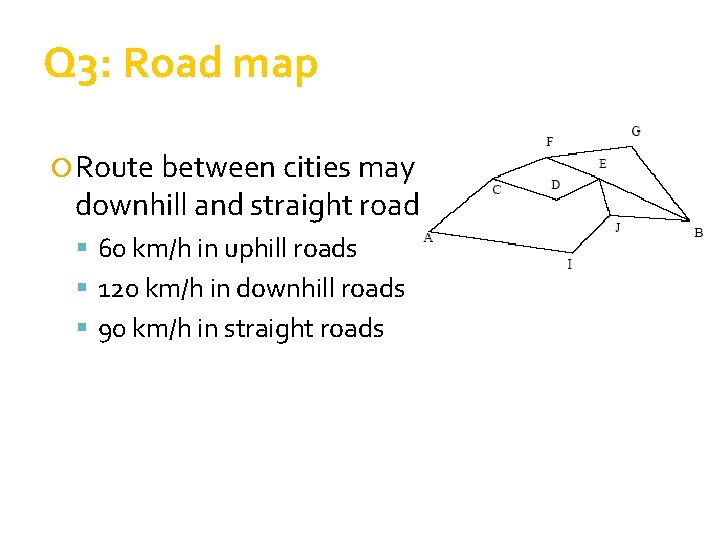
Q 3: Road map Route between cities may contain uphill, downhill and straight roads 60 km/h in uphill roads 120 km/h in downhill roads 90 km/h in straight roads
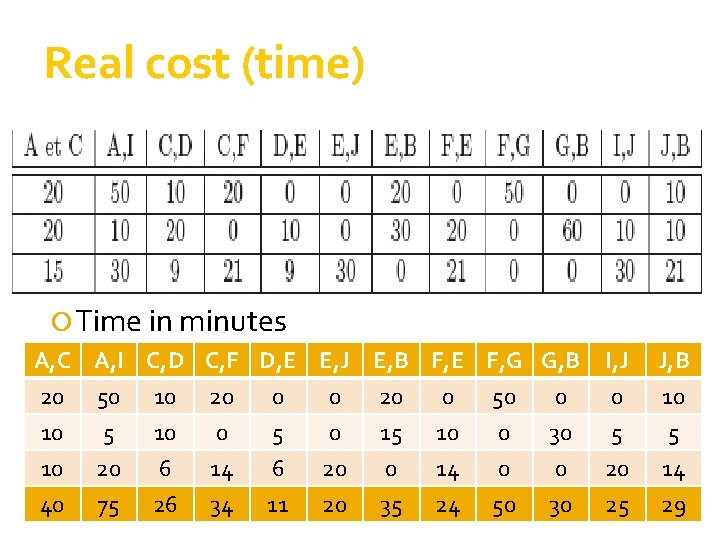
Real cost (time) Time in minutes A, C A, I C, D C, F D, E E, J E, B F, E F, G G, B 20 50 10 20 0 50 0 10 5 10 0 5 0 15 10 0 30 10 20 6 14 6 20 0 14 0 0 I, J 0 5 20 J, B 10 5 14 40 25 29 75 26 34 11 20 35 24 50 30
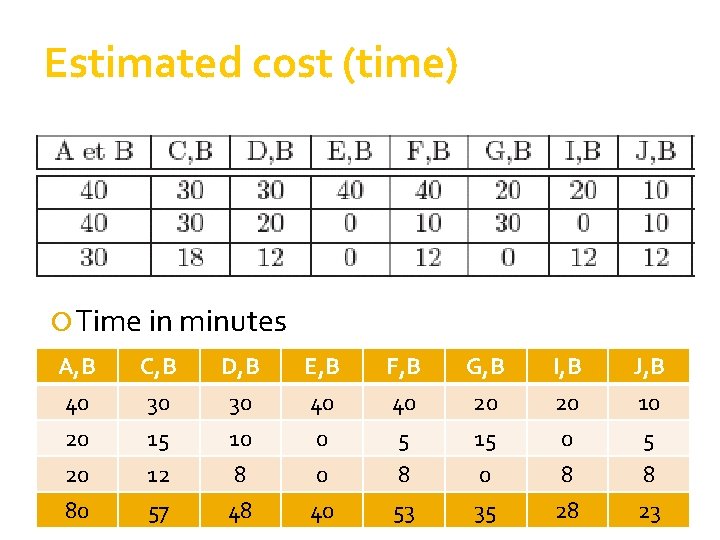
Estimated cost (time) Time in minutes A, B 40 20 20 C, B 30 15 12 D, B 30 10 8 E, B 40 0 0 F, B 40 5 8 G, B 20 15 0 I, B 20 0 8 J, B 10 5 8 80 57 48 40 53 35 28 23
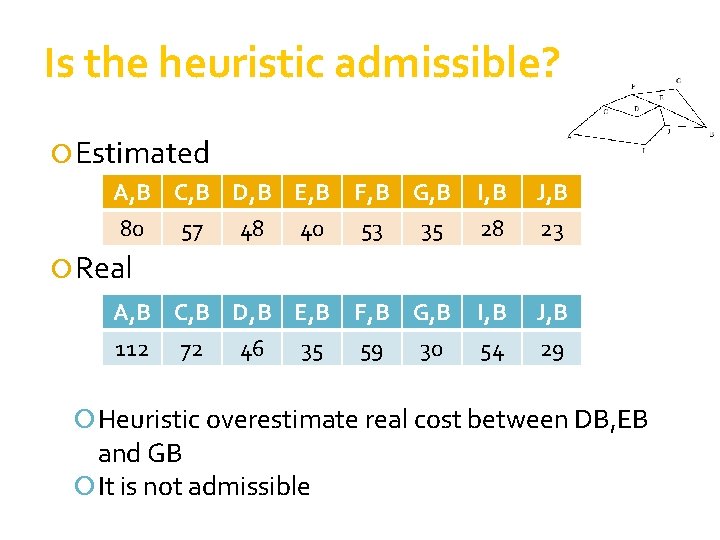
Is the heuristic admissible? Estimated A, B C, B D, B E, B 80 57 48 40 F, B G, B 53 35 I, B 28 J, B 23 F, B G, B 59 30 I, B 54 J, B 29 Real A, B C, B D, B E, B 112 72 46 35 Heuristic overestimate real cost between DB, EB and GB It is not admissible
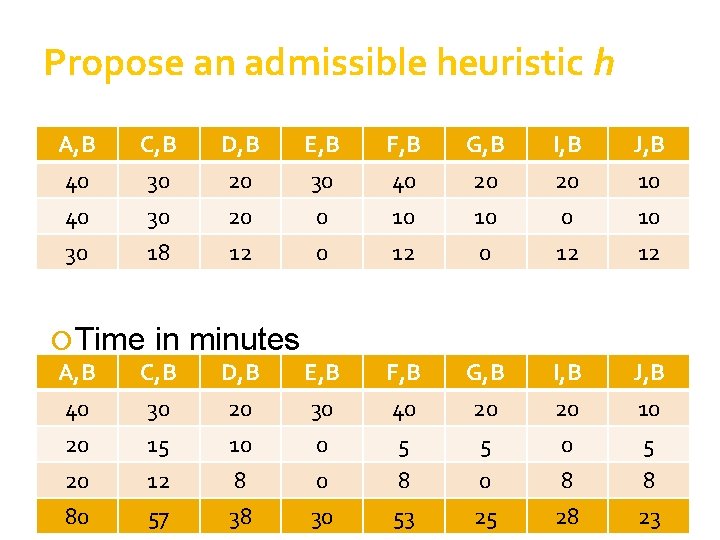
Propose an admissible heuristic h A, B 40 40 30 C, B 30 30 18 Time D, B 20 20 12 E, B 30 0 0 F, B 40 10 12 G, B 20 10 0 I, B 20 0 12 J, B 10 10 12 in minutes A, B 40 20 20 C, B 30 15 12 D, B 20 10 8 E, B 30 0 0 F, B 40 5 8 G, B 20 5 0 I, B 20 0 8 J, B 10 5 8 80 57 38 30 53 25 28 23
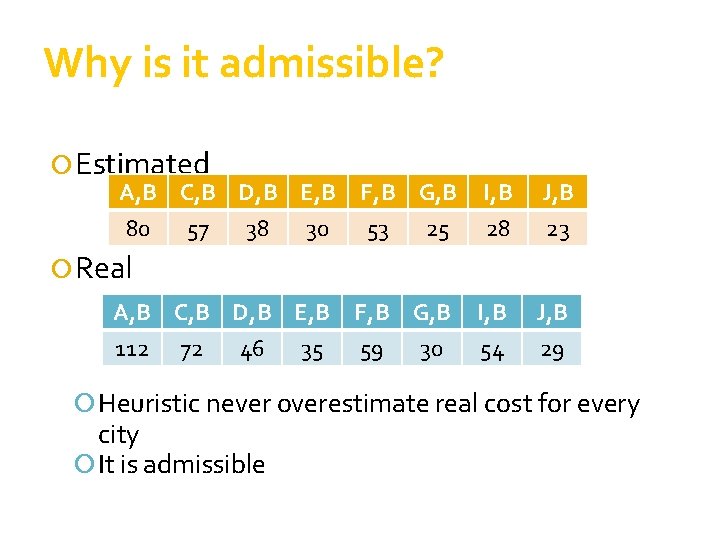
Why is it admissible? Estimated A, B C, B D, B E, B 80 57 38 30 F, B G, B 53 25 I, B 28 J, B 23 F, B G, B 59 30 I, B 54 J, B 29 Real A, B C, B D, B E, B 112 72 46 35 Heuristic never overestimate real cost for every city It is admissible
Trace greedy search Final Closed List [A I J] Solution path A I J B Order of node expansion A I J B Not optimal solution
Trace A* search Final Closed List [A C I D E] Solution path A C D E B Order of node expansion A C I D E B Optimal solution