
Artificial Intelligence The Turing Test Ian Gent ipgcs
- Slides: 18
Artificial Intelligence The Turing Test Ian Gent ipg@cs. st-and. ac. uk
Artificial Intelligence The Turing Test Part I : Part II: Turing’s Imitation Game Some sample games from the 60’s to the 90’s
Alan M Turing, Hero z Helped to found theoretical CS y 1936, before digital computers existed z Helped to found practical CS y wartime work decoding Enigma machines y ACE Report, 1946 z Helped to found practical AI y first (simulated) chess program z Helped to found theoretical AI … 3
Can Machines Think? z Computing Machinery and Intelligence y y Alan M Turing Mind, Vol LIX, Number 236 (1950) Can be found reprinted in many places e. g. Computers and Thought 4
Can Machines Think? z Turing starts by defining machine & think y Will not use everyday meaning of the words x otherwise we could answer by Gallup poll y Instead, use a different question x closely related, but unambiguous z “I believe the original question to be too meaningless to deserve discussion” 5
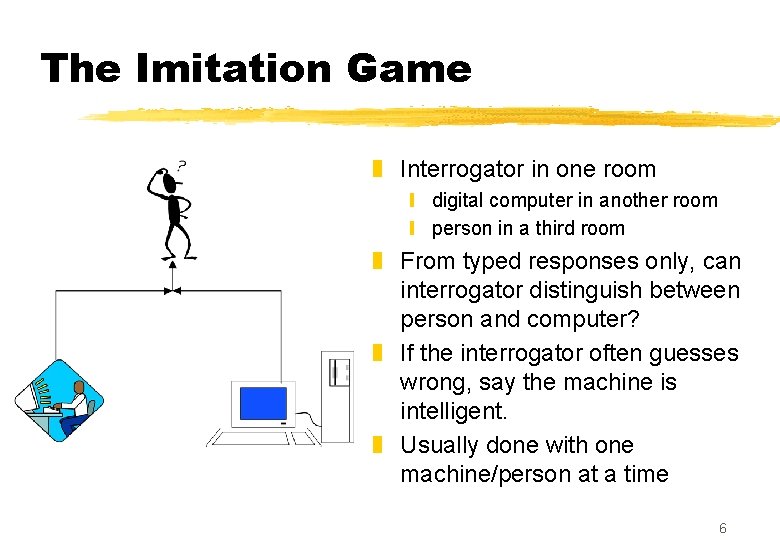
The Imitation Game z Interrogator in one room y digital computer in another room y person in a third room z From typed responses only, can interrogator distinguish between person and computer? z If the interrogator often guesses wrong, say the machine is intelligent. z Usually done with one machine/person at a time 6
A sample imitation game z Turing suggests some specimen Q & A’s: z Q: Please write me a sonnet on the subject of the Forth Bridge z A: Count me out on this one, I never could write poetry z Q: Add 34957 to 70764. y (pause about 30 seconds) z z A: 105621 Q: Do you play chess? A: Yes Q: I have K at my K 1, and no other pieces. You have only K at K 6 and R at R 1. It is your move. What do you play? y (pause about 15 s) z A: R-R 8 mate 7
What did Turing think? z Turing (in 1950) believed that by 2000 y computers available with 128 Mbytes storage y programmed so well that interrogators have only a 70% chance after 5 minutes of being right z “By 2000 the use of words and general educated opinion will have altered so much that one will be able to speak of machines thinking without expecting to be contradicted” 8
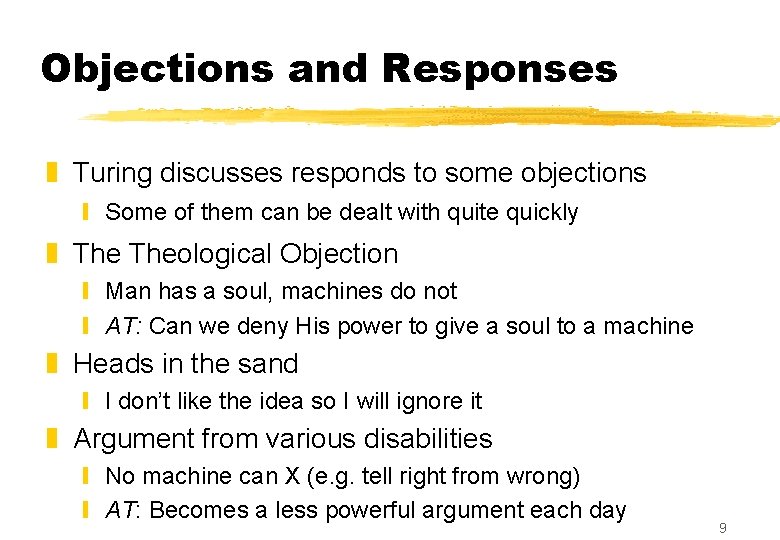
Objections and Responses z Turing discusses responds to some objections y Some of them can be dealt with quite quickly z Theological Objection y Man has a soul, machines do not y AT: Can we deny His power to give a soul to a machine z Heads in the sand y I don’t like the idea so I will ignore it z Argument from various disabilities y No machine can X (e. g. tell right from wrong) y AT: Becomes a less powerful argument each day 9
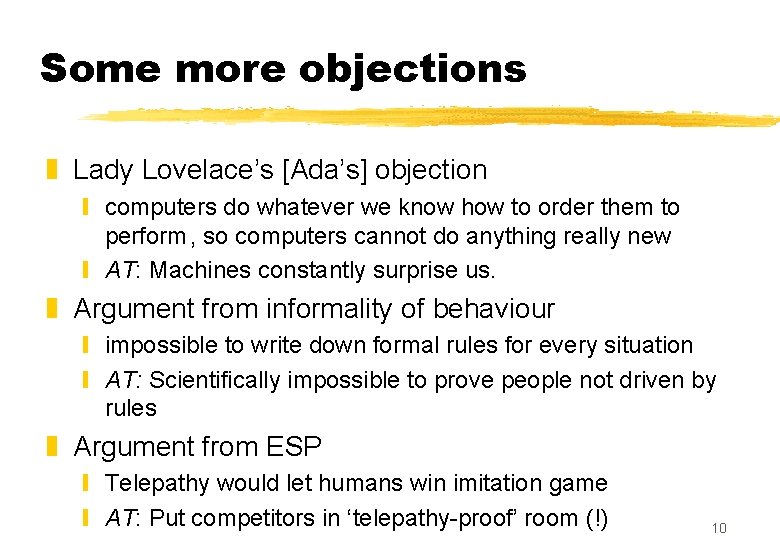
Some more objections z Lady Lovelace’s [Ada’s] objection y computers do whatever we know how to order them to perform , so computers cannot do anything really new y AT: Machines constantly surprise us. z Argument from informality of behaviour y impossible to write down formal rules for every situation y AT: Scientifically impossible to prove people not driven by rules z Argument from ESP y Telepathy would let humans win imitation game y AT: Put competitors in ‘telepathy-proof’ room (!) 10
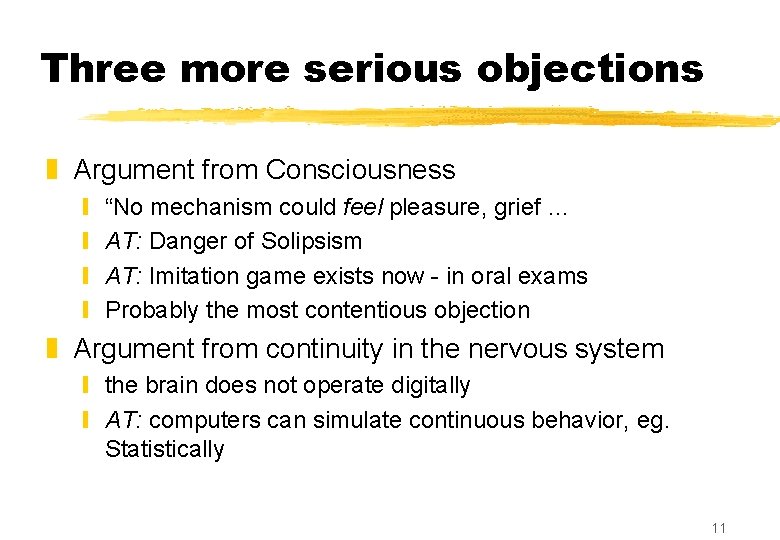
Three more serious objections z Argument from Consciousness y y “No mechanism could feel pleasure, grief … AT: Danger of Solipsism AT: Imitation game exists now - in oral exams Probably the most contentious objection z Argument from continuity in the nervous system y the brain does not operate digitally y AT: computers can simulate continuous behavior, eg. Statistically 11
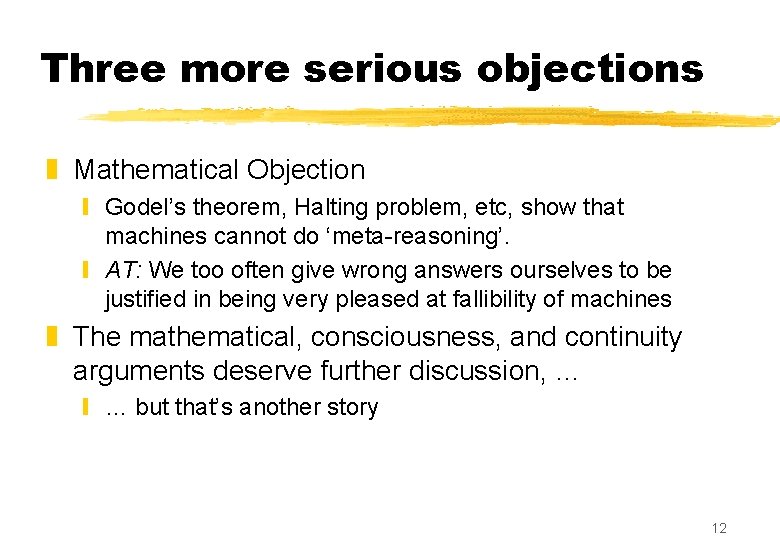
Three more serious objections z Mathematical Objection y Godel’s theorem, Halting problem, etc, show that machines cannot do ‘meta-reasoning’. y AT: We too often give wrong answers ourselves to be justified in being very pleased at fallibility of machines z The mathematical, consciousness, and continuity arguments deserve further discussion, … y … but that’s another story 12
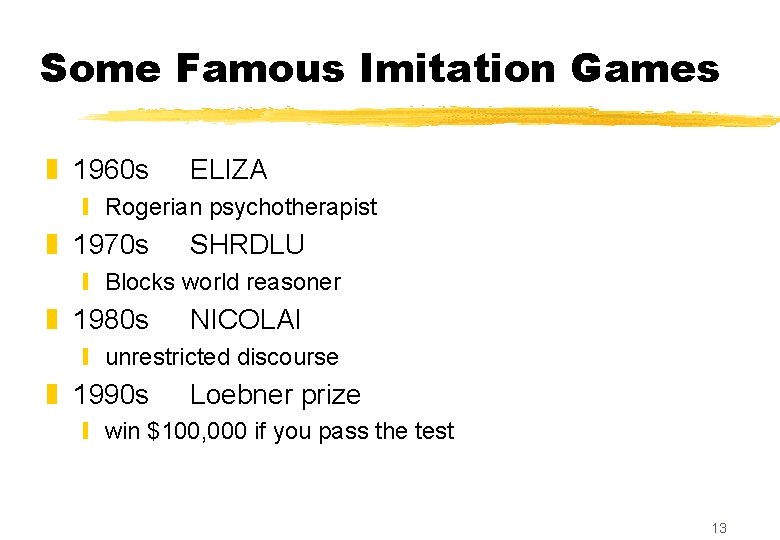
Some Famous Imitation Games z 1960 s ELIZA y Rogerian psychotherapist z 1970 s SHRDLU y Blocks world reasoner z 1980 s NICOLAI y unrestricted discourse z 1990 s Loebner prize y win $100, 000 if you pass the test 13
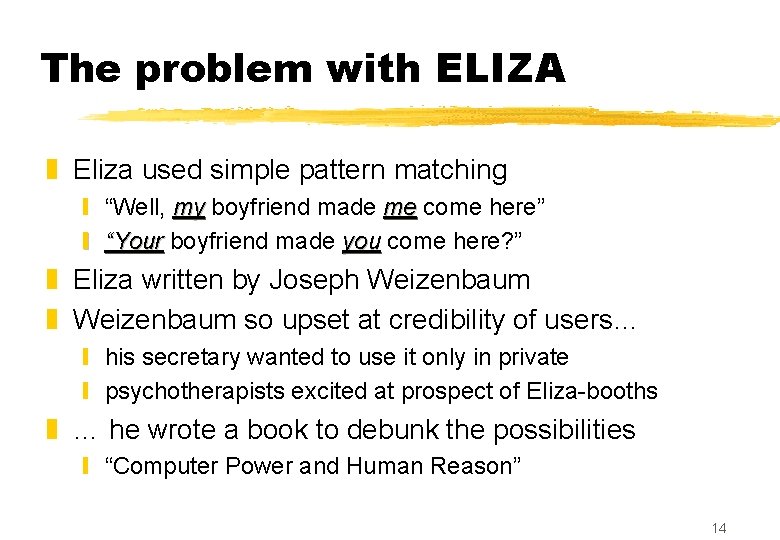
The problem with ELIZA z Eliza used simple pattern matching y “Well, my boyfriend made me come here” y “Your boyfriend made you come here? ” z Eliza written by Joseph Weizenbaum z Weizenbaum so upset at credibility of users… y his secretary wanted to use it only in private y psychotherapists excited at prospect of Eliza-booths z … he wrote a book to debunk the possibilities y “Computer Power and Human Reason” 14
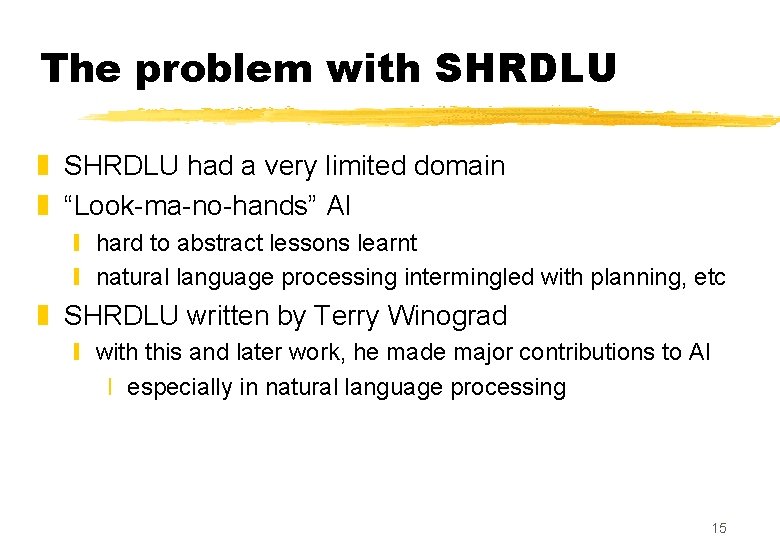
The problem with SHRDLU z SHRDLU had a very limited domain z “Look-ma-no-hands” AI y hard to abstract lessons learnt y natural language processing intermingled with planning, etc z SHRDLU written by Terry Winograd y with this and later work, he made major contributions to AI x especially in natural language processing 15
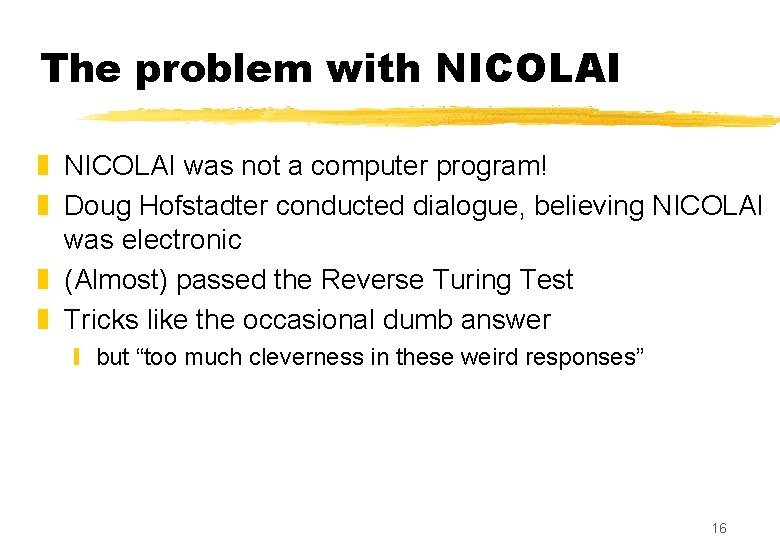
The problem with NICOLAI z NICOLAI was not a computer program! z Doug Hofstadter conducted dialogue, believing NICOLAI was electronic z (Almost) passed the Reverse Turing Test z Tricks like the occasional dumb answer y but “too much cleverness in these weird responses” 16
The problem with the Loebner Prize z Jason Hutchens programmed the 1996 winner z Then wrote an article y “How to pass the Turing test by cheating” ! y “Turing’s imitation game in general is inadequate as a test of intelligence, as it relies solely on the ability to fool people, and this can be very easy to achieve, as Weizenbaum found. ” 17
Summary: The Turing Test z The Turing test turns a philosophical question. . . x Can Machines think? z … Into an operational one x Can machines play the imitation game? z We are not near writing programs to pass the test z The Turing test does NOT drive much AI research z Improving the capabilities of computers DOES 18