
ARTIFICIAL INTELLIGENCE Slide 1 of 19 CONTENTS What

- Slides: 19
인공지능 시스템 ( ARTIFICIAL INTELLIGENCE) Slide 1 (of 19)
CONTENTS What is Artificial Intelligence? History of AI Techniques AI System Main Components of AI System Suitable Areas of AI Slide 3 (of 19)
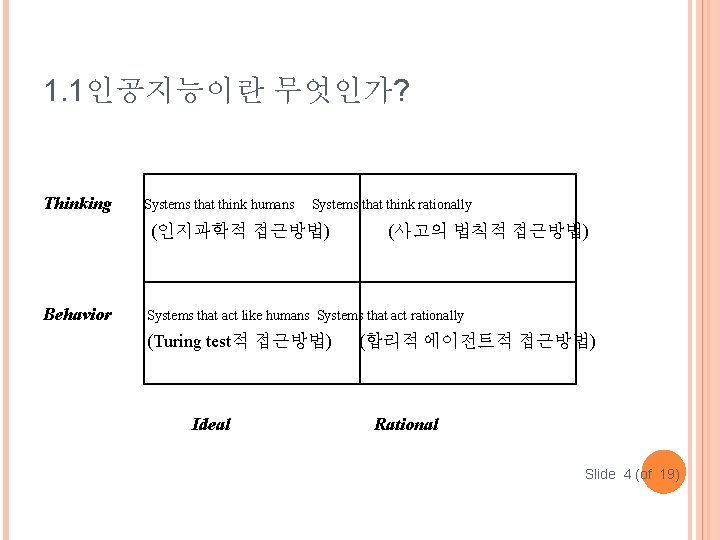
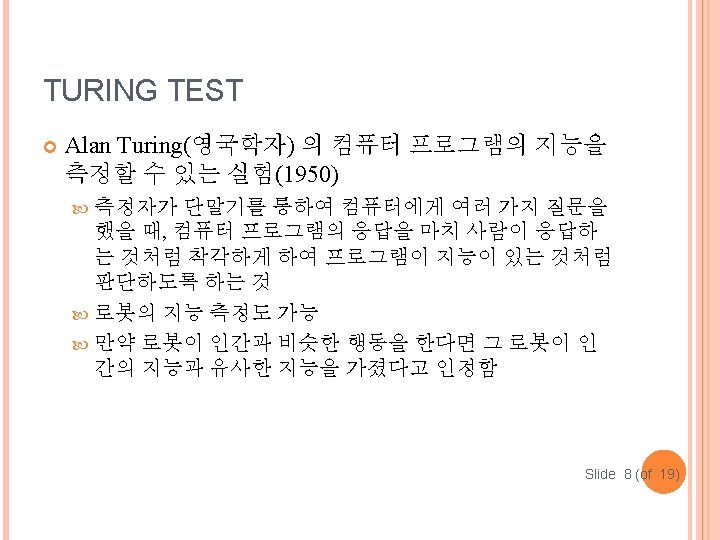
1. 1인공지능이란 무엇인가? Thinking Systems that think humans Systems that think rationally (인지과학적 접근방법) Behavior (사고의 법칙적 접근방법) Systems that act like humans Systems that act rationally (Turing test적 접근방법) Ideal (합리적 에이전트적 접근방법) Rational Slide 4 (of 19)
인간과 같은 사고 시스템 인지과학적 접근 방법 The exciting new effort to make computers think… machine with minds, in the full and literal sense(Haugeland, 1985) The automation of activities that we associate with human thinking, activities such as decision-making, problem solving, learning…(Bellman, 1978) Cognitive Science Slide 5 (of 19)
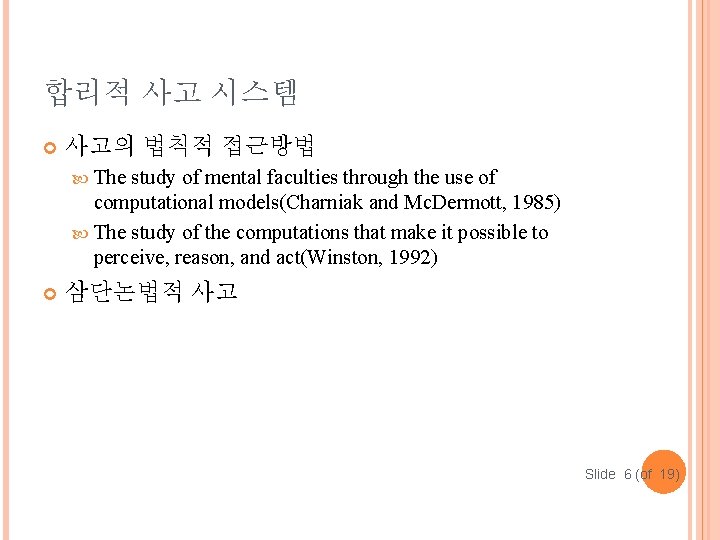
합리적 사고 시스템 사고의 법칙적 접근방법 The study of mental faculties through the use of computational models(Charniak and Mc. Dermott, 1985) The study of the computations that make it possible to perceive, reason, and act(Winston, 1992) 삼단논법적 사고 Slide 6 (of 19)
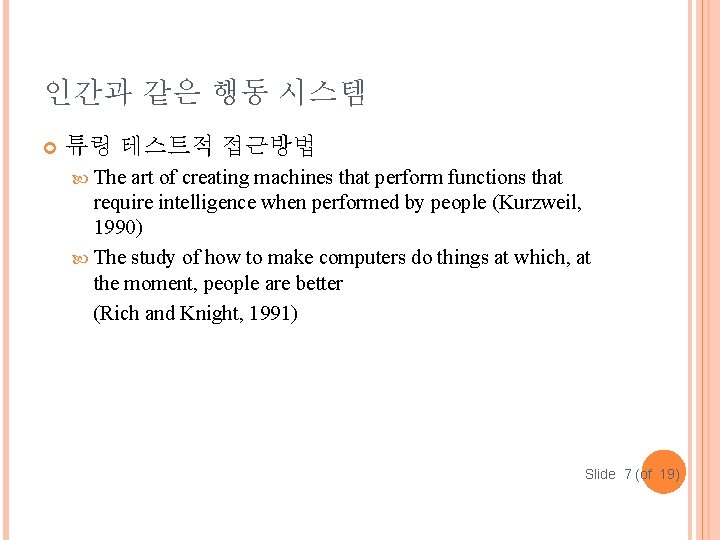
인간과 같은 행동 시스템 튜링 테스트적 접근방법 The art of creating machines that perform functions that require intelligence when performed by people (Kurzweil, 1990) The study of how to make computers do things at which, at the moment, people are better (Rich and Knight, 1991) Slide 7 (of 19)
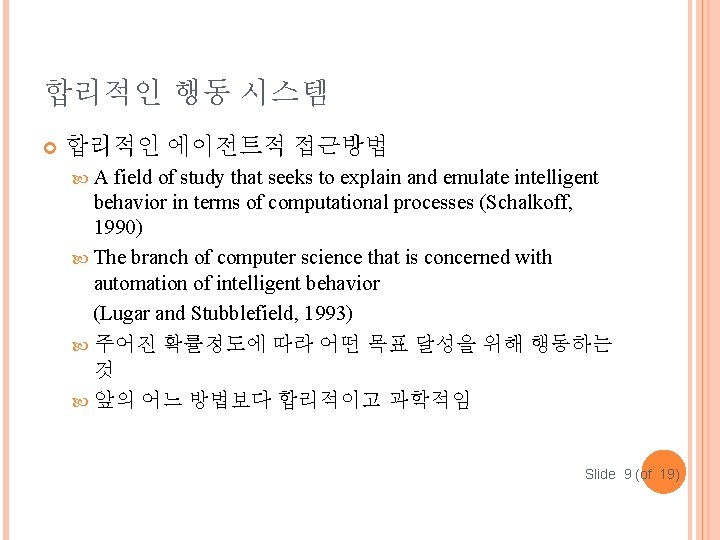
합리적인 행동 시스템 합리적인 에이전트적 접근방법 A field of study that seeks to explain and emulate intelligent behavior in terms of computational processes (Schalkoff, 1990) The branch of computer science that is concerned with automation of intelligent behavior (Lugar and Stubblefield, 1993) 주어진 확률정도에 따라 어떤 목표 달성을 위해 행동하는 것 앞의 어느 방법보다 합리적이고 과학적임 Slide 9 (of 19)
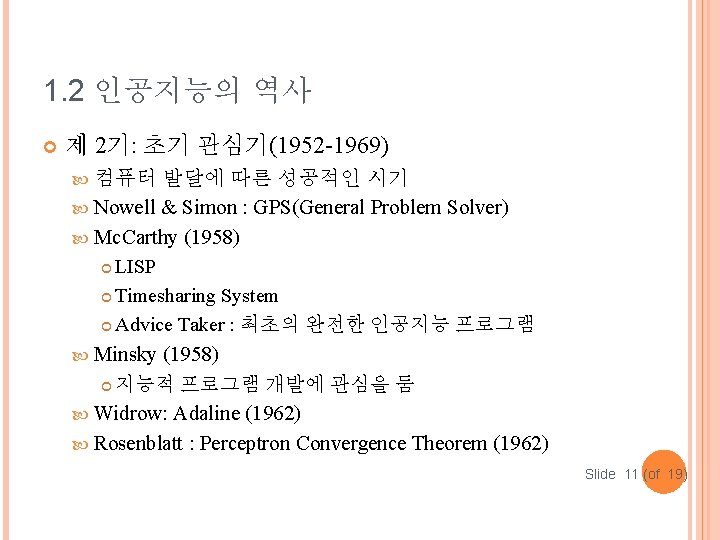
1. 2 인공지능의 역사 제 2기: 초기 관심기(1952 -1969) 컴퓨터 발달에 따른 성공적인 시기 Nowell & Simon : GPS(General Problem Solver) Mc. Carthy (1958) LISP Timesharing System Advice Taker : 최초의 완전한 인공지능 프로그램 Minsky (1958) 지능적 프로그램 개발에 관심을 둠 Widrow: Adaline (1962) Rosenblatt : Perceptron Convergence Theorem (1962) Slide 11 (of 19)
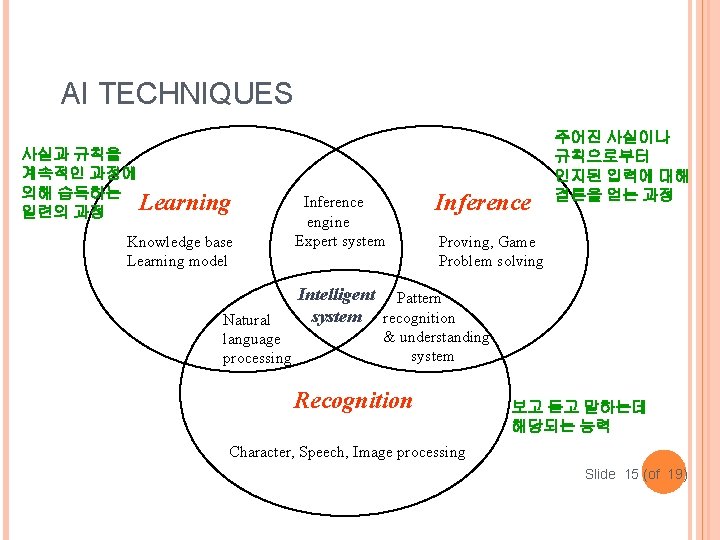
AI TECHNIQUES 사실과 규칙을 계속적인 과정에 의해 습득하는 Learning 일련의 과정 Knowledge base Learning model Natural language processing Inference engine Expert system Inference 주어진 사실이나 규칙으로부터 인지된 입력에 대해 결론을 얻는 과정 Proving, Game Problem solving Intelligent Pattern system recognition & understanding system Recognition 보고 듣고 말하는데 해당되는 능력 Character, Speech, Image processing Slide 15 (of 19)
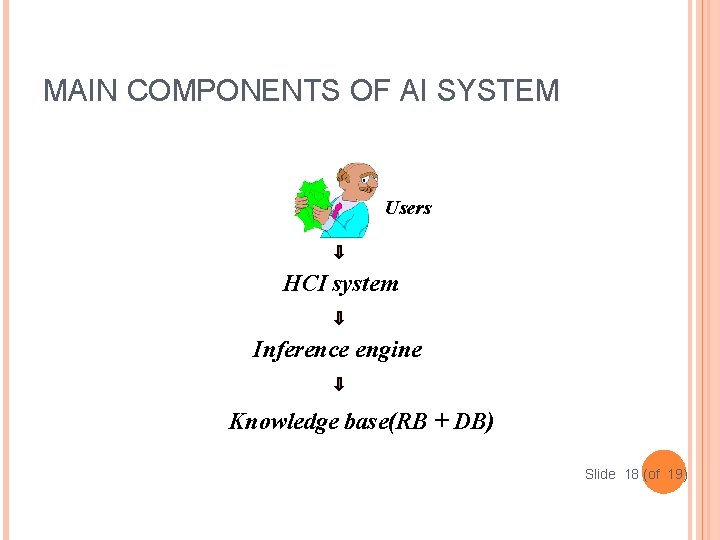
MAIN COMPONENTS OF AI SYSTEM Users HCI system Inference engine Knowledge base(RB + DB) Slide 18 (of 19)
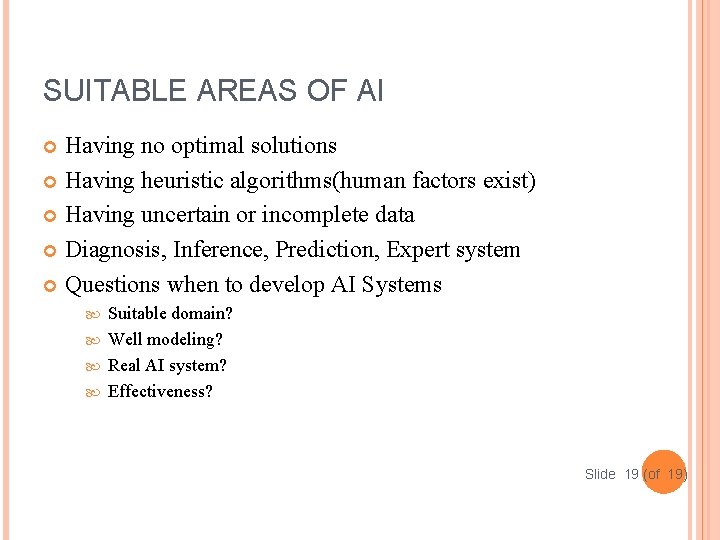
SUITABLE AREAS OF AI Having no optimal solutions Having heuristic algorithms(human factors exist) Having uncertain or incomplete data Diagnosis, Inference, Prediction, Expert system Questions when to develop AI Systems Suitable domain? Well modeling? Real AI system? Effectiveness? Slide 19 (of 19)