
ARTIFICIAL INTELLIGENCE MACHINE LEARNING MEDICAL DEVICE SOFTWARE ACTION










- Slides: 27
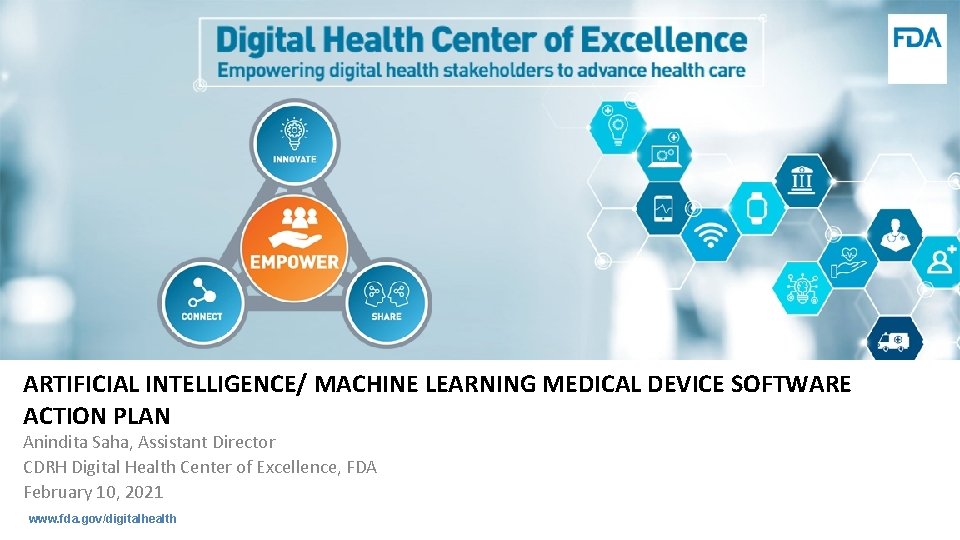
ARTIFICIAL INTELLIGENCE/ MACHINE LEARNING MEDICAL DEVICE SOFTWARE ACTION PLAN Anindita Saha, Assistant Director CDRH Digital Health Center of Excellence, FDA February 10, 2021 www. fda. gov/digitalhealth
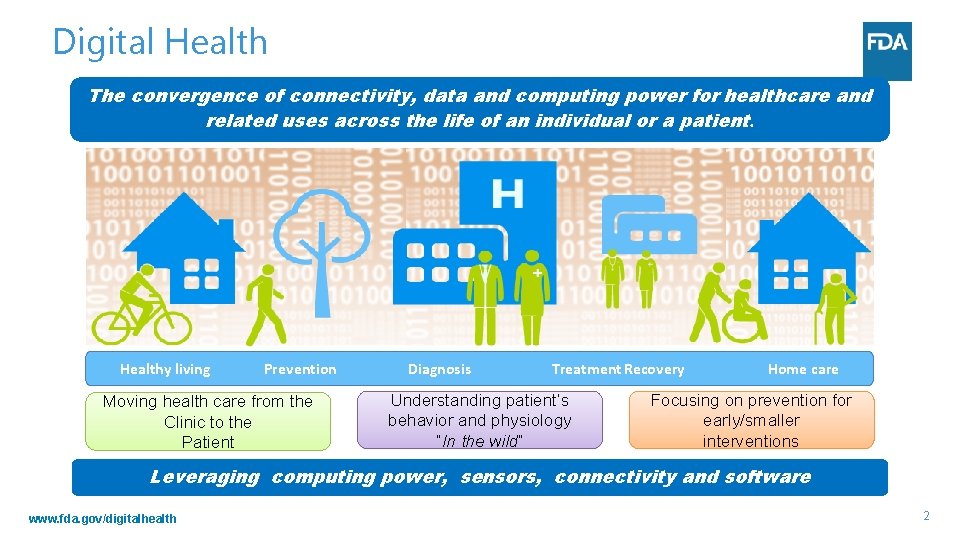
Digital Health The convergence of connectivity, data and computing power for healthcare and related uses across the life of an individual or a patient. Healthy living Prevention Moving health care from the Clinic to the Patient Diagnosis Treatment Recovery Understanding patient’s behavior and physiology “In the wild” Home care Focusing on prevention for early/smaller interventions Leveraging computing power, sensors, connectivity and software www. fda. gov/digitalhealth 2
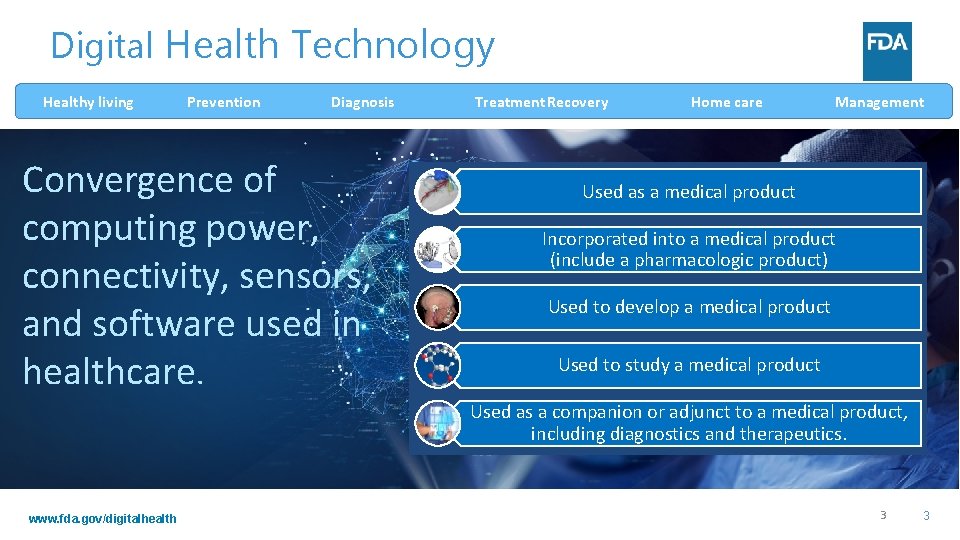
Digital Health Technology Healthy living Prevention Diagnosis Convergence of computing power, connectivity, sensors, and software used in healthcare. Treatment Recovery Home care Management Used as a medical product Incorporated into a medical product (include a pharmacologic product) Used to develop a medical product Used to study a medical product Used as a companion or adjunct to a medical product, including diagnostics and therapeutics. www. fda. gov/digitalhealth 3 3
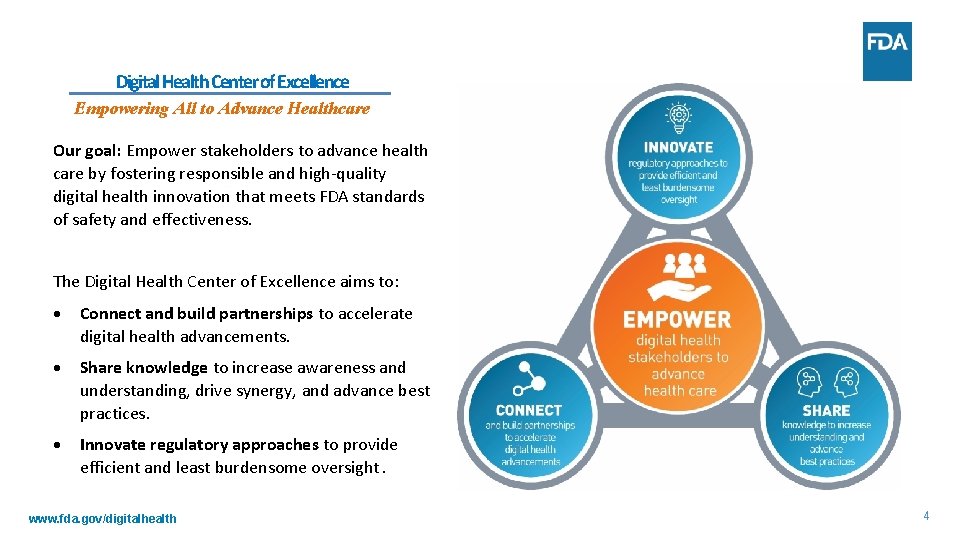
Digital Health Center of Excellence Empowering All to Advance Healthcare Our goal: Empower stakeholders to advance health care by fostering responsible and high-quality digital health innovation that meets FDA standards of safety and effectiveness. Develop novel, efficient regulatory approaches that are least burdensome The Digital Health Center of Excellence aims to: Connect and build partnerships to accelerate digital health advancements. Share knowledge to increase awareness and Share understanding, drive synergy, and advance best Connect Gather, simplify, Build partnerships, practices. and share new networks to accelerate and scale information to Innovate regulatory approaches provide increaseto awareness and understanding efficient and least burdensome oversight. www. fda. gov/digitalhealth 4
DHCo. E Services www. fda. gov/digitalhealth 5
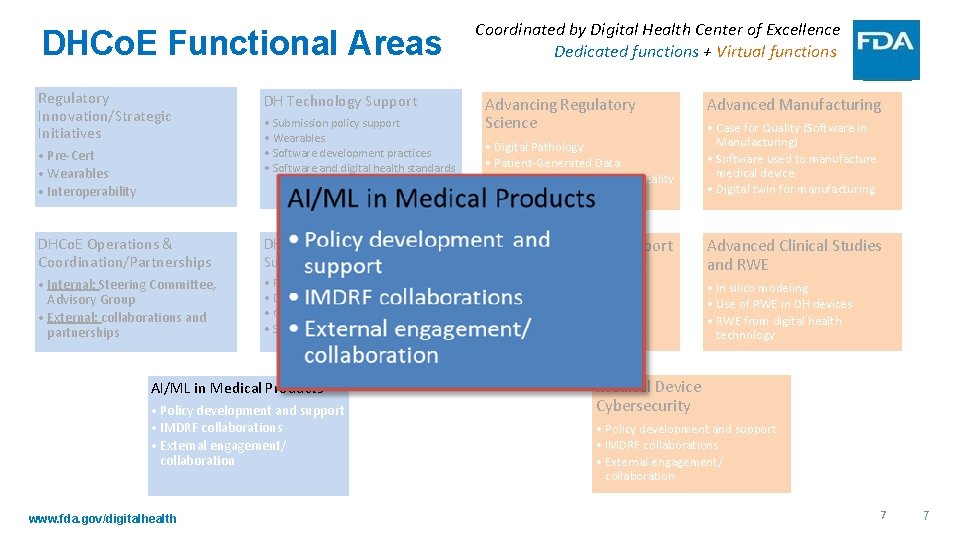
DHCo. E Functional Areas Regulatory Innovation/Strategic Initiatives • Pre-Cert • Wearables • Interoperability • Digital Biomarkers DH Technology Support • Submission policy support • Wearables • Software development practices • Software and digital health standards DHCo. E Operations & Coordination/Partnerships DH Policy Development/ Support • Internal: Steering Committee, Advisory Group • External: collaborations and partnerships • Policy development and support • DH inquiries • Guidance/Policy development • Submission support AI/ML in Medical Products • Policy development and support • IMDRF collaborations • External engagement/ collaboration www. fda. gov/digitalhealth Coordinated by Digital Health Center of Excellence Dedicated functions + Virtual functions Advancing Regulatory Science • Digital Pathology • Patient-Generated Data • Virtual Reality/Augmented Reality Regulatory Review Support • Day – day review support for OHTs • Implement DH policies • Training for reviewers • Implement competency tiers Advanced Manufacturing • Case for Quality (Software in Manufacturing) • Software used to manufacture medical device • Digital twin for manufacturing Advanced Clinical Studies and RWE • In silico modeling • Use of RWE in DH devices • RWE from digital health technology Medical Device Cybersecurity • Policy development and support • IMDRF collaborations • External engagement/ collaboration 6 6
DHCo. E Functional Areas Regulatory Innovation/Strategic Initiatives • Pre-Cert • Wearables • Interoperability DH Technology Support • Submission policy support • Wearables • Software development practices • Software and digital health standards DHCo. E Operations & Coordination/Partnerships DH Policy Development/ Support • Internal: Steering Committee, Advisory Group • External: collaborations and partnerships • Policy development and support • DH inquiries • Guidance/Policy development • Submission support AI/ML in Medical Products • Policy development and support • IMDRF collaborations • External engagement/ collaboration www. fda. gov/digitalhealth Coordinated by Digital Health Center of Excellence Dedicated functions + Virtual functions Advancing Regulatory Science • Digital Pathology • Patient-Generated Data • Virtual Reality/Augmented Reality Regulatory Review Support • Day – day review support for OHTs • Implement DH policies • Training for reviewers • Implement competency tiers Advanced Manufacturing • Case for Quality (Software in Manufacturing) • Software used to manufacture medical device • Digital twin for manufacturing Advanced Clinical Studies and RWE • In silico modeling • Use of RWE in DH devices • RWE from digital health technology Medical Device Cybersecurity • Policy development and support • IMDRF collaborations • External engagement/ collaboration 7 7
AI/ML Medical Device Software Action Plan www. fda. gov/digitalhealth 8
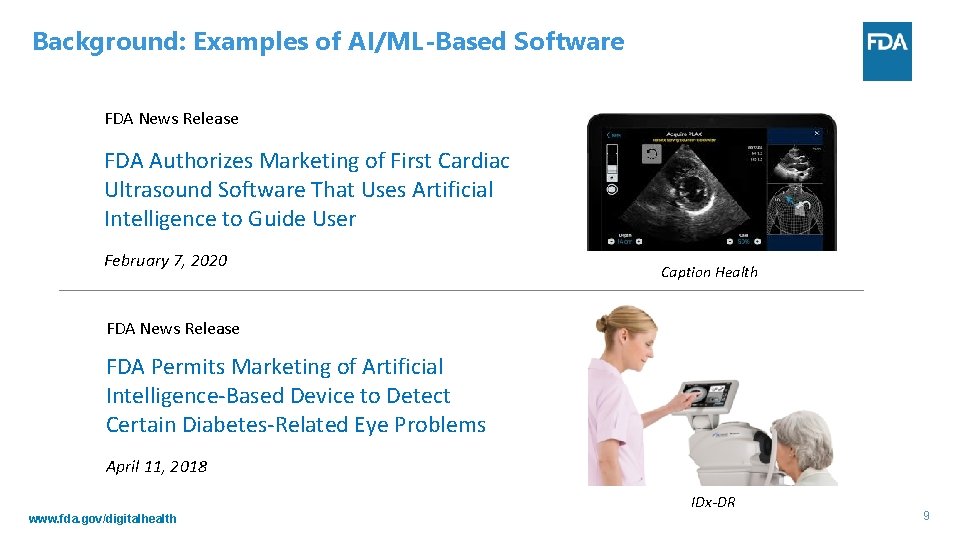
Background: Examples of AI/ML-Based Software FDA News Release FDA Authorizes Marketing of First Cardiac Ultrasound Software That Uses Artificial Intelligence to Guide User February 7, 2020 Caption Health FDA News Release FDA Permits Marketing of Artificial Intelligence-Based Device to Detect Certain Diabetes-Related Eye Problems April 11, 2018 IDx-DR www. fda. gov/digitalhealth 9
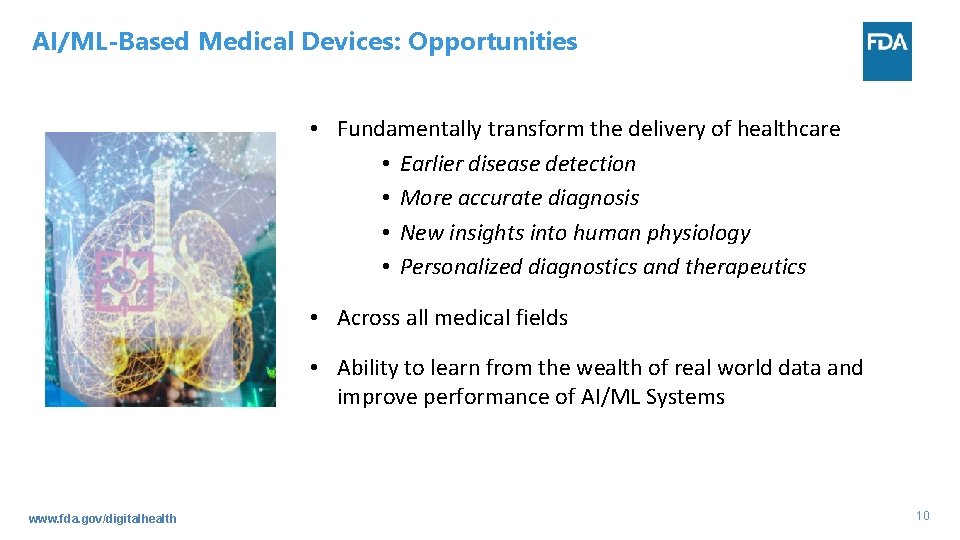
AI/ML-Based Medical Devices: Opportunities • Fundamentally transform the delivery of healthcare • Earlier disease detection • More accurate diagnosis • New insights into human physiology • Personalized diagnostics and therapeutics • Across all medical fields • Ability to learn from the wealth of real world data and improve performance of AI/ML Systems www. fda. gov/digitalhealth 10
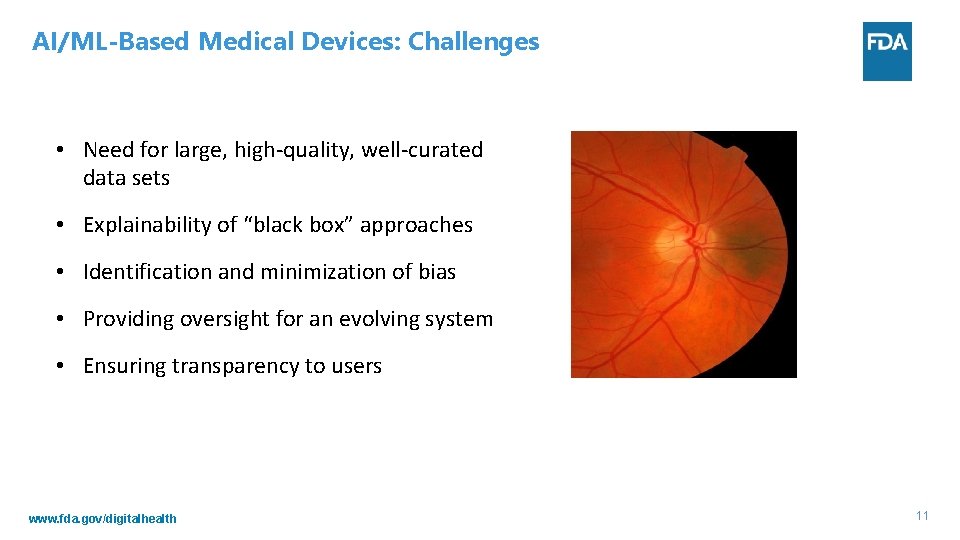
AI/ML-Based Medical Devices: Challenges • Need for large, high-quality, well-curated data sets • Explainability of “black box” approaches • Identification and minimization of bias • Providing oversight for an evolving system • Ensuring transparency to users www. fda. gov/digitalhealth 11
Digital Health Center of Excellence Artificial Intelligence/ Machine Learning (AI/ML) Recent Milestones April 2019: Published AI/ML-Sa. MD - Discussion Paper Sept 2019: Initiated participation in Collaborative Community related to AI/ML WORKSHOP Evolving Role of AI in Radiological Imaging February 28 -28, 2020 Feb 2020: Public Workshop on the Evolving Role of AI in Radiological Imaging Oct 2020: Patient Engagement Advisory Committee (PEAC) Meeting on patient trust in AI/ML technologies. www. fda. gov/digitalhealth 12
Proposed Regulatory Framework for AI/ML-Based Sa. MD: Discussion Paper & Request for Feedback Since publishing in April 2019 FDA’s Proposed Regulatory Framework for Modifications to AI/ML-Based Sa. MD, we’ve received stakeholder feedback through: • > 1, 000 comments on public docket from a diverse community of stakeholders • > 30 publications in peer-reviewed journals • Pre-submission meetings on AI/ML devices • Patient Engagement Advisory Committee Meeting (PEAC) www. fda. gov/digitalhealth 13
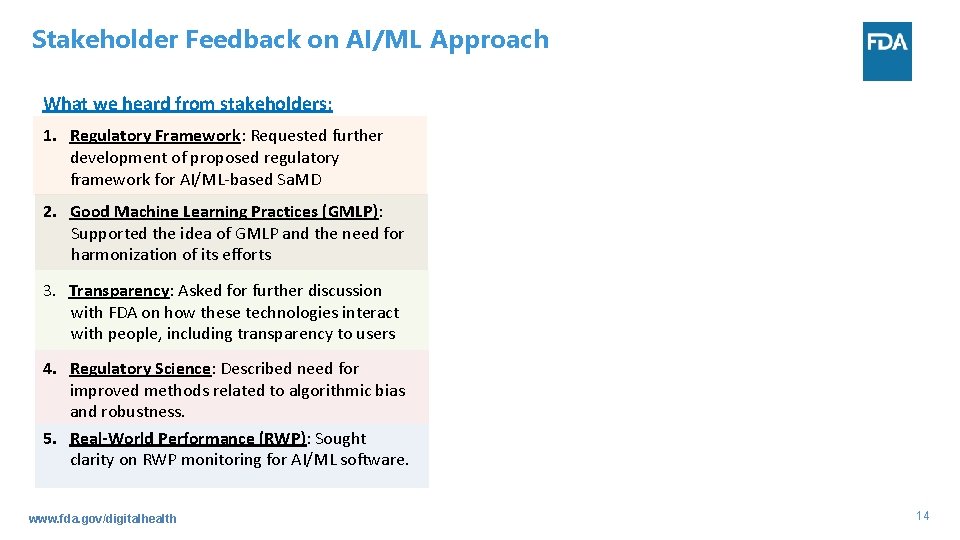
Stakeholder Feedback on AI/ML Approach What we heard from stakeholders: 1. Regulatory Framework: Requested further development of proposed regulatory framework for AI/ML-based Sa. MD 2. Good Machine Learning Practices (GMLP): Supported the idea of GMLP and the need for harmonization of its efforts 3. Transparency: Asked for further discussion with FDA on how these technologies interact with people, including transparency to users 4. Regulatory Science: Described need for improved methods related to algorithmic bias and robustness. 5. Real-World Performance (RWP): Sought clarity on RWP monitoring for AI/ML software. www. fda. gov/digitalhealth 14
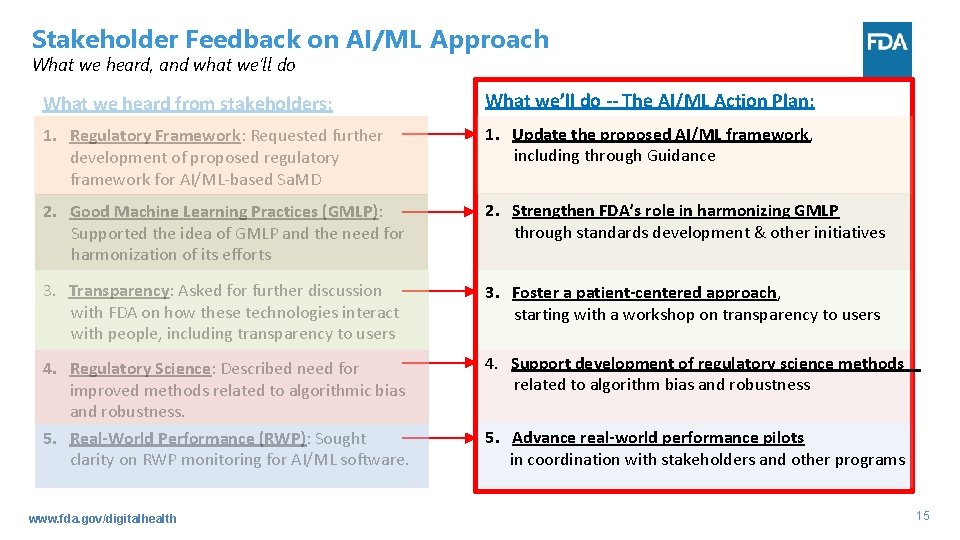
Stakeholder Feedback on AI/ML Approach What we heard, and what we’ll do What we heard from stakeholders: What we’ll do -- The AI/ML Action Plan: 1. Regulatory Framework: Requested further development of proposed regulatory framework for AI/ML-based Sa. MD 1. Update the proposed AI/ML framework, including through Guidance 2. Good Machine Learning Practices (GMLP): Supported the idea of GMLP and the need for harmonization of its efforts 2. Strengthen FDA’s role in harmonizing GMLP through standards development & other initiatives 3. Transparency: Asked for further discussion with FDA on how these technologies interact with people, including transparency to users 3. Foster a patient-centered approach, starting with a workshop on transparency to users 4. Regulatory Science: Described need for improved methods related to algorithmic bias and robustness. 5. Real-World Performance (RWP): Sought clarity on RWP monitoring for AI/ML software. 4. Support development of regulatory science methods related to algorithm bias and robustness www. fda. gov/digitalhealth 5. Advance real-world performance pilots in coordination with stakeholders and other programs 15
Part 1: Regulatory Framework Part 2: GMLP and Harmonization Part 3: Pt-Centered Transparency Part 4: Regulatory Science Methods Part 5: RWP Considerations Tailoring a Regulatory Framework for AI/ML-based Sa. MD • A strength of AI/ML systems is their ability to learn from real world data and improve performance over time • Predetermined Change Control Plan includes: – Sa. MD Pre-Specifications (SPS): describes "what" aspects the manufacturer intends to change through learning, – Algorithm Change Protocol (ACP): explains "how" the algorithm will learn and change while remaining safe and effective • Goal is to issue a Draft Guidance on the Predetermined Change Control Plan in 2021 www. fda. gov/digitalhealth 16
Part 1: Regulatory Framework Part 2: GMLP and Harmonization Part 3: Pt-Centered Transparency Part 4: Regulatory Science Methods Part 5: RWP Considerations Tailoring a Regulatory Framework for AI/ML-based Sa. MD Enhance patient access to high quality digital medical products www. fda. gov/digitalhealth Maintain a reasonable assurance of safety and effectiveness Enable manufacturers to rapidly improve software products with minor changes Least burdensome 17
Part 1: Regulatory Framework Part 2: GMLP and Harmonization Part 3: Pt-Centered Transparency Part 4: Regulatory Science Methods Part 5: RWP Considerations Good Machine Learning Practices (GMLP) • Accepted practices in ML/AI algorithm design, development, training, and testing that facilitate the quality development and assessment of ML/AI-based algorithms • Based on concepts from quality systems, software reliability, machine learning, and data analysis www. fda. gov/digitalhealth 18
Part 1: Regulatory Framework Part 2: GMLP and Harmonization Part 3: Pt-Centered Transparency Part 4: Regulatory Science Methods Part 5: RWP Considerations Good Machine Learning Practices (GMLP) • Standards Development: – IEEE AI Medical Device Working Group P 2801 – ISO/IEC Sub. Committee on AI 42 (ISO/ IEC JTC 1/SC 42) – AAMI/ BSI Initiative on AI in Medical Technology Xavier AI World Consortium Collaborative Community • Collaborative Communities: – Xavier AI World Consortium Collaborative Community – Collaborative Community on Ophthalmic Imaging – Pathology Innovation Collaborative Community on Ophthalmic Imaging • Other Collaborations: – IMDRF AI Medical Devices WG www. fda. gov/digitalhealth Pathology Innovation Collaborative Community 19
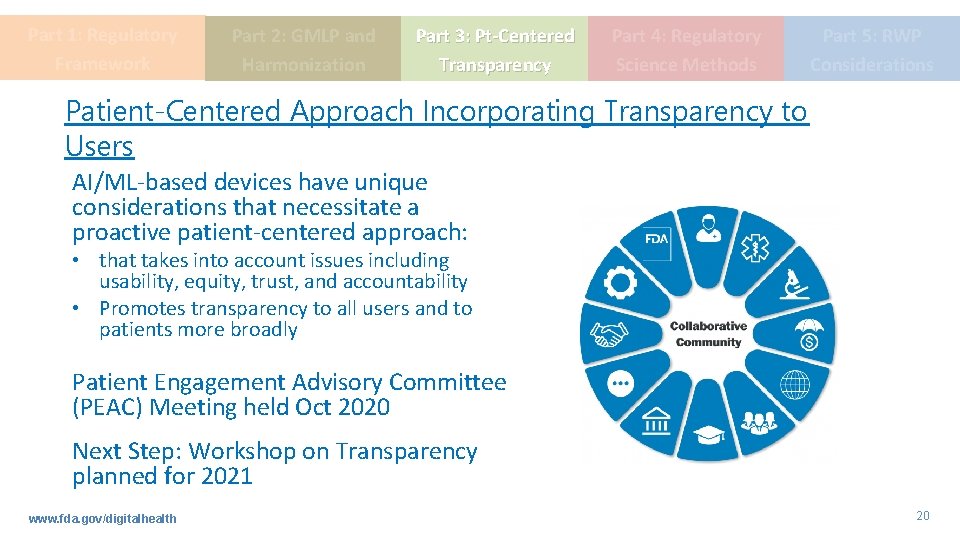
Part 1: Regulatory Framework Part 2: GMLP and Harmonization Part 3: Pt-Centered Transparency Part 4: Regulatory Science Methods Part 5: RWP Considerations Patient-Centered Approach Incorporating Transparency to Users AI/ML-based devices have unique considerations that necessitate a proactive patient-centered approach: • that takes into account issues including usability, equity, trust, and accountability • Promotes transparency to all users and to patients more broadly Patient Engagement Advisory Committee (PEAC) Meeting held Oct 2020 Next Step: Workshop on Transparency planned for 2021 www. fda. gov/digitalhealth 20
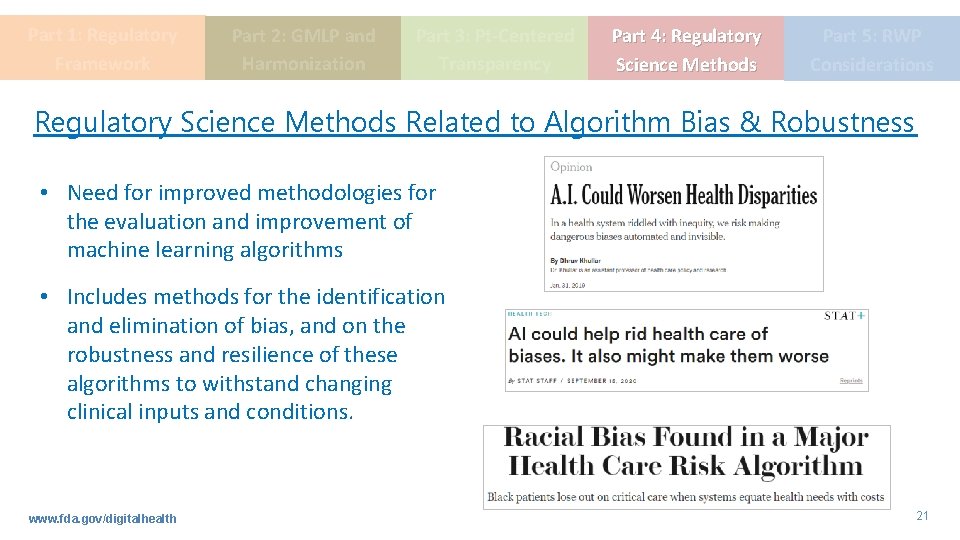
Part 1: Regulatory Framework Part 2: GMLP and Harmonization Part 3: Pt-Centered Transparency Part 4: Regulatory Science Methods Part 5: RWP Considerations Regulatory Science Methods Related to Algorithm Bias & Robustness • Need for improved methodologies for the evaluation and improvement of machine learning algorithms • Includes methods for the identification and elimination of bias, and on the robustness and resilience of these algorithms to withstand changing clinical inputs and conditions. www. fda. gov/digitalhealth 21
Part 1: Regulatory Framework Part 2: GMLP and Harmonization Part 3: Pt-Centered Transparency Part 4: Regulatory Science Methods Part 5: RWP Considerations Regulatory Science Methods Related to Algorithm Bias & Robustness • Regulatory science research efforts to develop these methods to evaluate AI/ML-based medical software. • Ongoing research being conducting in collaboration with Centers for Excellence in Regulatory Science and Innovation (CERSIs) at: • University of California San Francisco (UCSF)/ Stanford University; • Johns Hopkins University. • These collaborations complement the ongoing research efforts and the AI/ML program charter at OSEL. www. fda. gov/digitalhealth 22
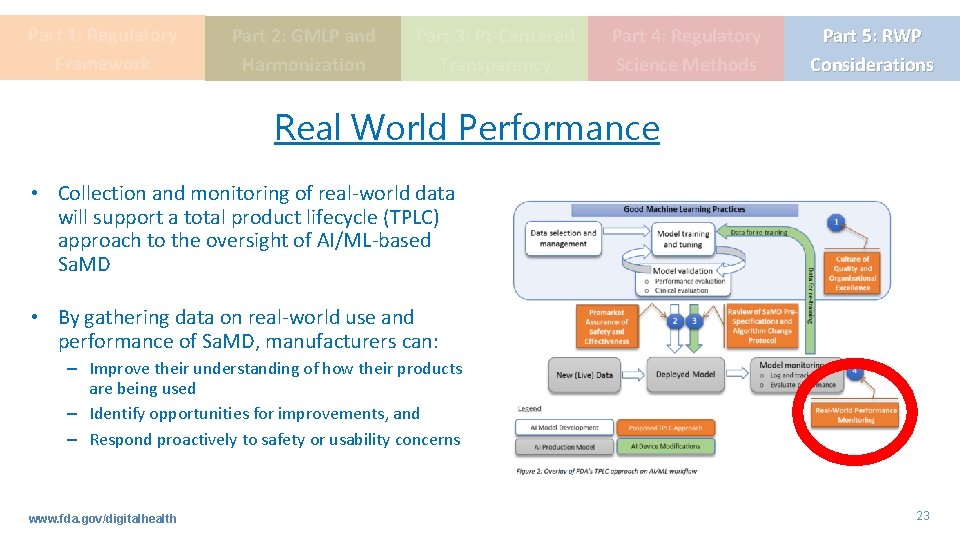
Part 1: Regulatory Framework Part 2: GMLP and Harmonization Part 3: Pt-Centered Transparency Part 4: Regulatory Science Methods Part 5: RWP Considerations Real World Performance • Collection and monitoring of real-world data will support a total product lifecycle (TPLC) approach to the oversight of AI/ML-based Sa. MD • By gathering data on real-world use and performance of Sa. MD, manufacturers can: – Improve their understanding of how their products are being used – Identify opportunities for improvements, and – Respond proactively to safety or usability concerns www. fda. gov/digitalhealth 23
Part 1: Regulatory Framework Part 2: GMLP and Harmonization Part 3: Pt-Centered Transparency Part 4: Regulatory Science Methods Part 5: RWP Considerations Real World Performance • What type of reference data are appropriate to utilize in measuring the performance of AI/ML software devices in the field? • How much of the oversight should be performed by each stakeholder? • How much data should be provided to the Agency, and how often? • How can the algorithms, models, and claims be validated and tested? • How can feedback from end-users be incorporated into the training and evaluation of AI/ML-based Sa. MD? www. fda. gov/digitalhealth https: //angel. co/quantitative-insights 24
Part 1: Regulatory Framework Part 2: GMLP and Harmonization Part 3: Pt-Centered Transparency Part 4: Regulatory Science Methods Part 5: RWP Considerations Real World Performance Actions: • Support the piloting of real-world performance monitoring by working with stakeholders on a voluntary basis • Coordination with other ongoing FDA programs focused on the use of real-world data • Develop a framework for seamless gathering, validation, and evaluation of relevant real-world performance metrics • Continued stakeholder and public engagement www. fda. gov/digitalhealth https: //angel. co/quantitative-insights 25
Digital Health Center of Excellence AI/ML-Related Activities Future Plans (2021+) Recent Milestones April 2019– Published AI/MLSa. MD - Discussion Paper § Sept 2019– First joined Collaborative Community related to AI/ML WORKSHOP Evolving Role of AI in Radiological Imaging February 28 -28, 2020 Feb 2020 - Public Workshop on the Evolving Role of AI in Radiological Imaging Oct 2020 - Patient Engagement Advisory Committee (PEAC) Meeting on patient trust in AI/ML technologies AI/ML Medical Device Software Action Plan q Update the proposed AI/ML framework, including through Guidance q Strengthen FDA’s role in harmonizing GMLP through standards development & other initiatives q Foster a patient-centered approach, starting with a workshop on transparency to users q Support development of regulatory science methods related to algorithm bias and robustness q Advance real-world performance pilots in coordination with stakeholders and other programs . www. fda. gov/digitalhealth 26
Further Questions or Feedback www. fda. gov/digitalhealth Digital. Health@fda. hhs. gov Anindita Saha Assistant Director, CDRH Digital Health Center of Excellence Office of Strategic Partnerships & Technology Innovation (OST) Center for Devices and Radiological Health (CDRH) U. S. Food and Drug Administration Anindita. Saha@fda. hhs. gov www. fda. gov/digitalhealth 27