
Artificial Intelligence Lee Wee Sun School of Computing
- Slides: 52
Artificial Intelligence Lee Wee Sun School of Computing leews@comp. nus. edu. sg
Imitation Game • A man and a woman are in a separate room from us. • Communicate using chat: only text, without video or voice. • The man pretends to be the woman. • The woman tries to convince us she really is a woman! • Figure out who is for real. Artificial Intelligence
Can Machines Think? Alan Turing (1950): The question is meaningless. • Let the machine play the role of the man in the imitation game. • If it does as well as the man, it can think! Artificial Intelligence
Scientific Method • Turing’s proposal converted the question of whether machines can think into an empirical question. • Can apply the scientific method to the question: – Propose hypothesis – Design experiment – Gather data and analyze data Artificial Intelligence
• Note the clever design of the experiment – Use of instant messaging prevents irrelevant factors such as appearance, voice, motion from confounding the result – Randomized design where the participants do not know which candidate is woman and which is machine • What’s wrong with an experiment where we know which candidate is the machine and are asked whether the machine behaves like the woman? Artificial Intelligence
Contrary Arguments • AI will never be possible because … • Theological Objection – Thinking is a function of the soul and God has given souls only to humans – Response: God can confer souls to machines if He so chooses; to forbid that would be to limit God’s power • Head in the Sand Objection – Let’s hope and believe machines cannot think; the consequences are too dreadful – Response: Not a logical argument. Consolation would be more appropriate. Artificial Intelligence
• Mathematical Objection – Mathematical theorems such as Godel’s incompleteness theorem show that there are some things that machines cannot do – Response: There are some things that humans cannot do as well; does not prevent us from accepting that humans can think • Argument from Consciousness – Machines can think only when it is able to feel its own emotions and talk about its own thoughts – Response: The only way to feel someone thinking is to be that person. Too extreme, we accept that humans think from their behaviour. Artificial Intelligence
• Arguments from Various Disabilities – A machine will never be able to do …. – Various things suggested e. g. learn from experience, make mistakes, etc. – Mostly because people have never observed them doing it – Response: Today we’ll look at how machines can be programmed to • Play chess • Learn Artificial Intelligence
Applications • Success at the level of passing the Turing test has so far been elusive. • Success in more limited domains are available – – – Chess playing programs Expert systems Web search Speech recognition Driving cars …. . Artificial Intelligence
Chess Play chess as well as a human being! • Turing suggested that intellectual activities such as playing chess may be a good place to start. • In 1997, Deep Blue defeated World Chess Champion Gary Kasparov! Artificial Intelligence
Computational Thinking • Computers are originally invented by Turing as a model of human thinking – Capable of solving extremely complex problems • To deal with the complexity, computer scientists have developed very powerful computational thinking methods – Should be learned by all as we are already in the information age – Do computing at university! : ) Artificial Intelligence
Reduction to Search • Playing chess seems complicated • Computational thinking suggests transforming (reducing) it into something that computers do well: search Artificial Intelligence
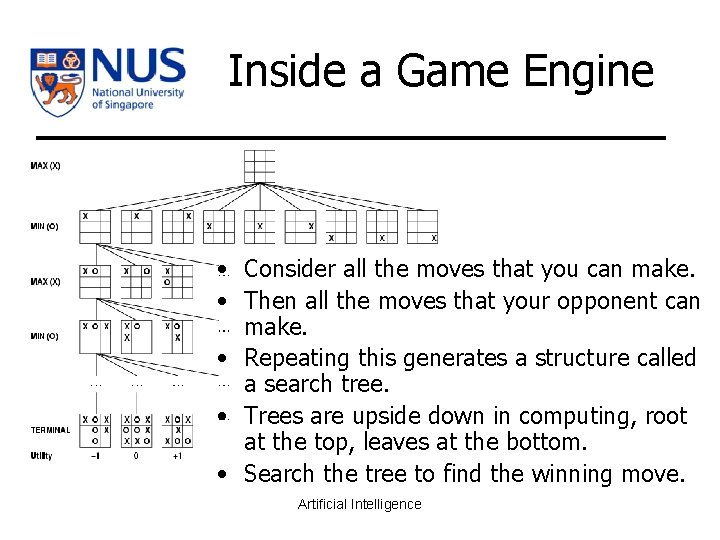
Inside a Game Engine • Consider all the moves that you can make. • Then all the moves that your opponent can make. • Repeating this generates a structure called a search tree. • Trees are upside down in computing, root at the top, leaves at the bottom. • Search the tree to find the winning move. Artificial Intelligence
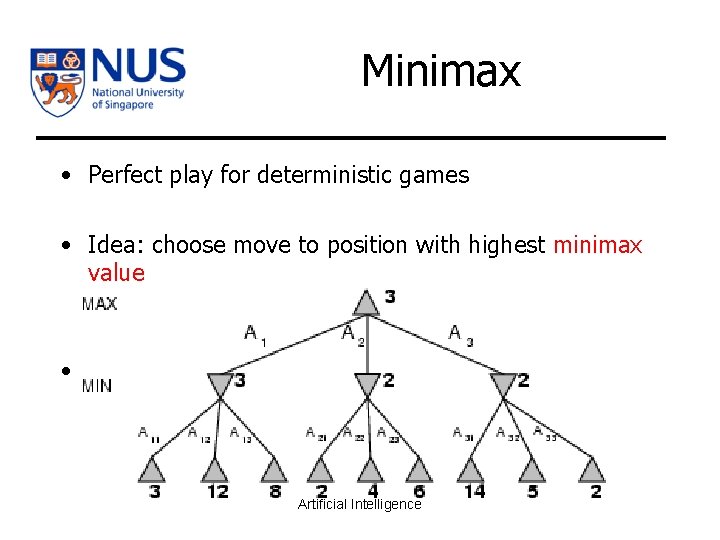
Minimax • Perfect play for deterministic games • Idea: choose move to position with highest minimax value = best achievable payoff against best play • E. g. , 2 -ply game: Artificial Intelligence
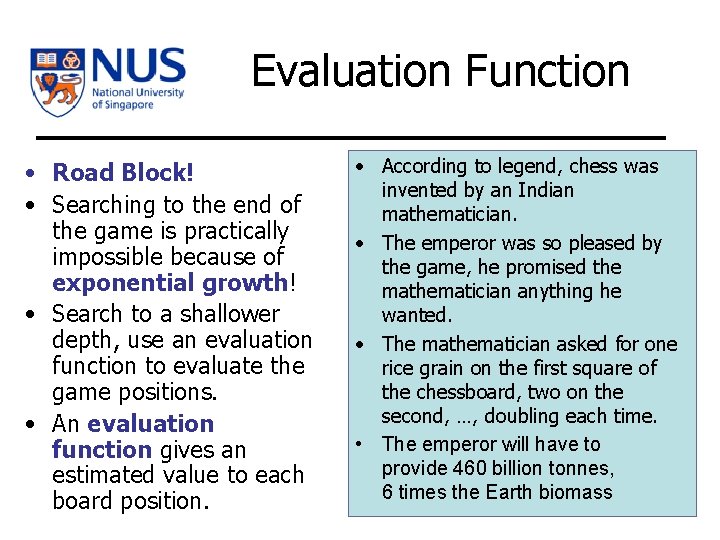
Evaluation Function • Road Block! • Searching to the end of the game is practically impossible because of exponential growth! • Search to a shallower depth, use an evaluation function to evaluate the game positions. • An evaluation function gives an estimated value to each board position. • According to legend, chess was invented by an Indian mathematician. • The emperor was so pleased by the game, he promised the mathematician anything he wanted. • The mathematician asked for one rice grain on the first square of the chessboard, two on the second, …, doubling each time. • The emperor will have to provide 460 billion tonnes, 6 times the Earth biomass
Player Strength What determines the AI player strength? • Knowledge encoded in the evaluation function – What is the board position worth? • Value of the queen, bishop, knight, etc. • Positions of the pieces – Expert knowledge of the game helpful • Speed - how deep can you search? – Better algorithm helps: α-β pruning – Better hardware helps Artificial Intelligence
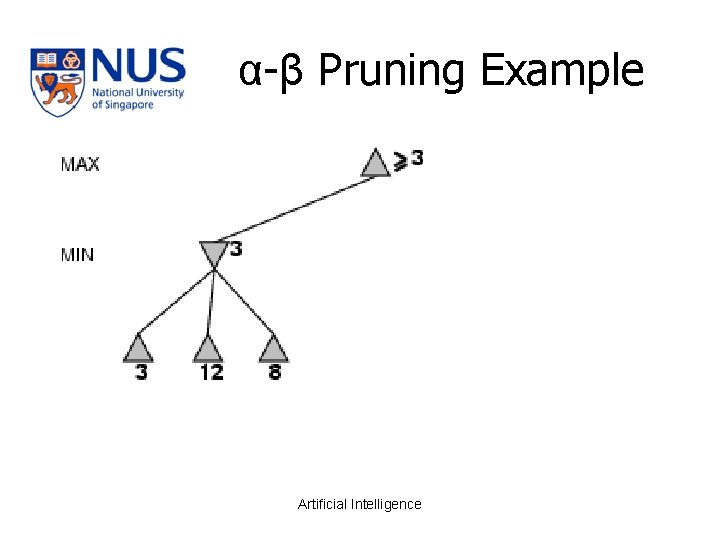
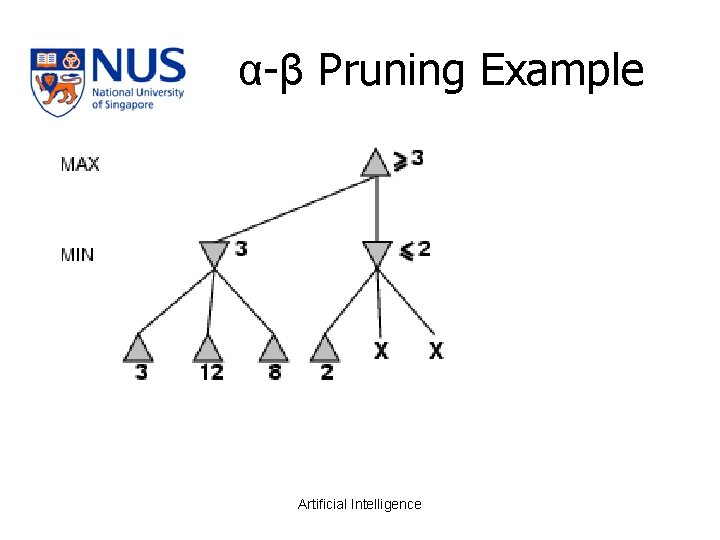
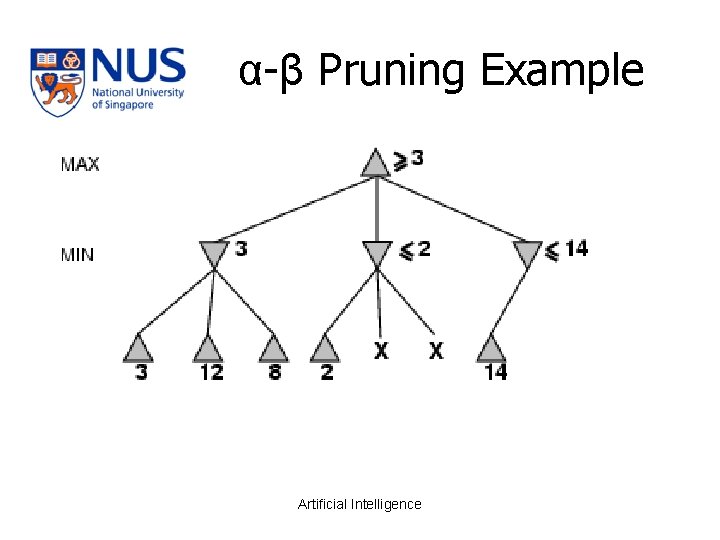
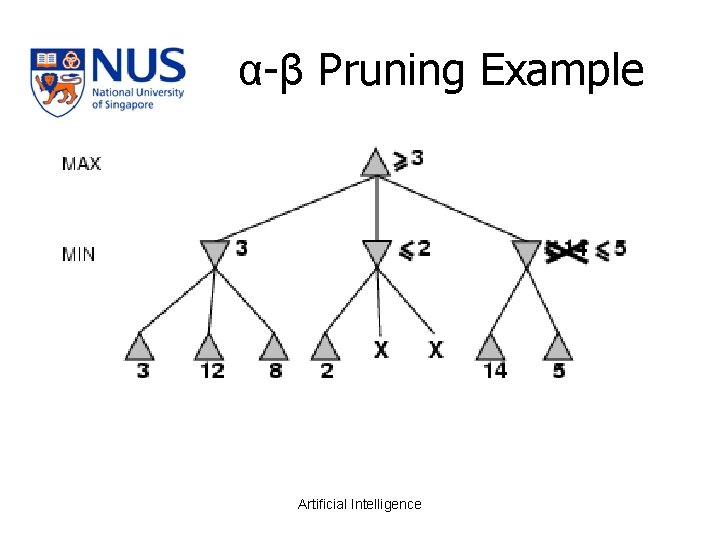
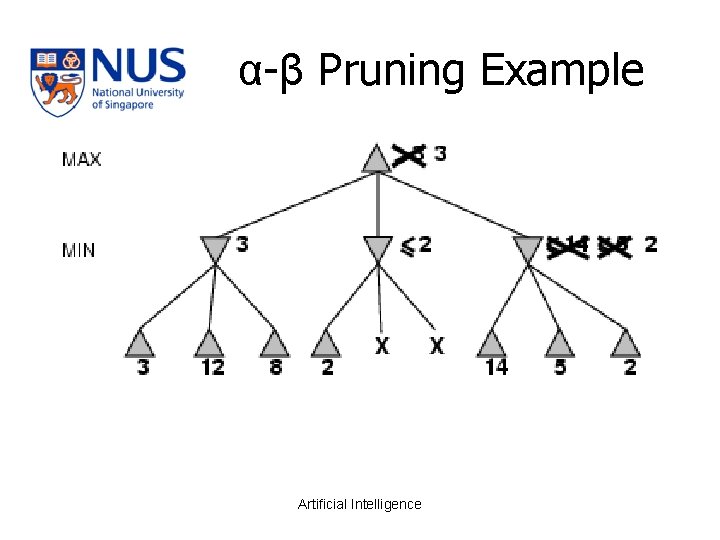
α-β Pruning • More advance search method. • Use knowledge of parts of tree already searched to prune branches of the tree. • Can usually search twice as deep for games like chess! Artificial Intelligence
α-β Pruning Example Artificial Intelligence
α-β Pruning Example Artificial Intelligence
α-β Pruning Example Artificial Intelligence
α-β Pruning Example Artificial Intelligence
α-β Pruning Example Artificial Intelligence
Activity: Constructing Evaluation Function • You will construct evaluation functions for Othello • We will have a tournament to see whose evaluation function works best! Artificial Intelligence
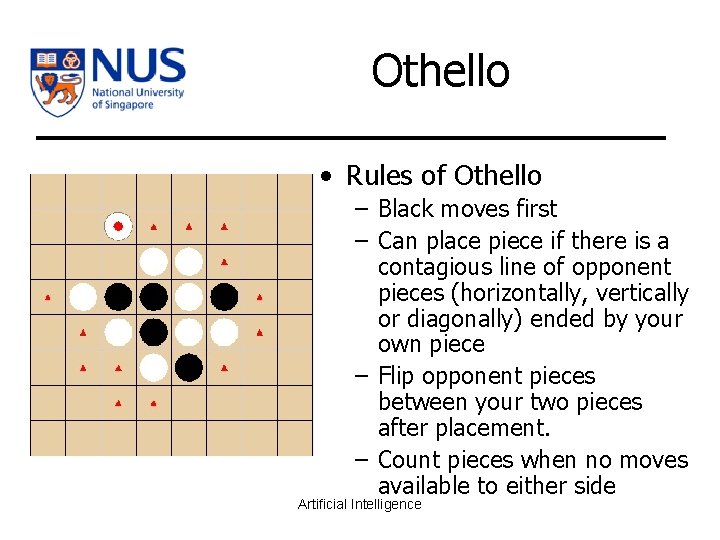
Othello • Rules of Othello – Black moves first – Can place piece if there is a contagious line of opponent pieces (horizontally, vertically or diagonally) ended by your own piece – Flip opponent pieces between your two pieces after placement. – Count pieces when no moves available to either side Artificial Intelligence
Othello Evaluation • Corners and other positions – Certain positions such as corners are highly valued. • Mobility and potential mobility – Force your opponent to have fewer legal moves (or potentially fewer moves in future): forces bad moves from opponent. • Stability – Some positions can no longer be flipped (such as corners), so are valued higher. Artificial Intelligence
Construction • Value function viewed from black’s view, positive value good for black • Two types of patterns – Static – Dynamic • Each pattern returns the number of matches for black minus the number of matches for white on the board • Evaluation function made up of sum of weighted patterns. Artificial Intelligence
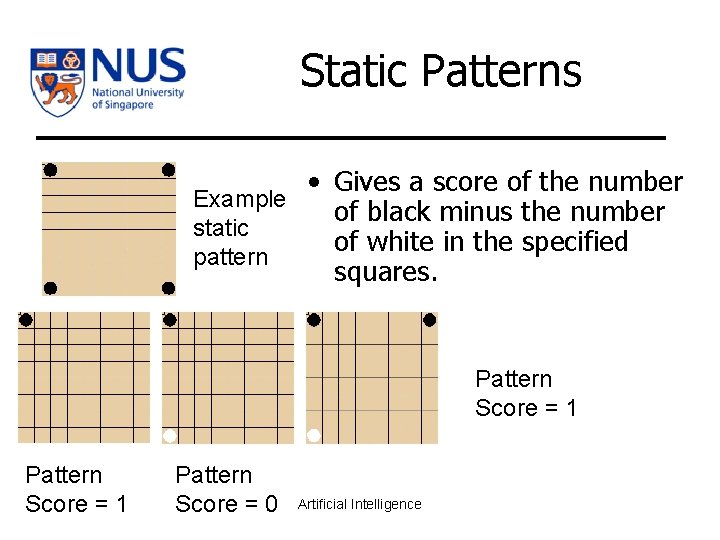
Static Patterns • Gives a score of the number Example of black minus the number static of white in the specified pattern squares. Pattern Score = 1 Pattern Score = 0 Artificial Intelligence
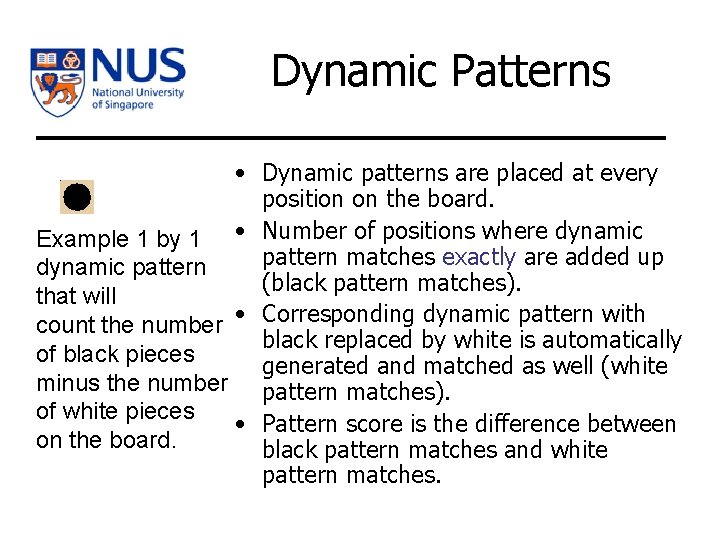
Dynamic Patterns • Dynamic patterns are placed at every position on the board. Example 1 by 1 • Number of positions where dynamic pattern matches exactly are added up dynamic pattern (black pattern matches). that will count the number • Corresponding dynamic pattern with black replaced by white is automatically of black pieces generated and matched as well (white minus the number pattern matches). of white pieces • Pattern score is the difference between on the board. black pattern matches and white pattern matches.
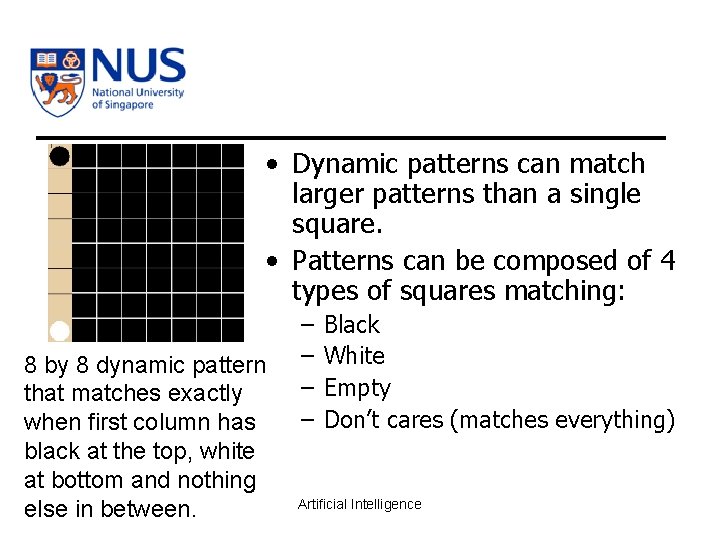
• Dynamic patterns can match larger patterns than a single square. • Patterns can be composed of 4 types of squares matching: 8 by 8 dynamic pattern that matches exactly when first column has black at the top, white at bottom and nothing else in between. – – Black White Empty Don’t cares (matches everything) Artificial Intelligence
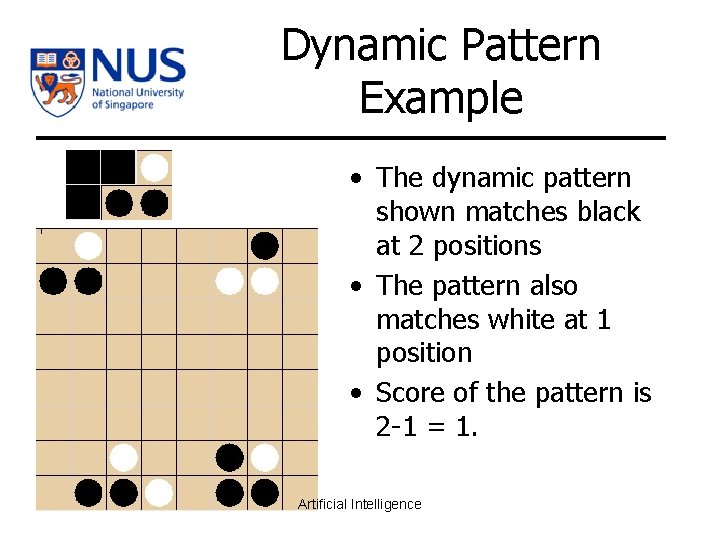
Dynamic Pattern Example • The dynamic pattern shown matches black at 2 positions • The pattern also matches white at 1 position • Score of the pattern is 2 -1 = 1. Artificial Intelligence
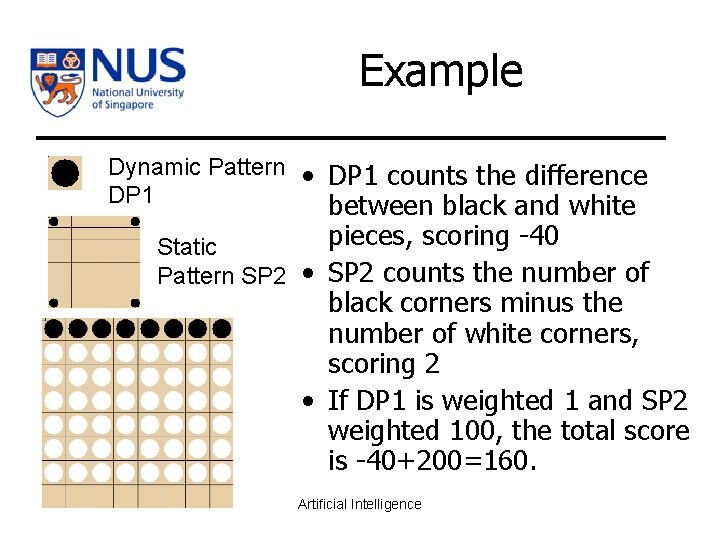
Example Dynamic Pattern • DP 1 counts the difference DP 1 between black and white pieces, scoring -40 Static Pattern SP 2 • SP 2 counts the number of black corners minus the number of white corners, scoring 2 • If DP 1 is weighted 1 and SP 2 weighted 100, the total score is -40+200=160. Artificial Intelligence
Tournament • Start constructing the evaluation function! • Use the test examples to guide your construction. • If you have time, you can play your evaluation function against the built-in evaluation functions. • We will have a tournament at the end. Artificial Intelligence
Summary (Games) • Playing intellectual board games seems complex but can be reduced to a simple computer search problem (computational thinking) • Problem is too difficult to search completely, so knowledge (evaluation function) is also important. • Can we extend to other types of computer games, such as real time strategy games? – See NUS team’s performance in international RTS game AI tournament • Tactical combat video • Strategic combat video Artificial Intelligence
Learning Machines • Learning has always been an important part of artificial intelligence. • Alan Turing suggested the use of machine learning to build a machine that can pass the Turing test. • Lots of practical applications. Artificial Intelligence
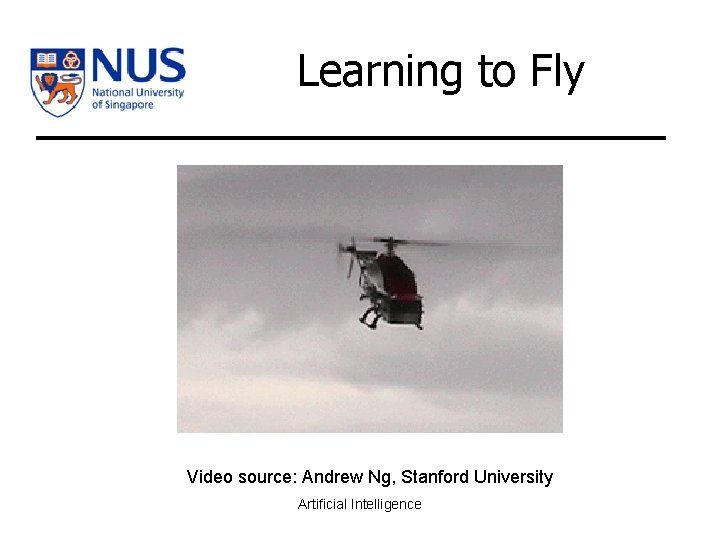
Learning to Fly Video source: Andrew Ng, Stanford University Artificial Intelligence
Wired Magazine’s #1 robot of all time Stanley, winner of the US$2 millon DARPA Grand Challenge • Drove autonomously through 130 miles of dessert roads. • Key technology: Adaptive vision – Learn from human drivers before race. – Learn from experience during race. Artificial Intelligence
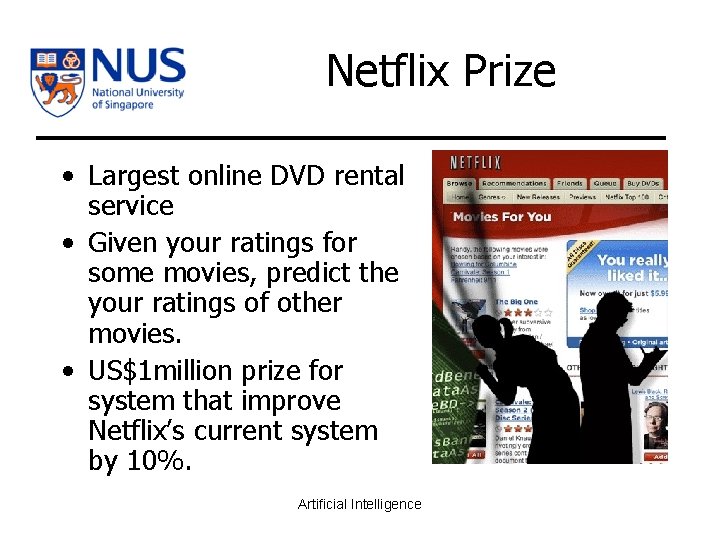
Netflix Prize • Largest online DVD rental service • Given your ratings for some movies, predict the your ratings of other movies. • US$1 million prize for system that improve Netflix’s current system by 10%. Artificial Intelligence
Computer Vision • Vision problems such as face detection, face recognition. • Over 85% of handwritten mail in US automatically sorted by software trained using machine learning Artificial Intelligence Google Image • NUS without face detection • NUS with face detection (add &imgtype=face to url)
Speech, Natural Language • Almost all speech recognition systems use some form of machine learning • Text and natural language processing applications e. g. spam filtering Machine learning methods give the best performance on the types of practical problems that we have shown. Why? Artificial Intelligence
Fundamental Questions • How do we build computers that learn from experience? • What are the laws that govern learning processes? Artificial Intelligence
How to Learn? • Assume that you have one million computer programs and you know that one of them can recognize handwritten digits. • How would you go about constructing a handwritten digit classifier? Artificial Intelligence
Computational Thinking • Computational Thinking: reduce it to a search problem! • Simple approach: – Collect lots of handwritten digit – Go through the one million programs and select the one that performed the best on the collected digits. Artificial Intelligence
Learning as Search • The example illustrates that we are interested in searching for a computer program that predicts well. • Most learning algorithms work as follows: – Define a class of models (programs) – Obtain some examples. – Search for a model that works well on the examples. Artificial Intelligence
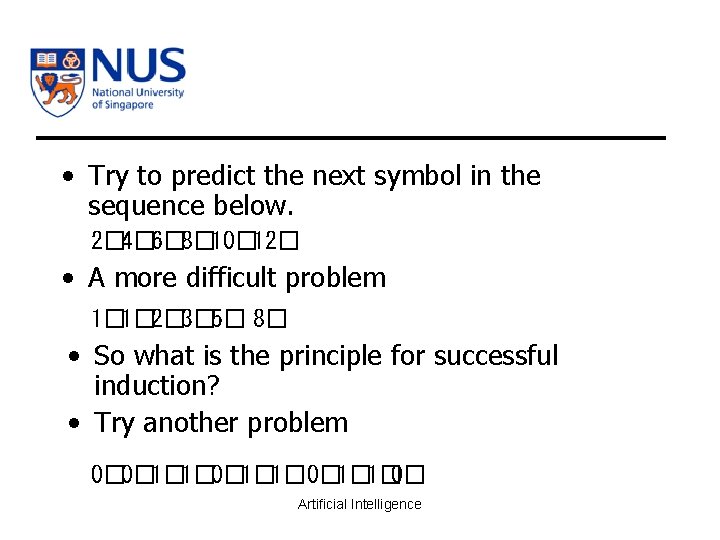
Principle of Induction • Search is not enough for learning. • Need another basic scientific principle used for doing induction. – In induction (as opposed to deduction), scientists develop theories based on observations. – After seeing 1000 white swans, the scientist may propose that all swans are white. • What is the principle that allows induction to be successful? Artificial Intelligence
• Try to predict the next symbol in the sequence below. 2� 4� 6� 8� 10� 12� • A more difficult problem 1� 1� 2� 3� 5� 8� • So what is the principle for successful induction? • Try another problem 0� 0� 1� 1� 0� Artificial Intelligence
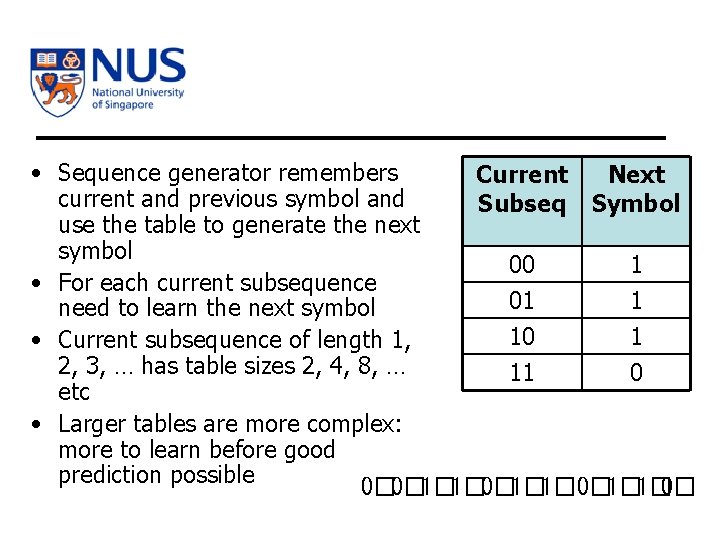
• Sequence generator remembers Current Next current and previous symbol and Subseq Symbol use the table to generate the next symbol 00 1 • For each current subsequence 01 1 need to learn the next symbol 10 1 • Current subsequence of length 1, 2, 3, … has table sizes 2, 4, 8, … 11 0 etc • Larger tables are more complex: more to learn before good prediction possible 0� 0� 1� 1� 0�
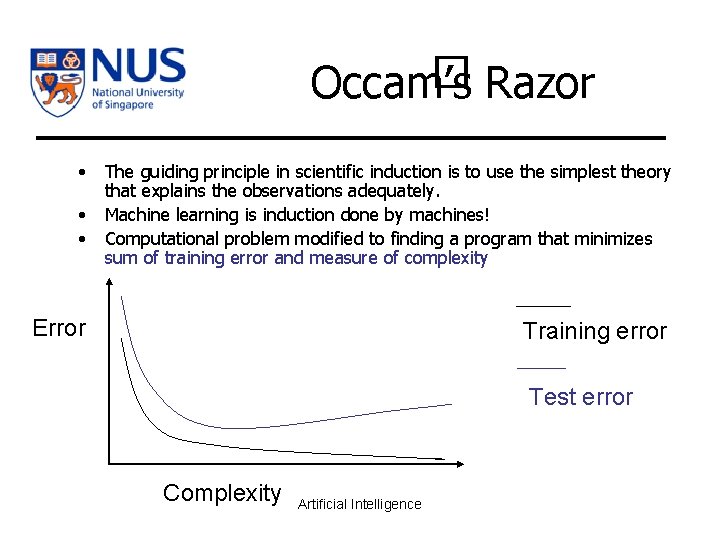
� Razor Occam’s • • • The guiding principle in scientific induction is to use the simplest theory that explains the observations adequately. Machine learning is induction done by machines! Computational problem modified to finding a program that minimizes sum of training error and measure of complexity Error Training error Test error Complexity Artificial Intelligence
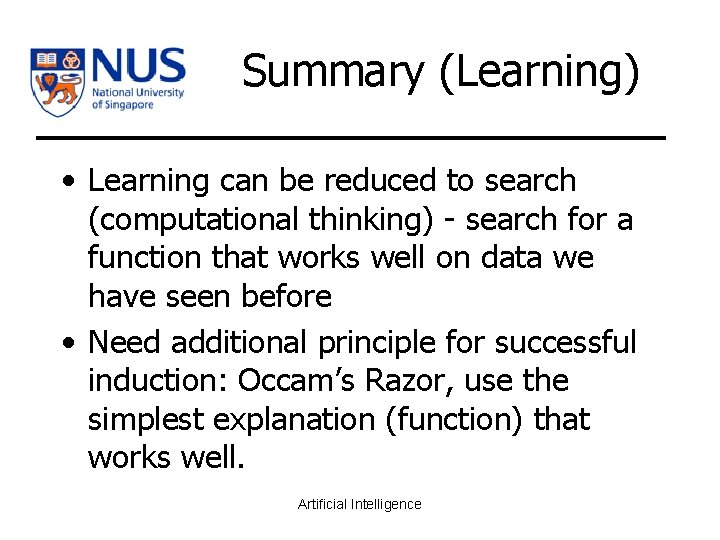
Summary (Learning) • Learning can be reduced to search (computational thinking) - search for a function that works well on data we have seen before • Need additional principle for successful induction: Occam’s Razor, use the simplest explanation (function) that works well. Artificial Intelligence
Summary (AI) • Computing is about extending human abilities. • Just like cars and planes extend our physical abilities, computers extend our mental abilities, allowing us to automate many things that previously need to be done manually. • Early days in AI still. • Lots of interesting work to come! Artificial Intelligence
Summary (Computational Thinking) • As computers help us solve very complex problems, computer scientists have developed methods for understanding and solving complex problems: computational thinking • We have seen two examples of application of a particular computational thinking paradigm to AI problems- reduction to search – Both games and learning can be reduced to search problems • Many others: abstraction, divide and conquer, use of invariants, etc. • Computational thinking is becoming essential knowledge in the information age • Interested? Do a computing degree. : )
To find out more about computing … • Do a project at the School of Computing • Join your school’s computing club • Participate in the National Infocomm Competition – – – Programming competition Quizzes Game programming Lego competition Etc. Artificial Intelligence
Acknowledgements • Some of the material and slides are taken from – Artificial Intelligence: A Modern Approach (Second Edition) by Stuart Russell and Peter Norvig http: //aima. eecs. berkeley. edu/ Artificial Intelligence