
Artificial Intelligence Lecture 2 Department of Computer Science
- Slides: 16
Artificial Intelligence Lecture 2 Department of Computer Science, International Islamic University Islamabad, Pakistan
FOUNDATIONS OF ARTIFICIAL INTELLIGENCE By Dr. Ayyaz Hussain
Marks Distribution n Textbook 1: George F Lugar, Artificial Intelligence n Textbook 2: S. Russell and P. Norvig Artificial Intelligence: A Modern Approach Prentice Hall, 2003, Second Edition n Grading: Class participation (05%), Programming assignment & Quizes (15%), Midterm test (20%), Final exam (60%) n n n Class participation includes participation in both lectures and tutorials (attendance, asking and answering questions, presenting solutions to tutorial questions). Note that attendance at every lecture and tutorial will be taken and constitutes part of the class participation grade.
Outline Course overview n What is AI? n A brief history n The state of the art n
Course overview Introduction and Agents (chapters 1, 2) n Search (chapters 3, 4, 5, 6) n Logic (chapters 7, 8, 9) n Planning (chapters 11, 12) n Uncertainty (chapters 13, 14) n Learning (chapters 18, 20) n Natural Language Processing (chapter 22, 23) n
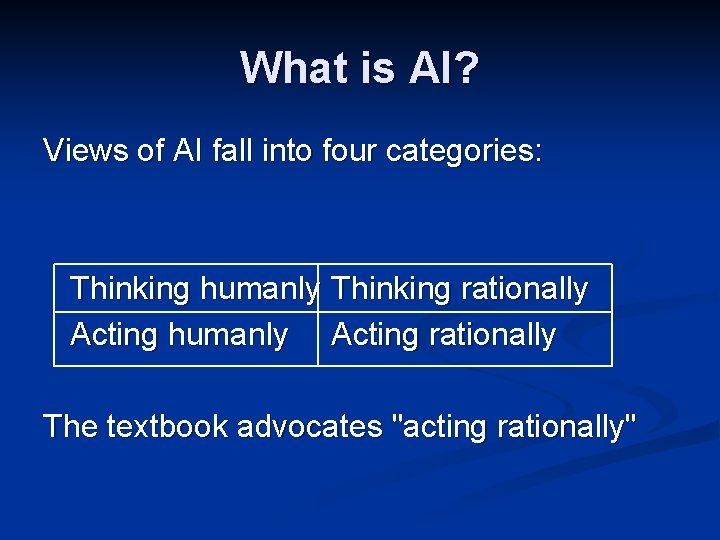
What is AI? Views of AI fall into four categories: Thinking humanly Thinking rationally Acting humanly Acting rationally The textbook advocates "acting rationally"
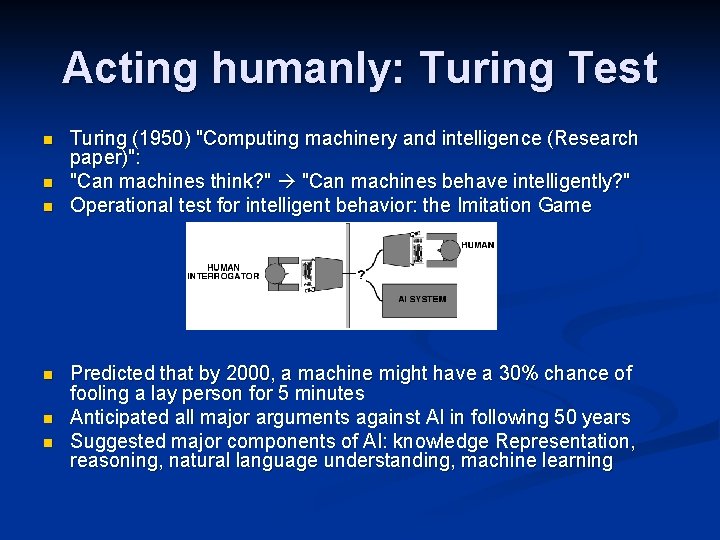
Acting humanly: Turing Test n n n Turing (1950) "Computing machinery and intelligence (Research paper)": "Can machines think? " "Can machines behave intelligently? " Operational test for intelligent behavior: the Imitation Game Predicted that by 2000, a machine might have a 30% chance of fooling a lay person for 5 minutes Anticipated all major arguments against AI in following 50 years Suggested major components of AI: knowledge Representation, reasoning, natural language understanding, machine learning
n Turing test was designed to provide satisfactory operational definition of intelligence. n He defined the intelligent behavior as n The ability to achieve human level performance in all cognitive tasks sufficient to fool an interrogator
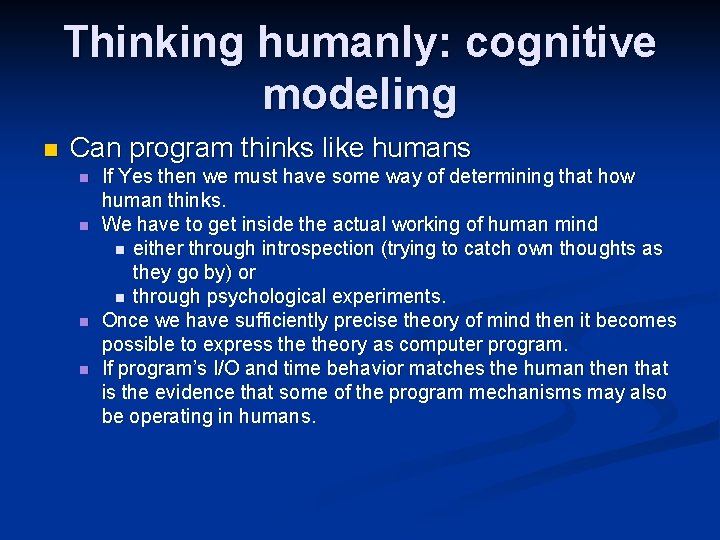
Thinking humanly: cognitive modeling n Can program thinks like humans n n If Yes then we must have some way of determining that how human thinks. We have to get inside the actual working of human mind n either through introspection (trying to catch own thoughts as they go by) or n through psychological experiments. Once we have sufficiently precise theory of mind then it becomes possible to express theory as computer program. If program’s I/O and time behavior matches the human then that is the evidence that some of the program mechanisms may also be operating in humans.
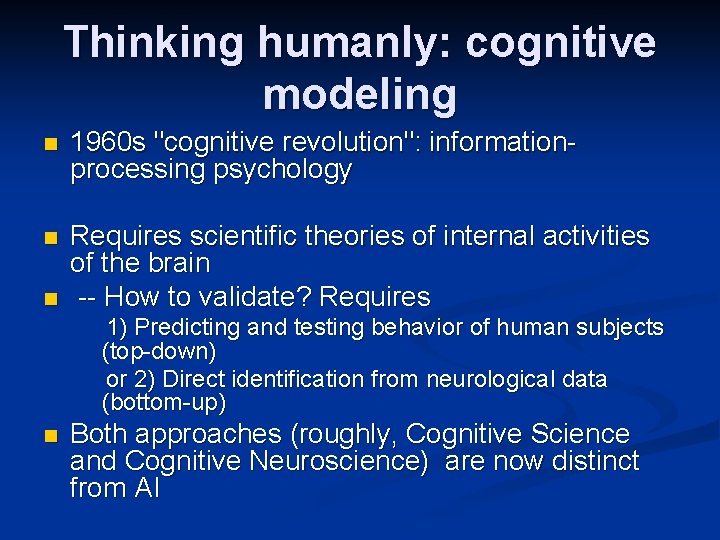
Thinking humanly: cognitive modeling n 1960 s "cognitive revolution": informationprocessing psychology n Requires scientific theories of internal activities of the brain -- How to validate? Requires n 1) Predicting and testing behavior of human subjects (top-down) or 2) Direct identification from neurological data (bottom-up) n Both approaches (roughly, Cognitive Science and Cognitive Neuroscience) are now distinct from AI
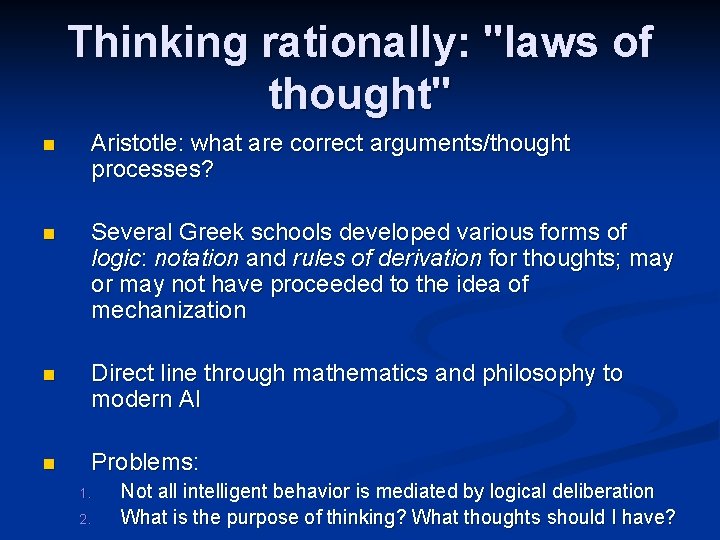
Thinking rationally: "laws of thought" n Aristotle: what are correct arguments/thought processes? n Several Greek schools developed various forms of logic: notation and rules of derivation for thoughts; may or may not have proceeded to the idea of mechanization n Direct line through mathematics and philosophy to modern AI n Problems: 1. 2. Not all intelligent behavior is mediated by logical deliberation What is the purpose of thinking? What thoughts should I have?
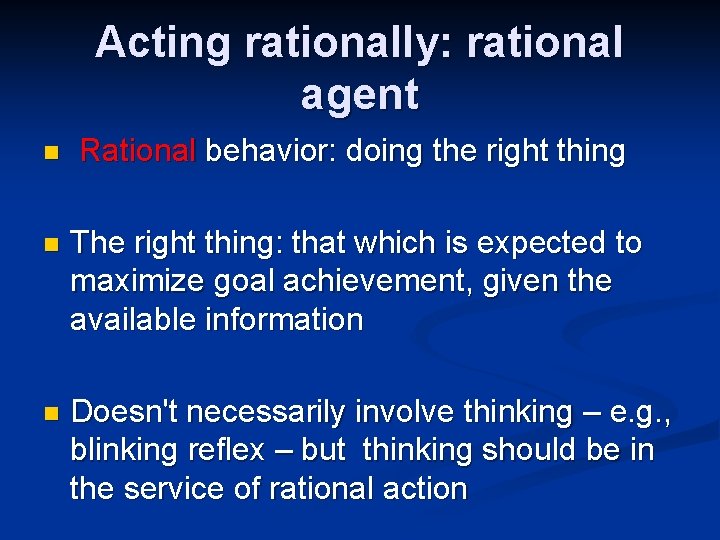
Acting rationally: rational agent n Rational behavior: doing the right thing n The right thing: that which is expected to maximize goal achievement, given the available information n Doesn't necessarily involve thinking – e. g. , blinking reflex – but thinking should be in the service of rational action
Rational agents n An agent is an entity that perceives and acts n This course is about designing rational agents n Abstractly, an agent is a function from percept histories to actions: [f: P* A] For any given class of environments and tasks, we seek the agent (or class of agents) with the best performance Caveat: computational limitations make perfect rationality unachievable n n n design best program for given machine resources
AI prehistory n Philosophy n Mathematics n Economics Neuroscience Psychology n n n Computer engineering Control theory n Linguistics n Logic, methods of reasoning, mind as physical system foundations of learning, language, rationality Formal representation and proof algorithms, computation, (un)decidability, (in)tractability, probability utility, decision theory physical substrate for mental activity phenomena of perception and motor control, experimental techniques building fast computers design systems that maximize an objective function over time knowledge representation, grammar
Abridged history of AI n n n 1943 1950 1956 1952— 69 1950 s 1965 1966— 73 1969— 79 1980 -1986 -1987 -1995 -- Mc. Culloch & Pitts: Boolean circuit model of brain Turing's "Computing Machinery and Intelligence" Dartmouth meeting: "Artificial Intelligence" adopted Look, Ma, no hands! Early AI programs, including Samuel's checkers program, Newell & Simon's Logic Theorist, Gelernter's Geometry Engine Robinson's complete algorithm for logical reasoning AI discovers computational complexity Neural network research almost disappears Early development of knowledge-based systems AI becomes an industry Neural networks return to popularity AI becomes a science The emergence of intelligent agents
State of the art n n n Deep Blue defeated the reigning world chess champion Garry Kasparov in 1997 Proved a mathematical conjecture (Robbins conjecture) unsolved for decades No hands across America (driving autonomously 98% of the time from Pittsburgh to San Diego) During the 1991 Gulf War, US forces deployed an AI logistics planning and scheduling program that involved up to 50, 000 vehicles, cargo, and people NASA's on-board autonomous planning program controlled the scheduling of operations for a spacecraft Proverb solves crossword puzzles better than most humans