
ARTIFICIAL INTELLIGENCE LAW Legal informatics History of legislation




- Slides: 35
ARTIFICIAL INTELLIGENCE & LAW Legal informatics
History of legislation Systematic perspecitve
Reorganisation due to the inconsistency of legal sources 3000 BC - ancient Egyptian law was formed as a civil code � basis: concept of Ma’at - meaning “Justice” or” truth” but more generally cosmic or earthly order Between 1792– 1750 BC- the first written code ”The code of Hammurabi“. 6 -th century AD: romans introduced Corpus Juris Civilis � Division of laws into several groups: acts, plebeian statutes, senate resolutions etc
Reorganisation due to the inconsistency of legal sources : Gaius AD 161 - introductory textbook of legal institutions in four books „Institutes of Gaius“ � Three partite division: the law of person, law of things law of action (civil procedure) 291 until 528 AD – different collections legal acts: “Codex Gregorianus“, „Codex Hermogenianus“, „Codex Theodosianus“, „Codex Justinianus“
Reorganisation due to the inconsistency of legal sources : 1140 AD – emerge of the largest and best organized compendium of church law ever made “Decretum Gratiani“ Between 1220 and 1250 – attempts to interpret the text so that no contradictions remained Notes- glosses � system of references – allegationes � grouping together the texts in favour of and against a certain argument or rule � interpreting some texts as the rule and others as the exceptions to it by means of distinctions � ordines iudiciarii- attempt to collect together all the relevant provisions on procedure in general and on specific actions, and provided instructions on how to produce a writ. �
Reorganisation due to the inconsistency of legal sources : around 1120 –introduction of scholastic method by Abélard, „Sic et non“ formal logic applied to an authoritative text to handle the text as a logical unit � Texts were collected together based on their similarity (similia) or controversy (contraria) � around 1150– 1230 – introduction of hierarchy of sources of law � civil lawyer Azo in „Summa“ put some sources of law into higher level than others. 1235 and further- advancements in systematisation � new genre called repetitio by school of Orlèans a separate lecture of especially difficult texts.
Reorganisation due to the inconsistency of legal sources Canon law -contributed to the systematic buildup through adding a ordines iudiciarii – systematic overview of the law of procedure 1814 - Professor Anton Friedrich Justus Thibaut of Heidelberg, proposed a general civil law codification 1900 - publishing of the. German codification, the „Bürgerliches Gesetzbuch“
Legtislation and ICT
Primacy of legislation is coming to end! We are moving from the age of legislation to the � age of administration (by specialized technical bodies), or � jurisdiction (creation of law by judges, supported by jurists), or � custom (as emerging especially from economic relations, contracts and decisions by private arbiters), or even � computer code (enabling or constraining actions in virtual environments Legal Informatics and Management of Legislative Documents, Global Centre for ICT in Parliament Working Paper No. 2
Reasons? Legislative authorities are national; economic and social networks are global; Legislation is slow; current problems require quick solutions; Elective assemblies are political bodies; complex problems require technical, economical and legal competences; Legislation is static; accelerated economical and technical progress requires continuous adjustments.
The values which a good legislation should implement: Means-end rationality. Discursive rationality. Responsiveness to citizens need and preferences. Progress (ability to change). Legal certainty. Citizens’ rights.
ICT to support these values Means-ends rationality. � ICT tools for anticipating the impact of new laws on the legal system, on administration, on society for monitoring and evaluating impacts of an existing law. Discursive rationality. � ICT to promote critical debate around legislation, providing communication tools for promoting the informed debate facilitating the preparation of legislative proposals, offering citizens new ways to participate in the legislative process.
ICT to support these values Responsiveness to citizens’ need and preference. � ICT can facilitate the contact between citizens and their representatives, provide citizens with new ways to express their views with feedback about the choices of their representatives. Legal certainty. � ICT can enable citizens to anticipate legislation’s impact on them, provide access to laws and cases, facilitate the drafting of more understandable regulations maintenance of the legal systems understandability as much as possible.
ICT to support these values Citizens’ rights. � ICT can contribute to ensure that laws protect citizens’ rights by making more accessible knowledge about rules and remedies ensuring publicity of information about officers’ behaviour.
ICT dual role Problem creator � ICT are the infrastructure of globalization (reach) � ICT are the engine of economical and social development (speed) � ICT are the enzyme of complexity Problem solver � ICT can provide an infrastructure to enable legislative coordination to address global issues; (networks) � ICT can support dynamic drafting (content support) � ICT can help legislators in modeling laws according to social complexities (complexity handling)
Legal Informatics
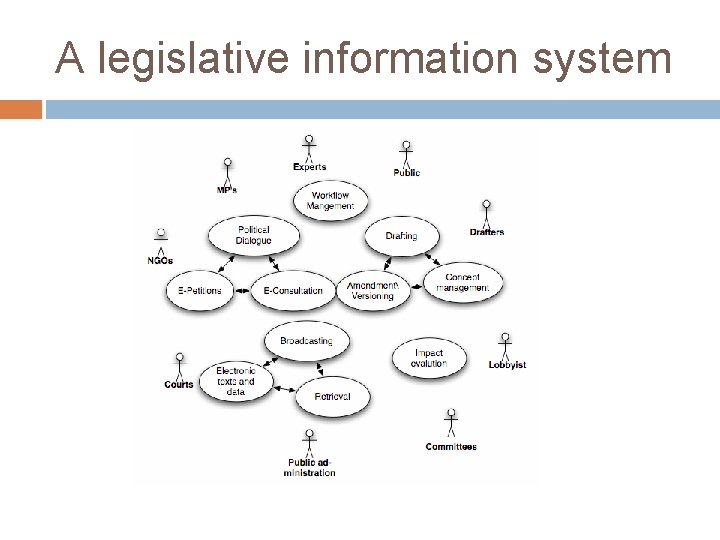
A legislative information system
The trends the Internet has already become � the principal source of legal cognition for citizens, � it is rapidly becoming the main source of information also for lawyers, the previously existing legal sources are moving into the Internet, new sources of legal information are emerging. a legal web is emerging as a distinct subset of the broader worldwide Web.
The trends A global society can be matched by a network of networks of democratic legislative authorities, using a distributed shared set of documents and information. Sharing information not only enables each one to learn from the experience of the other so that best practices can spread, it may also induce national legislators to take into account the needs of others countries, so that they move beyond a narrow view of national interests and frame legal provisions in the light of all concerned interests, also outside national borders
Legal informatics is the discipline which deals with � the use of ICT to process legal information to support legal activities: the creation of the law the cognition of the law the application of the law.
Legal informatcis domain Has been expanding from: � mathematics calculations, � data management, � office automation, � telecommunications � global knowledge infrastructure
History 1960’s - the first databases of legal documents 1970’s growth of informatics within the public administration: � large databases where constructed with various administrative data 1980’s – introduction of the personal computer, � enabled the decentralized use of information technology by individual users. � computers entered most legal and administrative offices accompanied by appropirate applications
History 1990’s -creation of computerized information systems for supporting the activities � the integration of the so far separate applications � automation as an integrated enterprise � provision of new tools: occasion for reengineering processes occasion for rationalizing workflows occasion to adopt advanced techniques for managing legal information
History End of the 1990 s and the beginning of the 2000 s legal informatics impact on management and integration of processes of law. � expanded its scope to the � communications their � In between legal organizations public, namely citizens, economic units, their consultants (lawyers, accountants, etc. ). this way a significant aspect and an important resource of e-government
Main sectors of e-government: e-administration � improving of government processes � improving of the internal workings of the public sector with new ICT-executed information processes; e-services � improved delivery of public services to citizens e-democracy � greater and more active citizen participation and involvement enabled by ICT in the decisionmaking processes;
Legislative informatics
Functions Providing information to all actors involved in the legislative process: � legislators, � citizens, � experts, � political parties, � associations, � organizations, � lobbies, � etc.
Functions Enabling cooperation among such actors, � so that each one can contribute to the process, according to his or her role Ensuring efficiency, transparency, and control Enabling access to the outcomes � of each phase of the legislative process, � contributions to the next phase (managing the workflow);
Functions Ensuring the quality of the legislative outputs; Ensuring knowledge of the � produced law texts � preliminary documents.
Achievements so far in general legislation is now available in electronic format (in many countries), it can be accessible online (in many countries), the version in force can be automatically constructed (in some advanced approaches), retrieval is facilitated � � legislation � � by metadata and thesauri or ontologies (in some advanced approaches), produced by different bodies stored in different databases is retrieved � through a single Internet-based interface (in some advanced approaches).
Achievements in management of the legislative process All information concerning a new bill can be preserved and updated during the process (in many countries) The legislative process is monitored and supported by workflow facilities (to some extent, in many countries) Amendments are updated, so that accurate information is provided on the state of the text as the procedure goes on (in some advanced approaches)
Achievements in communication and information support IT supports interaction between legislators and other actors: � between individual MPs and their constituency through e-petition, e-consultation, Relevant information is offered � before any legislative choice
Achievements in the construction of computable models of legislative knowledge Computer models are built of legislative concepts Consistency and completeness of legislation are checked Legislative impacts are being modelled Knowledge-based systems for the ITsupported application legislation are being developed
Achievements in the area of legislative standards Standards are available for the structure of law texts (in Europe, Africa and other countries) Standards are available for references and modifications (in some advanced approaches) Standards are being developed for preliminary materials produced along the legislative process (in some advanced approaches) Standard-compliant software is being developed (in many countries)
Achievements in using shared standard improving the quality and accessibility of legal information in different legal systems; promoting the interoperability among applications and information systems managing legal information; providing high quality integrated services for both policy makers and citizens.