
Artificial Intelligence is not new so why all


- Slides: 17
Artificial Intelligence is not new so why all the fuss now? Nick Taylor
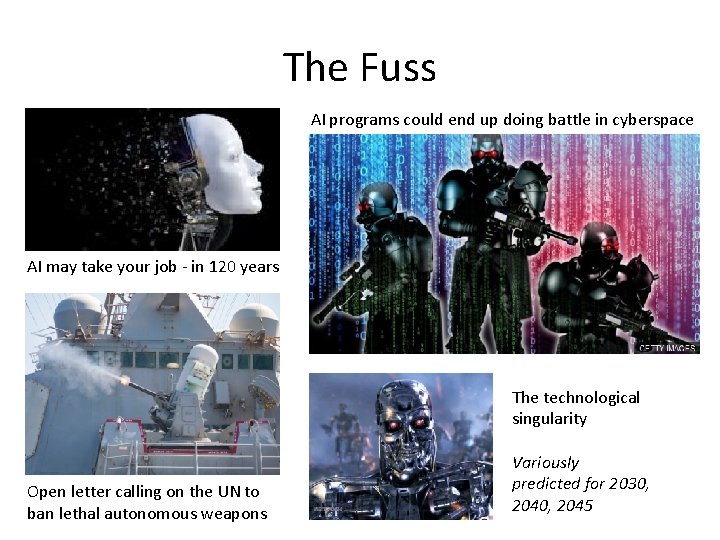
The Fuss AI programs could end up doing battle in cyberspace AI may take your job - in 120 years The technological singularity Open letter calling on the UN to ban lethal autonomous weapons Variously predicted for 2030, 2045
Some Questions • What are we talking about? – Achievability? – Controllability? – Desirability? – Inevitability?
Weak AI, Strong AI & AGI • Turing Test (Imitation Game), 1950 • Searle’s Chinese Room, 1980 • Weak AI – An AI system that can act like it thinks and has a mind – Non-sentient • Strong AI – An AI system that can think and has a mind – Sentient ? • Artificial General Intelligence (AGI) – Being smart – Common sense
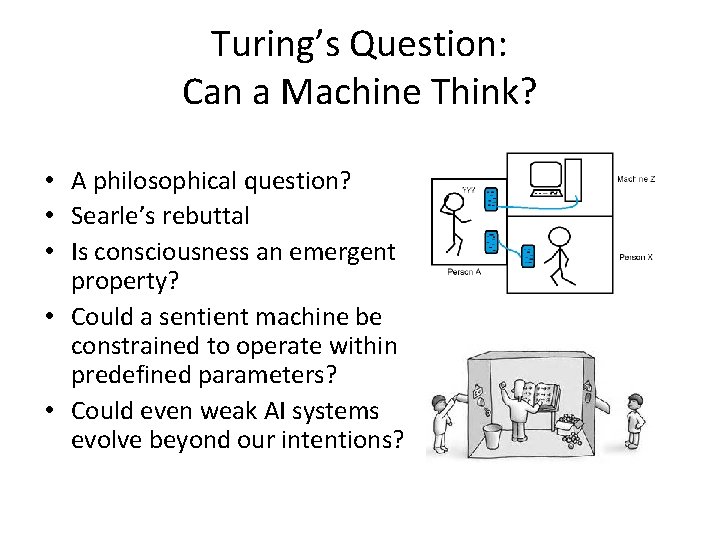
Turing’s Question: Can a Machine Think? • A philosophical question? • Searle’s rebuttal • Is consciousness an emergent property? • Could a sentient machine be constrained to operate within predefined parameters? • Could even weak AI systems evolve beyond our intentions?
The Concerns • Artificial intelligence and robots taking human jobs – What happens if the many become unemployed and the few who control the technology become squillionaires? • Military robots killing people – Moral and practical objections • Artificial intelligence delivering unforeseen outcomes – Inexorable logic and human error • Artificial intelligence outstripping human intelligence – The Technological Singularity • Artificial intelligence being subverted to criminal purposes – AI will be available to all, not just the noble minded
AI and Armaments • Why would anybody put a weapon in the hands of a robot? – Robotic soldiers could minimise • Body bags • Collateral damage • Why would anybody put AI into a weapon? – What about using AI to prevent a humancontrolled weapon being discharged against a non -combatant?
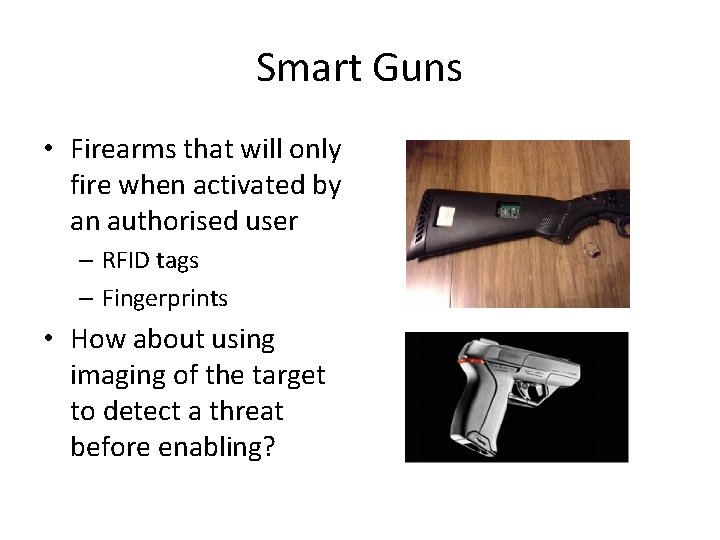
Smart Guns • Firearms that will only fire when activated by an authorised user – RFID tags – Fingerprints • How about using imaging of the target to detect a threat before enabling?
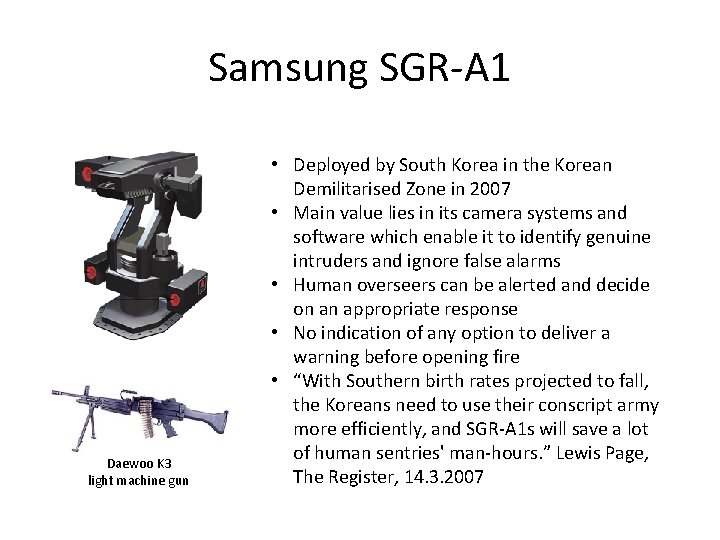
Samsung SGR-A 1 Daewoo K 3 light machine gun • Deployed by South Korea in the Korean Demilitarised Zone in 2007 • Main value lies in its camera systems and software which enable it to identify genuine intruders and ignore false alarms • Human overseers can be alerted and decide on an appropriate response • No indication of any option to deliver a warning before opening fire • “With Southern birth rates projected to fall, the Koreans need to use their conscript army more efficiently, and SGR-A 1 s will save a lot of human sentries' man-hours. ” Lewis Page, The Register, 14. 3. 2007
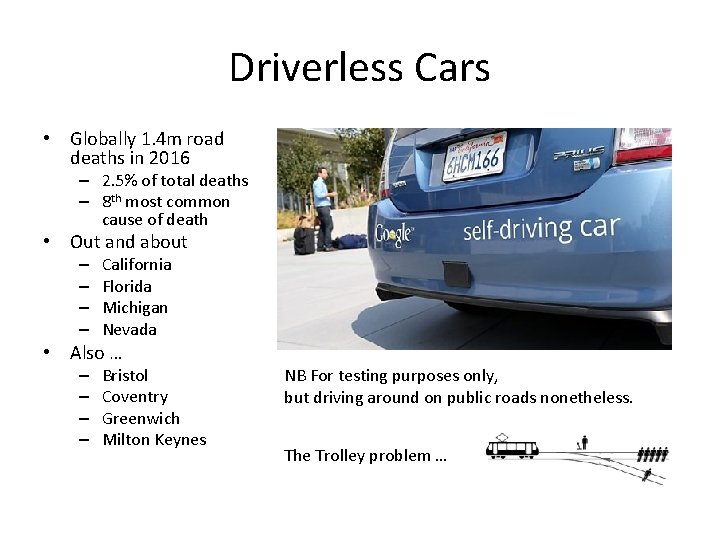
Driverless Cars • Globally 1. 4 m road deaths in 2016 – 2. 5% of total deaths – 8 th most common cause of death • Out and about – – California Florida Michigan Nevada • Also … – – Bristol Coventry Greenwich Milton Keynes NB For testing purposes only, but driving around on public roads nonetheless. The Trolley problem …
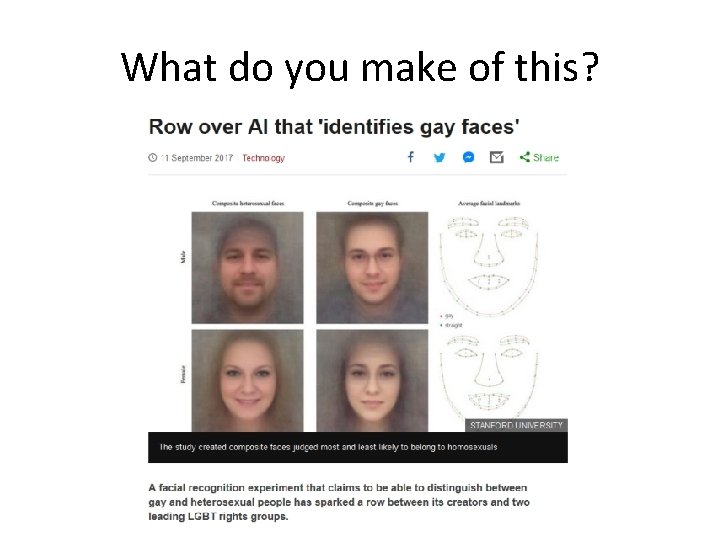
What do you make of this?
Demis Hassabis Deep. Mind (Google) “Terminator is one of those examples that is very iconic, but extremely unrealistic in a number of ways. “Certainly that's not what I worry about. “It's more where there are unintended things - something you might have missed, rather than people intentionally building systems to control weapons and other things. ” Interview with Kamal Ahmed, BBC, 16. 9. 2015
The Law of Unintended Consequences • If you want to write a truly impressive software system then you need the input of teams of developers (see Year 3 Group Project) • We re-use code to build even the simplest of applications these days (don’t you? ) • Open source projects can have enormous numbers of contributors • There is just so much code out there now … and it is inconceivable that it is all perfect
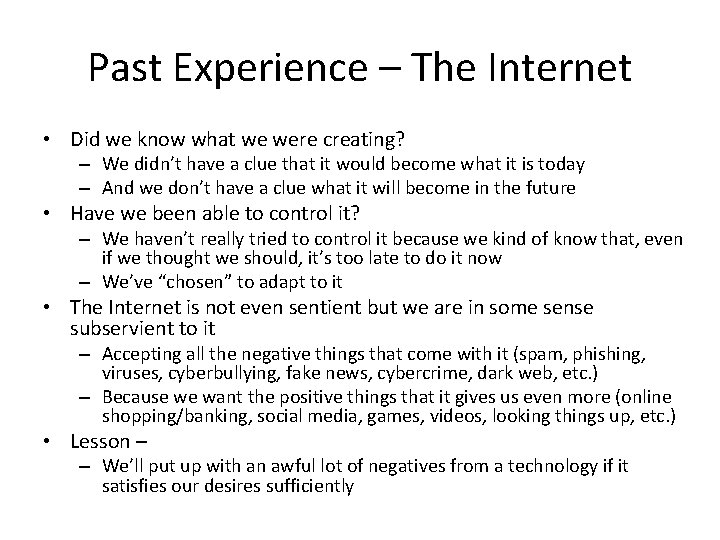
Past Experience – The Internet • Did we know what we were creating? – We didn’t have a clue that it would become what it is today – And we don’t have a clue what it will become in the future • Have we been able to control it? – We haven’t really tried to control it because we kind of know that, even if we thought we should, it’s too late to do it now – We’ve “chosen” to adapt to it • The Internet is not even sentient but we are in some sense subservient to it – Accepting all the negative things that come with it (spam, phishing, viruses, cyberbullying, fake news, cybercrime, dark web, etc. ) – Because we want the positive things that it gives us even more (online shopping/banking, social media, games, videos, looking things up, etc. ) • Lesson – – We’ll put up with an awful lot of negatives from a technology if it satisfies our desires sufficiently
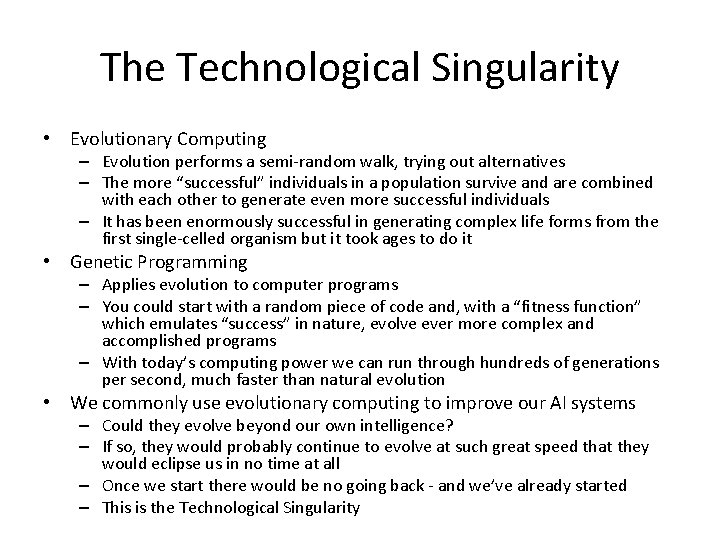
The Technological Singularity • Evolutionary Computing – Evolution performs a semi-random walk, trying out alternatives – The more “successful” individuals in a population survive and are combined with each other to generate even more successful individuals – It has been enormously successful in generating complex life forms from the first single-celled organism but it took ages to do it • Genetic Programming – Applies evolution to computer programs – You could start with a random piece of code and, with a “fitness function” which emulates “success” in nature, evolve ever more complex and accomplished programs – With today’s computing power we can run through hundreds of generations per second, much faster than natural evolution • We commonly use evolutionary computing to improve our AI systems – Could they evolve beyond our own intelligence? – If so, they would probably continue to evolve at such great speed that they would eclipse us in no time at all – Once we start there would be no going back - and we’ve already started – This is the Technological Singularity
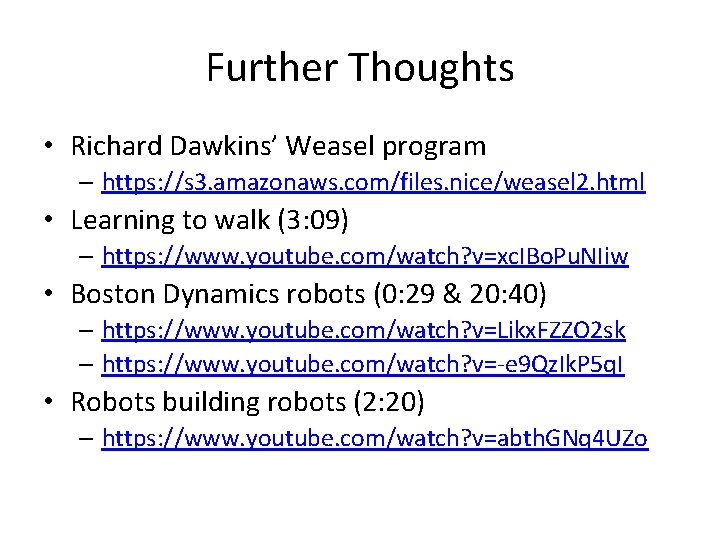
Further Thoughts • Richard Dawkins’ Weasel program – https: //s 3. amazonaws. com/files. nice/weasel 2. html • Learning to walk (3: 09) – https: //www. youtube. com/watch? v=xc. IBo. Pu. NIiw • Boston Dynamics robots (0: 29 & 20: 40) – https: //www. youtube. com/watch? v=Likx. FZZO 2 sk – https: //www. youtube. com/watch? v=-e 9 Qz. Ik. P 5 q. I • Robots building robots (2: 20) – https: //www. youtube. com/watch? v=abth. GNq 4 UZo
Any Questions?