
Artificial Intelligence Intelligent Agents aima cs berkeley edu
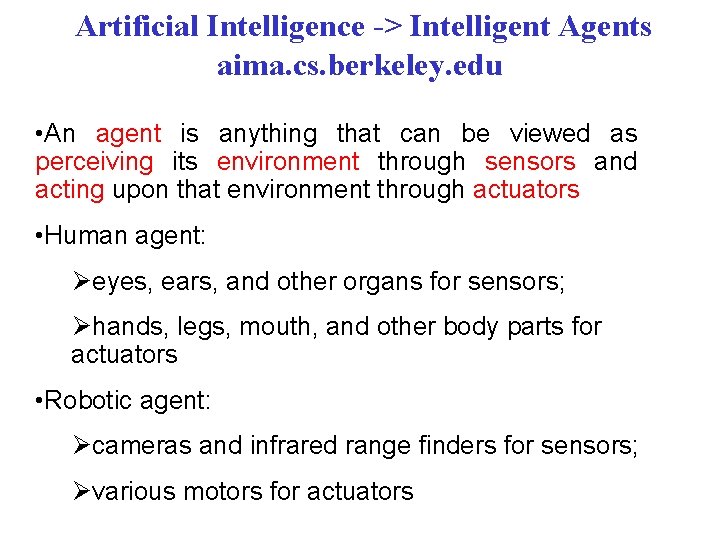
Artificial Intelligence -> Intelligent Agents aima. cs. berkeley. edu • An agent is anything that can be viewed as perceiving its environment through sensors and acting upon that environment through actuators • Human agent: eyes, ears, and other organs for sensors; hands, legs, mouth, and other body parts for actuators • Robotic agent: cameras and infrared range finders for sensors; various motors for actuators
![Environment/Agent • The agent function maps from percept histories to actions: [f: P* A]](http://slidetodoc.com/presentation_image_h2/28341bce6f93ac27696e4b7ee5e5db93/image-2.jpg "Environment/Agent • The agent function maps from percept histories to actions: [f: P* A]")
Environment/Agent • The agent function maps from percept histories to actions: [f: P* A] • The agent program runs on the physical architecture to produce f • agent = architecture + program 2
![Vacuum-cleaner world • Percepts: location and contents, e. g. , [A, Dirty]; • Actions:](http://slidetodoc.com/presentation_image_h2/28341bce6f93ac27696e4b7ee5e5db93/image-3.jpg "Vacuum-cleaner world • Percepts: location and contents, e. g. , [A, Dirty]; • Actions:")
Vacuum-cleaner world • Percepts: location and contents, e. g. , [A, Dirty]; • Actions: Left, Right, Suck, No. Op; • Table of Percepts-> Actions • Which Action Considering a Percept ? 3
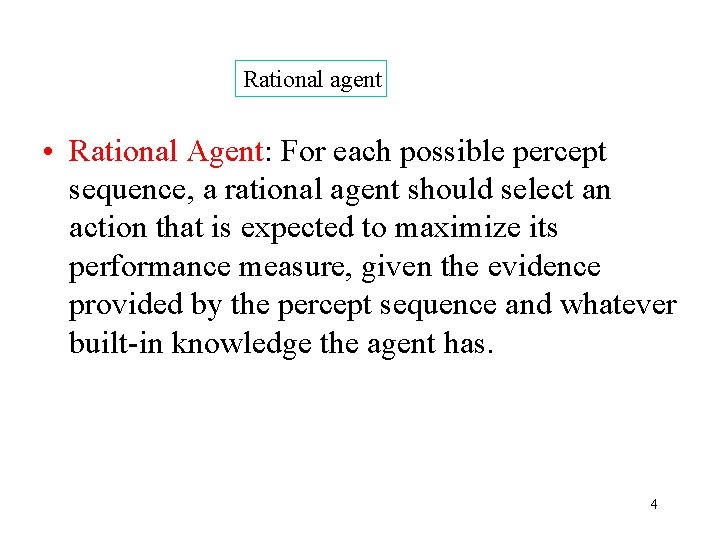
Rational agent • Rational Agent: For each possible percept sequence, a rational agent should select an action that is expected to maximize its performance measure, given the evidence provided by the percept sequence and whatever built-in knowledge the agent has. 4
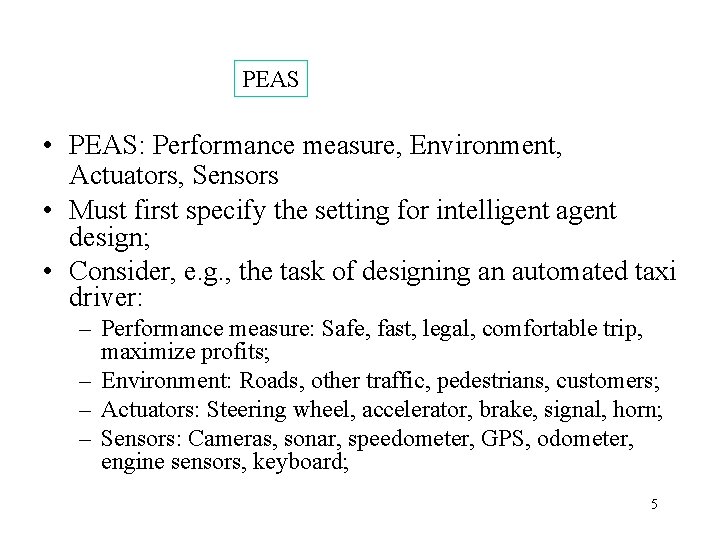
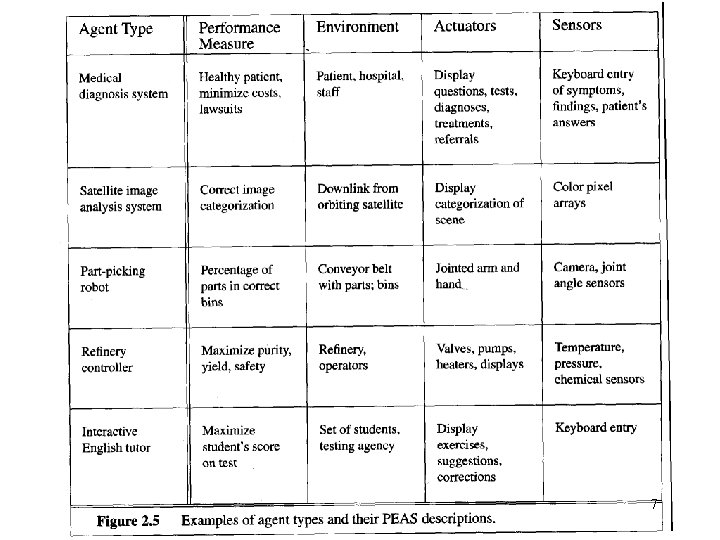
PEAS • PEAS: Performance measure, Environment, Actuators, Sensors • Must first specify the setting for intelligent agent design; • Consider, e. g. , the task of designing an automated taxi driver: – Performance measure: Safe, fast, legal, comfortable trip, maximize profits; – Environment: Roads, other traffic, pedestrians, customers; – Actuators: Steering wheel, accelerator, brake, signal, horn; – Sensors: Cameras, sonar, speedometer, GPS, odometer, engine sensors, keyboard; 5

• An agent is completely specified by the agent function mapping percept sequences to actions • One agent function is rational; • Aim: find a way to implement the rational agent function concisely; 6
7
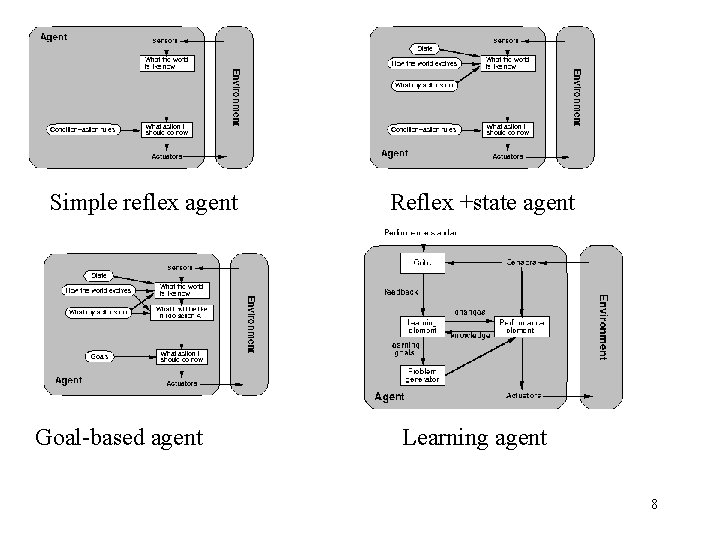
Simple reflex agent Goal-based agent Reflex +state agent Learning agent 8
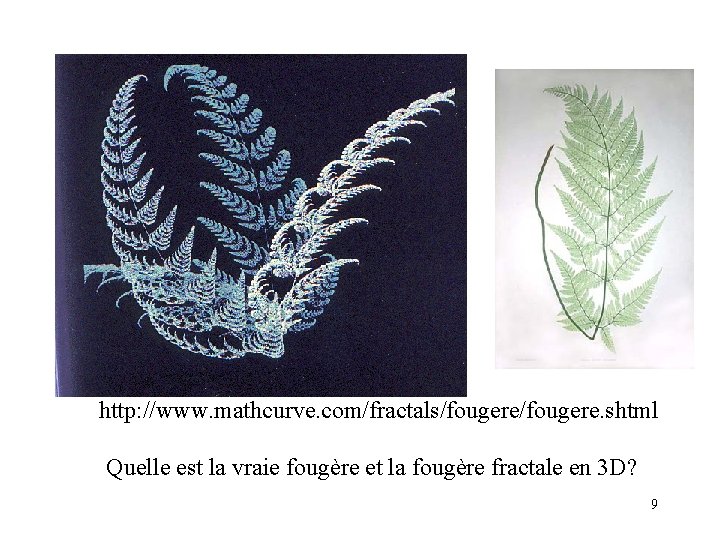
http: //www. mathcurve. com/fractals/fougere. shtml Quelle est la vraie fougère et la fougère fractale en 3 D? 9
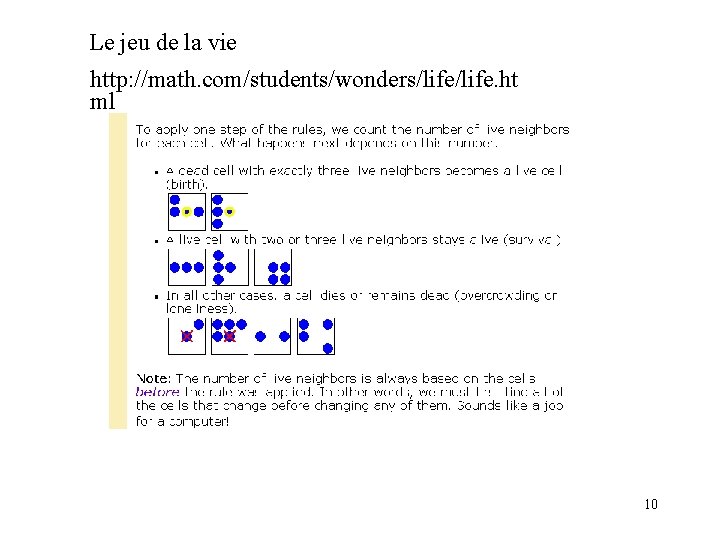
Le jeu de la vie http: //math. com/students/wonders/life. ht ml 10
11
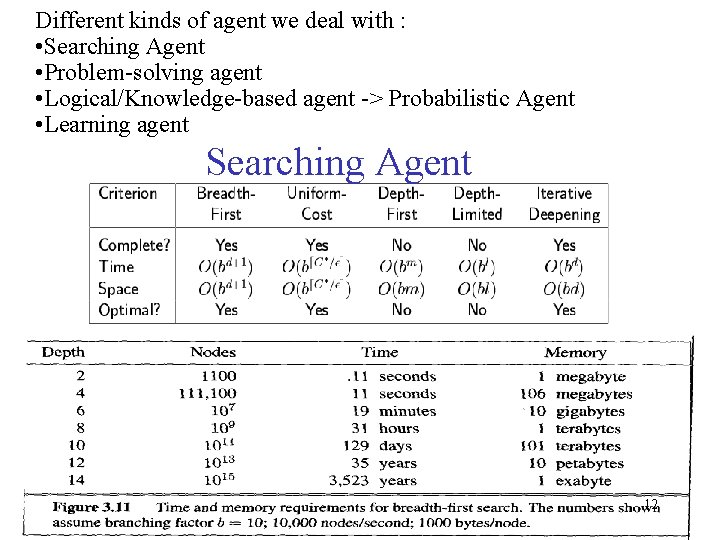
Different kinds of agent we deal with : • Searching Agent • Problem-solving agent • Logical/Knowledge-based agent -> Probabilistic Agent • Learning agent Searching Agent 12
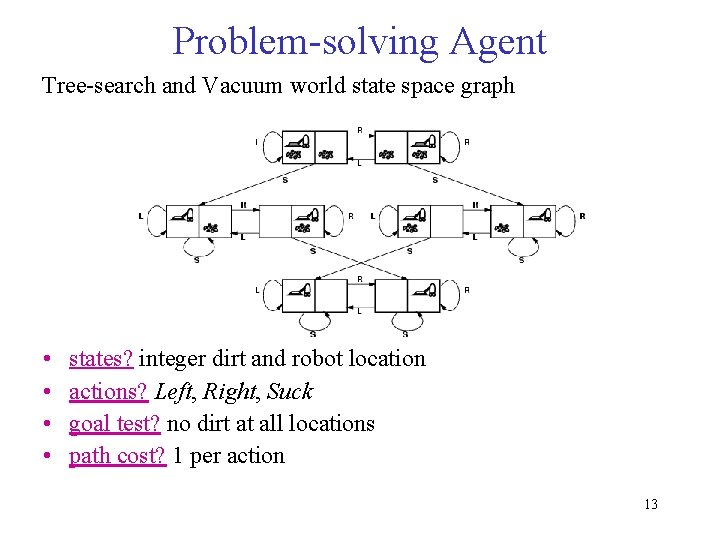
Problem-solving Agent Tree-search and Vacuum world state space graph • • states? integer dirt and robot location actions? Left, Right, Suck goal test? no dirt at all locations path cost? 1 per action 13
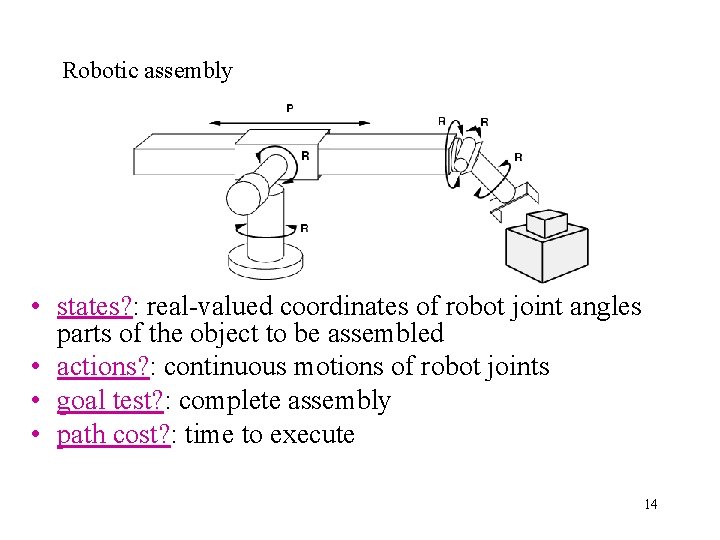
Robotic assembly • states? : real-valued coordinates of robot joint angles parts of the object to be assembled • actions? : continuous motions of robot joints • goal test? : complete assembly • path cost? : time to execute 14
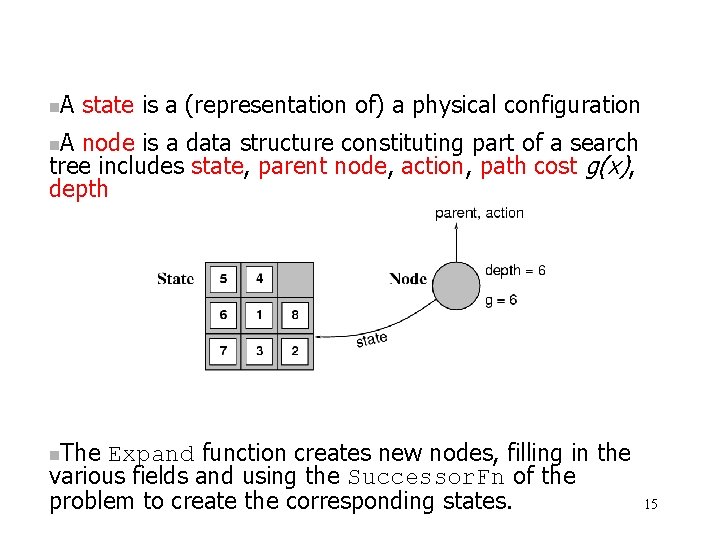
A state is a (representation of) a physical configuration A node is a data structure constituting part of a search tree includes state, parent node, action, path cost g(x), depth The Expand function creates new nodes, filling in the various fields and using the Successor. Fn of the problem to create the corresponding states. 15
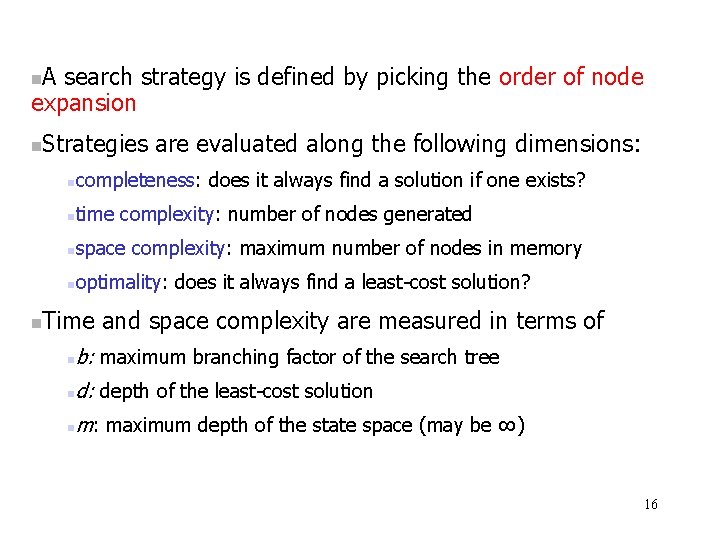
A search strategy is defined by picking the order of node expansion Strategies are evaluated along the following dimensions: completeness: does it always find a solution if one exists? time complexity: number of nodes generated space complexity: maximum number of nodes in memory optimality: does it always find a least-cost solution? Time and space complexity are measured in terms of b: maximum branching factor of the search tree d: depth of the least-cost solution m: maximum depth of the state space (may be ∞) 16
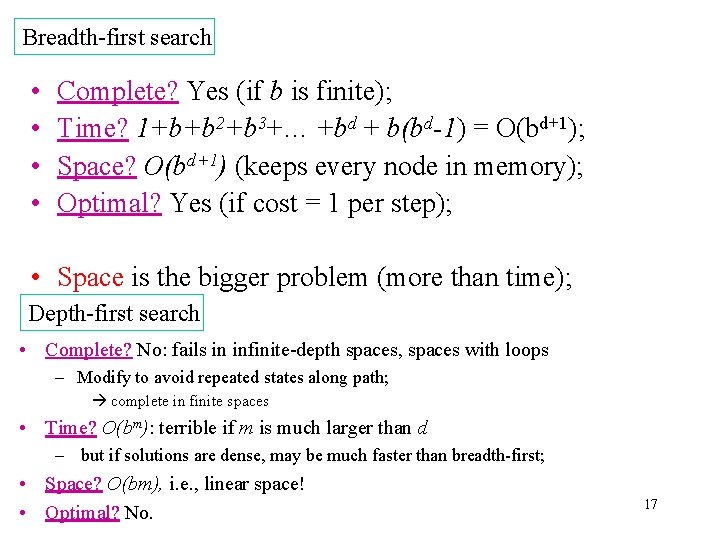
Breadth-first search • • Complete? Yes (if b is finite); Time? 1+b+b 2+b 3+… +bd + b(bd-1) = O(bd+1); Space? O(bd+1) (keeps every node in memory); Optimal? Yes (if cost = 1 per step); • Space is the bigger problem (more than time); Depth-first search • Complete? No: fails in infinite-depth spaces, spaces with loops – Modify to avoid repeated states along path; complete in finite spaces • Time? O(bm): terrible if m is much larger than d – but if solutions are dense, may be much faster than breadth-first; • Space? O(bm), i. e. , linear space! • Optimal? No. 17
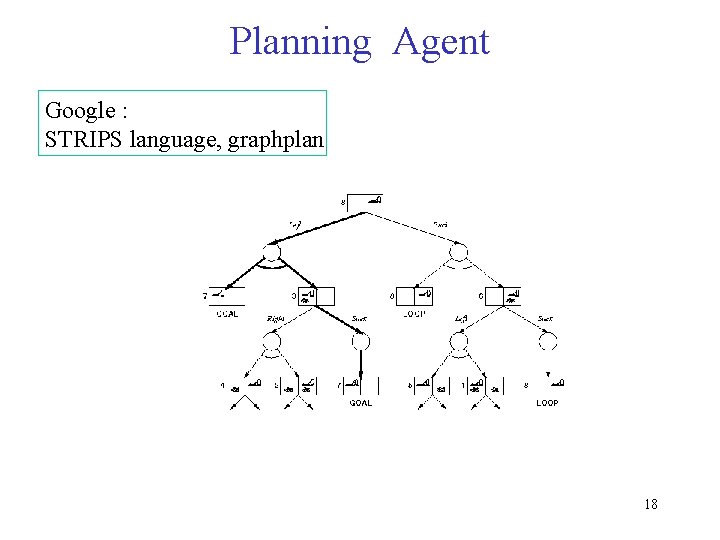
Planning Agent Google : STRIPS language, graphplan 18
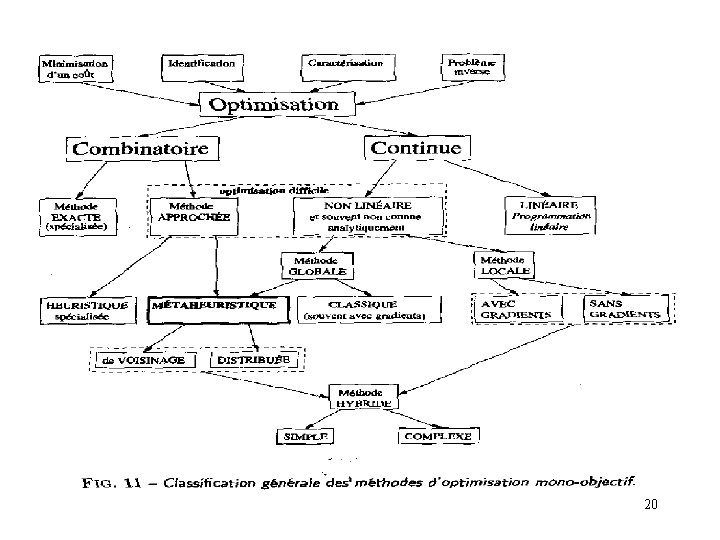
Local search algorithms / Metaheuristics Optimisation • In many optimization problems, the path to the goal is irrelevant; the goal state itself is the solution; • State space = set of "complete" configurations • Find configuration satisfying constraints, e. g. , nqueens • In such cases, we can use local search algorithms • keep a single "current" state, try to improve it; 19
20
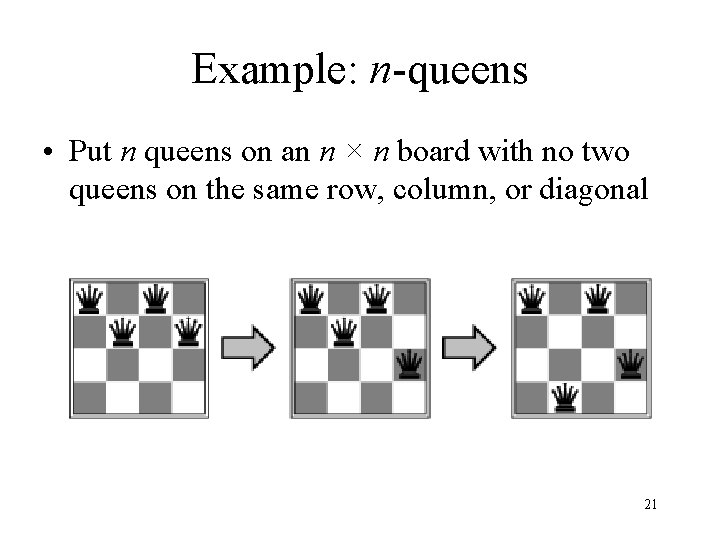
Example: n-queens • Put n queens on an n × n board with no two queens on the same row, column, or diagonal 21
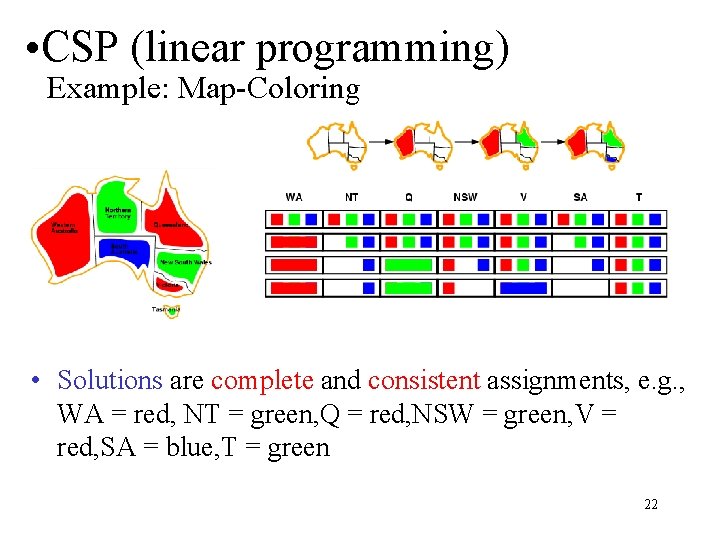
• CSP (linear programming) Example: Map-Coloring • Solutions are complete and consistent assignments, e. g. , WA = red, NT = green, Q = red, NSW = green, V = red, SA = blue, T = green 22
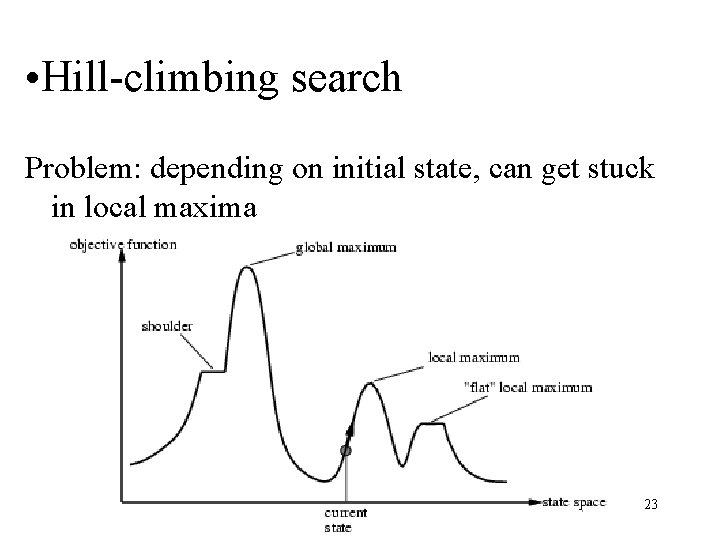
• Hill-climbing search Problem: depending on initial state, can get stuck in local maxima 23
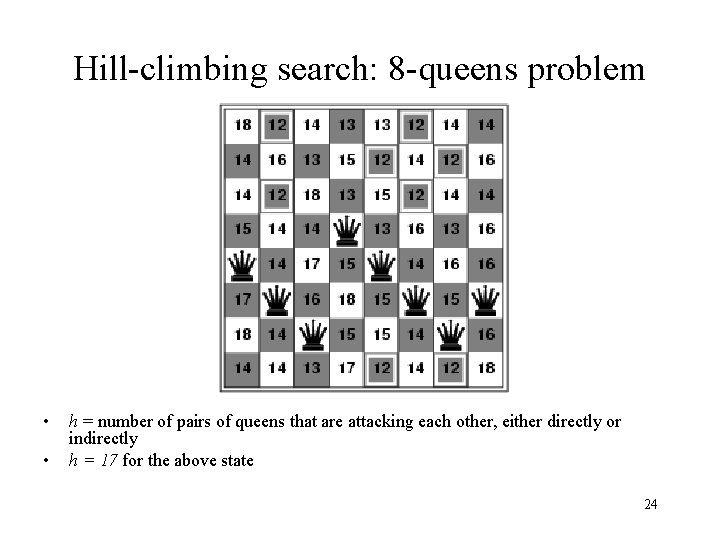
Hill-climbing search: 8 -queens problem • • h = number of pairs of queens that are attacking each other, either directly or indirectly h = 17 for the above state 24
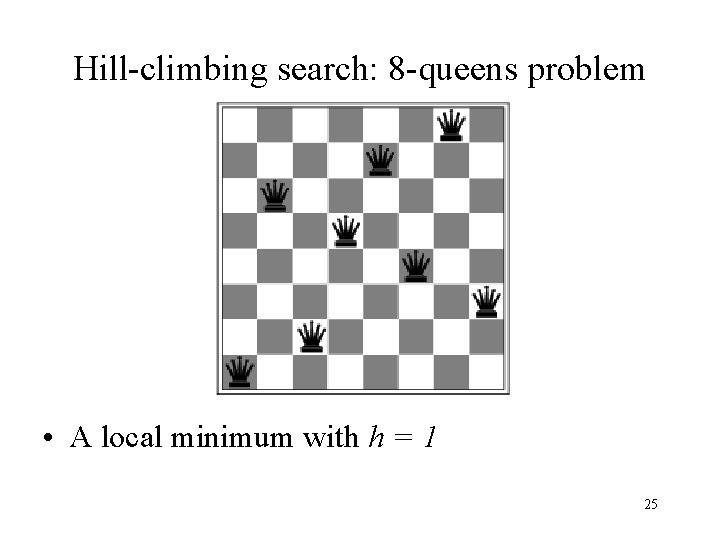
Hill-climbing search: 8 -queens problem • A local minimum with h = 1 25
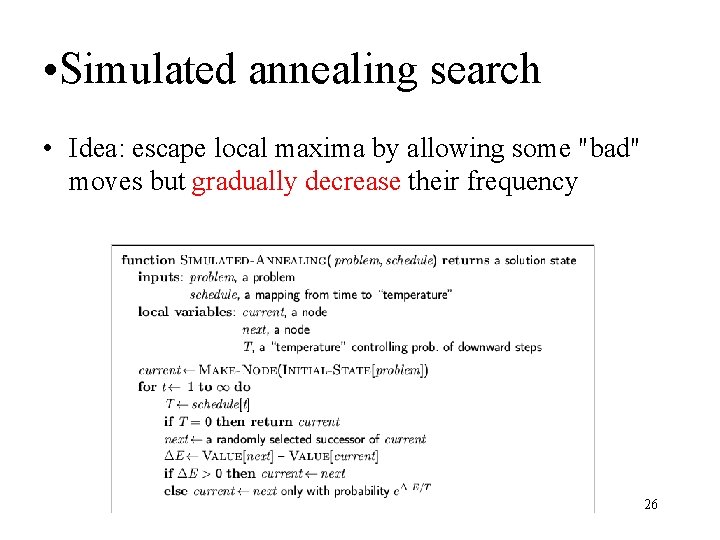
• Simulated annealing search • Idea: escape local maxima by allowing some "bad" moves but gradually decrease their frequency 26
Properties of simulated annealing search • One can prove: If T decreases slowly enough, then simulated annealing search will find a global optimum with probability approaching 1 • Widely used in VLSI layout, airline scheduling, etc • Local beam search • Genetic algorithms 27
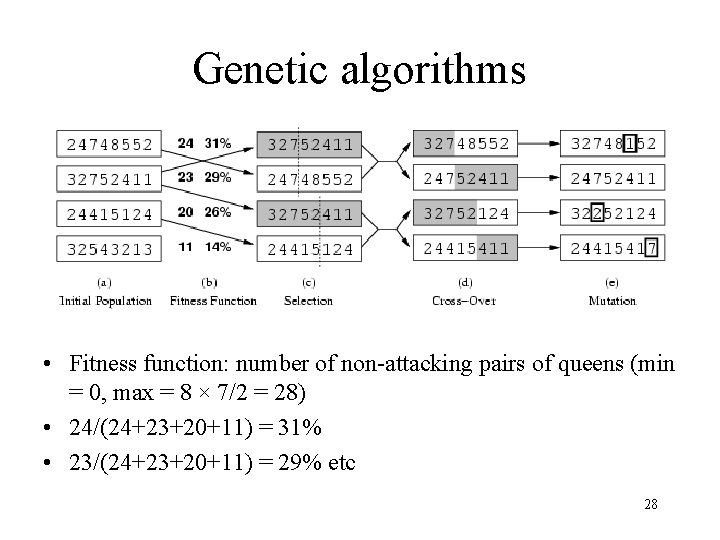
Genetic algorithms • Fitness function: number of non-attacking pairs of queens (min = 0, max = 8 × 7/2 = 28) • 24/(24+23+20+11) = 31% • 23/(24+23+20+11) = 29% etc 28
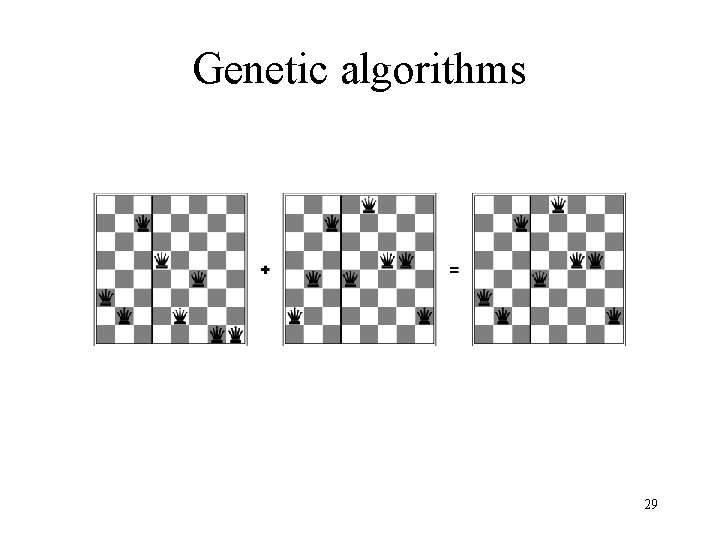
Genetic algorithms 29
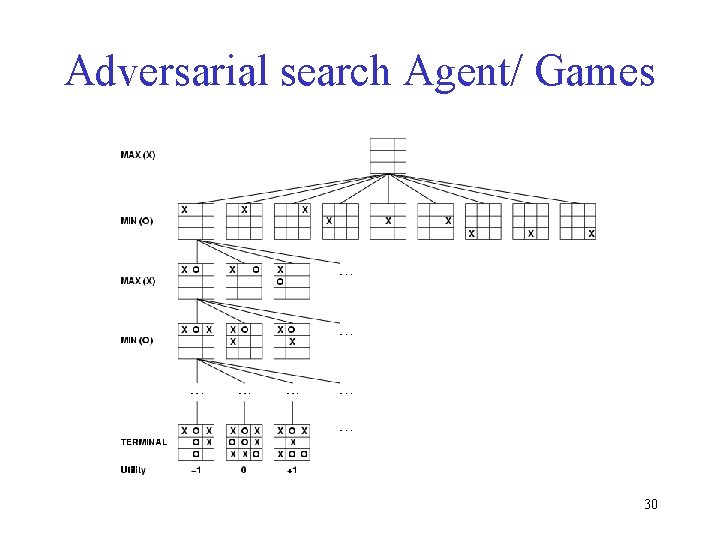
Adversarial search Agent/ Games 30
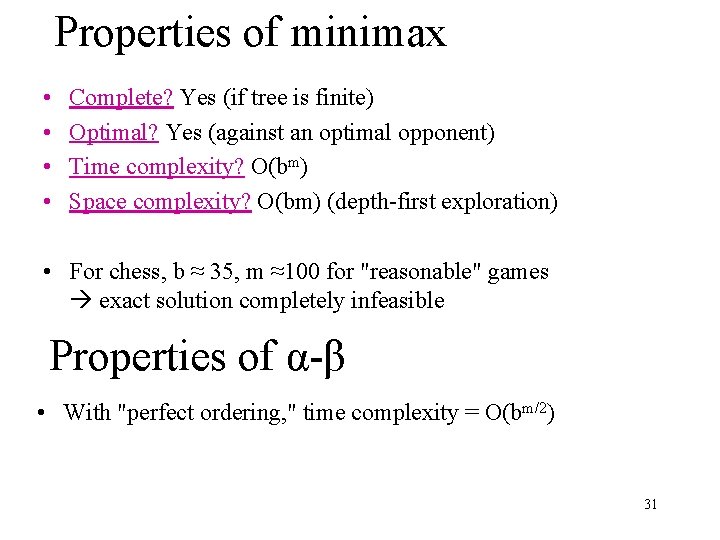
Properties of minimax • • Complete? Yes (if tree is finite) Optimal? Yes (against an optimal opponent) Time complexity? O(bm) Space complexity? O(bm) (depth-first exploration) • For chess, b ≈ 35, m ≈100 for "reasonable" games exact solution completely infeasible Properties of α-β • With "perfect ordering, " time complexity = O(bm/2) 31
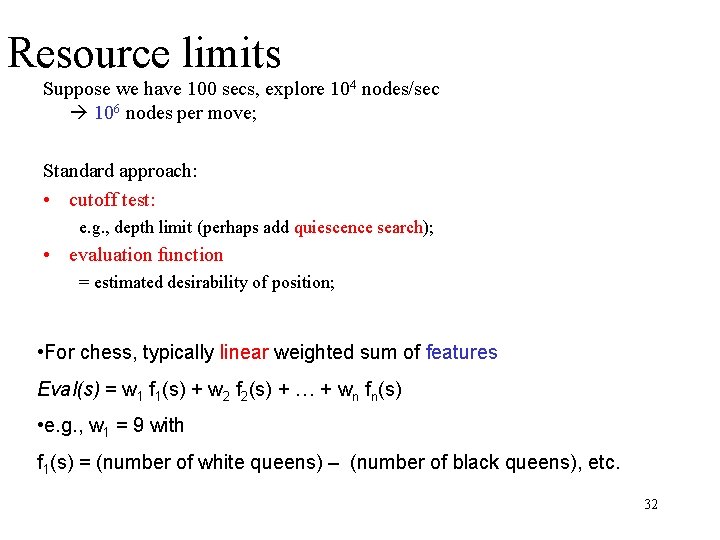
Resource limits Suppose we have 100 secs, explore 104 nodes/sec 106 nodes per move; Standard approach: • cutoff test: e. g. , depth limit (perhaps add quiescence search); • evaluation function = estimated desirability of position; • For chess, typically linear weighted sum of features Eval(s) = w 1 f 1(s) + w 2 f 2(s) + … + wn fn(s) • e. g. , w 1 = 9 with f 1(s) = (number of white queens) – (number of black queens), etc. 32
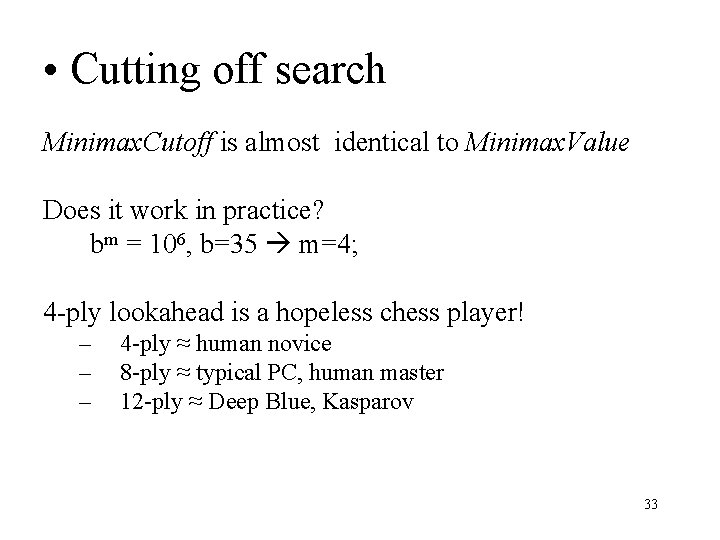
• Cutting off search Minimax. Cutoff is almost identical to Minimax. Value Does it work in practice? bm = 106, b=35 m=4; 4 -ply lookahead is a hopeless chess player! – – – 4 -ply ≈ human novice 8 -ply ≈ typical PC, human master 12 -ply ≈ Deep Blue, Kasparov 33
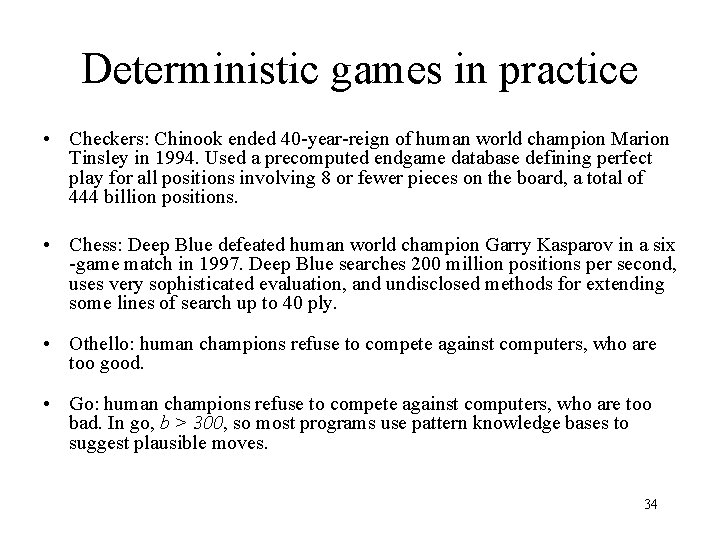
Deterministic games in practice • Checkers: Chinook ended 40 -year-reign of human world champion Marion Tinsley in 1994. Used a precomputed endgame database defining perfect play for all positions involving 8 or fewer pieces on the board, a total of 444 billion positions. • Chess: Deep Blue defeated human world champion Garry Kasparov in a six -game match in 1997. Deep Blue searches 200 million positions per second, uses very sophisticated evaluation, and undisclosed methods for extending some lines of search up to 40 ply. • Othello: human champions refuse to compete against computers, who are too good. • Go: human champions refuse to compete against computers, who are too bad. In go, b > 300, so most programs use pattern knowledge bases to suggest plausible moves. 34
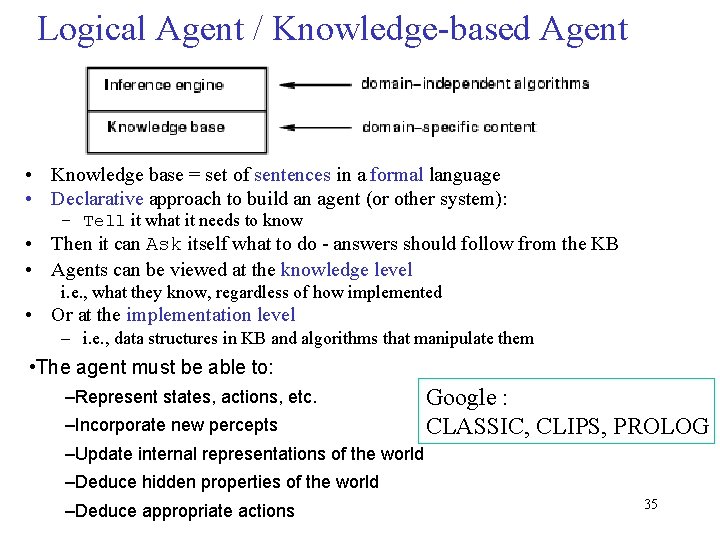
Logical Agent / Knowledge-based Agent • Knowledge base = set of sentences in a formal language • Declarative approach to build an agent (or other system): – Tell it what it needs to know • Then it can Ask itself what to do - answers should follow from the KB • Agents can be viewed at the knowledge level i. e. , what they know, regardless of how implemented • Or at the implementation level – i. e. , data structures in KB and algorithms that manipulate them • The agent must be able to: –Represent states, actions, etc. –Incorporate new percepts Google : CLASSIC, CLIPS, PROLOG –Update internal representations of the world –Deduce hidden properties of the world –Deduce appropriate actions 35
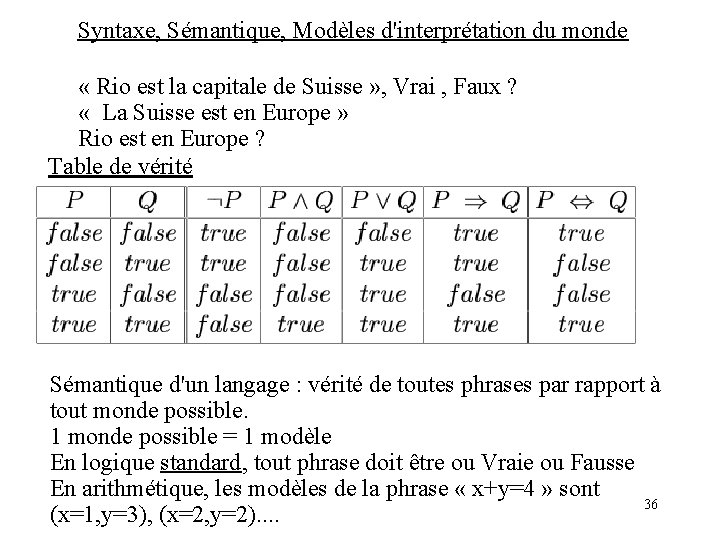
Syntaxe, Sémantique, Modèles d'interprétation du monde « Rio est la capitale de Suisse » , Vrai , Faux ? « La Suisse est en Europe » Rio est en Europe ? Table de vérité Sémantique d'un langage : vérité de toutes phrases par rapport à tout monde possible. 1 monde possible = 1 modèle En logique standard, tout phrase doit être ou Vraie ou Fausse En arithmétique, les modèles de la phrase « x+y=4 » sont 36 (x=1, y=3), (x=2, y=2). .
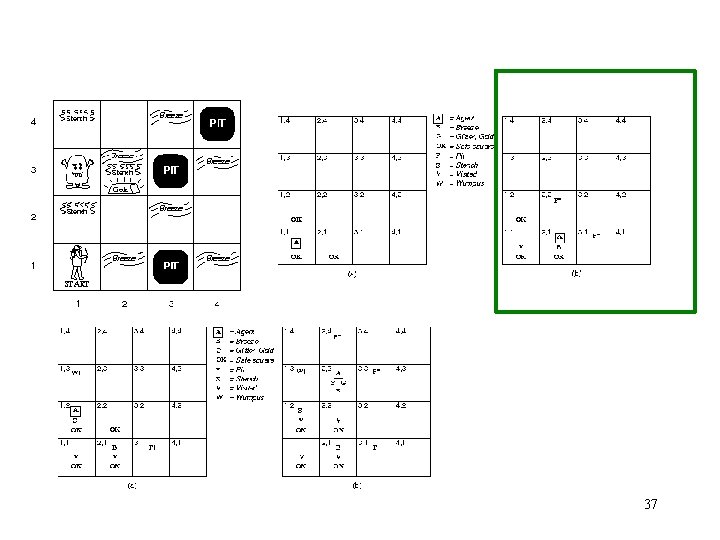
37
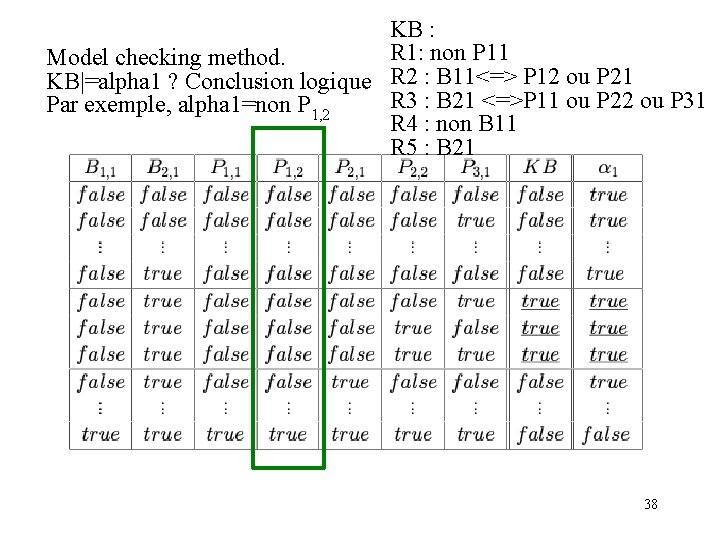
KB : R 1: non P 11 Model checking method. KB|=alpha 1 ? Conclusion logique R 2 : B 11<=> P 12 ou P 21 R 3 : B 21 <=>P 11 ou P 22 ou P 31 Par exemple, alpha 1=non P 1, 2 R 4 : non B 11 R 5 : B 21 38
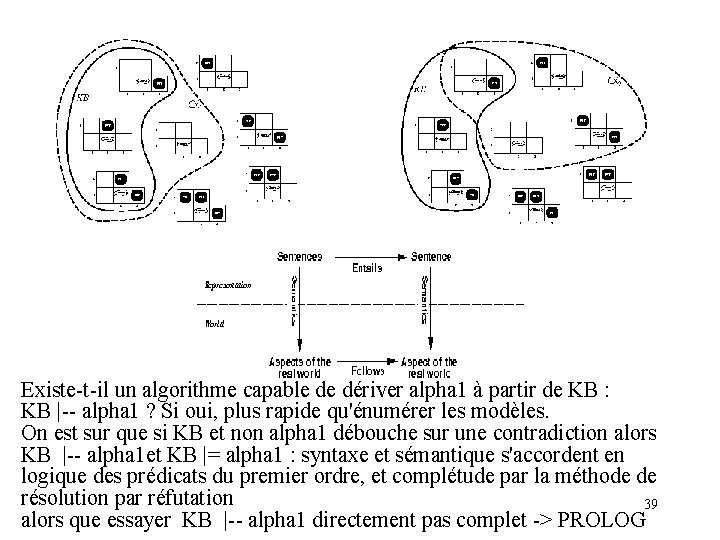
Existe-t-il un algorithme capable de dériver alpha 1 à partir de KB : KB |-- alpha 1 ? Si oui, plus rapide qu'énumérer les modèles. On est sur que si KB et non alpha 1 débouche sur une contradiction alors KB |-- alpha 1 et KB |= alpha 1 : syntaxe et sémantique s'accordent en logique des prédicats du premier ordre, et complétude par la méthode de résolution par réfutation 39 alors que essayer KB |-- alpha 1 directement pas complet -> PROLOG
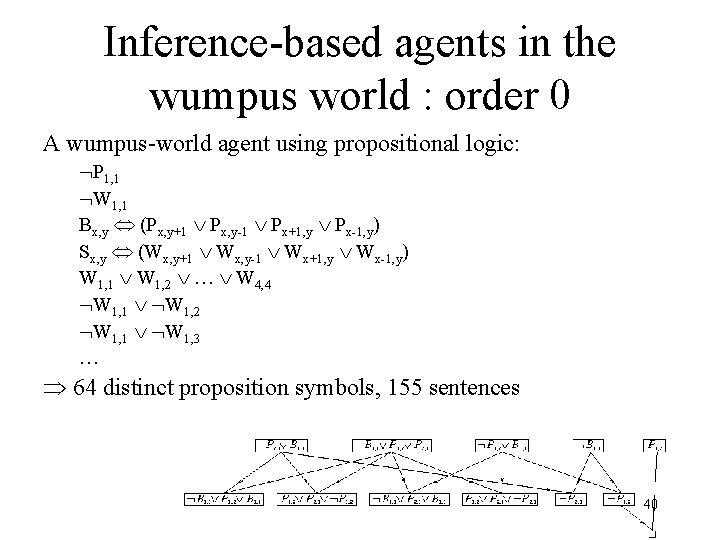
Inference-based agents in the wumpus world : order 0 A wumpus-world agent using propositional logic: P 1, 1 W 1, 1 Bx, y (Px, y+1 Px, y-1 Px+1, y Px-1, y) Sx, y (Wx, y+1 Wx, y-1 Wx+1, y Wx-1, y) W 1, 1 W 1, 2 … W 4, 4 W 1, 1 W 1, 2 W 1, 1 W 1, 3 … 64 distinct proposition symbols, 155 sentences 40
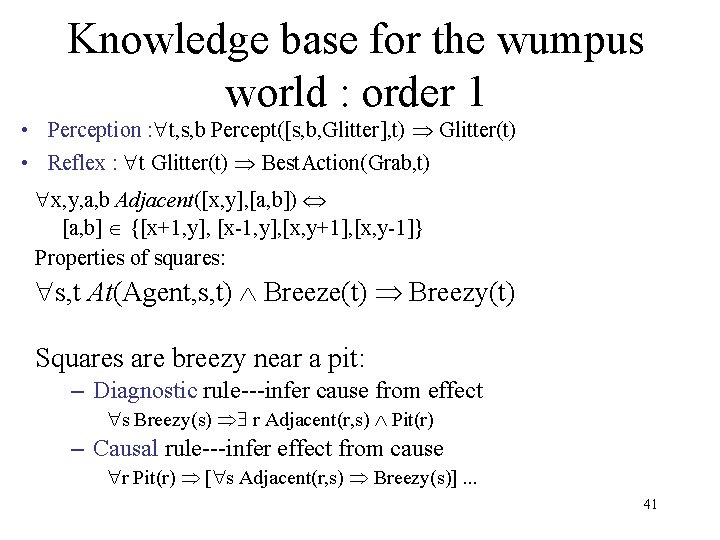
Knowledge base for the wumpus world : order 1 • Perception : t, s, b Percept([s, b, Glitter], t) Glitter(t) • Reflex : t Glitter(t) Best. Action(Grab, t) x, y, a, b Adjacent([x, y], [a, b]) [a, b] {[x+1, y], [x-1, y], [x, y+1], [x, y-1]} Properties of squares: s, t At(Agent, s, t) Breeze(t) Breezy(t) Squares are breezy near a pit: – Diagnostic rule---infer cause from effect s Breezy(s) r Adjacent(r, s) Pit(r) – Causal rule---infer effect from cause r Pit(r) [ s Adjacent(r, s) Breezy(s)]. . . 41
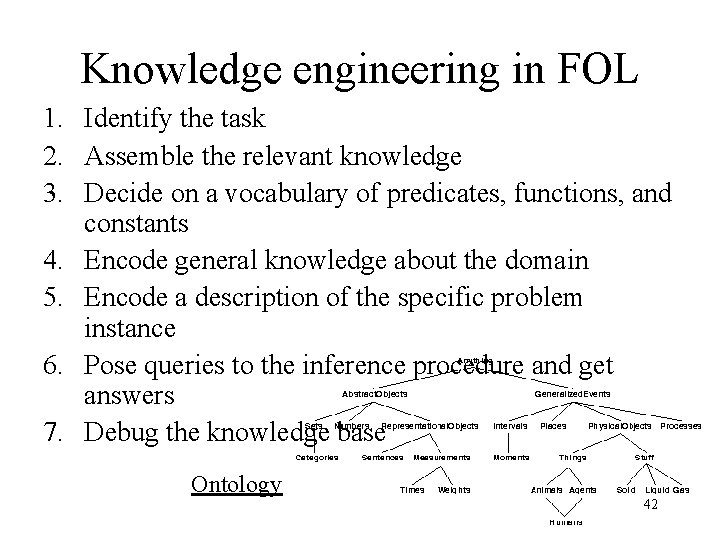
Knowledge engineering in FOL 1. Identify the task 2. Assemble the relevant knowledge 3. Decide on a vocabulary of predicates, functions, and constants 4. Encode general knowledge about the domain 5. Encode a description of the specific problem instance 6. Pose queries to the inference procedure and get answers 7. Debug the knowledge base Ontology 42
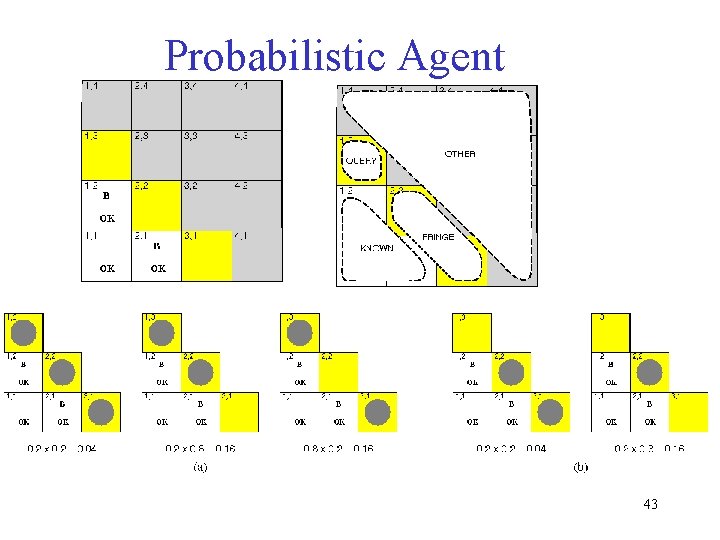
Probabilistic Agent 43
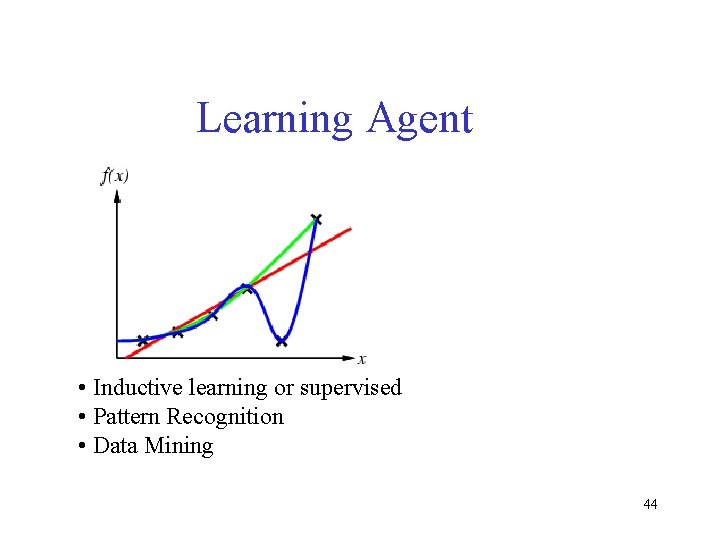
Learning Agent • Inductive learning or supervised • Pattern Recognition • Data Mining 44
- Slides: 44