
Artificial Intelligence Human vs Machine Adapted from slides




- Slides: 43
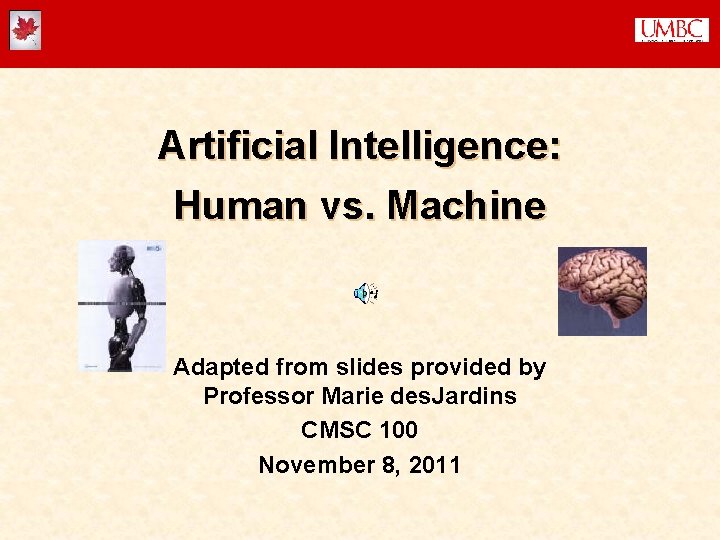
Artificial Intelligence: Human vs. Machine Adapted from slides provided by Professor Marie des. Jardins CMSC 100 November 8, 2011
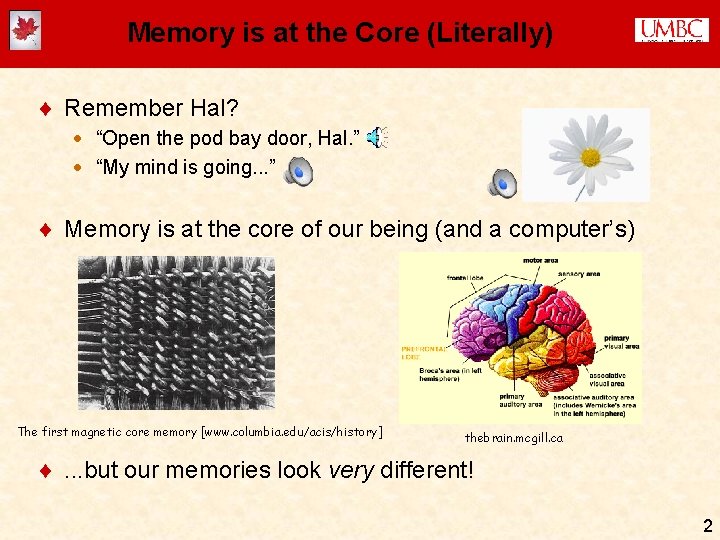
Memory is at the Core (Literally) ¨ Remember Hal? · “Open the pod bay door, Hal. ” · “My mind is going. . . ” ¨ Memory is at the core of our being (and a computer’s) The first magnetic core memory [www. columbia. edu/acis/history] thebrain. mcgill. ca ¨. . . but our memories look very different! 2
Overview ¨What is AI? (and why is it so cool? ) ¨AI: Past and Present · History of AI · AI Today ¨Computational vs. Biological Memory ¨The Skeptics Speak 3
What is AI?
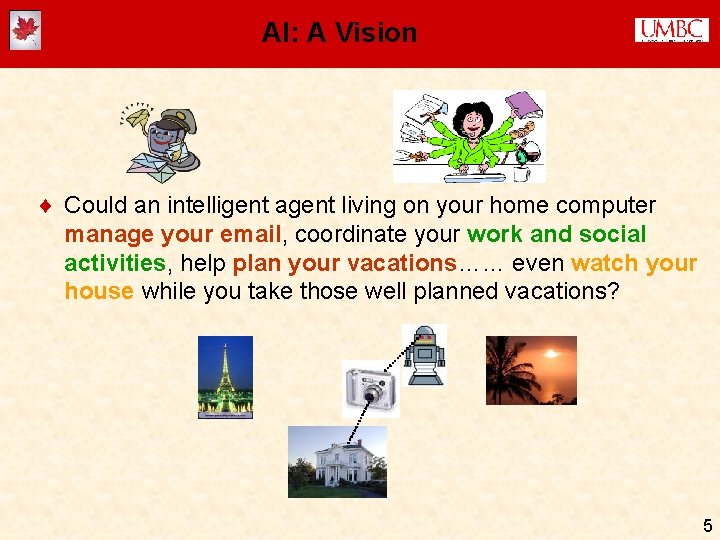
AI: A Vision ¨ Could an intelligent agent living on your home computer manage your email, coordinate your work and social activities, help plan your vacations…… even watch your house while you take those well planned vacations? 5
Main Goals of AI ¨Represent and store knowledge ¨Retrieve and reason about knowledge ¨Behave intelligently in complex environments ¨Develop interesting and useful applications ¨Interact with people, agents, and the environment 6
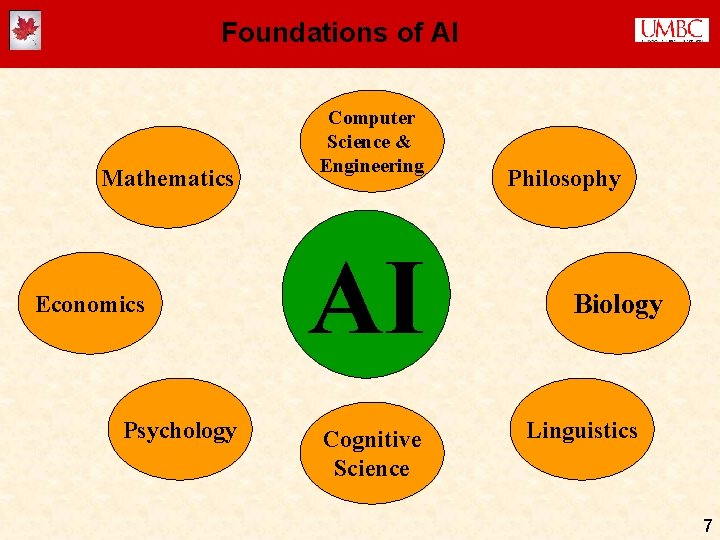
Foundations of AI Mathematics Economics Psychology Computer Science & Engineering AI Cognitive Science Philosophy Biology Linguistics 7
Big Questions ¨ Can machines think? ¨ If so, how? ¨ If not, why not? ¨ What does this say about human beings? ¨ What does this say about the mind? ¨ And if we can make machines think, should we? 8
History of AI
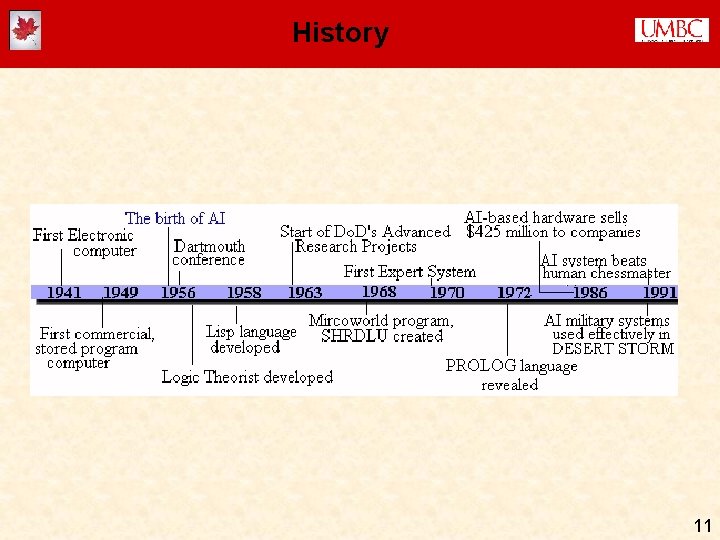
History 11
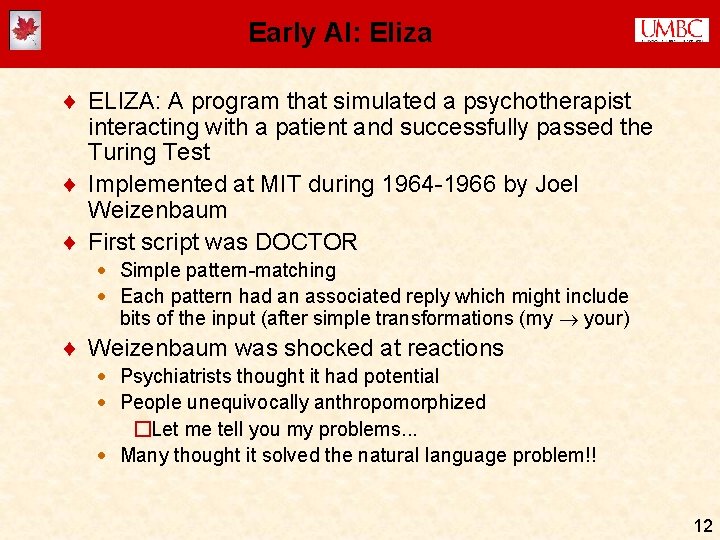
Early AI: Eliza ¨ ELIZA: A program that simulated a psychotherapist interacting with a patient and successfully passed the Turing Test ¨ Implemented at MIT during 1964 -1966 by Joel Weizenbaum ¨ First script was DOCTOR · Simple pattern-matching · Each pattern had an associated reply which might include bits of the input (after simple transformations (my your) ¨ Weizenbaum was shocked at reactions · Psychiatrists thought it had potential · People unequivocally anthropomorphized �Let me tell you my problems. . . · Many thought it solved the natural language problem!! 12
Eliza Speaks ¨ ¨ ¨ ¨ I am the psychotherapist. Please, describe your problems. i'm having a hard time with my students Why do you say that? well, they keep asking me for money Maybe your plans have something to do with this. what plans? Is it because of your life that you say what plans? No, it's because I didn't know what you were talking about Is it because you didn't know what I was talking about that you came to me? no, it's because i wanted to see if you could pass the turing test Does it bother you that you wanted to see if I could really pass the turing test? …. . How do you reconcile problems at school? This is a waste of time. Good bye My secretary will send you a bill. 13
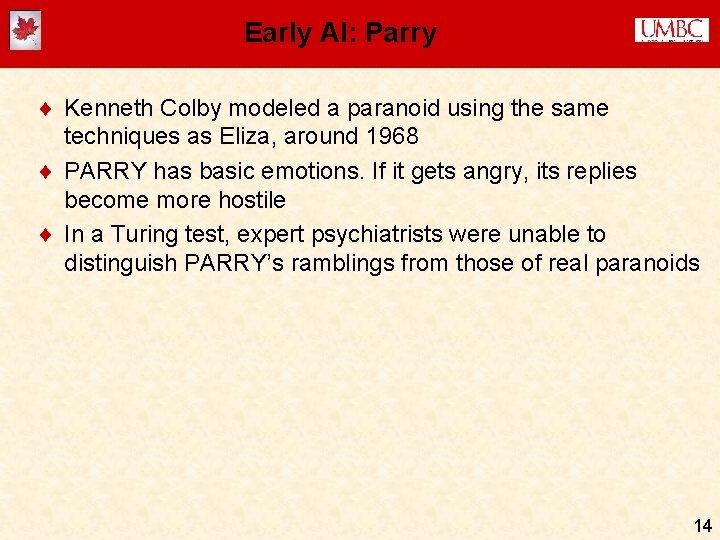
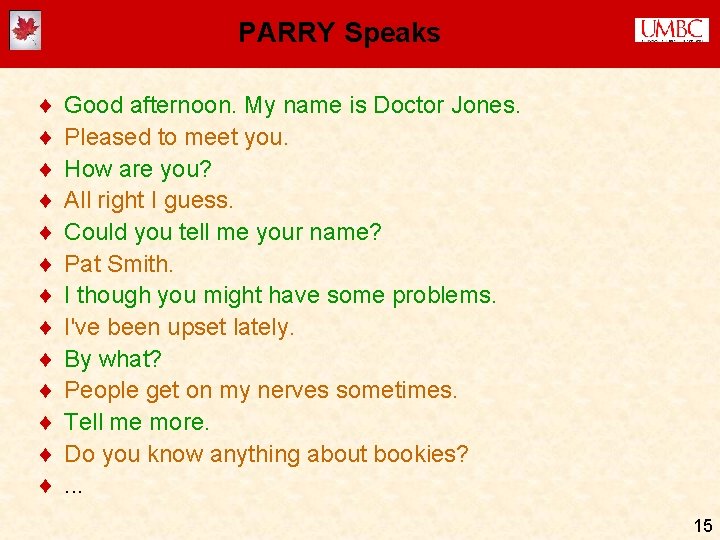
Early AI: Parry ¨ Kenneth Colby modeled a paranoid using the same techniques as Eliza, around 1968 ¨ PARRY has basic emotions. If it gets angry, its replies become more hostile ¨ In a Turing test, expert psychiatrists were unable to distinguish PARRY’s ramblings from those of real paranoids 14
PARRY Speaks ¨ ¨ ¨ ¨ Good afternoon. My name is Doctor Jones. Pleased to meet you. How are you? All right I guess. Could you tell me your name? Pat Smith. I though you might have some problems. I've been upset lately. By what? People get on my nerves sometimes. Tell me more. Do you know anything about bookies? . . . 15
P: I don't understand your motives. E: Why don't you understand my motives? P: Shouldn't I be? E: Why do you say that just now? P: That's just the way it is. E: Suppose that's the way it were not. P: So? E: I am not sure I understand you fully. P: You harp on the same questions too much. E: What does that similarity suggest to you? P: I don't get you. E: Do you wish that you did get I? 16
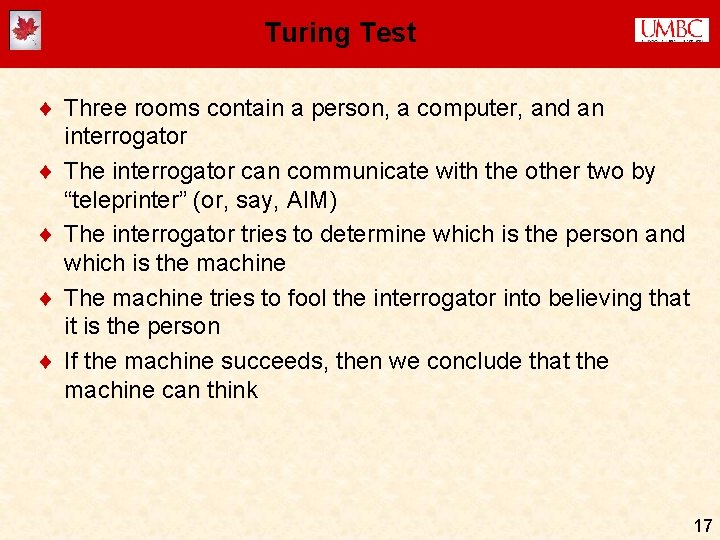
Turing Test ¨ Three rooms contain a person, a computer, and an interrogator ¨ The interrogator can communicate with the other two by “teleprinter” (or, say, AIM) ¨ The interrogator tries to determine which is the person and which is the machine ¨ The machine tries to fool the interrogator into believing that it is the person ¨ If the machine succeeds, then we conclude that the machine can think 17
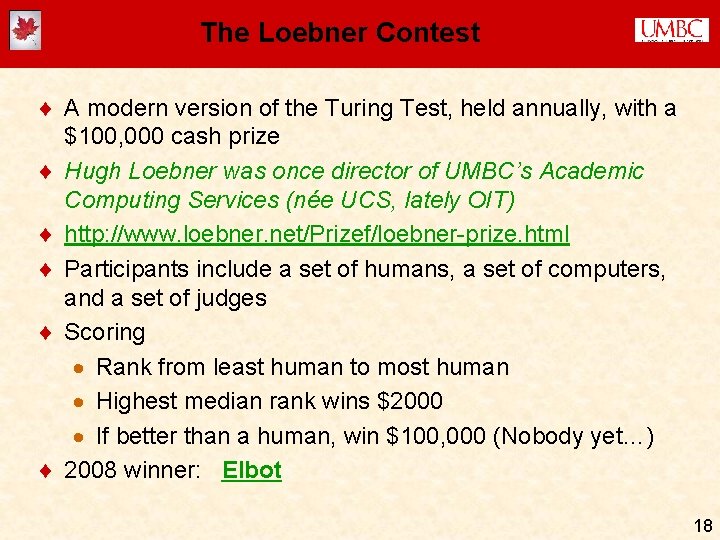
The Loebner Contest ¨ A modern version of the Turing Test, held annually, with a $100, 000 cash prize ¨ Hugh Loebner was once director of UMBC’s Academic Computing Services (née UCS, lately OIT) ¨ http: //www. loebner. net/Prizef/loebner-prize. html ¨ Participants include a set of humans, a set of computers, and a set of judges ¨ Scoring · Rank from least human to most human · Highest median rank wins $2000 · If better than a human, win $100, 000 (Nobody yet…) ¨ 2008 winner: Elbot 18
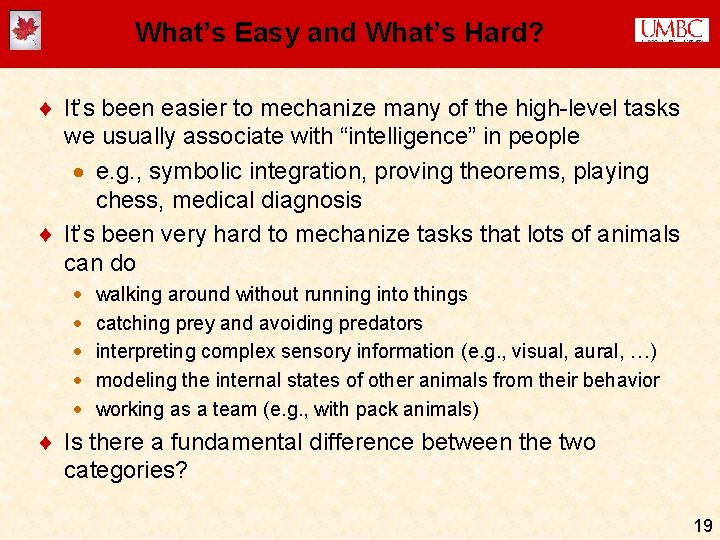
What’s Easy and What’s Hard? ¨ It’s been easier to mechanize many of the high-level tasks we usually associate with “intelligence” in people · e. g. , symbolic integration, proving theorems, playing chess, medical diagnosis ¨ It’s been very hard to mechanize tasks that lots of animals can do · · · walking around without running into things catching prey and avoiding predators interpreting complex sensory information (e. g. , visual, aural, …) modeling the internal states of other animals from their behavior working as a team (e. g. , with pack animals) ¨ Is there a fundamental difference between the two categories? 19
AI Today
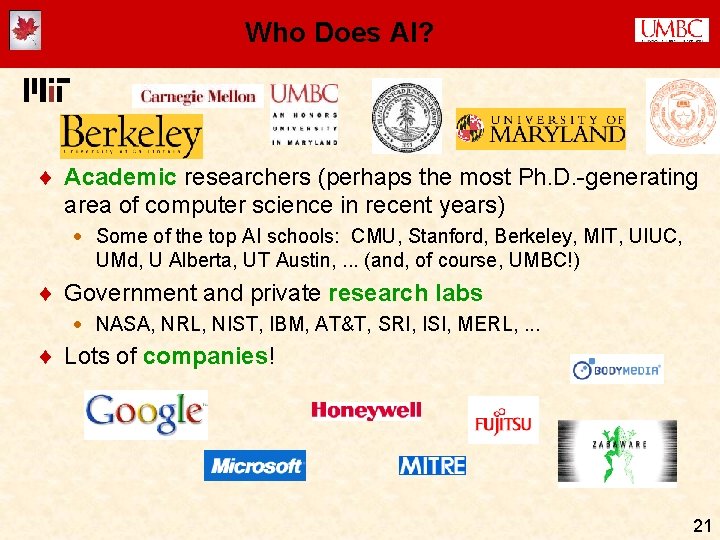
Who Does AI? ¨ Academic researchers (perhaps the most Ph. D. -generating area of computer science in recent years) · Some of the top AI schools: CMU, Stanford, Berkeley, MIT, UIUC, UMd, U Alberta, UT Austin, . . . (and, of course, UMBC!) ¨ Government and private research labs · NASA, NRL, NIST, IBM, AT&T, SRI, ISI, MERL, . . . ¨ Lots of companies! 21
Applications ¨ A sample from the 2008 International Conference on Innovative Applications of AI: · · · · · Event management (for Olympic equestrian competition) Language and culture instruction Public school choice (for parents) Turbulence prediction (for air traffic safety) Heart wall abnormality diagnosis Epilepsy treatment planning Personalization of telecommunications services Earth observation flight planning (for science data) Crop selection (for optimal soil planning) 22
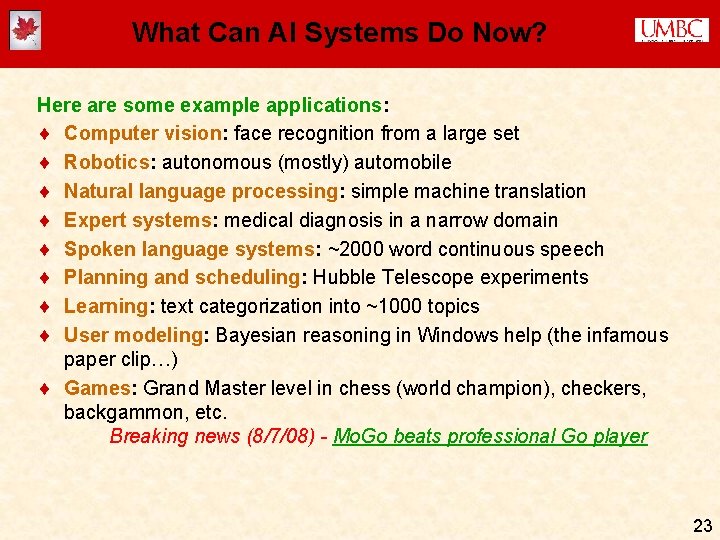
What Can AI Systems Do Now? Here are some example applications: ¨ Computer vision: face recognition from a large set ¨ Robotics: autonomous (mostly) automobile ¨ Natural language processing: simple machine translation ¨ Expert systems: medical diagnosis in a narrow domain ¨ Spoken language systems: ~2000 word continuous speech ¨ Planning and scheduling: Hubble Telescope experiments ¨ Learning: text categorization into ~1000 topics ¨ User modeling: Bayesian reasoning in Windows help (the infamous paper clip…) ¨ Games: Grand Master level in chess (world champion), checkers, backgammon, etc. Breaking news (8/7/08) - Mo. Go beats professional Go player 23
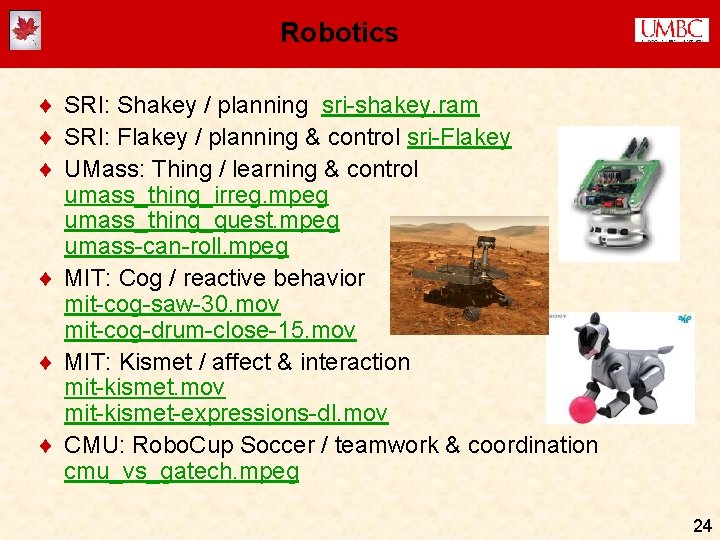
Robotics ¨ SRI: Shakey / planning sri-shakey. ram ¨ SRI: Flakey / planning & control sri-Flakey ¨ UMass: Thing / learning & control umass_thing_irreg. mpeg umass_thing_quest. mpeg umass-can-roll. mpeg ¨ MIT: Cog / reactive behavior mit-cog-saw-30. mov mit-cog-drum-close-15. mov ¨ MIT: Kismet / affect & interaction mit-kismet. mov mit-kismet-expressions-dl. mov ¨ CMU: Robo. Cup Soccer / teamwork & coordination cmu_vs_gatech. mpeg 24
DARPA Grand Challenge ¨ Completely autonomous vehicles (no human guidance) ¨ Several hundred miles over varied terrain ¨ First challenge (2004) – 142 miles · “winner” traveled seven(!) miles ¨ Second challenge (2005) – 131 miles · Winning team (Stanford) completed the course in under 7 hours · Three other teams completed the course in just over 7 hours ¨ Onwards and upwards (2007) · Urban Challenge · Traffic laws, merging, traffic circles, busy intersections. . . · Six finishers (best time: 2. 8 miles in 4+ hours) 25
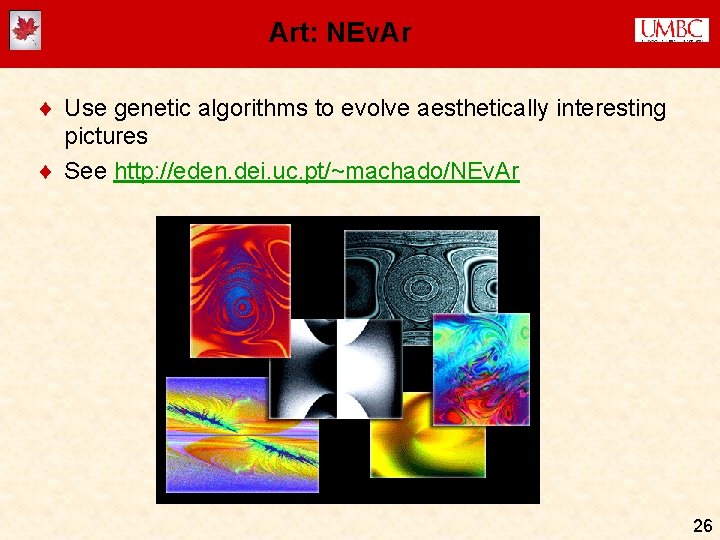
Art: NEv. Ar ¨ Use genetic algorithms to evolve aesthetically interesting pictures ¨ See http: //eden. dei. uc. pt/~machado/NEv. Ar 26
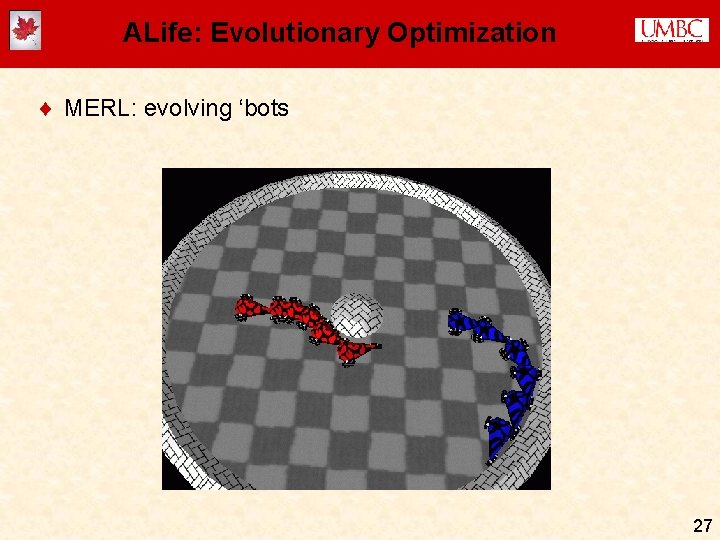
ALife: Evolutionary Optimization ¨ MERL: evolving ‘bots 27
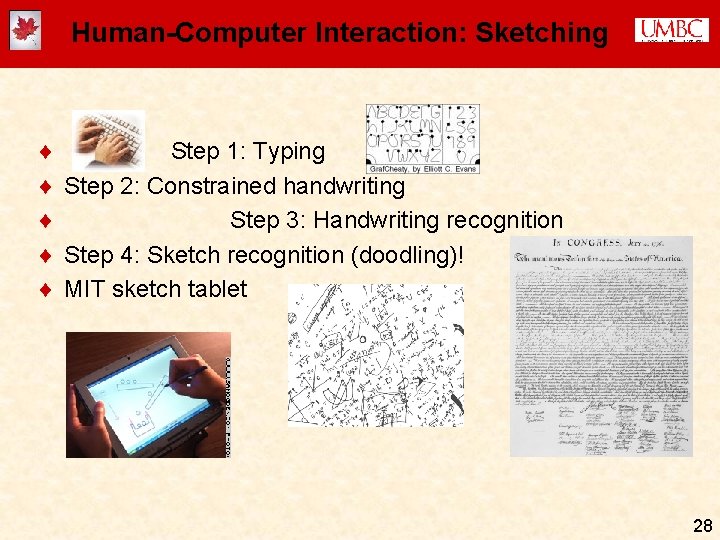
Human-Computer Interaction: Sketching ¨ Step 1: Typing ¨ Step 2: Constrained handwriting ¨ Step 3: Handwriting recognition ¨ Step 4: Sketch recognition (doodling)! ¨ MIT sketch tablet 28
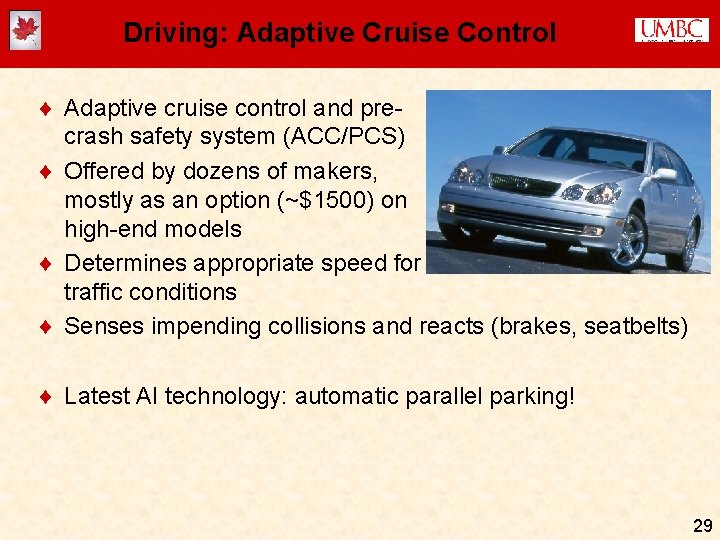
Driving: Adaptive Cruise Control ¨ Adaptive cruise control and precrash safety system (ACC/PCS) ¨ Offered by dozens of makers, mostly as an option (~$1500) on high-end models ¨ Determines appropriate speed for traffic conditions ¨ Senses impending collisions and reacts (brakes, seatbelts) ¨ Latest AI technology: automatic parallel parking! 29
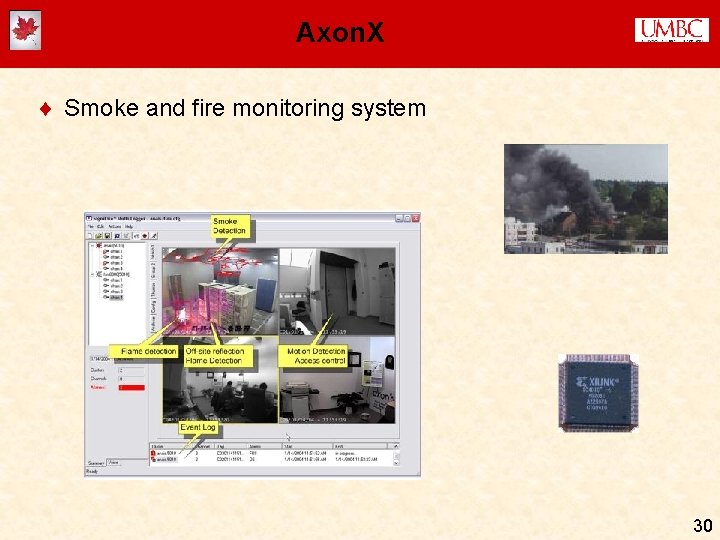
Axon. X ¨ Smoke and fire monitoring system 30
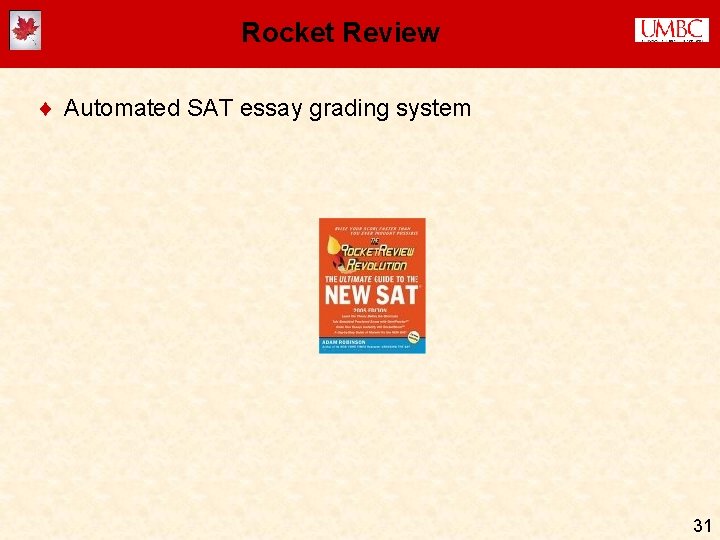
Rocket Review ¨ Automated SAT essay grading system 31
What Can’t AI Systems Do (Yet)? ¨ Understand natural language robustly (e. g. , read and understand articles in a newspaper) ¨ Surf the web (or a wave) ¨ Interpret an arbitrary visual scene ¨ Learn a natural language ¨ Play Go well √ ¨ Construct plans in dynamic real-time domains ¨ Refocus attention in complex environments ¨ Perform life-long learning 32
Computational vs. Biological Memory
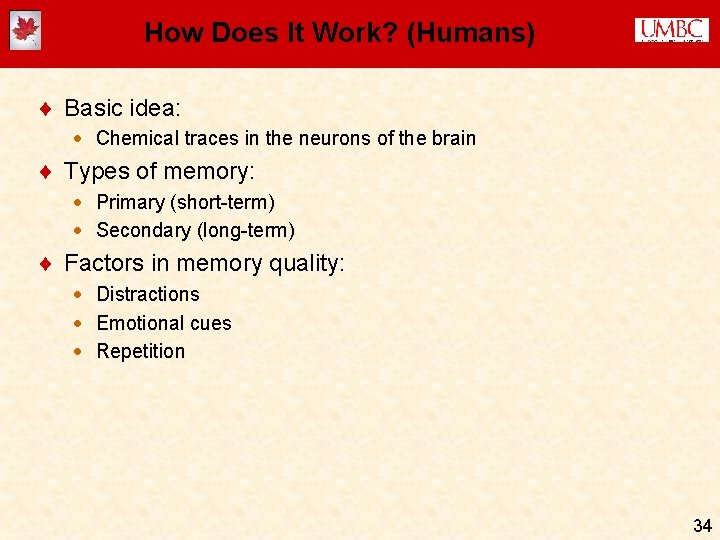
How Does It Work? (Humans) ¨ Basic idea: · Chemical traces in the neurons of the brain ¨ Types of memory: · Primary (short-term) · Secondary (long-term) ¨ Factors in memory quality: · Distractions · Emotional cues · Repetition 34
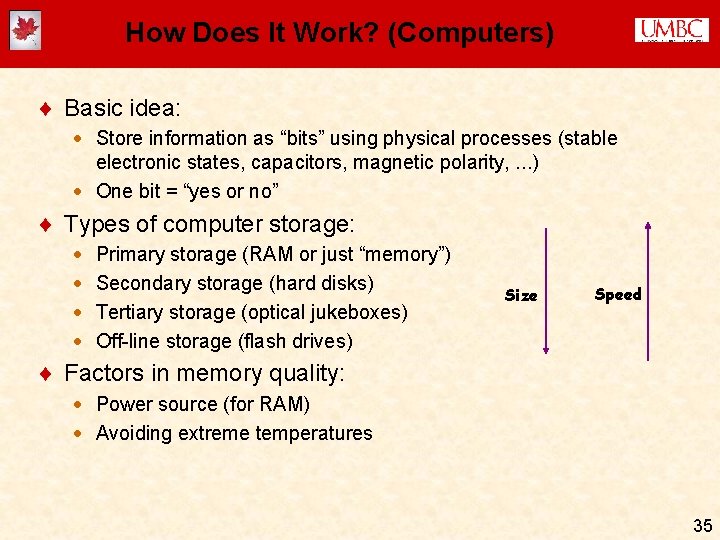
How Does It Work? (Computers) ¨ Basic idea: · Store information as “bits” using physical processes (stable electronic states, capacitors, magnetic polarity, . . . ) · One bit = “yes or no” ¨ Types of computer storage: · · Primary storage (RAM or just “memory”) Secondary storage (hard disks) Tertiary storage (optical jukeboxes) Off-line storage (flash drives) Size Speed ¨ Factors in memory quality: · Power source (for RAM) · Avoiding extreme temperatures 35
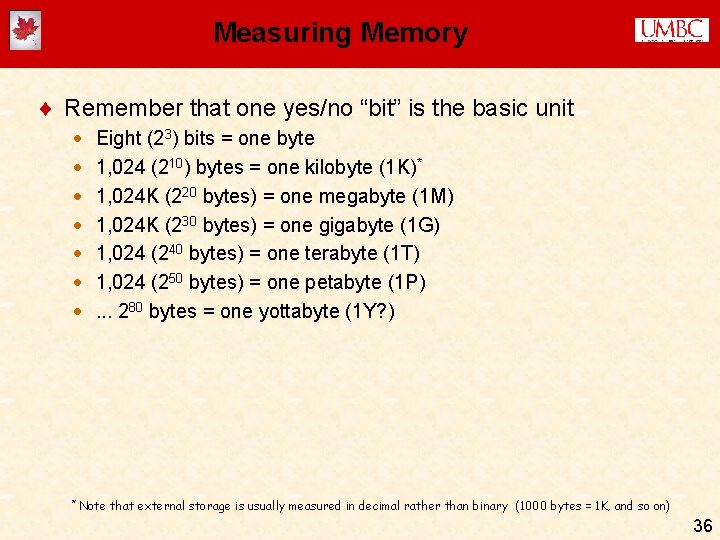
Measuring Memory ¨ Remember that one yes/no “bit” is the basic unit · · · · * Eight (23) bits = one byte 1, 024 (210) bytes = one kilobyte (1 K)* 1, 024 K (220 bytes) = one megabyte (1 M) 1, 024 K (230 bytes) = one gigabyte (1 G) 1, 024 (240 bytes) = one terabyte (1 T) 1, 024 (250 bytes) = one petabyte (1 P). . . 280 bytes = one yottabyte (1 Y? ) Note that external storage is usually measured in decimal rather than binary (1000 bytes = 1 K, and so on) 36
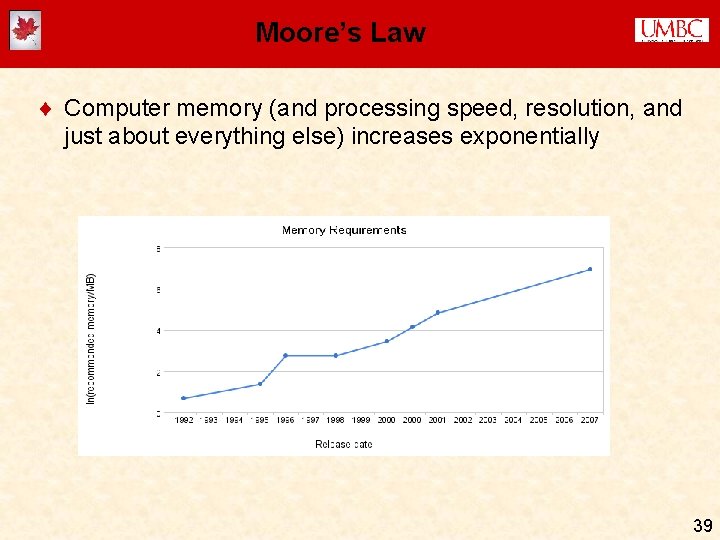
Moore’s Law ¨ Computer memory (and processing speed, resolution, and just about everything else) increases exponentially 39
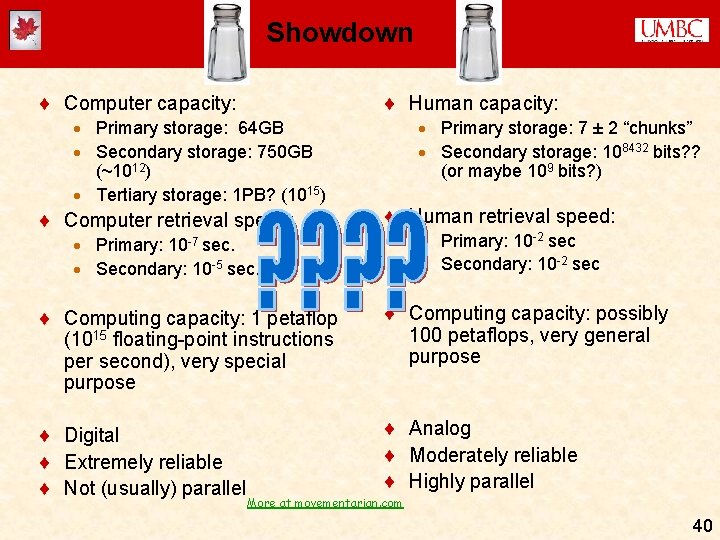
Showdown ¨ Computer capacity: ¨ Human capacity: · Primary storage: 64 GB · Secondary storage: 750 GB (~1012) · Tertiary storage: 1 PB? (1015) ¨ Computer retrieval speed: · Primary storage: 7 ± 2 “chunks” · Secondary storage: 108432 bits? ? (or maybe 109 bits? ) ¨ Human retrieval speed: · Primary: 10 -2 sec · Secondary: 10 -2 sec · Primary: 10 -7 sec. · Secondary: 10 -5 sec. ¨ Computing capacity: 1 petaflop (1015 floating-point instructions per second), very special purpose ¨ Computing capacity: possibly 100 petaflops, very general purpose ¨ Digital ¨ Extremely reliable ¨ Not (usually) parallel ¨ Analog ¨ Moderately reliable ¨ Highly parallel More at movementarian. com 40
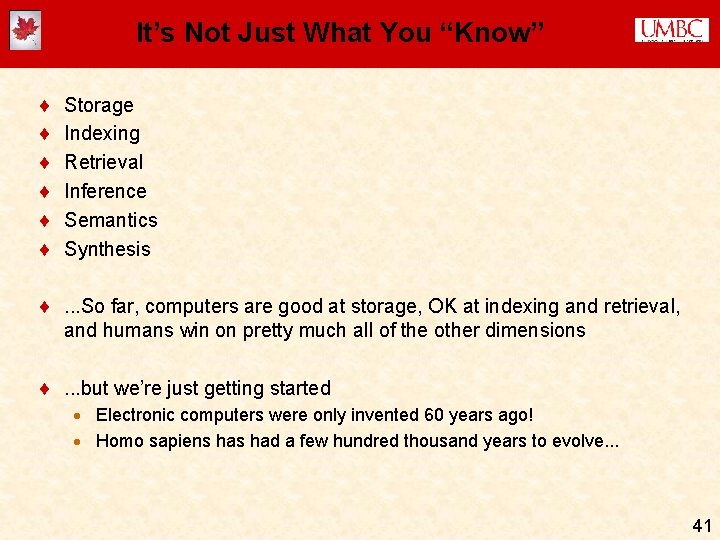
It’s Not Just What You “Know” ¨ ¨ ¨ Storage Indexing Retrieval Inference Semantics Synthesis ¨. . . So far, computers are good at storage, OK at indexing and retrieval, and humans win on pretty much all of the other dimensions ¨. . . but we’re just getting started · Electronic computers were only invented 60 years ago! · Homo sapiens had a few hundred thousand years to evolve. . . 41
The Skeptics Speak
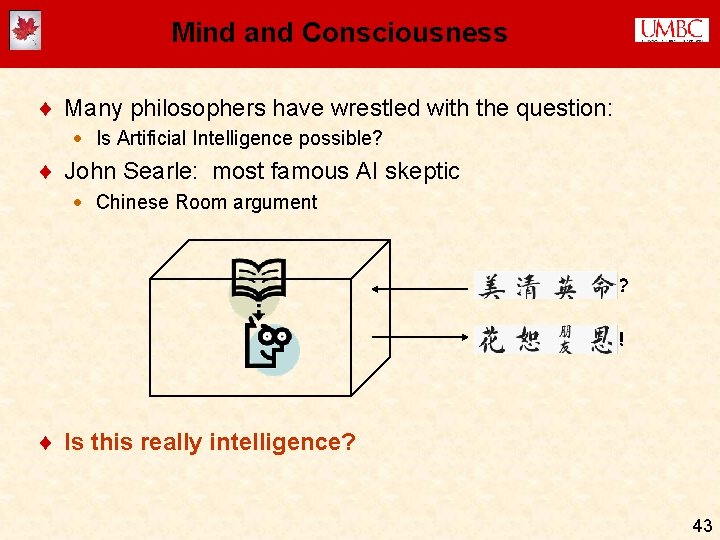
Mind and Consciousness ¨ Many philosophers have wrestled with the question: · Is Artificial Intelligence possible? ¨ John Searle: most famous AI skeptic · Chinese Room argument ? ! ¨ Is this really intelligence? 43
What Searle Argues ¨ People have beliefs; computers and machines don’t. ¨ People have “intentionality”; computers and machines don’t. ¨ Brains have “causal properties”; computers and machines don’t. ¨ Brains have a particular biological and chemical structure; computers and machines don’t. ¨ (Philosophers can make claims like “People have intentionality” without ever really saying what “intentionality” is, except (in effect) “the stuff that people have and computers don’t. ”) 44
Let’s Introspect For a Moment. . . ¨ Have you ever learned something by rote that you didn’t really understand? ¨ Were you able to get a good grade on an essay where you didn’t really know what you were talking about? ¨ Have you ever convinced somebody you know a lot about something you really don’t? ¨ Are you a Chinese room? ? ¨ What does “understanding” really mean? ¨ What is intentionality? Are human beings the only entities that can ever have it? ¨ What is consciousness? Why do we have it and other animals and inanimate objects don’t? (Or do they? ) 45
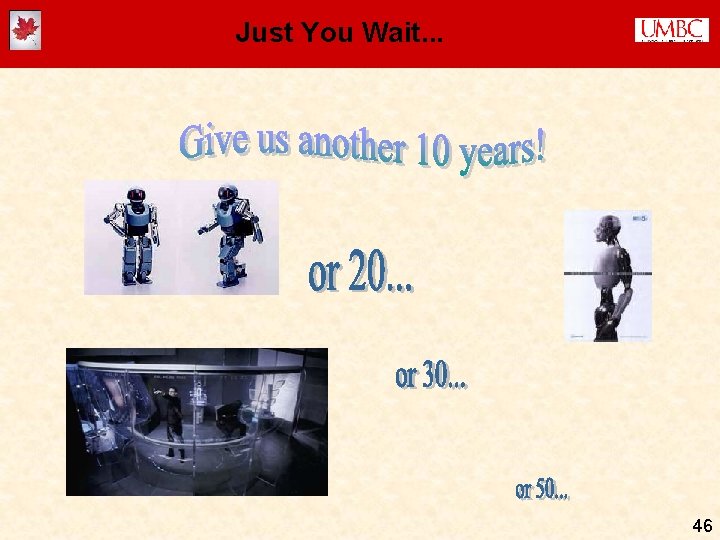
Just You Wait. . . 46