
Artificial Intelligence Dartmouth College v AI conference at

- Slides: 29
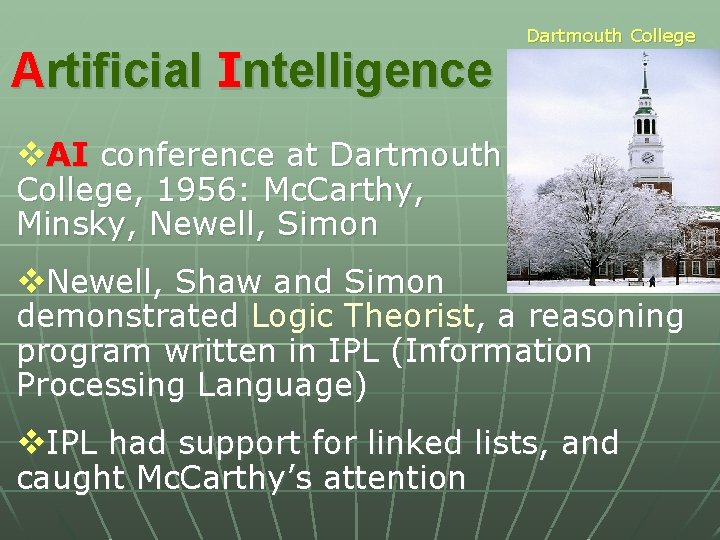
Artificial Intelligence Dartmouth College v. AI conference at Dartmouth College, 1956: Mc. Carthy, Minsky, Newell, Simon v. Newell, Shaw and Simon demonstrated Logic Theorist, a reasoning program written in IPL (Information Processing Language) v. IPL had support for linked lists, and caught Mc. Carthy’s attention
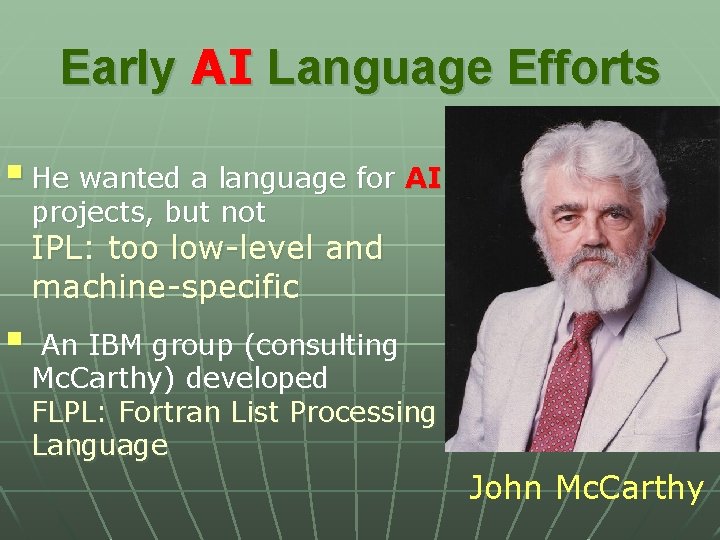
Early AI Language Efforts § He wanted a language for AI projects, but not IPL: too low-level and machine-specific § An IBM group (consulting Mc. Carthy) developed FLPL: Fortran List Processing Language John Mc. Carthy
§ Mc. Carthy’s wish list, developed while writing AI programs (chess and differential calculus) • Conditional expressions • Recursion • Higher-order functions (like ML’s map) • Garbage collection § FLPL was not the answer for Mc. Carthy’s group at MIT in 1958…
ØA Lisp program is a list representing an AST: (+ a (* b c)) ØThe plan was to use some Fortran-like notation ØBut Mc. Carthy wrote a paper showing a simple Lisp interpreter in Lisp: a function called eval ØTo avoid syntax issues, he used the list-AST form, both for eval’s input and for eval itself ØThis eval, hand-translated into assembly language, became the first implementation of Lisp’s Unusual Syntax
Lisp’s Unusual Syntax v. The group never gave up the idea of compiling from some Fortran-like syntax v. But they never did it either v. Later, people tried to compile Lisp from a Fortran- or Algol-like syntax v. None of these efforts were very popular v. There advantages to programs and data using the same syntax
Lisp Evolution § Quickly became, and remains, the most popular language for AI applications § Before 1980: many dialects in use: • Each AI research group had its own dialect • In the 1970’s, a number of Lisp machines were developed, each with its own dialect § Today: some standardization: • Common Lisp: a large language and API • Scheme: a smaller and simpler dialect
Lisp Influence v 2 nd oldest general-purpose programming language still in use v. Some ideas, like the conditional expression and recursion, were adopted by Algol and later by many other imperative languages
Lisp Influence v. The function-oriented approach influenced modern functional languages like ML v. Garbage collection is increasingly common in many different language families
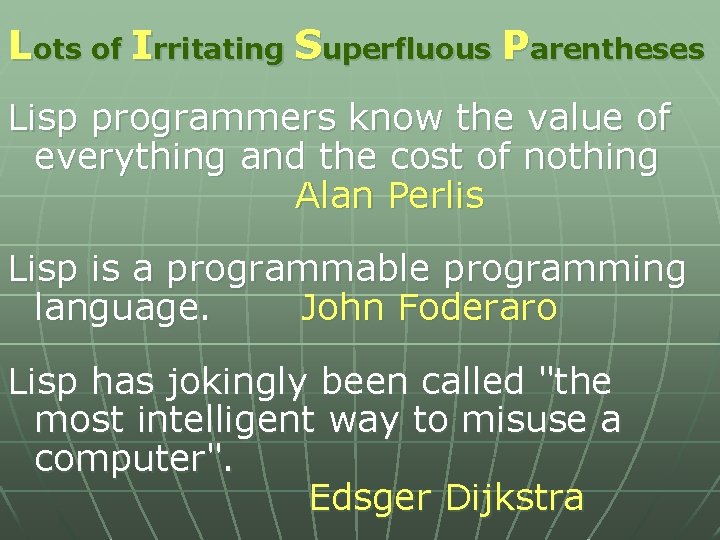
Lots of Irritating Superfluous Parentheses Lisp programmers know the value of everything and the cost of nothing Alan Perlis Lisp is a programmable programming language. John Foderaro Lisp has jokingly been called "the most intelligent way to misuse a computer". Edsger Dijkstra
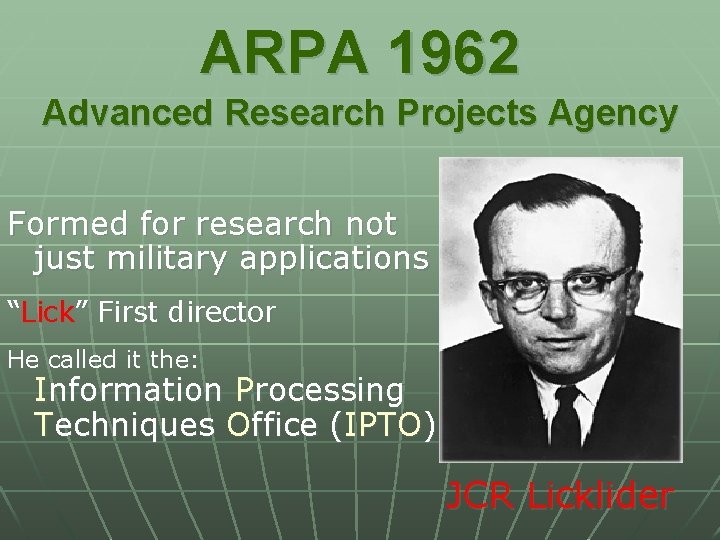
ARPA 1962 Advanced Research Projects Agency Formed for research not just military applications “Lick” First director He called it the: Information Processing Techniques Office (IPTO) JCR Licklider
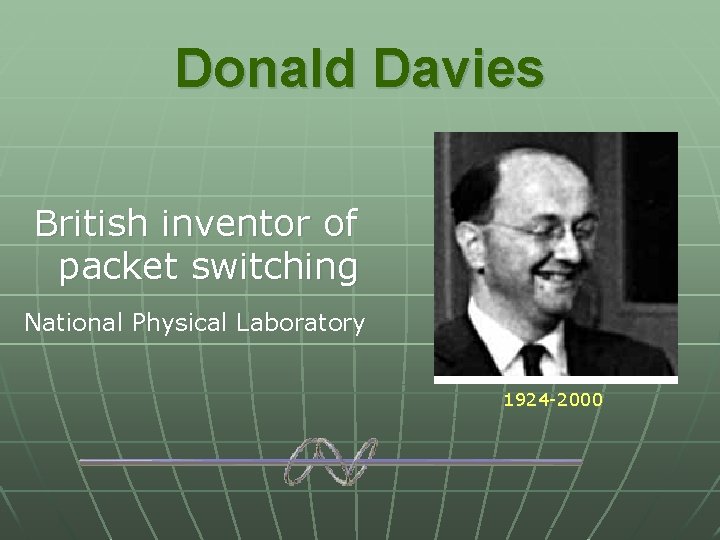
Donald Davies British inventor of packet switching National Physical Laboratory 1924 -2000
Lick’s Intergalactic Network 1965 n With ARPA funding, Larry Roberts and n n n Thomas Marill created first wide-area network connection: MIT to Santa Monica Dedicated telephone line with acoustic couplers Telephone lines work for data, but are Inefficient Wasteful of bandwidth Expensive As Kleinrock predicts, packet switching offers the most promising model for communication between computers.
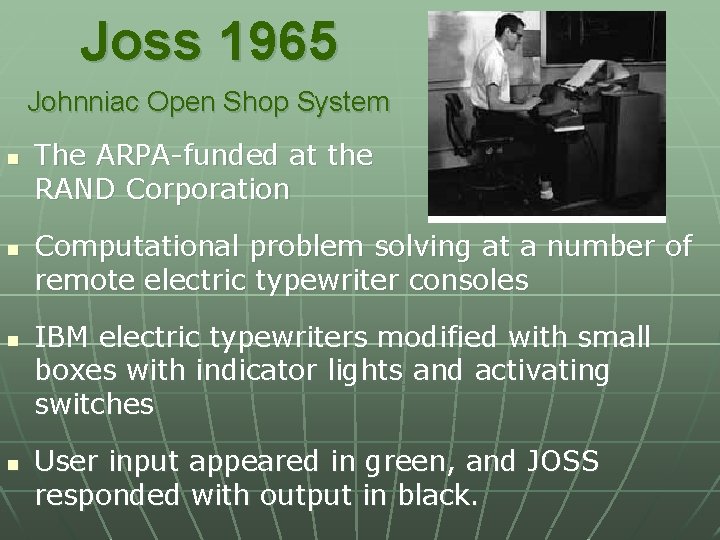
Joss 1965 Johnniac Open Shop System n n The ARPA-funded at the RAND Corporation Computational problem solving at a number of remote electric typewriter consoles IBM electric typewriters modified with small boxes with indicator lights and activating switches User input appeared in green, and JOSS responded with output in black.
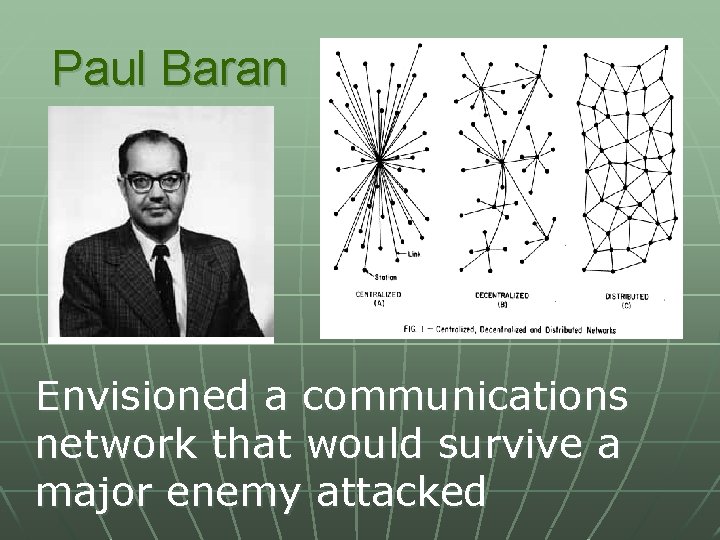
Paul Baran Envisioned a communications network that would survive a major enemy attacked
October 29, 1969 n n n first host-to-host connection, from UCLA to SRI first “Log-In” crashed the IMPs (Interface Message Processors) but the next “Log-In” worked!
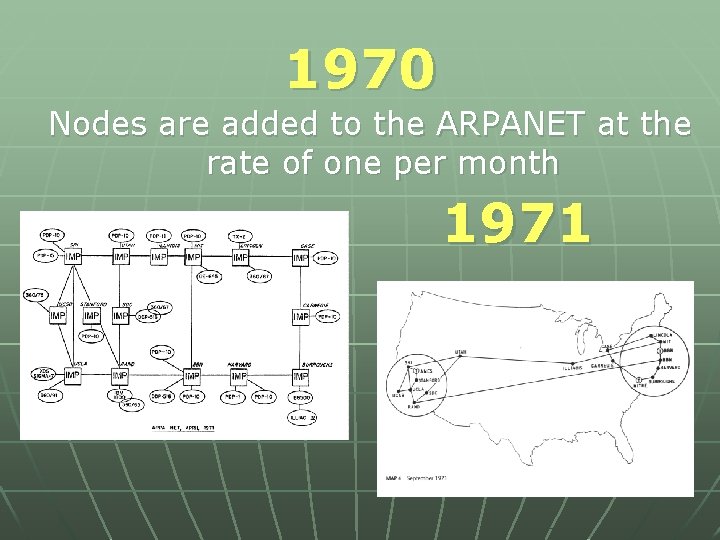
1970 Nodes are added to the ARPANET at the rate of one per month 1971
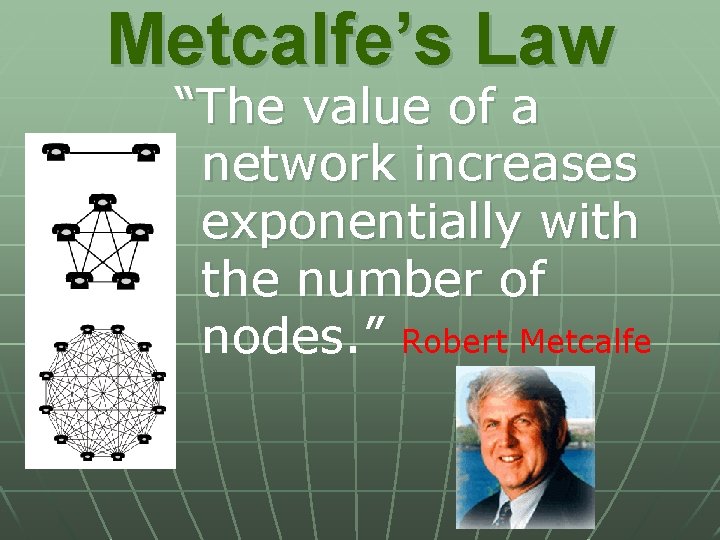
Metcalfe’s Law “The value of a network increases exponentially with the number of nodes. ” Robert Metcalfe
Ethernet v. Invented 1973 at Xerox–PARC by Robert Metcalfe and David Boggs v. Got the idea of packets from the ALOHAnet packet maximum 1000 bits long recipients address attached to the head of each packet computers tuned to UHF frequency, listening for packets addressed to it
Industry Standard Ø Metcalfe left Xerox in 1979 to promote the use of personal computers and Local Area Networks (LANs). Ø He convinced Digital Equipment, Intel, and Xerox Corporations to work together and promote ethernet as a standard. Ø Today, ethernet is the most widely installed LAN protocol. Ø Ethernet is no longer limited to LANs.
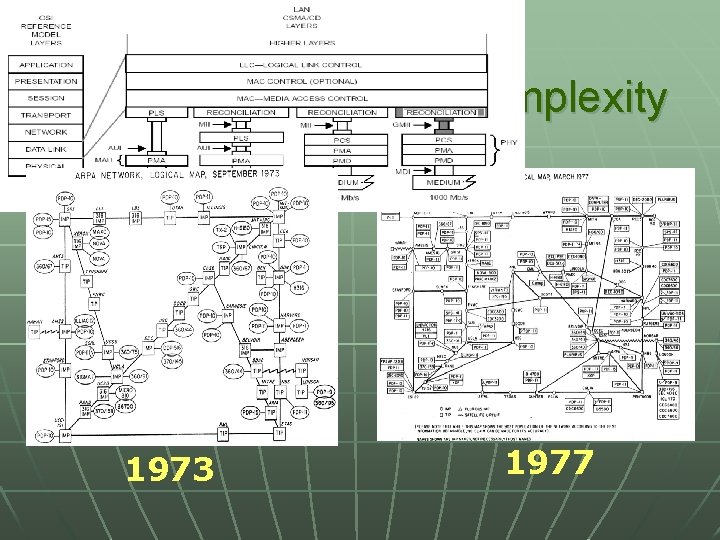
Arpanet Successive levels of complexity 1973 1977
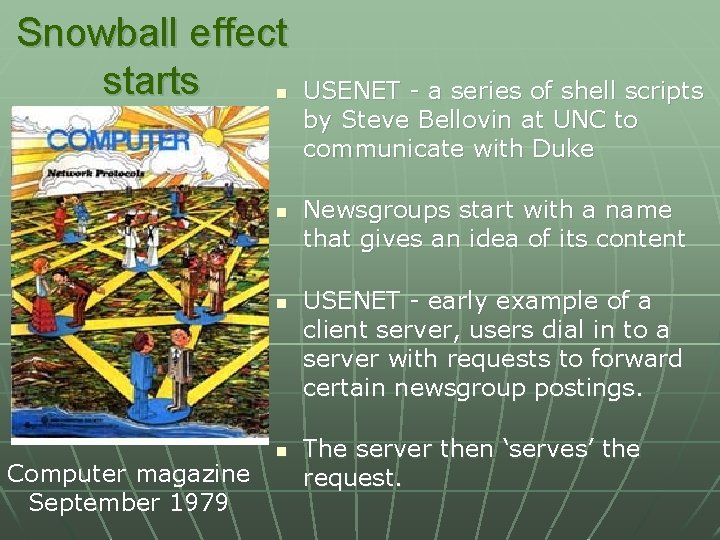
Snowball effect starts n n n Computer magazine September 1979 n USENET - a series of shell scripts by Steve Bellovin at UNC to communicate with Duke Newsgroups start with a name that gives an idea of its content USENET - early example of a client server, users dial in to a server with requests to forward certain newsgroup postings. The server then ‘serves’ the request.
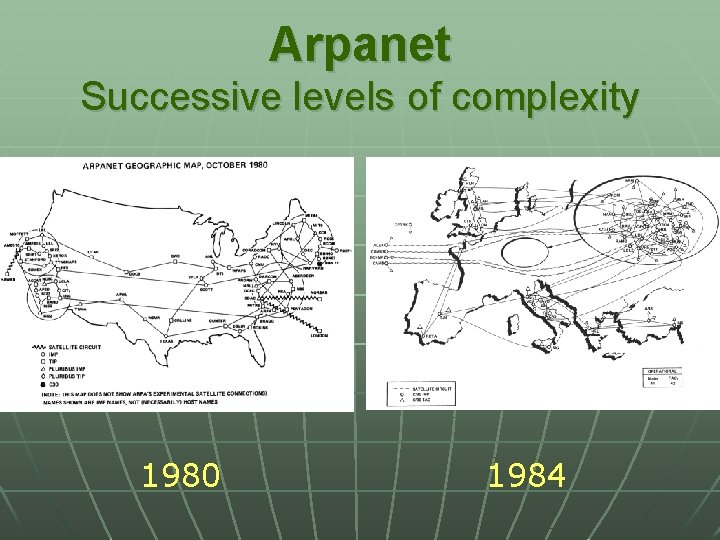
Arpanet Successive levels of complexity 1980 1984
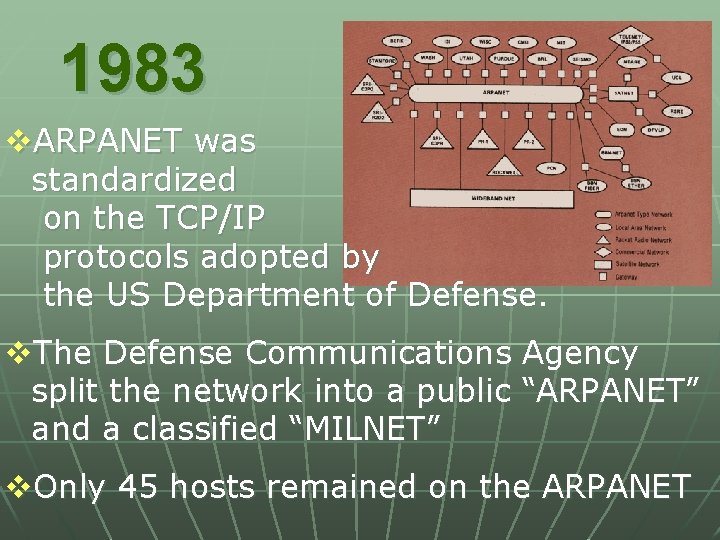
1983 v. ARPANET was standardized on the TCP/IP protocols adopted by the US Department of Defense. v. The Defense Communications Agency split the network into a public “ARPANET” and a classified “MILNET” v. Only 45 hosts remained on the ARPANET
1983 ØNumbering the Internet hosts and keeping track of the host names fails to keep up with the growth of the Internet. ØDevelopment of the Domain Name System - user@host. domain
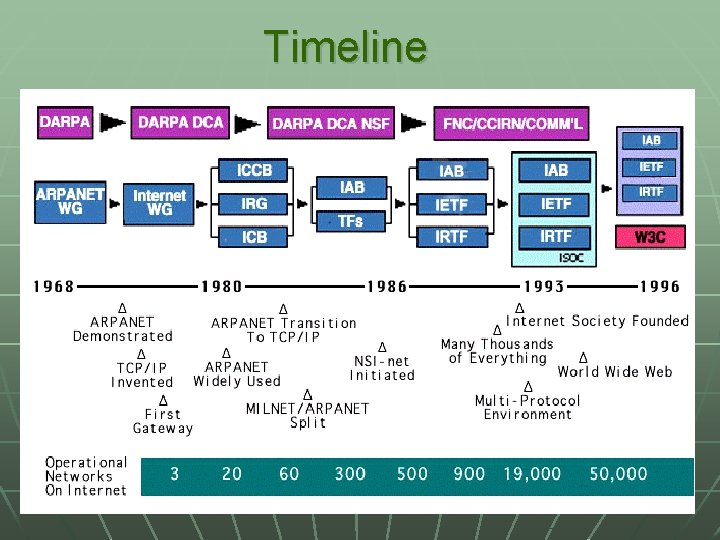
Timeline
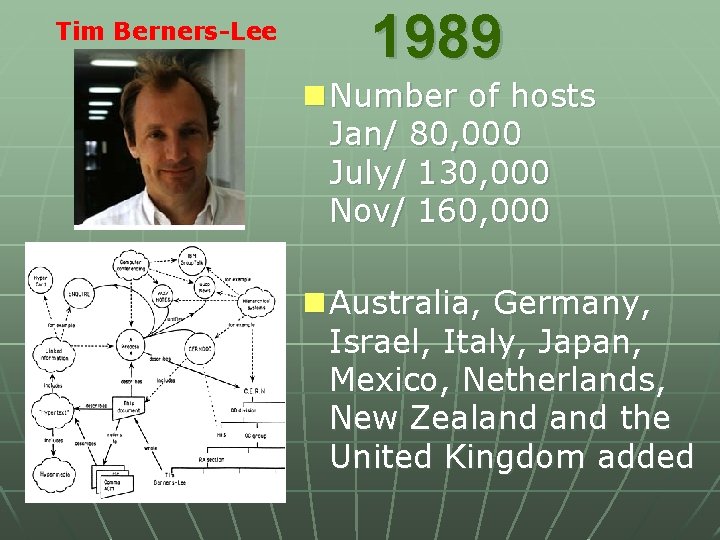
Tim Berners-Lee 1989 n Number of hosts Jan/ 80, 000 July/ 130, 000 Nov/ 160, 000 n Australia, Germany, Israel, Italy, Japan, Mexico, Netherlands, New Zealand the United Kingdom added
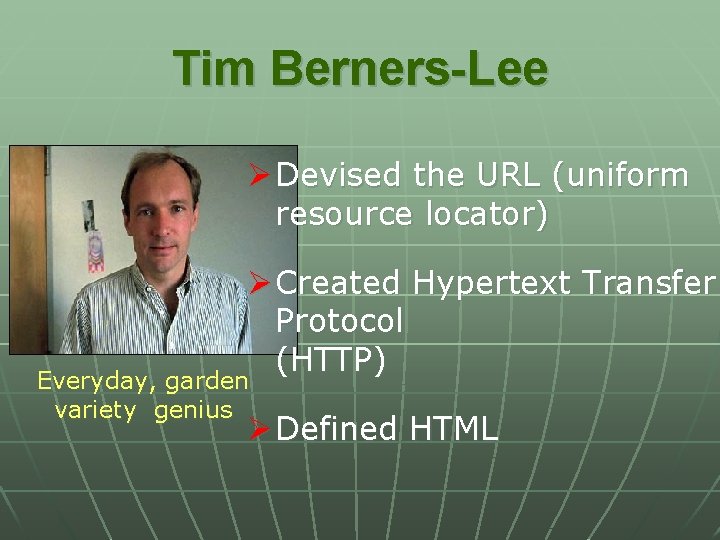
Tim Berners-Lee Ø Devised the URL (uniform resource locator) Ø Created Hypertext Transfer Protocol (HTTP) Everyday, garden variety genius Ø Defined HTML
1990 Gopher – University of Minnesota n Early Browsers Lynx & Viola n 1993 n 1995 Mosaic Netscape Mozilla • Ease of Hypercard • Full HTML capacity of WWW