
Artificial Intelligence Computations that make it possible for
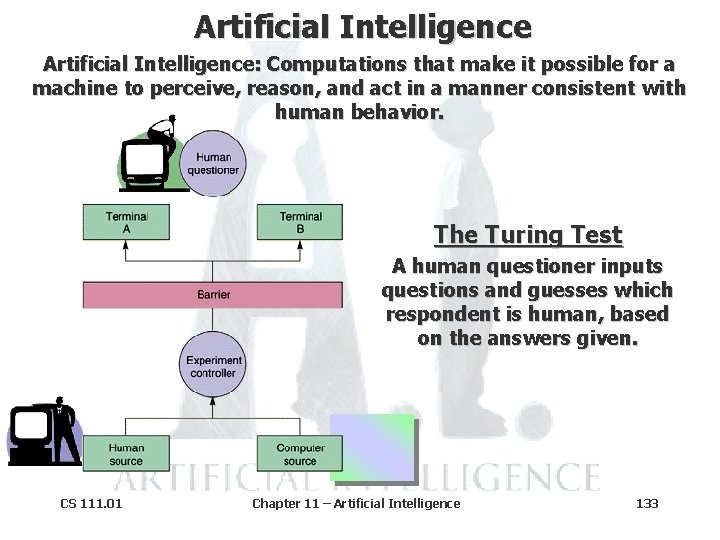
Artificial Intelligence: Computations that make it possible for a machine to perceive, reason, and act in a manner consistent with human behavior. The Turing Test A human questioner inputs questions and guesses which respondent is human, based on the answers given. CS 111. 01 Chapter 11 – Artificial Intelligence 133

Image Analysis Character Recognition: How can a computer be programmed to distinguish between different letters of the alphabet? A RB KHN 3 D Perspective Recognition: How can a computer be programmed to distinguish between separate 3 D objects? To distinguish between near and far objects? To determine which part of an object is obscured by another object? Trihedral Vertex Types L-Vertex Arrow Vertex CS 111. 01 Non-trihedral Figures Fork Vertex T-Vertex Chapter 11 – Artificial Intelligence 134

Natural Language Processing Written Comprehension: How can a computer be programmed to grasp the syntax and semantics of a natural language? John saw the boy in the park with the telescope. Question: Whose telescope is it? Answer: John’s John saw the boy in the park with the puppy. Question: Whose puppy is it? Answer: The boy’s John saw the boy in the park with the statue. Question: Whose statue is it? CS 111. 01 Answer: The park’s Chapter 11 – Artificial Intelligence 135
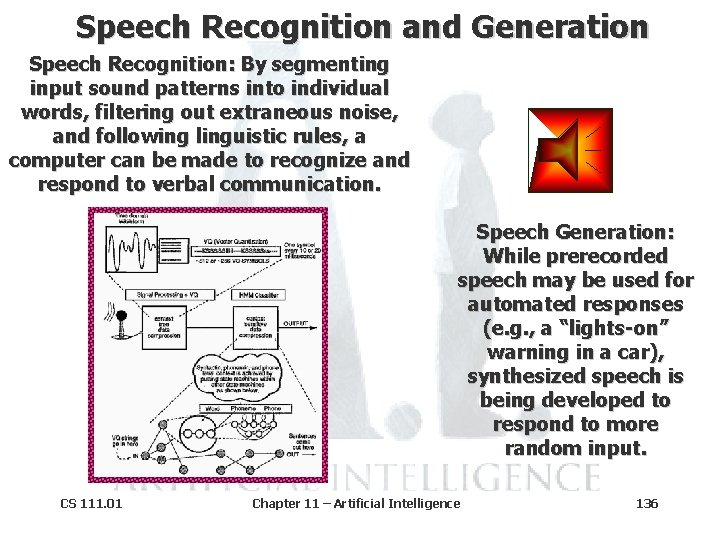
Speech Recognition and Generation Speech Recognition: By segmenting input sound patterns into individual words, filtering out extraneous noise, and following linguistic rules, a computer can be made to recognize and respond to verbal communication. Speech Generation: While prerecorded speech may be used for automated responses (e. g. , a “lights-on” warning in a car), synthesized speech is being developed to respond to more random input. CS 111. 01 Chapter 11 – Artificial Intelligence 136

Computer Reasoning To simulate logical reasoning, heuristic functions are often used. A heuristic is an artificial measure of how close the computer’s current status is to its problem-solving goal. F(config) = (# of completable rows, columns, and diagonals for X-player) – (# of completable rows, columns, and diagonals for O-player) if config is a non-winning configuration if config is an X-win - if config is an O-win O O X X 1 - X O O X - X X O O O X X 2 -1=1 X O O X X O 3 -1=2 X O O X X O 2 -1=1 X O O X 3 -1=2 O O O X X X - O O X X X O 3 -2=1 2 -2=0 O O X X O O O 3 -2=1 - X X X O O O X X X 2 -2=0 X O O X X X O X X - - X O O X X X O 2 -2=0 O O X X O O O 3 -2=1 - X X X O O O X X X 2 -1=1 X O O X X O X 3 -1=2 O O O X X X 2 -1=1 X - O O X X X O 2 -1=1 O O X X 3 -1=2 In the tic-tac-toe example above, when the computer is ready to make an X-move, it uses the heuristic max{F(config), where config can be the result of any O-move}. CS 111. 01 Chapter 11 – Artificial Intelligence 137

Neural Networks To simulate learning, certain multiprocessor systems, called neural networks, have been built to “learn” to recognize particular patterns as correct or incorrect, based upon a trial-and-error process. In the example below, a neural network is used to teach a computerized system how to back a truck up to a loading dock. The physical characteristics of the truck are programmed, with the relationship between the steering wheel, the tires, the cab, and the trailer formally calculated. CS 111. 01 Starting at some initial position, the truck is backed up one meter at a time, with programmed steering; the error in the result is measured and factored into the next attempt, until the error is zero. Chapter 11 – Artificial Intelligence 138

Expert Systems By programming a computer with the assistance of experts in a particular field, an expert system can be developed to perform very specialized tasks. CS 111. 01 Chapter 11 – Artificial Intelligence 139

Genetic Algorithms When a problem has no definitive algorithmic solution, it’s possible that a technique can be developed by which the solution can evolve. This type of solution, known as a genetic algorithm, involves the generation of numerous possible solutions, the best features of which are “bred” together to mutate into an acceptable overall solution. For example, in the example at left, the problem of producing a flywheel composed of a variety of ceramic, polymer, and fiber materials is addressed. The right balance of materials is desired so the flywheel can spin faster (thus producing greater kinetic energy), but not so fast that the resulting shear forces will rip the flywheel apart. CS 111. 01 Chapter 11 – Artificial Intelligence 140

Robotics Robots are programmable devices capable of manipulating objects and performing tasks much like humans are able to do. CS 111. 01 Chapter 11 – Artificial Intelligence 141
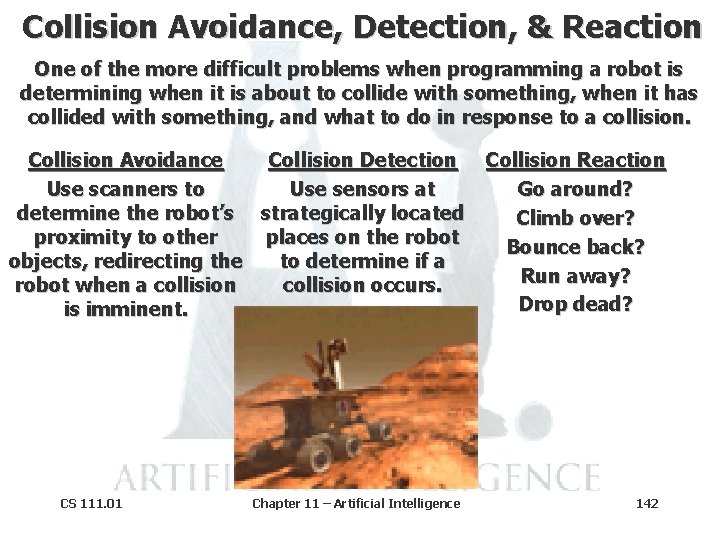
Collision Avoidance, Detection, & Reaction One of the more difficult problems when programming a robot is determining when it is about to collide with something, when it has collided with something, and what to do in response to a collision. Collision Avoidance Collision Detection Use scanners to Use sensors at determine the robot’s strategically located proximity to other places on the robot objects, redirecting the to determine if a robot when a collision occurs. is imminent. CS 111. 01 Chapter 11 – Artificial Intelligence Collision Reaction Go around? Climb over? Bounce back? Run away? Drop dead? 142
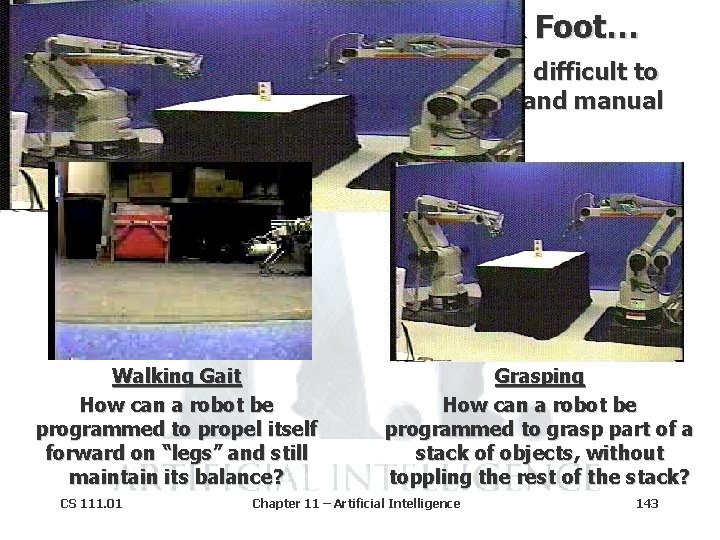
Waiting On Robot’s Hand & Foot… Other common human actions that are difficult to program include propelled locomotion and manual manipulation. Walking Gait How can a robot be programmed to propel itself forward on “legs” and still maintain its balance? CS 111. 01 Grasping How can a robot be programmed to grasp part of a stack of objects, without toppling the rest of the stack? Chapter 11 – Artificial Intelligence 143
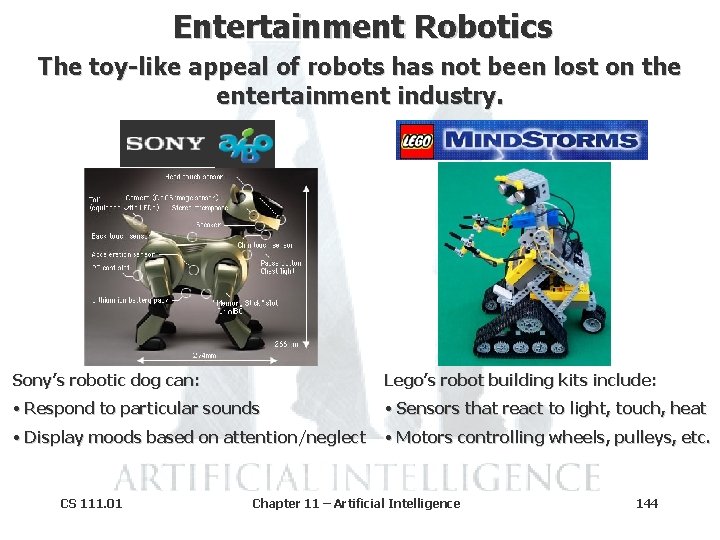
Entertainment Robotics The toy-like appeal of robots has not been lost on the entertainment industry. Sony’s robotic dog can: Lego’s robot building kits include: • Respond to particular sounds • Sensors that react to light, touch, heat • Display moods based on attention/neglect • Motors controlling wheels, pulleys, etc. CS 111. 01 Chapter 11 – Artificial Intelligence 144
- Slides: 12