
Artificial Intelligence Chapter 9 Inference in First Order
![Logic Programming • Example: Appending two lists to produce a third – append([], Y,](https://slidetodoc.com/presentation_image/4ccce2cf265ed07d4b250b424bb45ca6/image-57.jpg "Logic Programming • Example: Appending two lists to produce a third – append([], Y,")
- Slides: 69
Artificial Intelligence Chapter 9: Inference in First. Order Logic Michael Scherger Department of Computer Science Kent State University March 14, 2006 AI: Chapter 9: Inference in First. Order Logic 1
Contents • Reducing FO inference to propositional inference • Unification • Generalized Modus Ponens • Forward and Backward Chaining • Logic Programming • Resolution March 14, 2006 AI: Chapter 9: Inference in First. Order Logic 2
Necessary Algorithms • We already know enough to implement TELL (although maybe not efficiently) • But how do we implement ASK? • Recall 3 cases – Direct matching – Finding a proof (inference) – Finding a set of bindings (unification) March 14, 2006 AI: Chapter 9: Inference in First. Order Logic 3
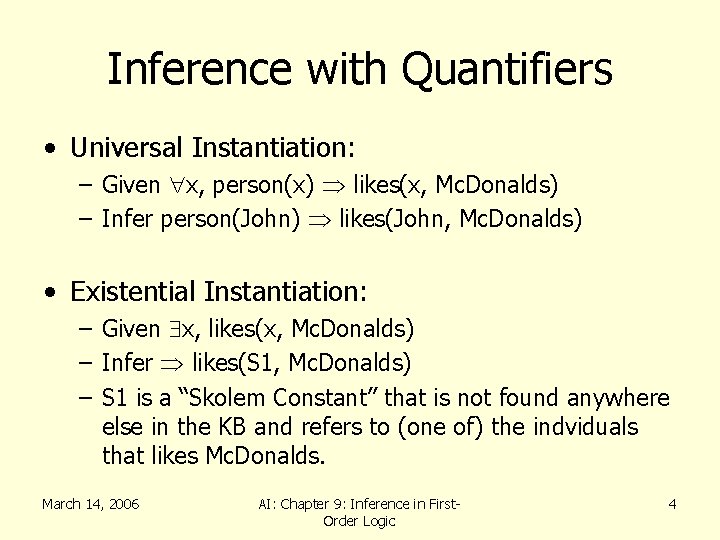
Inference with Quantifiers • Universal Instantiation: – Given x, person(x) likes(x, Mc. Donalds) – Infer person(John) likes(John, Mc. Donalds) • Existential Instantiation: – Given x, likes(x, Mc. Donalds) – Infer likes(S 1, Mc. Donalds) – S 1 is a “Skolem Constant” that is not found anywhere else in the KB and refers to (one of) the indviduals that likes Mc. Donalds. March 14, 2006 AI: Chapter 9: Inference in First. Order Logic 4
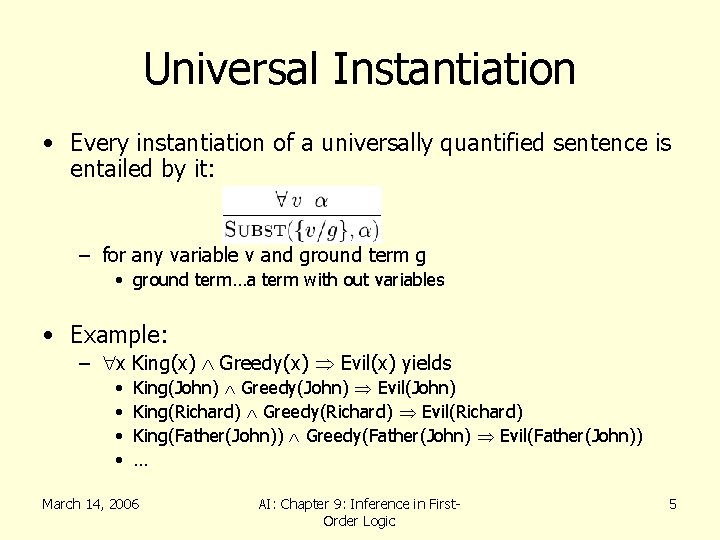
Universal Instantiation • Every instantiation of a universally quantified sentence is entailed by it: – for any variable v and ground term g • ground term…a term with out variables • Example: – x King(x) Greedy(x) Evil(x) yields • • King(John) Greedy(John) Evil(John) King(Richard) Greedy(Richard) Evil(Richard) King(Father(John)) Greedy(Father(John) Evil(Father(John)) … March 14, 2006 AI: Chapter 9: Inference in First. Order Logic 5
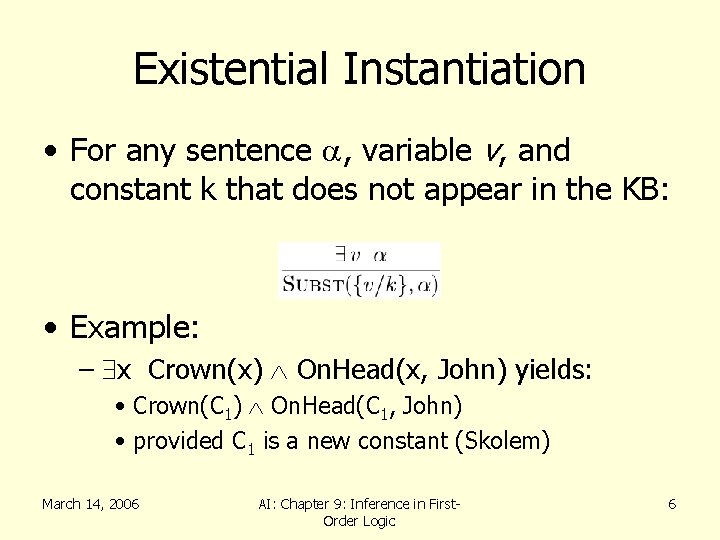
Existential Instantiation • For any sentence a, variable v, and constant k that does not appear in the KB: • Example: – x Crown(x) On. Head(x, John) yields: • Crown(C 1) On. Head(C 1, John) • provided C 1 is a new constant (Skolem) March 14, 2006 AI: Chapter 9: Inference in First. Order Logic 6
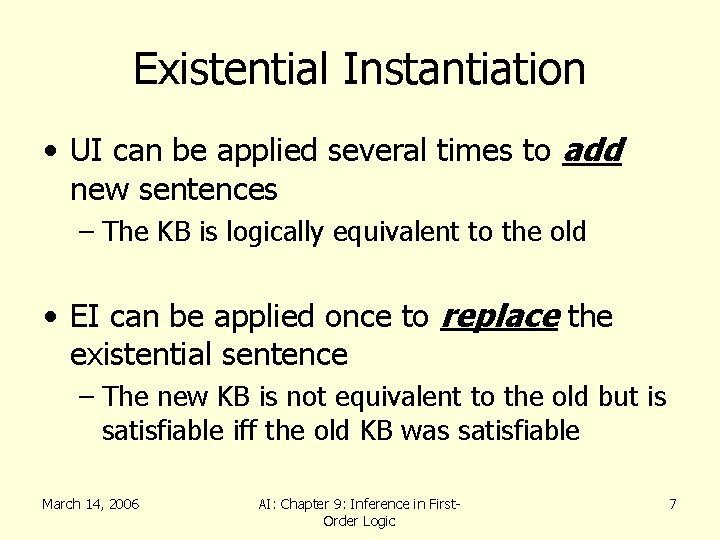
Existential Instantiation • UI can be applied several times to add new sentences – The KB is logically equivalent to the old • EI can be applied once to replace the existential sentence – The new KB is not equivalent to the old but is satisfiable iff the old KB was satisfiable March 14, 2006 AI: Chapter 9: Inference in First. Order Logic 7
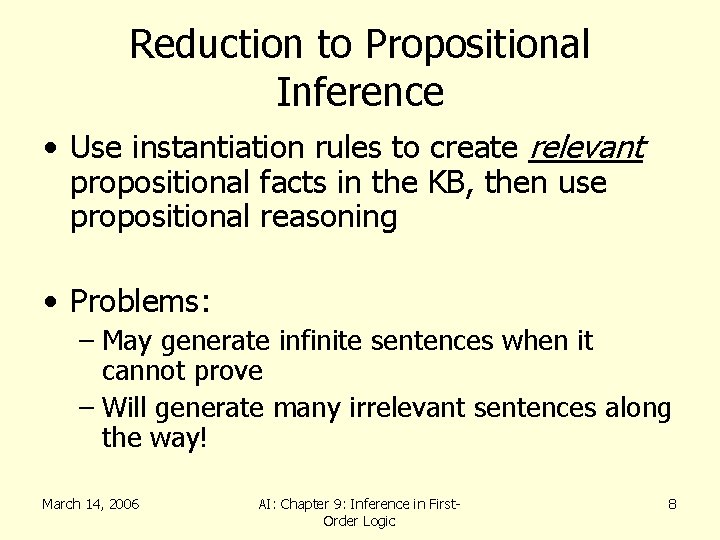
Reduction to Propositional Inference • Use instantiation rules to create relevant propositional facts in the KB, then use propositional reasoning • Problems: – May generate infinite sentences when it cannot prove – Will generate many irrelevant sentences along the way! March 14, 2006 AI: Chapter 9: Inference in First. Order Logic 8
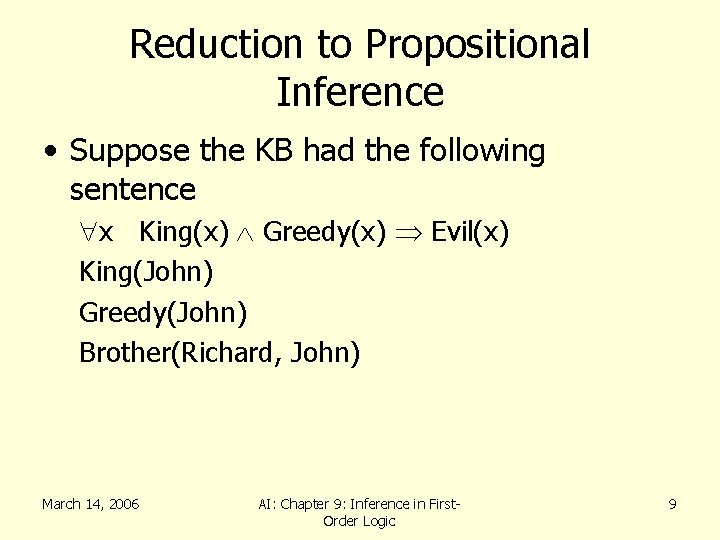
Reduction to Propositional Inference • Suppose the KB had the following sentence x King(x) Greedy(x) Evil(x) King(John) Greedy(John) Brother(Richard, John) March 14, 2006 AI: Chapter 9: Inference in First. Order Logic 9
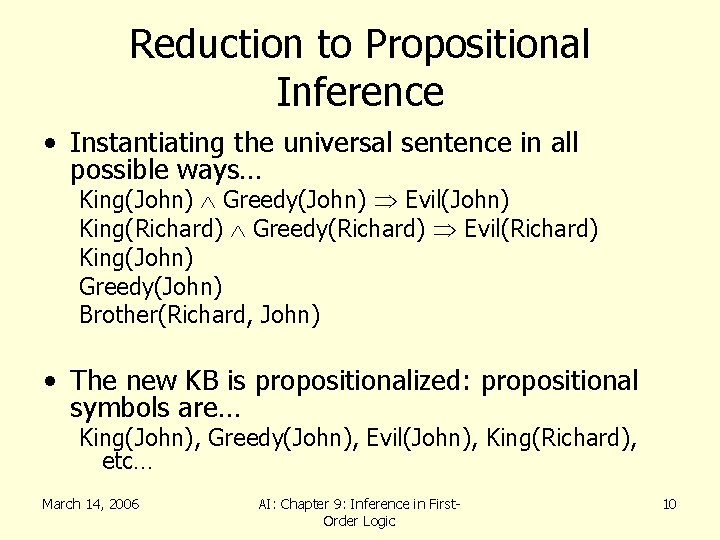
Reduction to Propositional Inference • Instantiating the universal sentence in all possible ways… King(John) Greedy(John) Evil(John) King(Richard) Greedy(Richard) Evil(Richard) King(John) Greedy(John) Brother(Richard, John) • The new KB is propositionalized: propositional symbols are… King(John), Greedy(John), Evil(John), King(Richard), etc… March 14, 2006 AI: Chapter 9: Inference in First. Order Logic 10
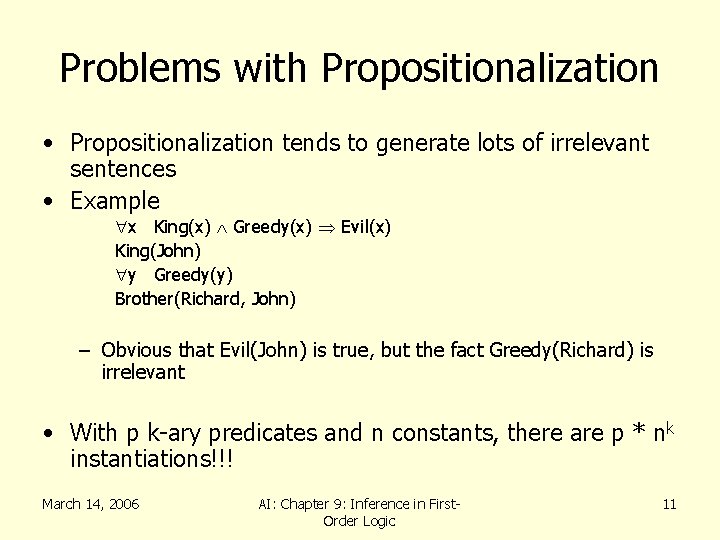
Problems with Propositionalization • Propositionalization tends to generate lots of irrelevant sentences • Example x King(x) Greedy(x) Evil(x) King(John) y Greedy(y) Brother(Richard, John) – Obvious that Evil(John) is true, but the fact Greedy(Richard) is irrelevant • With p k-ary predicates and n constants, there are p * nk instantiations!!! March 14, 2006 AI: Chapter 9: Inference in First. Order Logic 11
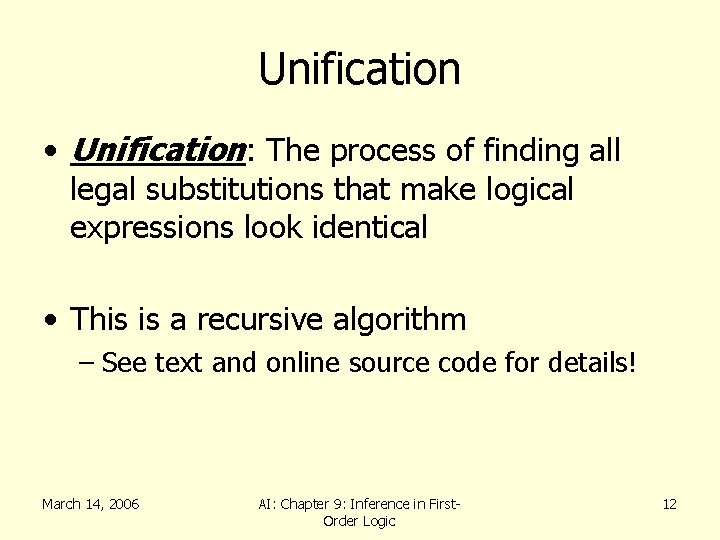
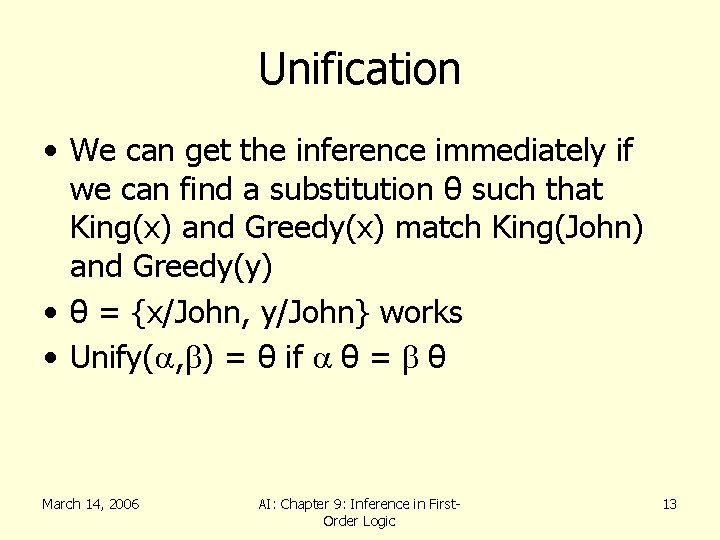
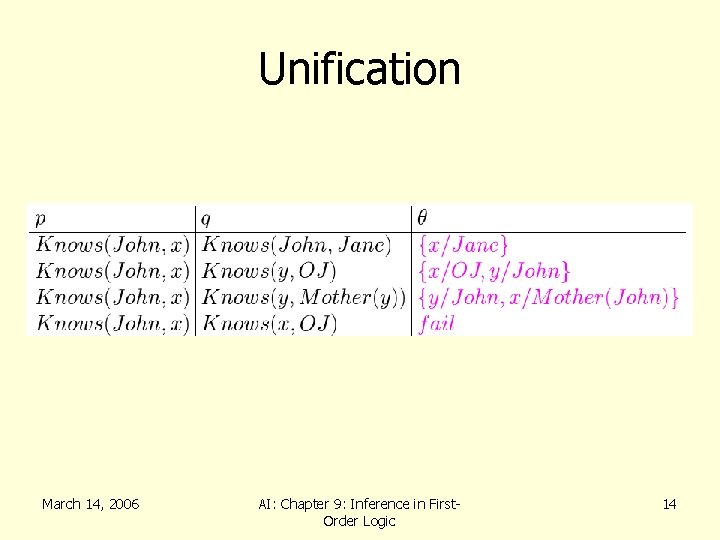
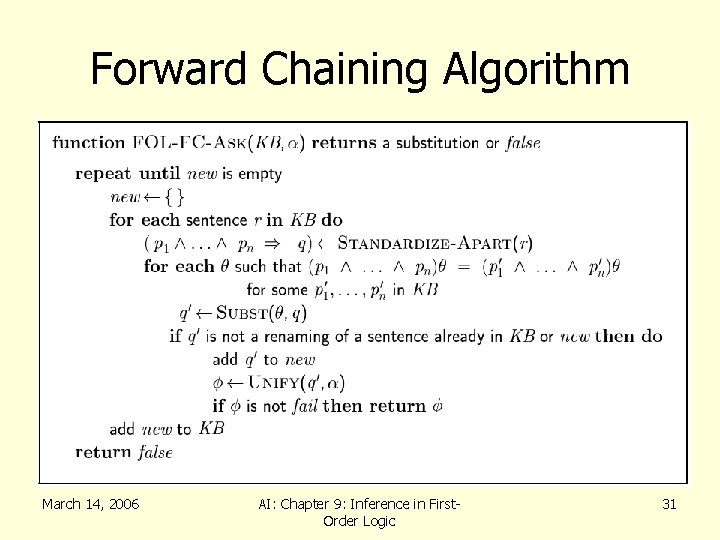
Unification • Unification: The process of finding all legal substitutions that make logical expressions look identical • This is a recursive algorithm – See text and online source code for details! March 14, 2006 AI: Chapter 9: Inference in First. Order Logic 12
Unification • We can get the inference immediately if we can find a substitution θ such that King(x) and Greedy(x) match King(John) and Greedy(y) • θ = {x/John, y/John} works • Unify(a, b) = θ if a θ = b θ March 14, 2006 AI: Chapter 9: Inference in First. Order Logic 13
Unification March 14, 2006 AI: Chapter 9: Inference in First. Order Logic 14
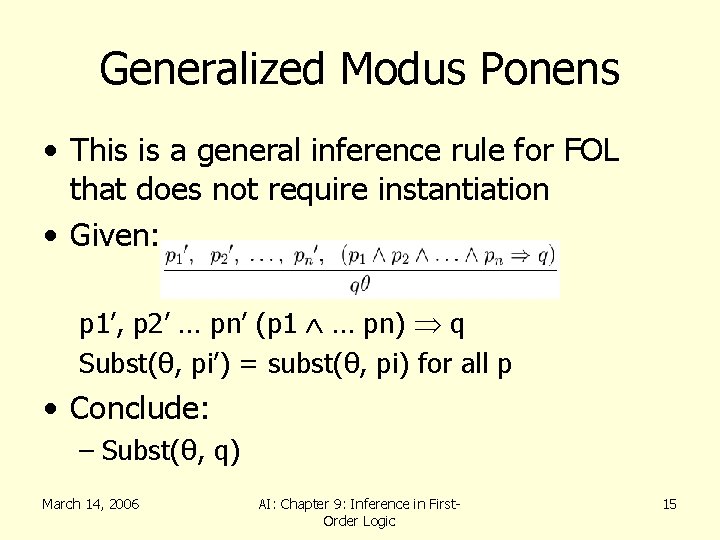
Generalized Modus Ponens • This is a general inference rule for FOL that does not require instantiation • Given: p 1’, p 2’ … pn’ (p 1 … pn) q Subst(θ, pi’) = subst(θ, pi) for all p • Conclude: – Subst(θ, q) March 14, 2006 AI: Chapter 9: Inference in First. Order Logic 15
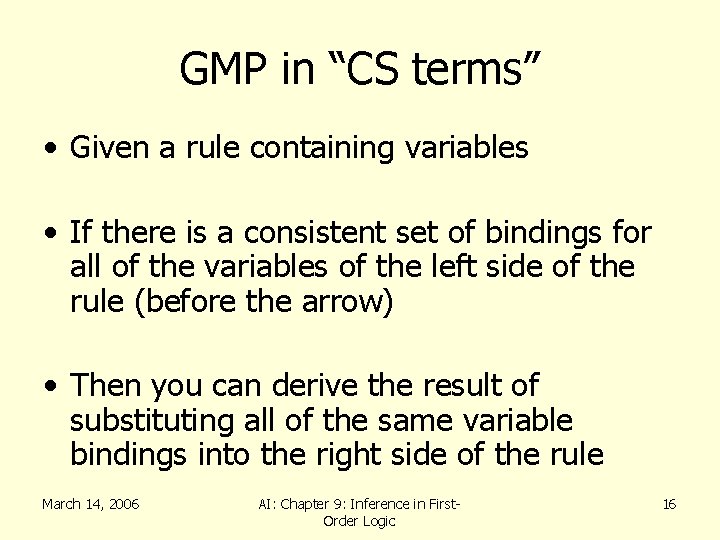
GMP in “CS terms” • Given a rule containing variables • If there is a consistent set of bindings for all of the variables of the left side of the rule (before the arrow) • Then you can derive the result of substituting all of the same variable bindings into the right side of the rule March 14, 2006 AI: Chapter 9: Inference in First. Order Logic 16
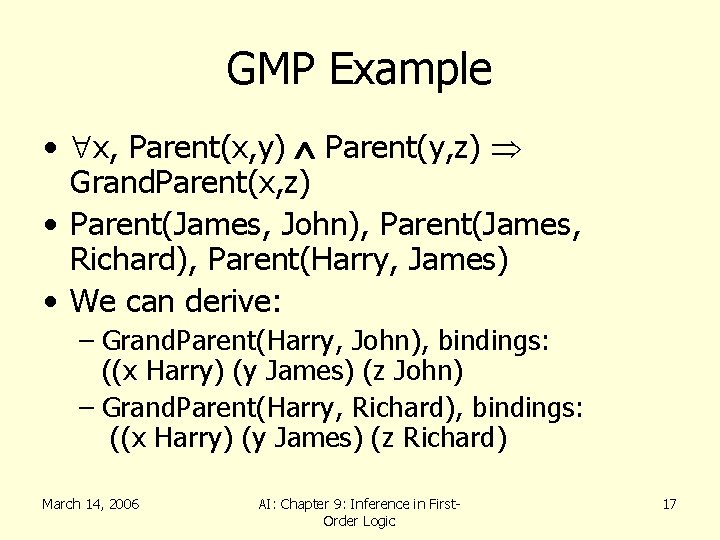
GMP Example • x, Parent(x, y) Parent(y, z) Grand. Parent(x, z) • Parent(James, John), Parent(James, Richard), Parent(Harry, James) • We can derive: – Grand. Parent(Harry, John), bindings: ((x Harry) (y James) (z John) – Grand. Parent(Harry, Richard), bindings: ((x Harry) (y James) (z Richard) March 14, 2006 AI: Chapter 9: Inference in First. Order Logic 17
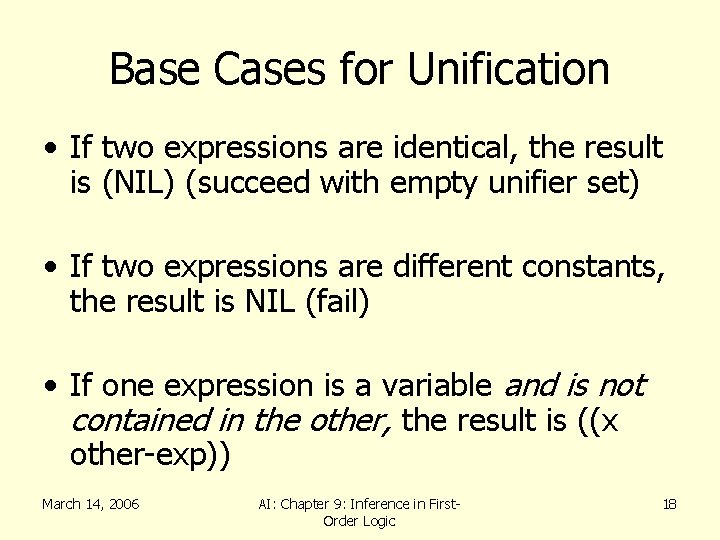
Base Cases for Unification • If two expressions are identical, the result is (NIL) (succeed with empty unifier set) • If two expressions are different constants, the result is NIL (fail) • If one expression is a variable and is not contained in the other, the result is ((x other-exp)) March 14, 2006 AI: Chapter 9: Inference in First. Order Logic 18
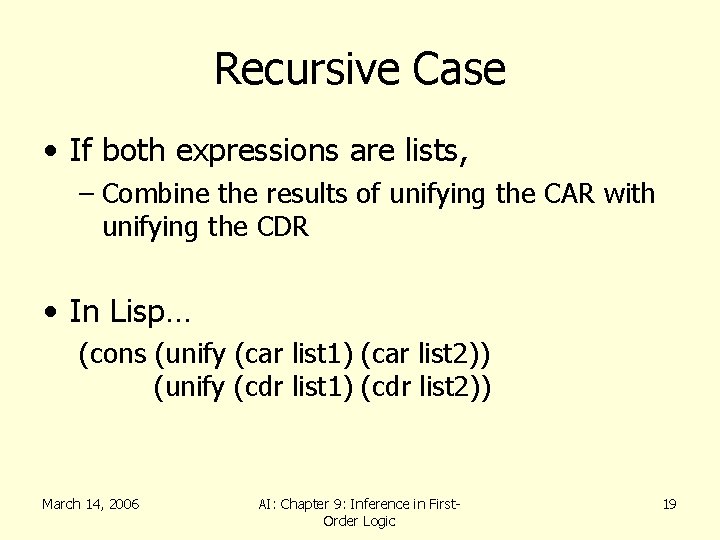
Recursive Case • If both expressions are lists, – Combine the results of unifying the CAR with unifying the CDR • In Lisp… (cons (unify (car list 1) (car list 2)) (unify (cdr list 1) (cdr list 2)) March 14, 2006 AI: Chapter 9: Inference in First. Order Logic 19
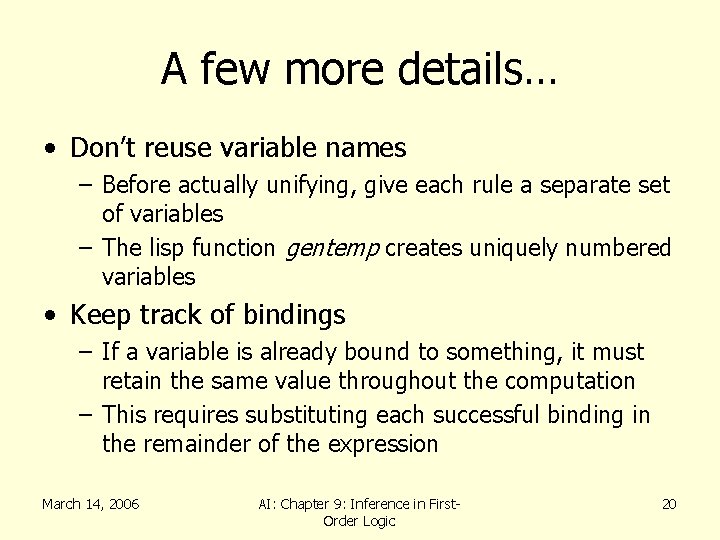
A few more details… • Don’t reuse variable names – Before actually unifying, give each rule a separate set of variables – The lisp function gentemp creates uniquely numbered variables • Keep track of bindings – If a variable is already bound to something, it must retain the same value throughout the computation – This requires substituting each successful binding in the remainder of the expression March 14, 2006 AI: Chapter 9: Inference in First. Order Logic 20
Storage and retrieval • Most systems don’t use variables on predicates • Therefore, hash statements by predicate for quick retrieval (predicate indexing) • Subsumption lattice for efficiency (see p. 279) March 14, 2006 AI: Chapter 9: Inference in First. Order Logic 21
Forward Chaining • Forward Chaining – Start with atomic sentences in the KB and apply Modus Ponens in the forward direction, adding new atomic sentences, until no further inferences can be made. March 14, 2006 AI: Chapter 9: Inference in First. Order Logic 22
Forward Chaining • Given a new fact, generate all consequences • Assumes all rules are of the form – C 1 and C 2 and C 3 and…. --> Result • • Each rule & binding generates a new fact This new fact will “trigger” other rules Keep going until the desired fact is generated (Semi-decidable as is FOL in general) March 14, 2006 AI: Chapter 9: Inference in First. Order Logic 23
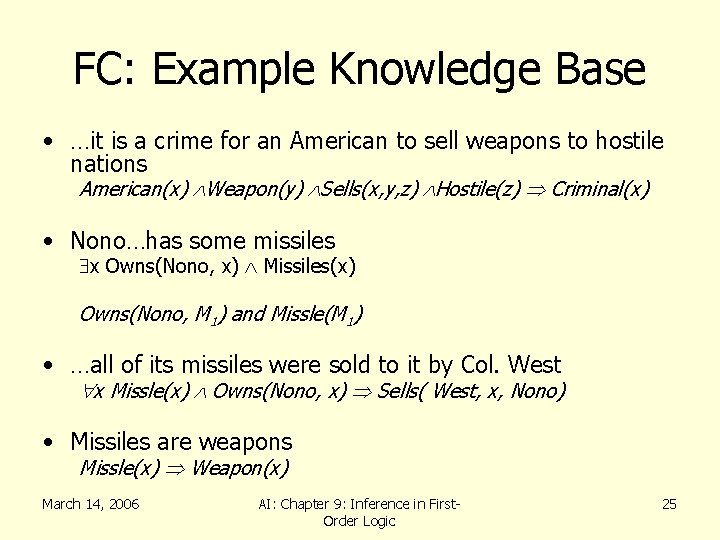
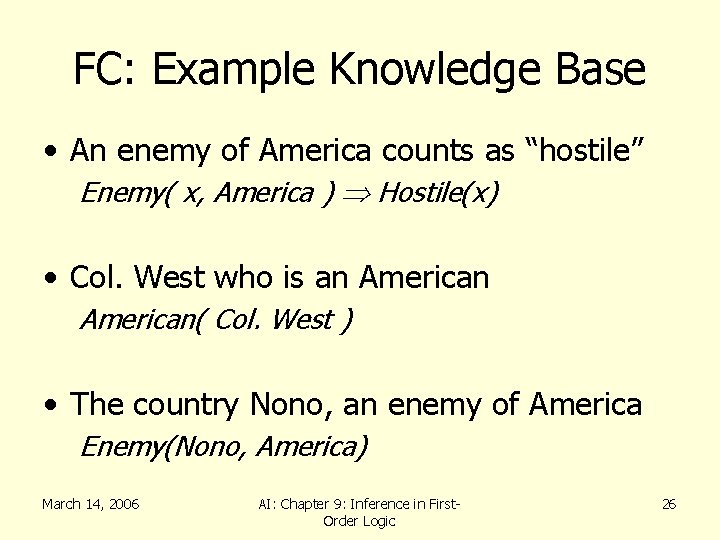
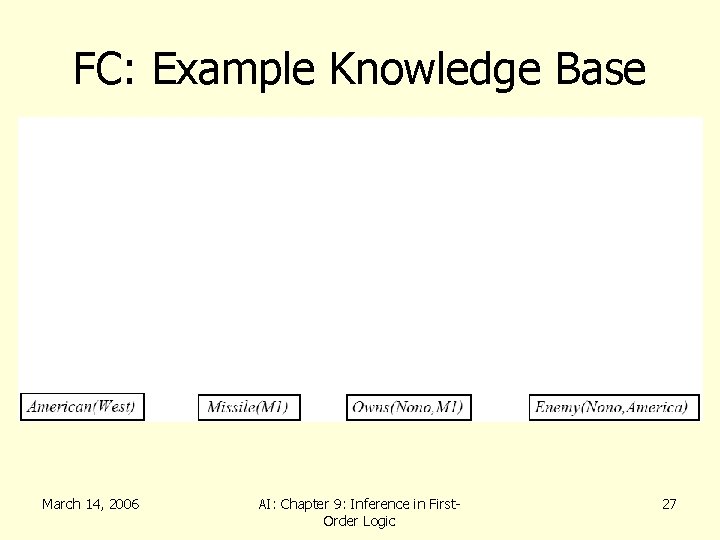
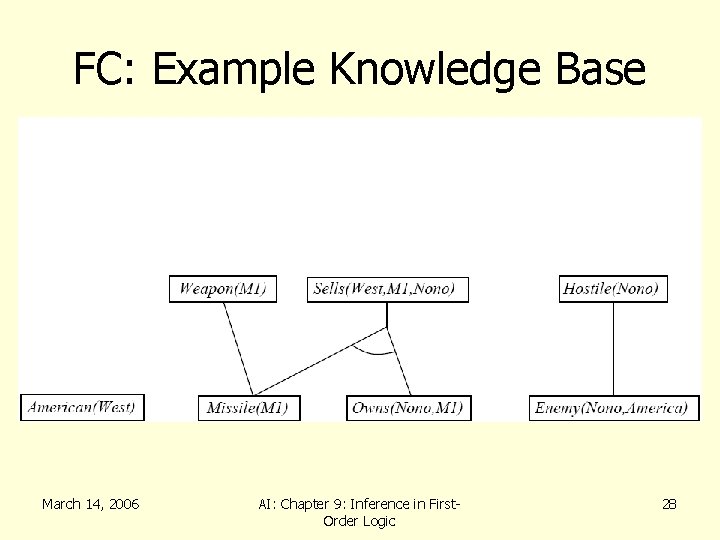
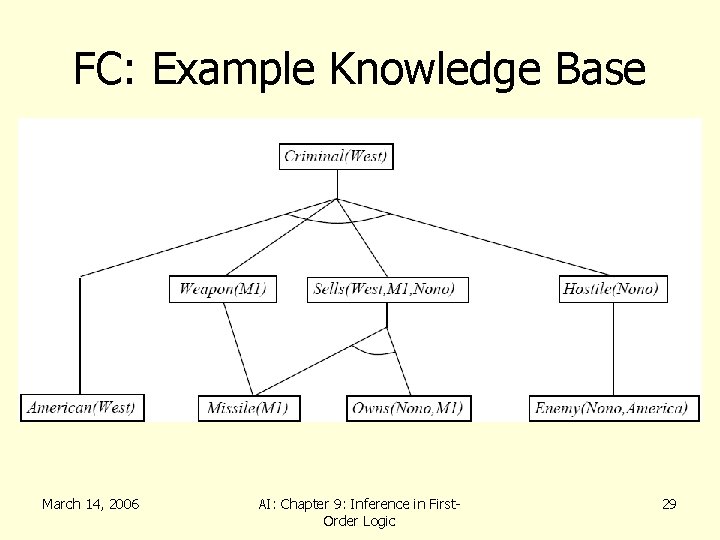
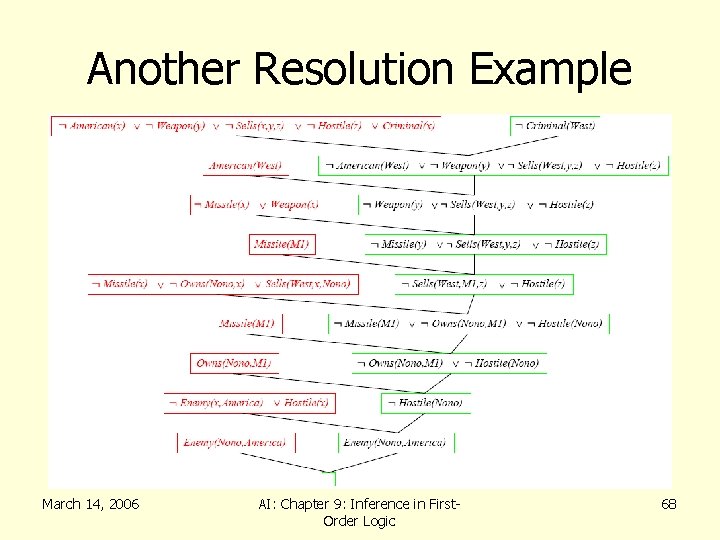
FC: Example Knowledge Base • The law says that it is a crime for an American to sell weapons to hostile nations. The country Nono, an enemy America, has some missiles, and all of its missiles were sold to it by Col. West, who is an American. • Prove that Col. West is a criminal. March 14, 2006 AI: Chapter 9: Inference in First. Order Logic 24
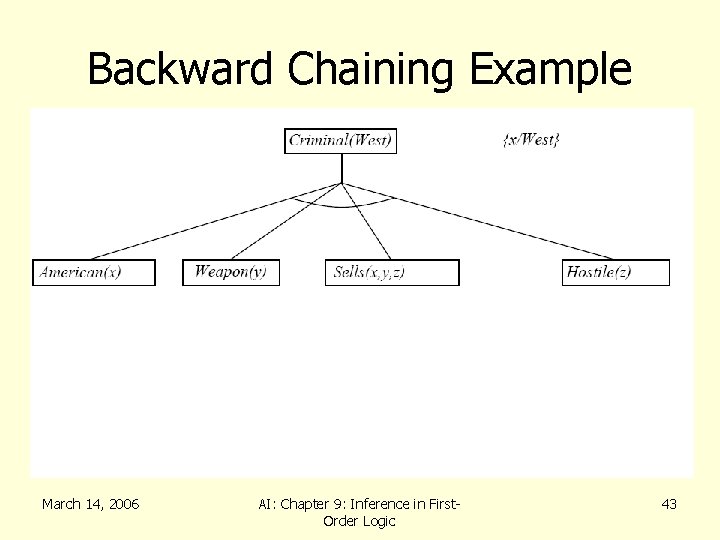
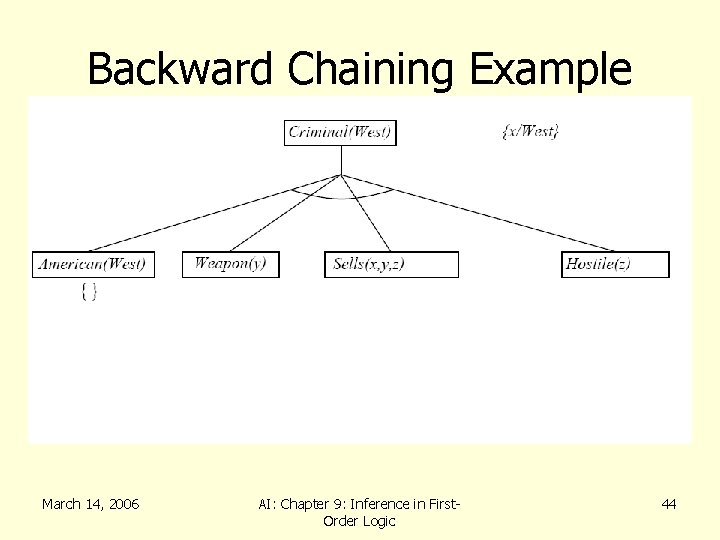
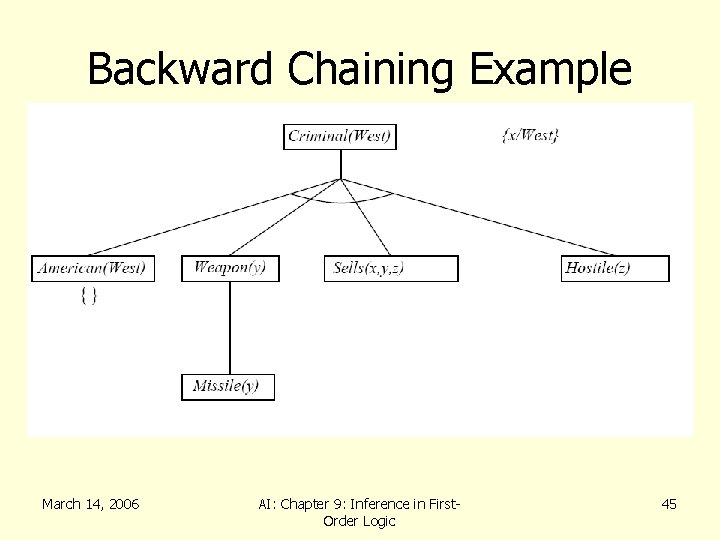
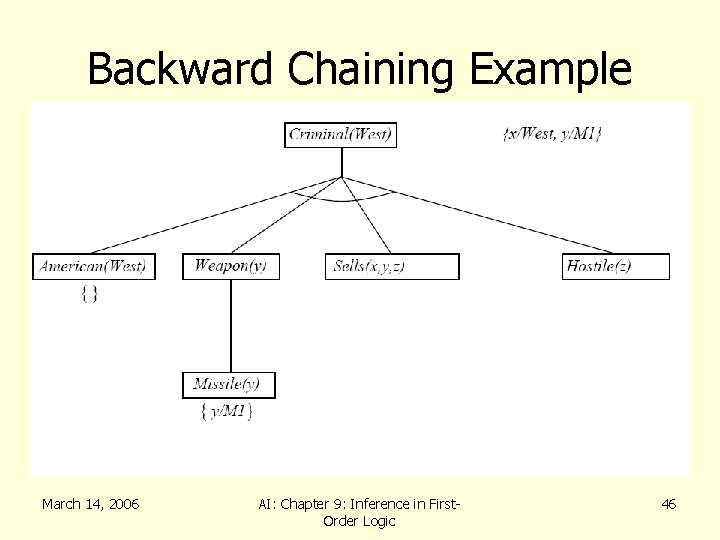
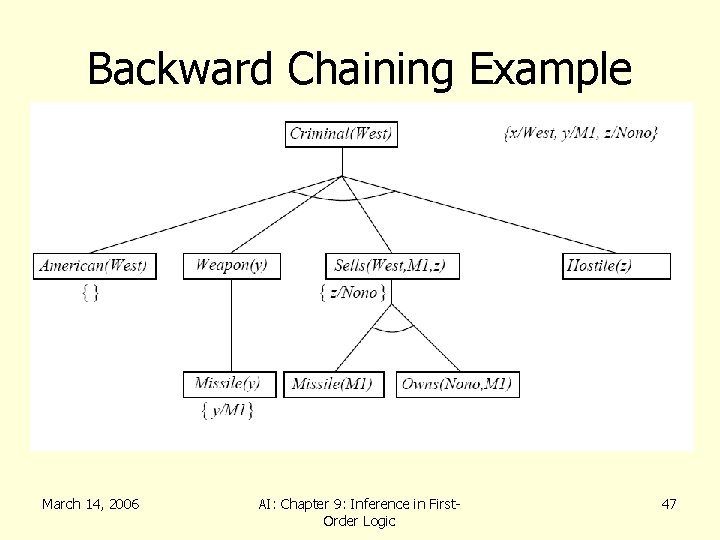
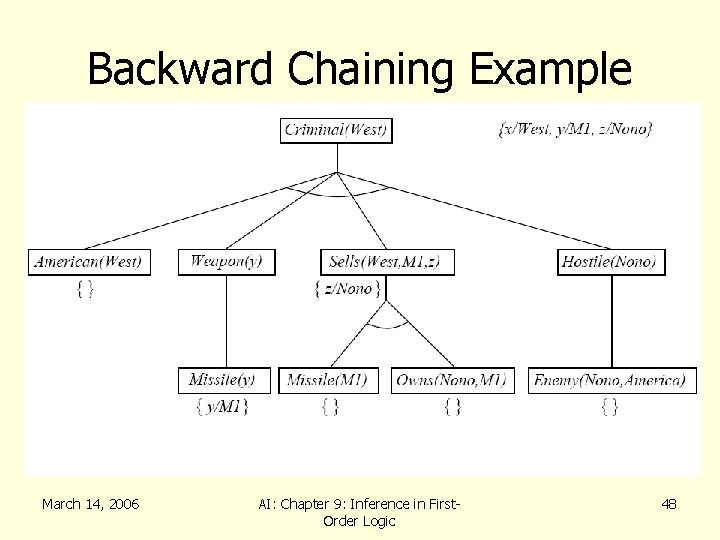
FC: Example Knowledge Base • …it is a crime for an American to sell weapons to hostile nations American(x) Weapon(y) Sells(x, y, z) Hostile(z) Criminal(x) • Nono…has some missiles x Owns(Nono, x) Missiles(x) Owns(Nono, M 1) and Missle(M 1) • …all of its missiles were sold to it by Col. West x Missle(x) Owns(Nono, x) Sells( West, x, Nono) • Missiles are weapons Missle(x) Weapon(x) March 14, 2006 AI: Chapter 9: Inference in First. Order Logic 25
FC: Example Knowledge Base • An enemy of America counts as “hostile” Enemy( x, America ) Hostile(x) • Col. West who is an American( Col. West ) • The country Nono, an enemy of America Enemy(Nono, America) March 14, 2006 AI: Chapter 9: Inference in First. Order Logic 26
FC: Example Knowledge Base March 14, 2006 AI: Chapter 9: Inference in First. Order Logic 27
FC: Example Knowledge Base March 14, 2006 AI: Chapter 9: Inference in First. Order Logic 28
FC: Example Knowledge Base March 14, 2006 AI: Chapter 9: Inference in First. Order Logic 29
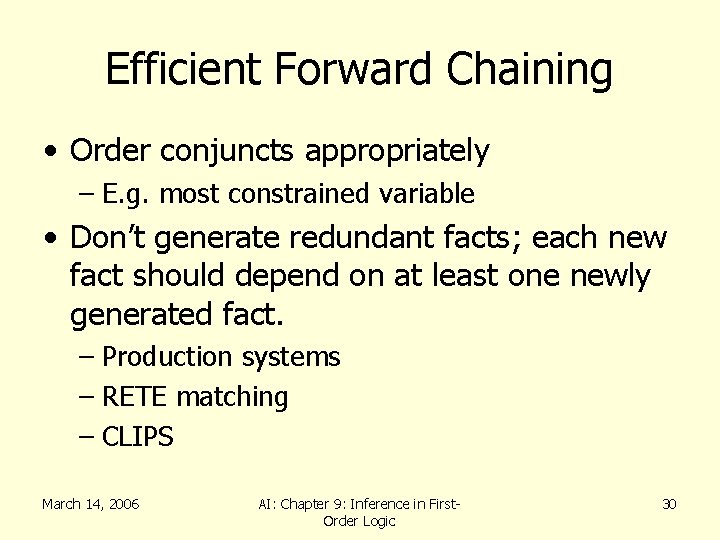
Efficient Forward Chaining • Order conjuncts appropriately – E. g. most constrained variable • Don’t generate redundant facts; each new fact should depend on at least one newly generated fact. – Production systems – RETE matching – CLIPS March 14, 2006 AI: Chapter 9: Inference in First. Order Logic 30
Forward Chaining Algorithm March 14, 2006 AI: Chapter 9: Inference in First. Order Logic 31
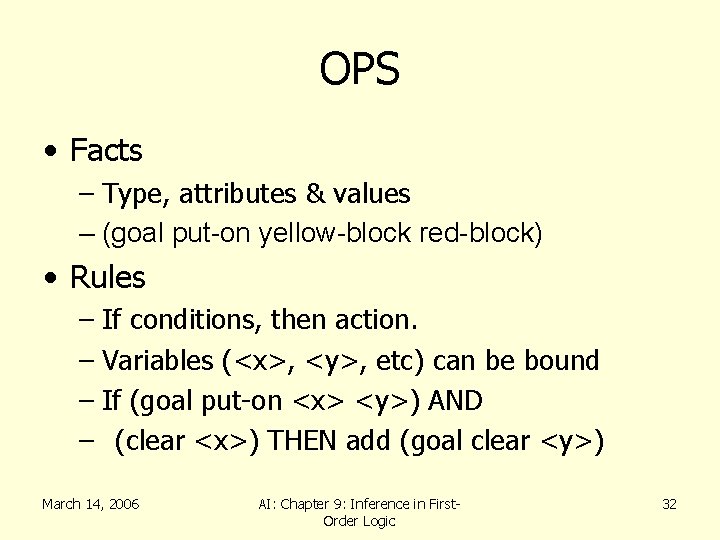
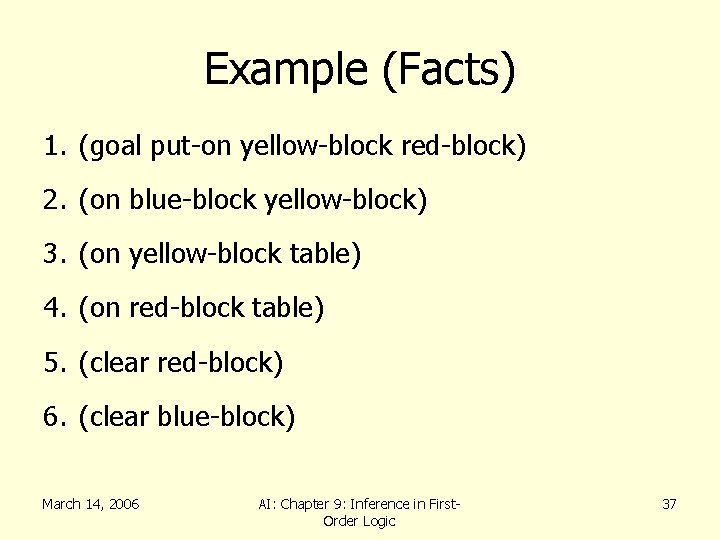
OPS • Facts – Type, attributes & values – (goal put-on yellow-block red-block) • Rules – If conditions, then action. – Variables (<x>, <y>, etc) can be bound – If (goal put-on <x> <y>) AND – (clear <x>) THEN add (goal clear <y>) March 14, 2006 AI: Chapter 9: Inference in First. Order Logic 32
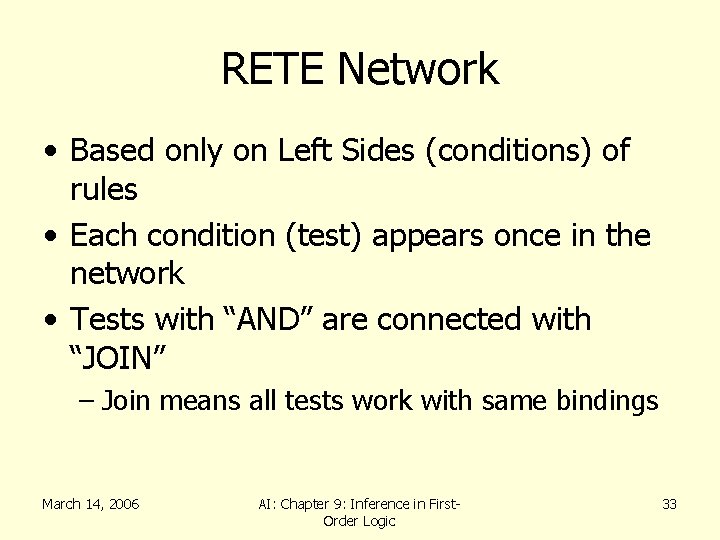
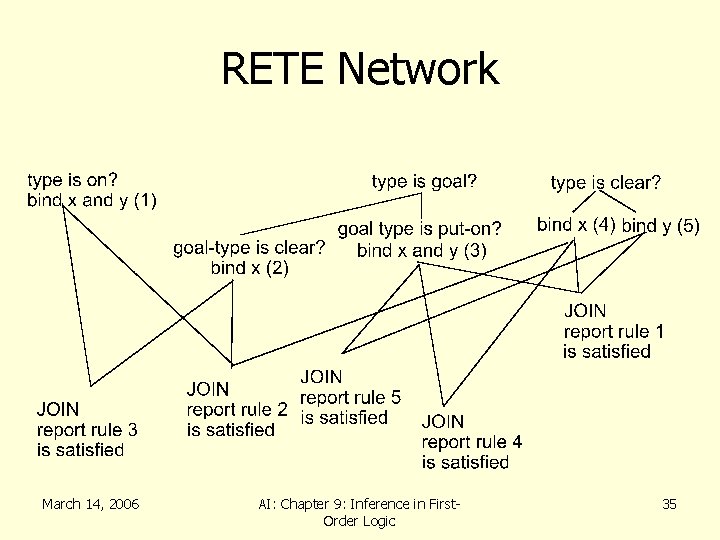
RETE Network • Based only on Left Sides (conditions) of rules • Each condition (test) appears once in the network • Tests with “AND” are connected with “JOIN” – Join means all tests work with same bindings March 14, 2006 AI: Chapter 9: Inference in First. Order Logic 33
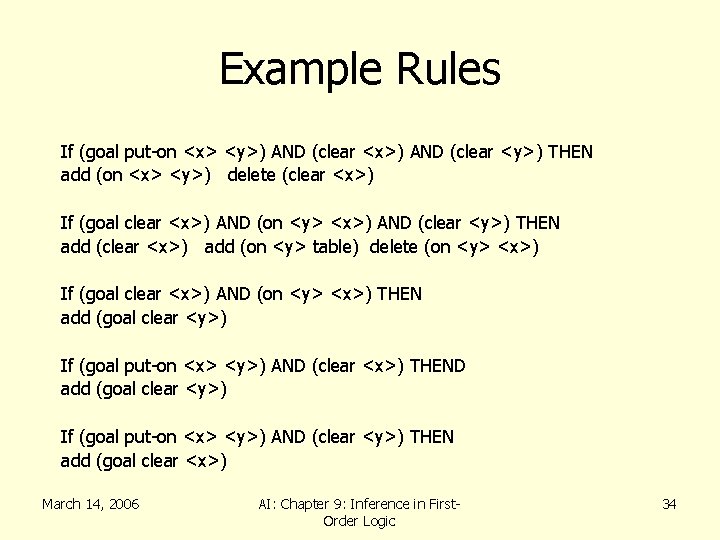
Example Rules If (goal put-on <x> <y>) AND (clear <x>) AND (clear <y>) THEN add (on <x> <y>) delete (clear <x>) If (goal clear <x>) AND (on <y> <x>) AND (clear <y>) THEN add (clear <x>) add (on <y> table) delete (on <y> <x>) If (goal clear <x>) AND (on <y> <x>) THEN add (goal clear <y>) If (goal put-on <x> <y>) AND (clear <x>) THEND add (goal clear <y>) If (goal put-on <x> <y>) AND (clear <y>) THEN add (goal clear <x>) March 14, 2006 AI: Chapter 9: Inference in First. Order Logic 34
RETE Network March 14, 2006 AI: Chapter 9: Inference in First. Order Logic 35
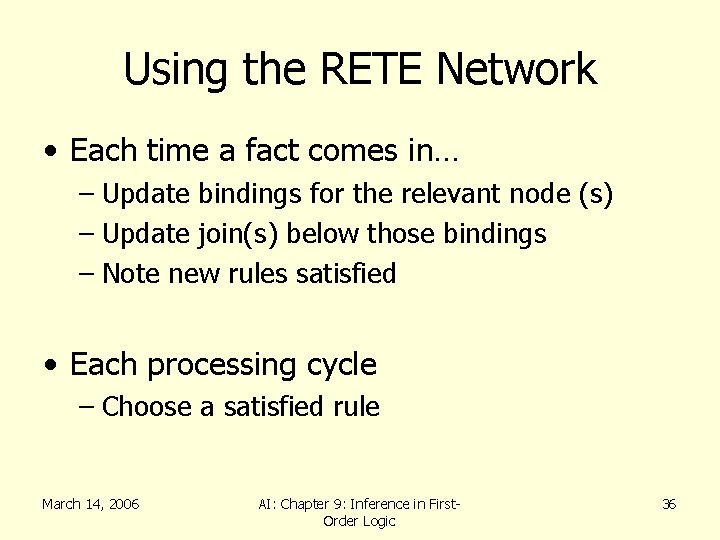
Using the RETE Network • Each time a fact comes in… – Update bindings for the relevant node (s) – Update join(s) below those bindings – Note new rules satisfied • Each processing cycle – Choose a satisfied rule March 14, 2006 AI: Chapter 9: Inference in First. Order Logic 36
Example (Facts) 1. (goal put-on yellow-block red-block) 2. (on blue-block yellow-block) 3. (on yellow-block table) 4. (on red-block table) 5. (clear red-block) 6. (clear blue-block) March 14, 2006 AI: Chapter 9: Inference in First. Order Logic 37
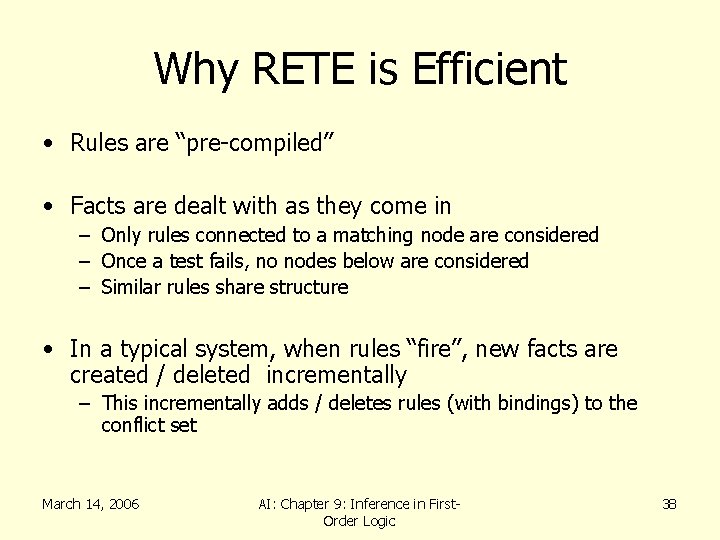
Why RETE is Efficient • Rules are “pre-compiled” • Facts are dealt with as they come in – Only rules connected to a matching node are considered – Once a test fails, no nodes below are considered – Similar rules share structure • In a typical system, when rules “fire”, new facts are created / deleted incrementally – This incrementally adds / deletes rules (with bindings) to the conflict set March 14, 2006 AI: Chapter 9: Inference in First. Order Logic 38
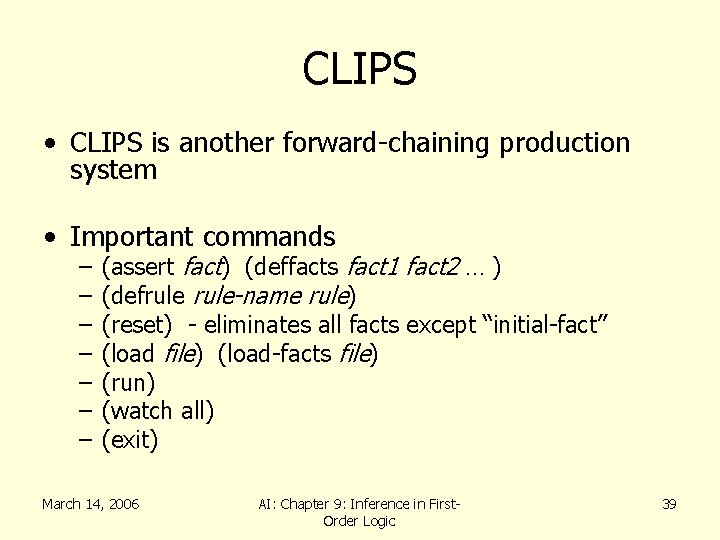
CLIPS • CLIPS is another forward-chaining production system • Important commands – – – – (assert fact) (deffacts fact 1 fact 2 … ) (defrule-name rule) (reset) - eliminates all facts except “initial-fact” (load file) (load-facts file) (run) (watch all) (exit) March 14, 2006 AI: Chapter 9: Inference in First. Order Logic 39
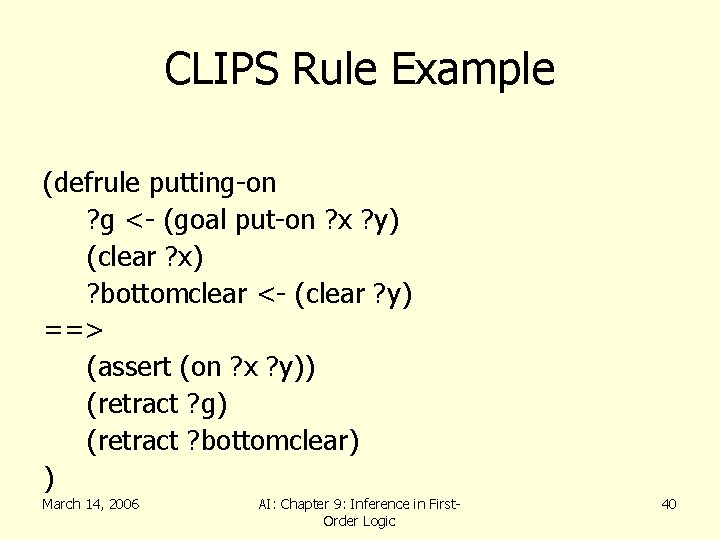
CLIPS Rule Example (defrule putting-on ? g <- (goal put-on ? x ? y) (clear ? x) ? bottomclear <- (clear ? y) ==> (assert (on ? x ? y)) (retract ? g) (retract ? bottomclear) ) March 14, 2006 AI: Chapter 9: Inference in First. Order Logic 40
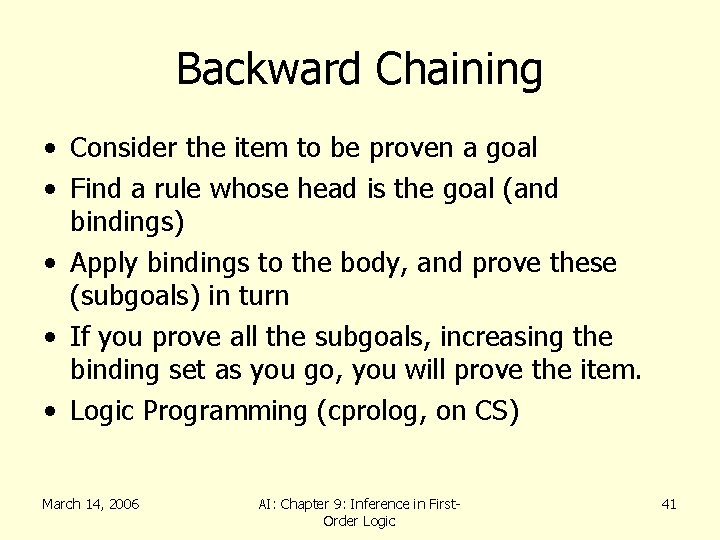
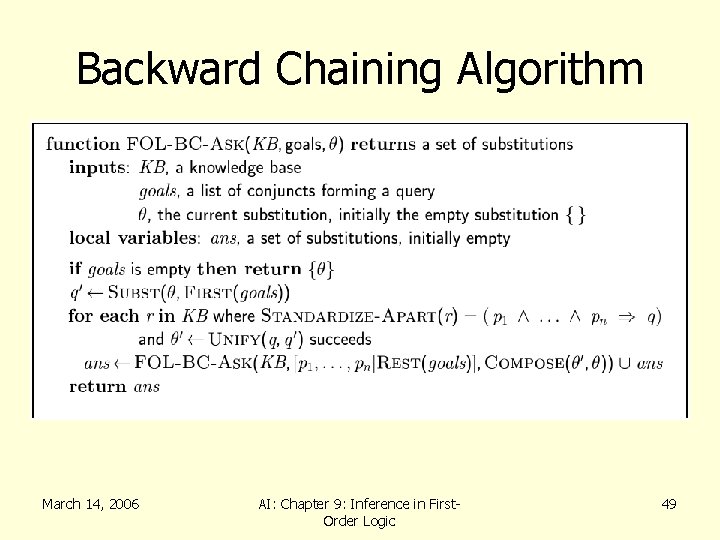
Backward Chaining • Consider the item to be proven a goal • Find a rule whose head is the goal (and bindings) • Apply bindings to the body, and prove these (subgoals) in turn • If you prove all the subgoals, increasing the binding set as you go, you will prove the item. • Logic Programming (cprolog, on CS) March 14, 2006 AI: Chapter 9: Inference in First. Order Logic 41
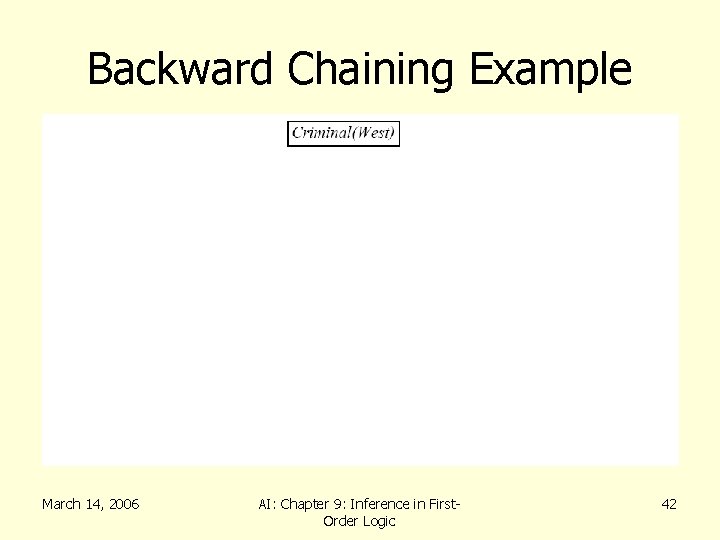
Backward Chaining Example March 14, 2006 AI: Chapter 9: Inference in First. Order Logic 42
Backward Chaining Example March 14, 2006 AI: Chapter 9: Inference in First. Order Logic 43
Backward Chaining Example March 14, 2006 AI: Chapter 9: Inference in First. Order Logic 44
Backward Chaining Example March 14, 2006 AI: Chapter 9: Inference in First. Order Logic 45
Backward Chaining Example March 14, 2006 AI: Chapter 9: Inference in First. Order Logic 46
Backward Chaining Example March 14, 2006 AI: Chapter 9: Inference in First. Order Logic 47
Backward Chaining Example March 14, 2006 AI: Chapter 9: Inference in First. Order Logic 48
Backward Chaining Algorithm March 14, 2006 AI: Chapter 9: Inference in First. Order Logic 49
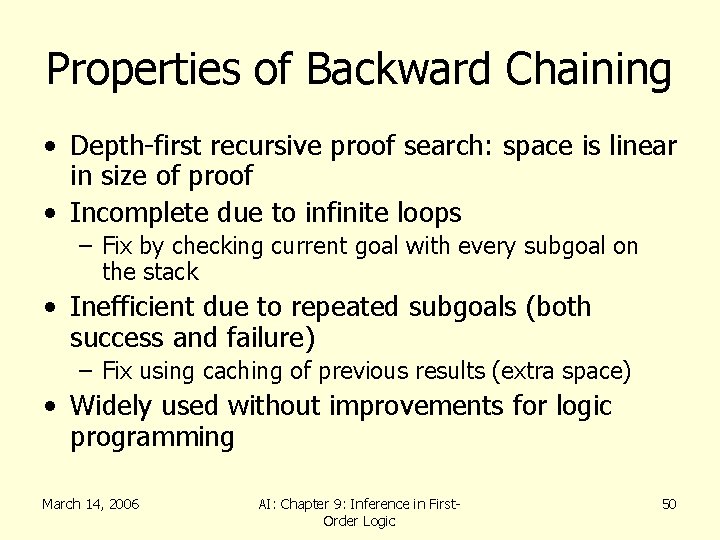
Properties of Backward Chaining • Depth-first recursive proof search: space is linear in size of proof • Incomplete due to infinite loops – Fix by checking current goal with every subgoal on the stack • Inefficient due to repeated subgoals (both success and failure) – Fix using caching of previous results (extra space) • Widely used without improvements for logic programming March 14, 2006 AI: Chapter 9: Inference in First. Order Logic 50
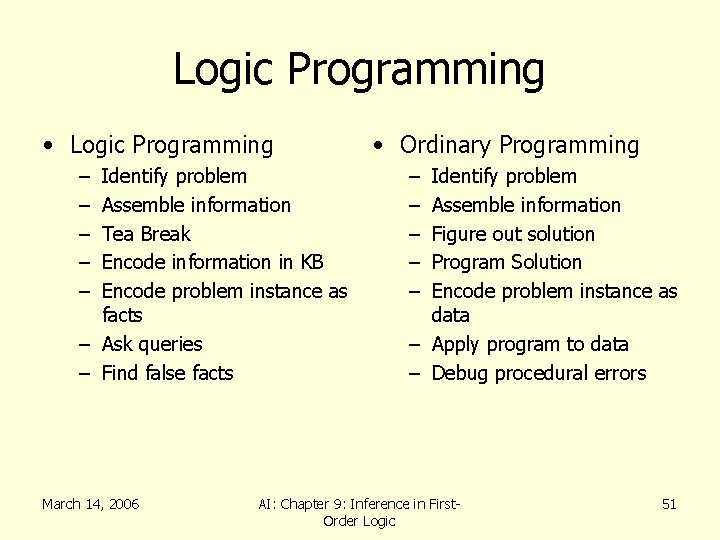
Logic Programming • Logic Programming – – – Identify problem Assemble information Tea Break Encode information in KB Encode problem instance as facts – Ask queries – Find false facts March 14, 2006 • Ordinary Programming – – – Identify problem Assemble information Figure out solution Program Solution Encode problem instance as data – Apply program to data – Debug procedural errors AI: Chapter 9: Inference in First. Order Logic 51
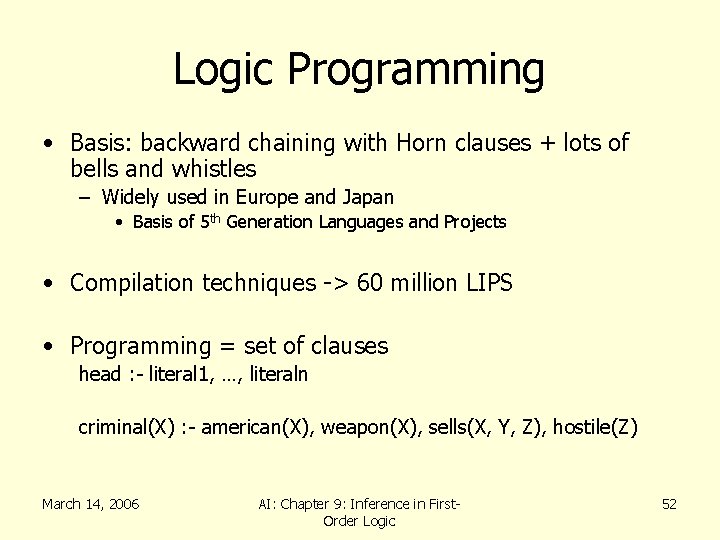
Logic Programming • Basis: backward chaining with Horn clauses + lots of bells and whistles – Widely used in Europe and Japan • Basis of 5 th Generation Languages and Projects • Compilation techniques -> 60 million LIPS • Programming = set of clauses head : - literal 1, …, literaln criminal(X) : - american(X), weapon(X), sells(X, Y, Z), hostile(Z) March 14, 2006 AI: Chapter 9: Inference in First. Order Logic 52
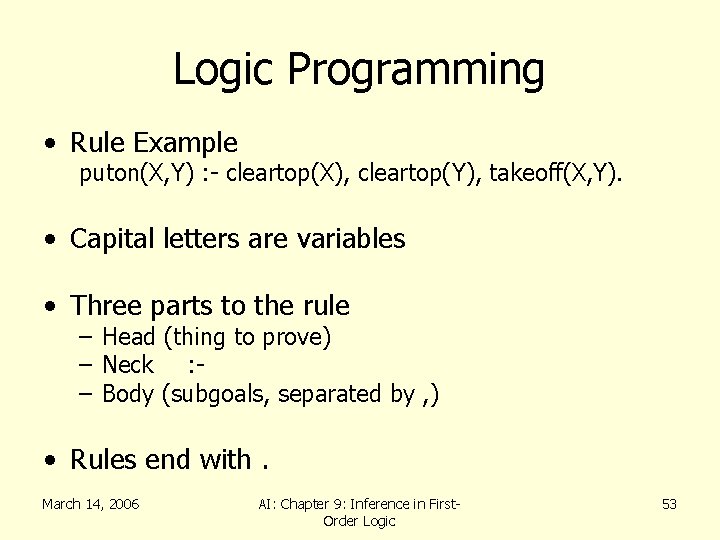
Logic Programming • Rule Example puton(X, Y) : - cleartop(X), cleartop(Y), takeoff(X, Y). • Capital letters are variables • Three parts to the rule – Head (thing to prove) – Neck : – Body (subgoals, separated by , ) • Rules end with. March 14, 2006 AI: Chapter 9: Inference in First. Order Logic 53
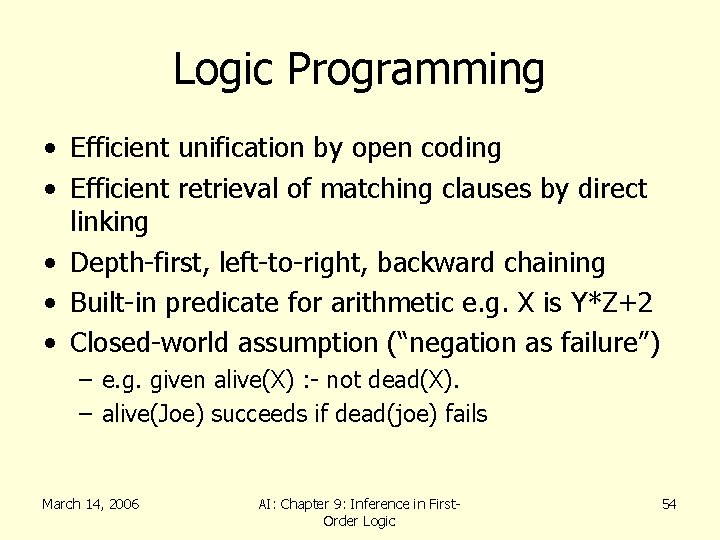
Logic Programming • Efficient unification by open coding • Efficient retrieval of matching clauses by direct linking • Depth-first, left-to-right, backward chaining • Built-in predicate for arithmetic e. g. X is Y*Z+2 • Closed-world assumption (“negation as failure”) – e. g. given alive(X) : - not dead(X). – alive(Joe) succeeds if dead(joe) fails March 14, 2006 AI: Chapter 9: Inference in First. Order Logic 54
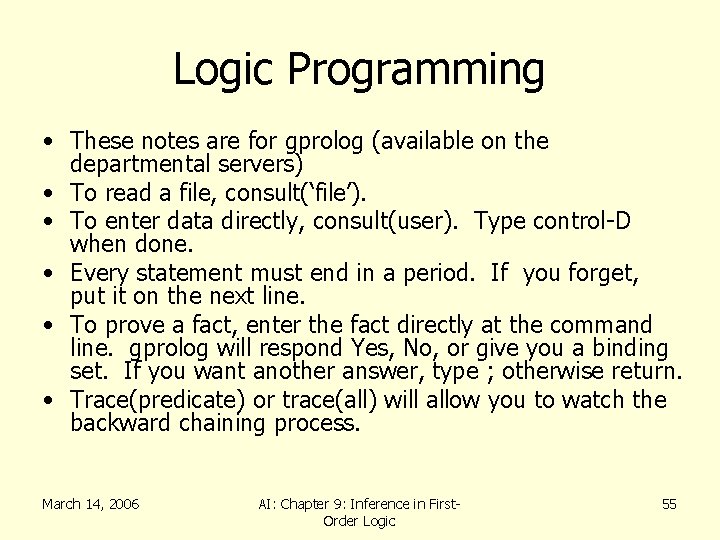
Logic Programming • These notes are for gprolog (available on the departmental servers) • To read a file, consult(‘file’). • To enter data directly, consult(user). Type control-D when done. • Every statement must end in a period. If you forget, put it on the next line. • To prove a fact, enter the fact directly at the command line. gprolog will respond Yes, No, or give you a binding set. If you want another answer, type ; otherwise return. • Trace(predicate) or trace(all) will allow you to watch the backward chaining process. March 14, 2006 AI: Chapter 9: Inference in First. Order Logic 55
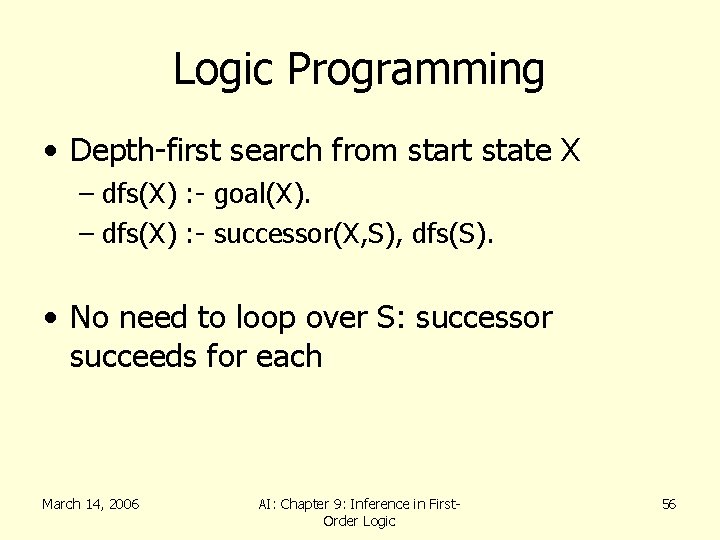
Logic Programming • Depth-first search from start state X – dfs(X) : - goal(X). – dfs(X) : - successor(X, S), dfs(S). • No need to loop over S: successor succeeds for each March 14, 2006 AI: Chapter 9: Inference in First. Order Logic 56
Logic Programming • Example: Appending two lists to produce a third – append([], Y, Y). – append([X|L], Y, [X|Z]) : - append( L, Y, Z). – query: append( A, B, [1, 2]). – answers: • A=[] • A=[1, 2] March 14, 2006 B=[1, 2] B=[] AI: Chapter 9: Inference in First. Order Logic 57
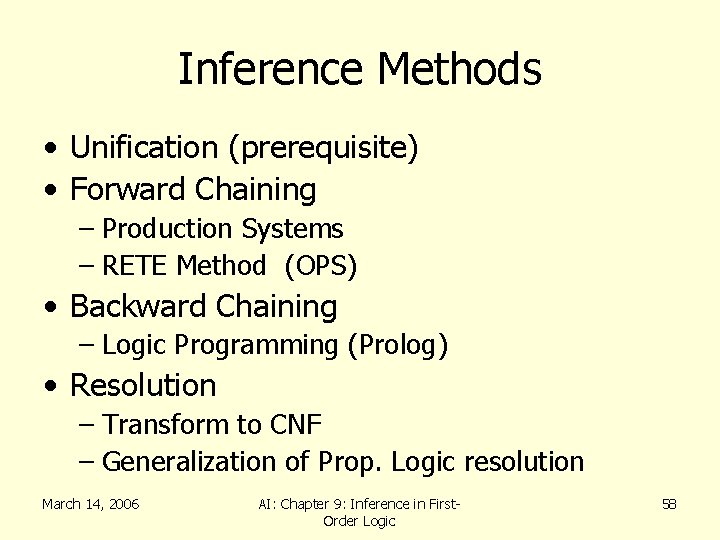
Inference Methods • Unification (prerequisite) • Forward Chaining – Production Systems – RETE Method (OPS) • Backward Chaining – Logic Programming (Prolog) • Resolution – Transform to CNF – Generalization of Prop. Logic resolution March 14, 2006 AI: Chapter 9: Inference in First. Order Logic 58
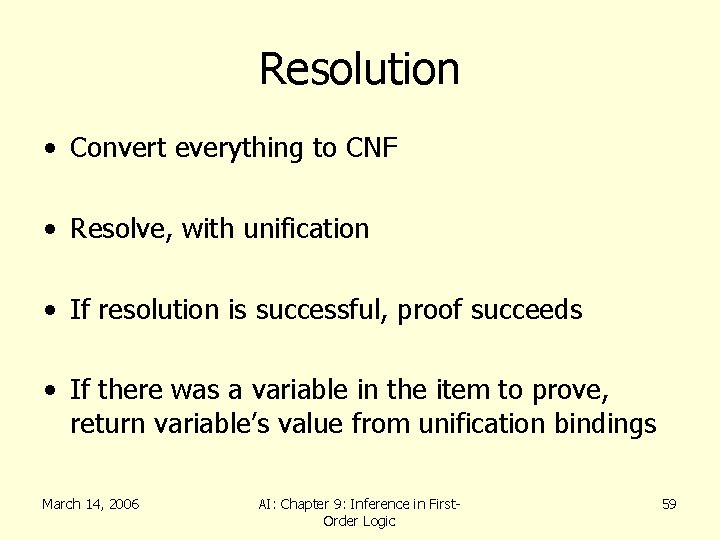
Resolution • Convert everything to CNF • Resolve, with unification • If resolution is successful, proof succeeds • If there was a variable in the item to prove, return variable’s value from unification bindings March 14, 2006 AI: Chapter 9: Inference in First. Order Logic 59
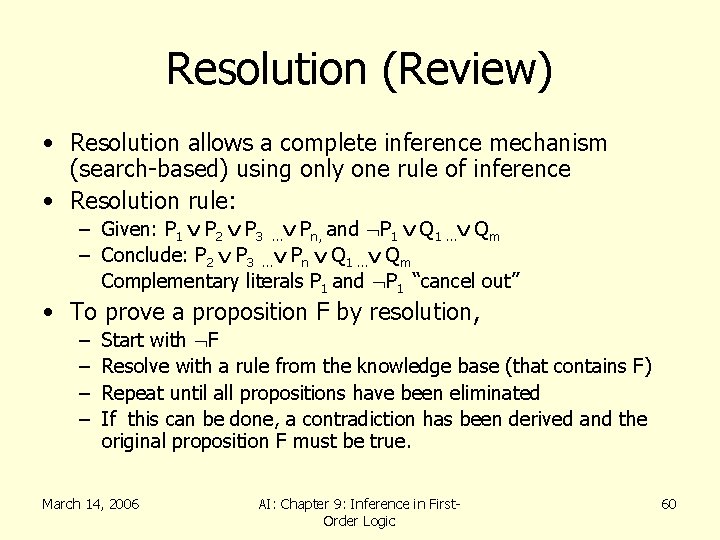
Resolution (Review) • Resolution allows a complete inference mechanism (search-based) using only one rule of inference • Resolution rule: – Given: P 1 P 2 P 3 … Pn, and P 1 Q 1 … Qm – Conclude: P 2 P 3 … Pn Q 1 … Qm Complementary literals P 1 and P 1 “cancel out” • To prove a proposition F by resolution, – – Start with F Resolve with a rule from the knowledge base (that contains F) Repeat until all propositions have been eliminated If this can be done, a contradiction has been derived and the original proposition F must be true. March 14, 2006 AI: Chapter 9: Inference in First. Order Logic 60
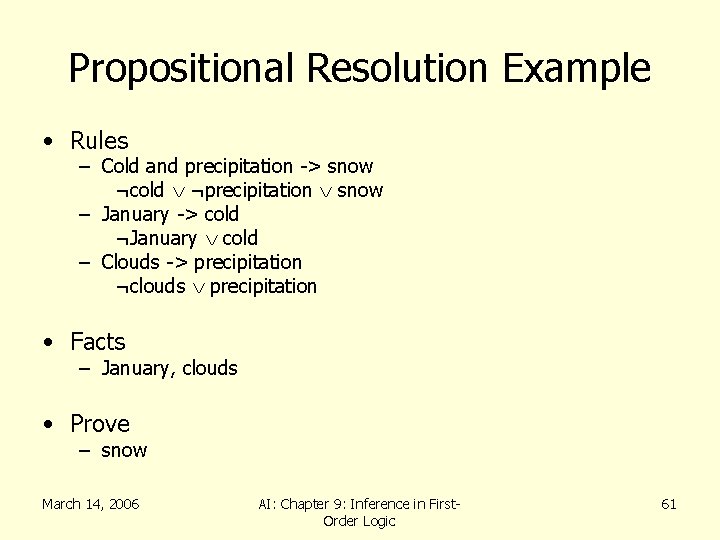
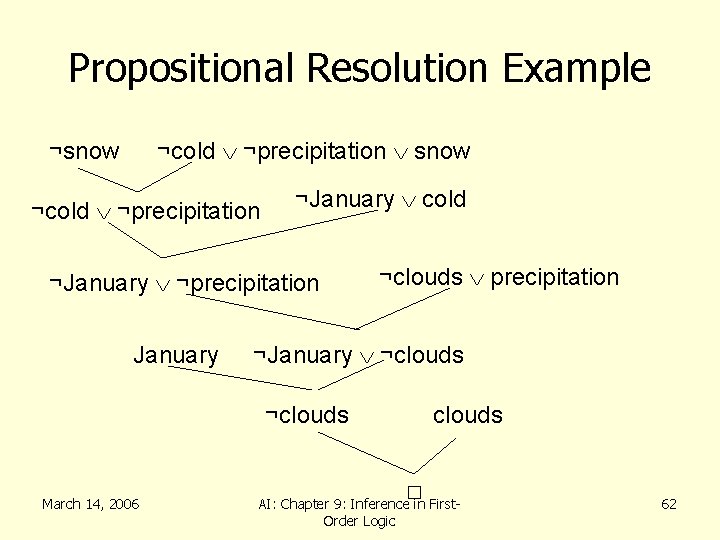
Propositional Resolution Example • Rules – Cold and precipitation -> snow ¬cold ¬precipitation snow – January -> cold ¬January cold – Clouds -> precipitation ¬clouds precipitation • Facts – January, clouds • Prove – snow March 14, 2006 AI: Chapter 9: Inference in First. Order Logic 61
Propositional Resolution Example ¬cold ¬precipitation snow ¬cold ¬precipitation ¬January cold ¬January ¬precipitation January ¬January ¬clouds March 14, 2006 ¬clouds precipitation clouds AI: Chapter 9: Inference in First. Order Logic 62
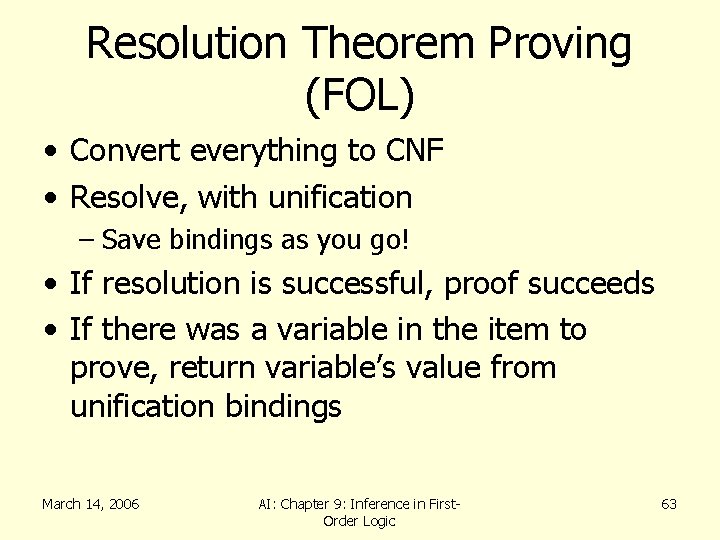
Resolution Theorem Proving (FOL) • Convert everything to CNF • Resolve, with unification – Save bindings as you go! • If resolution is successful, proof succeeds • If there was a variable in the item to prove, return variable’s value from unification bindings March 14, 2006 AI: Chapter 9: Inference in First. Order Logic 63
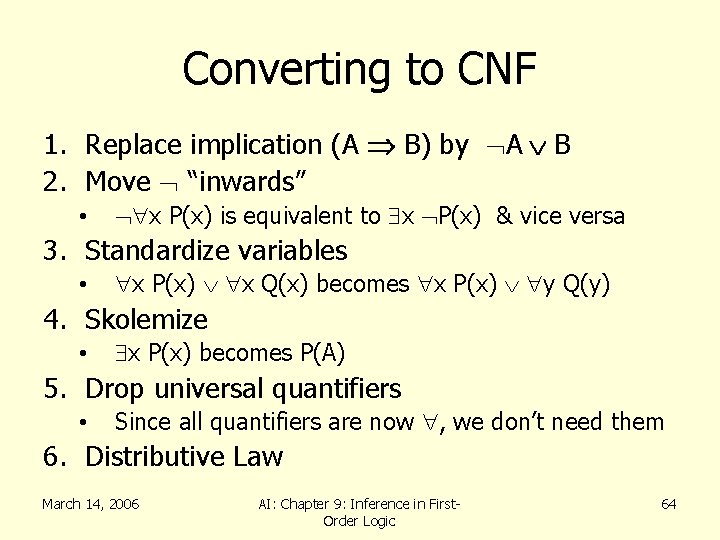
Converting to CNF 1. Replace implication (A B) by A B 2. Move “inwards” • x P(x) is equivalent to x P(x) & vice versa 3. Standardize variables • x P(x) x Q(x) becomes x P(x) y Q(y) 4. Skolemize • x P(x) becomes P(A) 5. Drop universal quantifiers • Since all quantifiers are now , we don’t need them 6. Distributive Law March 14, 2006 AI: Chapter 9: Inference in First. Order Logic 64
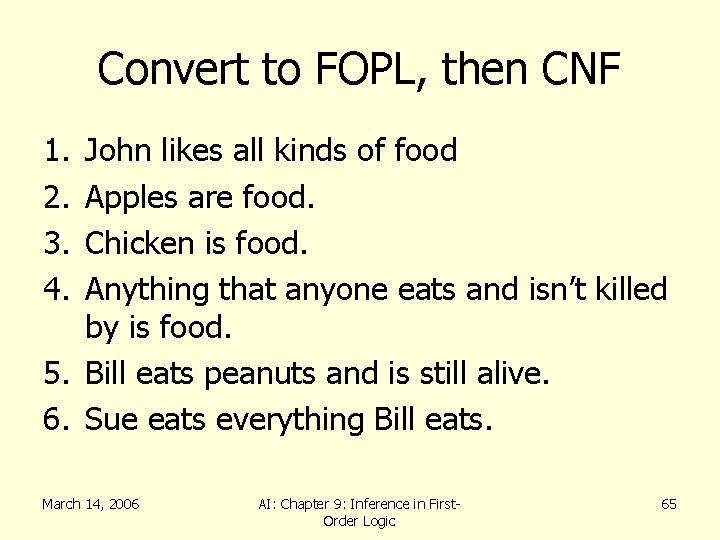
Convert to FOPL, then CNF 1. 2. 3. 4. John likes all kinds of food Apples are food. Chicken is food. Anything that anyone eats and isn’t killed by is food. 5. Bill eats peanuts and is still alive. 6. Sue eats everything Bill eats. March 14, 2006 AI: Chapter 9: Inference in First. Order Logic 65
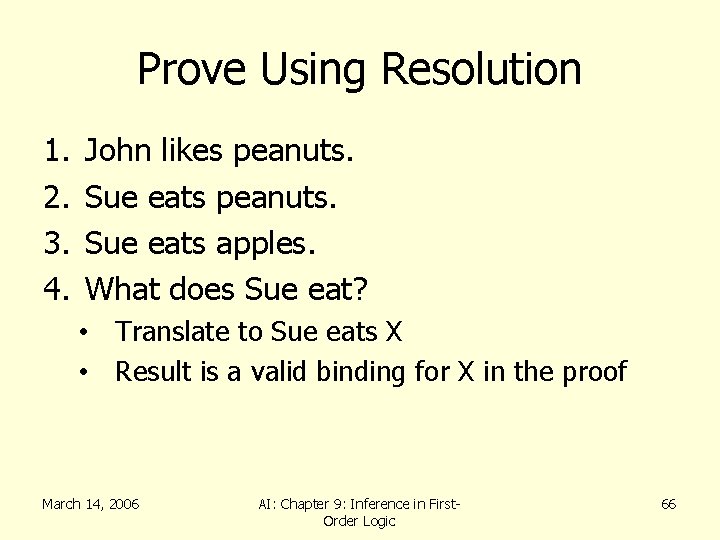
Prove Using Resolution 1. 2. 3. 4. John likes peanuts. Sue eats apples. What does Sue eat? • Translate to Sue eats X • Result is a valid binding for X in the proof March 14, 2006 AI: Chapter 9: Inference in First. Order Logic 66
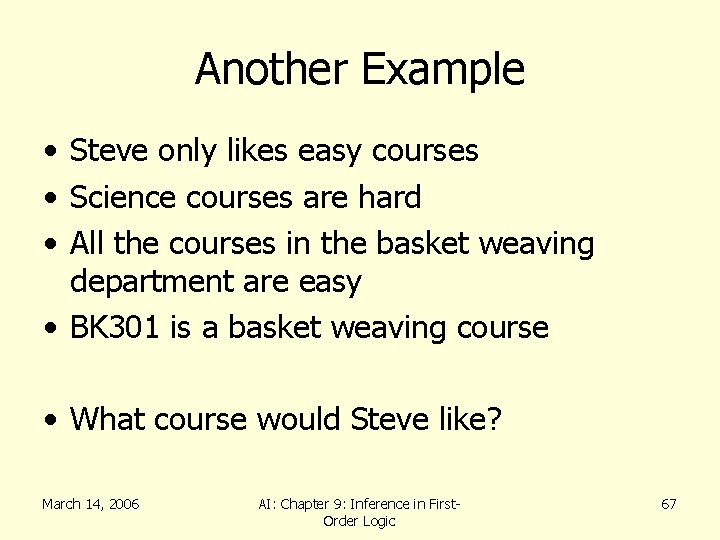
Another Example • Steve only likes easy courses • Science courses are hard • All the courses in the basket weaving department are easy • BK 301 is a basket weaving course • What course would Steve like? March 14, 2006 AI: Chapter 9: Inference in First. Order Logic 67
Another Resolution Example March 14, 2006 AI: Chapter 9: Inference in First. Order Logic 68
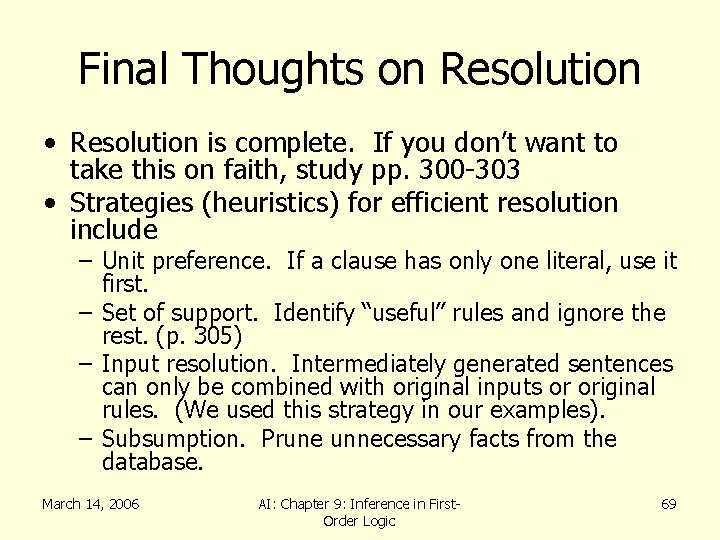
Final Thoughts on Resolution • Resolution is complete. If you don’t want to take this on faith, study pp. 300 -303 • Strategies (heuristics) for efficient resolution include – Unit preference. If a clause has only one literal, use it first. – Set of support. Identify “useful” rules and ignore the rest. (p. 305) – Input resolution. Intermediately generated sentences can only be combined with original inputs or original rules. (We used this strategy in our examples). – Subsumption. Prune unnecessary facts from the database. March 14, 2006 AI: Chapter 9: Inference in First. Order Logic 69