
Artificial Intelligence Chapter 7 Logical Agents Michael Scherger
![Logic • Entailment in Wumpus World • Situation after detecting nothing in [1, 1],](https://slidetodoc.com/presentation_image_h/cb7aa4acf4ba304c1e511911b235245b/image-23.jpg "Logic • Entailment in Wumpus World • Situation after detecting nothing in [1, 1],")
- Slides: 71
Artificial Intelligence Chapter 7: Logical Agents Michael Scherger Department of Computer Science Kent State University February 20, 2006 AI: Chapter 7: Logical Agents 1
Contents • • • Knowledge Based Agents Wumpus World Logic in General – models and entailment Propositional (Boolean) Logic Equivalence, Validity, Satisfiability Inference Rules and Theorem Proving – Forward Chaining – Backward Chaining – Resolution February 20, 2006 AI: Chapter 7: Logical Agents 2
Logical Agents • Humans can know “things” and “reason” – Representation: How are things stored? – Reasoning: How is the knowledge used? • To solve a problem… • To generate more knowledge… • Knowledge and reasoning are important to artificial agents because they enable successful behaviors difficult to achieve otherwise – Useful in partially observable environments • Can benefit from knowledge in very general forms, combining and recombining information February 20, 2006 AI: Chapter 7: Logical Agents 3
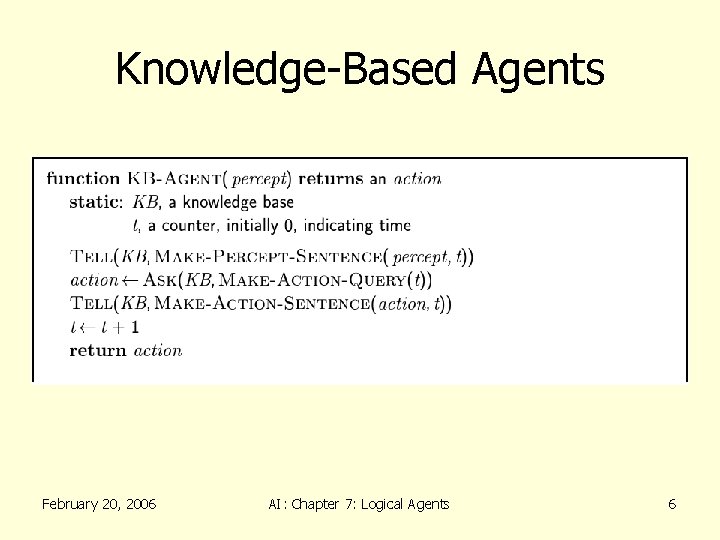
Knowledge-Based Agents • Central component of a Knowledge-Based Agent is a Knowledge-Base – A set of sentences in a formal language • Sentences are expressed using a knowledge representation language • Two generic functions: – TELL - add new sentences (facts) to the KB • “Tell it what it needs to know” – ASK - query what is known from the KB • “Ask what to do next” February 20, 2006 AI: Chapter 7: Logical Agents 4
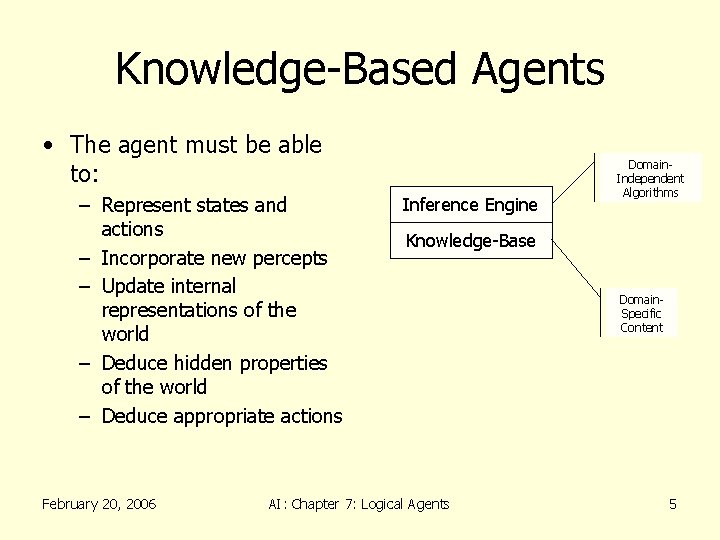
Knowledge-Based Agents • The agent must be able to: – Represent states and actions – Incorporate new percepts – Update internal representations of the world – Deduce hidden properties of the world – Deduce appropriate actions February 20, 2006 Inference Engine Domain. Independent Algorithms Knowledge-Base AI: Chapter 7: Logical Agents Domain. Specific Content 5
Knowledge-Based Agents February 20, 2006 AI: Chapter 7: Logical Agents 6
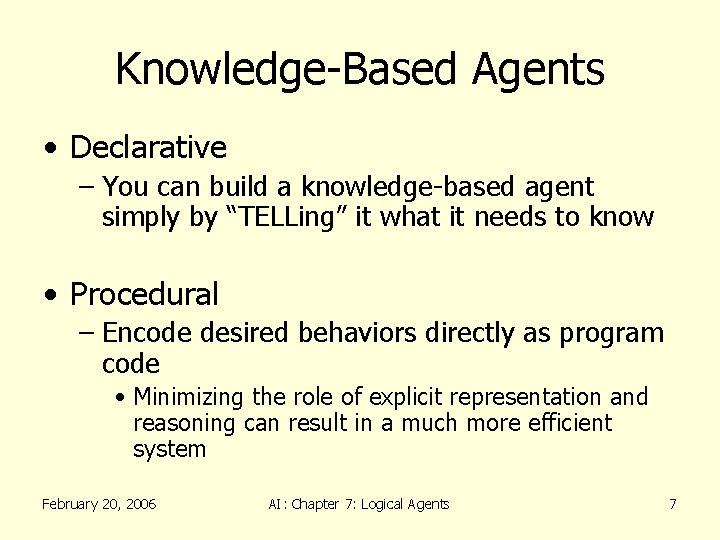
Knowledge-Based Agents • Declarative – You can build a knowledge-based agent simply by “TELLing” it what it needs to know • Procedural – Encode desired behaviors directly as program code • Minimizing the role of explicit representation and reasoning can result in a much more efficient system February 20, 2006 AI: Chapter 7: Logical Agents 7
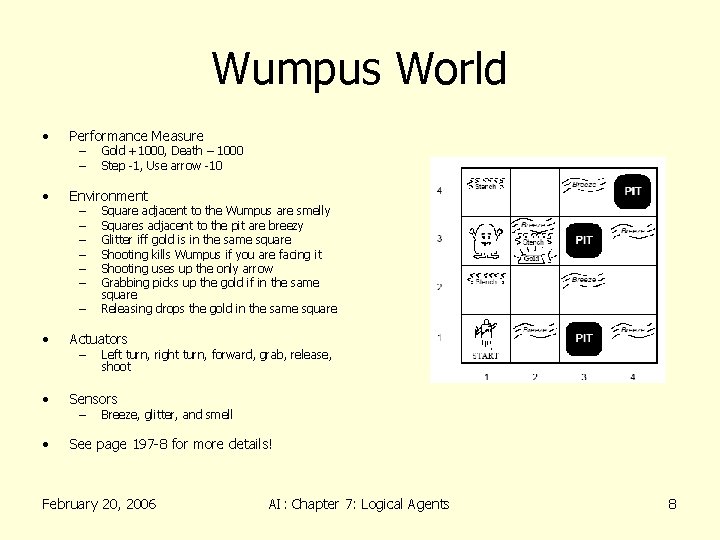
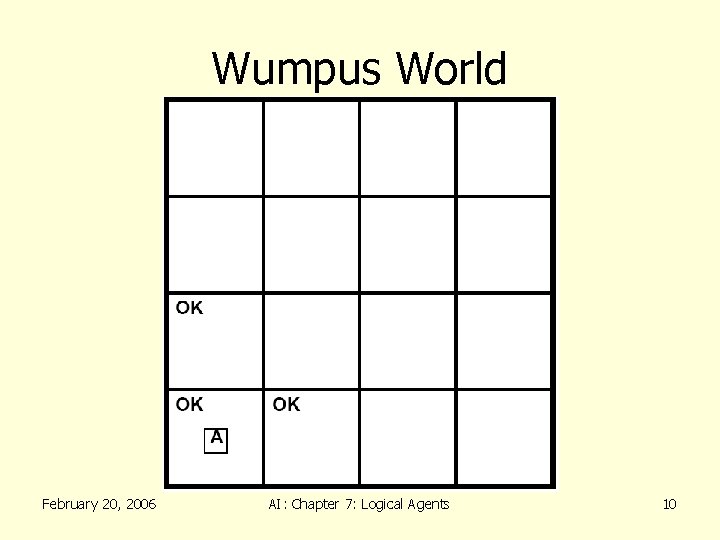
Wumpus World • Performance Measure • Environment – – – – – Gold +1000, Death – 1000 Step -1, Use arrow -10 Square adjacent to the Wumpus are smelly Squares adjacent to the pit are breezy Glitter iff gold is in the same square Shooting kills Wumpus if you are facing it Shooting uses up the only arrow Grabbing picks up the gold if in the same square Releasing drops the gold in the same square • Actuators • Sensors • See page 197 -8 for more details! – – Left turn, right turn, forward, grab, release, shoot Breeze, glitter, and smell February 20, 2006 AI: Chapter 7: Logical Agents 8
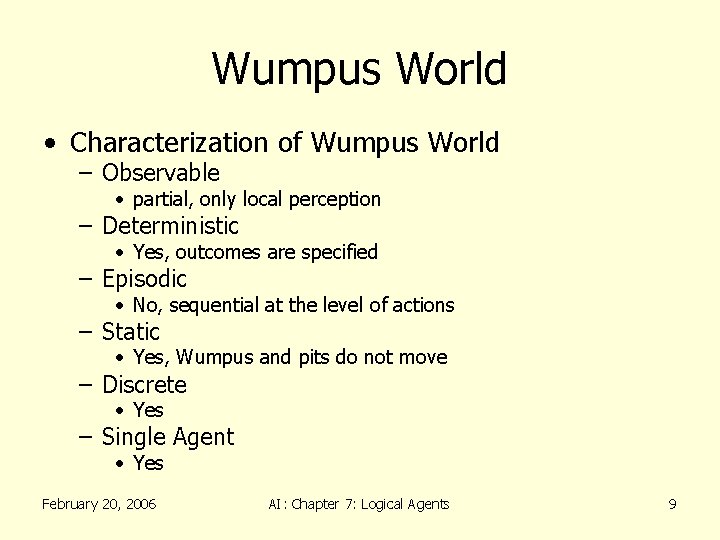
Wumpus World • Characterization of Wumpus World – Observable • partial, only local perception – Deterministic • Yes, outcomes are specified – Episodic • No, sequential at the level of actions – Static • Yes, Wumpus and pits do not move – Discrete • Yes – Single Agent • Yes February 20, 2006 AI: Chapter 7: Logical Agents 9
Wumpus World February 20, 2006 AI: Chapter 7: Logical Agents 10
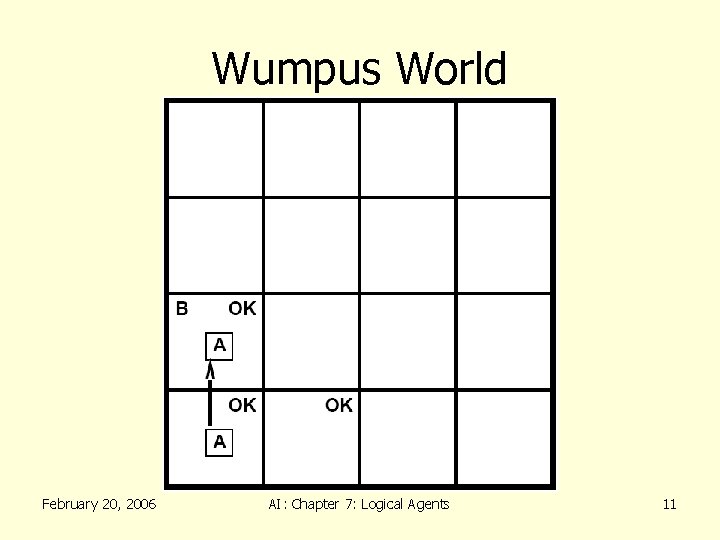
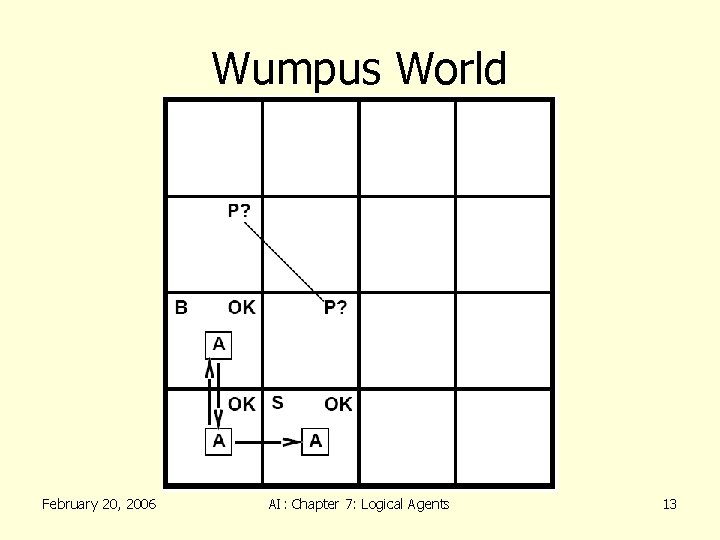
Wumpus World February 20, 2006 AI: Chapter 7: Logical Agents 11
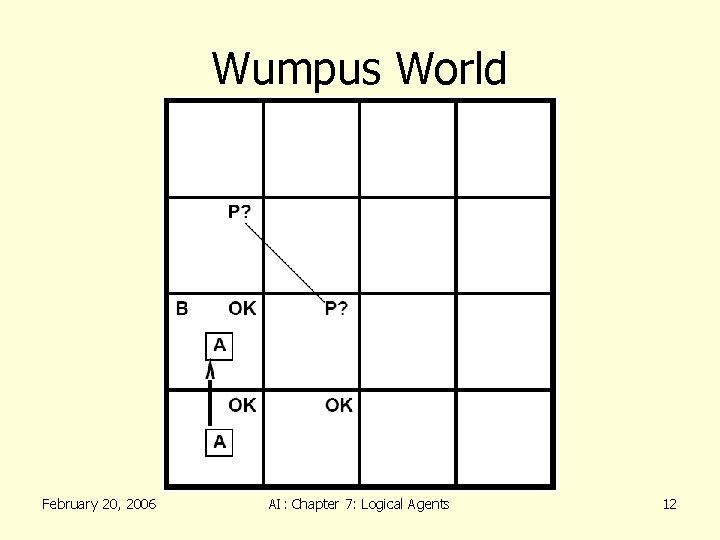
Wumpus World February 20, 2006 AI: Chapter 7: Logical Agents 12
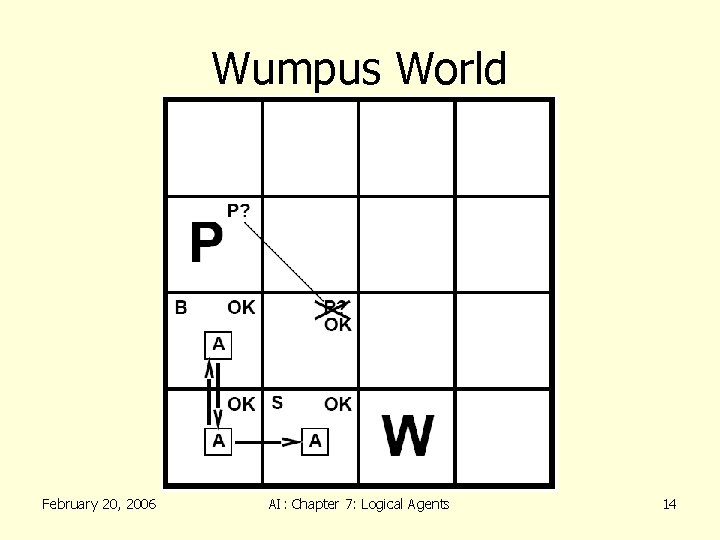
Wumpus World February 20, 2006 AI: Chapter 7: Logical Agents 13
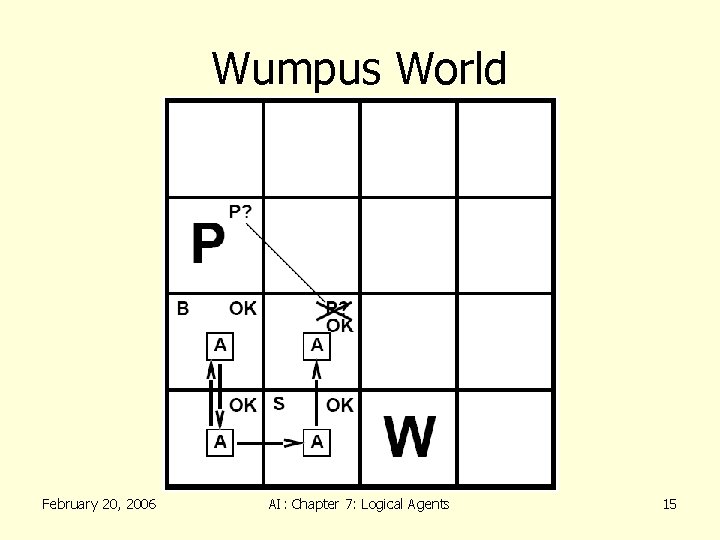
Wumpus World February 20, 2006 AI: Chapter 7: Logical Agents 14
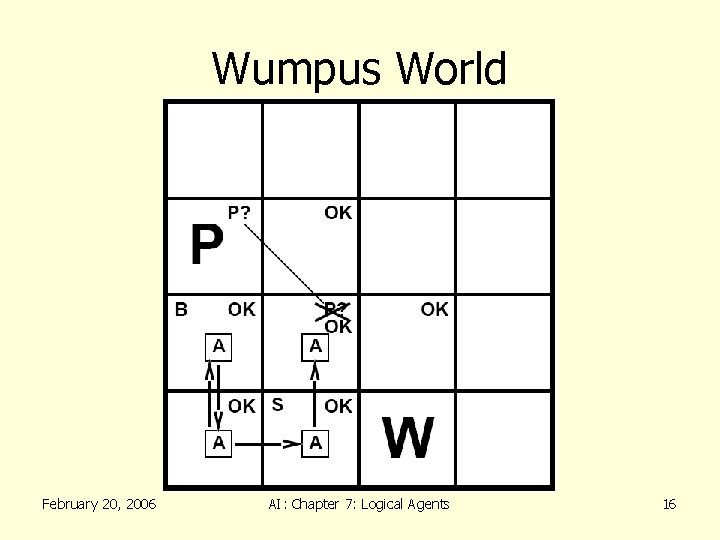
Wumpus World February 20, 2006 AI: Chapter 7: Logical Agents 15
Wumpus World February 20, 2006 AI: Chapter 7: Logical Agents 16
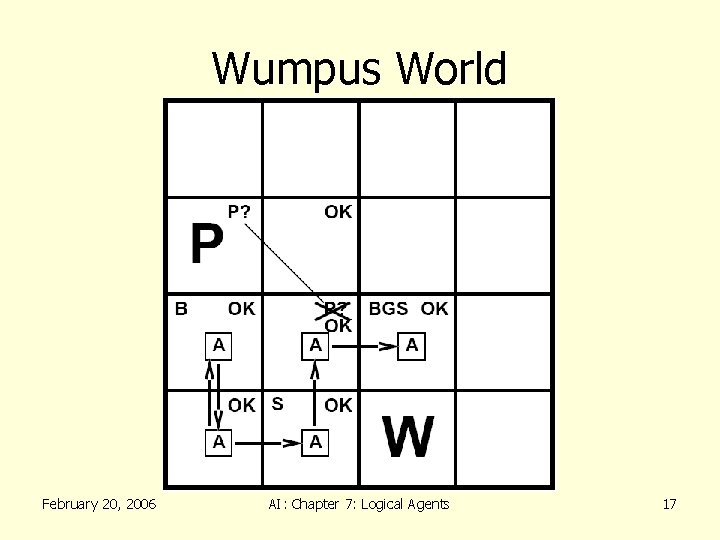
Wumpus World February 20, 2006 AI: Chapter 7: Logical Agents 17
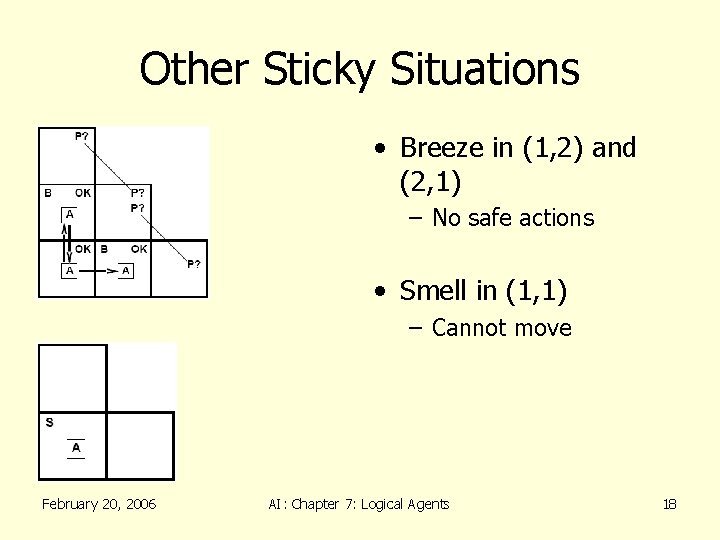
Other Sticky Situations • Breeze in (1, 2) and (2, 1) – No safe actions • Smell in (1, 1) – Cannot move February 20, 2006 AI: Chapter 7: Logical Agents 18
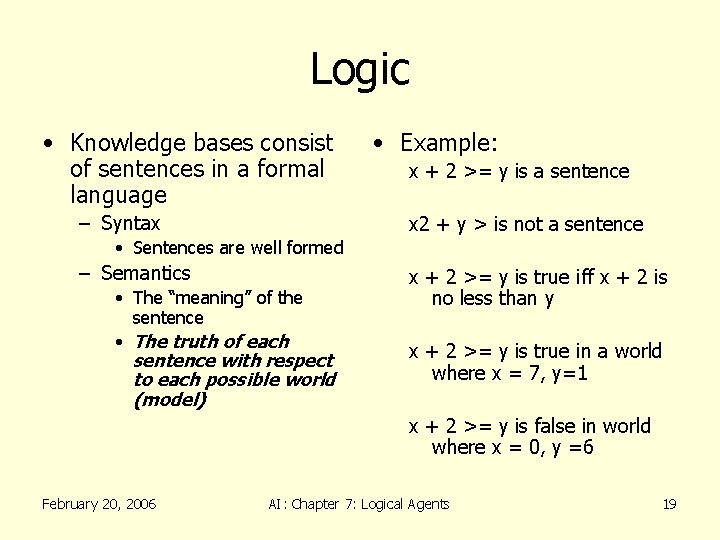
Logic • Knowledge bases consist of sentences in a formal language – Syntax • Example: x + 2 >= y is a sentence x 2 + y > is not a sentence • Sentences are well formed – Semantics • The “meaning” of the sentence • The truth of each sentence with respect to each possible world (model) x + 2 >= y is true iff x + 2 is no less than y x + 2 >= y is true in a world where x = 7, y=1 x + 2 >= y is false in world where x = 0, y =6 February 20, 2006 AI: Chapter 7: Logical Agents 19
Logic • Entailment means that one thing follows logically from another a |= b • a |= b iff in every model in which a is true, b is also true • if a is true, then b must be true • the truth of b is “contained” in the truth of a February 20, 2006 AI: Chapter 7: Logical Agents 20
Logic • Example: – A KB containing • “Cleveland won” • “Dallas won” • Entails… – “Either Cleveland won or Dallas won” • Example: x + y = 4 entails 4 = x + y February 20, 2006 AI: Chapter 7: Logical Agents 21
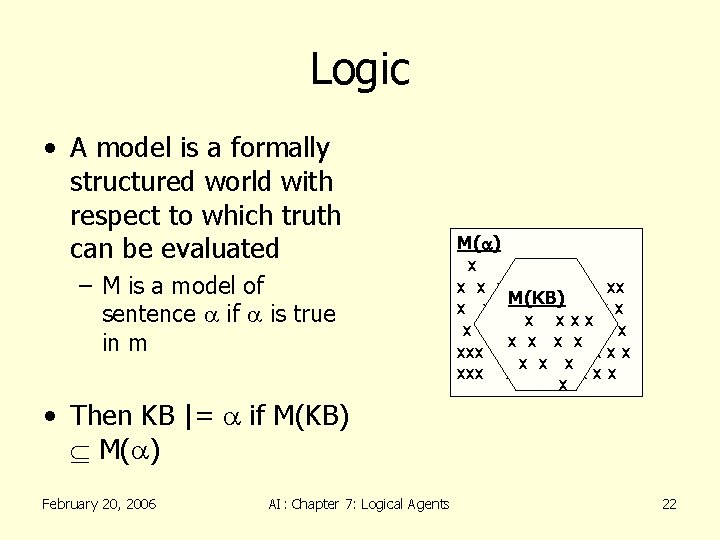
Logic • A model is a formally structured world with respect to which truth can be evaluated – M is a model of sentence a if a is true in m M(a) x x x x xx M(KB) x xx xxx xxx xx x x xxx x x x x • Then KB |= a if M(KB) M(a) February 20, 2006 AI: Chapter 7: Logical Agents 22
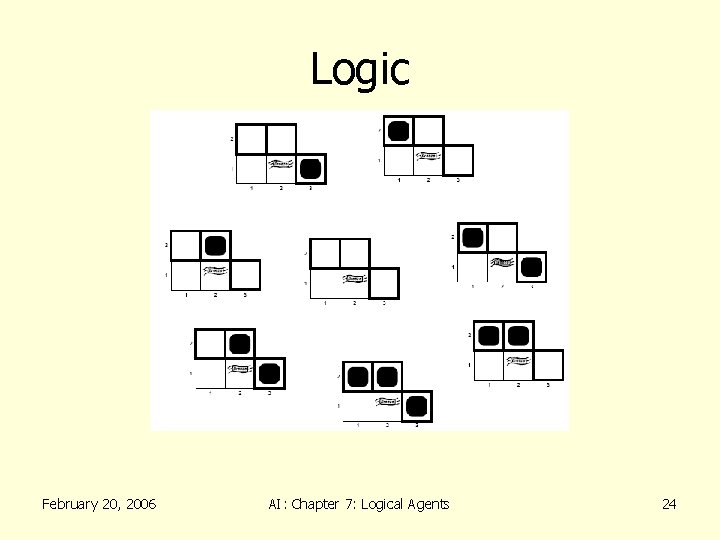
Logic • Entailment in Wumpus World • Situation after detecting nothing in [1, 1], moving right, breeze in [2, 1] • Consider possible models for ? assuming only pits • 3 Boolean choices => 8 possible models February 20, 2006 AI: Chapter 7: Logical Agents 23
Logic February 20, 2006 AI: Chapter 7: Logical Agents 24
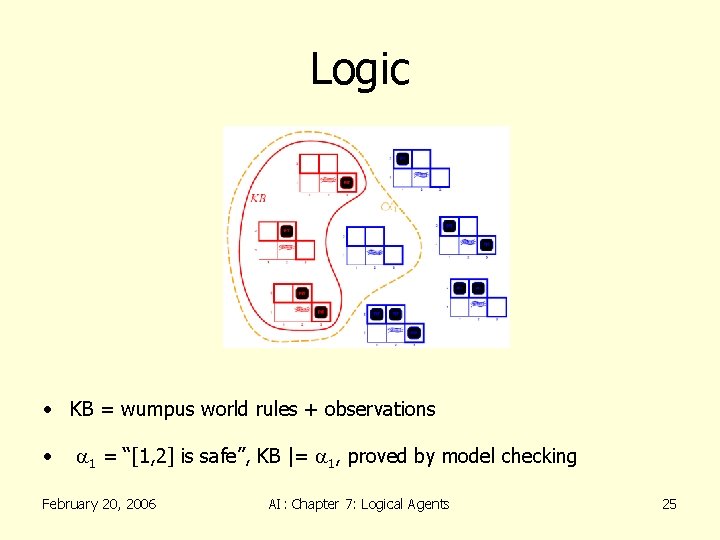
Logic • KB = wumpus world rules + observations • a 1 = “[1, 2] is safe”, KB |= a 1, proved by model checking February 20, 2006 AI: Chapter 7: Logical Agents 25
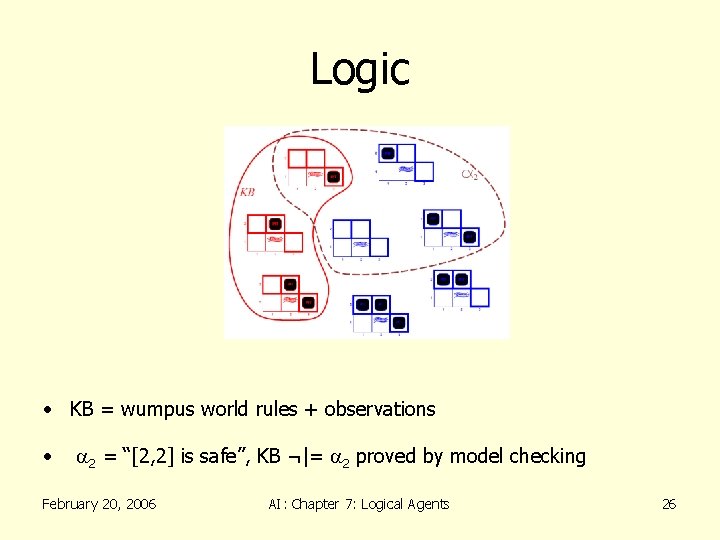
Logic • KB = wumpus world rules + observations • a 2 = “[2, 2] is safe”, KB ¬|= a 2 proved by model checking February 20, 2006 AI: Chapter 7: Logical Agents 26
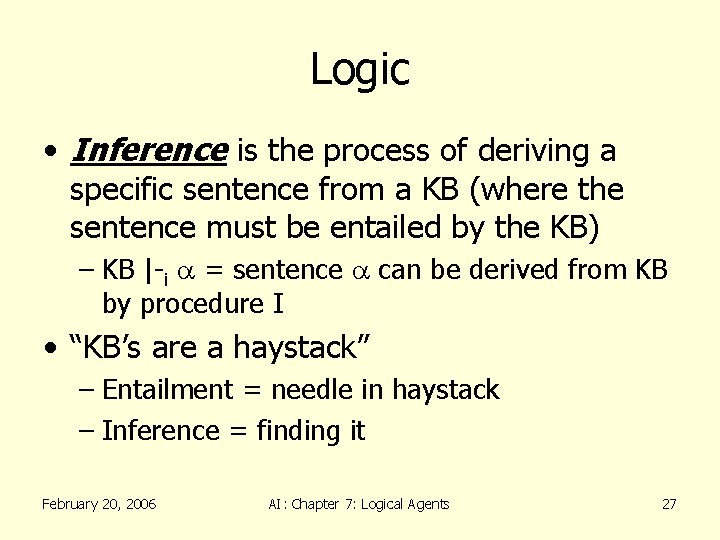
Logic • Inference is the process of deriving a specific sentence from a KB (where the sentence must be entailed by the KB) – KB |-i a = sentence a can be derived from KB by procedure I • “KB’s are a haystack” – Entailment = needle in haystack – Inference = finding it February 20, 2006 AI: Chapter 7: Logical Agents 27
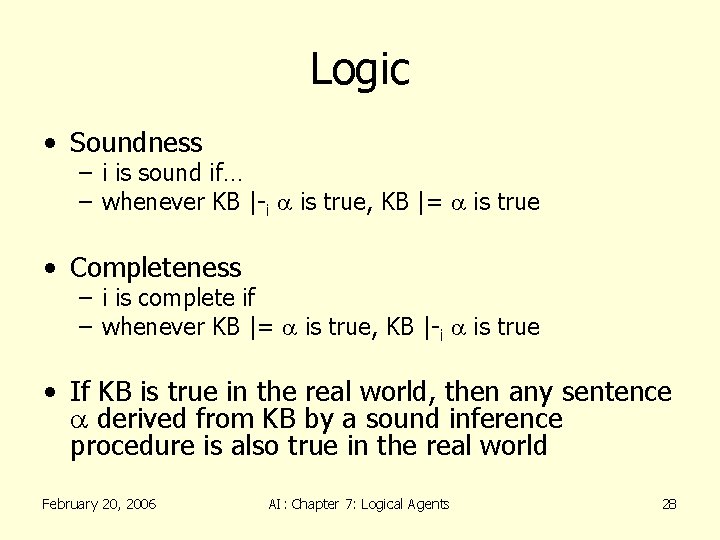
Logic • Soundness – i is sound if… – whenever KB |-i a is true, KB |= a is true • Completeness – i is complete if – whenever KB |= a is true, KB |-i a is true • If KB is true in the real world, then any sentence a derived from KB by a sound inference procedure is also true in the real world February 20, 2006 AI: Chapter 7: Logical Agents 28
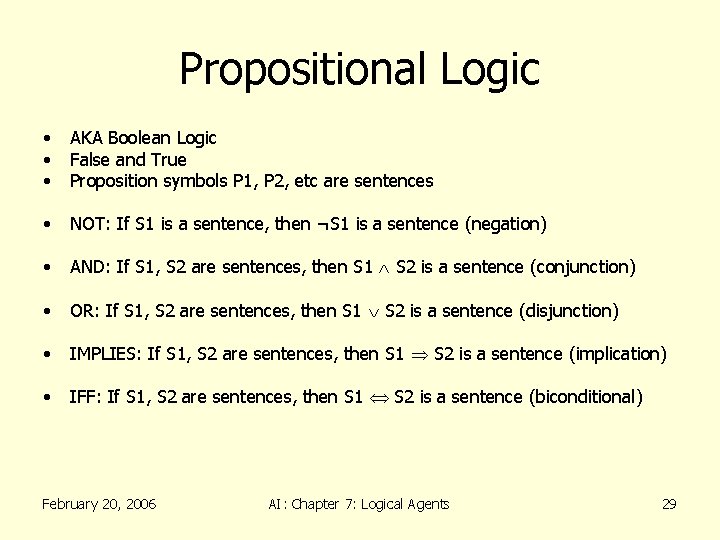
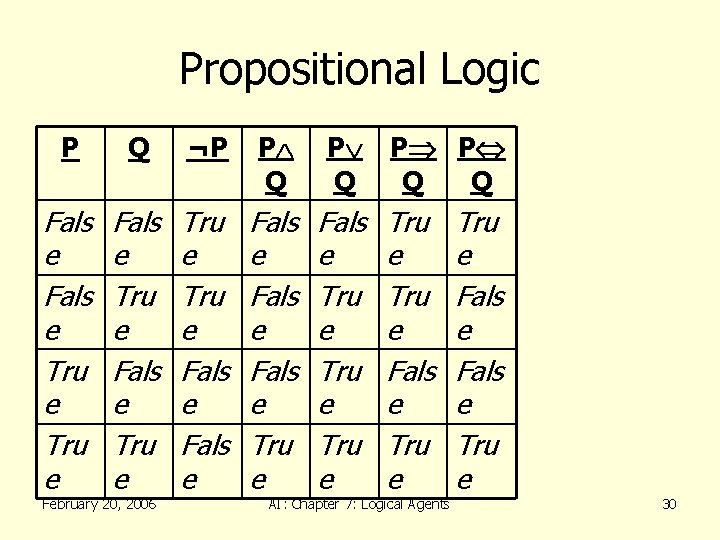
Propositional Logic • • • AKA Boolean Logic False and True Proposition symbols P 1, P 2, etc are sentences • NOT: If S 1 is a sentence, then ¬S 1 is a sentence (negation) • AND: If S 1, S 2 are sentences, then S 1 S 2 is a sentence (conjunction) • OR: If S 1, S 2 are sentences, then S 1 S 2 is a sentence (disjunction) • IMPLIES: If S 1, S 2 are sentences, then S 1 S 2 is a sentence (implication) • IFF: If S 1, S 2 are sentences, then S 1 S 2 is a sentence (biconditional) February 20, 2006 AI: Chapter 7: Logical Agents 29
Propositional Logic P Q ¬P P Q Fals e Tru e Tru e Fals e Fals e Tru e February 20, 2006 P P P Q Q Q Fals e Tru e Tru e Fals e Tru e AI: Chapter 7: Logical Agents Tru e Fals e Tru e 30
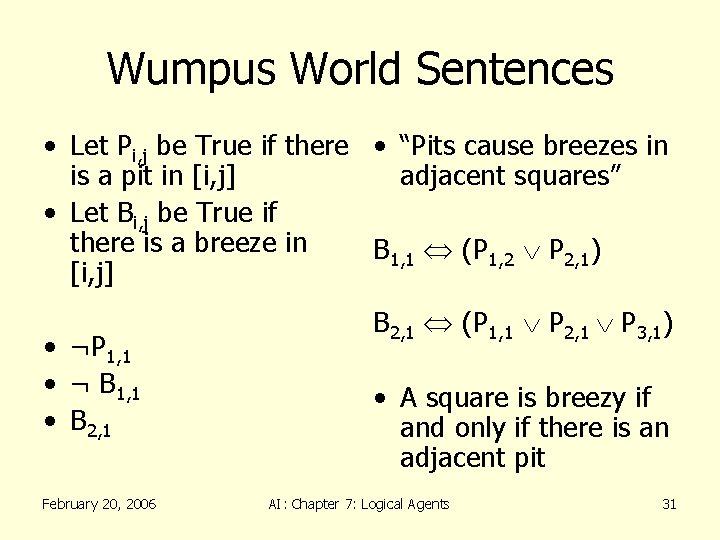
Wumpus World Sentences • Let Pi, j be True if there • “Pits cause breezes in is a pit in [i, j] adjacent squares” • Let Bi, j be True if there is a breeze in B 1, 1 (P 1, 2 P 2, 1) [i, j] • ¬P 1, 1 • ¬ B 1, 1 • B 2, 1 February 20, 2006 B 2, 1 (P 1, 1 P 2, 1 P 3, 1) • A square is breezy if and only if there is an adjacent pit AI: Chapter 7: Logical Agents 31
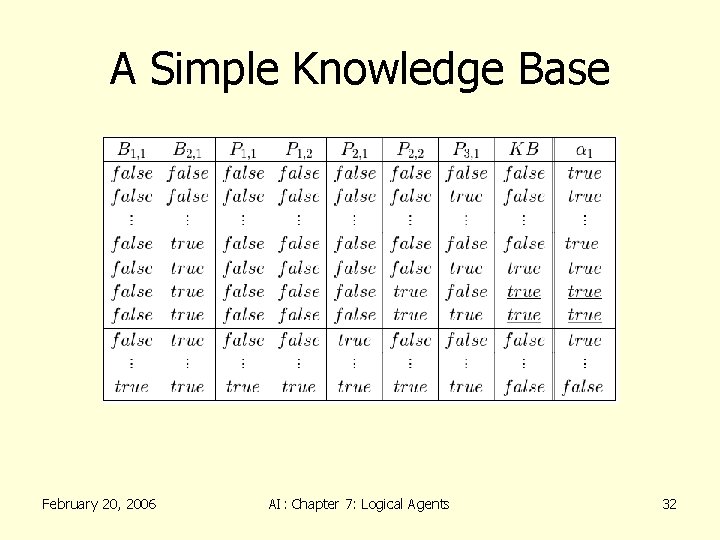
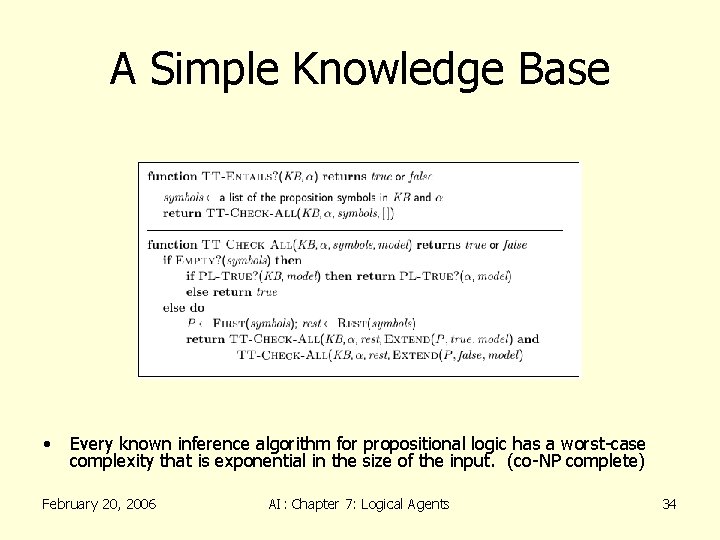
A Simple Knowledge Base February 20, 2006 AI: Chapter 7: Logical Agents 32
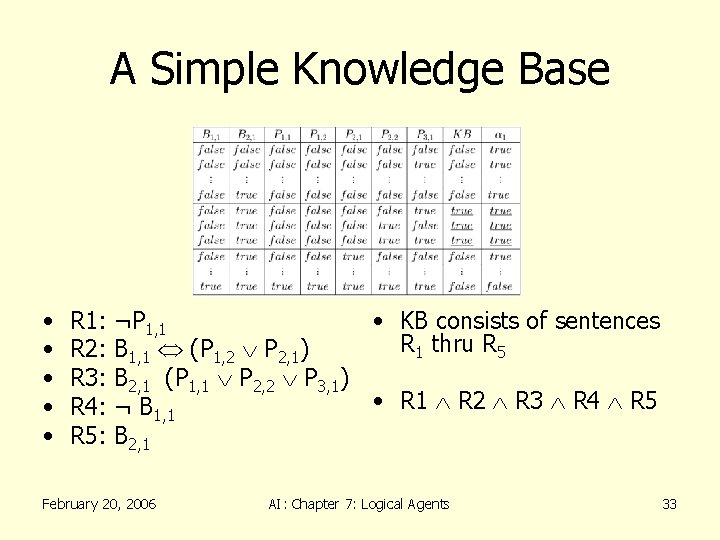
A Simple Knowledge Base • • • R 1: R 2: R 3: R 4: R 5: ¬P 1, 1 B 1, 1 (P 1, 2 P 2, 1) B 2, 1 (P 1, 1 P 2, 2 P 3, 1) ¬ B 1, 1 B 2, 1 February 20, 2006 • KB consists of sentences R 1 thru R 5 • R 1 R 2 R 3 R 4 R 5 AI: Chapter 7: Logical Agents 33
A Simple Knowledge Base • Every known inference algorithm for propositional logic has a worst-case complexity that is exponential in the size of the input. (co-NP complete) February 20, 2006 AI: Chapter 7: Logical Agents 34
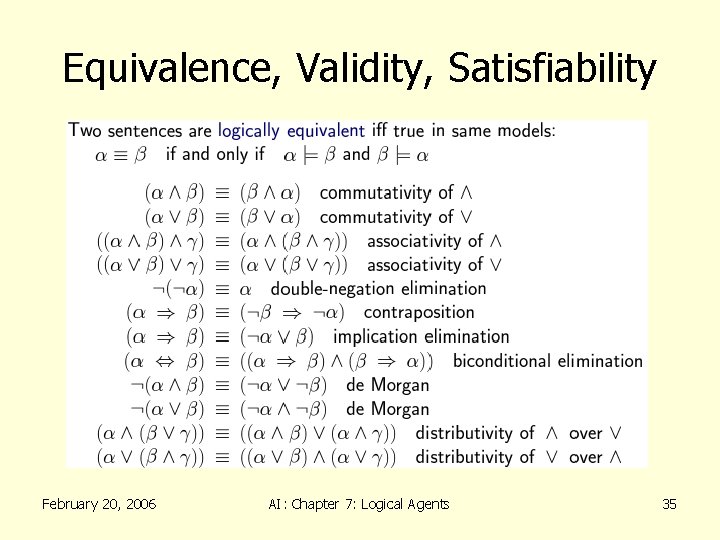
Equivalence, Validity, Satisfiability February 20, 2006 AI: Chapter 7: Logical Agents 35
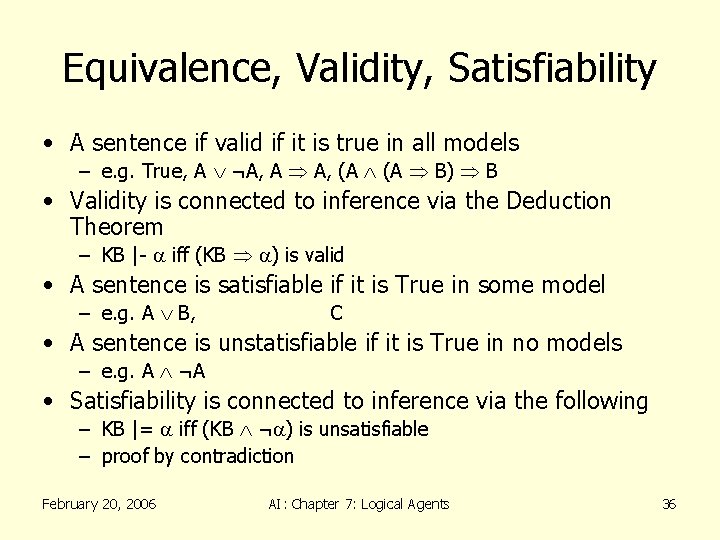
Equivalence, Validity, Satisfiability • A sentence if valid if it is true in all models – e. g. True, A ¬A, A A, (A B) B • Validity is connected to inference via the Deduction Theorem – KB |- a iff (KB a) is valid • A sentence is satisfiable if it is True in some model – e. g. A B, C • A sentence is unstatisfiable if it is True in no models – e. g. A ¬A • Satisfiability is connected to inference via the following – KB |= a iff (KB ¬a) is unsatisfiable – proof by contradiction February 20, 2006 AI: Chapter 7: Logical Agents 36
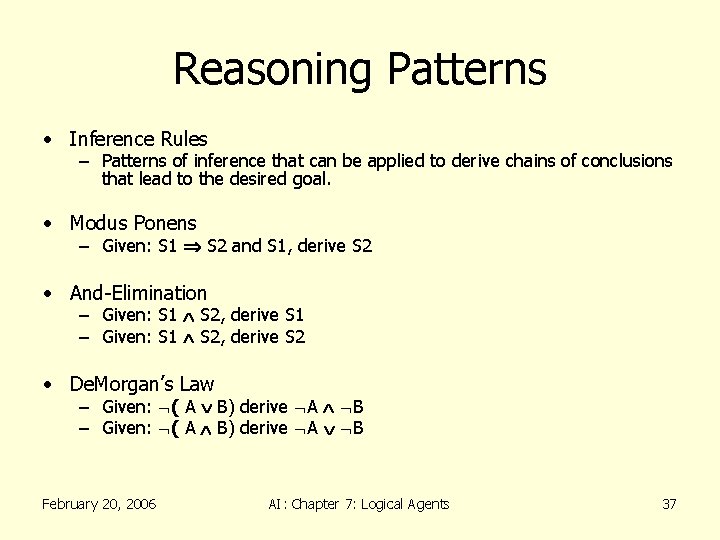
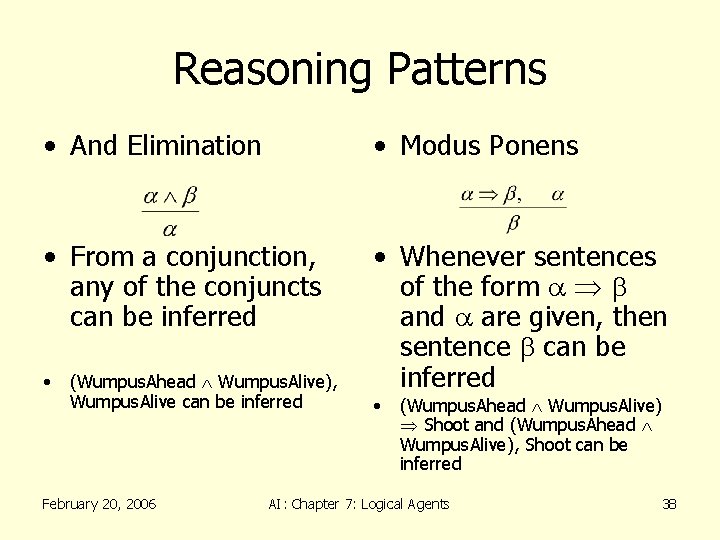
Reasoning Patterns • Inference Rules – Patterns of inference that can be applied to derive chains of conclusions that lead to the desired goal. • Modus Ponens – Given: S 1 S 2 and S 1, derive S 2 • And-Elimination – Given: S 1 S 2, derive S 1 – Given: S 1 S 2, derive S 2 • De. Morgan’s Law – Given: ( A B) derive A B February 20, 2006 AI: Chapter 7: Logical Agents 37
Reasoning Patterns • And Elimination • Modus Ponens • From a conjunction, any of the conjuncts can be inferred • Whenever sentences of the form a b and a are given, then sentence b can be inferred • (Wumpus. Ahead Wumpus. Alive), Wumpus. Alive can be inferred February 20, 2006 • (Wumpus. Ahead Wumpus. Alive) Shoot and (Wumpus. Ahead Wumpus. Alive), Shoot can be inferred AI: Chapter 7: Logical Agents 38
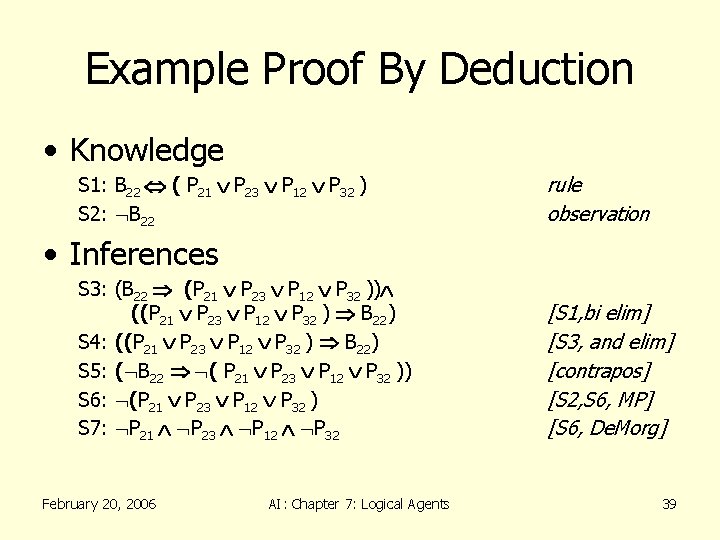
Example Proof By Deduction • Knowledge S 1: B 22 ( P 21 P 23 P 12 P 32 ) S 2: B 22 rule observation • Inferences S 3: (B 22 (P 21 P 23 P 12 P 32 )) ((P 21 P 23 P 12 P 32 ) B 22) S 4: ((P 21 P 23 P 12 P 32 ) B 22) S 5: ( B 22 ( P 21 P 23 P 12 P 32 )) S 6: (P 21 P 23 P 12 P 32 ) S 7: P 21 P 23 P 12 P 32 February 20, 2006 AI: Chapter 7: Logical Agents [S 1, bi elim] [S 3, and elim] [contrapos] [S 2, S 6, MP] [S 6, De. Morg] 39
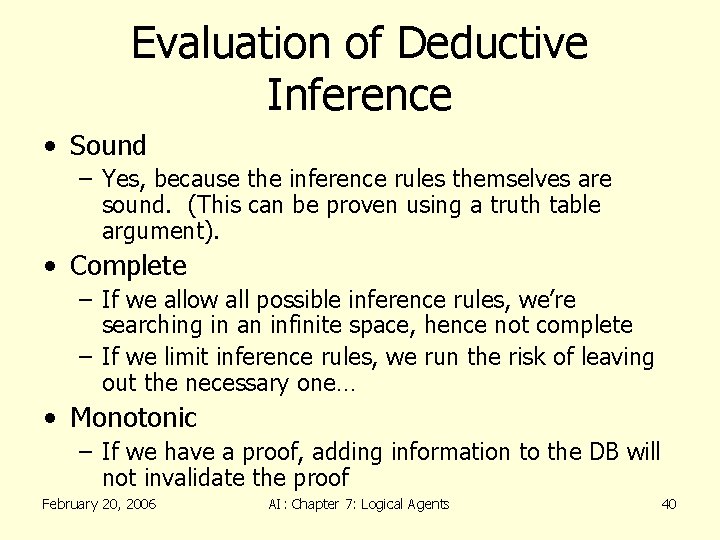
Evaluation of Deductive Inference • Sound – Yes, because the inference rules themselves are sound. (This can be proven using a truth table argument). • Complete – If we allow all possible inference rules, we’re searching in an infinite space, hence not complete – If we limit inference rules, we run the risk of leaving out the necessary one… • Monotonic – If we have a proof, adding information to the DB will not invalidate the proof February 20, 2006 AI: Chapter 7: Logical Agents 40
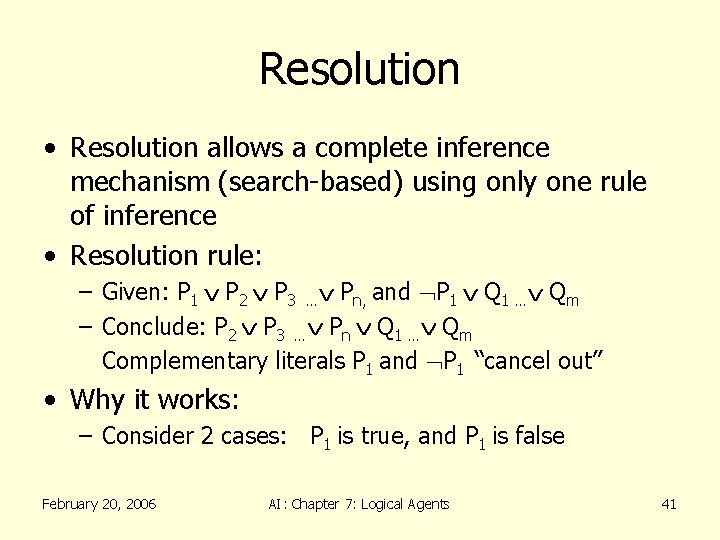
Resolution • Resolution allows a complete inference mechanism (search-based) using only one rule of inference • Resolution rule: – Given: P 1 P 2 P 3 … Pn, and P 1 Q 1 … Qm – Conclude: P 2 P 3 … Pn Q 1 … Qm Complementary literals P 1 and P 1 “cancel out” • Why it works: – Consider 2 cases: P 1 is true, and P 1 is false February 20, 2006 AI: Chapter 7: Logical Agents 41
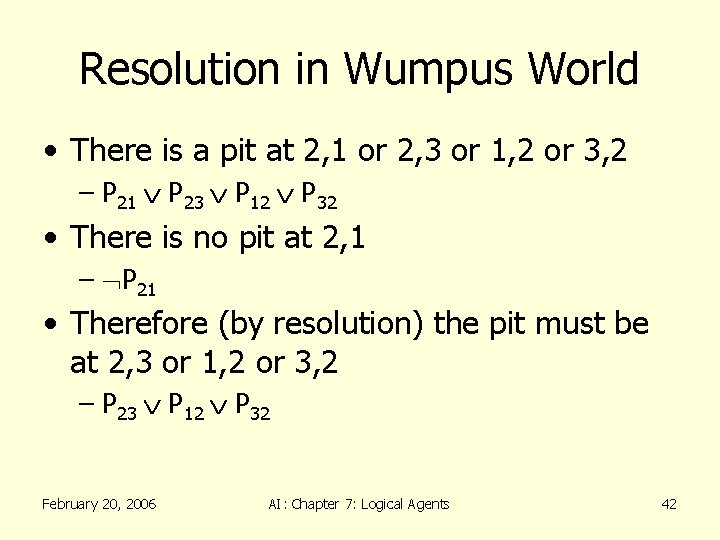
Resolution in Wumpus World • There is a pit at 2, 1 or 2, 3 or 1, 2 or 3, 2 – P 21 P 23 P 12 P 32 • There is no pit at 2, 1 – P 21 • Therefore (by resolution) the pit must be at 2, 3 or 1, 2 or 3, 2 – P 23 P 12 P 32 February 20, 2006 AI: Chapter 7: Logical Agents 42
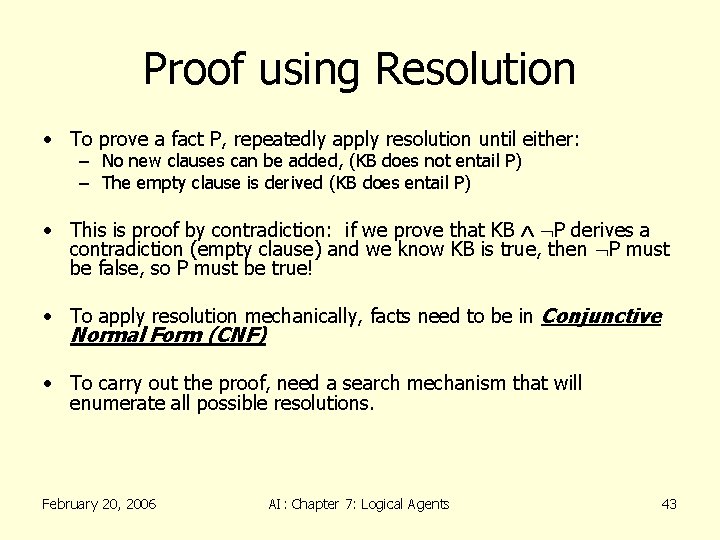
Proof using Resolution • To prove a fact P, repeatedly apply resolution until either: – No new clauses can be added, (KB does not entail P) – The empty clause is derived (KB does entail P) • This is proof by contradiction: if we prove that KB P derives a contradiction (empty clause) and we know KB is true, then P must be false, so P must be true! • To apply resolution mechanically, facts need to be in Conjunctive Normal Form (CNF) • To carry out the proof, need a search mechanism that will enumerate all possible resolutions. February 20, 2006 AI: Chapter 7: Logical Agents 43
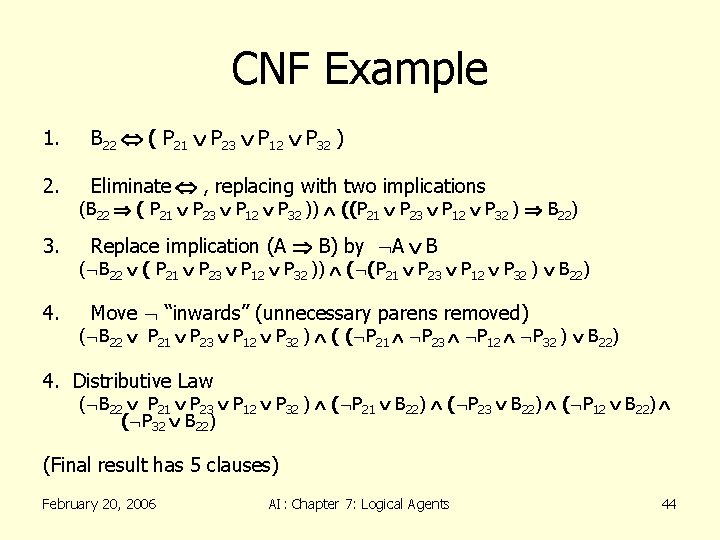
CNF Example 1. B 22 ( P 21 P 23 P 12 P 32 ) 2. Eliminate , replacing with two implications 3. 4. (B 22 ( P 21 P 23 P 12 P 32 )) ((P 21 P 23 P 12 P 32 ) B 22) Replace implication (A B) by A B ( B 22 ( P 21 P 23 P 12 P 32 )) ( (P 21 P 23 P 12 P 32 ) B 22) Move “inwards” (unnecessary parens removed) ( B 22 P 21 P 23 P 12 P 32 ) ( ( P 21 P 23 P 12 P 32 ) B 22) 4. Distributive Law ( B 22 P 21 P 23 P 12 P 32 ) ( P 21 B 22) ( P 23 B 22) ( P 12 B 22) ( P 32 B 22) (Final result has 5 clauses) February 20, 2006 AI: Chapter 7: Logical Agents 44
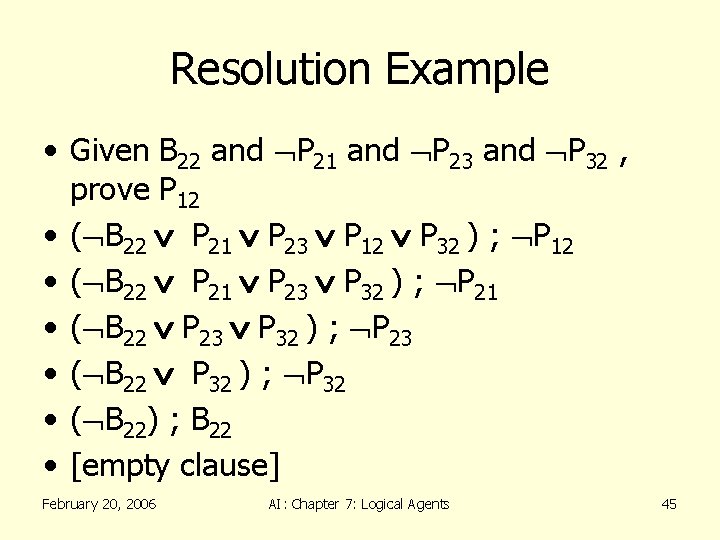
Resolution Example • Given B 22 and P 21 and P 23 and P 32 , prove P 12 • ( B 22 P 21 P 23 P 12 P 32 ) ; P 12 • ( B 22 P 21 P 23 P 32 ) ; P 21 • ( B 22 P 23 P 32 ) ; P 23 • ( B 22 P 32 ) ; P 32 • ( B 22) ; B 22 • [empty clause] February 20, 2006 AI: Chapter 7: Logical Agents 45
Evaluation of Resolution • Resolution is sound – Because the resolution rule is true in all cases • Resolution is complete – Provided a complete search method is used to find the proof, if a proof can be found it will – Note: you must know what you’re trying to prove in order to prove it! • Resolution is exponential – The number of clauses that we must search grows exponentially… February 20, 2006 AI: Chapter 7: Logical Agents 46
Horn Clauses • A Horn Clause is a CNF clause with exactly one positive literal – – – The positive literal is called the head The negative literals are called the body Prolog: head: - body 1, body 2, body 3 … English: “To prove the head, prove body 1, …” Implication: If (body 1, body 2 …) then head • Horn Clauses form the basis of forward and backward chaining • The Prolog language is based on Horn Clauses • Deciding entailment with Horn Clauses is linear in the size of the knowledge base February 20, 2006 AI: Chapter 7: Logical Agents 47
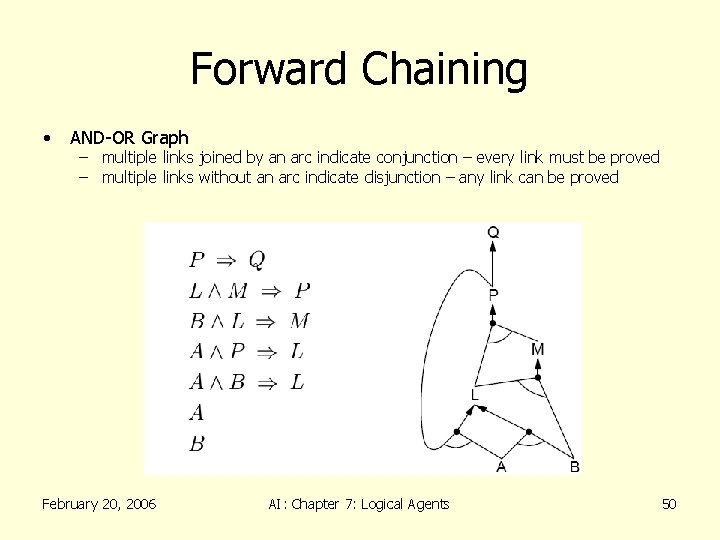
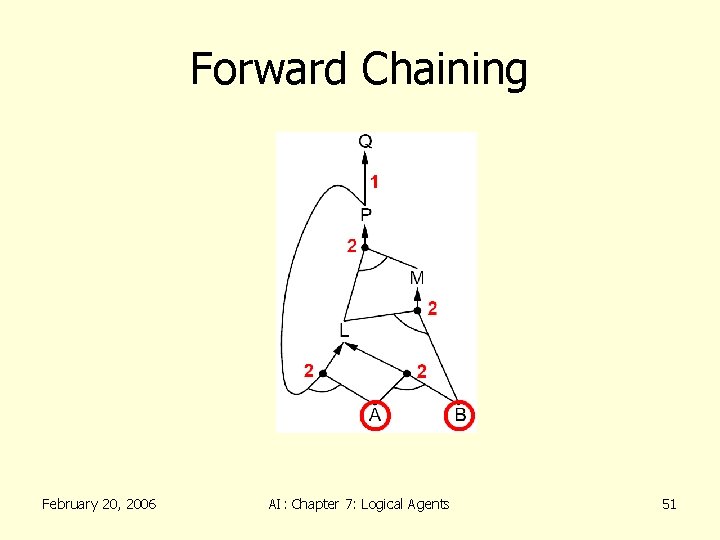
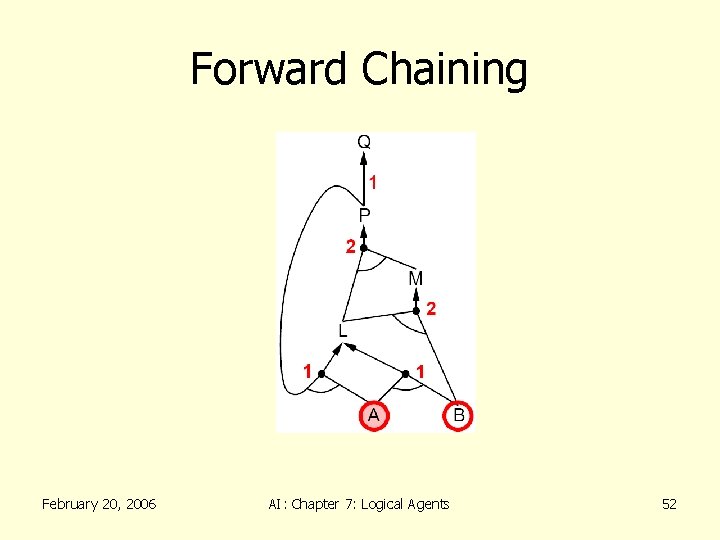
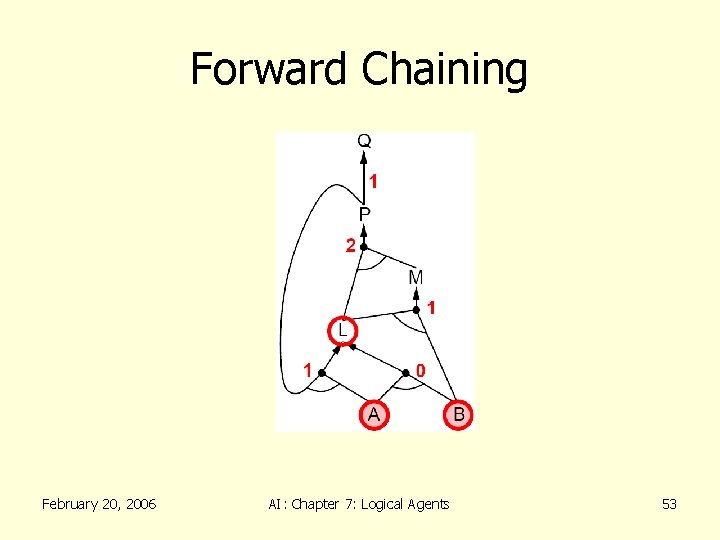
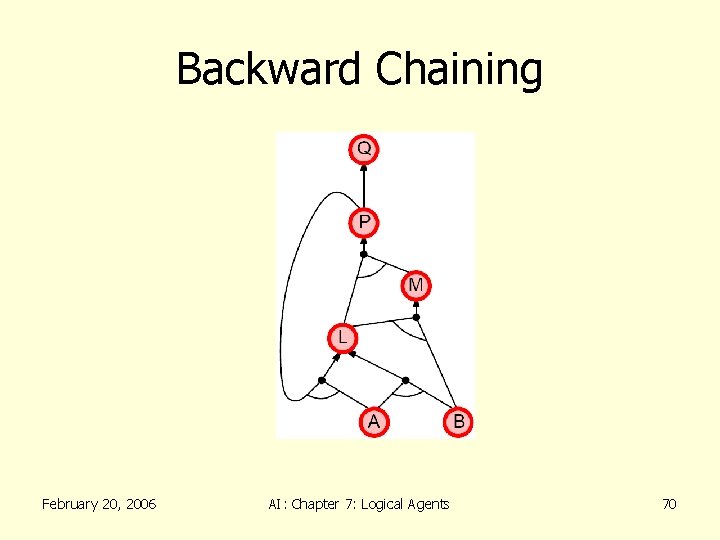
Reasoning with Horn Clauses • Forward Chaining – For each new piece of data, generate all new facts, until the desired fact is generated – Data-directed reasoning • Backward Chaining – To prove the goal, find a clause that contains the goal as its head, and prove the body recursively – (Backtrack when you chose the wrong clause) – Goal-directed reasoning February 20, 2006 AI: Chapter 7: Logical Agents 48
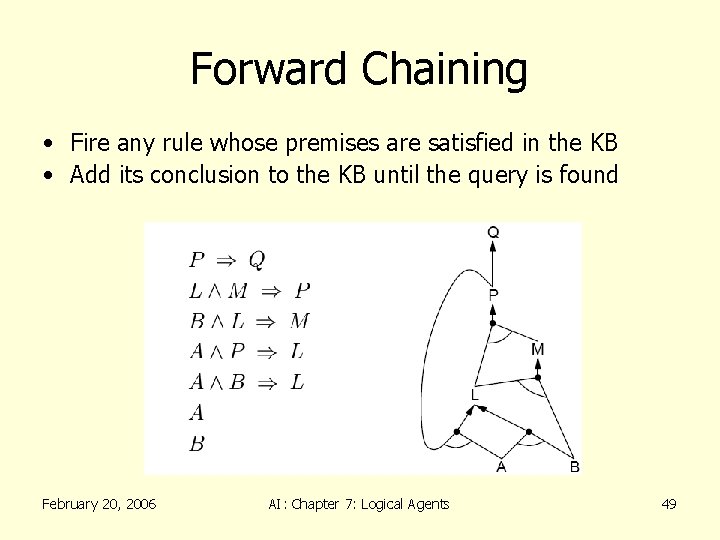
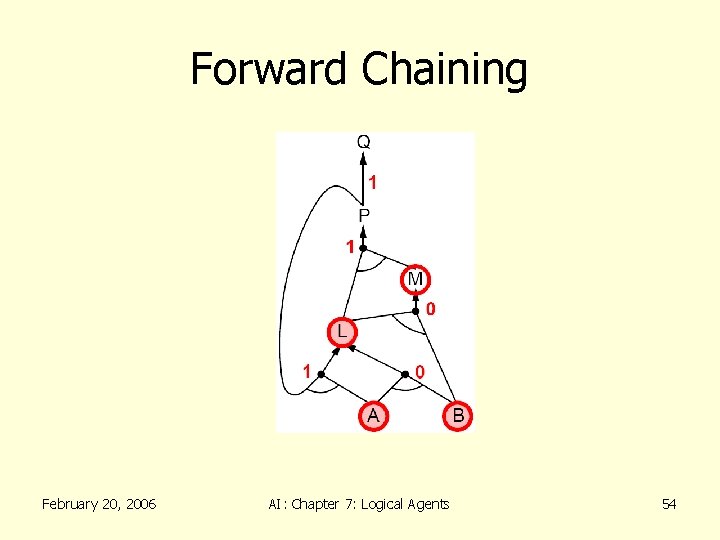
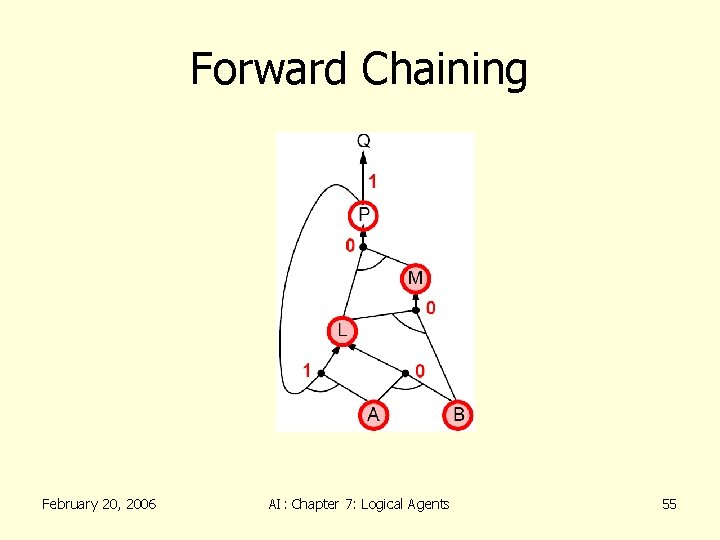
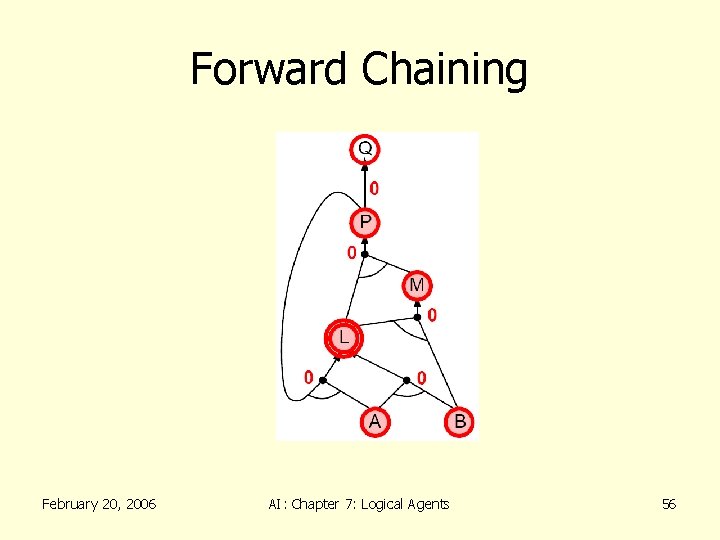
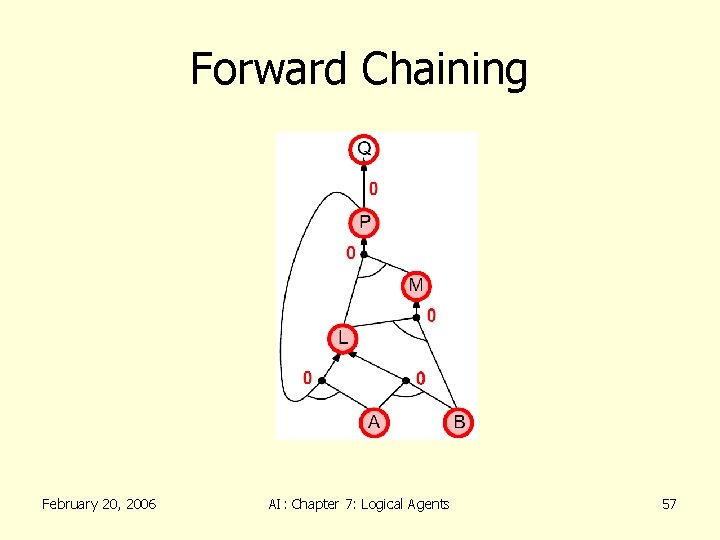
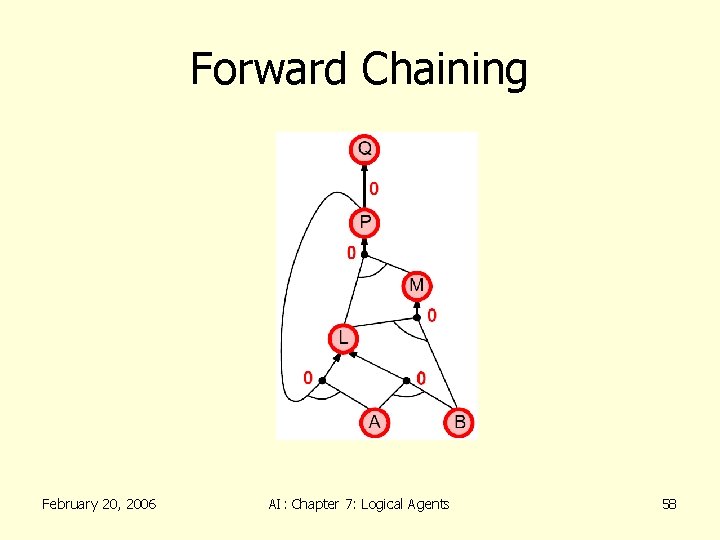
Forward Chaining • Fire any rule whose premises are satisfied in the KB • Add its conclusion to the KB until the query is found February 20, 2006 AI: Chapter 7: Logical Agents 49
Forward Chaining • AND-OR Graph – multiple links joined by an arc indicate conjunction – every link must be proved – multiple links without an arc indicate disjunction – any link can be proved February 20, 2006 AI: Chapter 7: Logical Agents 50
Forward Chaining February 20, 2006 AI: Chapter 7: Logical Agents 51
Forward Chaining February 20, 2006 AI: Chapter 7: Logical Agents 52
Forward Chaining February 20, 2006 AI: Chapter 7: Logical Agents 53
Forward Chaining February 20, 2006 AI: Chapter 7: Logical Agents 54
Forward Chaining February 20, 2006 AI: Chapter 7: Logical Agents 55
Forward Chaining February 20, 2006 AI: Chapter 7: Logical Agents 56
Forward Chaining February 20, 2006 AI: Chapter 7: Logical Agents 57
Forward Chaining February 20, 2006 AI: Chapter 7: Logical Agents 58
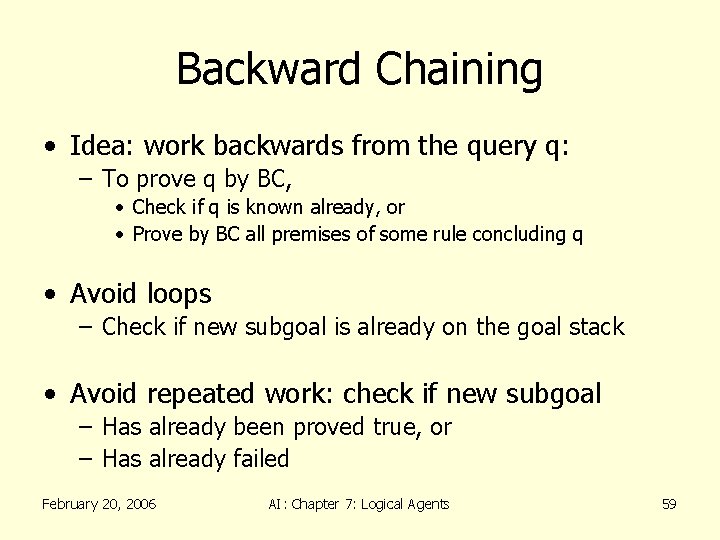
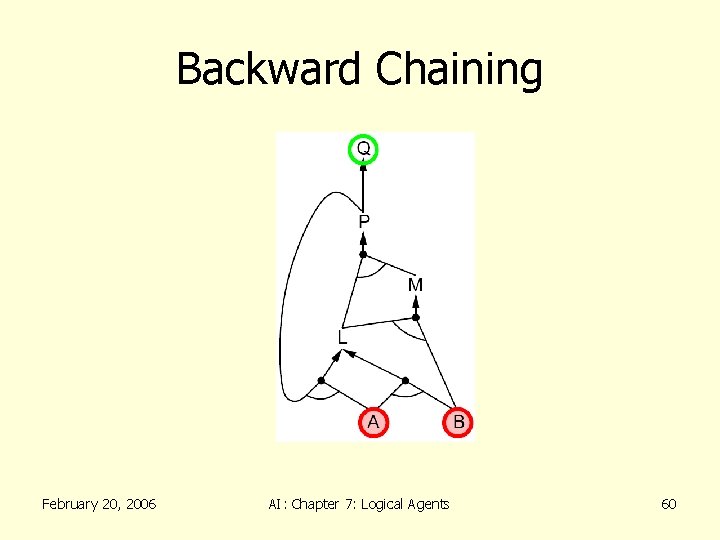
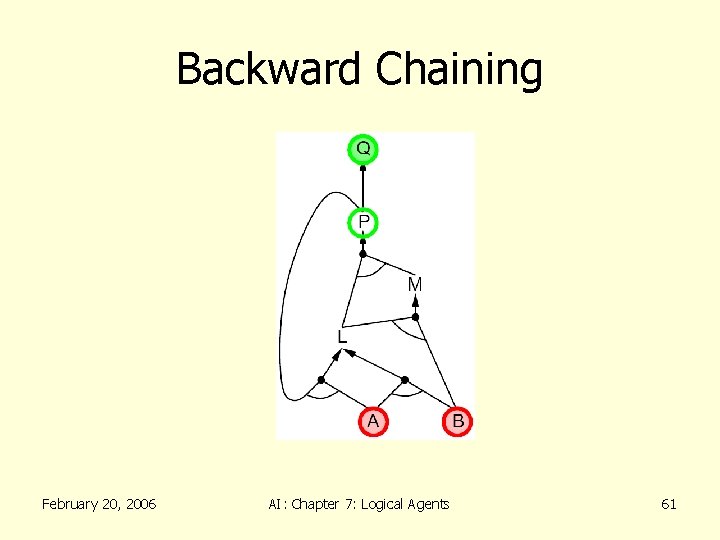
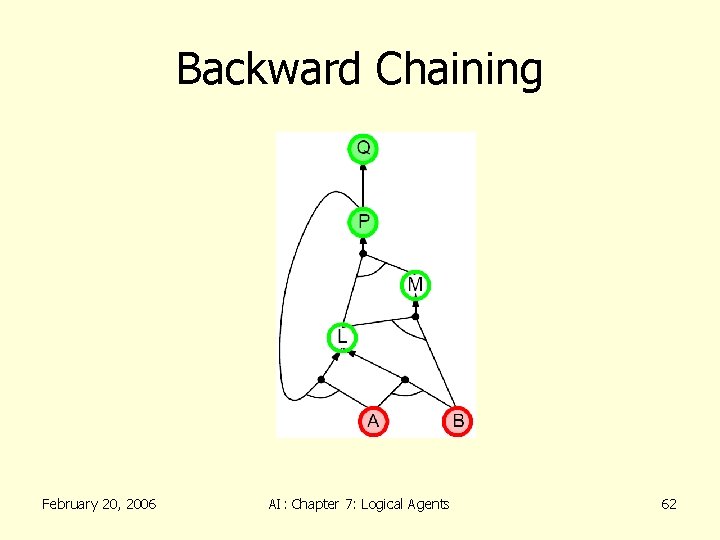
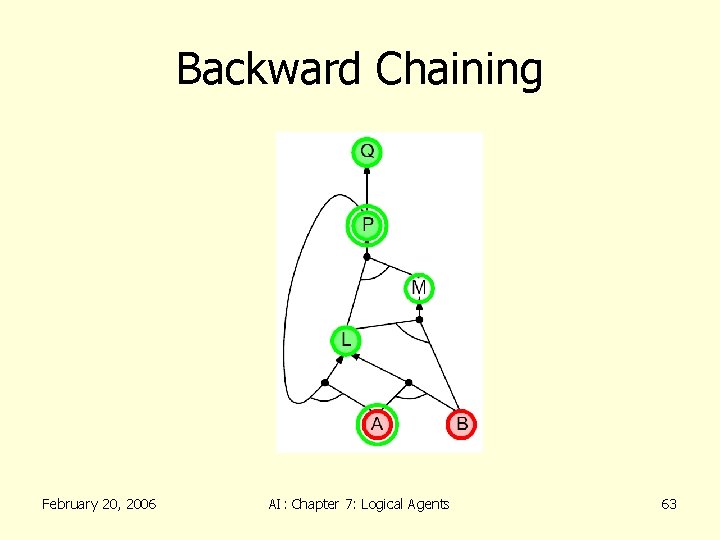
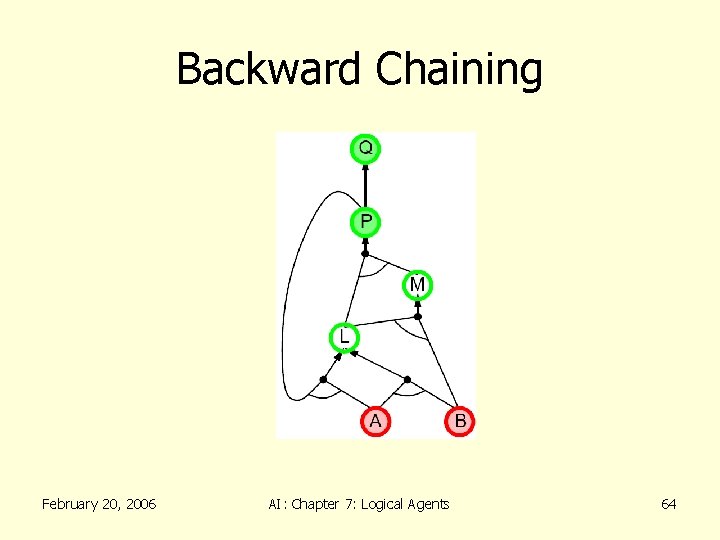
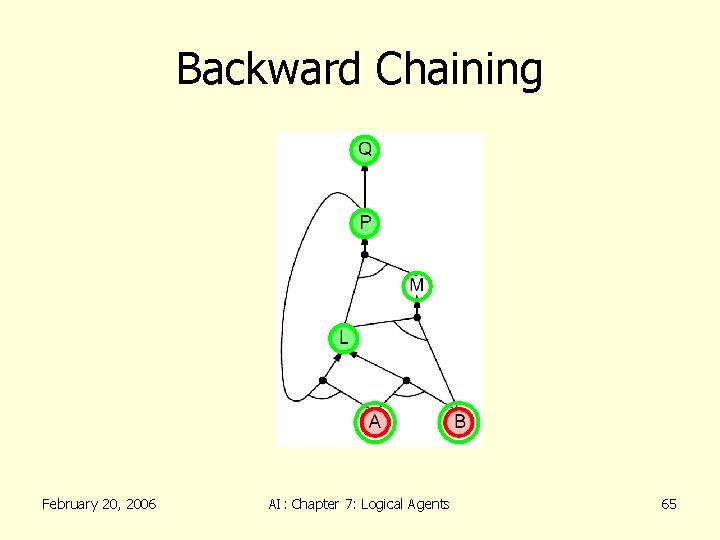
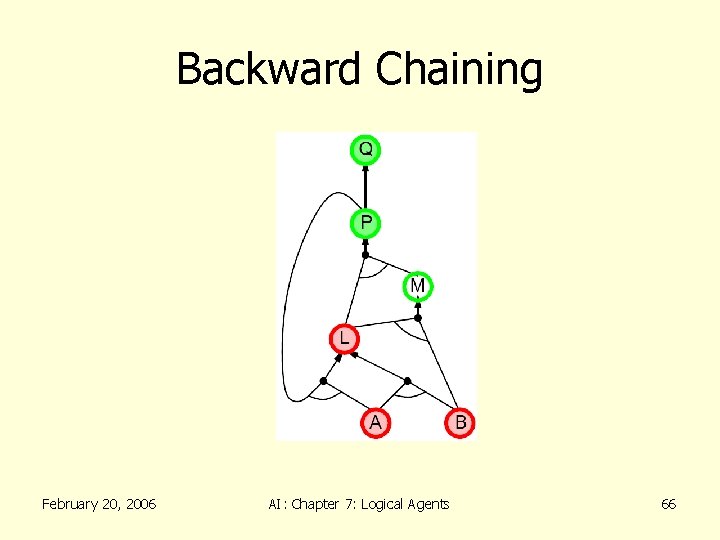
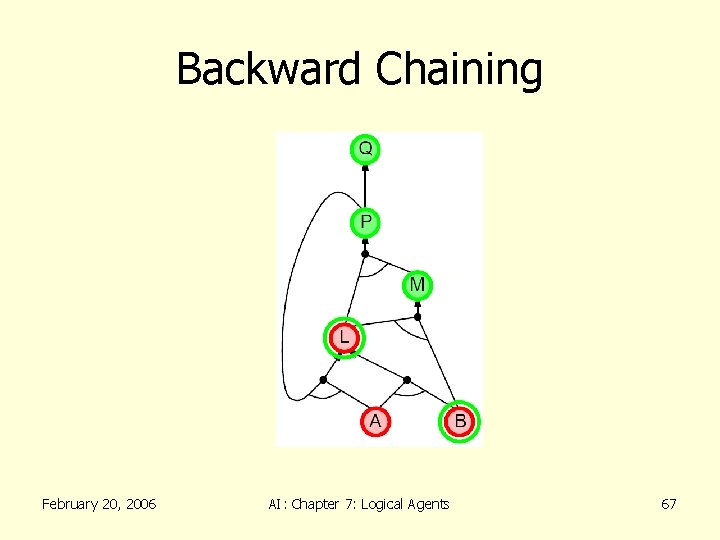
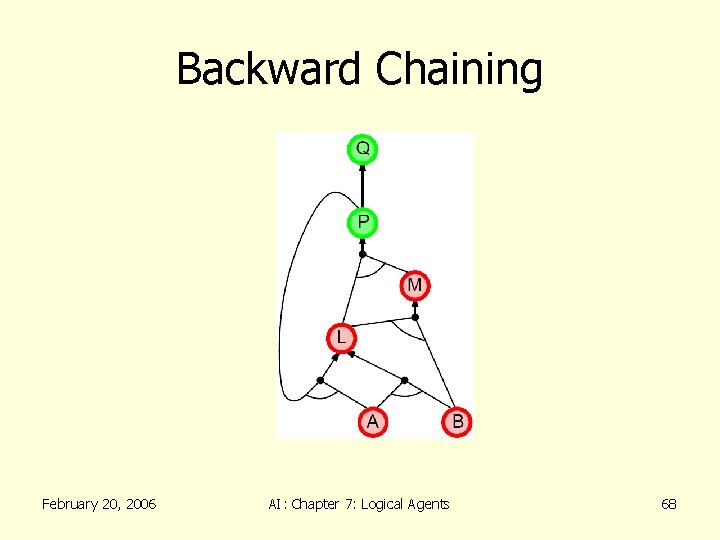
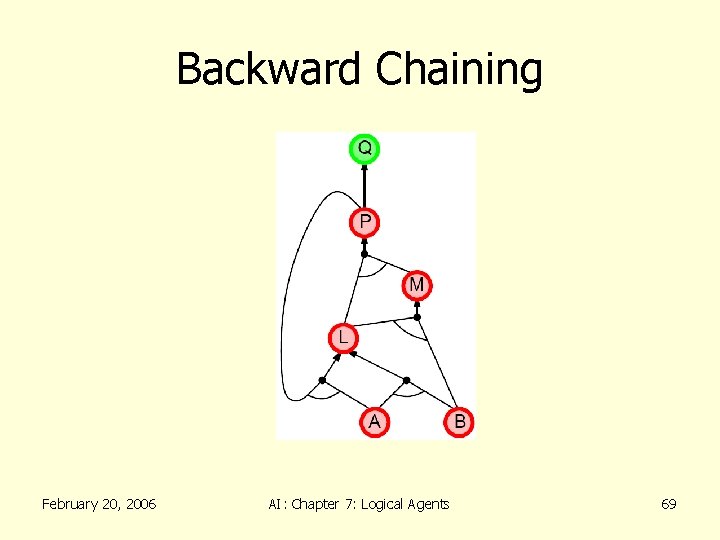
Backward Chaining • Idea: work backwards from the query q: – To prove q by BC, • Check if q is known already, or • Prove by BC all premises of some rule concluding q • Avoid loops – Check if new subgoal is already on the goal stack • Avoid repeated work: check if new subgoal – Has already been proved true, or – Has already failed February 20, 2006 AI: Chapter 7: Logical Agents 59
Backward Chaining February 20, 2006 AI: Chapter 7: Logical Agents 60
Backward Chaining February 20, 2006 AI: Chapter 7: Logical Agents 61
Backward Chaining February 20, 2006 AI: Chapter 7: Logical Agents 62
Backward Chaining February 20, 2006 AI: Chapter 7: Logical Agents 63
Backward Chaining February 20, 2006 AI: Chapter 7: Logical Agents 64
Backward Chaining February 20, 2006 AI: Chapter 7: Logical Agents 65
Backward Chaining February 20, 2006 AI: Chapter 7: Logical Agents 66
Backward Chaining February 20, 2006 AI: Chapter 7: Logical Agents 67
Backward Chaining February 20, 2006 AI: Chapter 7: Logical Agents 68
Backward Chaining February 20, 2006 AI: Chapter 7: Logical Agents 69
Backward Chaining February 20, 2006 AI: Chapter 7: Logical Agents 70
Forward Chaining vs. Backward Chaining • Forward Chaining is data driven – Automatic, unconscious processing – E. g. object recognition, routine decisions – May do lots of work that is irrelevant to the goal • Backward Chaining is goal driven – Appropriate for problem solving – E. g. “Where are my keys? ”, “How do I start the car? ” • The complexity of BC can be much less than linear in size of the KB February 20, 2006 AI: Chapter 7: Logical Agents 71