
Artificial Intelligence Chapter 19 Reasoning with Uncertain Information
![Additional Readings (1/5) l [Feller 1968] ¨ Probability Theory l [Goldszmidt, Morris & Pearl](https://slidetodoc.com/presentation_image_h2/9162431e6e433784bc9db0acbd680bb8/image-27.jpg "Additional Readings (1/5) l [Feller 1968] ¨ Probability Theory l [Goldszmidt, Morris & Pearl")
![Additional Readings (2/5) l [Shachter & Kenley 1989] ¨ Bayesian network for continuous random](https://slidetodoc.com/presentation_image_h2/9162431e6e433784bc9db0acbd680bb8/image-28.jpg "Additional Readings (2/5) l [Shachter & Kenley 1989] ¨ Bayesian network for continuous random")
![Additional Readings (3/5) l [Jensen 1996] ¨ Bayesian networks: HUGIN system l [Neal 1991]](https://slidetodoc.com/presentation_image_h2/9162431e6e433784bc9db0acbd680bb8/image-29.jpg "Additional Readings (3/5) l [Jensen 1996] ¨ Bayesian networks: HUGIN system l [Neal 1991]")
![Additional Readings (4/5) l [Shortliffe 1976, Buchanan & Shortliffe 1984] ¨ MYCIN: uses certainty](https://slidetodoc.com/presentation_image_h2/9162431e6e433784bc9db0acbd680bb8/image-30.jpg "Additional Readings (4/5) l [Shortliffe 1976, Buchanan & Shortliffe 1984] ¨ MYCIN: uses certainty")
![Additional Readings (5/5) l [Nilsson 1986] ¨ Probabilistic logic l [Tversky & Kahneman 1982]](https://slidetodoc.com/presentation_image_h2/9162431e6e433784bc9db0acbd680bb8/image-31.jpg "Additional Readings (5/5) l [Nilsson 1986] ¨ Probabilistic logic l [Tversky & Kahneman 1982]")
- Slides: 31
Artificial Intelligence Chapter 19 Reasoning with Uncertain Information Biointelligence Lab School of Computer Sci. & Eng. Seoul National University (C) 2000 -2002 SNU CSE Biointelligence Lab
Outline l l l l Review of Probability Theory Probabilistic Inference Bayes Networks Patterns of Inference in Bayes Networks Uncertain Evidence D-Separation Probabilistic Inference in Polytrees (C) 2000 -2002 SNU CSE Biointelligence Lab 2
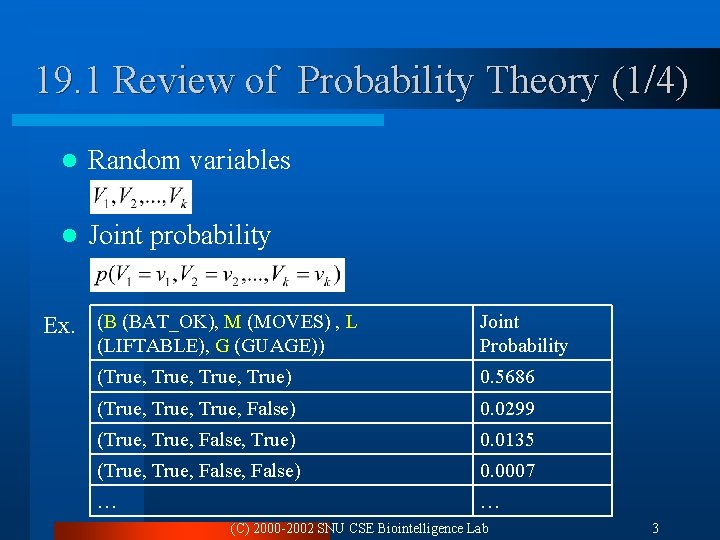
19. 1 Review of Probability Theory (1/4) l Random variables l Joint probability Ex. (B (BAT_OK), M (MOVES) , L (LIFTABLE), G (GUAGE)) Joint Probability (True, True) 0. 5686 (True, False) 0. 0299 (True, False, True) 0. 0135 (True, False, False) 0. 0007 … … (C) 2000 -2002 SNU CSE Biointelligence Lab 3
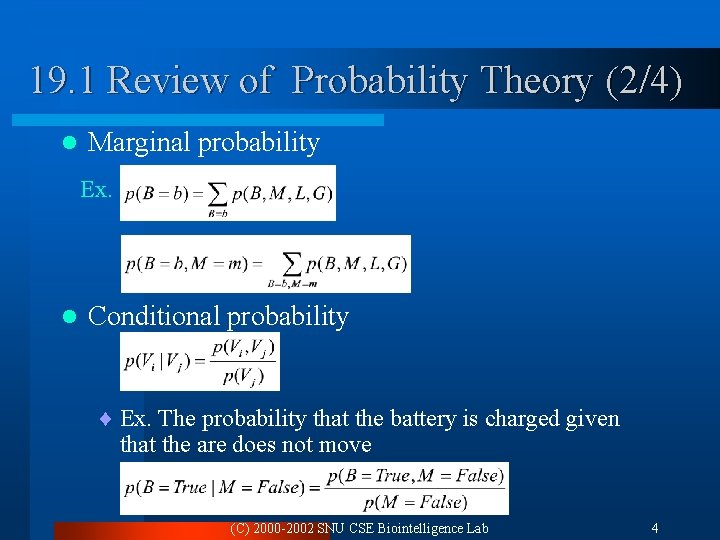
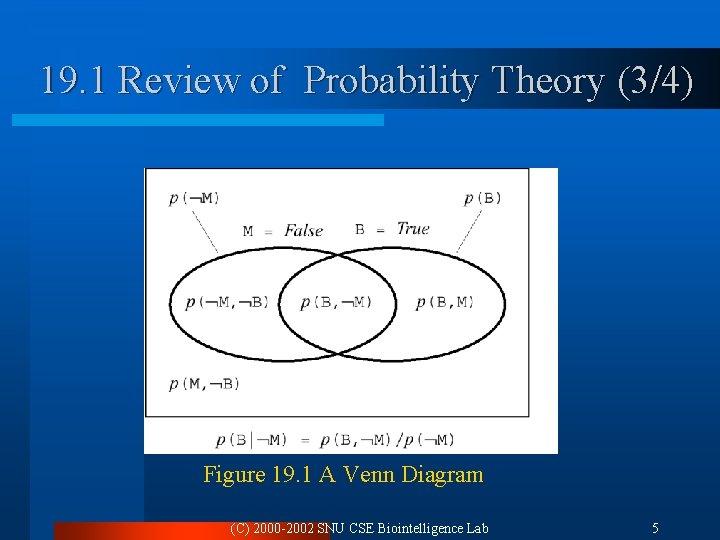
19. 1 Review of Probability Theory (2/4) l Marginal probability Ex. l Conditional probability ¨ Ex. The probability that the battery is charged given that the are does not move (C) 2000 -2002 SNU CSE Biointelligence Lab 4
19. 1 Review of Probability Theory (3/4) Figure 19. 1 A Venn Diagram (C) 2000 -2002 SNU CSE Biointelligence Lab 5
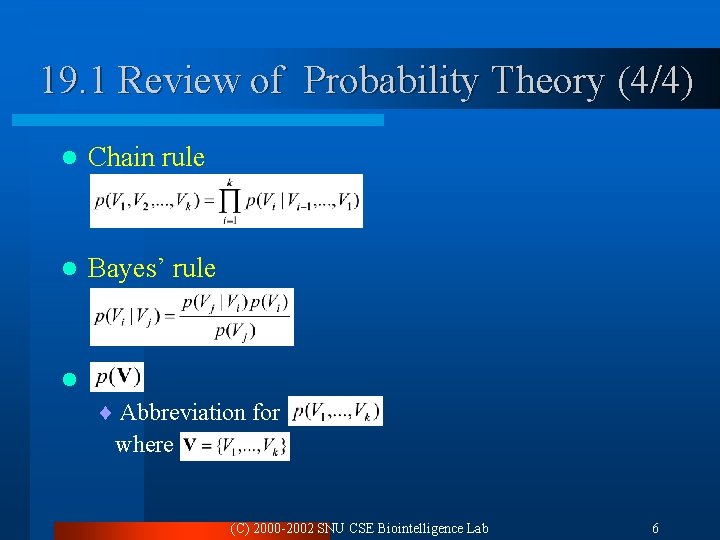
19. 1 Review of Probability Theory (4/4) l Chain rule l Bayes’ rule l ¨ Abbreviation for where (C) 2000 -2002 SNU CSE Biointelligence Lab 6
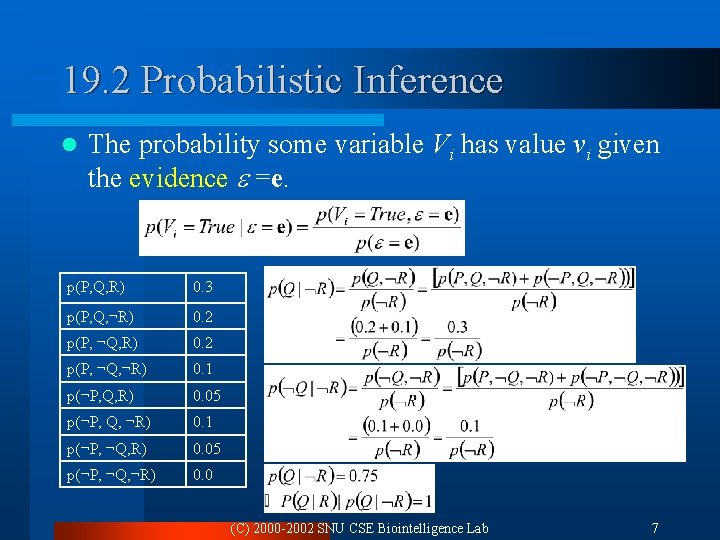
19. 2 Probabilistic Inference l The probability some variable Vi has value vi given the evidence =e. p(P, Q, R) 0. 3 p(P, Q, ¬R) 0. 2 p(P, ¬Q, ¬R) 0. 1 p(¬P, Q, R) 0. 05 p(¬P, Q, ¬R) 0. 1 p(¬P, ¬Q, R) 0. 05 p(¬P, ¬Q, ¬R) 0. 0 (C) 2000 -2002 SNU CSE Biointelligence Lab 7
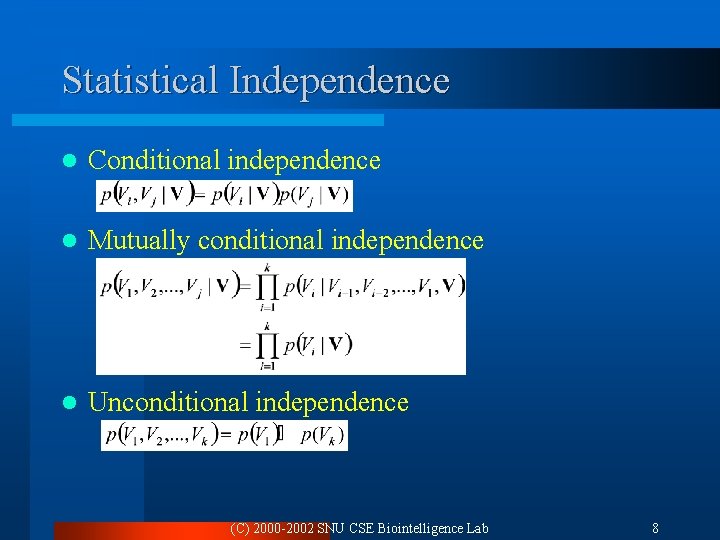
Statistical Independence l Conditional independence l Mutually conditional independence l Unconditional independence (C) 2000 -2002 SNU CSE Biointelligence Lab 8
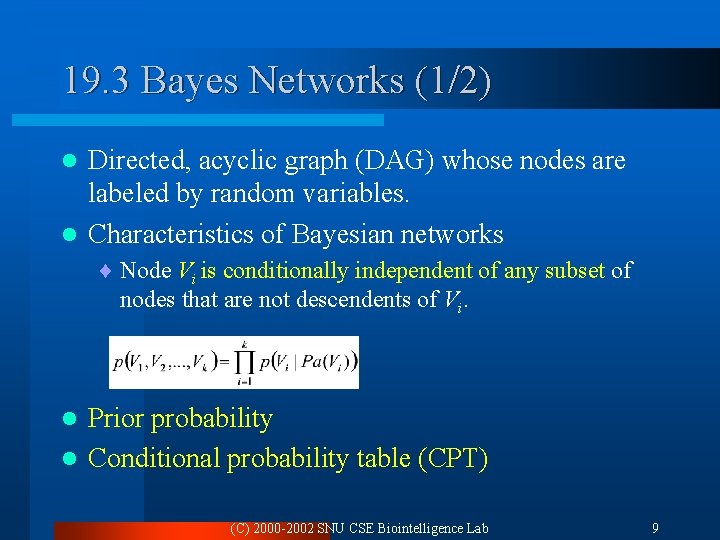
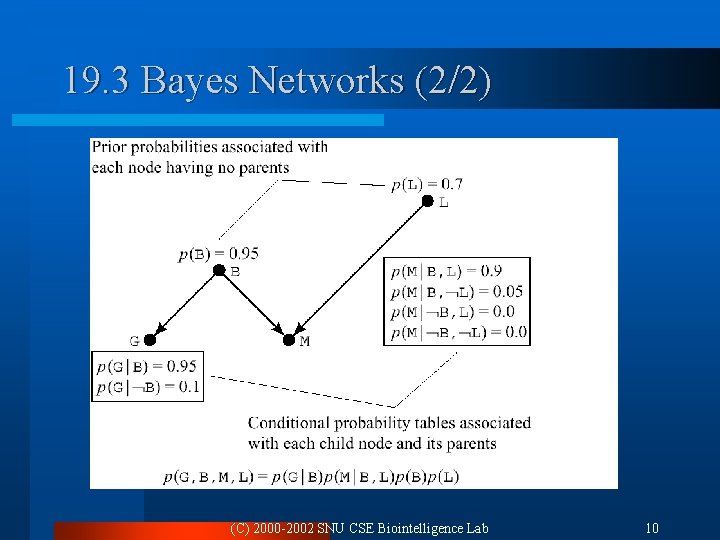
19. 3 Bayes Networks (1/2) Directed, acyclic graph (DAG) whose nodes are labeled by random variables. l Characteristics of Bayesian networks l ¨ Node Vi is conditionally independent of any subset of nodes that are not descendents of Vi. Prior probability l Conditional probability table (CPT) l (C) 2000 -2002 SNU CSE Biointelligence Lab 9
19. 3 Bayes Networks (2/2) (C) 2000 -2002 SNU CSE Biointelligence Lab 10
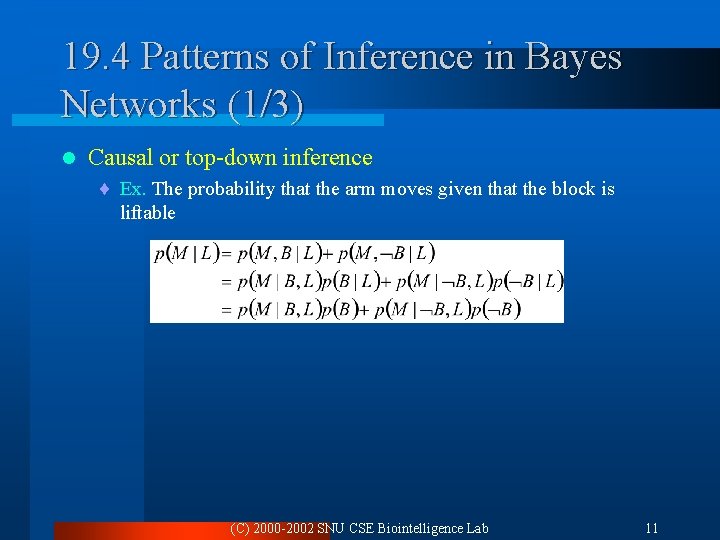
19. 4 Patterns of Inference in Bayes Networks (1/3) l Causal or top-down inference ¨ Ex. The probability that the arm moves given that the block is liftable (C) 2000 -2002 SNU CSE Biointelligence Lab 11
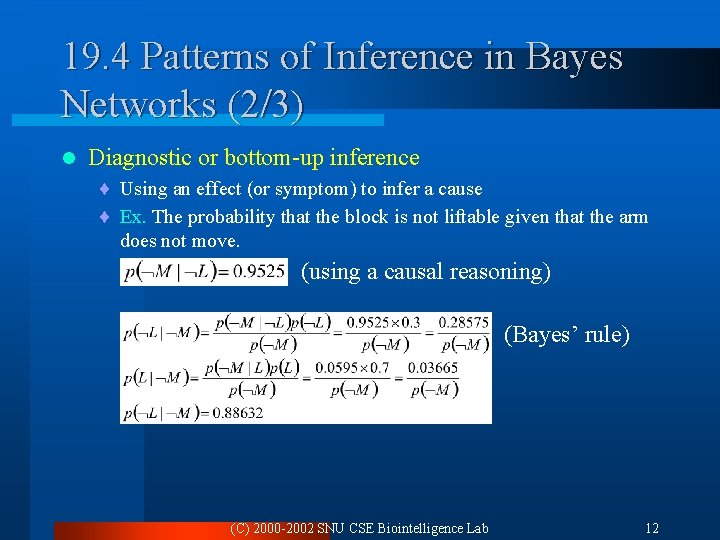
19. 4 Patterns of Inference in Bayes Networks (2/3) l Diagnostic or bottom-up inference ¨ Using an effect (or symptom) to infer a cause ¨ Ex. The probability that the block is not liftable given that the arm does not move. (using a causal reasoning) (Bayes’ rule) (C) 2000 -2002 SNU CSE Biointelligence Lab 12
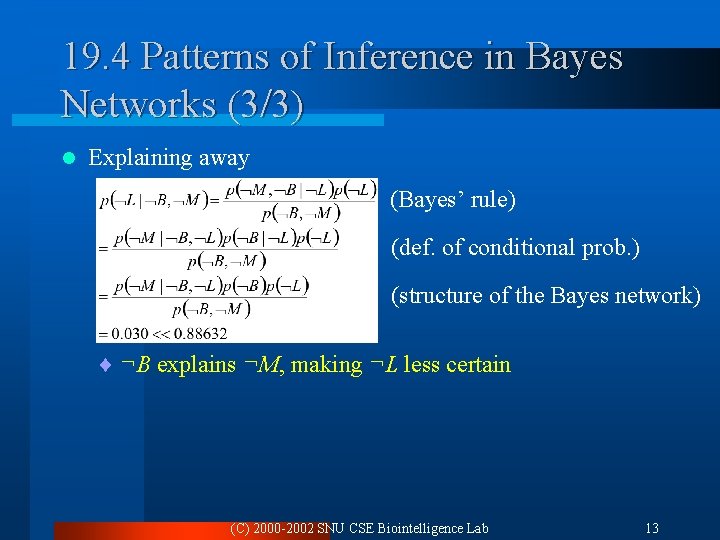
19. 4 Patterns of Inference in Bayes Networks (3/3) l Explaining away (Bayes’ rule) (def. of conditional prob. ) (structure of the Bayes network) ¨ ¬B explains ¬M, making ¬L less certain (C) 2000 -2002 SNU CSE Biointelligence Lab 13
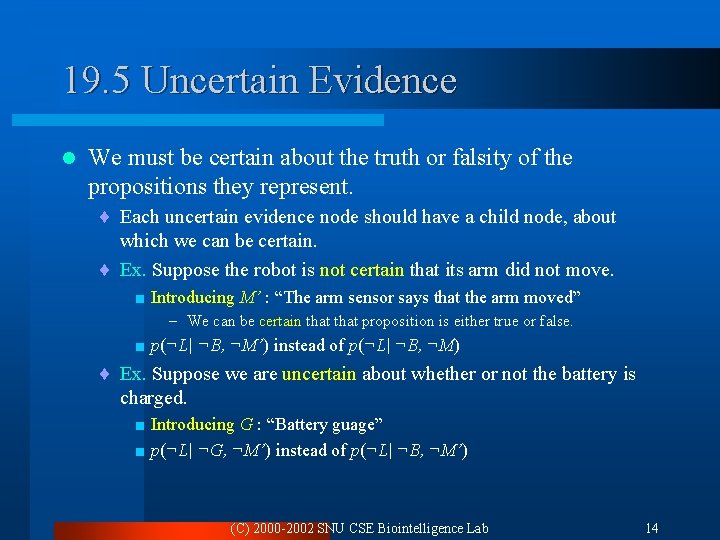
19. 5 Uncertain Evidence l We must be certain about the truth or falsity of the propositions they represent. ¨ Each uncertain evidence node should have a child node, about which we can be certain. ¨ Ex. Suppose the robot is not certain that its arm did not move. < Introducing M’ : “The arm sensor says that the arm moved” – We can be certain that proposition is either true or false. < p(¬L| ¬B, ¬M’) instead of p(¬L| ¬B, ¬M) ¨ Ex. Suppose we are uncertain about whether or not the battery is charged. < Introducing G : “Battery guage” < p(¬L| ¬G, ¬M’) instead of p(¬L| ¬B, ¬M’) (C) 2000 -2002 SNU CSE Biointelligence Lab 14
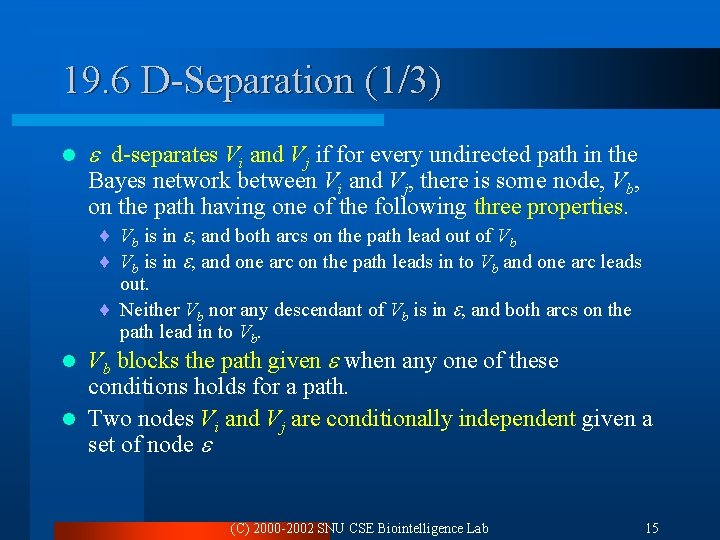
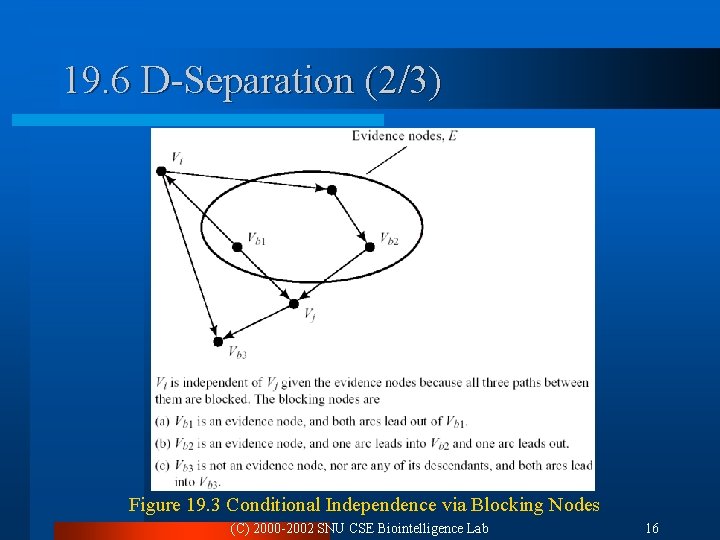
19. 6 D-Separation (1/3) l d-separates Vi and Vj if for every undirected path in the Bayes network between Vi and Vj, there is some node, Vb, on the path having one of the following three properties. ¨ Vb is in , and both arcs on the path lead out of Vb ¨ Vb is in , and one arc on the path leads in to Vb and one arc leads out. ¨ Neither Vb nor any descendant of Vb is in , and both arcs on the path lead in to Vb. Vb blocks the path given when any one of these conditions holds for a path. l Two nodes Vi and Vj are conditionally independent given a set of node l (C) 2000 -2002 SNU CSE Biointelligence Lab 15
19. 6 D-Separation (2/3) Figure 19. 3 Conditional Independence via Blocking Nodes (C) 2000 -2002 SNU CSE Biointelligence Lab 16
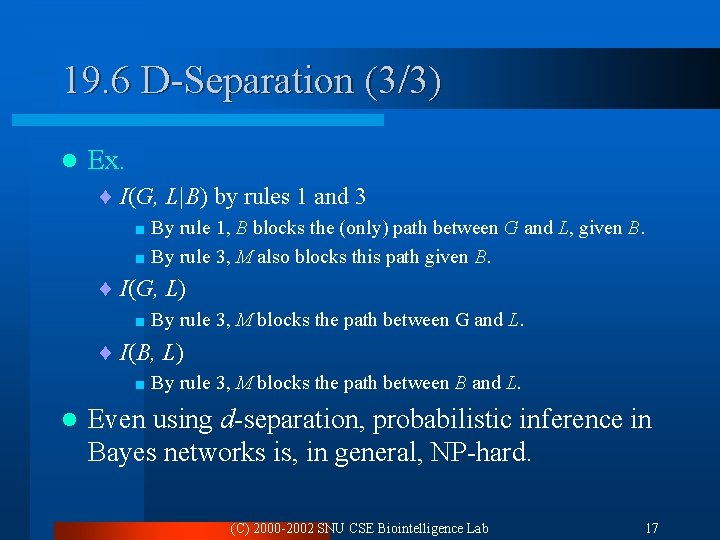
19. 6 D-Separation (3/3) l Ex. ¨ I(G, L|B) by rules 1 and 3 < By rule 1, B blocks the (only) path between G and L, given B. < By rule 3, M also blocks this path given B. ¨ I(G, L) < By rule 3, M blocks the path between G and L. ¨ I(B, L) < By l rule 3, M blocks the path between B and L. Even using d-separation, probabilistic inference in Bayes networks is, in general, NP-hard. (C) 2000 -2002 SNU CSE Biointelligence Lab 17
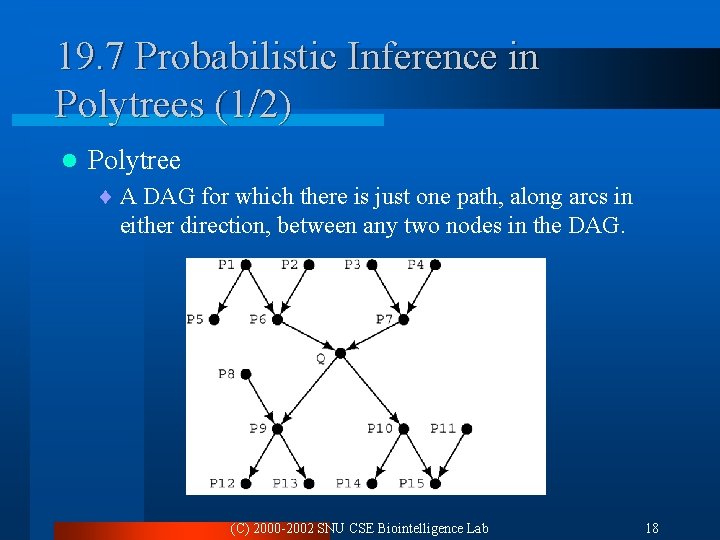
19. 7 Probabilistic Inference in Polytrees (1/2) l Polytree ¨ A DAG for which there is just one path, along arcs in either direction, between any two nodes in the DAG. (C) 2000 -2002 SNU CSE Biointelligence Lab 18
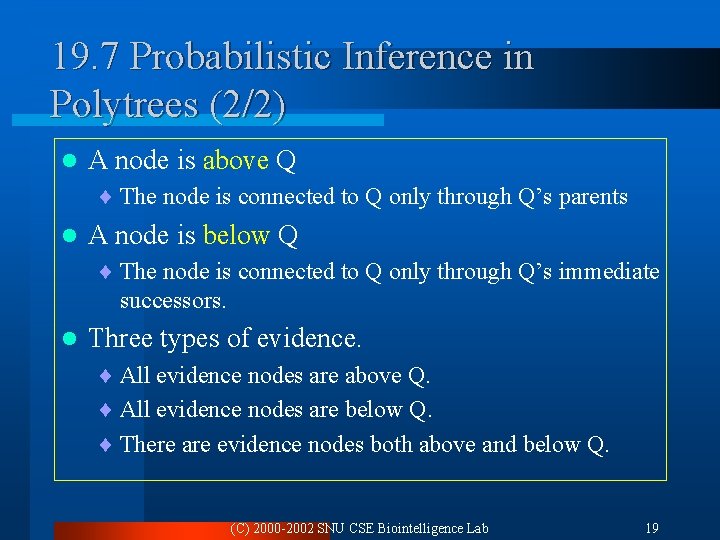
19. 7 Probabilistic Inference in Polytrees (2/2) l A node is above Q ¨ The node is connected to Q only through Q’s parents l A node is below Q ¨ The node is connected to Q only through Q’s immediate successors. l Three types of evidence. ¨ All evidence nodes are above Q. ¨ All evidence nodes are below Q. ¨ There are evidence nodes both above and below Q. (C) 2000 -2002 SNU CSE Biointelligence Lab 19
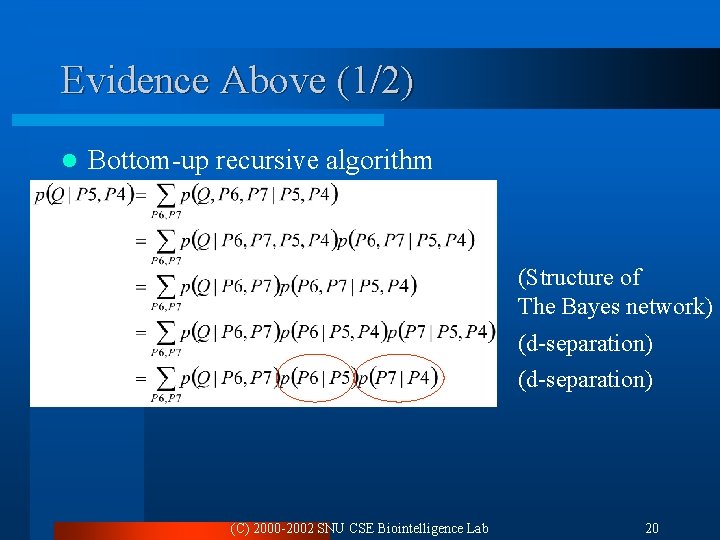
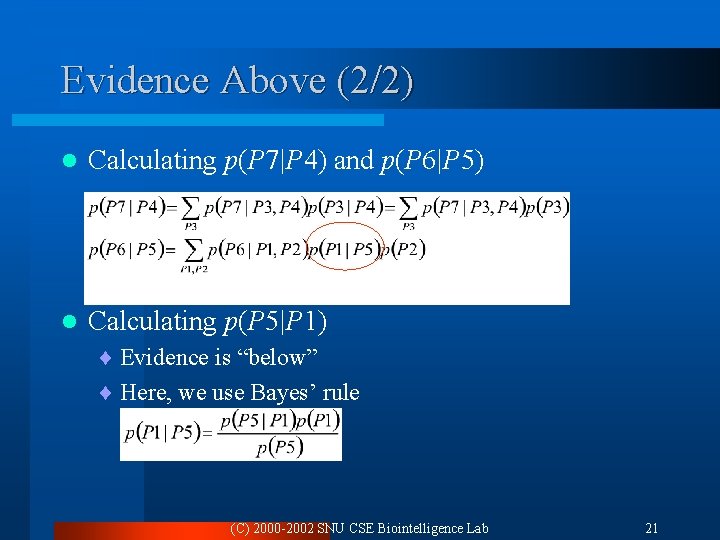
Evidence Above (1/2) Bottom-up recursive algorithm l Ex. p(Q|P 5, P 4) l (Structure of The Bayes network) (d-separation) (C) 2000 -2002 SNU CSE Biointelligence Lab 20
Evidence Above (2/2) l Calculating p(P 7|P 4) and p(P 6|P 5) l Calculating p(P 5|P 1) ¨ Evidence is “below” ¨ Here, we use Bayes’ rule (C) 2000 -2002 SNU CSE Biointelligence Lab 21
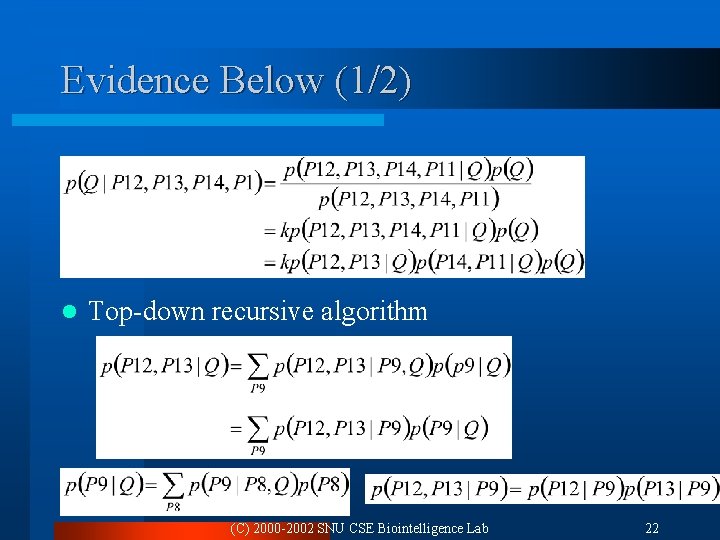
Evidence Below (1/2) l Top-down recursive algorithm (C) 2000 -2002 SNU CSE Biointelligence Lab 22
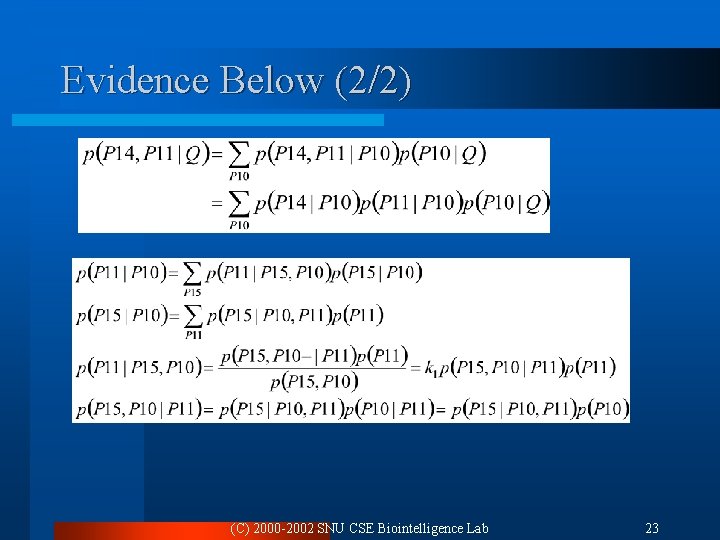
Evidence Below (2/2) (C) 2000 -2002 SNU CSE Biointelligence Lab 23
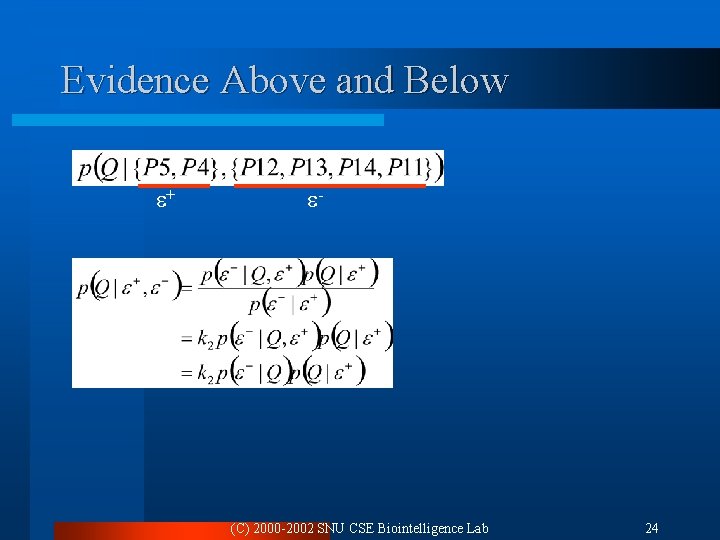
Evidence Above and Below + - (C) 2000 -2002 SNU CSE Biointelligence Lab 24
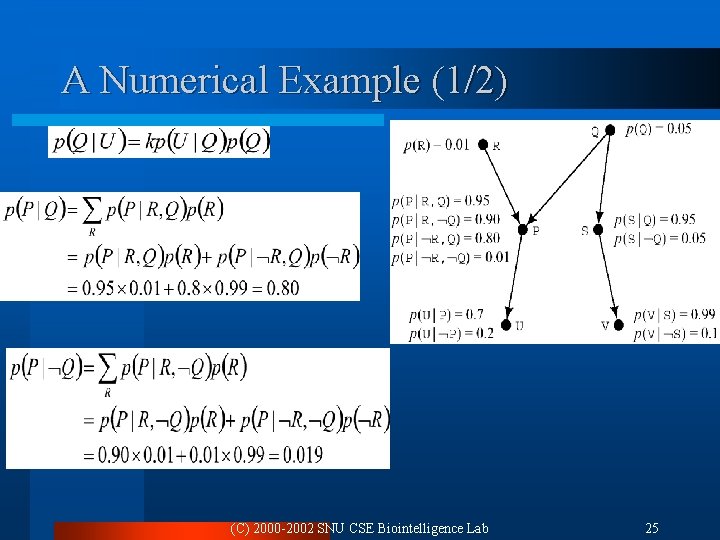
A Numerical Example (1/2) (C) 2000 -2002 SNU CSE Biointelligence Lab 25
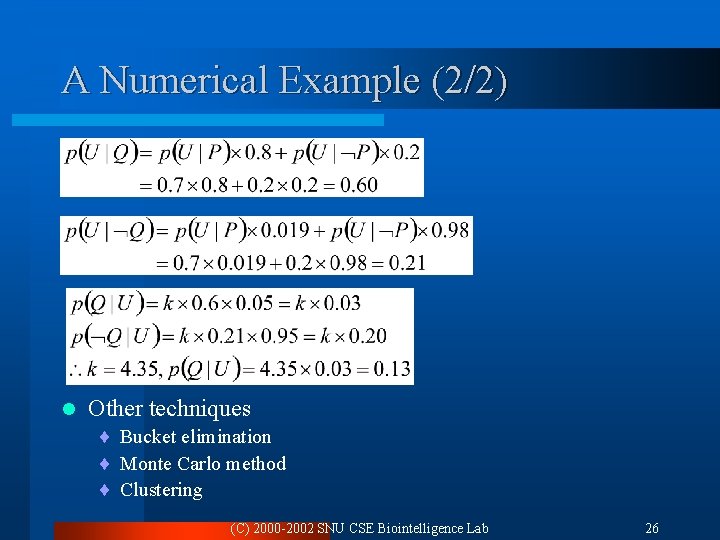
A Numerical Example (2/2) l Other techniques ¨ Bucket elimination ¨ Monte Carlo method ¨ Clustering (C) 2000 -2002 SNU CSE Biointelligence Lab 26
Additional Readings (1/5) l [Feller 1968] ¨ Probability Theory l [Goldszmidt, Morris & Pearl 1990] ¨ Non-monotonic inference through probabilistic method l [Pearl 1982 a, Kim & Pearl 1983] ¨ Message-passing algorithm l [Russell & Norvig 1995, pp. 447 ff] ¨ Polytree methods (C) 2000 -2002 SNU CSE Biointelligence Lab 27
Additional Readings (2/5) l [Shachter & Kenley 1989] ¨ Bayesian network for continuous random variables l [Wellman 1990] ¨ Qualitative networks l [Neapolitan 1990] ¨ Probabilistic methods in expert systems l [Henrion 1990] ¨ Probability inference in Bayesian networks (C) 2000 -2002 SNU CSE Biointelligence Lab 28
Additional Readings (3/5) l [Jensen 1996] ¨ Bayesian networks: HUGIN system l [Neal 1991] ¨ Relationships between Bayesian networks and neural networks l [Hecherman 1991, Heckerman & Nathwani 1992] ¨ PATHFINDER l [Pradhan, et al. 1994] ¨ CPCSBN (C) 2000 -2002 SNU CSE Biointelligence Lab 29
Additional Readings (4/5) l [Shortliffe 1976, Buchanan & Shortliffe 1984] ¨ MYCIN: uses certainty factor l [Duda, Hart & Nilsson 1987] ¨ PROSPECTOR: uses sufficiency index and necessity index l [Zadeh 1975, Zadeh 1978, Elkan 1993] ¨ Fuzzy logic and possibility theory l [Dempster 1968, Shafer 1979] ¨ Dempster-Shafer’s combination rules (C) 2000 -2002 SNU CSE Biointelligence Lab 30
Additional Readings (5/5) l [Nilsson 1986] ¨ Probabilistic logic l [Tversky & Kahneman 1982] ¨ Human generally loses consistency facing uncertainty l [Shafer & Pearl 1990] ¨ Papers for uncertain inference l Proceedings & Journals ¨ Uncertainty in Artificial Intelligence (UAI) ¨ International Journal of Approximate Reasoning (C) 2000 -2002 SNU CSE Biointelligence Lab 31