
Artificial Intelligence applied to IPC and Nice classifications



- Slides: 31
Artificial Intelligence applied to IPC and Nice classifications Geneva May 25, 2018 Patrick FIÉVET
2 IPCCAT-neural : automatic text categorization in the IPC What is it about? Patent Classifications : IPC (and CPC) Automatic text CATegorization in the specific context of patent documents Artificial Intelligence (AI) to mimic legacy patent classification practices
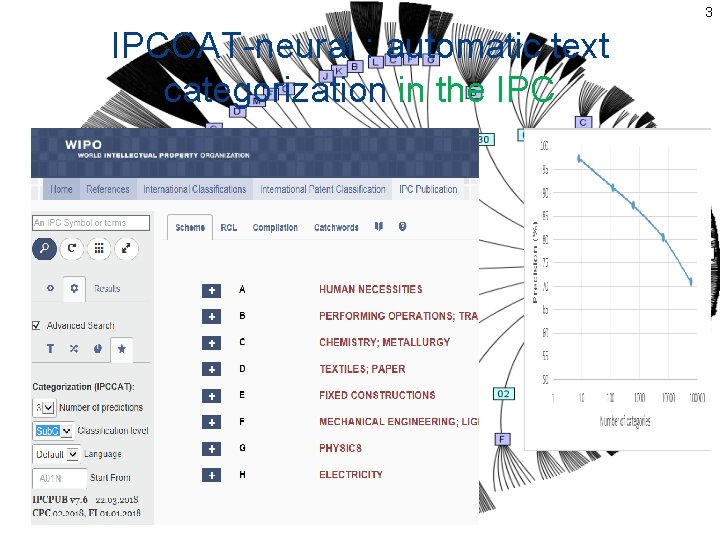
3 IPCCAT-neural : automatic text categorization in the IPC
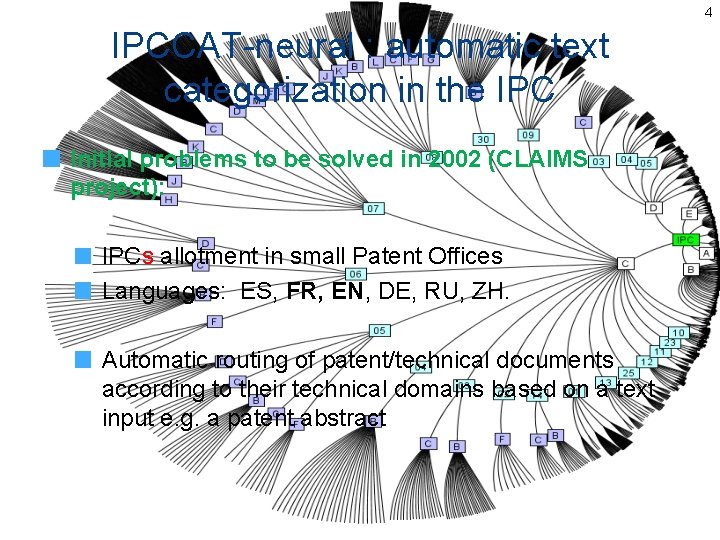
4 IPCCAT-neural : automatic text categorization in the IPC Initial problems to be solved in 2002 (CLAIMS project): IPCs allotment in small Patent Offices Languages: ES, FR, EN, DE, RU, ZH. Automatic routing of patent/technical documents according to their technical domains based on a text input e. g. a patent abstract
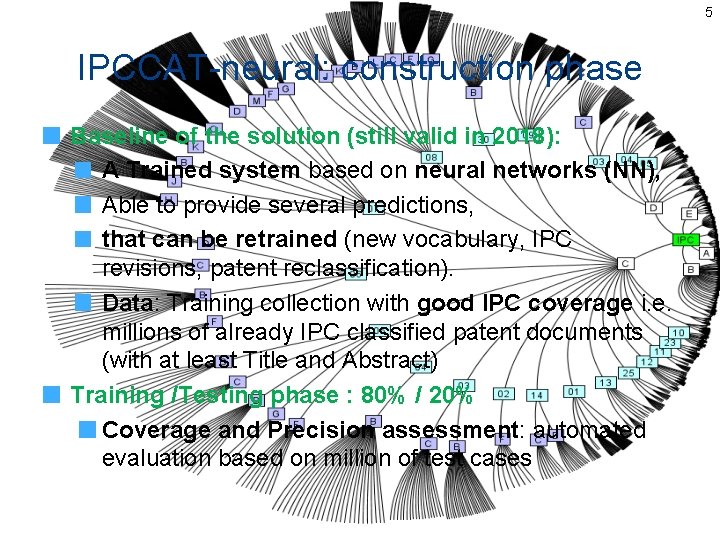
5 IPCCAT-neural: construction phase Baseline of the solution (still valid in 2018): A Trained system based on neural networks (NN), Able to provide several predictions, that can be retrained (new vocabulary, IPC revisions, patent reclassification). Data: Training collection with good IPC coverage i. e. millions of already IPC classified patent documents (with at least Title and Abstract) Training /Testing phase : 80% / 20% Coverage and Precision assessment: automated evaluation based on million of test cases
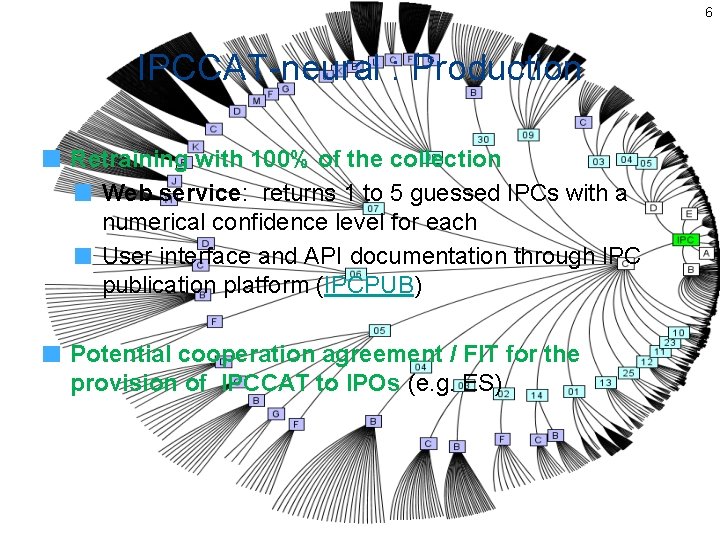
6 IPCCAT-neural : Production Retraining with 100% of the collection Web service: returns 1 to 5 guessed IPCs with a numerical confidence level for each User interface and API documentation through IPC publication platform (IPCPUB) Potential cooperation agreement / FIT for the provision of IPCCAT to IPOs (e. g. ES)
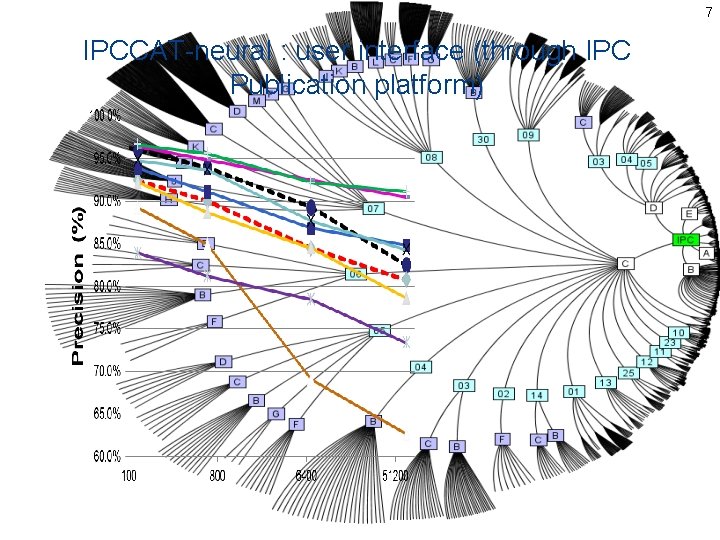
7 IPCCAT-neural : user interface (through IPC Publication platform)
8 IPCCAT-neural : automatic text categorization in the IPC Challenges/current solution: Availability of large and unified training collections with good IPC coverage: WIPO DELTA XML (currently computed from DOCDB XML) Quality of IPCCAT-Neural ( Absolute Vs. Relative): imitates IPC actual usage in DOCDB.
9 IPCCAT-neural : challenges Precision versus Recall: One IPC is usually not enough for patent classification =>highest possible precision for the top prediction is not necessarily the best objective e. g. for prior art search IPCCAT precision based on three-guesses evaluation method Predictions of IPC symbols on the basis on a text input with a confidence level for each Consideration for additional feature (NN) to predict the number of IPCs to be used
10 IPCCAT-neural : quality IPCCAT quality is relative to IPC quality in its training collection: IPCCAT imitates human practices (good and bad ones) Limited by patent documents fragments available for its training (currently Title & Abstract) Potential added value from Full text data needs to be revisited (last assessed in 2003) IPCCAT offers consistent and repeatable predictions
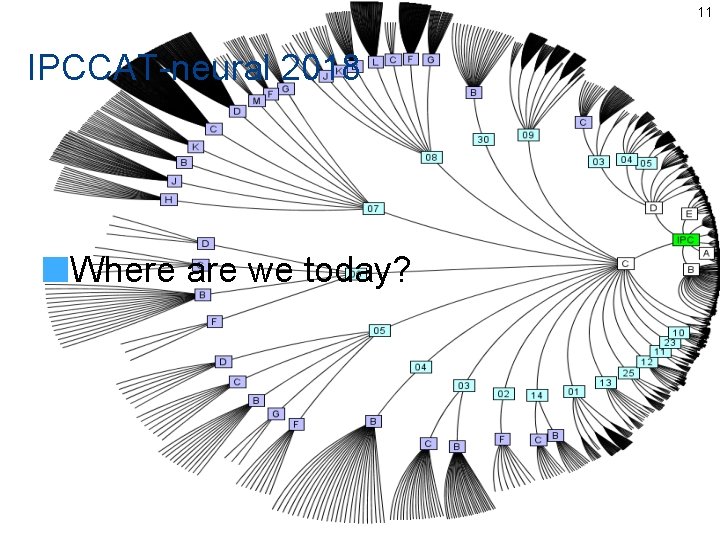
11 IPCCAT-neural 2018 Where are we today?
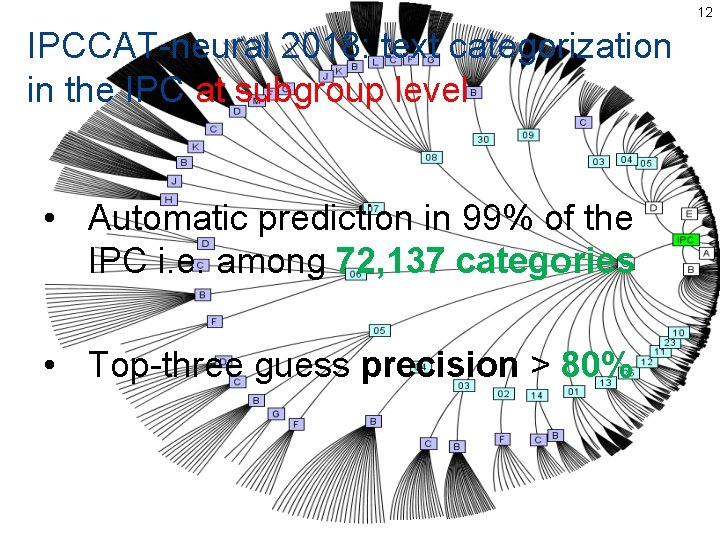
12 IPCCAT-neural 2018: text categorization in the IPC at subgroup level • Automatic prediction in 99% of the IPC i. e. among 72, 137 categories • Top-three guess precision > 80%
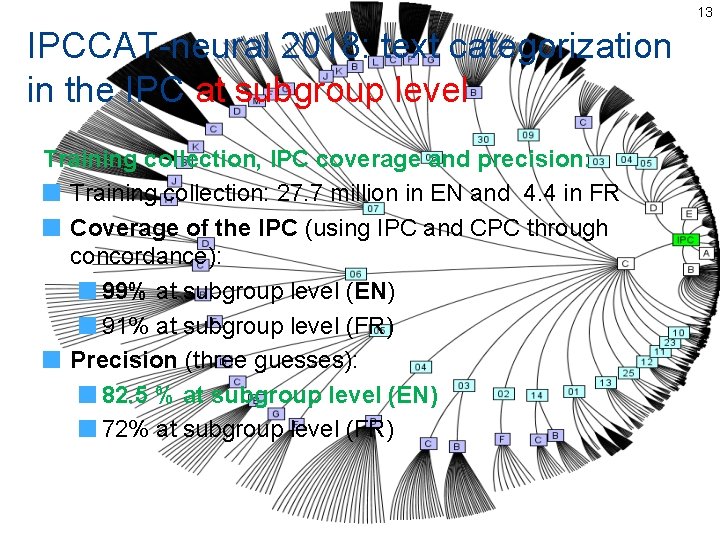
13 IPCCAT-neural 2018: text categorization in the IPC at subgroup level Training collection, IPC coverage and precision: Training collection: 27. 7 million in EN and 4. 4 in FR Coverage of the IPC (using IPC and CPC through concordance): 99% at subgroup level (EN) 91% at subgroup level (FR) Precision (three guesses): 82. 5 % at subgroup level (EN) 72% at subgroup level (FR)
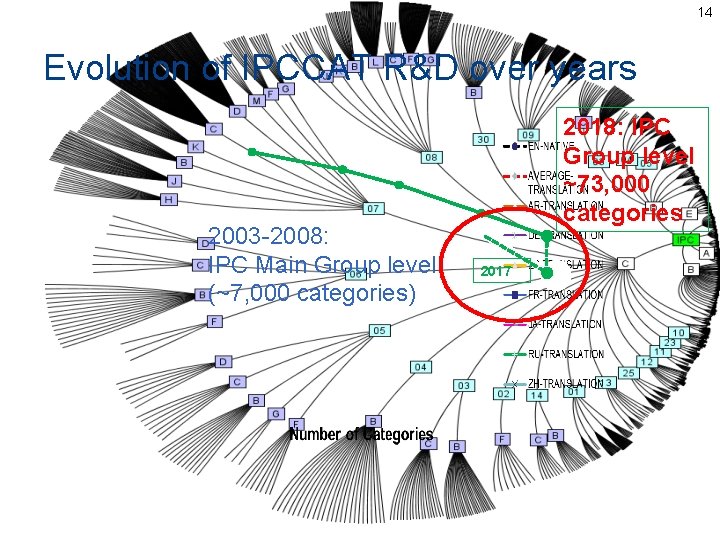
14 Evolution of IPCCAT R&D over years 2003 -2008: IPC Main Group level (~7, 000 categories) 2018: IPC Group level ~73, 000 categories 2017
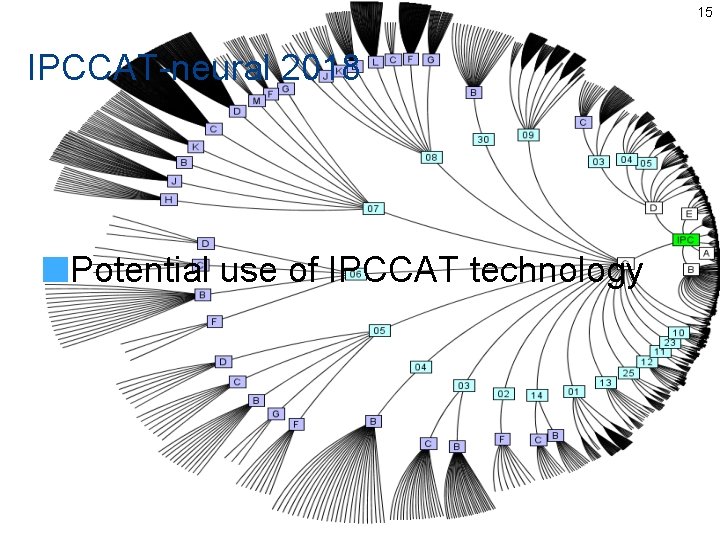
15 IPCCAT-neural 2018 Potential use of IPCCAT technology
16 IPCCAT-neural technology potential usage What it could be for? patent or NPL classification: improving consistency Others: Massive extraction of documents according to training patterns (seeds) e. g. for EST… Practical use of IPCCAT-neural Reduction of the backlog of IPC reclassification through automation of the residual IPC reclassification of patent documents after some years: Potential alternative to IPC reclassification Default transfer
17 IPCCAT-neural for IPC reclassification Additional Challenges: non-EN languages: Large training collections, with good IPC coverage Consistency in IPC classification practices Number of IPCs to be used for a given document
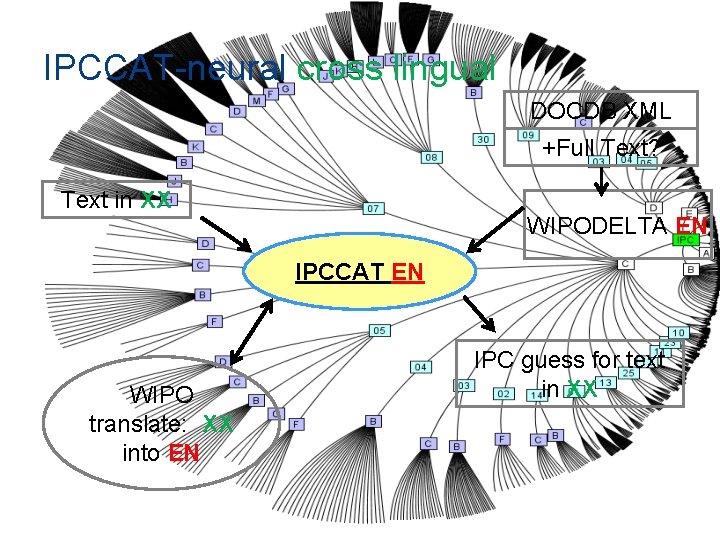
IPCCAT-neural cross lingual DOCDB XML +Full Text? Text in XX WIPODELTA EN IPCCAT EN WIPO translate: XX into EN IPC guess for text in XX
19 Cross-lingual text categorization to assist IPC reclassification Chronology: 1. Evidence that text categorization works at IPC subgroup level with an acceptable level of precision: Done 2. Integration of IPCCAT neural at sub-group level into IPCPUB v 7. 6 Done 3. Confirmation that Cross-lingual text categorization can assist in other languages than EN, even in absence of large training collections: Done
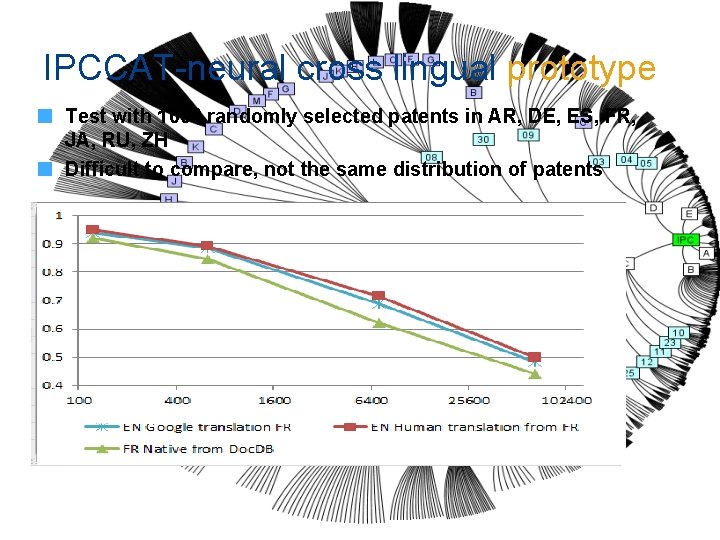
IPCCAT-neural cross lingual prototype Test with 1000 randomly selected patents in AR, DE, ES, FR, JA, RU, ZH Difficult to compare, not the same distribution of patents
IPCCAT-neural cross lingual evaluation IPCCAT trained in FR with a smaller corpus (5 million) Vs. IPCCAT trained in EN with a bigger corpus (27 million) + automatic translation into FR Promising but …answer to come (work in progress)
IPCCAT-neural cross lingual Vs. IPCCAT-neural FR 1000 randomly selected patent docs > sept 2017 in FR with (human? ) translation in Doc. DB
IPCCAT-neural cross lingual Test 1000 randomly selected patent docs > sept 2017 in FR with (human? ) translation in Doc. DB within G 06 F subclass
24 Cross-lingual text categorization to assist IPC reclassification Chronology: (Still a long way to go) 4. Incentives for R&D in automated text categorization: WIPO DELTA training collection: Done 5. Propose alternatives to Default Transfer e. g. guessed number of symbols and IPC symbols based on IPCCAT prediction and related confidence levels, IPC-CE decisions, resource planning, etc…: 2019 -2020? 6. Development of the production-scale solution integrating cross-lingual text categorization and WIPO translate: 20192020? 7. Integration in IPC reclassification system (IPCWLMS) 2020?
25 Incentive to R&D in text categorization: WIPO-Delta collections & mycat Incentives for research and development institutes interested in automatic text categorization : WIPO DELTA 2018 EN and FR datasets available upon request Fully specified XML format ~50 million excerpts of patent documents classified in the IPC (and 4. 7 million in FR) See http: //www. wipo. int/classifications/ipc/en/ITsupport/Cate gorization/dataset/index. html Open source: Mycat classifier available as on demand by the Olanto Foundation
26 NCLCAT-neural 2017 Proof of Concept Potential use of AI for the Nice classification (NCL)
27 NCLCAT-neural 2017 Proof of Concept Potential use of AI for the Nice classification (NCL) Cost-limited R&D to visit the potential of AI in predicting the most appropriate NCL CLASS on the basis on a text input (e. g. for TM applicants) Deep learning Classic Neural Networks Analysis and Prototype based on US and ES data
28 NCLCAT-neural 2017 POC Main outcomes (details in the NCLCAT report) AI support to NCL is promising and performs better than classic text search (Tests on US / ES collections) Prototype was done based on web service Automated testing on 40% of the collection indicates an average accuracy ~98% for top 3 guesses
29 NCLCAT-neural POC Other outcomes Processing of the training collection is the real added-value Expensive data standardization and extraction should be improved more investigation needed to address confusion between Classes (in particular Service Classes)
30 NCLCAT-neural POC Some more outcomes A test on the ES collection using Mycat (classic Neural Network without recent improvements): Precision: 96. 4%, top 3 accuracy at 99. 0% Deep Learning Vs. classic Neural Network: Not yet any evidence that convolutional Neural Network perform better Need for better and larger training sets (e. g. Madrid collection)
31 Thank you for your attention!