
Artificial Intelligence and Big Data in Finance Ruth
Artificial Intelligence and Big Data in Finance Ruth Kaila Aalto University Tvärminne 6. 3. 2018
MOTIVATION Financial sector is facing new challenges and new opportunities stemming from • digitalisation and new technologies: blockchain, platforms, big data and data analytics, machine learning and artificial intelligence • new regulations: regulation to open the financial markets for competition, to easen investments and to stabilize financial markets • rapidly changing global landscape: Fintech (Financial technologies) startups and large tech companies Facebook, Google, Amazon are challenging traditional banks and financial institutions. • According to Pw. C report 2017, financial services could lose as much as 40% of revenue to Fintech firms in the coming years. • Large tech companies have modified expectations of online customer experience. Payment becomes an invisible part of the buying process; online-shopping has brought new ways of paying.
MOTIVATION Financial markets are facing new challenges and new opportunities stemming from • digitalisation and new technologies: blockchain, platforms, big data and data analytics, machine learning and artificial intelligence Cheaper and faster solutions are needed through the • new regulations: regulation to open the financial markets for whole financial sector. competition, to easen investments and to stabilize financial markets; • rapidly changing global landscape: Fintech (Financial technologies) startups and large tech companies are challenging traditional banks and financial institutions. According to Pw. C report 2017, financial services could lose as much as 40% of revenue to Fintech firms. • Large tech companies (Facebook, Google, Amazon) have modified expectations of online customer experience. Payment becomes an invisible part of the buying process; online-shopping has brought new ways of paying
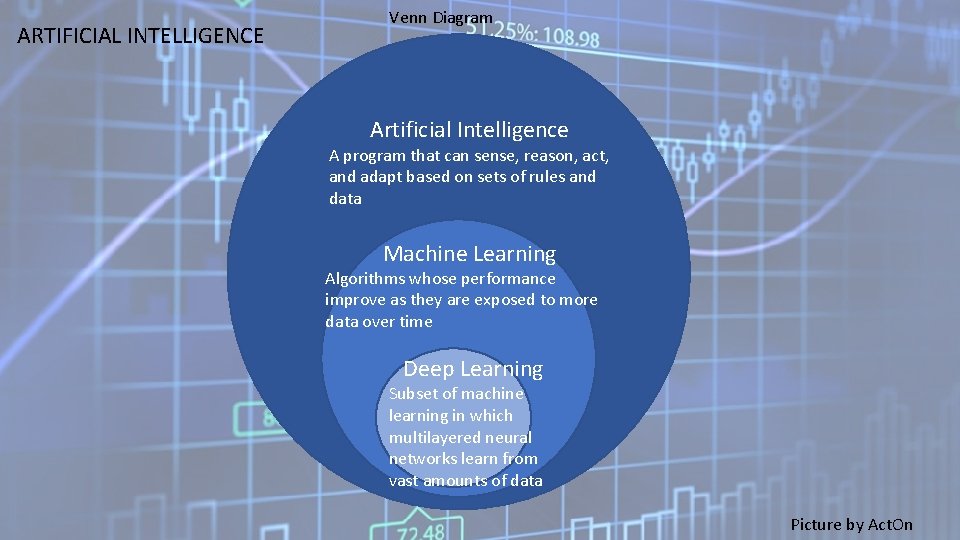
ARTIFICIAL INTELLIGENCE Venn Diagram Artificial Intelligence A program that can sense, reason, act, and adapt based on sets of rules and data Machine Learning time Algorithms whose performance improve as they are exposed to more data over time Deep Learning Subset of machine learning in which multilayered neural networks learn from vast amounts of data Picture by Act. On
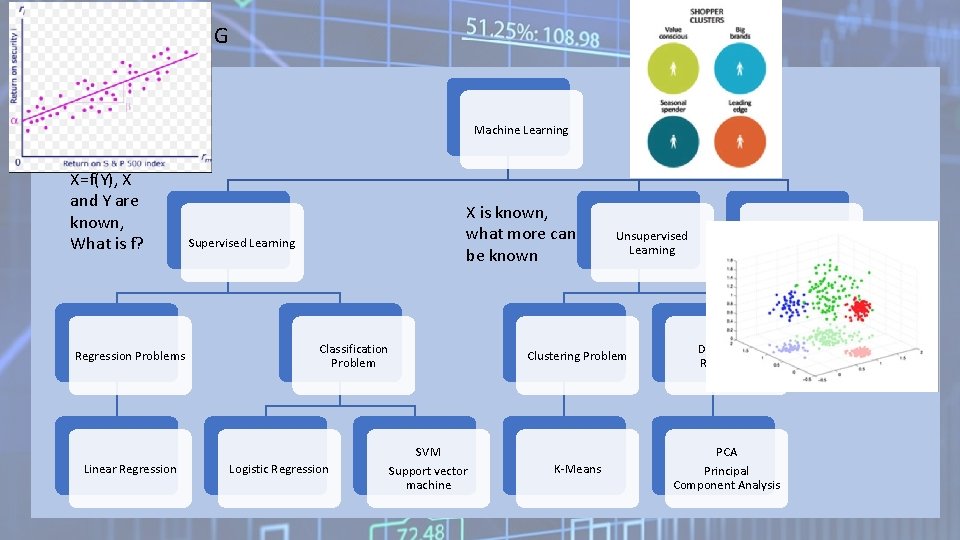
MACHINE LEARNING Machine Learning X=f(Y), X and Y are known, What is f? Regression Problems Linear Regression X is known, what more can be known Supervised Learning Classification Problem Logistic Regression SVM Support vector machine Unsupervised Learning Reinforcement Learning Clustering Problem Dimension Reduction K-Means PCA Principal Component Analysis
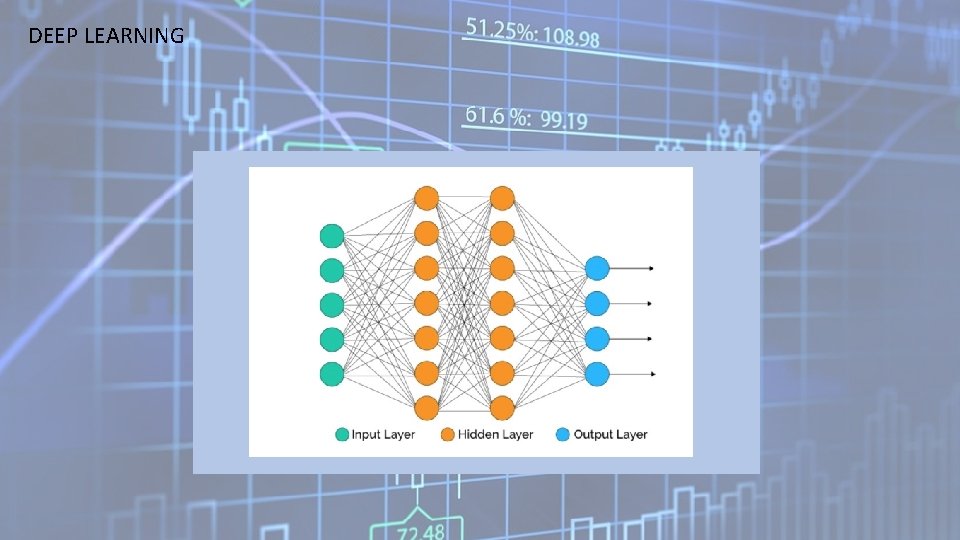
DEEP LEARNING
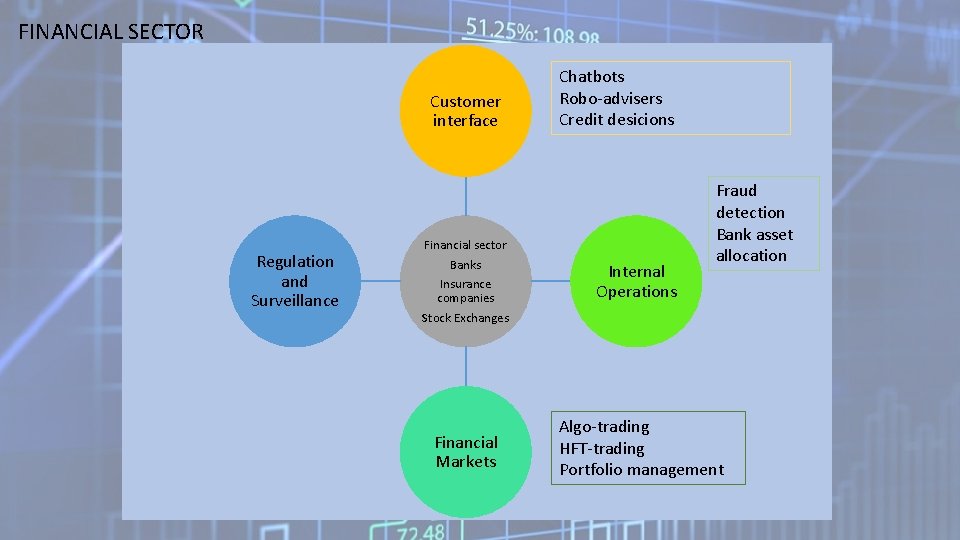
FINANCIAL SECTOR Customer interface Regulation and Surveillance Financial sector Banks Insurance companies Stock Exchanges Financial Markets Chatbots Robo-advisers Credit desicions Internal Operations Fraud detection Bank asset allocation Algo-trading HFT-trading Portfolio management
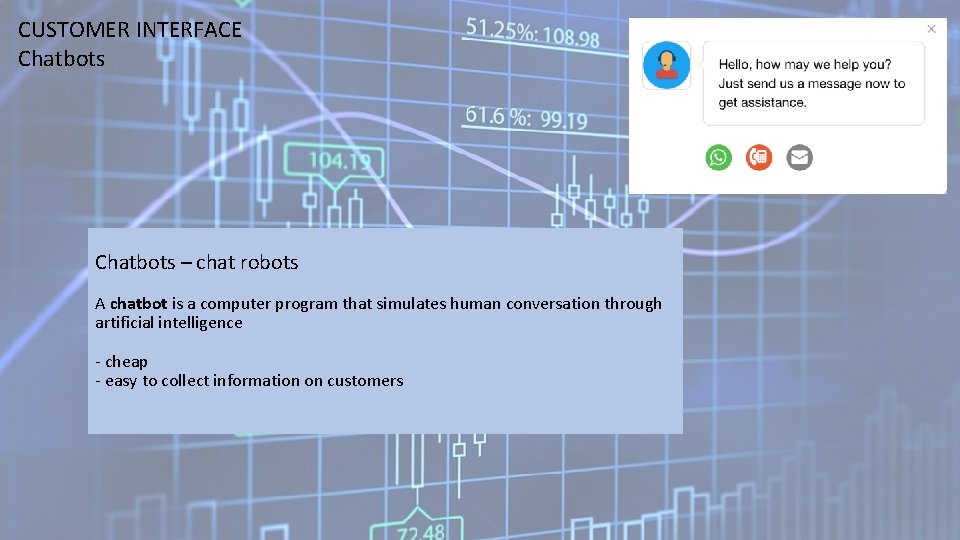
CUSTOMER INTERFACE Chatbots – chat robots A chatbot is a computer program that simulates human conversation through artificial intelligence - cheap - easy to collect information on customers
CUSTOMER INTERFACE Robo-advisors provide digital financial advice or investment management based on mathematical rules or algorithms. Human intervention is moderate or minimial. Low cost structure + can easily serve large markets –> available for not-sowelfare people. (f. ex. , in GB, typically only very welfare people can use financial advisors) Transparent: the regulator has continuously been obliged to monitor investment companies that are cheating their clients. In their daily lives, customers have already been accustomed with online customer interfaces; no expectation of traditional banking environment. BUT The customers using robo-advisors bring a relatively low profit. How is it possible to differentiate from other robo-advisors?
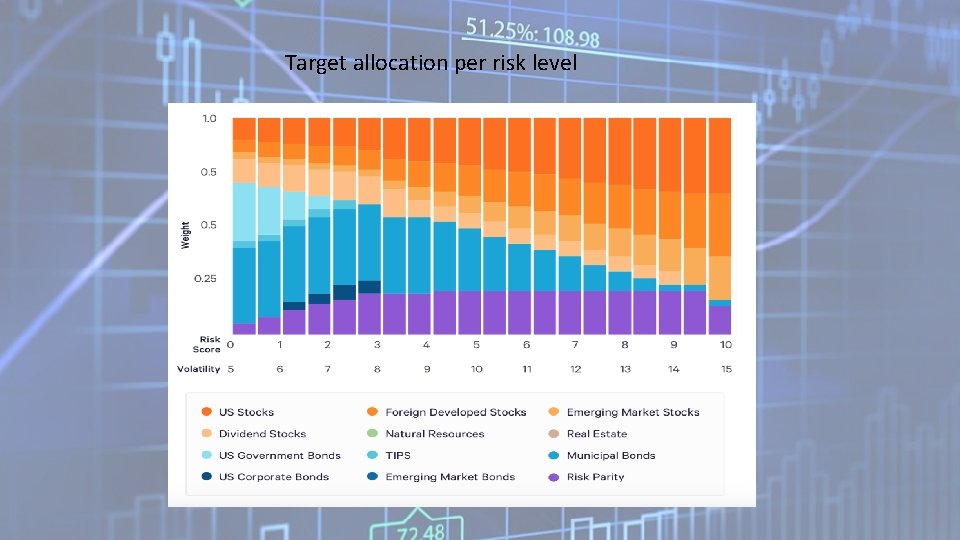
Target allocation per risk level
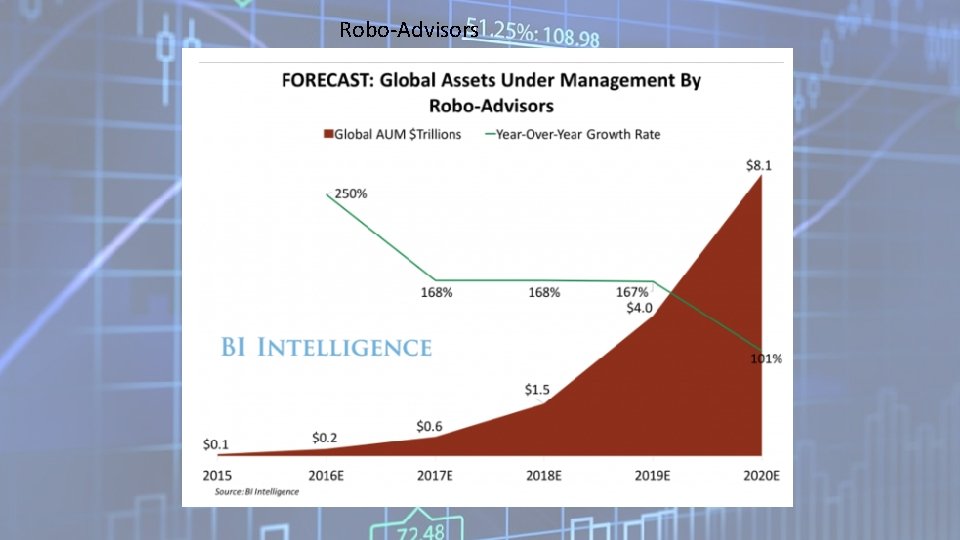
Robo-Advisors
CUSTOMER INTERFACE Credit desicion - AI based desicions faster than humans, credit desicion possibly in seconds - possibility to use a lot of data on the customer (also of people without banking history) - typically 50 data points has been used to make a credit decision; nowdays, easy to use 1000 data points - non-traditional variables: how a customer fills out a form, how much time they spend on a site, mobile phone payments data - traditional variables and in-house data: customer interaction data, payments profile, and purchase transactions - machine learning can be used; we look at the payment record of customers who have payed the whole loan back; the algo can be trained with this kind of data and predict the credit quality of a new customer - problem in machine learning: the customer has the right to know according to which principles the desicion has been made; problems related to discrimination
CUSTOMER INTERFACE Customer recognition Banking is moving more and more on-line and mobile customer recognition becomes more and more important - image recognition technologies - biometric recognition problem when the information is stolen; cannot be changed
INTERNAL OPERATIONS Fraud detection Credit cards - Each transaction is compared against account history; machine learning algos are able to assess the probability of a transaction being fraudulent. - unusual activities, f. ex out-of-the-country purchases, untypical purchases, large cash withdrawals will be checked by humans -> algos can learn the changing patterns of the customer Insurances - Machine learning algos can be taugth using historical data from typical types of frauds.
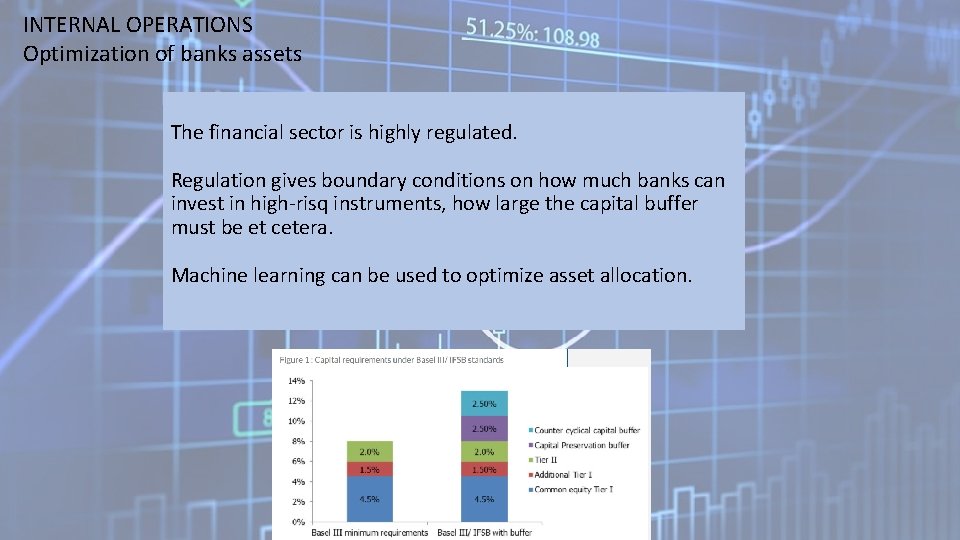
INTERNAL OPERATIONS Optimization of banks assets The financial sector is highly regulated. Regulation gives boundary conditions on how much banks can invest in high-risq instruments, how large the capital buffer must be et cetera. Machine learning can be used to optimize asset allocation.
REGULATION AND SUPERVISION - more and more regulation - more and more supervision - supervisor wants to see the original data, not only reports on it expensive - for companies, does not provide additional value -> should be automatized (ex: all Austrian banks are collaborating)
FINANCIAL MARKETS A lot of data is available. This data must be analysed before it can be used in trading - data generated by individuals: social media posts, product reviews, search trends - business data: company data, commercial transactions, credit card data - sensor data: satellite image data, car traffic, ship locations Deep learning: can be used in analyzing satellite pictures (how many cars in the Walmart parking place, what kind of harvest, risk of floods et cetera) Unsupervised learning: - f. ex a set of asset returns data is given; the task is to find correlations - clustering: finding historical regimes with high or low volatility or falling inflations - factor analysis: identify the main drivers such as momentum, value, carry, volatility, or liquidity. Supervised learning: - regression-based: how growing inflation will affect the market
ALGORITHMIC TRADING Algorithmic trading has been used for a long time; today 70 % of the trade is made by algos - information on what and when to buy and sell - splitting market offers in optimal sizes in order to minimize the market impact - High-frequency trading (1/1000 second); optimization of time, market place, lot size; search of price discrepancies
ALGO TRADING Strategies Source: ASIC 2010 Name of Algo strategy Description of strategy Trade execution algorithms Designed to minimize the price impact of executing trades of large volumes by splitting orders into smaller parcels and slowly releasing these into the market. Strategy implementation algorithms Designed to read real-time market data and formulate trading signals to be executed by trade execution algorithms. Stealth/gaming algorithms Designed to take advantage of the price movement caused when large trades are filled, and also to detect and outperform other algorithmic strategies.
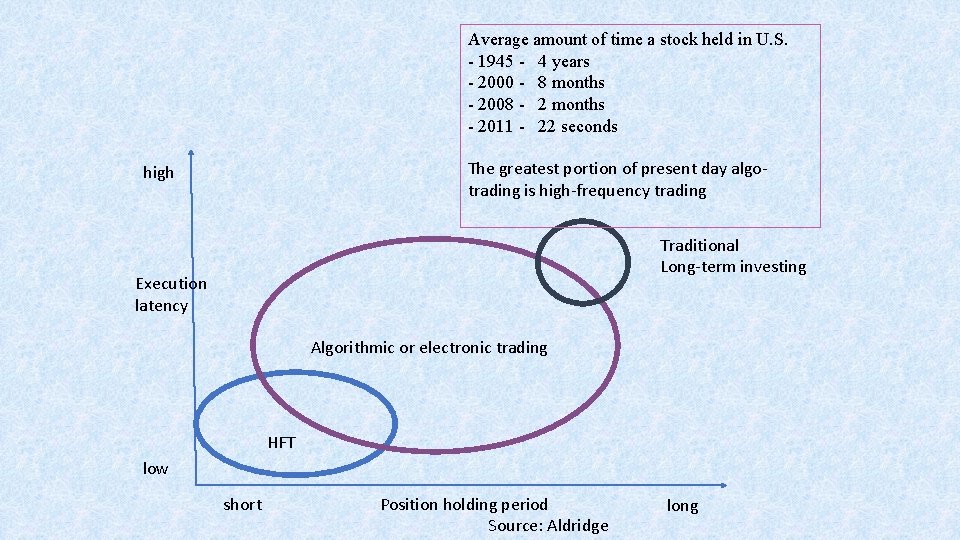
Average amount of time a stock held in U. S. - 1945 - 4 years - 2000 - 8 months - 2008 - 2 months - 2011 - 22 seconds The greatest portion of present day algotrading is high-frequency trading high Traditional Long-term investing Execution latency Algorithmic or electronic trading HFT low short Position holding period Source: Aldridge long
• Trades are executed at the best possible prices • Trades timed correctly and instantly, to avoid significant price changes • Reduced transaction costs • Simultaneous automated checks on multiple market conditions • Risk of manual errors in placing the trades is reduced • Backtest the algorithm, based on available historical and real time data • Reduced possibility of mistakes by human traders based on emotional and psychological factors In the long term, however, humans will retain an advantage: “Machines will likely not do well in assessing regime changes (market turning points) and forecasts which involve interpreting more complicated human responses such as those of politicians and central bankers, understanding client positioning, or anticipating crowding, ” says J. P. Morgan (investment bank)
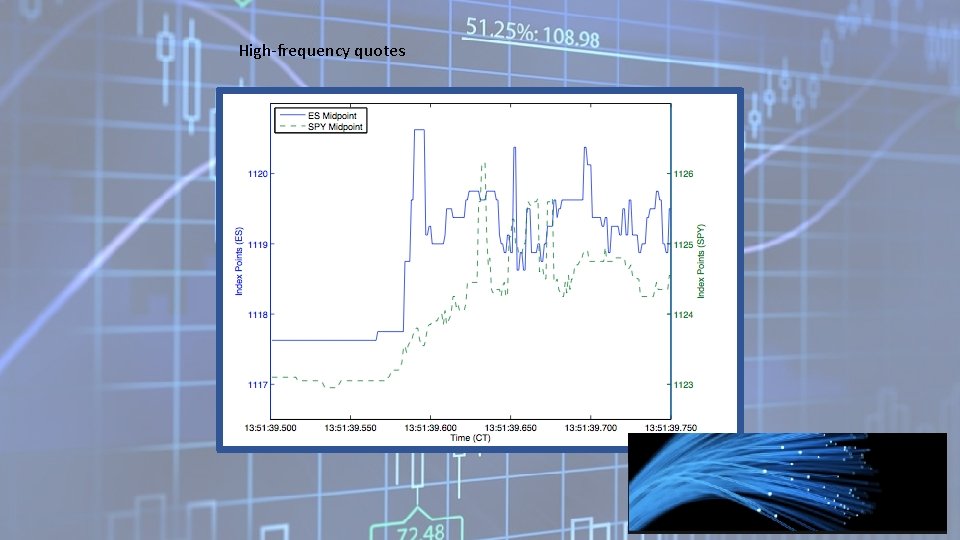
High-frequency quotes
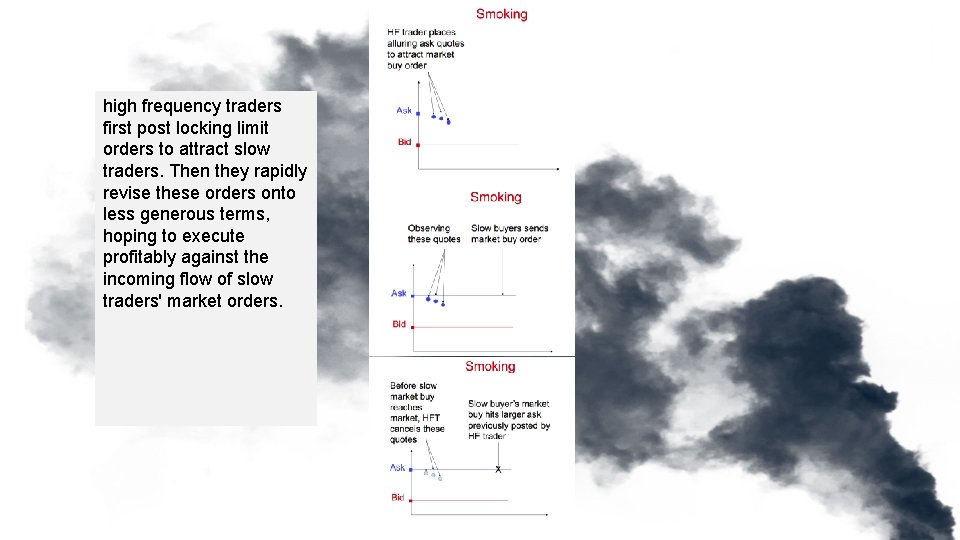
high frequency traders first post locking limit orders to attract slow traders. Then they rapidly revise these orders onto less generous terms, hoping to execute profitably against the incoming flow of slow traders' market orders.
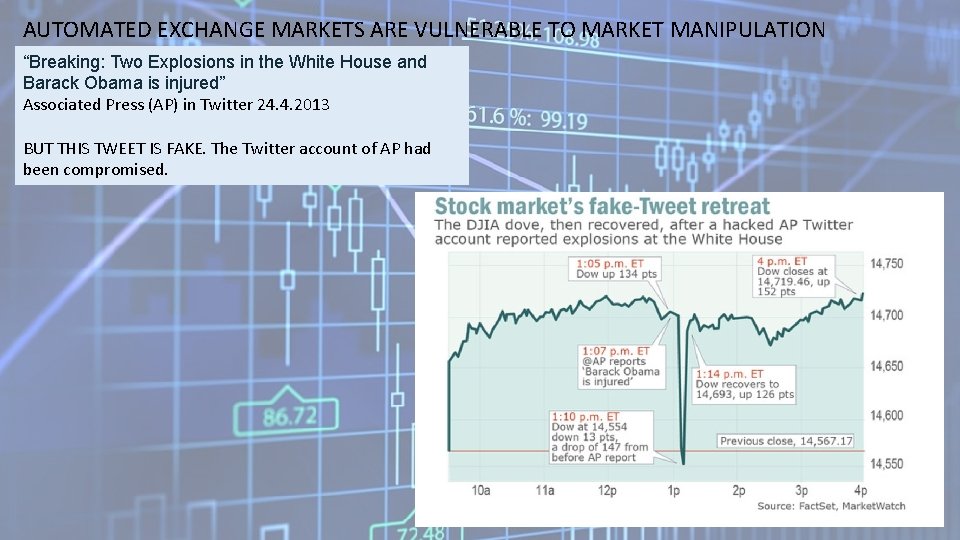
AUTOMATED EXCHANGE MARKETS ARE VULNERABLE TO MARKET MANIPULATION “Breaking: Two Explosions in the White House and Barack Obama is injured” Associated Press (AP) in Twitter 24. 4. 2013 BUT THIS TWEET IS FAKE. The Twitter account of AP had been compromised.
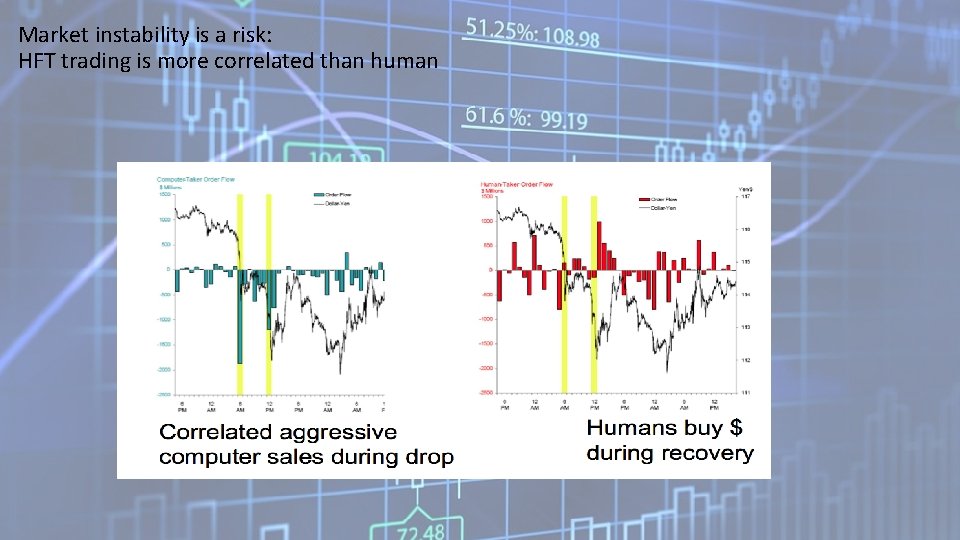
Market instability is a risk: HFT trading is more correlated than human
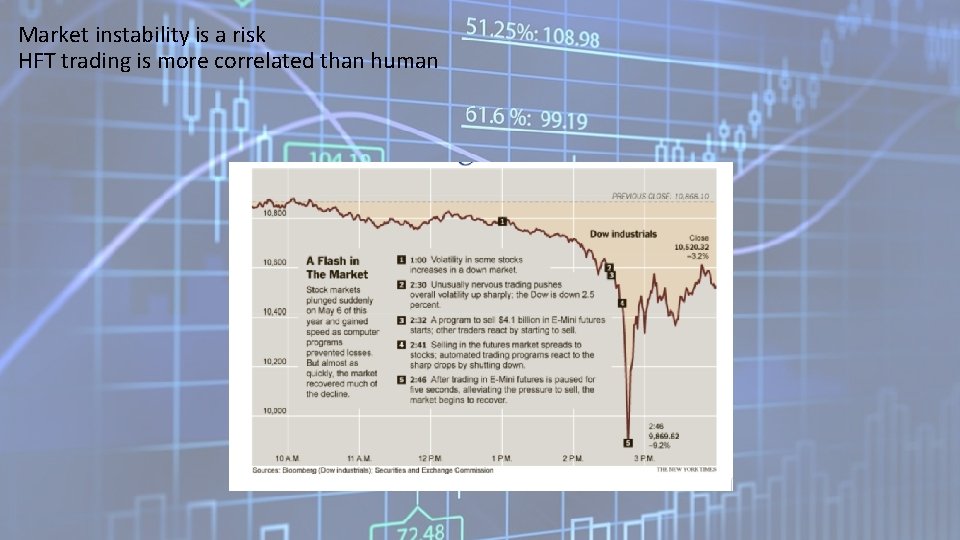
Market instability is a risk HFT trading is more correlated than human
CONCLUSIONS - technology is an important factor on the financial sector - the financial sector is highly regulated - huge amount of data is available -> very much possibilities for artificial intelligence on all fields of the financial sector - threats: cyber threats, threats related to data privacy and market instability
- Slides: 27