
Artificial Intelligence AI Lecture No 1 Agenda Intelligence

- Slides: 27
Artificial Intelligence (AI) Lecture No. 1
Agenda Ø Ø Ø Ø Ø Intelligence of computer Artificial intelligence Intelligent computing Vs Conventional computing Contribution of other fields to AI +History of AI +Applications of AI References End 9/6/2021 2
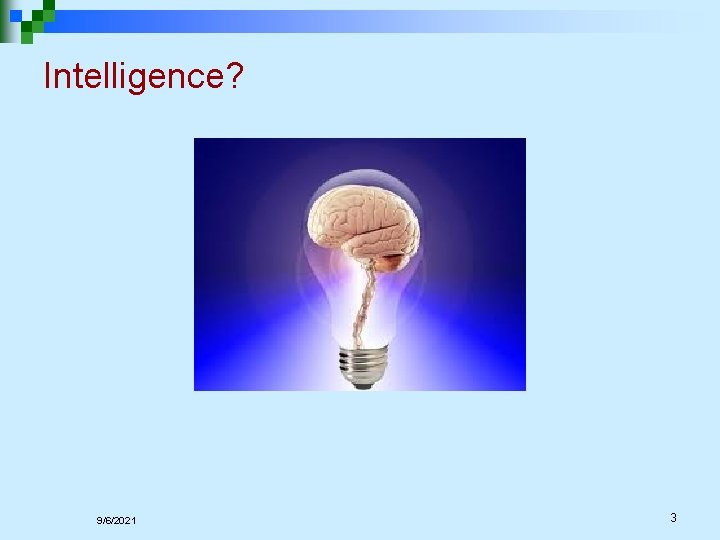
Intelligence? 9/6/2021 3
Can Intelligence be defined? Ø Ø Intelligence can not be defined abstractly/ precisely. There are probably as many definitions of intelligence as there are experts of this field. 9/6/2021 4
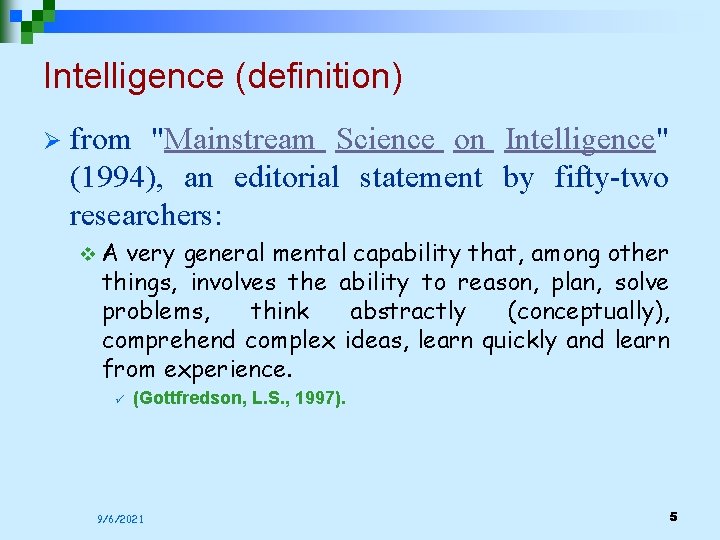
Intelligence (definition) Ø from "Mainstream Science on Intelligence" (1994), an editorial statement by fifty-two researchers: v. A very general mental capability that, among other things, involves the ability to reason, plan, solve problems, think abstractly (conceptually), comprehend complex ideas, learn quickly and learn from experience. ü (Gottfredson, L. S. , 1997). 9/6/2021 5
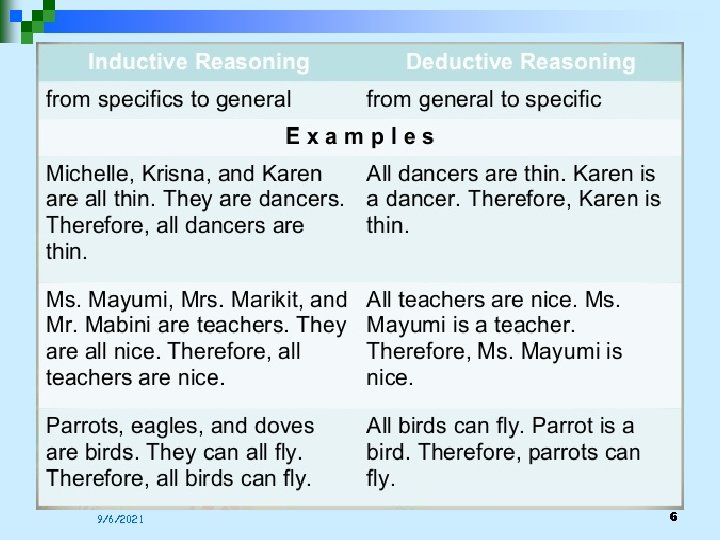
9/6/2021 6
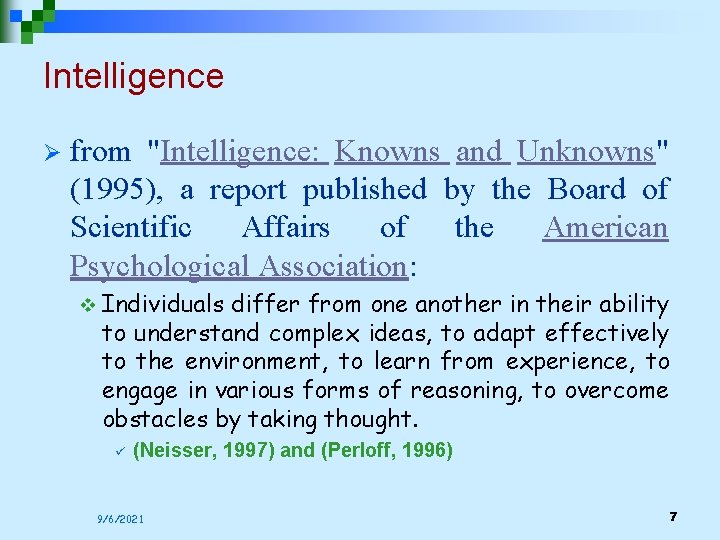
Intelligence Ø from "Intelligence: Knowns and Unknowns" (1995), a report published by the Board of Scientific Affairs of the American Psychological Association: v Individuals differ from one another in their ability to understand complex ideas, to adapt effectively to the environment, to learn from experience, to engage in various forms of reasoning, to overcome obstacles by taking thought. ü (Neisser, 1997) and (Perloff, 1996) 9/6/2021 7
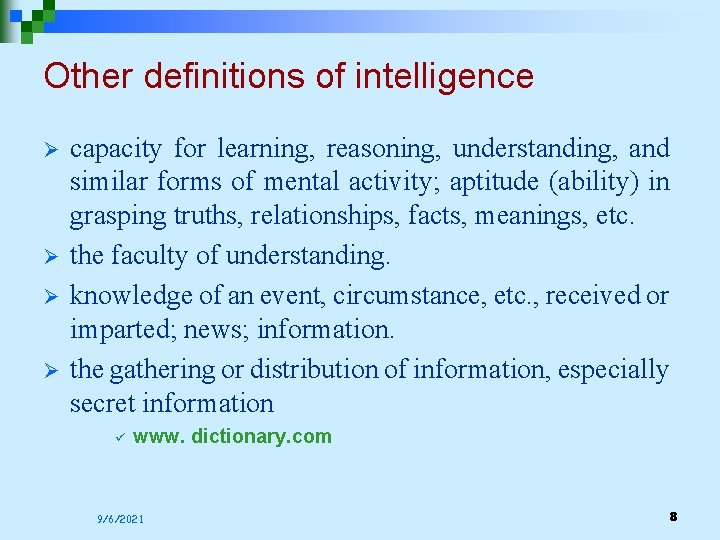
Other definitions of intelligence Ø Ø capacity for learning, reasoning, understanding, and similar forms of mental activity; aptitude (ability) in grasping truths, relationships, facts, meanings, etc. the faculty of understanding. knowledge of an event, circumstance, etc. , received or imparted; news; information. the gathering or distribution of information, especially secret information ü www. dictionary. com 9/6/2021 8
Intelligence (summary) Ø Intelligence is the ability of: v abstract thought v understanding v communication v reasoning v learning v planning v problem solving 9/6/2021 9
Intelligence of computer Ø According to the British computer scientist Alan Turing's test in (1950): v “a computer would deserves to be called intelligent if it could deceive a human into believing that it was human. ” 9/6/2021 10
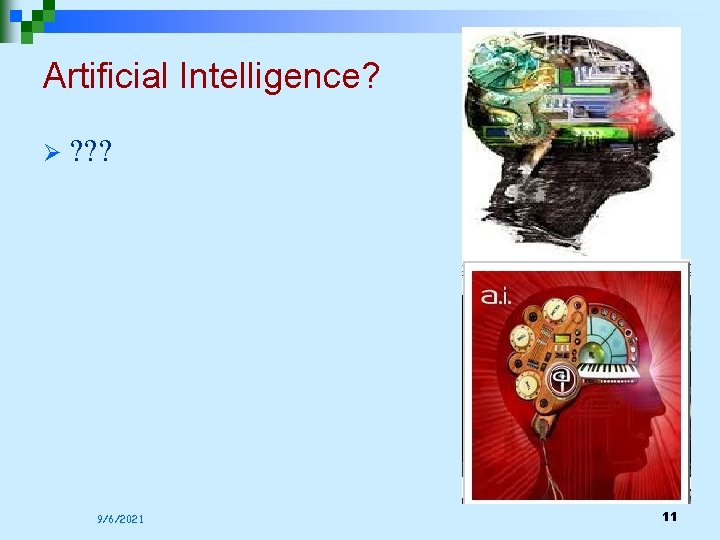
Artificial Intelligence? Ø ? ? ? 9/6/2021 11
Artificial Intelligence Ø “A branch of a computer science which studies the development of software and hardware which simulates human intelligence” ü (Dr. Ghassan Issa) 9/6/2021 12
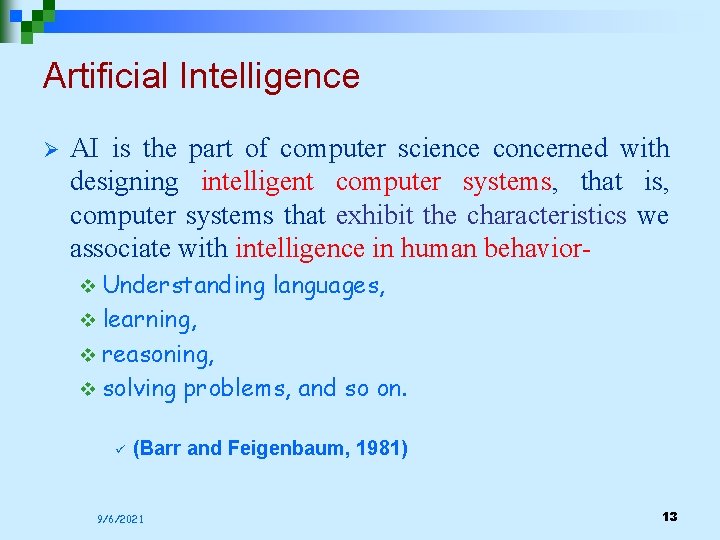
Artificial Intelligence Ø AI is the part of computer science concerned with designing intelligent computer systems, that is, computer systems that exhibit the characteristics we associate with intelligence in human behaviorv Understanding languages, v learning, v reasoning, v solving ü problems, and so on. (Barr and Feigenbaum, 1981) 9/6/2021 13
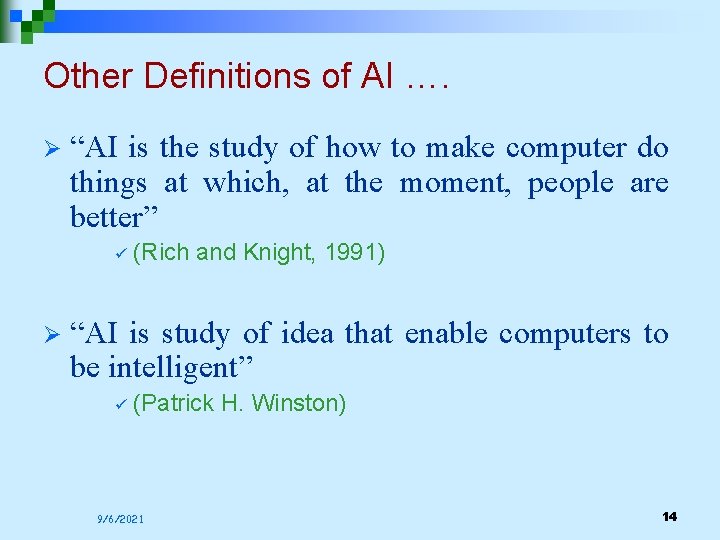
Other Definitions of AI …. Ø “AI is the study of how to make computer do things at which, at the moment, people are better” ü Ø (Rich and Knight, 1991) “AI is study of idea that enable computers to be intelligent” ü (Patrick H. Winston) 9/6/2021 14
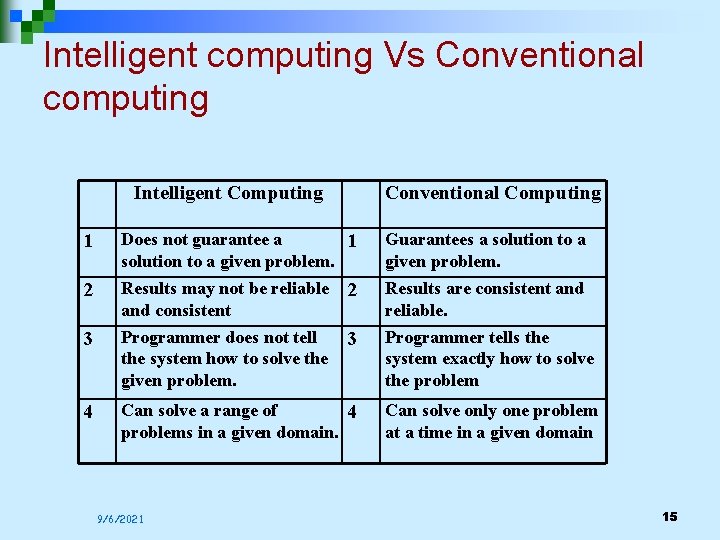
Intelligent computing Vs Conventional computing Intelligent Computing Conventional Computing 1 Does not guarantee a 1 solution to a given problem. Guarantees a solution to a given problem. 2 Results may not be reliable and consistent 2 Results are consistent and reliable. 3 Programmer does not tell the system how to solve the given problem. 3 Programmer tells the system exactly how to solve the problem 4 Can solve a range of 4 problems in a given domain. Can solve only one problem at a time in a given domain 9/6/2021 15
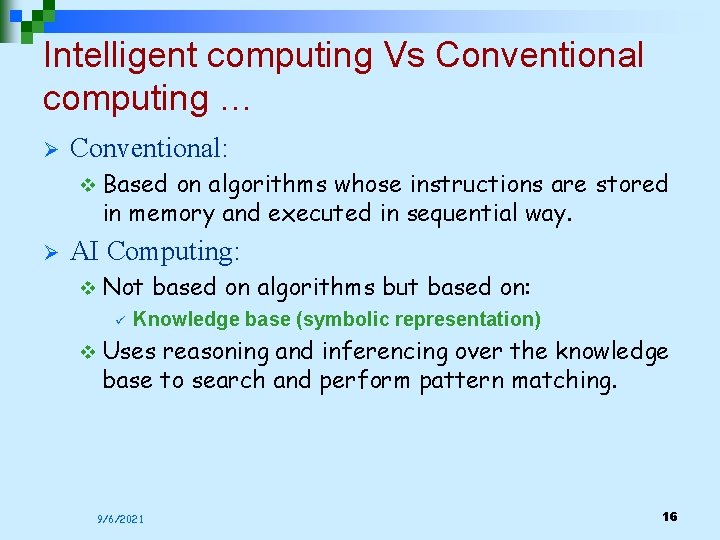
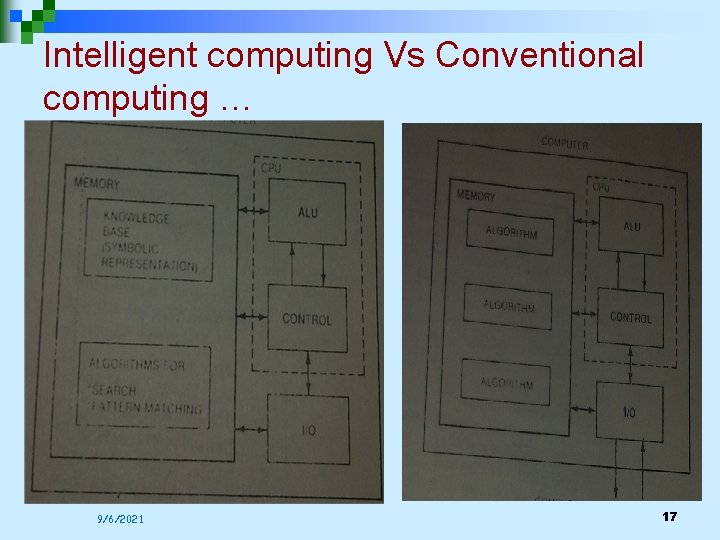
Intelligent computing Vs Conventional computing … Ø Conventional: v Based on algorithms whose instructions are stored in memory and executed in sequential way. Ø AI Computing: v Not ü based on algorithms but based on: Knowledge base (symbolic representation) v Uses reasoning and inferencing over the knowledge base to search and perform pattern matching. 9/6/2021 16
Intelligent computing Vs Conventional computing … 9/6/2021 17
Applications of AI Ø Ø Ø Ø Game playing General problem solving Expert system Natural language Processing Computer vision Robotics Education Others 9/6/2021 18
Contributions of other disciplines to AI Ø Philosophy Ø Mathematics Ø Economics Neuroscience Ø Logic, methods of reasoning, mind as physical system, foundations of learning, language, rationality (wisdom) Formal representation and proof of algorithms, computation, (un)decidability, (in)tractability, probability utility, decision theory how do brain process information (neuron operation) Ø 9/6/2021 19
Abridged history of artificial intelligence Ø Ø 1941 1943 v Ø first electric computer was developed Mc. Culloch & Pitts: Boolean circuit model of brain 1949 first “stored program” computer was introduced Ø 9/6/2021 20
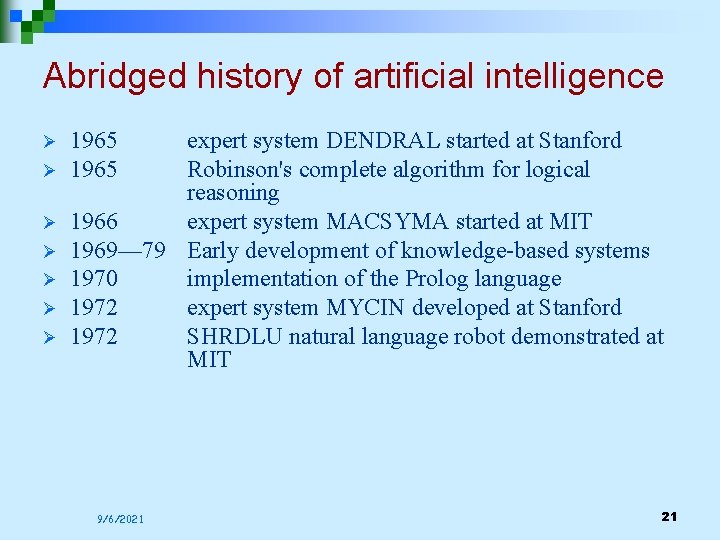
Abridged history of artificial intelligence Ø Ø Ø Ø 1965 expert system DENDRAL started at Stanford Robinson's complete algorithm for logical reasoning 1966 expert system MACSYMA started at MIT 1969— 79 Early development of knowledge-based systems 1970 implementation of the Prolog language 1972 expert system MYCIN developed at Stanford 1972 SHRDLU natural language robot demonstrated at MIT 9/6/2021 21
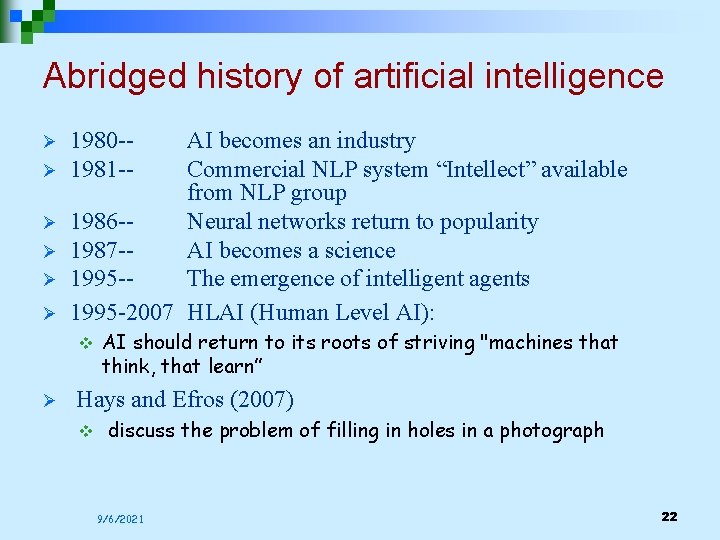
Abridged history of artificial intelligence Ø Ø Ø 1980 -1981 -- AI becomes an industry Commercial NLP system “Intellect” available from NLP group 1986 -Neural networks return to popularity 1987 -AI becomes a science 1995 -The emergence of intelligent agents 1995 -2007 HLAI (Human Level AI): v Ø AI should return to its roots of striving "machines that think, that learn” Hays and Efros (2007) v discuss the problem of filling in holes in a photograph 9/6/2021 22
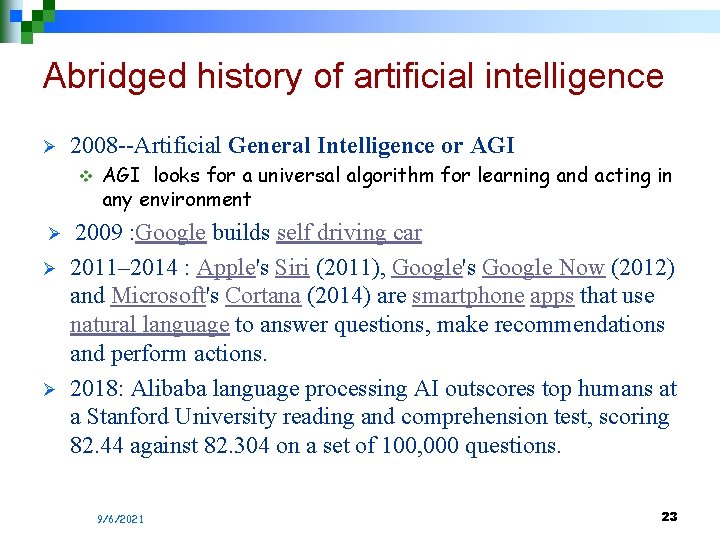
Abridged history of artificial intelligence Ø 2008 --Artificial General Intelligence or AGI v Ø Ø Ø AGI looks for a universal algorithm for learning and acting in any environment 2009 : Google builds self driving car 2011– 2014 : Apple's Siri (2011), Google's Google Now (2012) and Microsoft's Cortana (2014) are smartphone apps that use natural language to answer questions, make recommendations and perform actions. 2018: Alibaba language processing AI outscores top humans at a Stanford University reading and comprehension test, scoring 82. 44 against 82. 304 on a set of 100, 000 questions. 9/6/2021 23
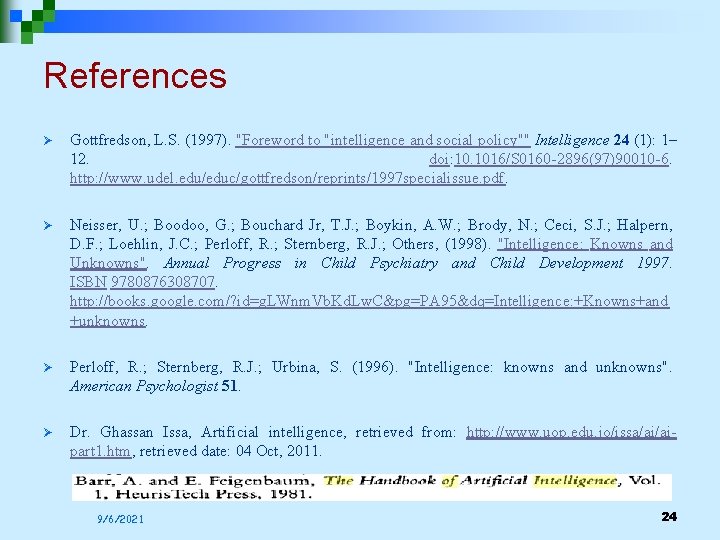
References Ø Gottfredson, L. S. (1997). "Foreword to "intelligence and social policy"" Intelligence 24 (1): 1– 12. doi: 10. 1016/S 0160 -2896(97)90010 -6. http: //www. udel. edu/educ/gottfredson/reprints/1997 specialissue. pdf. Ø Neisser, U. ; Boodoo, G. ; Bouchard Jr, T. J. ; Boykin, A. W. ; Brody, N. ; Ceci, S. J. ; Halpern, D. F. ; Loehlin, J. C. ; Perloff, R. ; Sternberg, R. J. ; Others, (1998). "Intelligence: Knowns and Unknowns". Annual Progress in Child Psychiatry and Child Development 1997. ISBN 9780876308707. http: //books. google. com/? id=g. LWnm. Vb. Kd. Lw. C&pg=PA 95&dq=Intelligence: +Knowns+and +unknowns. Ø Perloff, R. ; Sternberg, R. J. ; Urbina, S. (1996). "Intelligence: knowns and unknowns". American Psychologist 51. Ø Dr. Ghassan Issa, Artificial intelligence, retrieved from: http: //www. uop. edu. jo/issa/ai/aipart 1. htm, retrieved date: 04 Oct, 2011. 9/6/2021 24
References Ø Crash Course in Artificial Intelligence and Expert systems by Louise E. Frenzel. Ø Chapter No. 1 9/6/2021 25
Question? ? 9/6/2021 26
The end 9/6/2021 27