
Artificial Groundwater Recharge What you need to know

- Slides: 13
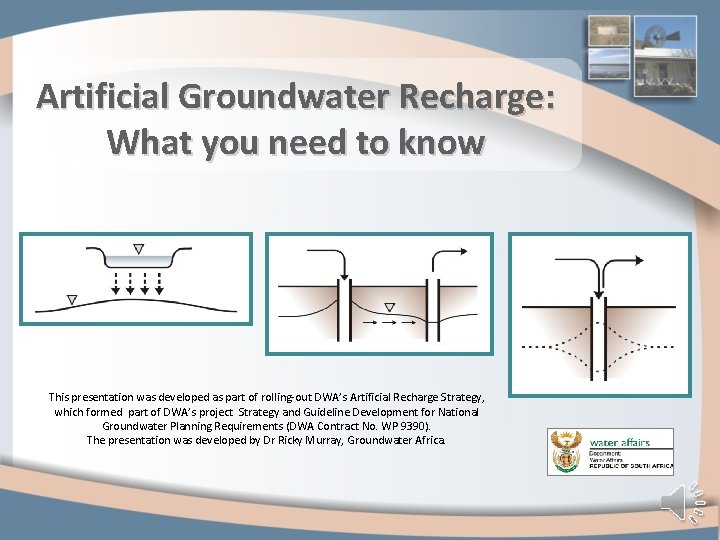
Artificial Groundwater Recharge: What you need to know This presentation was developed as part of rolling-out DWA’s Artificial Recharge Strategy, which formed part of DWA’s project Strategy and Guideline Development for National Groundwater Planning Requirements (DWA Contract No. WP 9390). The presentation was developed by Dr Ricky Murray, Groundwater Africa.
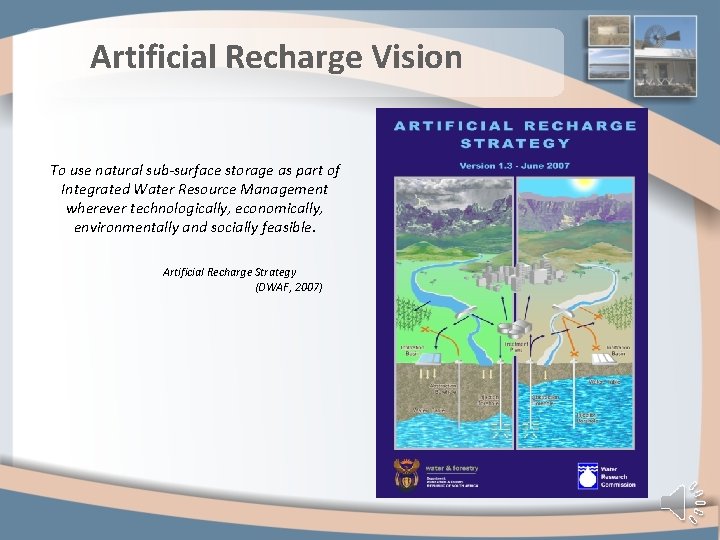
Artificial Recharge Vision To use natural sub-surface storage as part of Integrated Water Resource Management wherever technologically, economically, environmentally and socially feasible. Artificial Recharge Strategy (DWAF, 2007)
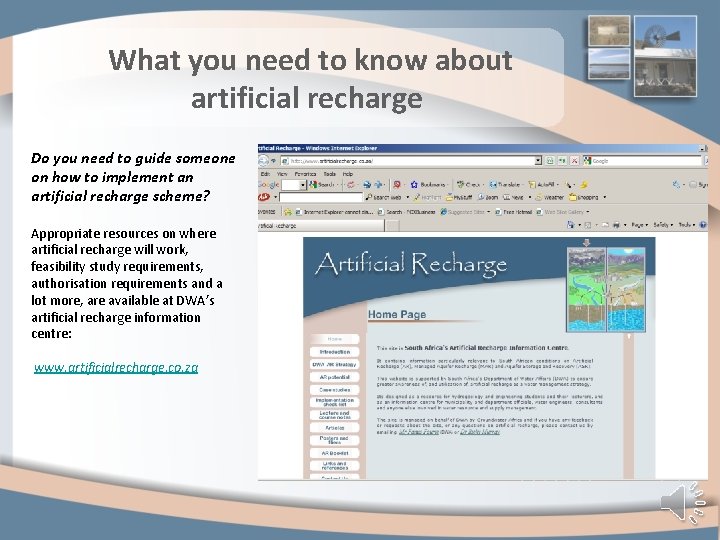
What you need to know about artificial recharge Do you need to guide someone on how to implement an artificial recharge scheme? Appropriate resources on where artificial recharge will work, feasibility study requirements, authorisation requirements and a lot more, are available at DWA’s artificial recharge information centre: www. artificialrecharge. co. za
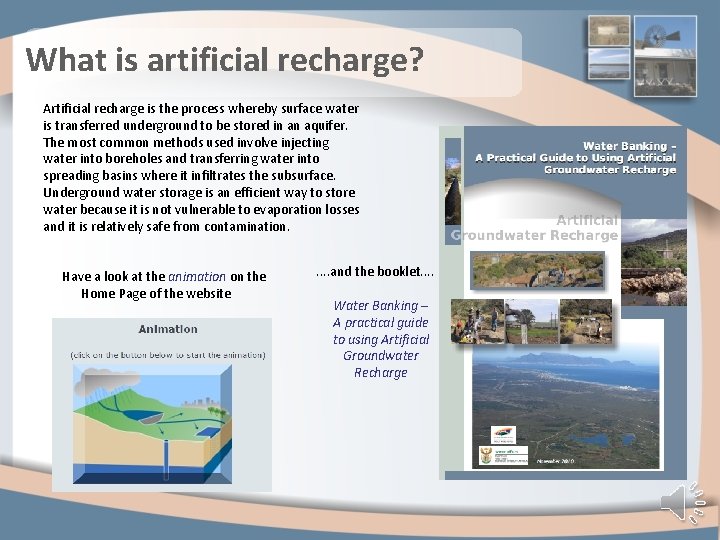
What is artificial recharge? Artificial recharge is the process whereby surface water is transferred underground to be stored in an aquifer. The most common methods used involve injecting water into boreholes and transferring water into spreading basins where it infiltrates the subsurface. Underground water storage is an efficient way to store water because it is not vulnerable to evaporation losses and it is relatively safe from contamination. Have a look at the animation on the Home Page of the website . . and the booklet. . Water Banking – A practical guide to using Artificial Groundwater Recharge
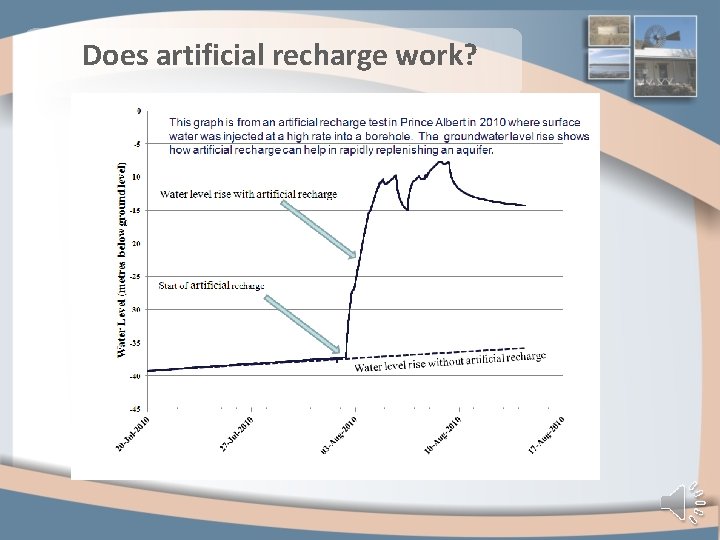
Does artificial recharge work?
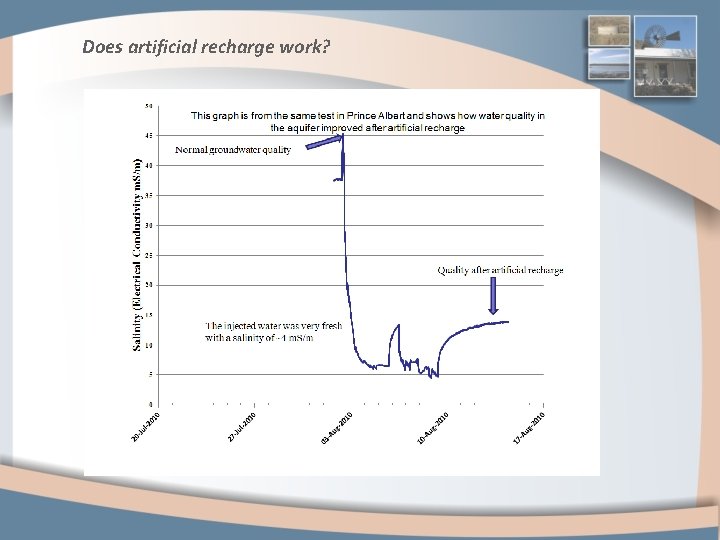
Does artificial recharge work?
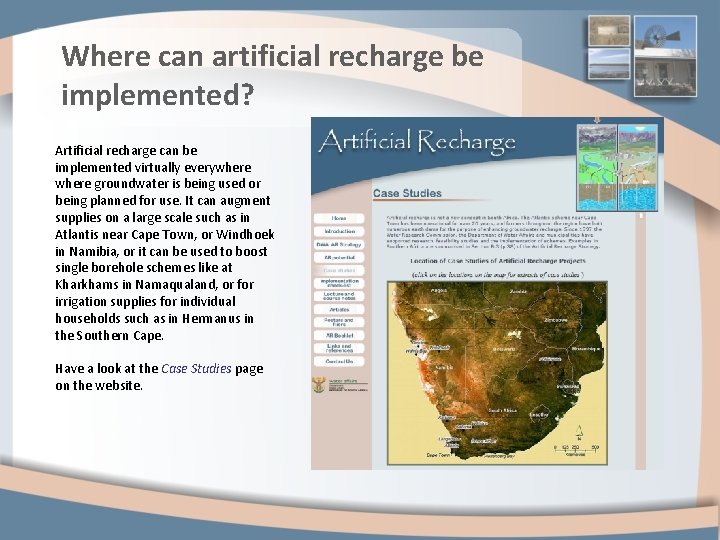
Where can artificial recharge be implemented? Artificial recharge can be implemented virtually everywhere groundwater is being used or being planned for use. It can augment supplies on a large scale such as in Atlantis near Cape Town, or Windhoek in Namibia, or it can be used to boost single borehole schemes like at Kharkhams in Namaqualand, or for irrigation supplies for individual households such as in Hermanus in the Southern Cape. Have a look at the Case Studies page on the website.
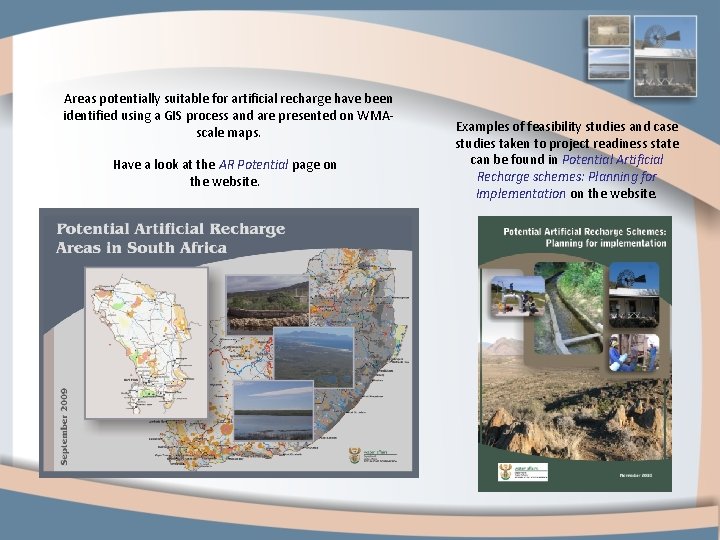
Areas potentially suitable for artificial recharge have been identified using a GIS process and are presented on WMAscale maps. Have a look at the AR Potential page on the website. Examples of feasibility studies and case studies taken to project readiness state can be found in Potential Artificial Recharge schemes: Planning for Implementation on the website.
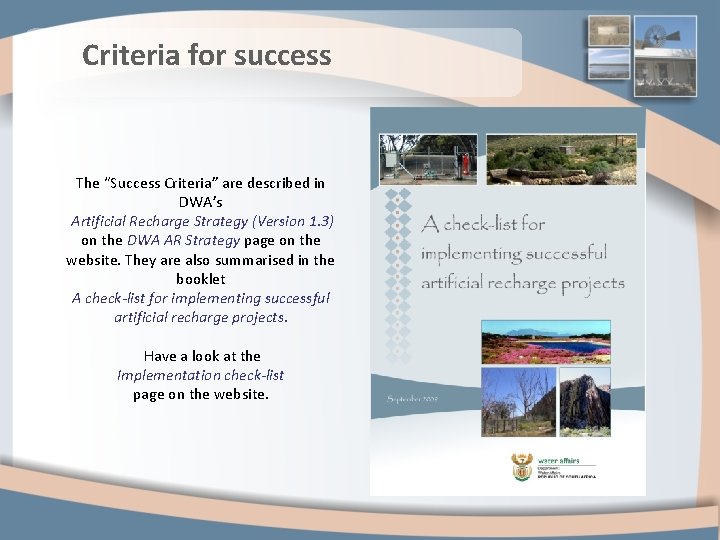
Criteria for success The “Success Criteria” are described in DWA’s Artificial Recharge Strategy (Version 1. 3) on the DWA AR Strategy page on the website. They are also summarised in the booklet A check-list for implementing successful artificial recharge projects. Have a look at the Implementation check-list page on the website.
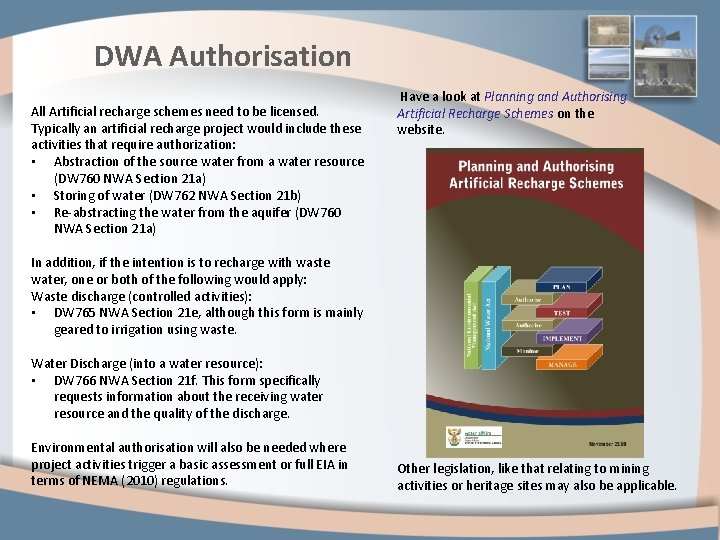
DWA Authorisation All Artificial recharge schemes need to be licensed. Typically an artificial recharge project would include these activities that require authorization: • Abstraction of the source water from a water resource (DW 760 NWA Section 21 a) • Storing of water (DW 762 NWA Section 21 b) • Re-abstracting the water from the aquifer (DW 760 NWA Section 21 a) In addition, if the intention is to recharge with waste water, one or both of the following would apply: Waste discharge (controlled activities): • DW 765 NWA Section 21 e, although this form is mainly geared to irrigation using waste. Water Discharge (into a water resource): • DW 766 NWA Section 21 f. This form specifically requests information about the receiving water resource and the quality of the discharge. Environmental authorisation will also be needed where project activities trigger a basic assessment or full EIA in terms of NEMA (2010) regulations. Have a look at Planning and Authorising Artificial Recharge Schemes on the website. Other legislation, like that relating to mining activities or heritage sites may also be applicable.
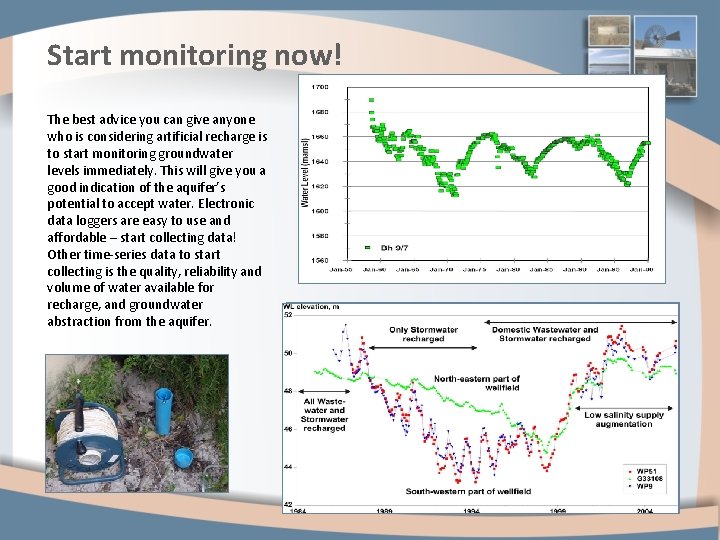
Start monitoring now! The best advice you can give anyone who is considering artificial recharge is to start monitoring groundwater levels immediately. This will give you a good indication of the aquifer’s potential to accept water. Electronic data loggers are easy to use and affordable – start collecting data! Other time-series data to start collecting is the quality, reliability and volume of water available for recharge, and groundwater abstraction from the aquifer.
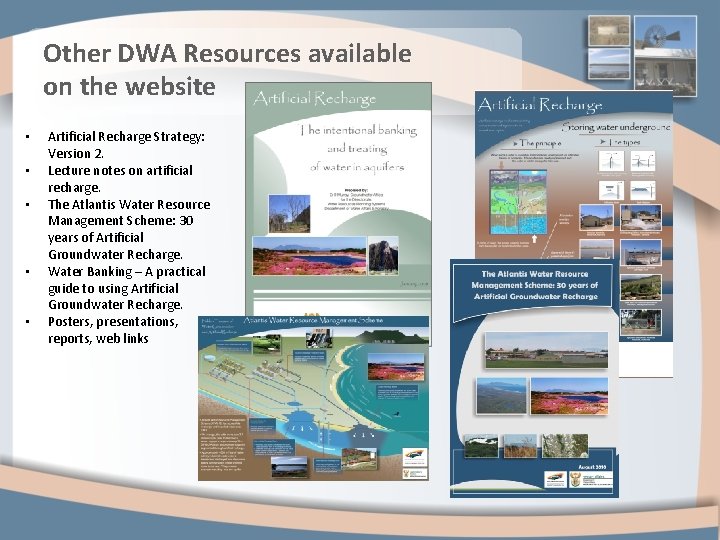
Other DWA Resources available on the website • • • Artificial Recharge Strategy: Version 2. Lecture notes on artificial recharge. The Atlantis Water Resource Management Scheme: 30 years of Artificial Groundwater Recharge. Water Banking – A practical guide to using Artificial Groundwater Recharge. Posters, presentations, reports, web links
Thank you