
Artifacts 101 The Role of Artifacts in Educator
- Slides: 16
Artifacts 101: The Role of Artifacts in Educator Support and Evaluation
Outcomes • Explain the three categories of evidence required by the Oregon Framework, and identify concrete examples of each • Understand the role of artifacts in the evaluation process • Identify a process that is efficient and effective and reduces redundancy 2
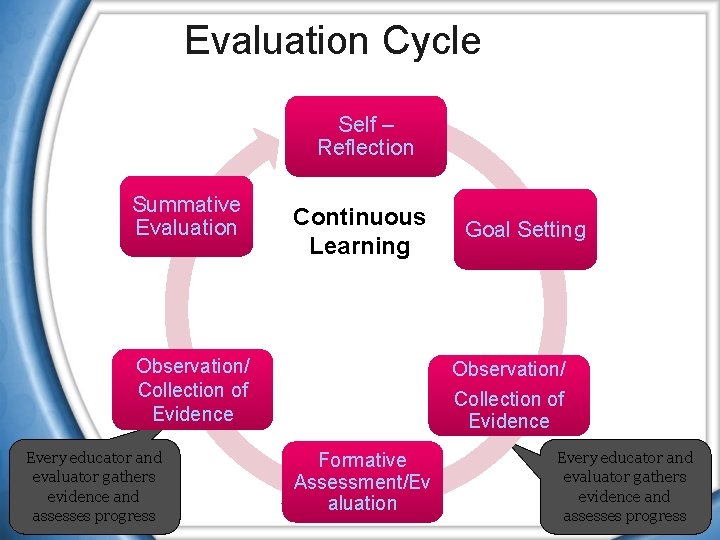
Evaluation Cycle Self – Reflection Summative Evaluation Continuous Learning Observation/ Collection of Evidence Every educator and evaluator gathers evidence and assesses progress Goal Setting Observation/ Collection of Evidence Formative Assessment/Ev aluation Every educator and evaluator gathers evidence and assesses progress
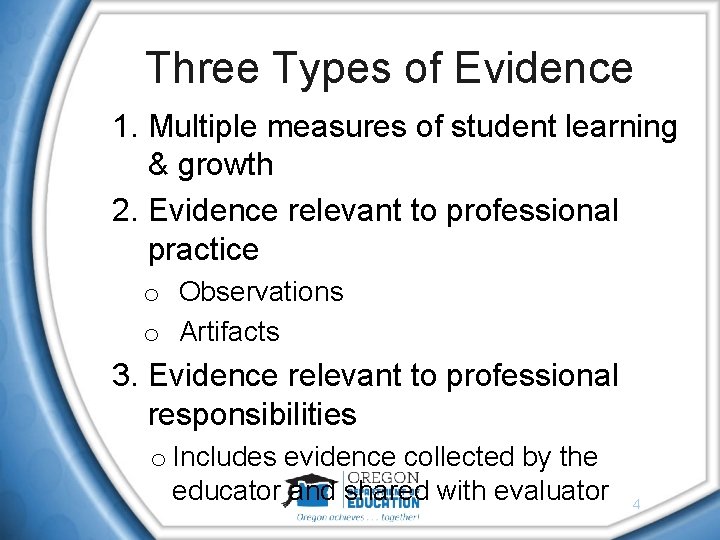
Three Types of Evidence 1. Multiple measures of student learning & growth 2. Evidence relevant to professional practice o Observations o Artifacts 3. Evidence relevant to professional responsibilities o Includes evidence collected by the educator and shared with evaluator 4
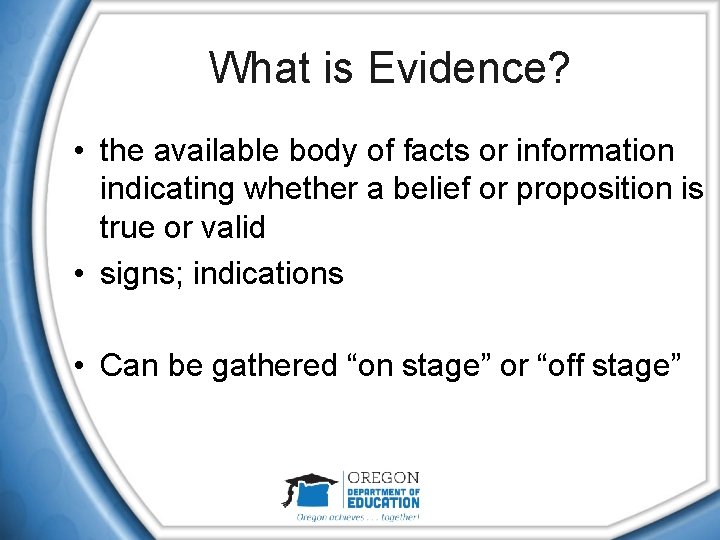
What is Evidence? • the available body of facts or information indicating whether a belief or proposition is true or valid • signs; indications • Can be gathered “on stage” or “off stage”
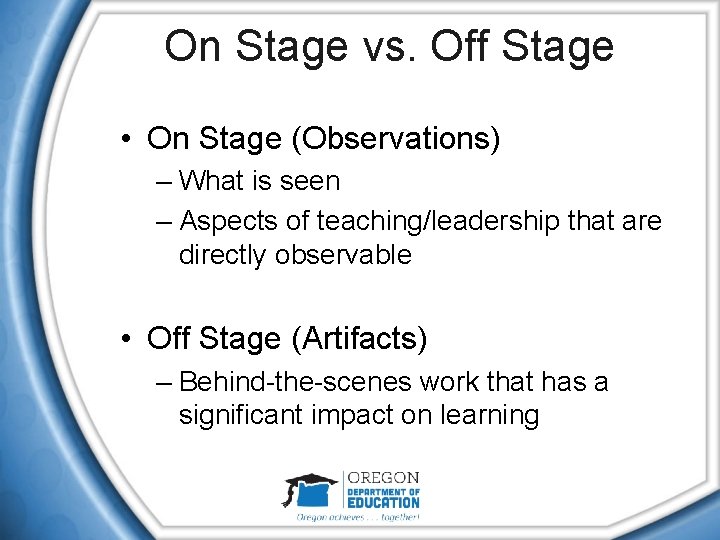
On Stage vs. Off Stage • On Stage (Observations) – What is seen – Aspects of teaching/leadership that are directly observable • Off Stage (Artifacts) – Behind-the-scenes work that has a significant impact on learning
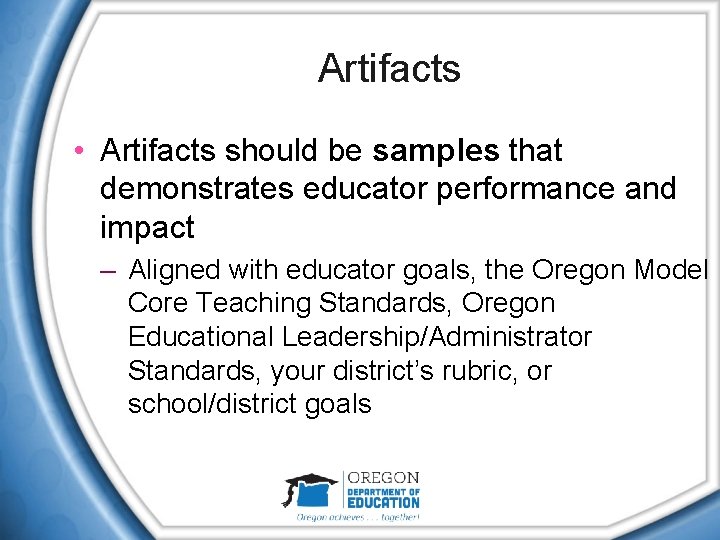
Artifacts • Artifacts should be samples that demonstrates educator performance and impact – Aligned with educator goals, the Oregon Model Core Teaching Standards, Oregon Educational Leadership/Administrator Standards, your district’s rubric, or school/district goals
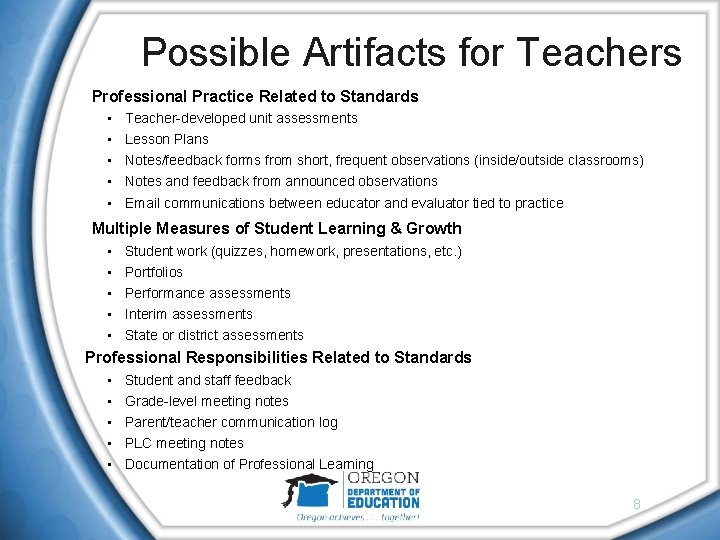
Possible Artifacts for Teachers Professional Practice Related to Standards • • • Teacher-developed unit assessments Lesson Plans Notes/feedback forms from short, frequent observations (inside/outside classrooms) Notes and feedback from announced observations Email communications between educator and evaluator tied to practice Multiple Measures of Student Learning & Growth • • • Student work (quizzes, homework, presentations, etc. ) Portfolios Performance assessments Interim assessments State or district assessments Professional Responsibilities Related to Standards • • • Student and staff feedback Grade-level meeting notes Parent/teacher communication log PLC meeting notes Documentation of Professional Learning 8
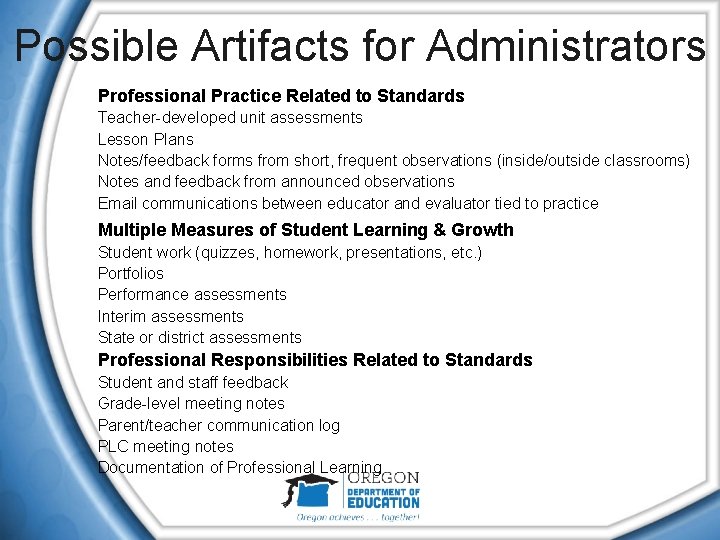
Possible Artifacts for Administrators Professional Practice Related to Standards Teacher-developed unit assessments Lesson Plans Notes/feedback forms from short, frequent observations (inside/outside classrooms) Notes and feedback from announced observations Email communications between educator and evaluator tied to practice Multiple Measures of Student Learning & Growth Student work (quizzes, homework, presentations, etc. ) Portfolios Performance assessments Interim assessments State or district assessments Professional Responsibilities Related to Standards Student and staff feedback Grade-level meeting notes Parent/teacher communication log PLC meeting notes Documentation of Professional Learning
What does the Framework say? • “The educator and evaluator collect evidence using multiple measures regarding student learning and growth, professional practice, professional responsibilities, and student learning to inform progress throughout the process of evaluation” • Provides examples of artifacts for PP and PR
Setting Your District Up for Success • Get Organized • Be Strategic • Communicate Expectations
1. Get Organized • Adopt a process for organizing artifacts by Standard or Indicator and/or goals: – Paper-based, email-driven, or online “cloudbased” system • Identify key points of contact throughout the year to review artifacts • Assign Responsibility – Educator collects and submits artifacts throughout the evaluation cycle – Evaluator organizes and analyzes artifacts 12
2. Be Strategic • The more focused the Student Learning and Growth and Professional Goals, the easier it is to identify and collect artifacts. • Share examples of artifacts during faculty or team meetings that provide evidence of more than one Standard or Indicator. • Identify common artifacts that all or most educators might already be collecting (unit assessments, parent-teacher logs, etc. ). • Number of artifacts to collect varies by educator 13
3. Communicate Expectations • Artifacts should be samples that demonstrates educator performance and impact • Evidence should be clearly tied to educator goals, Standards, or Indicators • Provide everyone with a clear idea of what, how, and when to share products of practice 14
Possible Processes • Artifacts reviewed through the lens of the performance rubric vs. “artifact tool” • Choice of artifacts left up to educator and evaluator vs. district required list of artifacts • Other?
Contacts • Brian Putnam brian. putnam@state. or. us • Sarah Martin sarah. martin@state. or. us