
Artifact analysis method Research skills and methods DOM
- Slides: 13
Artifact analysis method Research skills and methods, DOM E 0001 Media Design Research Prof. Lily Díaz-Kommonen 06 November 2017
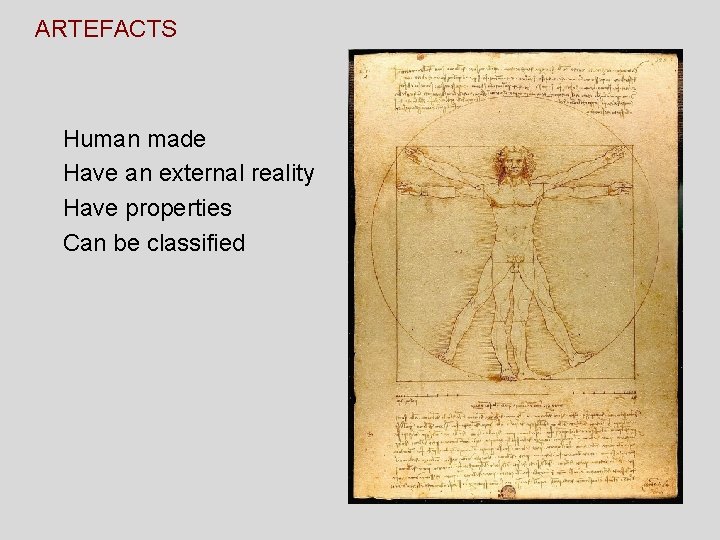
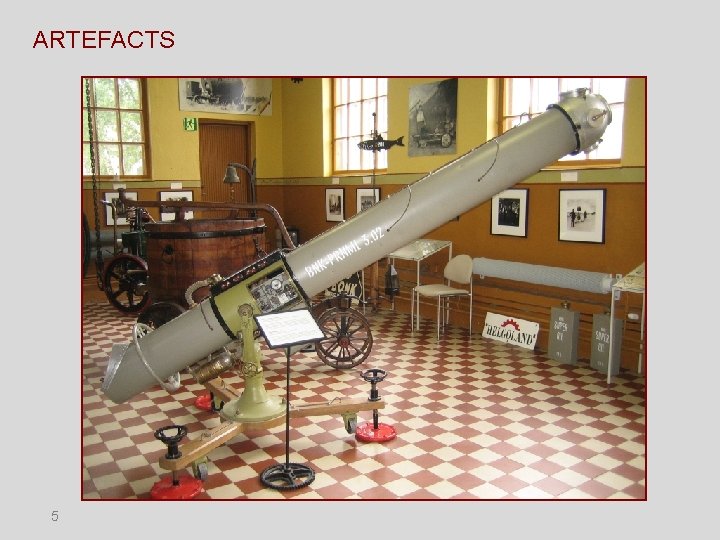
ARTEFACTS Human made Have an external reality Have properties Can be classified
ARTEFACTS
ARTEFACTS
ARTEFACTS 5
ARTEFACT DEFINITION – Risto Hilpinen Self-referential Accurate Scientific Ontological Authorship 6
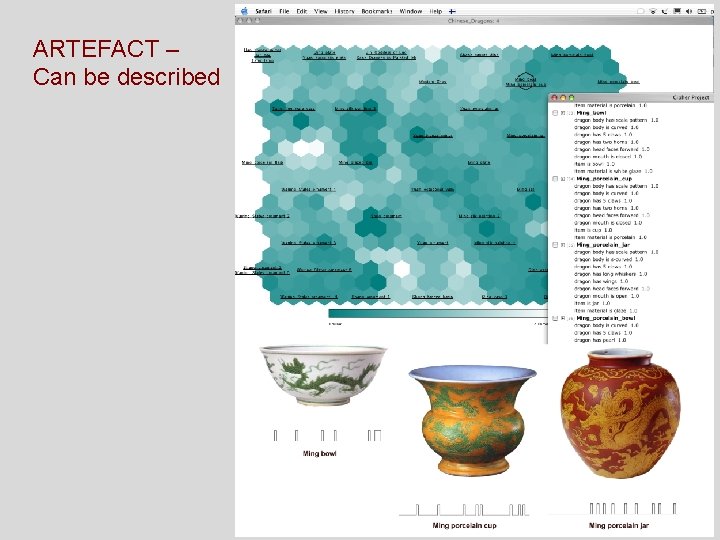
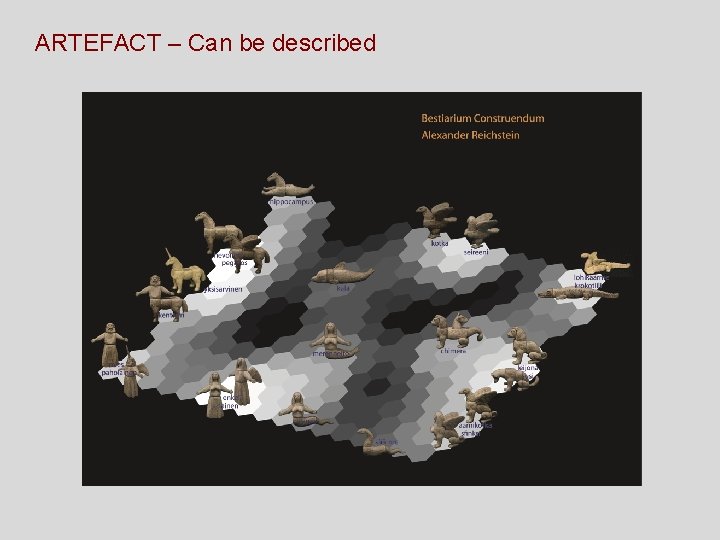
ARTEFACT DEFINITION “An artefact is any item, conceptual or material, created by a human being. An artifact can be described by a large, and virtually infinite number of descriptive features. These properties, which can be depicted as vectors, also define the position of the artifact in a multidimensional space. ” (Díaz-Kommonen & Kaipainen, 2002) 7
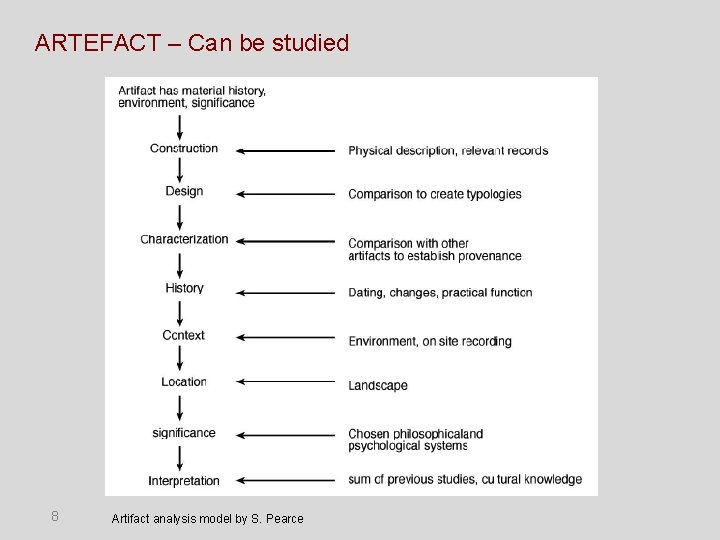
ARTEFACT – Can be studied 8 Artifact analysis model by S. Pearce
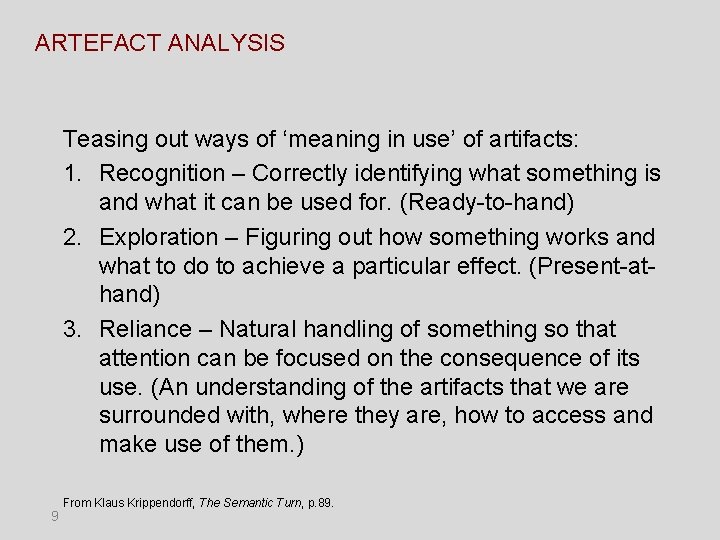
ARTEFACT ANALYSIS Teasing out ways of ‘meaning in use’ of artifacts: 1. Recognition – Correctly identifying what something is and what it can be used for. (Ready-to-hand) 2. Exploration – Figuring out how something works and what to do to achieve a particular effect. (Present-athand) 3. Reliance – Natural handling of something so that attention can be focused on the consequence of its use. (An understanding of the artifacts that we are surrounded with, where they are, how to access and make use of them. ) 9 From Klaus Krippendorff, The Semantic Turn, p. 89.
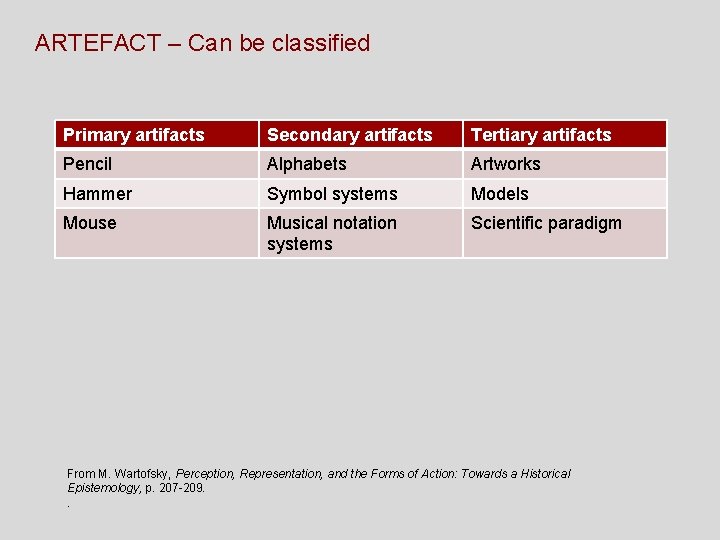
ARTEFACT – Can be classified Primary artifacts Secondary artifacts Tertiary artifacts Pencil Alphabets Artworks Hammer Symbol systems Models Mouse Musical notation systems Scientific paradigm From M. Wartofsky, Perception, Representation, and the Forms of Action: Towards a Historical Epistemology, p. 207 -209. .
ARTEFACT – Can be described
ARTEFACT – Can be described
ARTIFACT – Design activity The bringing -to-be of an artifact, its components and their organization, which interfaces in the desired manner with its outer environment, is one of the key activities of design research.