
Articulation Treatment The Baseline Phase Step 1 n

Articulation Treatment The Baseline Phase
Step 1 n Has your client already had a recent articulation evaluation or is s/he continuing in treatment from a previous quarter? – Do you know what sounds are in error? – Do you know what sounds are to be targeted in treatment from given recommendations? If NO, then go to Step 2 If YES, then go to Step 3
Step 2 – Articulation Evaluation n Conduct an evaluation using an articulation test. n Conduct a structural-functional exam
Step 2 – Articulation Test n There are many to choose from. n Some easy to administer tests include: – Goldman Fristoe Test of Articulation – 2 – Structured Photographic Articulation Test – II – Arizona Articulation Proficiency Scale
Step 2 – Articulation Test n Of the errors you find on the test, choose sounds in error or patterns that are expected to be developed by the child’s age and/or affect intelligibility the most. n If there are multiple sounds in error, conduct stimulability testing first to determine which sounds you will target for treatment (see Step 4 – Stimulability).
Step 2 – Structural-Functional Exam n Conduct a structural-functional exam to rule out any issues with the structure or function of the child’s articulators. n You will look at strength, range of motion, and coordination of the articulators. n You will receive instruction on this.
Step 3 – Connected Speech Sample n The connected speech sample is an important component of the baseline probing process. n You need to conduct this and put your findings in the assessment section of the report. n This information is generally reported as “percent correct. ”
Step 3 – Connected Speech Sample n Usually having a conversation with a child is sufficient for eliciting a sample with plenty of examples of sound/s in error in multiple word positions. n There is no set time limit to the connected speech sample – the point is to obtain an adequate sample of sounds. If you can do that in a 3 minute sample, great. If you need more time, take it.
Step 3 – Connected Speech Sample n If you are trying to elicit less frequently occurring sound/s you may need to try some other strategies to ensure you get an adequate sample.
Step 3 – Connected Speech Sample n Possible strategies (not inclusive): – Using a story retelling task that is loaded with the target sound. For example, Storytelling Probes of Articulation Competence (SPAC) is a pre-made resource available in the Materials Room. – You might also provide the child with picture cards of words with the target sound/s in many positions and have them create a silly story for you. Note: You may have to provide an example to the child of how to create the story – use other cards.
Step 3 – Connected Speech Sample n When you are recording data from the speech sample, you do not necessarily have to be careful to record by word position. n In general you record a “+” or “-” for all opportunities for the target sound and report it as a set. – (e. g. , /s/ was in error in 60% of opportunities in connected speech)
Step 3 – Connected Speech Sample Caveat! If, as you are analyzing your connected speech sample, you are hearing a pattern (e. g. , /s/ is correct in all word final positions, but in error in all other positions), you must record and report that. That is a significant finding.
Step 4 - Stimulability n Stimulability – Is trial teaching. – Is generally quick. – Informs your treatment: It tells you § what sounds (if there are multiple errors) are ready to be taught (or can be left alone to develop on their own!) § at what response level and cuing level to start in treatment for a single error sound.
Step 4 - Stimulability n As with all treatment, it is important to think systematically when doing stimulability. n Different clinicians have different ways of approaching stimulability, but the next several slides will describe one way to do it.
Step 4 - Stimulability your Eliciting Sounds, 2 E (Secord) focusing on the sounds you know to be in error. n Practice administering elicitation strategies on a peer, loved one, or child if you can. n Of course talk to your supervisor about any “tricks of the trade” s/he might have to share with you. n Study
Step 4 - Stimulability n Prepare word, phrase, and sentence lists that you will use during this trial teaching phase. n Available to you is a document to help you with this: http: //courses. washington. edu/sop/Artic. La ng/Stimulability. pdf
Step 4 - Stimulability n Start at the word level. n Try different word positions using a variety of teaching cues. n If the client is not succeeding, go down to the syllable level. n If the client is still not succeeding, try at the isolation level.
Step 4 - Stimulability n Of course if the child is doing well at the word level, increase to the phrase level. – You might do short, functional phrases (e. g. , “a white tooth” – You might use a “rote phrase” (e. g. , I see a ___; “This is a ___”) n If the child is doing well at the phrase level, increase to the sentence level.
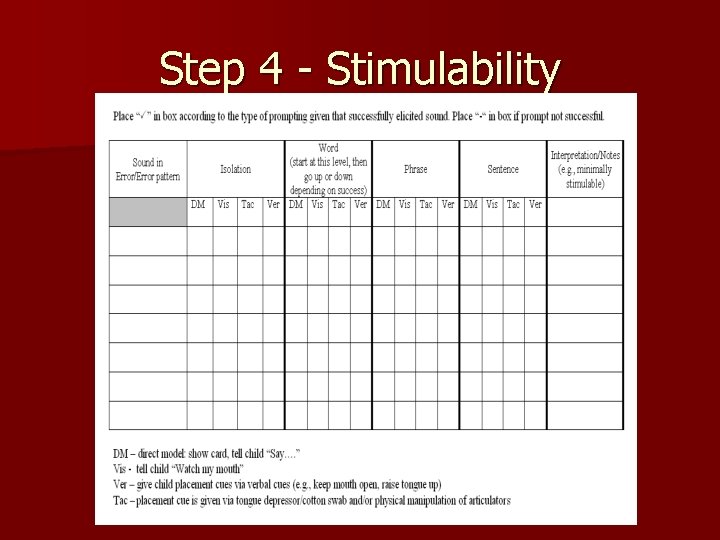
Step 4 - Stimulability n On the following slide is an example of a chart that you might want to create for yourself to help record your data.
Step 4 - Stimulability
Step 5 – Baseline Word Probes n Once you have established your target sounds you will administer word probes. n In general, you will probe all word positions or contexts.
Step 5 – Baseline Word Probes n Prepare probe cards. n There are many materials available in the Materials Room Articulation/Phonology cabinet. Or you can create your own. n Ideally find 10 words per position/pattern (but remember you have to have words to use in treatment as well). n If that’s not possible, see next slide for a strategy.
Step 5 – Baseline Word Probes n Can’t find 10 words per position? – Try to come up with at least 3 words per position/pattern. – Then present cards 2 times (not back to back though) to get a minimum of 6 opportunities.
Step 5 – Baseline Word Probes Probe cards may be either written words or picture cards. n Use good judgment in deciding whether it is appropriate to use only written words. Consider the age/educational level of the child. n Be sure to choose words that are appropriate vocabulary (consider age and experience of child as well as family religious/cultural beliefs). n
Step 5 – Baseline Word Probes n When selecting words try to keep the sounds in “pure positions. ” n For example, some commercial materials may use a word like “mushroom” as a medial ‘sh’ word. But technically speaking, in this case it is a syllable final sound and the /r/ may make it extra difficult. This is in contrast with “fishing” where the sound is truly intervocalic. Try the best you can.
Step 5 – Baseline Word Probes n When presenting baseline word probes you will instruct the child: “I’m going to show you a card with a word on it. I want you to say the word for me. If you are not sure what the word is, I will tell you and then we’ll come back to it later to see if you remember it. ”
Step 5 – Baseline Word Probes n In general we obtain 2 baseline word probe data points. – If the child was seen in a previous quarter (except for Summer), you can use a data point from the previous quarter as one of your baseline data points. n Once you have collected your baseline word probe data you will put these word cards away – probably until the end of the quarter. Do NOT use your baseline word probe cards for treatment (unless there is a special circumstance).
Step 6 – Begin the Treatment Phase n You now have all the information you might need to get started with treatment. n Be sure to prepare adequate treatment materials to begin your teaching.
Step 6 – Begin the Treatment Phase n Begin to think about Behavioral Objectives. n Think about what you can realistically achieve by the end of the quarter (consider stimulability results). n For the purposes of this clinical experience, you probably will not be writing your BOs at the level of generalization. Read on…
Step 6 – Begin the Treatment Phase n You will likely write your BOs in terms of where in treatment you will get. n So your BOs will reflect that you will use “treated” words, not “untreated. ” n You could write a BO that reflects performance at the conversational level, if that is appropriate (i. e. , your stimulability testing indicated the child is ready to work at a high level – like the sentence level).
Step 6 – Begin the Treatment Phase n You will talk about the child’s performance on “untreated” words in the generalization section after each behavioral objective.
Questions? n If you have any questions about the baseline process – Ask your supervisor!
- Slides: 32