
Articulation Disorders vs Phonological Disorders Standardized tests Consonant
- Slides: 31
� Articulation Disorders vs. � Phonological Disorders
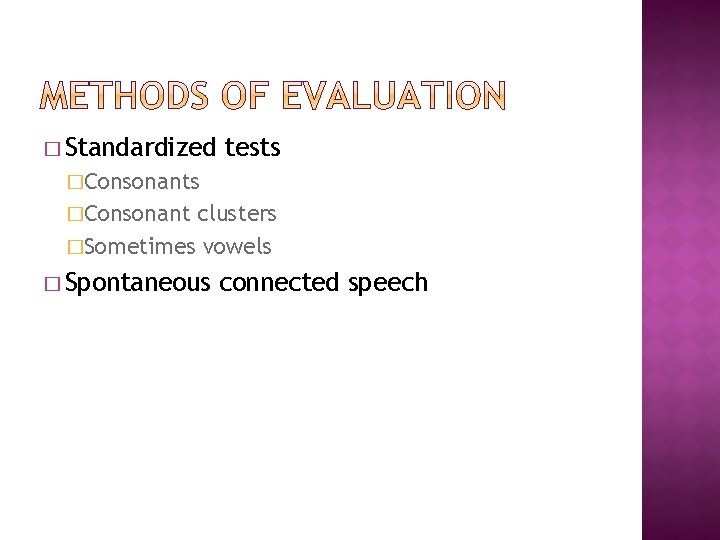
� Standardized tests �Consonant clusters �Sometimes vowels � Spontaneous connected speech
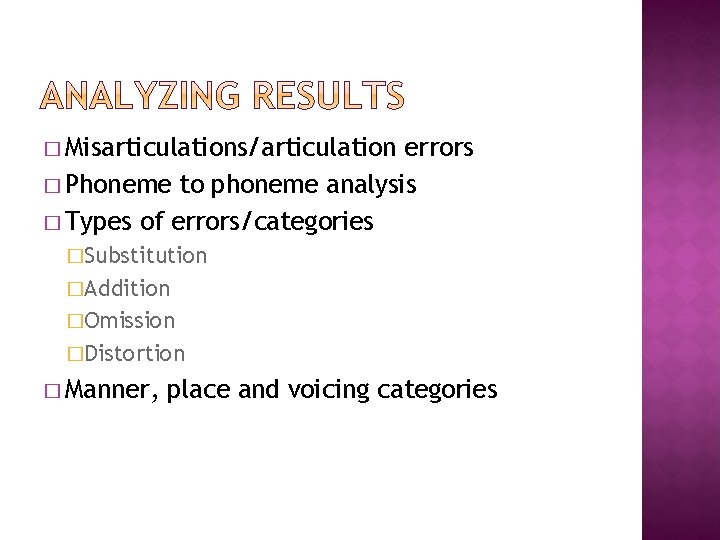
� Misarticulations/articulation errors � Phoneme to phoneme analysis � Types of errors/categories �Substitution �Addition �Omission �Distortion � Manner, place and voicing categories
� Disparity of Findings �Socioeconomic �Number of subjects �Method of speech sampling �Determining mastery – the age at which a particular phoneme is produced with some degree of accuracy (75 -100% or 90 -100%) �Customary Production – the age at which a particular phoneme is produced with greater than 50% accuracy in at least two word positions. �Gender of subjects �Dialects
� 90% mastery of several phonemes occurs by 3 � Master of English phonemes may not be complete until 7 -9 years � Manner – nasal, stops acquired first, then glides, fricatives, liquids and affricates � Place – front (labial/alverolar) produced first, then velar and palatal.
� Based on Natural Phonology theory – young children are born with innate processes necessary for the production of speech. � They often simplify the adult form. � As they mature, they learn to suppress the processes, and produce the appropriate form
� Simplification of adult speech patterns � As children mature they learn to suppress these processes � Child is not viewed as not having a sound in his phonetic inventory, but as using a process that results in the deletion of that sound � Are found in typically developing children
� Categories �Syllable structure processes �Substitution processes �Assimilatory processes
� Table 7. 2
� Syllables are simplified, usually into a consonant-vowel (CV) pattern � CV patterns among the first to be used by infants
�Weak syllable is omitted when it precedes or follows a stressed syllable �Final syllable deletion consonant deletion Final consonant is deleted Patten becomes open syllable (CV) Children start to use final consonants by 3: 0 Process suppressed by 3: 6
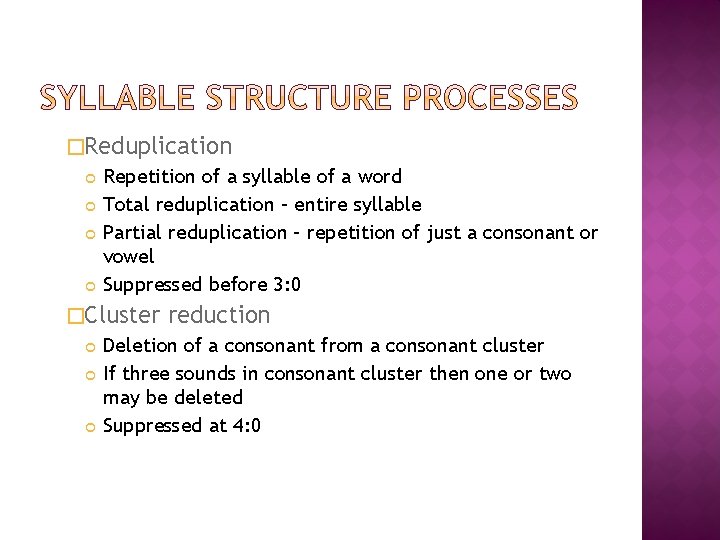
�Reduplication Repetition of a syllable of a word Total reduplication – entire syllable Partial reduplication – repetition of just a consonant or vowel Suppressed before 3: 0 �Cluster reduction Deletion of a consonant from a consonant cluster If three sounds in consonant cluster then one or two may be deleted Suppressed at 4: 0
� The replacement of one class of phonemes for another
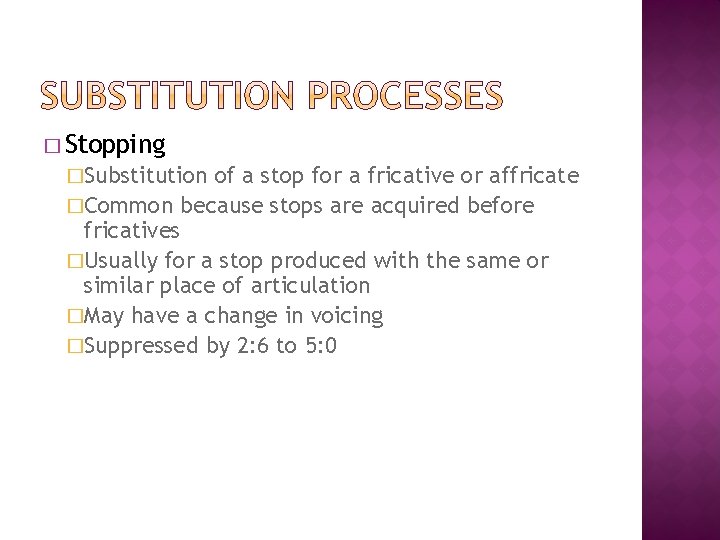
� Stopping �Substitution of a stop for a fricative or affricate �Common because stops are acquired before fricatives �Usually for a stop produced with the same or similar place of articulation �May have a change in voicing �Suppressed by 2: 6 to 5: 0
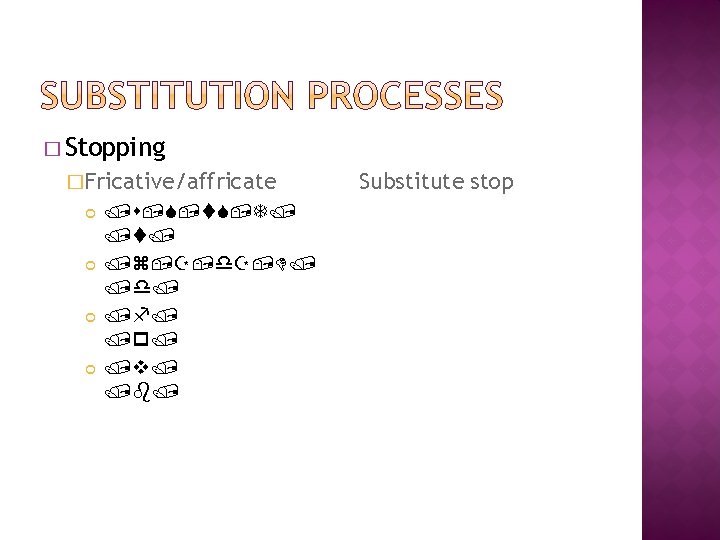
� Stopping �Fricative/affricate s, , , p b Substitute stop
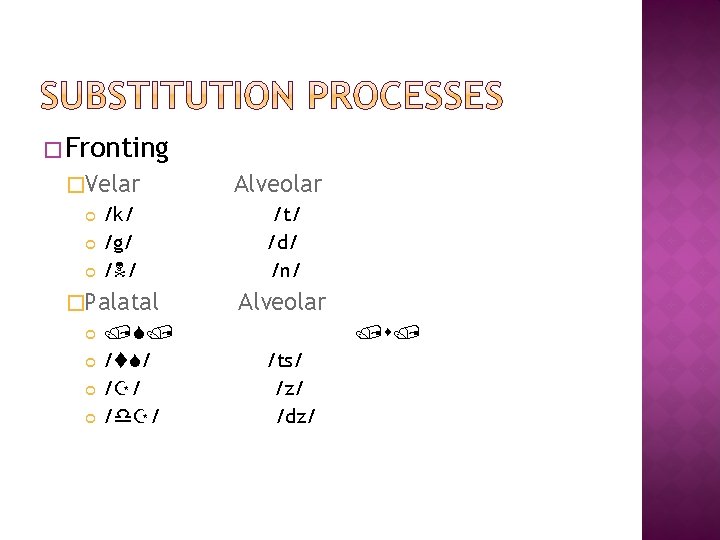
� Fronting �Substitution of velar and palatal consonants with alveolar place of articulation �Suppressed by 2: 6 to 3: 0
� Fronting �Velar /k/ /g/ / / Alveolar �Palatal / / Alveolar /t/ /d/ /n/ s /ts/ /z/ /dz/
� Deaffrication �Substitution of fricative for an affricate � Gliding �Substitution of glides /w/ or /j/ for liquid /l/ and /r/ �Suppressed by 5: 0 +
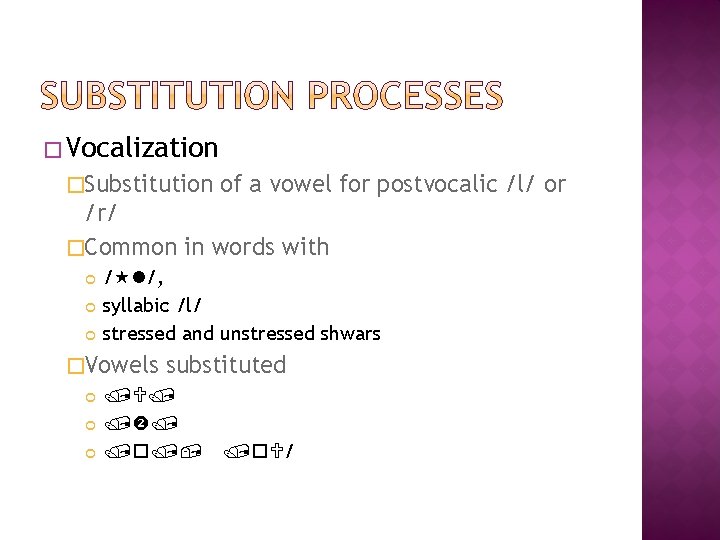
� Vocalization �Substitution of a vowel for postvocalic /l/ or /r/ �Common in words with / l/, syllabic /l/ stressed and unstressed shwars �Vowels substituted , /
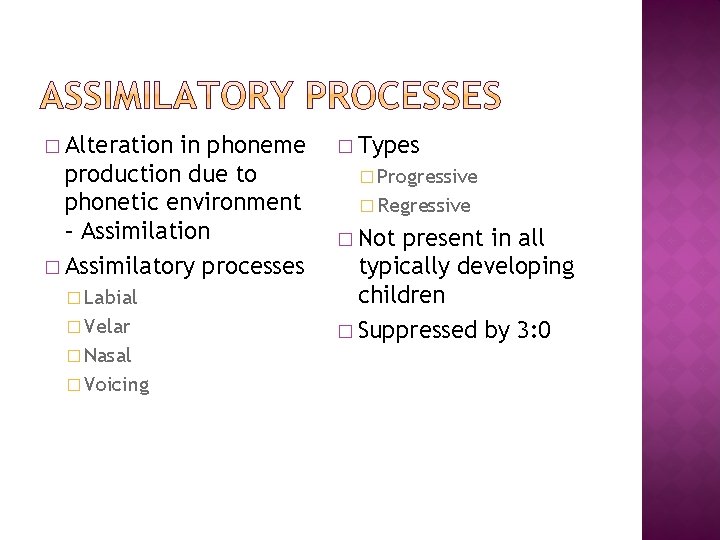
� Alteration in phoneme production due to phonetic environment – Assimilation � Assimilatory processes � Labial � Velar � Nasal � Voicing � Types � Progressive � Regressive � Not present in all typically developing children � Suppressed by 3: 0
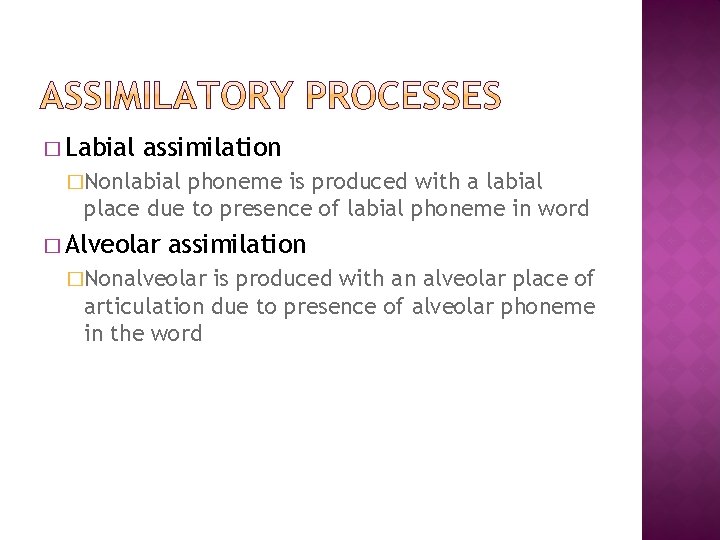
� Labial assimilation �Nonlabial phoneme is produced with a labial place due to presence of labial phoneme in word � Alveolar assimilation �Nonalveolar is produced with an alveolar place of articulation due to presence of alveolar phoneme in the word
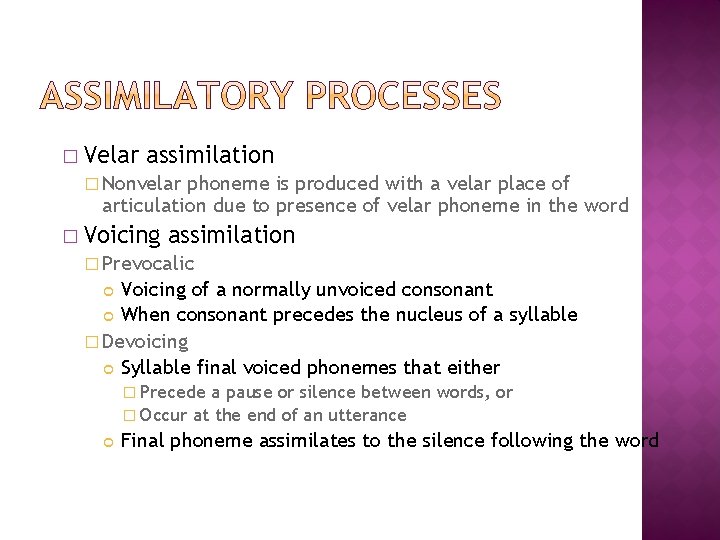
� Velar assimilation � Nonvelar phoneme is produced with a velar place of articulation due to presence of velar phoneme in the word � Voicing assimilation � Prevocalic Voicing of a normally unvoiced consonant When consonant precedes the nucleus of a syllable � Devoicing Syllable final voiced phonemes that either � Precede a pause or silence between words, or � Occur at the end of an utterance Final phoneme assimilates to the silence following the word
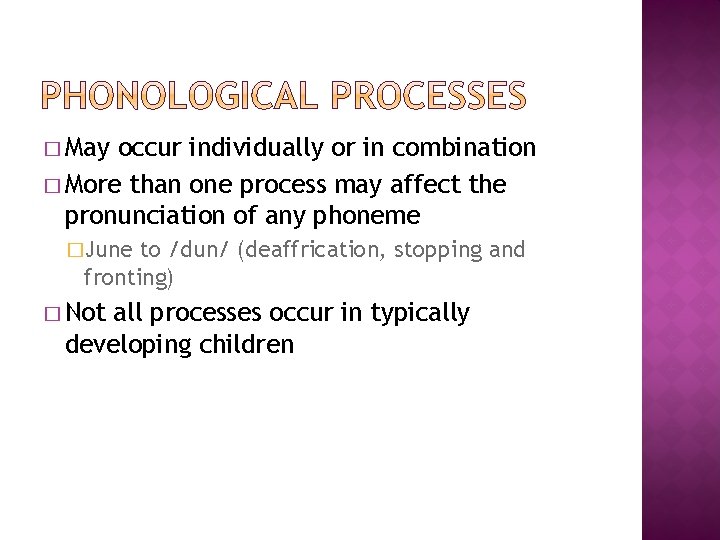
� May occur individually or in combination � More than one process may affect the pronunciation of any phoneme �June to /dun/ (deaffrication, stopping and fronting) � Not all processes occur in typically developing children
� Most common in typically developing children �Weak syllable deletion �Final consonant deletion �Gliding �Cluster reduction
� Suppression does not happen all at once � Most processes disappear by the age of 4 � Suppressed by the age of three �Weak syllable deletion �Final consonant deletion �Reduplication �Fronting �Consonant assimilation �Prevocalic voicing
� Suppressed �Cluster after the age of three reduction �Gliding �Vocalization �Stopping �Final devoicing
� Children may display same types of processes � Processes may be suppressed later
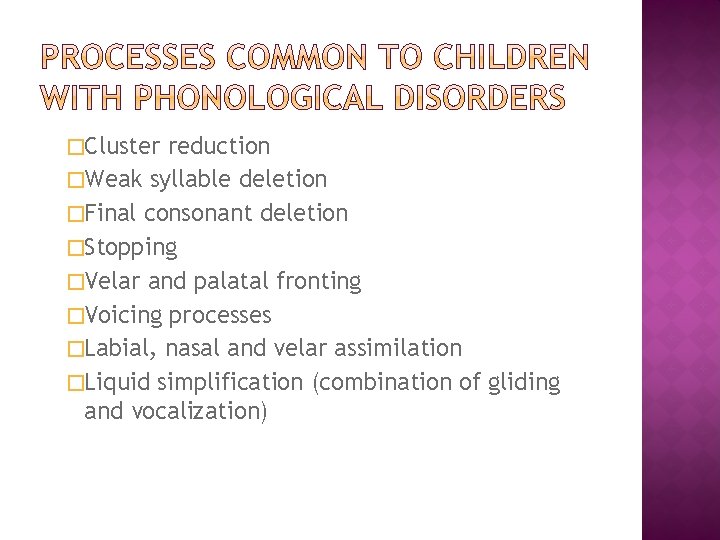
�Cluster reduction �Weak syllable deletion �Final consonant deletion �Stopping �Velar and palatal fronting �Voicing processes �Labial, nasal and velar assimilation �Liquid simplification (combination of gliding and vocalization)
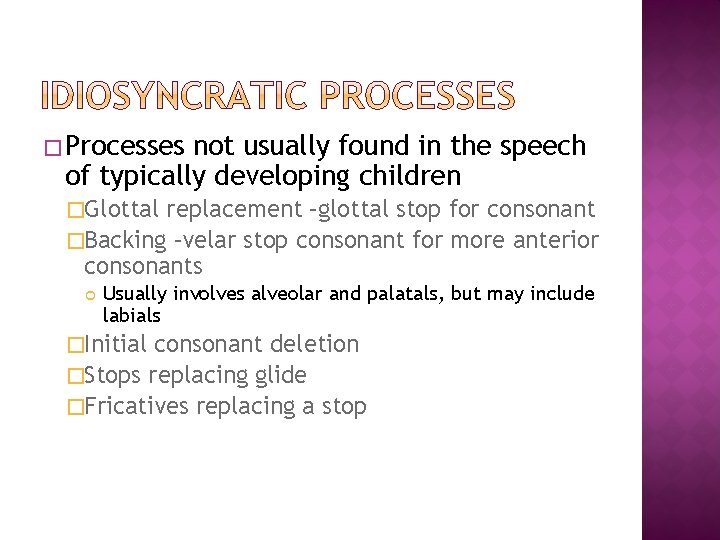
� Processes not usually found in the speech of typically developing children �Glottal replacement –glottal stop for consonant �Backing –velar stop consonant for more anterior consonants Usually involves alveolar and palatals, but may include labials �Initial consonant deletion �Stops replacing glide �Fricatives replacing a stop
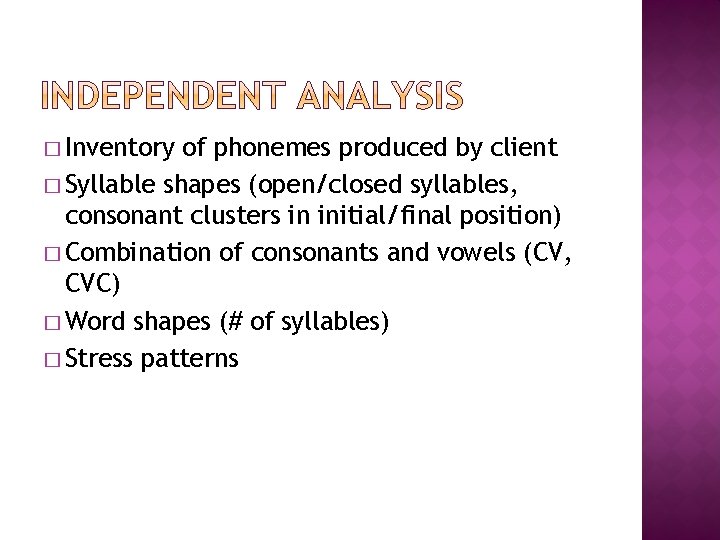
� Inventory of phonemes produced by client � Syllable shapes (open/closed syllables, consonant clusters in initial/final position) � Combination of consonants and vowels (CV, CVC) � Word shapes (# of syllables) � Stress patterns