
Articolo Determinativo The Uso ed eccezioni Regola generale

- Slides: 47
Articolo Determinativo: The Uso ed eccezioni
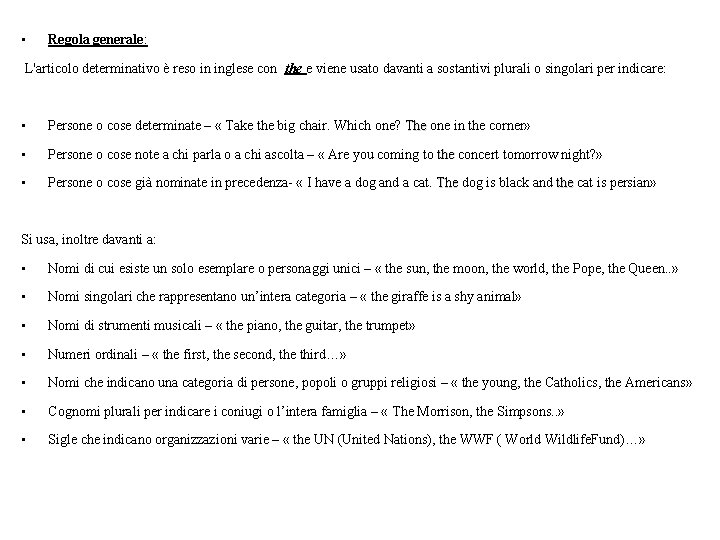
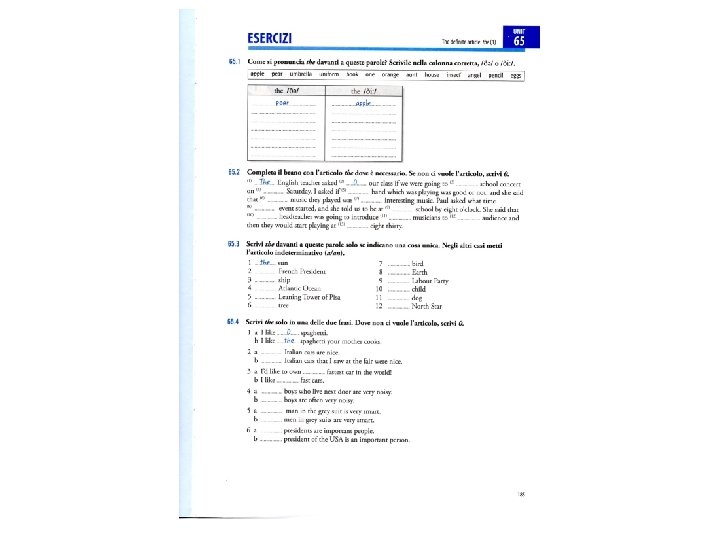
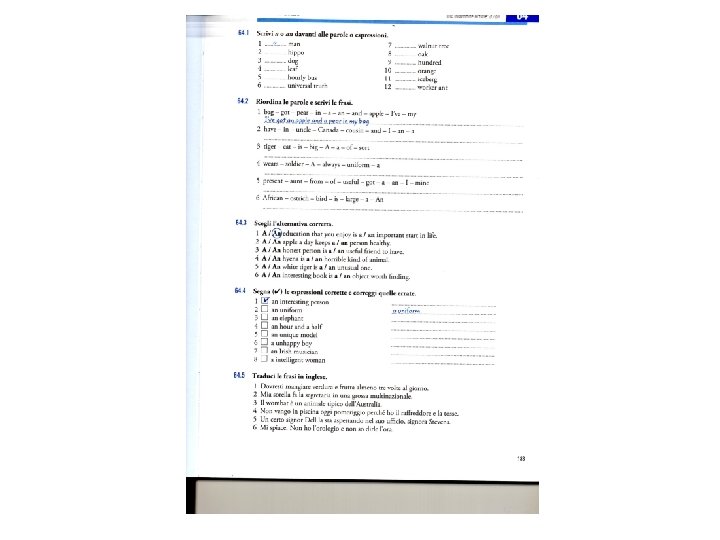
• Regola generale: L'articolo determinativo è reso in inglese con the e viene usato davanti a sostantivi plurali o singolari per indicare: • Persone o cose determinate – « Take the big chair. Which one? The one in the corner» The • Persone o cose note a chi parla o a chi ascolta – « Are you coming to the concert tomorrow night? » the • Persone o cose già nominate in precedenza- « I have a dog and a cat. The dog is black and the cat is persian» The the Si usa, inoltre davanti a: • Nomi di cui esiste un solo esemplare o personaggi unici – « the sun, the moon, the world, the Pope, the Queen. . » • Nomi singolari che rappresentano un’intera categoria – « the giraffe is a shy animal» • Nomi di strumenti musicali – « the piano, the guitar, the trumpet» • Numeri ordinali – « the first, the second, the third…» • Nomi che indicano una categoria di persone, popoli o gruppi religiosi – « the young, the Catholics, the Americans» • Cognomi plurali per indicare i coniugi o l’intera famiglia – « The Morrison, the Simpsons. . » • Sigle che indicano organizzazioni varie – « the UN (United Nations), the WWF ( World Wildlife. Fund)…»
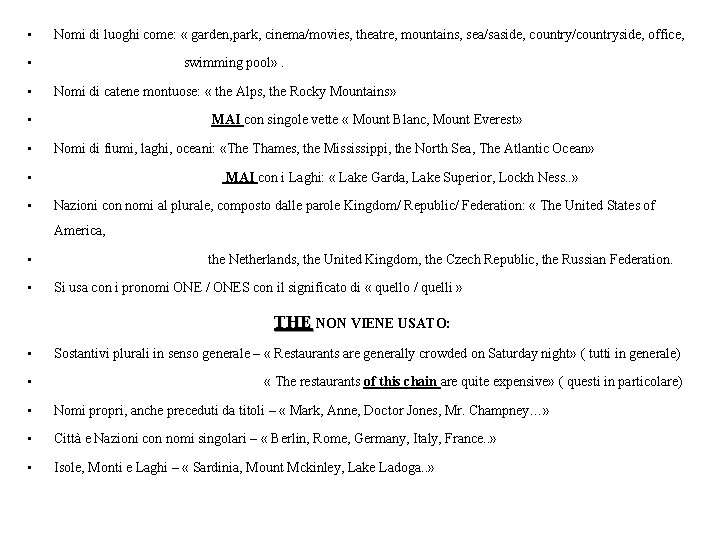
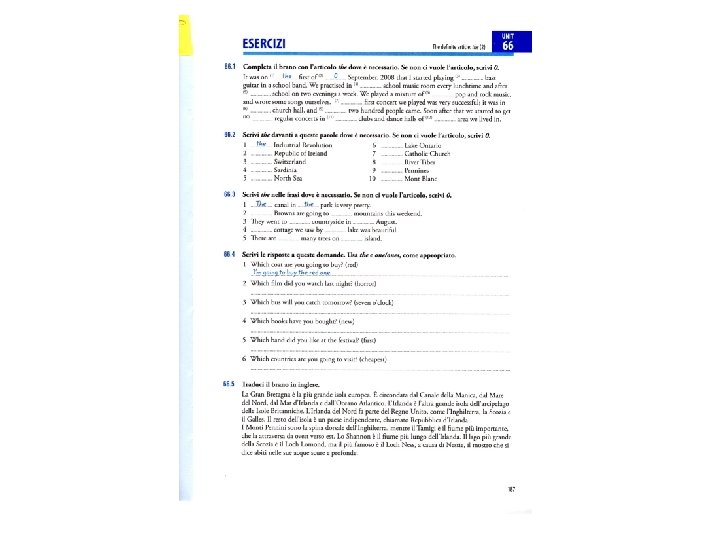
• Nomi di luoghi come: « garden, park, cinema/movies, theatre, mountains, sea/saside, country/countryside, office, • swimming pool» . • Nomi di catene montuose: « the Alps, the Rocky Mountains» • MAI con singole vette « Mount Blanc, Mount Everest» • Nomi di fiumi, laghi, oceani: «The Thames, the Mississippi, the North Sea, The Atlantic Ocean» • MAI con i Laghi: « Lake Garda, Lake Superior, Lockh Ness. . » • Nazioni con nomi al plurale, composto dalle parole Kingdom/ Republic/ Federation: « The United States of America, • the Netherlands, the United Kingdom, the Czech Republic, the Russian Federation. • Si usa con i pronomi ONE / ONES con il significato di « quello / quelli » THE NON VIENE USATO: • Sostantivi plurali in senso generale – « Restaurants are generally crowded on Saturday night» ( tutti in generale) • « The restaurants of this chain are quite expensive» ( questi in particolare) • Nomi propri, anche preceduti da titoli – « Mark, Anne, Doctor Jones, Mr. Champney…» • Città e Nazioni con nomi singolari – « Berlin, Rome, Germany, Italy, France. . » • Isole, Monti e Laghi – « Sardinia, Mount Mckinley, Lake Ladoga. . »
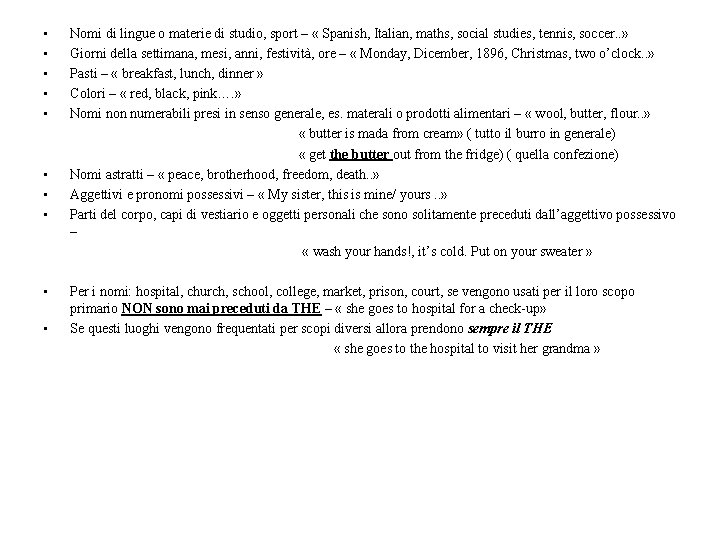
• Nomi di lingue o materie di studio, sport – « Spanish, Italian, maths, social studies, tennis, soccer. . » • Giorni della settimana, mesi, anni, festività, ore – « Monday, Dicember, 1896, Christmas, two o’clock. . » • Pasti – « breakfast, lunch, dinner » • Colori – « red, black, pink…. » • Nomi non numerabili presi in senso generale, es. materali o prodotti alimentari – « wool, butter, flour. . » « butter is mada from cream» ( tutto il burro in generale) « get the butter out from the fridge) ( quella confezione) • Nomi astratti – « peace, brotherhood, freedom, death. . » • Aggettivi e pronomi possessivi – « My sister, this is mine/ yours. . » • Parti del corpo, capi di vestiario e oggetti personali che sono solitamente preceduti dall’aggettivo possessivo – « wash your hands!, it’s cold. Put on your sweater » • Per i nomi: hospital, church, school, college, market, prison, court, se vengono usati per il loro scopo primario NON sono mai preceduti da THE – « she goes to hospital for a check-up» • Se questi luoghi vengono frequentati per scopi diversi allora prendono sempre il THE « she goes to the hospital to visit her grandma »
ARTICOLO INDETERMINATIVO A / AN
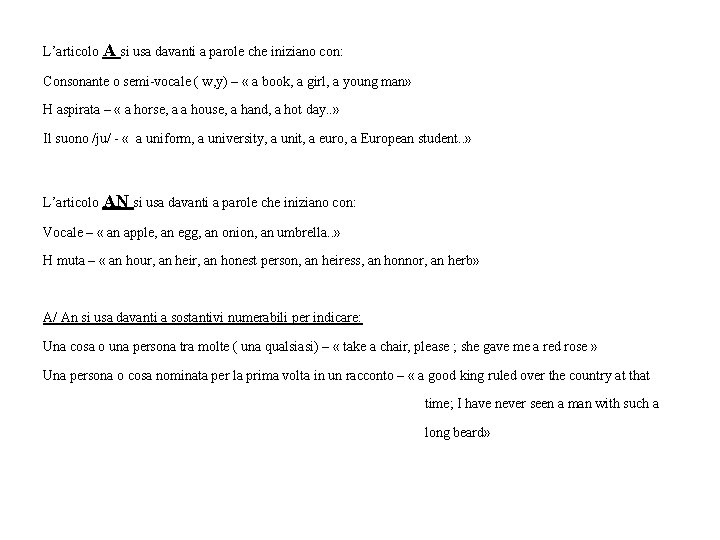
L’articolo A si usa davanti a parole che iniziano con: Consonante o semi-vocale ( w, y) – « a book, a girl, a young man» H aspirata – « a horse, a a house, a hand, a hot day. . » Il suono /ju/ - « a uniform, a university, a unit, a euro, a European student. . » L’articolo AN si usa davanti a parole che iniziano con: Vocale – « an apple, an egg, an onion, an umbrella. . » H muta – « an hour, an heir, an honest person, an heiress, an honnor, an herb» A/ An si usa davanti a sostantivi numerabili per indicare: Una cosa o una persona tra molte ( una qualsiasi) – « take a chair, please ; she gave me a red rose » Una persona o cosa nominata per la prima volta in un racconto – « a good king ruled over the country at that time; I have never seen a man with such a long beard»
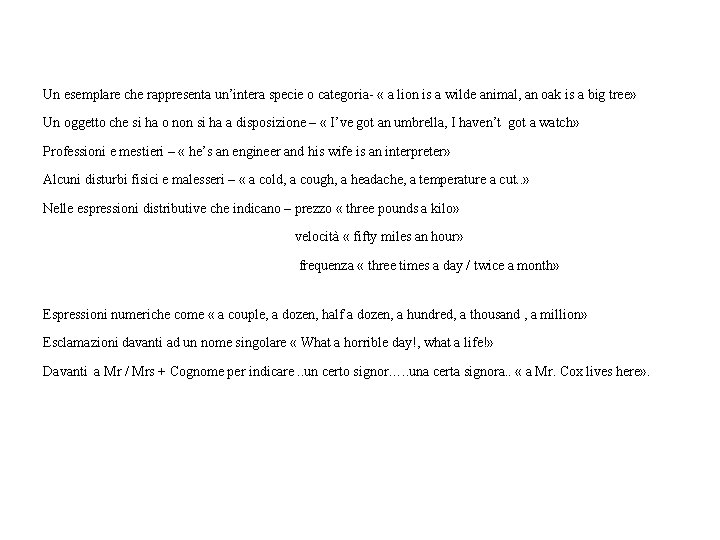
Un esemplare che rappresenta un’intera specie o categoria- « a lion is a wilde animal, an oak is a big tree» Un oggetto che si ha o non si ha a disposizione – « I’ve got an umbrella, I haven’t got a watch» Professioni e mestieri – « he’s an engineer and his wife is an interpreter» Alcuni disturbi fisici e malesseri – « a cold, a cough, a headache, a temperature a cut. . » Nelle espressioni distributive che indicano – prezzo « three pounds a kilo» velocità « fifty miles an hour» frequenza « three times a day / twice a month» Espressioni numeriche come « a couple, a dozen, half a dozen, a hundred, a thousand , a million» Esclamazioni davanti ad un nome singolare « What a horrible day!, what a life!» Davanti a Mr / Mrs + Cognome per indicare. . un certo signor…. . una certa signora. . « a Mr. Cox lives here» .
PRONOMI PERSONALI SOGGETTO E COMPLEMENTO
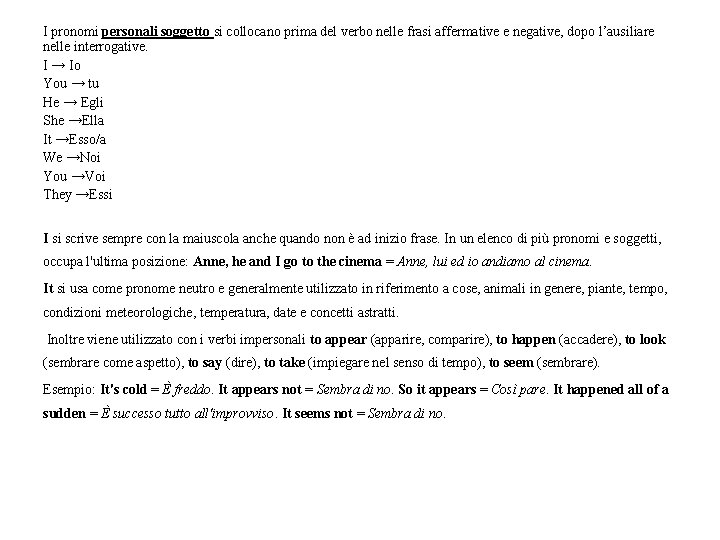
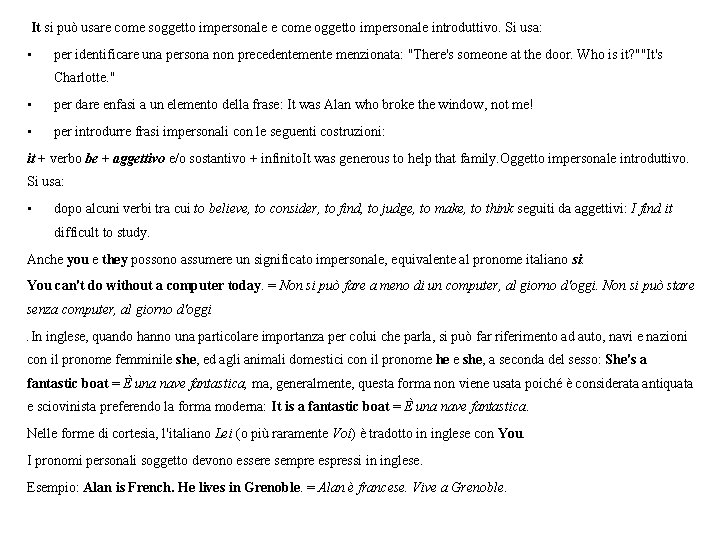
I pronomi personali soggetto si collocano prima del verbo nelle frasi affermative e negative, dopo l’ausiliare nelle interrogative. I → Io You → tu He → Egli She →Ella It →Esso/a We →Noi You →Voi They →Essi I si scrive sempre con la maiuscola anche quando non è ad inizio frase. In un elenco di più pronomi e soggetti, occupa l'ultima posizione: Anne, he and I go to the cinema = Anne, lui ed io andiamo al cinema. It si usa come pronome neutro e generalmente utilizzato in riferimento a cose, animali in genere, piante, tempo, condizioni meteorologiche, temperatura, date e concetti astratti. Inoltre viene utilizzato con i verbi impersonali to appear (apparire, comparire), to happen (accadere), to look (sembrare come aspetto), to say (dire), to take (impiegare nel senso di tempo), to seem (sembrare). Esempio: It's cold = È freddo. It appears not = Sembra di no. So it appears = Così pare. It happened all of a sudden = È successo tutto all'improvviso. It seems not = Sembra di no.
It si può usare come soggetto impersonale e come oggetto impersonale introduttivo. Si usa: • per identificare una persona non precedentemente menzionata: "There's someone at the door. Who is it? ""It's Charlotte. " • per dare enfasi a un elemento della frase: It was Alan who broke the window, not me! • per introdurre frasi impersonali con le seguenti costruzioni: it + verbo be + aggettivo e/o sostantivo + infinito. It was generous to help that family. Oggetto impersonale introduttivo. Si usa: • dopo alcuni verbi tra cui to believe, to consider, to find, to judge, to make, to think seguiti da aggettivi: I find it difficult to study. Anche you e they possono assumere un significato impersonale, equivalente al pronome italiano si: You can't do without a computer today. = Non si può fare a meno di un computer, al giorno d'oggi. Non si può stare senza computer, al giorno d'oggi. In inglese, quando hanno una particolare importanza per colui che parla, si può far riferimento ad auto, navi e nazioni con il pronome femminile she, ed agli animali domestici con il pronome he e she, a seconda del sesso: She's a fantastic boat = È una nave fantastica, ma, generalmente, questa forma non viene usata poiché è considerata antiquata e sciovinista preferendo la forma moderna: It is a fantastic boat = È una nave fantastica. Nelle forme di cortesia, l'italiano Lei (o più raramente Voi) è tradotto in inglese con You. I pronomi personali soggetto devono essere sempre espressi in inglese. Esempio: Alan is French. He lives in Grenoble. = Alan è francese. Vive a Grenoble.
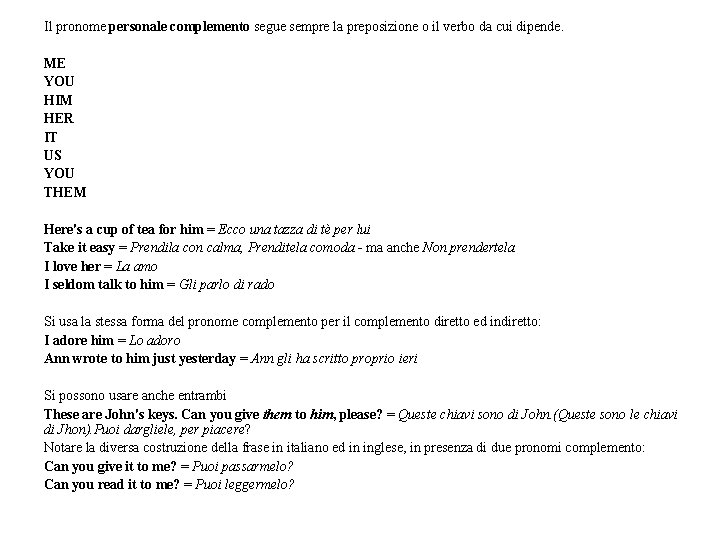
Il pronome personale complemento segue sempre la preposizione o il verbo da cui dipende. ME YOU HIM HER IT US YOU THEM Here's a cup of tea for him = Ecco una tazza di tè per lui Take it easy = Prendila con calma, Prenditela comoda - ma anche Non prendertela I love her = La amo I seldom talk to him = Gli parlo di rado Si usa la stessa forma del pronome complemento per il complemento diretto ed indiretto: I adore him = Lo adoro Ann wrote to him just yesterday = Ann gli ha scritto proprio ieri Si possono usare anche entrambi These are John's keys. Can you give them to him, please? = Queste chiavi sono di John. (Queste sono le chiavi di Jhon). Puoi dargliele, per piacere? Notare la diversa costruzione della frase in italiano ed in inglese, in presenza di due pronomi complemento: Can you give it to me? = Puoi passarmelo? Can you read it to me? = Puoi leggermelo?
I pronomi personali complemento si usano: come complemento di un verbo (anche "essere"): – I can see him now = Ora riesco a vederlo – I want to buy it. = Voglio comprarlo – Who's there? It's me = Chi è (là)? Sono io. come complemento di termine – Tell me what happened = Dimmi cos'è successo – Speak to me = Parlami – Give it to them = Dallo a loro attenzione alla diversa costruzione quando invece si utilizza un solo pronome: – Give me the pen = Dammi la penna come complemento indiretto, dopo una preposizione o nelle forme comparative – According to him = Secondo lui – I went on vacation (holiday) with them = Sono andato in vacanza con loro – Leave two eggs for her = Lasciale due uova (Lascia due uova per lei) – Tom is older than me = Tom è più vecchio di me – Sara is more intelligent than him = Sara è più intelligente di lui.
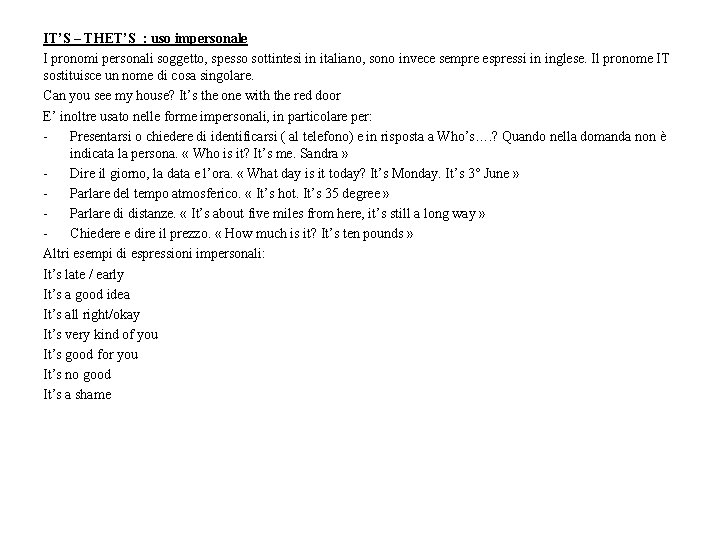
IT’S – THET’S : uso impersonale I pronomi personali soggetto, spesso sottintesi in italiano, sono invece sempre espressi in inglese. Il pronome IT sostituisce un nome di cosa singolare. Can you see my house? It’s the one with the red door E’ inoltre usato nelle forme impersonali, in particolare per: Presentarsi o chiedere di identificarsi ( al telefono) e in risposta a Who’s…. ? Quando nella domanda non è indicata la persona. « Who is it? It’s me. Sandra » Dire il giorno, la data e l’ora. « What day is it today? It’s Monday. It’s 3° June » Parlare del tempo atmosferico. « It’s hot. It’s 35 degree » Parlare di distanze. « It’s about five miles from here, it’s still a long way » Chiedere e dire il prezzo. « How much is it? It’s ten pounds » Altri esempi di espressioni impersonali: It’s late / early It’s a good idea It’s all right/okay It’s very kind of you It’s good for you It’s no good It’s a shame
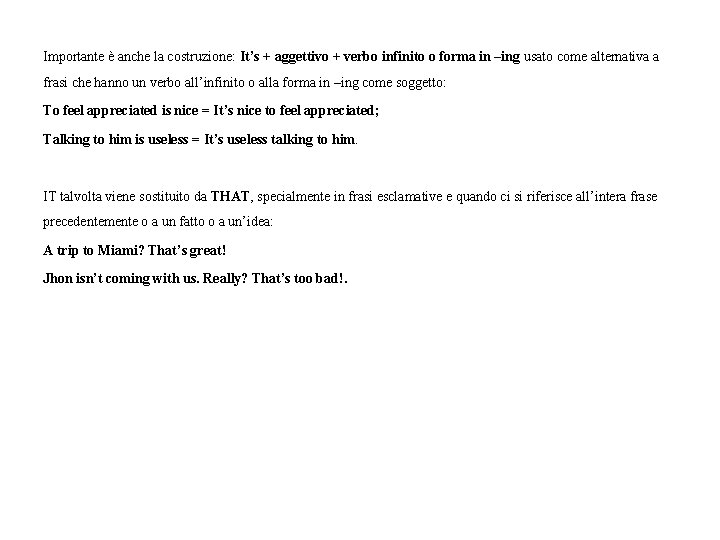
Importante è anche la costruzione: It’s + aggettivo + verbo infinito o forma in –ing usato come alternativa a frasi che hanno un verbo all’infinito o alla forma in –ing come soggetto: To feel appreciated is nice = It’s nice to feel appreciated; Talking to him is useless = It’s useless talking to him. IT talvolta viene sostituito da THAT, specialmente in frasi esclamative e quando ci si riferisce all’intera frase precedentemente o a un fatto o a un’idea: A trip to Miami? That’s great! Jhon isn’t coming with us. Really? That’s too bad!.
TO BE PRESENT SIMPLE Usi ed espressioni idiomatiche
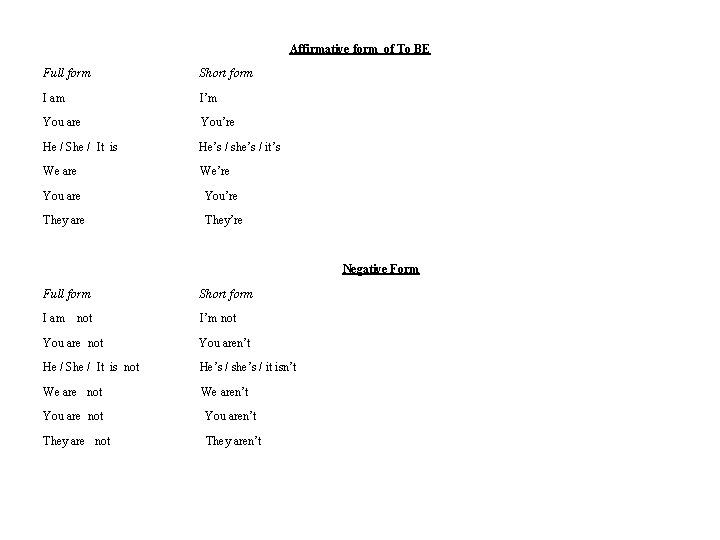
Affirmative form of To BE Full form Short form I am I’m You are You’re He / She / It is He’s / she’s / it’s We are We’re You are You’re They are They’re Negative Form Full form Short form I am not I’m not You are not You aren’t He / She / It is not He’s / she’s / it isn’t We are not We aren’t You are not You aren’t They are not They aren’t
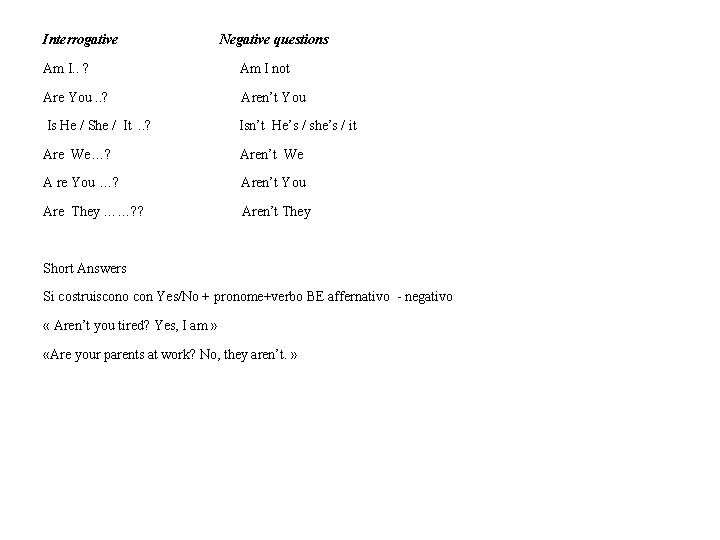
Interrogative Negative questions Am I. . ? Am I not Are You. . ? Aren’t You Is He / She / It . . ? Isn’t He’s / she’s / it Are We…? Aren’t We A re You …? Aren’t You Are They ……? ? Aren’t They Short Answers Si costruiscono con Yes/No + pronome+verbo BE affernativo - negativo « Aren’t you tired? Yes, I am » «Are your parents at work? No, they aren’t. »
Il verbo To BE indica l’esistenza di qualcosa, una condizione sia permanente che temporanea. Si usa per: - Presentarsi e dire la professione – « My name’s Robert Nolan. I’m a sale manager » - Presentare qualcuno – « this is Tina. She’s my neighbour » - Identificare qualcosa o qualcuno – « Who’s that? It’s my friend Alice » « What’s this? It’s a nutcracker » - Chiedere e dare dati personali ( età, provenienza, indirizzo, numero telefonico, compleanno…. . ) « How old are you? I’m eighteen ( years old) » « What’s your mobile phone? It’s 3333333 » - Parlare di condizioni fisiche e di salute – « Are you hungry? Yes, I’m starving! » « How are you? I’m fine thanks. And you? ? » - Esprimere stati d’animo - « Are you happy? Yes, I’m very happy! » - Indicare le caratteristiche di qualcuno o qualcosa ( altezza, carattere, colore, dimensione. . » « He’s a very lively child. Tom’s very tall. It’s a large room » - Chiedere e dire dove si trova qualcuno o qualcosa – « Where’s Peter ? He’s in the kitchen. » .
In tutte queste funzioni il verbo To BE è normalmente seguito da : Sostantivo I’m Laura Aggettivo You’re happy Avverbio They are late Frase nominale She’s a good student / It’s in the kitchen Espressioni idiomatiche. I’m cold/ warm / hot I’m hungry / Thirsty / Sleepy I’m afraid / ashamed You are right / wrong He’s in a hurry They’re late. Here is / Here are = ECCO « Here you are…. . ten pounds! Thanks, and here’s your change »
TO HAVE PRESENT SIMPLE Usi ed espressioni idiomatiche
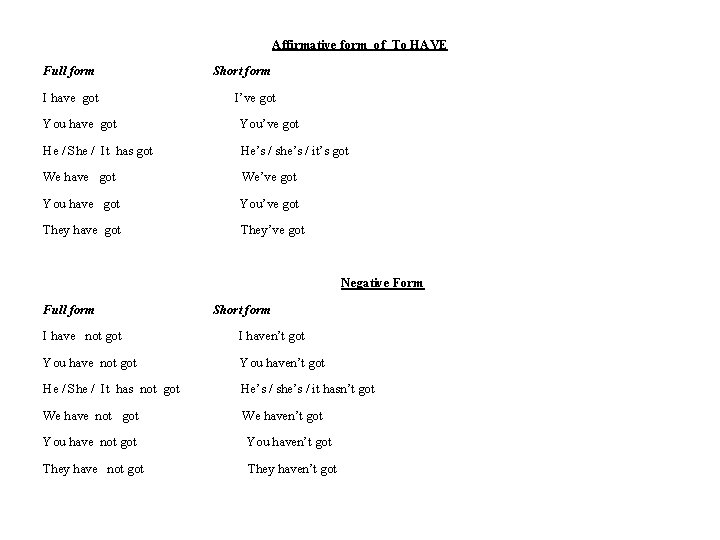
Affirmative form of To HAVE Full form Short form I have got I’ve got You have got You’ve got He / She / It has got He’s / she’s / it’s got We have got We’ve got You have got You’ve got They have got They’ve got Negative Form Full form Short form I have not got I haven’t got You have not got You haven’t got He / She / It has not got He’s / she’s / it hasn’t got We have not got We haven’t got You have not got You haven’t got They have not got They haven’t got
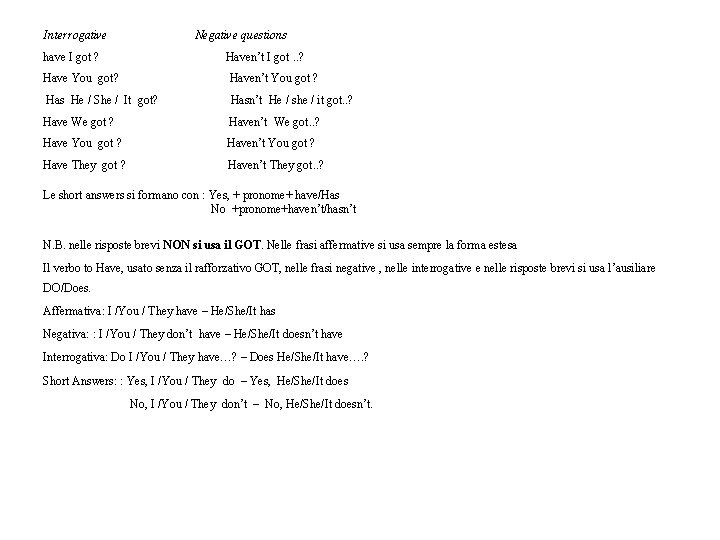
Interrogative Negative questions have I got ? Haven’t I got. . ? Have You got? Haven’t You got ? Has He / She / It got? Hasn’t He / she / it got. . ? Have We got ? Haven’t We got. . ? Have You got ? Haven’t You got ? Have They got ? Haven’t They got. . ? Le short answers si formano con : Yes, + pronome+ have/Has No +pronome+haven’t/hasn’t N. B. nelle risposte brevi NON si usa il GOT. Nelle frasi affermative si usa sempre la forma estesa Il verbo to Have, usato senza il rafforzativo GOT, nelle frasi negative , nelle interrogative e nelle risposte brevi si usa l’ausiliare DO/Does. Affermativa: I /You / They have – He/She/It has Negativa: : I /You / They don’t have – He/She/It doesn’t have Interrogativa: Do I /You / They have…? – Does He/She/It have…. ? Short Answers: : Yes, I /You / They do – Yes, He/She/It does No, I /You / They don’t – No, He/She/It doesn’t.
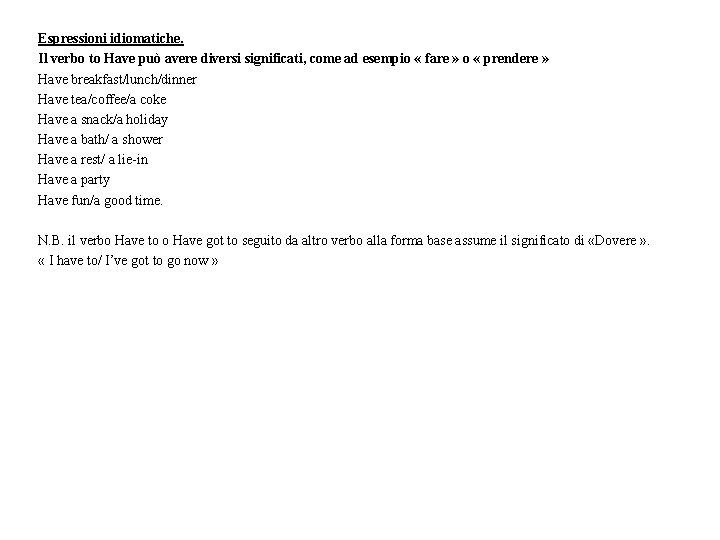
Espressioni idiomatiche. Il verbo to Have può avere diversi significati, come ad esempio « fare » o « prendere » Have breakfast/lunch/dinner Have tea/coffee/a coke Have a snack/a holiday Have a bath/ a shower Have a rest/ a lie-in Have a party Have fun/a good time. N. B. il verbo Have to o Have got to seguito da altro verbo alla forma base assume il significato di «Dovere » . « I have to/ I’ve got to go now »
NOMI GENERE E PLURALI
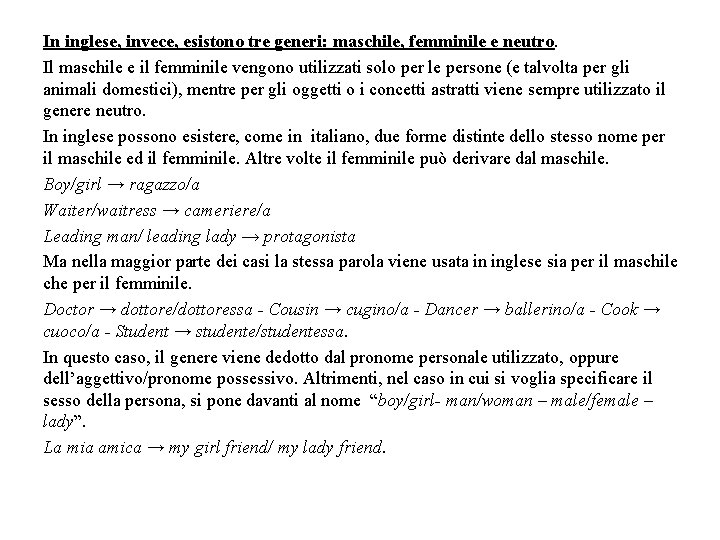
In inglese, invece, esistono tre generi: maschile, femminile e neutro. Il maschile e il femminile vengono utilizzati solo per le persone (e talvolta per gli animali domestici), mentre per gli oggetti o i concetti astratti viene sempre utilizzato il genere neutro. In inglese possono esistere, come in italiano, due forme distinte dello stesso nome per il maschile ed il femminile. Altre volte il femminile può derivare dal maschile. Boy/girl → ragazzo/a Waiter/waitress → cameriere/a Leading man/ leading lady → protagonista Ma nella maggior parte dei casi la stessa parola viene usata in inglese sia per il maschile che per il femminile. Doctor → dottore/dottoressa - Cousin → cugino/a - Dancer → ballerino/a - Cook → cuoco/a - Student → studente/studentessa. In questo caso, il genere viene dedotto dal pronome personale utilizzato, oppure dell’aggettivo/pronome possessivo. Altrimenti, nel caso in cui si voglia specificare il sesso della persona, si pone davanti al nome “boy/girl- man/woman – male/female – lady”. La mia amica → my girl friend/ my lady friend.
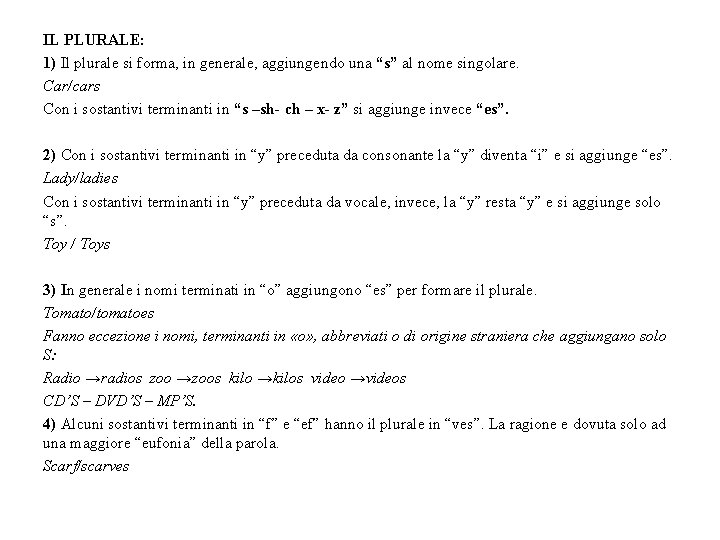
IL PLURALE: 1) Il plurale si forma, in generale, aggiungendo una “s” al nome singolare. Car/cars Con i sostantivi terminanti in “s –sh- ch – x- z” si aggiunge invece “es”. 2) Con i sostantivi terminanti in “y” preceduta da consonante la “y” diventa “i” e si aggiunge “es”. Lady/ladies Con i sostantivi terminanti in “y” preceduta da vocale, invece, la “y” resta “y” e si aggiunge solo “s”. Toy / Toys 3) In generale i nomi terminati in “o” aggiungono “es” per formare il plurale. Tomato/tomatoes Fanno eccezione i nomi, terminanti in «o» , abbreviati o di origine straniera che aggiungano solo S: Radio →radios zoo →zoos kilo →kilos video →videos CD’S – DVD’S – MP’S. 4) Alcuni sostantivi terminanti in “f” e “ef” hanno il plurale in “ves”. La ragione e dovuta solo ad una maggiore “eufonia” della parola. Scarf/scarves
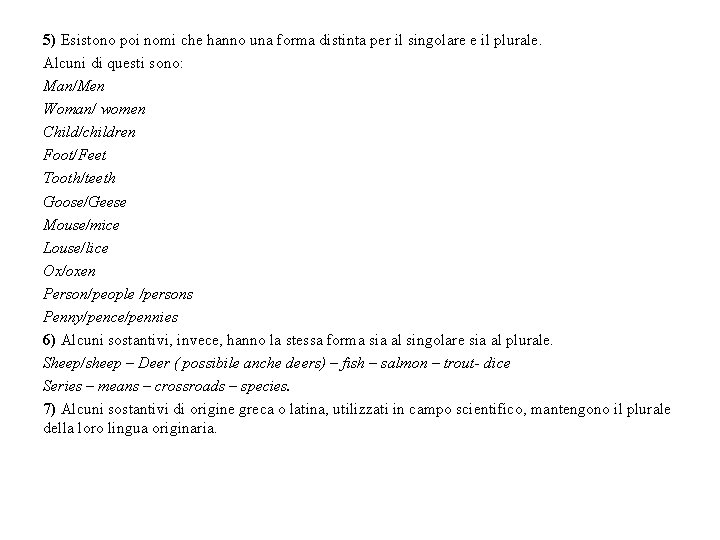
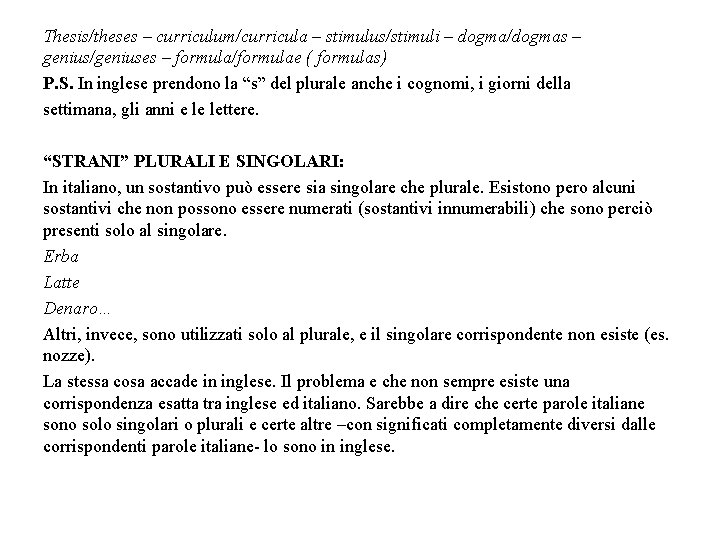
5) Esistono poi nomi che hanno una forma distinta per il singolare e il plurale. Alcuni di questi sono: Man/Men Woman/ women Child/children Foot/Feet Tooth/teeth Goose/Geese Mouse/mice Louse/lice Ox/oxen Person/people /persons Penny/pence/pennies 6) Alcuni sostantivi, invece, hanno la stessa forma sia al singolare sia al plurale. Sheep/sheep – Deer ( possibile anche deers) – fish – salmon – trout- dice Series – means – crossroads – species. 7) Alcuni sostantivi di origine greca o latina, utilizzati in campo scientifico, mantengono il plurale della loro lingua originaria.
Thesis/theses – curriculum/curricula – stimulus/stimuli – dogma/dogmas – genius/geniuses – formula/formulae ( formulas) P. S. In inglese prendono la “s” del plurale anche i cognomi, i giorni della settimana, gli anni e le lettere. “STRANI” PLURALI E SINGOLARI: In italiano, un sostantivo può essere sia singolare che plurale. Esistono pero alcuni sostantivi che non possono essere numerati (sostantivi innumerabili) che sono perciò presenti solo al singolare. Erba Latte Denaro… Altri, invece, sono utilizzati solo al plurale, e il singolare corrispondente non esiste (es. nozze). La stessa cosa accade in inglese. Il problema e che non sempre esiste una corrispondenza esatta tra inglese ed italiano. Sarebbe a dire che certe parole italiane sono solo singolari o plurali e certe altre –con significati completamente diversi dalle corrispondenti parole italiane- lo sono in inglese.
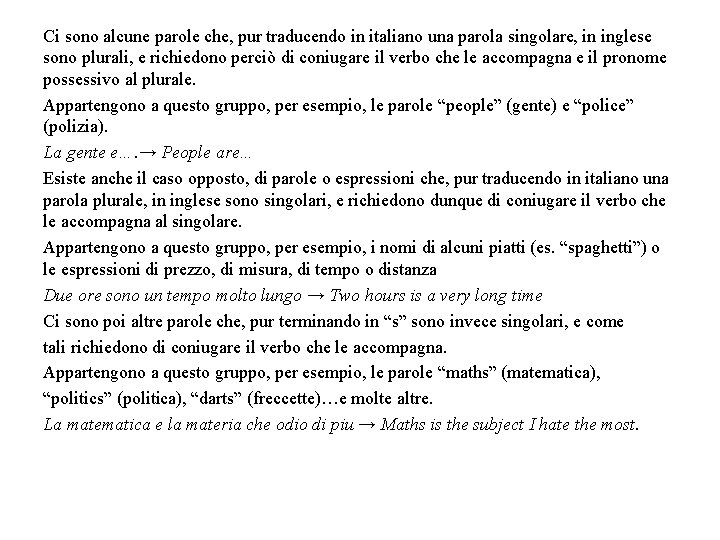
Ci sono alcune parole che, pur traducendo in italiano una parola singolare, in inglese sono plurali, e richiedono perciò di coniugare il verbo che le accompagna e il pronome possessivo al plurale. Appartengono a questo gruppo, per esempio, le parole “people” (gente) e “police” (polizia). La gente e…. → People are… Esiste anche il caso opposto, di parole o espressioni che, pur traducendo in italiano una parola plurale, in inglese sono singolari, e richiedono dunque di coniugare il verbo che le accompagna al singolare. Appartengono a questo gruppo, per esempio, i nomi di alcuni piatti (es. “spaghetti”) o le espressioni di prezzo, di misura, di tempo o distanza Due ore sono un tempo molto lungo → Two hours is a very long time Ci sono poi altre parole che, pur terminando in “s” sono invece singolari, e come tali richiedono di coniugare il verbo che le accompagna. Appartengono a questo gruppo, per esempio, le parole “maths” (matematica), “politics” (politica), “darts” (freccette)…e molte altre. La matematica e la materia che odio di piu → Maths is the subject I hate the most.
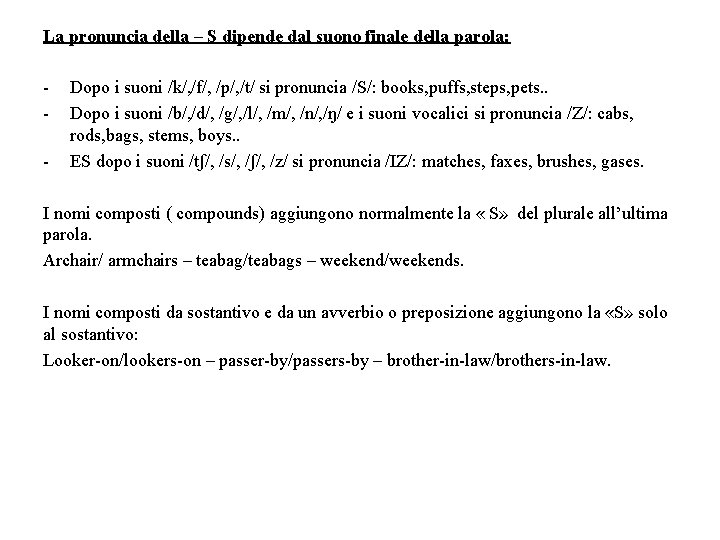
La pronuncia della – S dipende dal suono finale della parola: - Dopo i suoni /k/, /f/, /p/, /t/ si pronuncia /S/: books, puffs, steps, pets. . Dopo i suoni /b/, /d/, /g/, /l/, /m/, /n/, /ŋ/ e i suoni vocalici si pronuncia /Z/: cabs, rods, bags, stems, boys. . ES dopo i suoni /tʃ/, /s/, /ʃ/, /z/ si pronuncia /IZ/: matches, faxes, brushes, gases. I nomi composti ( compounds) aggiungono normalmente la « S» del plurale all’ultima parola. Archair/ armchairs – teabag/teabags – weekend/weekends. I nomi composti da sostantivo e da un avverbio o preposizione aggiungono la «S» solo al sostantivo: Looker-on/lookers-on – passer-by/passers-by – brother-in-law/brothers-in-law.
SIMPLE PRESENT CONSTRUCTION AND USE
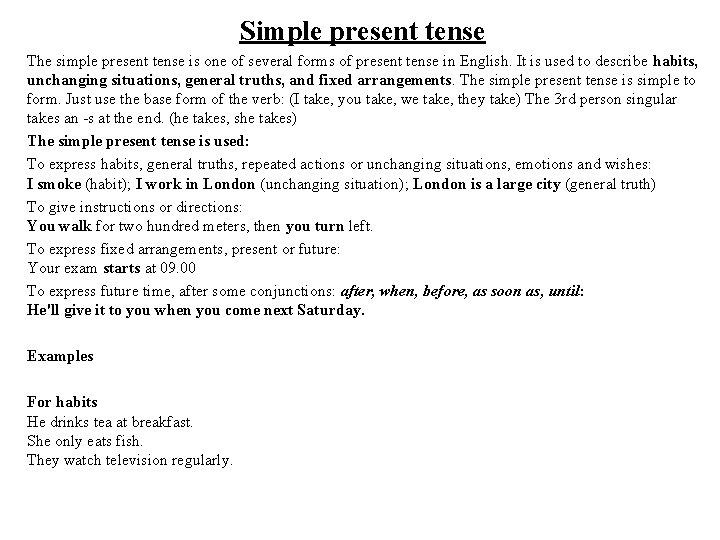
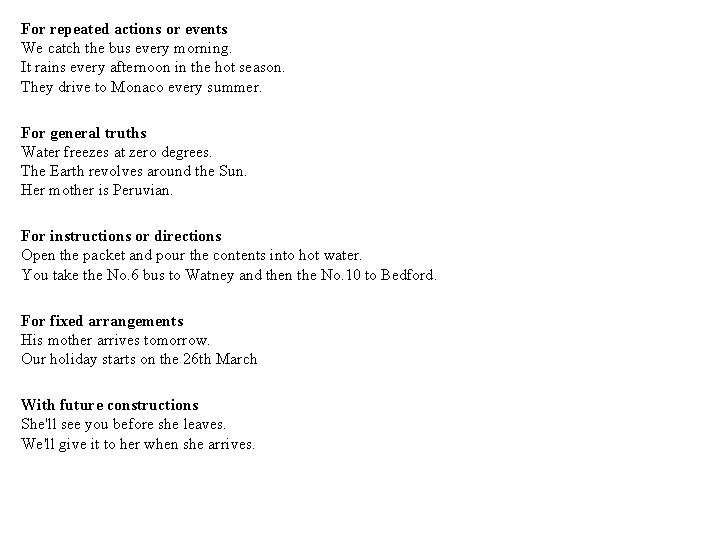
Simple present tense The simple present tense is one of several forms of present tense in English. It is used to describe habits, unchanging situations, general truths, and fixed arrangements. The simple present tense is simple to form. Just use the base form of the verb: (I take, you take, we take, they take) The 3 rd person singular takes an -s at the end. (he takes, she takes) The simple present tense is used: To express habits, general truths, repeated actions or unchanging situations, emotions and wishes: I smoke (habit); I work in London (unchanging situation); London is a large city (general truth) To give instructions or directions: You walk for two hundred meters, then you turn left. To express fixed arrangements, present or future: Your exam starts at 09. 00 To express future time, after some conjunctions: after, when, before, as soon as, until: He'll give it to you when you come next Saturday. Examples For habits He drinks tea at breakfast. She only eats fish. They watch television regularly.
For repeated actions or events We catch the bus every morning. It rains every afternoon in the hot season. They drive to Monaco every summer. For general truths Water freezes at zero degrees. The Earth revolves around the Sun. Her mother is Peruvian. For instructions or directions Open the packet and pour the contents into hot water. You take the No. 6 bus to Watney and then the No. 10 to Bedford. For fixed arrangements His mother arrives tomorrow. Our holiday starts on the 26 th March With future constructions She'll see you before she leaves. We'll give it to her when she arrives.
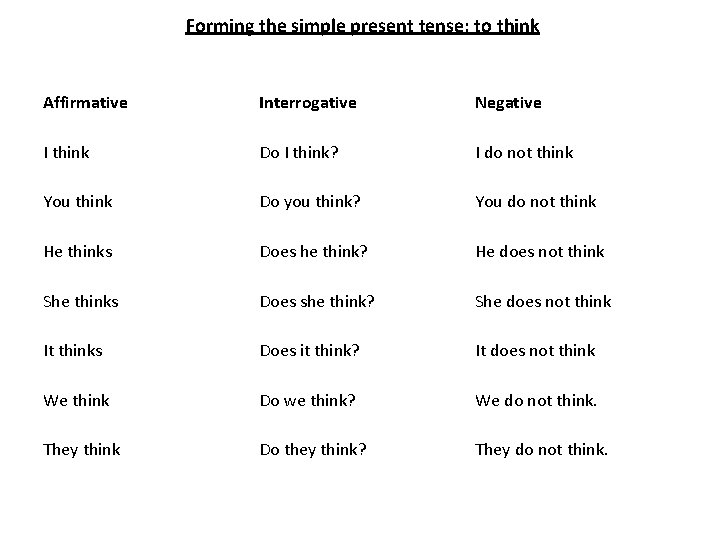
Forming the simple present tense: to think Affirmative Interrogative Negative I think Do I think? I do not think You think Do you think? You do not think He thinks Does he think? He does not think She thinks Does she think? She does not think It thinks Does it think? It does not think We think Do we think? We do not think. They think Do they think? They do not think.
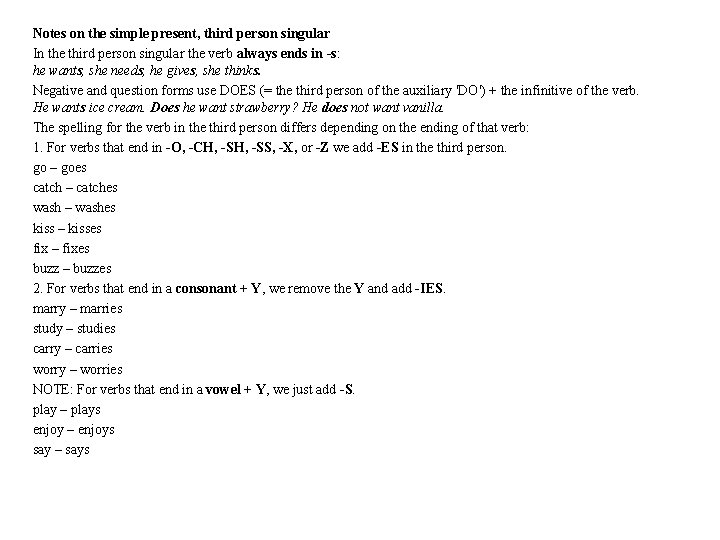
Notes on the simple present, third person singular In the third person singular the verb always ends in -s: he wants, she needs, he gives, she thinks. Negative and question forms use DOES (= the third person of the auxiliary 'DO') + the infinitive of the verb. He wants ice cream. Does he want strawberry? He does not want vanilla. The spelling for the verb in the third person differs depending on the ending of that verb: 1. For verbs that end in -O, -CH, -SS, -X, or -Z we add -ES in the third person. go – goes catch – catches wash – washes kiss – kisses fix – fixes buzz – buzzes 2. For verbs that end in a consonant + Y, we remove the Y and add -IES. marry – marries study – studies carry – carries worry – worries NOTE: For verbs that end in a vowel + Y, we just add -S. play – plays enjoy – enjoys say – says
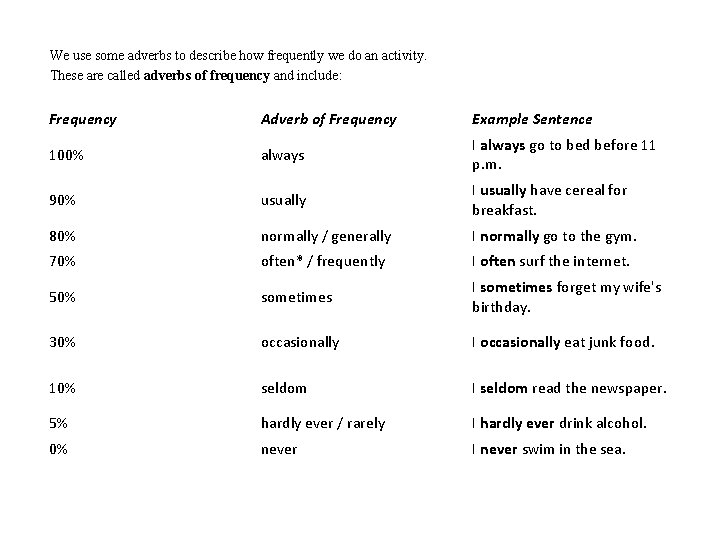
We use some adverbs to describe how frequently we do an activity. These are called adverbs of frequency and include: Frequency Adverb of Frequency Example Sentence 100% always I always go to bed before 11 p. m. 90% usually I usually have cereal for breakfast. 80% normally / generally I normally go to the gym. 70% often* / frequently I often surf the internet. 50% sometimes I sometimes forget my wife's birthday. 30% occasionally I occasionally eat junk food. 10% seldom I seldom read the newspaper. 5% hardly ever / rarely I hardly ever drink alcohol. 0% never I never swim in the sea.
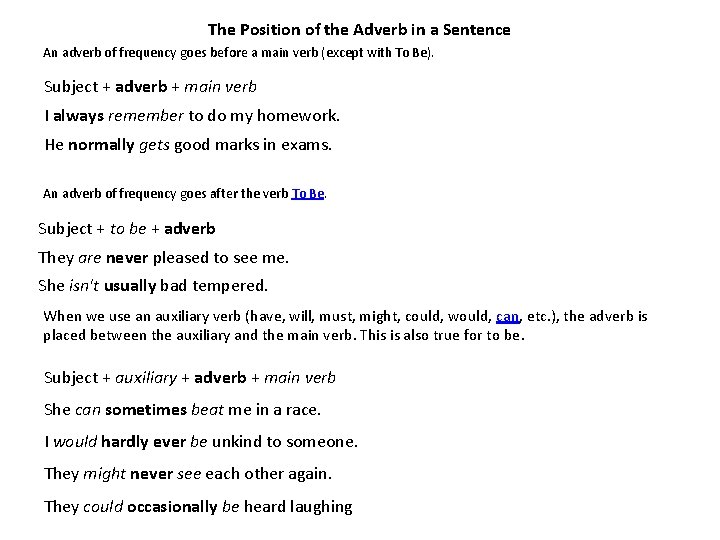
The Position of the Adverb in a Sentence An adverb of frequency goes before a main verb (except with To Be). Subject + adverb + main verb I always remember to do my homework. He normally gets good marks in exams. An adverb of frequency goes after the verb To Be. Subject + to be + adverb They are never pleased to see me. She isn't usually bad tempered. When we use an auxiliary verb (have, will, must, might, could, would, can, etc. ), the adverb is placed between the auxiliary and the main verb. This is also true for to be. Subject + auxiliary + adverb + main verb She can sometimes beat me in a race. I would hardly ever be unkind to someone. They might never see each other again. They could occasionally be heard laughing
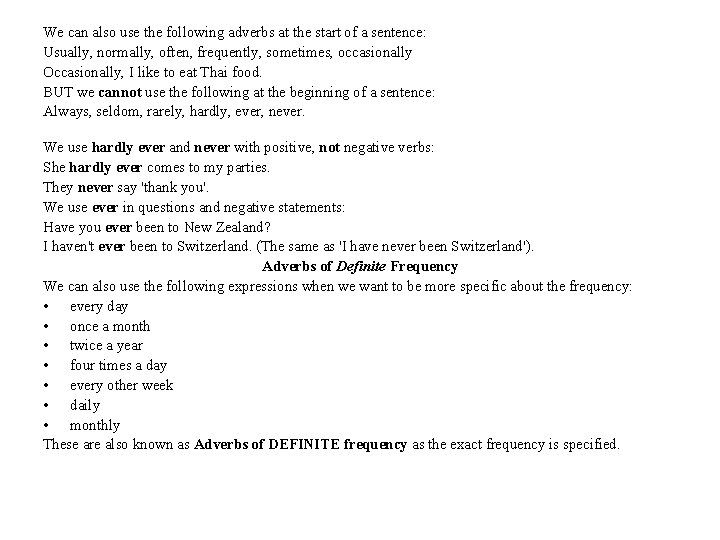
We can also use the following adverbs at the start of a sentence: Usually, normally, often, frequently, sometimes, occasionally Occasionally, I like to eat Thai food. BUT we cannot use the following at the beginning of a sentence: Always, seldom, rarely, hardly, ever, never. We use hardly ever and never with positive, not negative verbs: She hardly ever comes to my parties. They never say 'thank you'. We use ever in questions and negative statements: Have you ever been to New Zealand? I haven't ever been to Switzerland. (The same as 'I have never been Switzerland'). Adverbs of Definite Frequency We can also use the following expressions when we want to be more specific about the frequency: • every day • once a month • twice a year • four times a day • every other week • daily • monthly These are also known as Adverbs of DEFINITE frequency as the exact frequency is specified.