
Articles of Confederation The Structure of Government Level
- Slides: 11
Articles of Confederation The Structure of Government Level 1
Vocabulary �Government: a system of rule over citizens �Branch of government: a section of a government with a specific purpose (legislative branch, executive branch, judicial branch) �Alliance: an agreement to work together �Treaty of Paris: the agreement that ended the Revolutionary War with Britain �Foreign Debt: money owed to a foreign country �Depression: drastic decline in the economy
Essential Question �What is a government? �How did the first United States government operate?
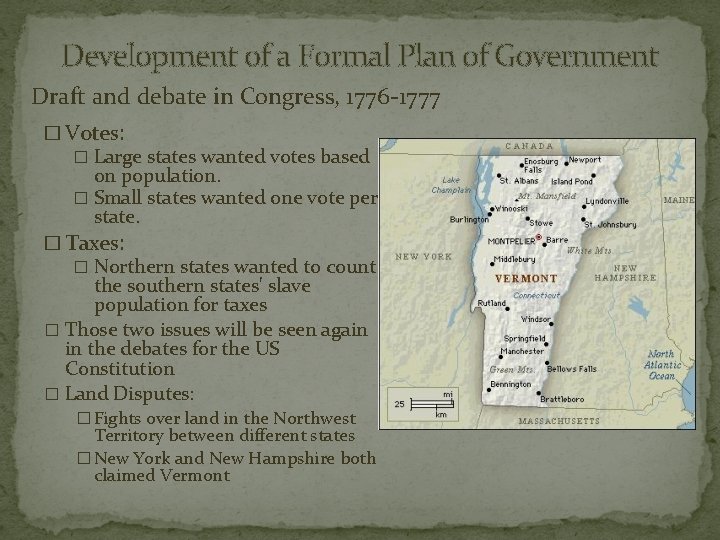
Development of a Formal Plan of Government Draft and debate in Congress, 1776 -1777 � Votes: � Large states wanted votes based on population. � Small states wanted one vote per state. � Taxes: � Northern states wanted to count the southern states' slave population for taxes � Those two issues will be seen again in the debates for the US Constitution � Land Disputes: � Fights over land in the Northwest Territory between different states � New York and New Hampshire both claimed Vermont
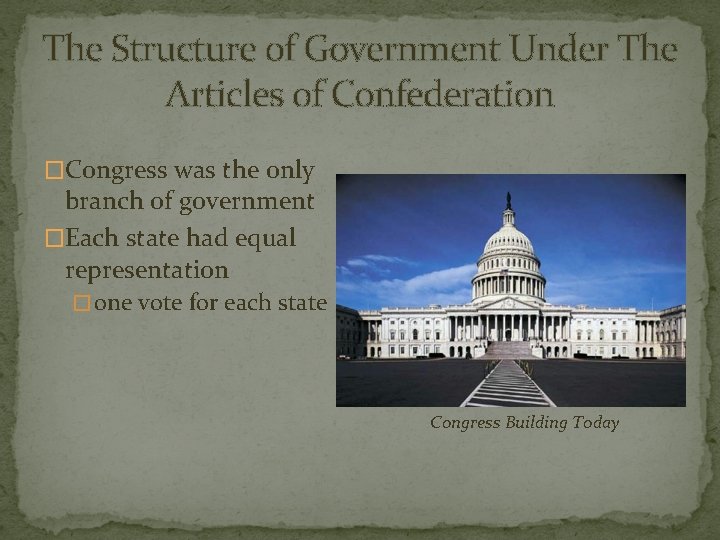
The Structure of Government Under The Articles of Confederation �Congress was the only branch of government �Each state had equal representation � one vote for each state Congress Building Today
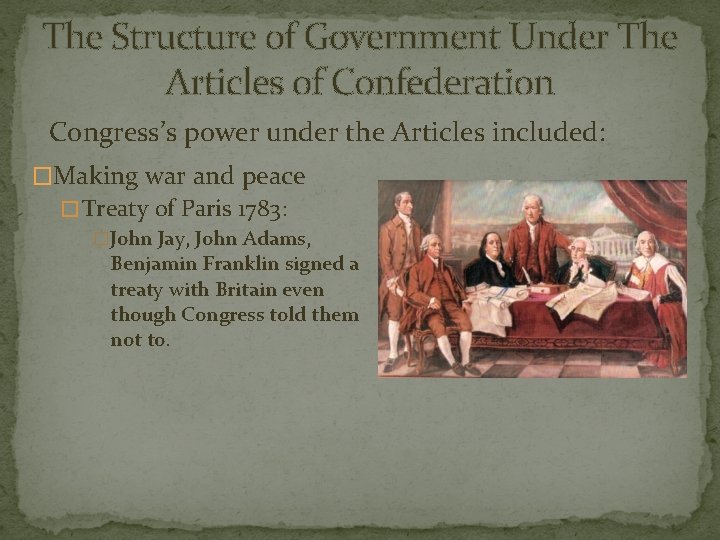
The Structure of Government Under The Articles of Confederation Congress’s power under the Articles included: �Making war and peace � Treaty of Paris 1783: �John Jay, John Adams, Benjamin Franklin signed a treaty with Britain even though Congress told them not to.
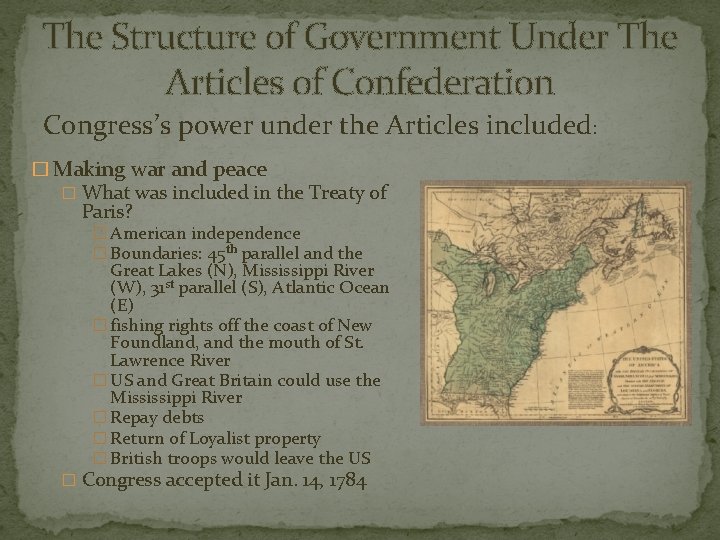
The Structure of Government Under The Articles of Confederation Congress’s power under the Articles included: � Making war and peace � What was included in the Treaty of Paris? � American independence � Boundaries: 45 th parallel and the Great Lakes (N), Mississippi River (W), 31 st parallel (S), Atlantic Ocean (E) � fishing rights off the coast of New Foundland, and the mouth of St. Lawrence River � US and Great Britain could use the Mississippi River � Repay debts � Return of Loyalist property � British troops would leave the US � Congress accepted it Jan. 14, 1784
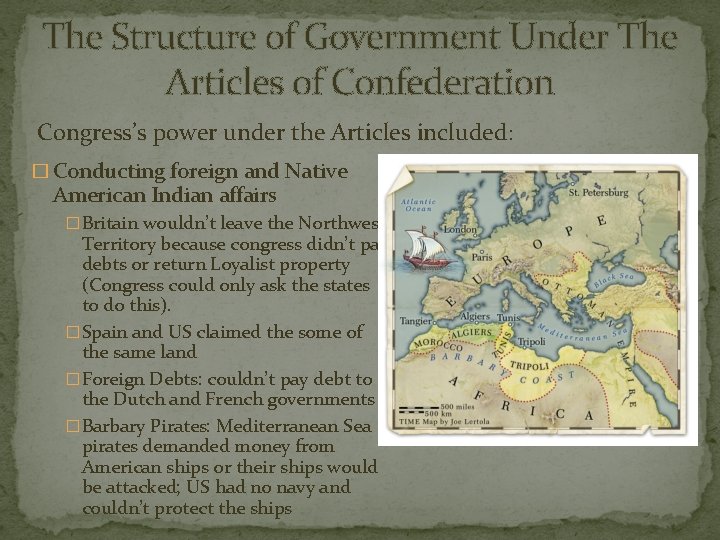
The Structure of Government Under The Articles of Confederation Congress’s power under the Articles included: � Conducting foreign and Native American Indian affairs � Britain wouldn’t leave the Northwest Territory because congress didn’t pay debts or return Loyalist property (Congress could only ask the states to do this). � Spain and US claimed the some of the same land � Foreign Debts: couldn’t pay debt to the Dutch and French governments � Barbary Pirates: Mediterranean Sea pirates demanded money from American ships or their ships would be attacked; US had no navy and couldn’t protect the ships
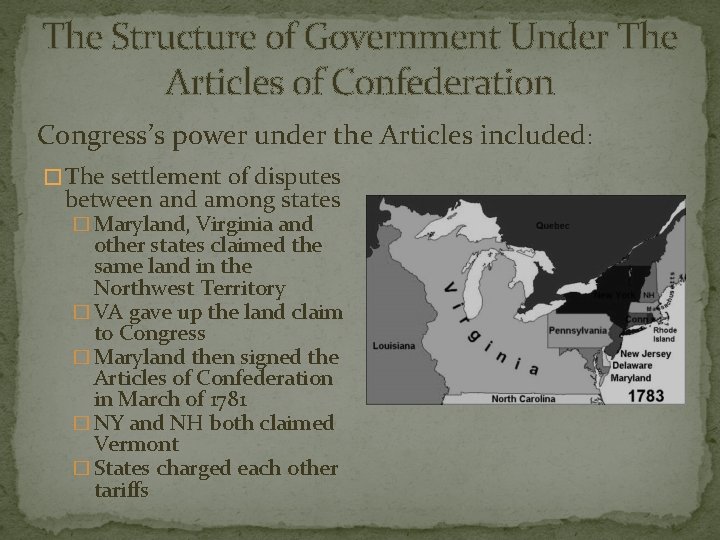
The Structure of Government Under The Articles of Confederation Congress’s power under the Articles included: � The settlement of disputes between and among states � Maryland, Virginia and other states claimed the same land in the Northwest Territory � VA gave up the land claim to Congress � Maryland then signed the Articles of Confederation in March of 1781 � NY and NH both claimed Vermont � States charged each other tariffs
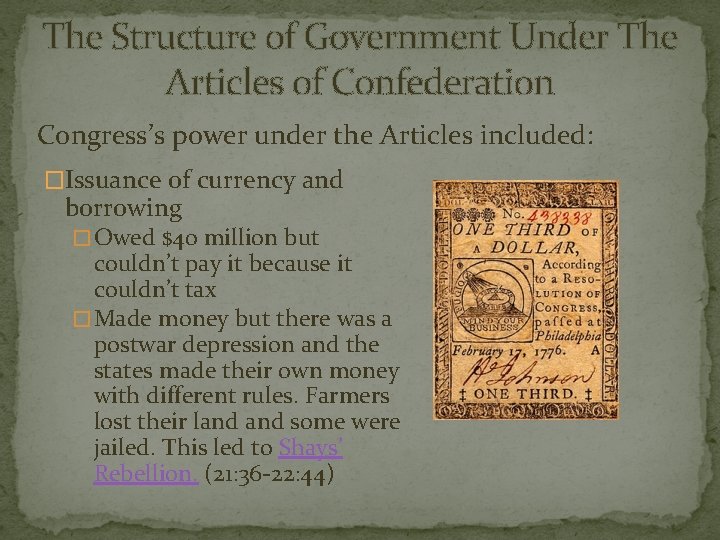
The Structure of Government Under The Articles of Confederation Congress’s power under the Articles included: �Issuance of currency and borrowing � Owed $40 million but couldn’t pay it because it couldn’t tax � Made money but there was a postwar depression and the states made their own money with different rules. Farmers lost their land some were jailed. This led to Shays’ Rebellion. (21: 36 -22: 44)
Essential Question �What is a government? �How did the first United States government operate?