
Article III Structure Section 1 The judicial Power
![Article III [Structure] Section 1. The judicial Power of the United States, shall be](https://slidetodoc.com/presentation_image/0e3f256e627f6c8c8cdeb405e4fd278b/image-1.jpg "Article III [Structure] Section 1. The judicial Power of the United States, shall be")
![Article III [Jurisdiction] Section 2. [1] The judicial Power shall extend to all Cases,](https://slidetodoc.com/presentation_image/0e3f256e627f6c8c8cdeb405e4fd278b/image-2.jpg "Article III [Jurisdiction] Section 2. [1] The judicial Power shall extend to all Cases,")
![Article III [Jurisdiction] Section 2. [1] The judicial Power shall extend to all Cases,](https://slidetodoc.com/presentation_image/0e3f256e627f6c8c8cdeb405e4fd278b/image-3.jpg "Article III [Jurisdiction] Section 2. [1] The judicial Power shall extend to all Cases,")
![Judiciary Act of 1789 [Structure] An Act to establish the Judicial Courts of the](https://slidetodoc.com/presentation_image/0e3f256e627f6c8c8cdeb405e4fd278b/image-4.jpg "Judiciary Act of 1789 [Structure] An Act to establish the Judicial Courts of the")
![Judiciary Act of 1789 [Jurisdiction] Sec. 13. That the Supreme Court shall have exclusive](https://slidetodoc.com/presentation_image/0e3f256e627f6c8c8cdeb405e4fd278b/image-6.jpg "Judiciary Act of 1789 [Jurisdiction] Sec. 13. That the Supreme Court shall have exclusive")
![Judiciary Act of 1789 [Jurisdiction] Sec. 25. That a final judgment or decree in](https://slidetodoc.com/presentation_image/0e3f256e627f6c8c8cdeb405e4fd278b/image-7.jpg "Judiciary Act of 1789 [Jurisdiction] Sec. 25. That a final judgment or decree in")
- Slides: 19
Article III [Structure] Section 1. The judicial Power of the United States, shall be vested in one supreme Court, and in such inferior Courts as the Congress may from time to time ordain and establish. The Judges, both of the supreme and inferior Courts, shall hold their Offices during good Behaviour, and shall, at stated Times, receive for their Services, a Compensation, which shall not be diminished during their Continuance in Office. 1
Article III [Jurisdiction] Section 2. [1] The judicial Power shall extend to all Cases, in Law and Equity, arising under this Constitution, the Laws of the United States, and Treaties made, or which shall be made, under their Authority; —to all Cases affecting Ambassadors, other public ministers and Consuls; —to all Cases of admiralty and maritime Jurisdiction; —to Controversies to which the United States shall be a Party; —to Controversies between two or more States; —between a State and Citizens of another State; —between Citizens of different States; —between Citizens of the same State claiming Lands under Grants of different States, and between a State, or the Citizens thereof, and foreign States, Citizens or Subjects. [2] In all Cases affecting Ambassadors, other public Ministers and Consuls, and those in which a State shall be Party, the supreme Court shall have original Jurisdiction. In all the other Cases before mentioned, the supreme Court shall have appellate Jurisdiction, both as to Law and Fact, with such Exceptions, and under such Regulations as the Congress shall make. 2
Article III [Jurisdiction] Section 2. [1] The judicial Power shall extend to all Cases, in Law and Equity, arising under this Constitution, the Laws of the United States, and Treaties made, or which shall be made, under their Authority; —to all Cases affecting Ambassadors, other public ministers and Consuls; —to all Cases of admiralty and maritime Jurisdiction; —to Controversies to which the United States shall be a Party; —to Controversies between two or more States; —between a State and Citizens of another State; —between Citizens of different States; —between Citizens of the same State claiming Lands under Grants of different States, and between a State, or the Citizens thereof, and foreign States, Citizens or Subjects. [2] In all Cases affecting Ambassadors, other public Ministers and Consuls, and those in which a State shall be Party, the supreme Court shall have original Jurisdiction. In all the other Cases before mentioned, the supreme Court shall have appellate Jurisdiction, both as to Law and Fact, with such Exceptions, and under such Regulations as the Congress shall make. Key Constitutional Provision re: Marbury v. Madison 3
Judiciary Act of 1789 [Structure] An Act to establish the Judicial Courts of the United States Sec. 1. Be it enacted, That the supreme court of the United States shall consist of a chief justice and five associate justices …. Sec. 2. That the United States shall be, and they hereby are, divided into thirteen districts …. Sec. 3. That there be a court called a District Court in each of the aforementioned districts, to consist of one judge …. Sec. 4. That the before mentioned districts … shall be divided into three circuits, and be called the eastern, the middle, and the southern circuit. [T]hat there shall be held annually in each district of said circuits two courts which shall be called Circuit Courts, and shall consist of any two justices of the Supreme Court and the district judge of such districts …. 4
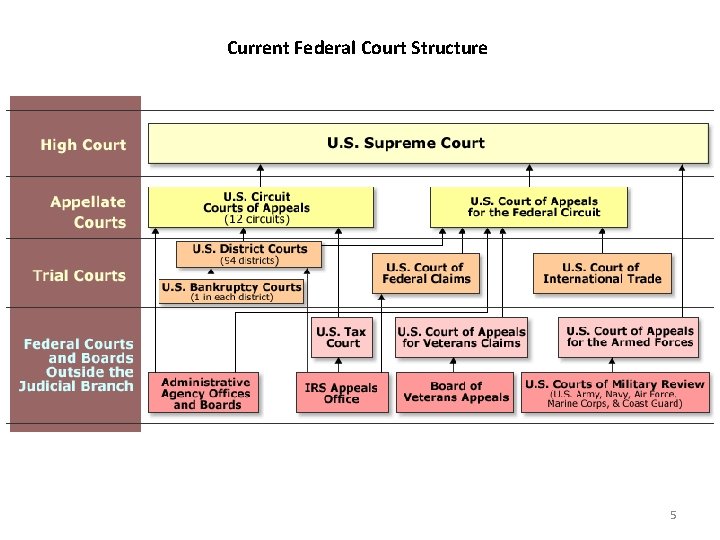
Current Federal Court Structure 5
Judiciary Act of 1789 [Jurisdiction] Sec. 13. That the Supreme Court shall have exclusive jurisdiction of all controversies of a civil nature, where a state is a party, except between a state and its citizens; and except also between a state and citizens of other states, or aliens, in which latter case it shall have original but not exclusive jurisdiction. And shall have exclusively all such jurisdiction of suits or proceedings against ambassadors or other public ministers, or their domestics, or domestic servants, as a court of law can have or exercise consistently with the law of nations; and original, but not exclusive jurisdiction of all suits brought by ambassadors or other public ministers, or in which a consul or viceconsul shall be a party. And the trial of issues in fact in the Supreme Court in all actions at law against citizens of the United States shall be by jury. The Supreme Court shall also have appellate jurisdiction from the circuit courts and courts of the several states in the cases hereinafter specially provided for and shall have power to issue writs of prohibition to the district courts, when proceeding as courts of admiralty and maritime jurisdiction, and writs of mandamus, in cases warranted by the principle and usages of law, to any courts appointed, or persons holding office under the authority of the United States …. An order from a court to an inferior government official ordering the government official to properly fulfill their official duties or correct an abuse of discretion. 6
Judiciary Act of 1789 [Jurisdiction] Sec. 25. That a final judgment or decree in any suit, in the highest court of law or equity of a State in which a decision in the suit could be had, [1] where is drawn in question the validity of a treaty or statute of, or an authority exercised under, the United States, and the decision is against their validity; or [2] where is drawn in question the validity of a statute of, or an authority exercised under, any State, on the ground of their being repugnant to the constitution, treaties, or laws of the United States, and the decision is in favour of such their validity, or [3] where is drawn in question the construction of any clause of the constitution, or of a treaty, or statute of, or commission held under, the United States, and the decision is against the title, right, privilege, or exemption, specially set up or claimed by either party, under such clause of the said Constitution, treaty, statute, or commission, may be re-examined, and reversed or affirmed in the Supreme Court of the United States upon a writ of error …. 7
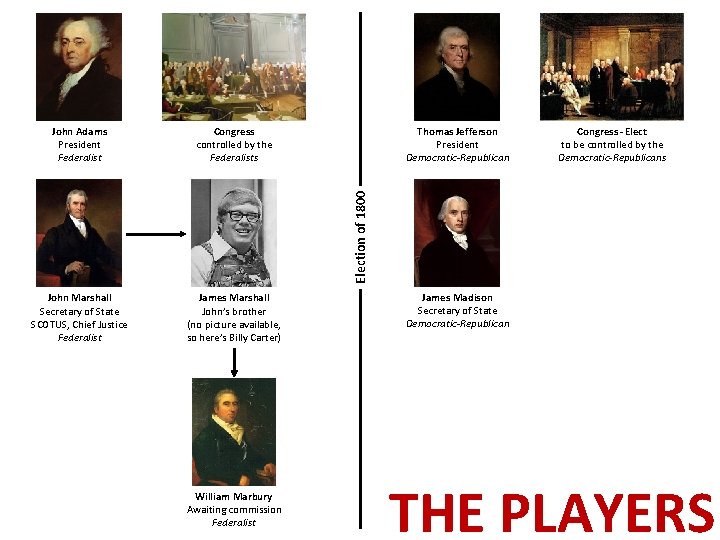
Congress controlled by the Federalists John Marshall Secretary of State SCOTUS, Chief Justice Federalist James Marshall John’s brother (no picture available, so here’s Billy Carter) Thomas Jefferson President Democratic-Republican Congress - Elect to be controlled by the Democratic-Republicans Election of 1800 John Adams President Federalist William Marbury Awaiting commission Federalist James Madison Secretary of State Democratic-Republican THE PLAYERS 8
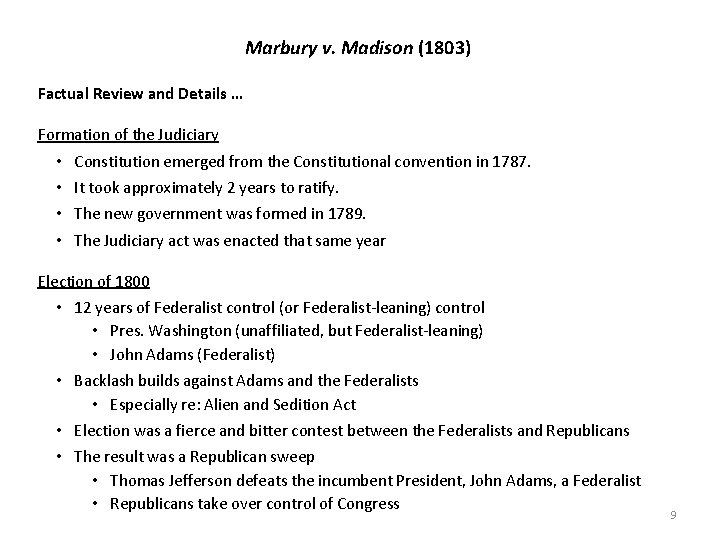
Marbury v. Madison (1803) Factual Review and Details … Formation of the Judiciary • Constitution emerged from the Constitutional convention in 1787. • It took approximately 2 years to ratify. • The new government was formed in 1789. • The Judiciary act was enacted that same year Election of 1800 • 12 years of Federalist control (or Federalist-leaning) control • Pres. Washington (unaffiliated, but Federalist-leaning) • John Adams (Federalist) • Backlash builds against Adams and the Federalists • Especially re: Alien and Sedition Act • Election was a fierce and bitter contest between the Federalists and Republicans • The result was a Republican sweep • Thomas Jefferson defeats the incumbent President, John Adams, a Federalist • Republicans take over control of Congress 9
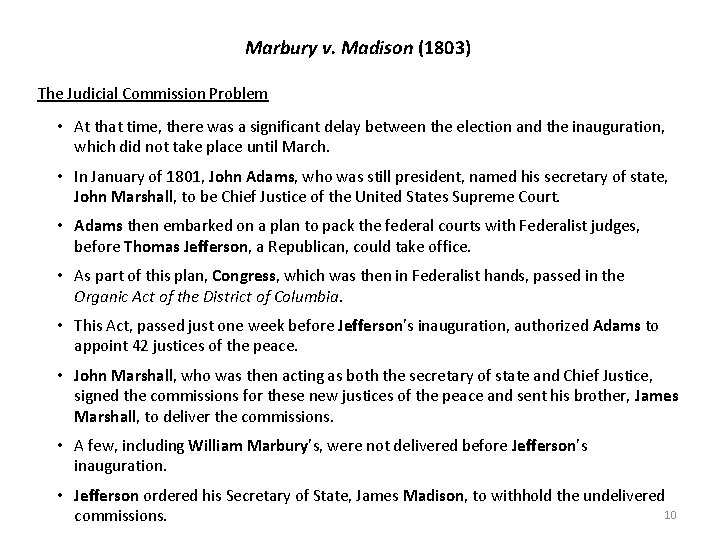
Marbury v. Madison (1803) The Judicial Commission Problem • At that time, there was a significant delay between the election and the inauguration, which did not take place until March. • In January of 1801, John Adams, who was still president, named his secretary of state, John Marshall, to be Chief Justice of the United States Supreme Court. • Adams then embarked on a plan to pack the federal courts with Federalist judges, before Thomas Jefferson, a Republican, could take office. • As part of this plan, Congress, which was then in Federalist hands, passed in the Organic Act of the District of Columbia. • This Act, passed just one week before Jefferson’s inauguration, authorized Adams to appoint 42 justices of the peace. • John Marshall, who was then acting as both the secretary of state and Chief Justice, signed the commissions for these new justices of the peace and sent his brother, James Marshall, to deliver the commissions. • A few, including William Marbury’s, were not delivered before Jefferson’s inauguration. • Jefferson ordered his Secretary of State, James Madison, to withhold the undelivered 10 commissions.
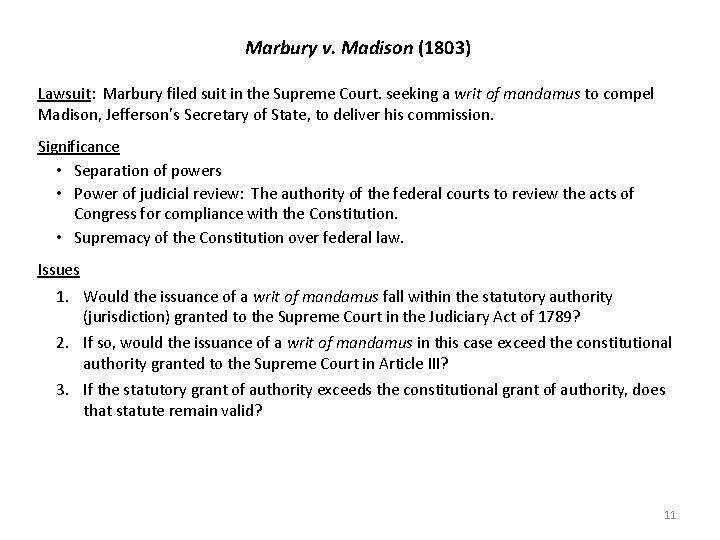
Marbury v. Madison (1803) Lawsuit: Marbury filed suit in the Supreme Court. seeking a writ of mandamus to compel Madison, Jefferson’s Secretary of State, to deliver his commission. Significance • Separation of powers • Power of judicial review: The authority of the federal courts to review the acts of Congress for compliance with the Constitution. • Supremacy of the Constitution over federal law. Issues 1. Would the issuance of a writ of mandamus fall within the statutory authority (jurisdiction) granted to the Supreme Court in the Judiciary Act of 1789? 2. If so, would the issuance of a writ of mandamus in this case exceed the constitutional authority granted to the Supreme Court in Article III? 3. If the statutory grant of authority exceeds the constitutional grant of authority, does that statute remain valid? 11
Marbury v. Madison (1803) ANALYSIS Issues 1. Would the issuance of a writ of mandamus fall within the statutory authority (jurisdiction) granted to the Supreme Court in the Judiciary Act of 1789? • Yes. Not at issue. 12
Marbury v. Madison (1803) Issues 2. If so, would the issuance of a writ of mandamus in this case exceed the constitutional authority granted to the Supreme Court in Article III? 13
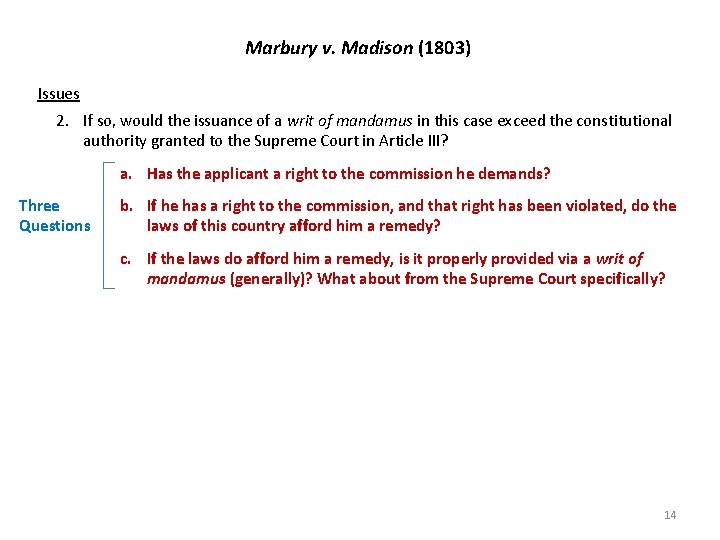
Marbury v. Madison (1803) Issues 2. If so, would the issuance of a writ of mandamus in this case exceed the constitutional authority granted to the Supreme Court in Article III? a. Has the applicant a right to the commission he demands? Three Questions b. If he has a right to the commission, and that right has been violated, do the laws of this country afford him a remedy? c. If the laws do afford him a remedy, is it properly provided via a writ of mandamus (generally)? What about from the Supreme Court specifically? 14
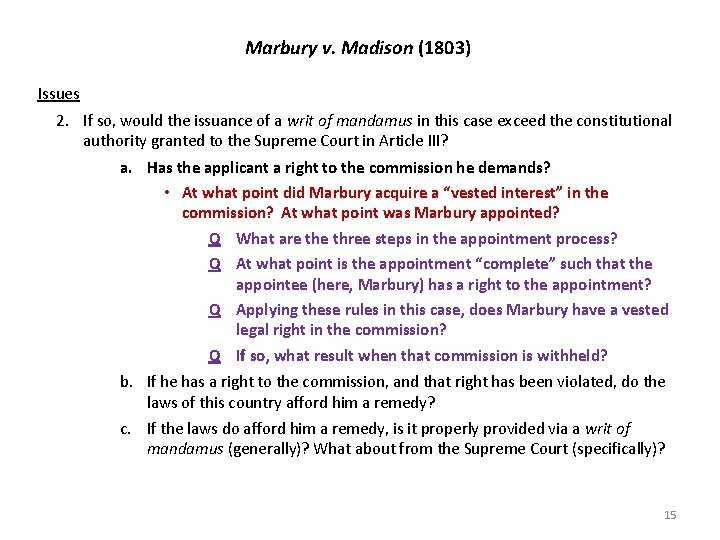
Marbury v. Madison (1803) Issues 2. If so, would the issuance of a writ of mandamus in this case exceed the constitutional authority granted to the Supreme Court in Article III? a. Has the applicant a right to the commission he demands? • At what point did Marbury acquire a “vested interest” in the commission? At what point was Marbury appointed? Q What are three steps in the appointment process? Q At what point is the appointment “complete” such that the appointee (here, Marbury) has a right to the appointment? Q Applying these rules in this case, does Marbury have a vested legal right in the commission? Q If so, what result when that commission is withheld? b. If he has a right to the commission, and that right has been violated, do the laws of this country afford him a remedy? c. If the laws do afford him a remedy, is it properly provided via a writ of mandamus (generally)? What about from the Supreme Court (specifically)? 15
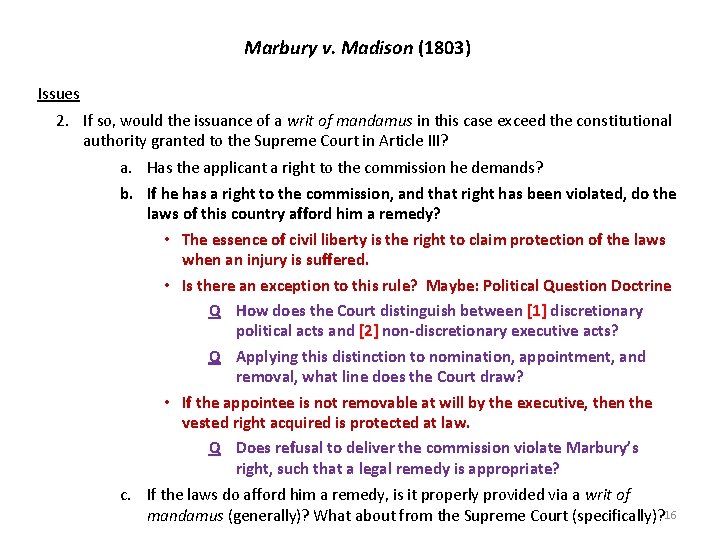
Marbury v. Madison (1803) Issues 2. If so, would the issuance of a writ of mandamus in this case exceed the constitutional authority granted to the Supreme Court in Article III? a. Has the applicant a right to the commission he demands? b. If he has a right to the commission, and that right has been violated, do the laws of this country afford him a remedy? • The essence of civil liberty is the right to claim protection of the laws when an injury is suffered. • Is there an exception to this rule? Maybe: Political Question Doctrine Q How does the Court distinguish between [1] discretionary political acts and [2] non-discretionary executive acts? Q Applying this distinction to nomination, appointment, and removal, what line does the Court draw? • If the appointee is not removable at will by the executive, then the vested right acquired is protected at law. Q Does refusal to deliver the commission violate Marbury’s right, such that a legal remedy is appropriate? c. If the laws do afford him a remedy, is it properly provided via a writ of mandamus (generally)? What about from the Supreme Court (specifically)? 16
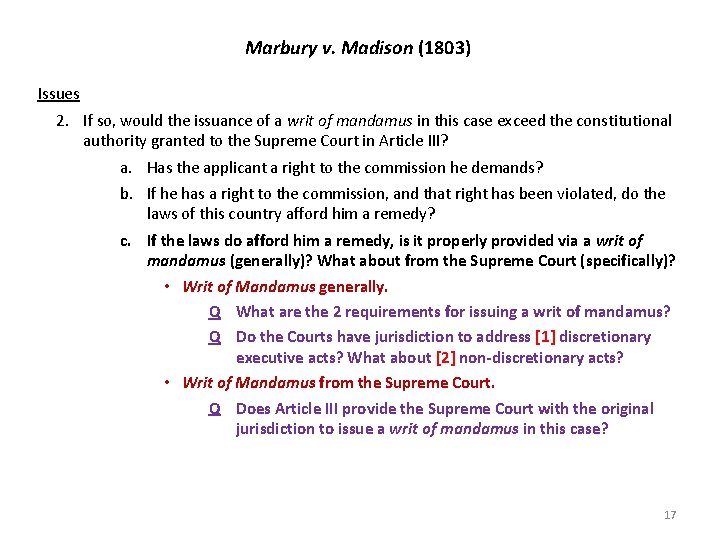
Marbury v. Madison (1803) Issues 2. If so, would the issuance of a writ of mandamus in this case exceed the constitutional authority granted to the Supreme Court in Article III? a. Has the applicant a right to the commission he demands? b. If he has a right to the commission, and that right has been violated, do the laws of this country afford him a remedy? c. If the laws do afford him a remedy, is it properly provided via a writ of mandamus (generally)? What about from the Supreme Court (specifically)? • Writ of Mandamus generally. Q What are the 2 requirements for issuing a writ of mandamus? Q Do the Courts have jurisdiction to address [1] discretionary executive acts? What about [2] non-discretionary acts? • Writ of Mandamus from the Supreme Court. Q Does Article III provide the Supreme Court with the original jurisdiction to issue a writ of mandamus in this case? 17
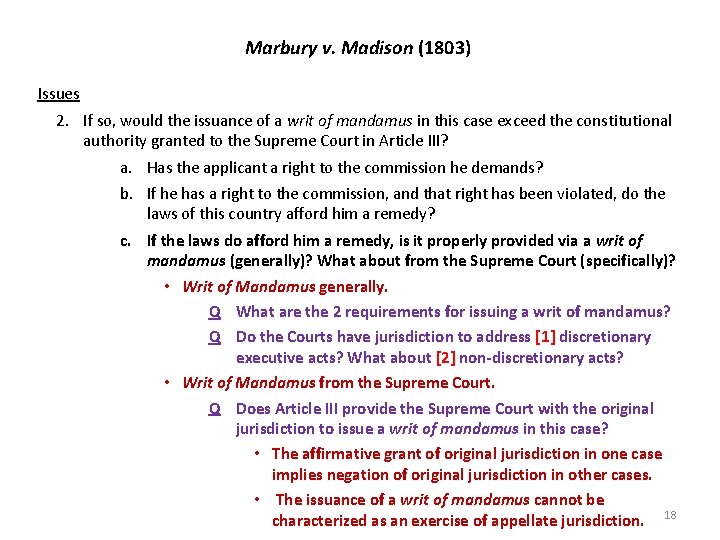
Marbury v. Madison (1803) Issues 2. If so, would the issuance of a writ of mandamus in this case exceed the constitutional authority granted to the Supreme Court in Article III? a. Has the applicant a right to the commission he demands? b. If he has a right to the commission, and that right has been violated, do the laws of this country afford him a remedy? c. If the laws do afford him a remedy, is it properly provided via a writ of mandamus (generally)? What about from the Supreme Court (specifically)? • Writ of Mandamus generally. Q What are the 2 requirements for issuing a writ of mandamus? Q Do the Courts have jurisdiction to address [1] discretionary executive acts? What about [2] non-discretionary acts? • Writ of Mandamus from the Supreme Court. Q Does Article III provide the Supreme Court with the original jurisdiction to issue a writ of mandamus in this case? • The affirmative grant of original jurisdiction in one case implies negation of original jurisdiction in other cases. • The issuance of a writ of mandamus cannot be characterized as an exercise of appellate jurisdiction. 18
Marbury v. Madison (1803) Issues 3. If the statutory grant of authority exceeds the constitutional grant of authority, does that statute remain valid? • The statutory grant of jurisdiction to issue a writ of mandamus exceeds Congress’ authority under Article III. • Is the statute therefore invalid? • Looking to the nature of this Constitution • The Constitution both … 1. Assigns powers to government departments, and 2. Defines and limits those powers. • Constitutional limits would have no purpose if Congress was free to ignore them. • The Constitution is either supreme or it is not. • If the Constitution is supreme “then a legislative act contrary to the Constitution is not law” • It is the essence of judicial duty to [1] say what the law is, and [2] determine whether that law and the Constitution are in conflict. • Additional Support 19