
Article Analysis A 1 minute summary of the


- Slides: 48
Article Analysis A 1 minute summary of the article § Key learnings: what information was new to you? What surprised you § How you can apply the information to your professional life § 1 2 -1
Chapter 2 Individual Behavior, Personality, and Values Mc. Graw-Hill/Irwin Copyright © 2013 by The Mc. Graw-Hill Companies, Inc. All rights reserved.
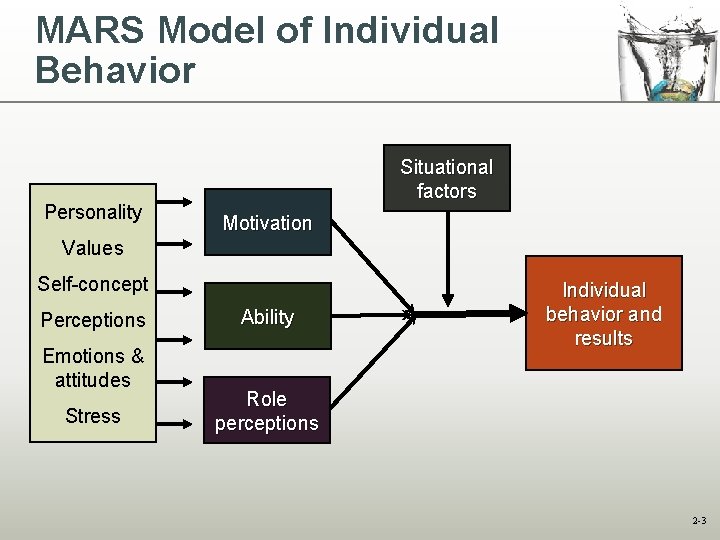
MARS Model of Individual Behavior Personality Situational factors Motivation Values Self-concept Perceptions Emotions & attitudes Stress Ability Individual behavior and results Role perceptions 2 -3
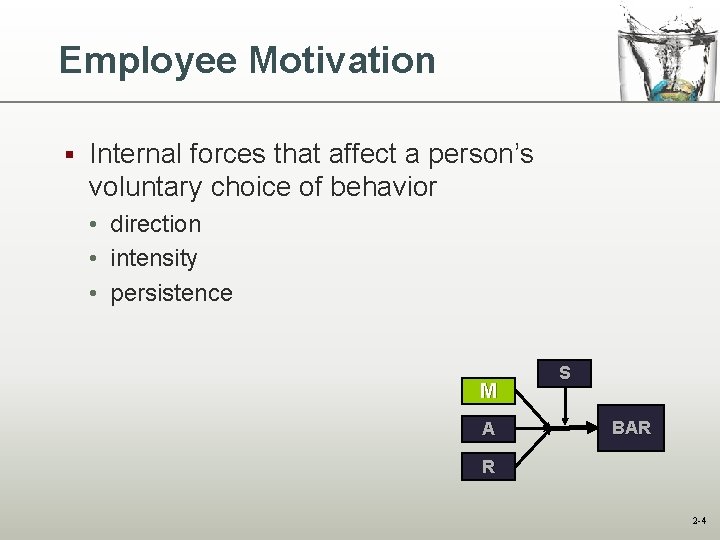
Employee Motivation § Internal forces that affect a person’s voluntary choice of behavior • direction • intensity • persistence M A S BAR R 2 -4
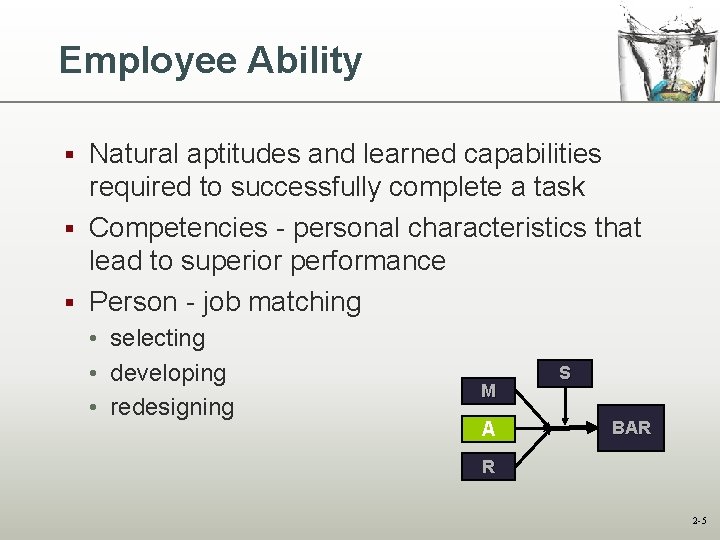
Employee Ability Natural aptitudes and learned capabilities required to successfully complete a task § Competencies - personal characteristics that lead to superior performance § Person - job matching § • selecting • developing • redesigning M A S BAR R 2 -5
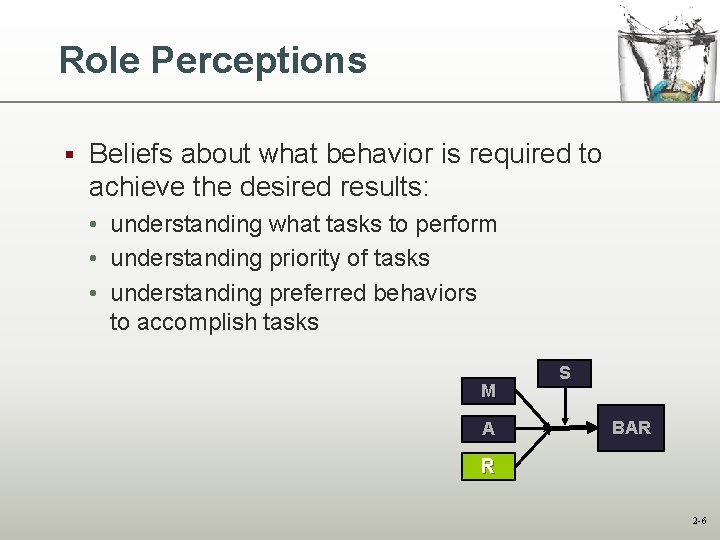
Role Perceptions § Beliefs about what behavior is required to achieve the desired results: • understanding what tasks to perform • understanding priority of tasks • understanding preferred behaviors to accomplish tasks M A S BAR R 2 -6
Situational Factors Environmental conditions beyond the individual’s short-term control that constrain or facilitate behavior § Constraints – time, budget, facilities, etc § Cues – e. g. signs of nearby hazards § M A S BAR R 2 -7
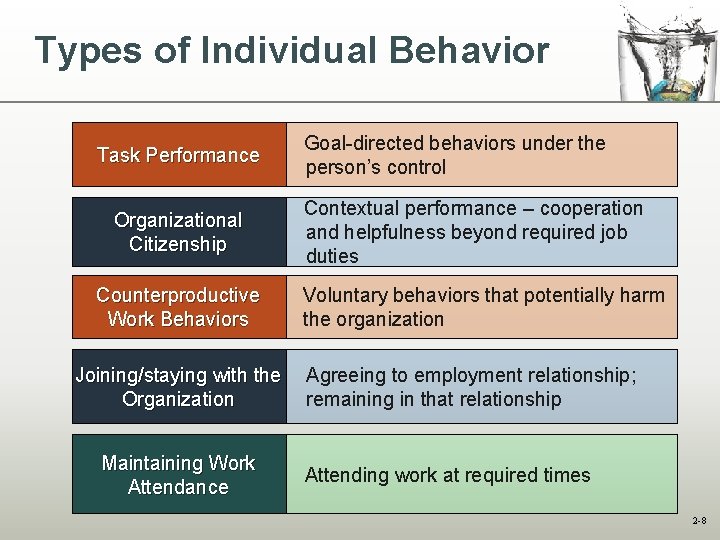
Types of Individual Behavior Task Performance Organizational Citizenship Counterproductive Work Behaviors Joining/staying with the Organization Maintaining Work Attendance Goal-directed behaviors under the person’s control Contextual performance – cooperation and helpfulness beyond required job duties Voluntary behaviors that potentially harm the organization Agreeing to employment relationship; remaining in that relationship Attending work at required times 2 -8
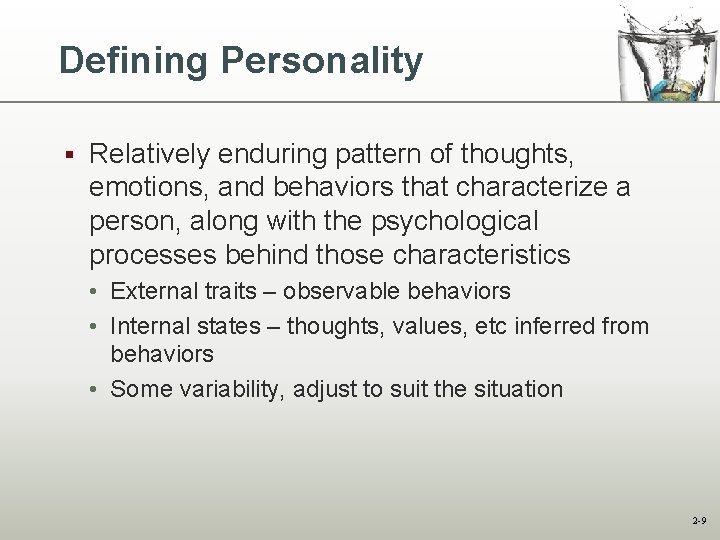
Defining Personality § Relatively enduring pattern of thoughts, emotions, and behaviors that characterize a person, along with the psychological processes behind those characteristics • External traits – observable behaviors • Internal states – thoughts, values, etc inferred from behaviors • Some variability, adjust to suit the situation 2 -9
Nature vs. Nurture of Personality § Influenced by Nature • Heredity explains about 50 percent of behavioral tendencies and 30 percent of temperament • Minnesota studies – twins had similar personalities § Influenced by Nurture • Socialization, learning • Personality stabilizes throughout adolescence • Executive function steers behavior guided by our self-concept 2 -10
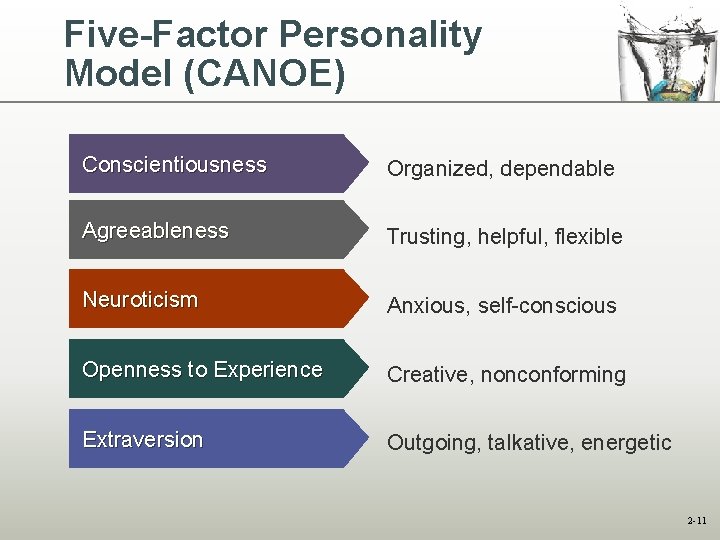
Five-Factor Personality Model (CANOE) Conscientiousness Organized, dependable Agreeableness Trusting, helpful, flexible Neuroticism Anxious, self-conscious Openness to Experience Creative, nonconforming Extraversion Outgoing, talkative, energetic 2 -11
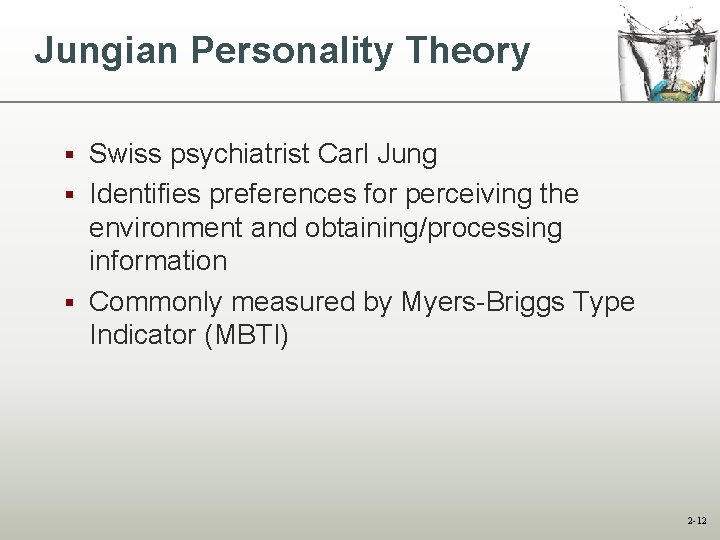
Jungian Personality Theory Swiss psychiatrist Carl Jung § Identifies preferences for perceiving the environment and obtaining/processing information § Commonly measured by Myers-Briggs Type Indicator (MBTI) § 2 -12
MBTI Personal type ? § http: //www. humanmetrics. com/cgiwin/jtypes 2. asp § 13 2 -13
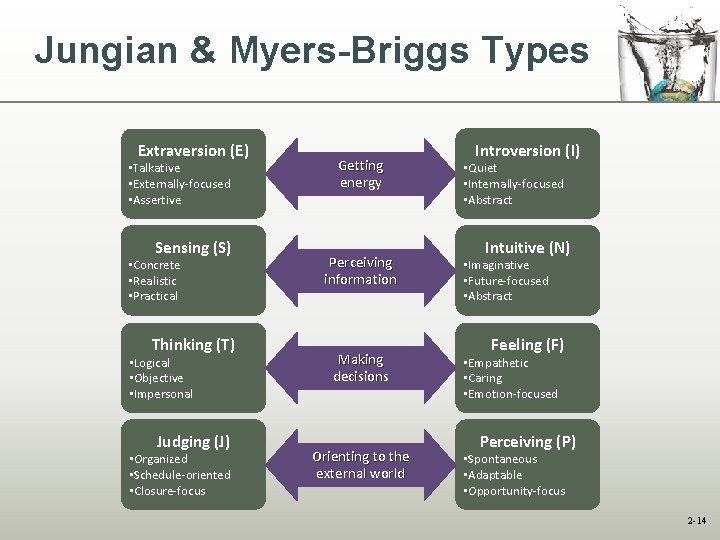
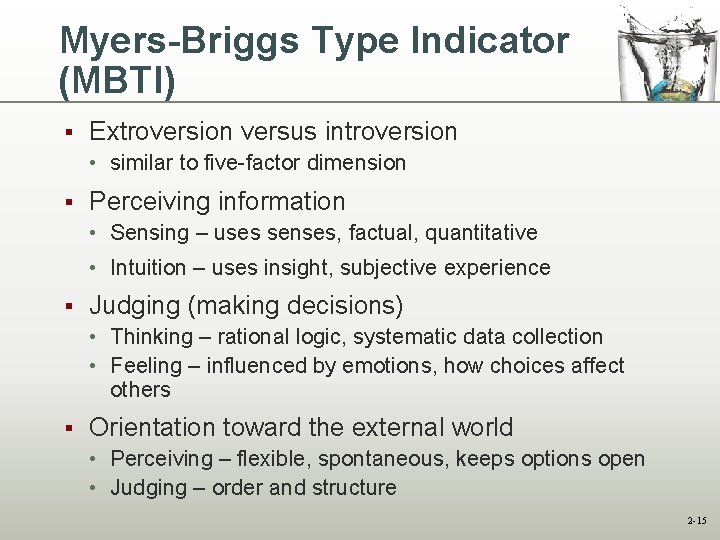
Jungian & Myers-Briggs Types Extraversion (E) • Talkative • Externally-focused • Assertive Sensing (S) • Concrete • Realistic • Practical Thinking (T) • Logical • Objective • Impersonal Judging (J) • Organized • Schedule-oriented • Closure-focus Getting energy Perceiving information Making decisions Orienting to the external world Introversion (I) • Quiet • Internally-focused • Abstract Intuitive (N) • Imaginative • Future-focused • Abstract Feeling (F) • Empathetic • Caring • Emotion-focused Perceiving (P) • Spontaneous • Adaptable • Opportunity-focus 2 -14
Myers-Briggs Type Indicator (MBTI) § Extroversion versus introversion • similar to five-factor dimension § Perceiving information • Sensing – uses senses, factual, quantitative • Intuition – uses insight, subjective experience § Judging (making decisions) • Thinking – rational logic, systematic data collection • Feeling – influenced by emotions, how choices affect others § Orientation toward the external world • Perceiving – flexible, spontaneous, keeps options open • Judging – order and structure 2 -15
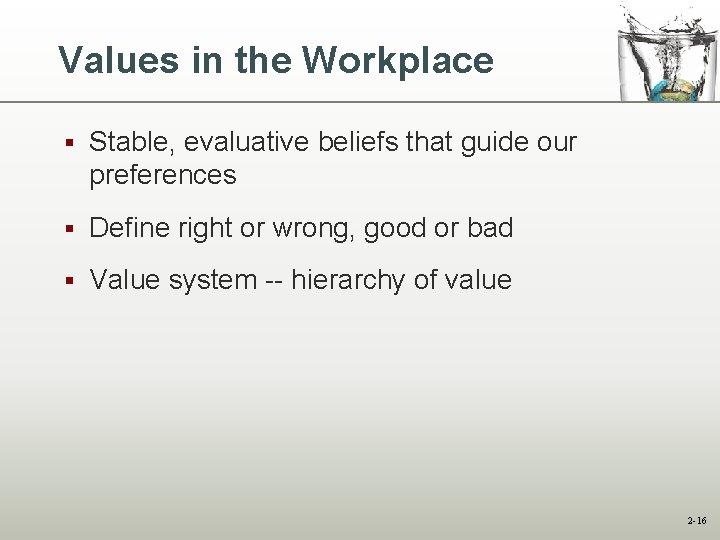
Values in the Workplace § Stable, evaluative beliefs that guide our preferences § Define right or wrong, good or bad § Value system -- hierarchy of value 2 -16
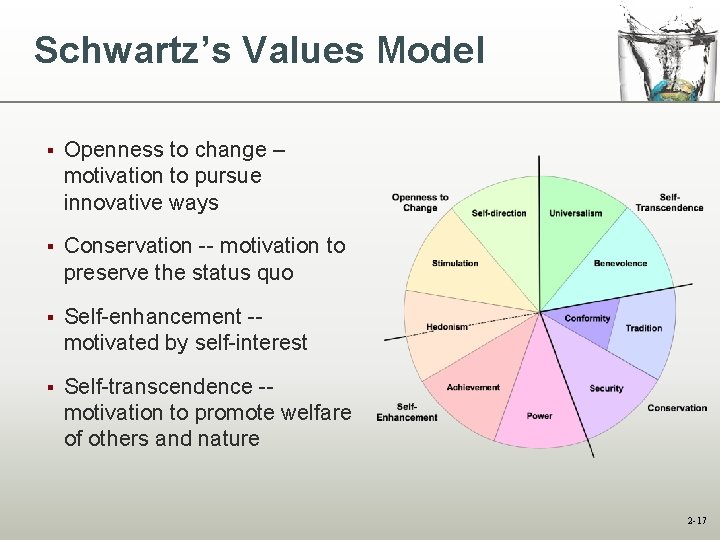
Schwartz’s Values Model § Openness to change – motivation to pursue innovative ways § Conservation -- motivation to preserve the status quo § Self-enhancement -motivated by self-interest § Self-transcendence -motivation to promote welfare of others and nature 2 -17
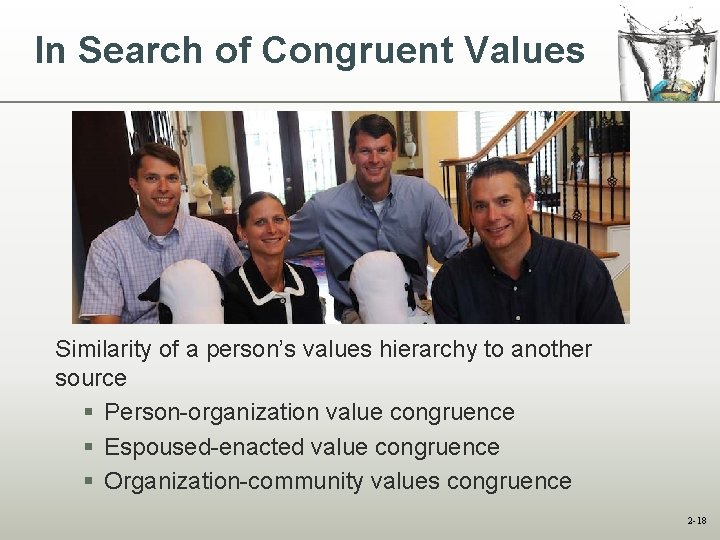
In Search of Congruent Values Similarity of a person’s values hierarchy to another source § Person-organization value congruence § Espoused-enacted value congruence § Organization-community values congruence 2 -18
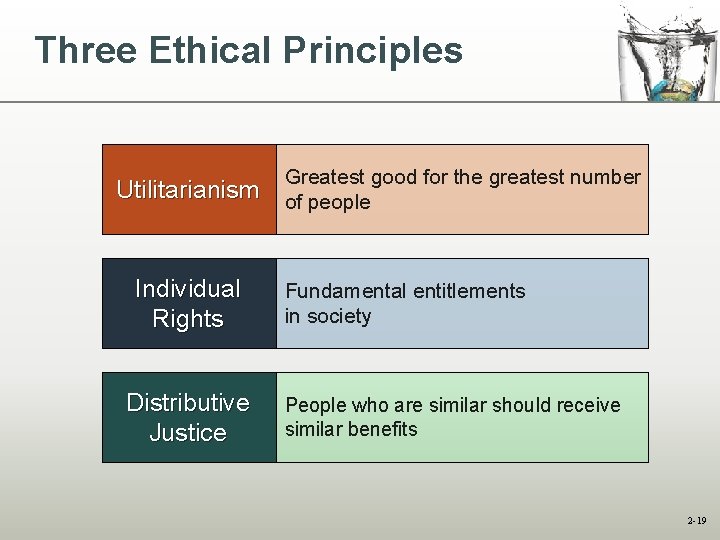
Three Ethical Principles Greatest good for the greatest number Utilitarianism of people Individual Rights Distributive Justice Fundamental entitlements in society People who are similar should receive similar benefits 2 -19
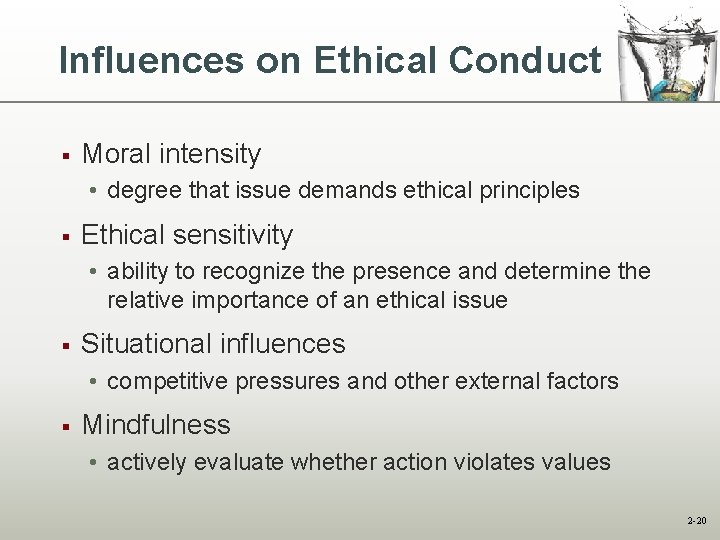
Influences on Ethical Conduct § Moral intensity • degree that issue demands ethical principles § Ethical sensitivity • ability to recognize the presence and determine the relative importance of an ethical issue § Situational influences • competitive pressures and other external factors § Mindfulness • actively evaluate whether action violates values 2 -20
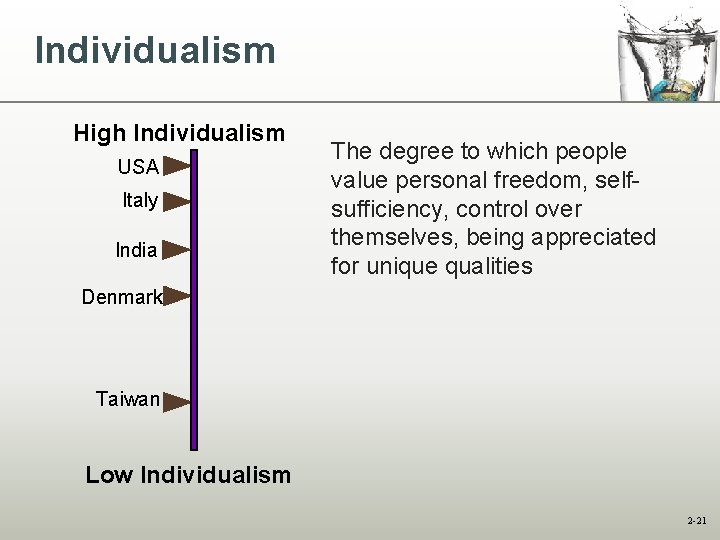
Individualism High Individualism USA Italy India The degree to which people value personal freedom, selfsufficiency, control over themselves, being appreciated for unique qualities Denmark Taiwan Low Individualism 2 -21
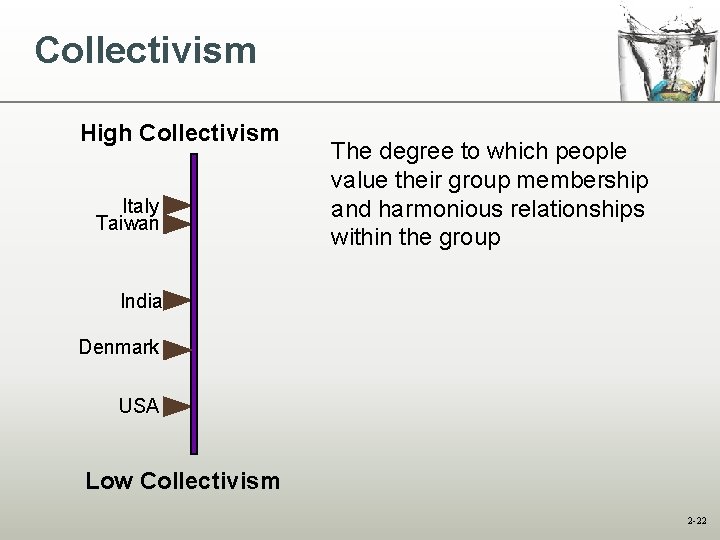
Collectivism High Collectivism Italy Taiwan The degree to which people value their group membership and harmonious relationships within the group India Denmark USA Low Collectivism 2 -22
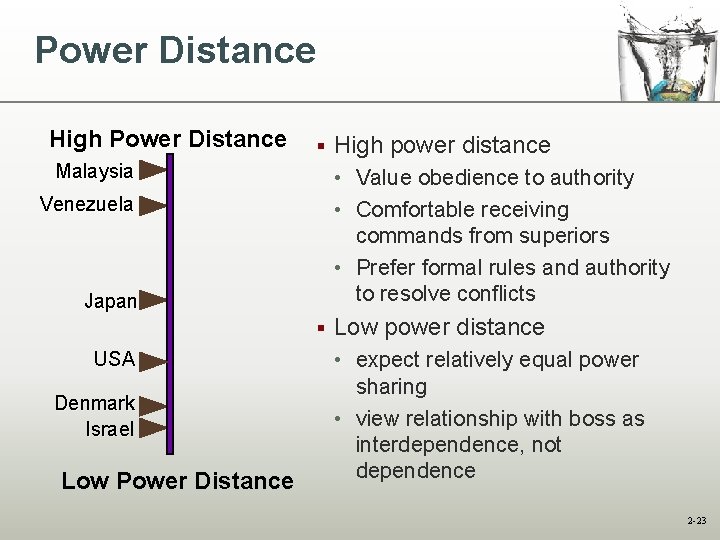
Power Distance High Power Distance § Malaysia • Value obedience to authority • Comfortable receiving commands from superiors • Prefer formal rules and authority to resolve conflicts Venezuela Japan § USA Denmark Israel Low Power Distance High power distance Low power distance • expect relatively equal power sharing • view relationship with boss as interdependence, not dependence 2 -23
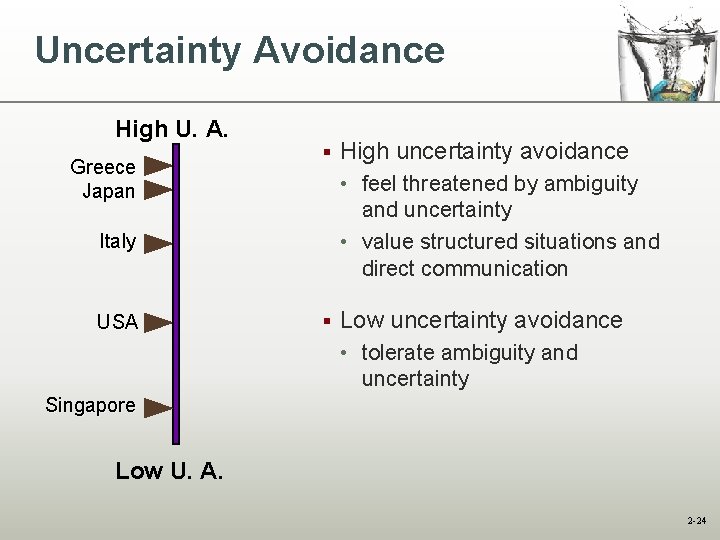
Uncertainty Avoidance High U. A. Greece Japan § • feel threatened by ambiguity and uncertainty • value structured situations and direct communication Italy USA High uncertainty avoidance § Low uncertainty avoidance • tolerate ambiguity and uncertainty Singapore Low U. A. 2 -24
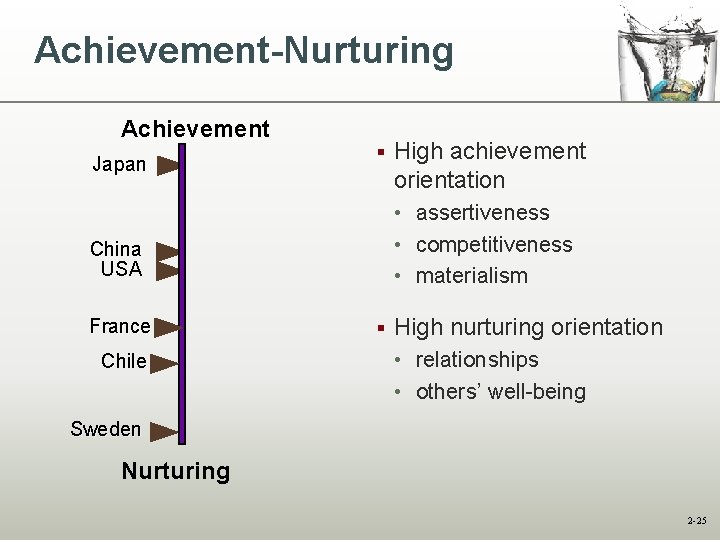
Achievement-Nurturing Achievement Japan § • assertiveness • competitiveness • materialism China USA France Chile High achievement orientation § High nurturing orientation • relationships • others’ well-being Sweden Nurturing 2 -25
Chapter 2 Perceiving Ourselves and Others in Organizations Mc. Graw-Hill/Irwin Copyright © 2013 by The Mc. Graw-Hill Companies, Inc. All rights reserved.
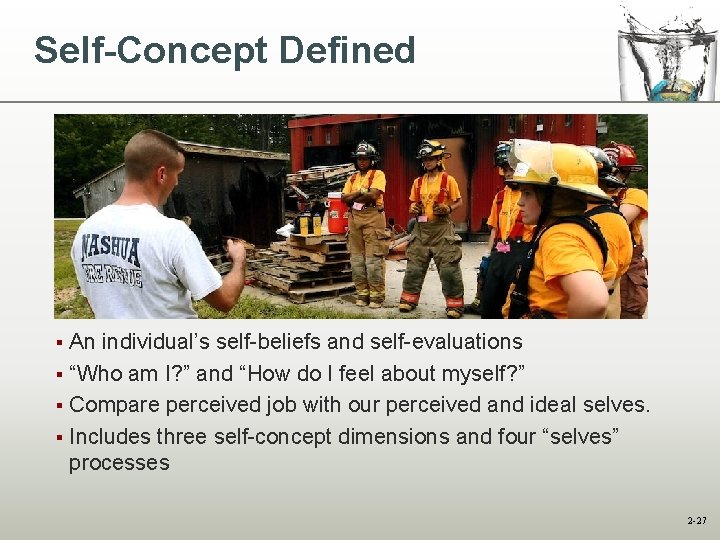
Self-Concept Defined An individual’s self-beliefs and self-evaluations § “Who am I? ” and “How do I feel about myself? ” § Compare perceived job with our perceived and ideal selves. § Includes three self-concept dimensions and four “selves” processes § 2 -27
Self-Concept Dimensions (3 C’s) § Complexity • People have multiple self-views § Consistency • Similar personality and values across multiple selves § Clarity • Clearly and confidently described, internally consistent, and stable across time. § People have better well-being with: • multiple selves (complexity) • well established selves (clarity) • selves are similar and compatible with traits (consistency) 2 -28
Four “Selves” of Self-Concept § Self-enhancement • Promoting and protecting our positive self-view § Self-verification • Affirming our existing self-concept § Self-evaluation • Evaluating ourselves through self-esteem, selfefficacy and locus of control § Social self • Defining ourselves in terms of group membership 2 -29
Self-Concept: Self. Enhancement § Drive to promote/protect a positive self-view • competent, attractive, lucky, ethical, valued § Positive self-concept outcomes: • better personal adjustment and mental/physical health • inflates personal causation and probability of success 2 -30
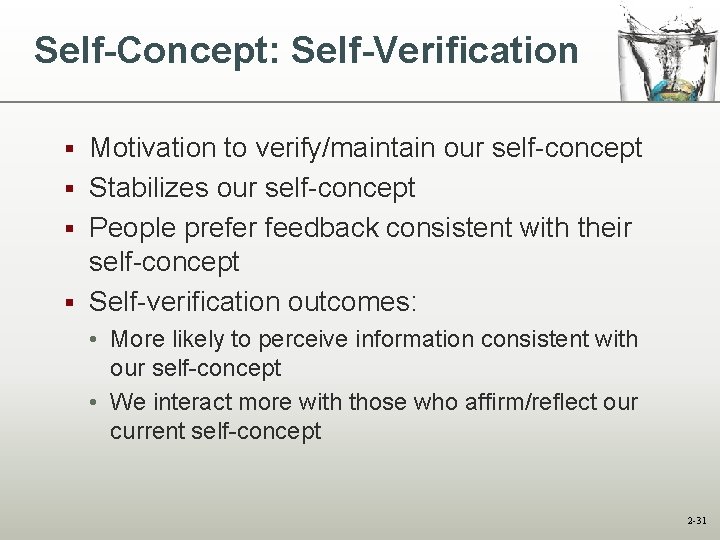
Self-Concept: Self-Verification Motivation to verify/maintain our self-concept § Stabilizes our self-concept § People prefer feedback consistent with their self-concept § Self-verification outcomes: § • More likely to perceive information consistent with our self-concept • We interact more with those who affirm/reflect our current self-concept 2 -31
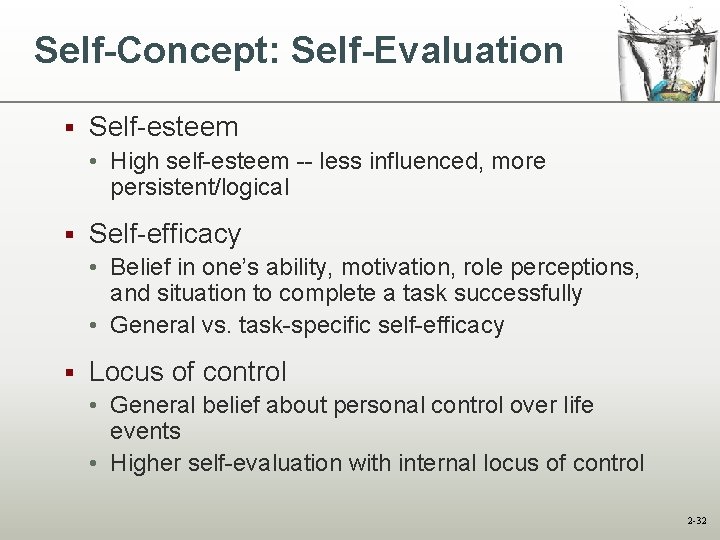
Self-Concept: Self-Evaluation § Self-esteem • High self-esteem -- less influenced, more persistent/logical § Self-efficacy • Belief in one’s ability, motivation, role perceptions, and situation to complete a task successfully • General vs. task-specific self-efficacy § Locus of control • General belief about personal control over life events • Higher self-evaluation with internal locus of control 2 -32
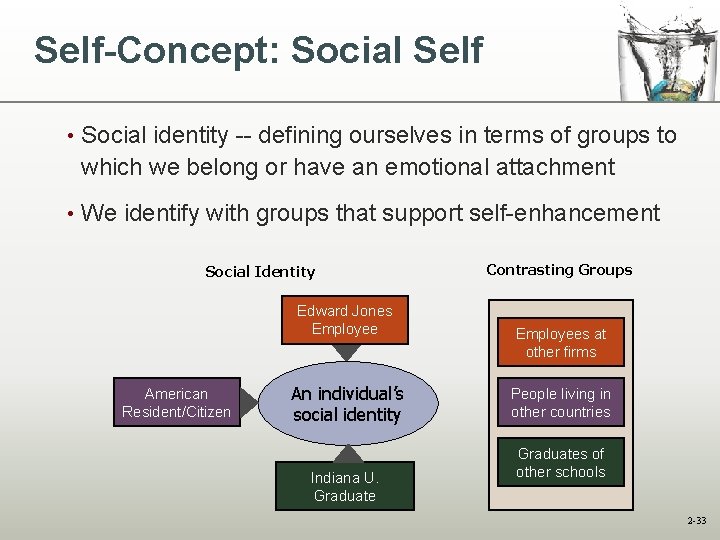
Self-Concept: Social Self • Social identity -- defining ourselves in terms of groups to which we belong or have an emotional attachment • We identify with groups that support self-enhancement Social Identity Edward Jones Employee American Resident/Citizen An individual’s social identity Indiana U. Graduate Contrasting Groups Employees at other firms People living in other countries Graduates of other schools 2 -33
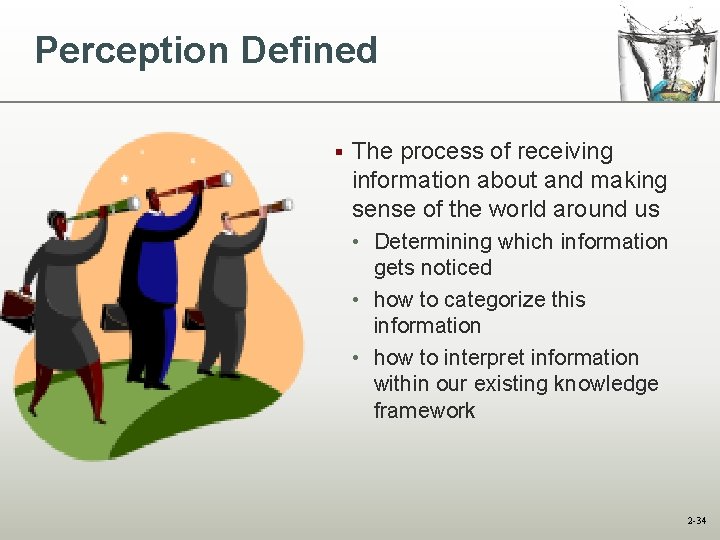
Perception Defined § The process of receiving information about and making sense of the world around us • Determining which information gets noticed • how to categorize this information • how to interpret information within our existing knowledge framework 2 -34
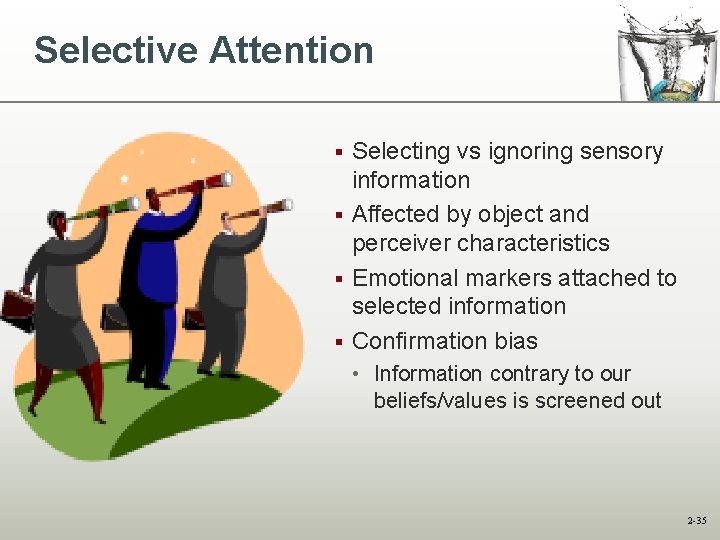
Selective Attention Selecting vs ignoring sensory information § Affected by object and perceiver characteristics § Emotional markers attached to selected information § Confirmation bias § • Information contrary to our beliefs/values is screened out 2 -35
Perceptual Organization/Interpretation § Categorical thinking • Mostly nonconscious process of organizing people/things § Perceptual grouping principles • Similarity or proximity • Closure -- filling in missing pieces • Perceiving trends § Interpreting incoming information • Emotional markers automatically evaluate information 2 -36
Mental Models in Perceptions § Internal representations of the external world § Help make sense of situations • Fill in missing pieces • Help to predict events § Problem with mental models: • May block recognition of new opportunities/perspectives 2 -37
Stereotyping Social identity and self-enhancement reinforce stereotyping through: § Categorization -- Categorize people into groups § § Homogenization -- Assign similar traits within a group; different traits to other groups § Differentiation process -- Assign less favorable attributes to other groups 2 -38
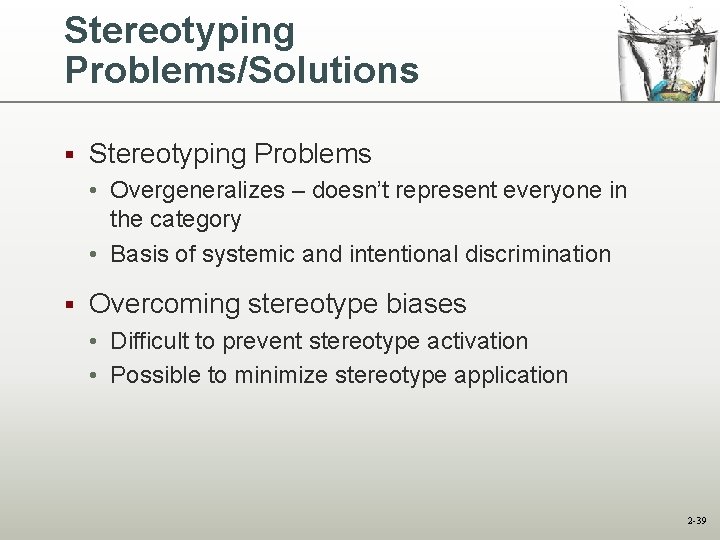
Stereotyping Problems/Solutions § Stereotyping Problems • Overgeneralizes – doesn’t represent everyone in the category • Basis of systemic and intentional discrimination § Overcoming stereotype biases • Difficult to prevent stereotype activation • Possible to minimize stereotype application 2 -39
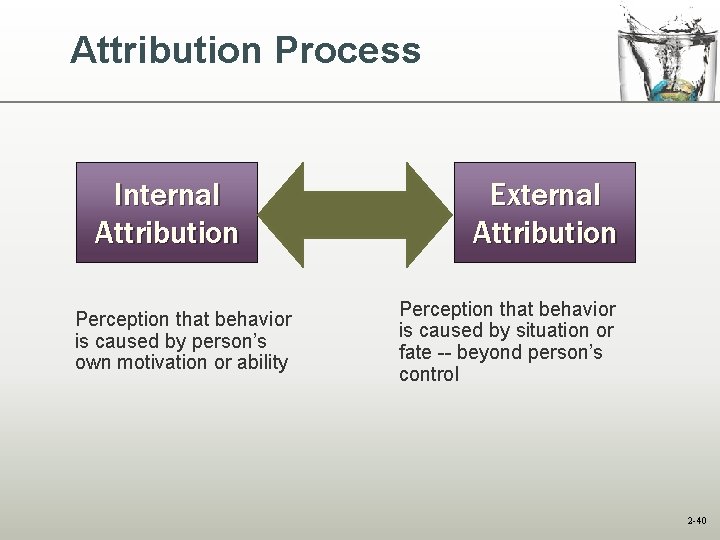
Attribution Process Internal Attribution Perception that behavior is caused by person’s own motivation or ability External Attribution Perception that behavior is caused by situation or fate -- beyond person’s control 2 -40
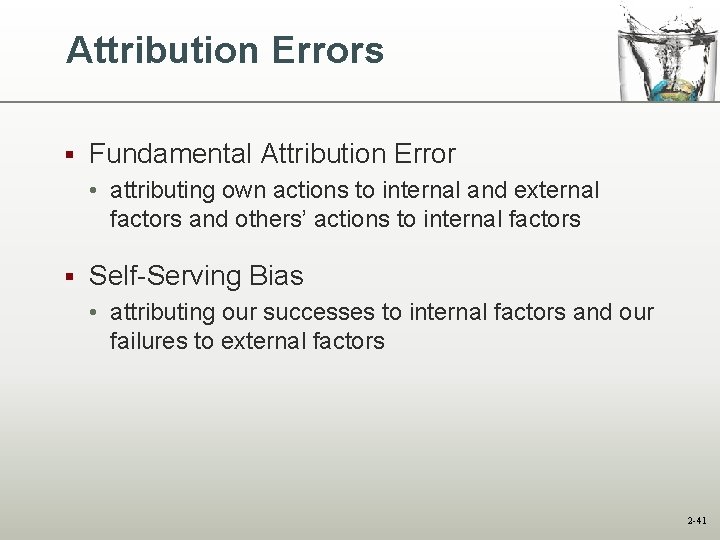
Attribution Errors § Fundamental Attribution Error • attributing own actions to internal and external factors and others’ actions to internal factors § Self-Serving Bias • attributing our successes to internal factors and our failures to external factors 2 -41
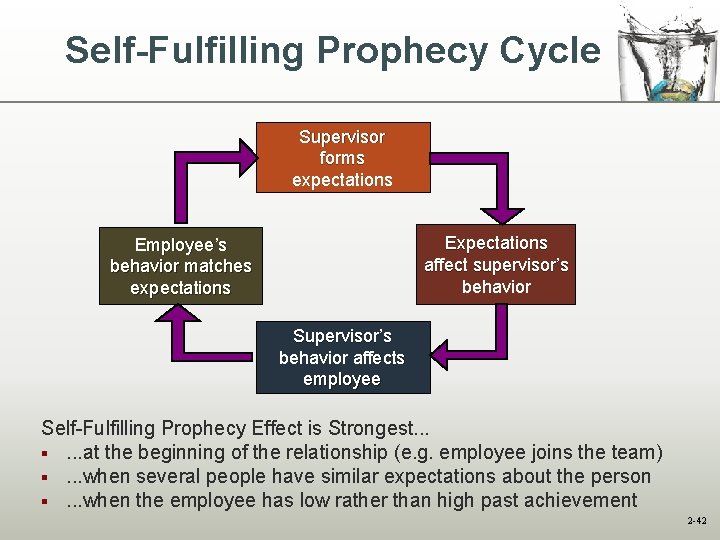
Self-Fulfilling Prophecy Cycle Supervisor forms expectations Expectations affect supervisor’s behavior Employee’s behavior matches expectations Supervisor’s behavior affects employee Self-Fulfilling Prophecy Effect is Strongest. . . §. . . at the beginning of the relationship (e. g. employee joins the team) §. . . when several people have similar expectations about the person §. . . when the employee has low rather than high past achievement 2 -42
Strategies to Improve Perceptions 1. Awareness of perceptual biases 2. Improving self-awareness • Applying Johari Window 3. Meaningful interaction • Close, frequent interaction toward a shared goal • Equal status • Engaged in a meaningful task 2 -43
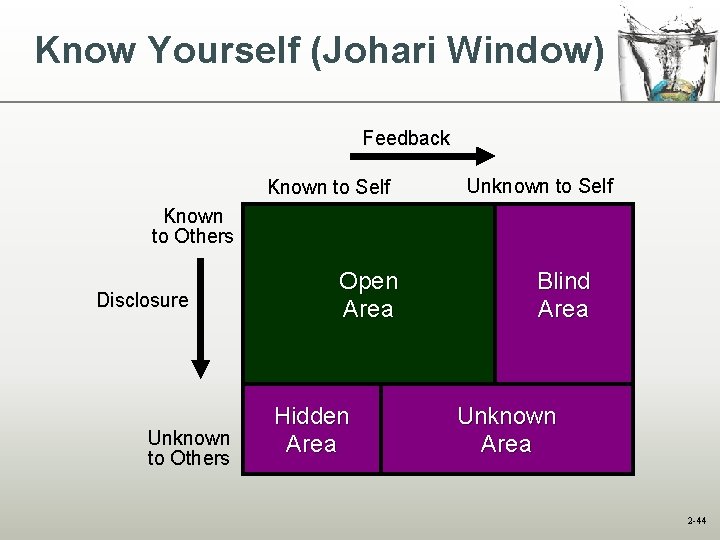
Know Yourself (Johari Window) Feedback Known to Self Known to Others Disclosure Unknown to Others Open Area Hidden Area Unknown to Self Blind Area Unknown Area 2 -44
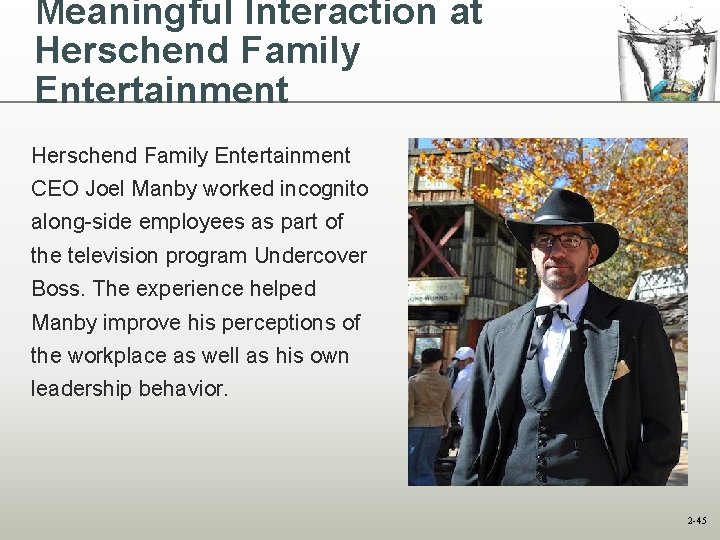
Meaningful Interaction at Herschend Family Entertainment CEO Joel Manby worked incognito along-side employees as part of the television program Undercover Boss. The experience helped Manby improve his perceptions of the workplace as well as his own leadership behavior. 2 -45
Global Mindset § An individual’s ability to perceive, appreciate, and empathize with people from other cultures, and to process complex cross-cultural information. • awareness of, openness to, and respect for other views and practices in the world • capacity to empathize and act effectively across cultures • ability to process complex information about novel environments • ability to comprehend and reconcile intercultural matters with multiple levels of thinking 2 -46
Developing a Global Mindset 1. Self-awareness activities – understand own values, beliefs, attitudes 2. Compare mental models with people from other cultures 3. Cross-cultural training 4. Immersion in other cultures 2 -47
Discussion Key learnings? § Next weeks assignments. § 2 -48