
ARTICLE 8 Civil Code of the Philippines Article


- Slides: 16
ARTICLE 8 Civil Code of the Philippines
• Article 8. Judicial decisions applying and interpreting the laws or the Constitution shall form a part of the legal system of the Philippines. • Artikulo 8. Ang mga desisyon ng hukuman na naglalapat o nagsisilbing interpretasyon ng mga umiiral na batas o ng Saligang Batas ay bahagi ng legal na sistema ng Pilipinas.
Background: Floresca vs. Philex Mining, L-30642, April 30, 1985 Workmen’s Compensation Act (1928) Provides for compensation benefits for loss of income due to work connected or work aggravated death, sickness or injury Exclusive jurisdiction of the Workmen’s Compensation Commission (now Employees Compensation Commission) Civil Code (1950) Awards damages to one as a vindication of the wrongful invasion of his rights; Damages (actual, moral and/or exemplary) -- the indemnity recoverable by a person who has sustained injury either in his person, property or relative rights, through the act or default of another. Exclusive jurisdiction of the regular courts (former Court of First Instance)
Background: Floresca vs. Philex Mining, L-30642, April 30, 1985 Issues: Whether the injured employee or his heirs’ action is RESTRICTED to compensation provided under the Workmen’s Compensation Act (WCA); or SELECTIVE between availing of the worker’s right under WCA and suing in the regular courts under the Civil Code for higher damages; or CUMULATIVE, that is, collect the limited compensation under WCA and sue in addition for damages in the regular courts. How did the Court resolve the issues?
The doctrine of “stare decisis” Stare decisis is a legal doctrine that obligates courts to follow historical cases when making a ruling on a similar current or future case. . Stare decisis is a Latin term meaning "to stand by that which is decided". Source: www. investopedia. com
The doctrine of “stare decisis” Examples: • Settled is the rule that in ascertaining whether or not the cause of action is in the nature of workmen's compensation claim or a claim for damages pursuant to the provisions of the Civil Code, the test is the averments or allegations in the complaint (Belandres vs. Lopez Sugar Mill, Co. , Inc. , 97 Phil. 100). • The rationale in awarding compensation under the Workmen's Compensation Act differs from that in giving damages under the Civil Code. The compensation acts are based on a theory of compensation distinct from the existing theories of damages, payments under the acts being made as compensation and not as damages (99 C. J. S. 53). • Compensation is given to mitigate the harshness and insecurity of industrial life for the workman and his family. Hence, an employer is liable whether negligence exists or not since liability is created by law. Recovery under the Act is not based on any theory of actionable wrong on the part of the employer (99 C. J. S. 36).
The doctrine of “stare decisis” • The claimant for damages under the Civil Code has the burden of proving the causal relation between the defendant's negligence and the resulting injury as well as the damages suffered. While under the Workmen's Compensation Act, there is a presumption in favor of the deceased or injured employee that the death or injury is work-connected or work-aggravated; and the employer has the burden to prove otherwise (De los Angeles vs. GSIS, 94 SCRA 308; Carino vs. WCC, 93 SCRA 551; Maria Cristina Fertilizer Corp. vs. WCC, 60 SCRA 228). • Etcetera … etcetera…. .
Decision WE hold that although the other petitioners had received the benefits under the Workmen's Compensation Act, such may not preclude them from bringing an action before the regular court because they became cognizant of the fact that Philex has been remiss in its contractual obligations with the deceased miners only after receiving compensation under the Act. Had petitioners been aware of said violation of government rules and regulations by Philex, and of its negligence, they would not have sought redress under the Workmen's Compensation Commission which awarded a lesser amount for compensation. The choice of the first remedy was based on ignorance or a mistake of fact, which nullifies the choice as it was not an intelligent choice. The case should therefore be remanded to the lower court for further proceedings. However, should the petitioners be successful in their bid before the lower court, the payments made under the Workmen's Compensation Act should be deducted from the damages that may be decreed in their favor.
Contemporaneous Interpretation of the Law The decision becomes part of the contemporaneous interpretation of the law. Definition of Contemporaneous: Events which occur at the same time or very proximate to each other are said to be contemporaneous. (http: //legaldictionary. lawin. org)
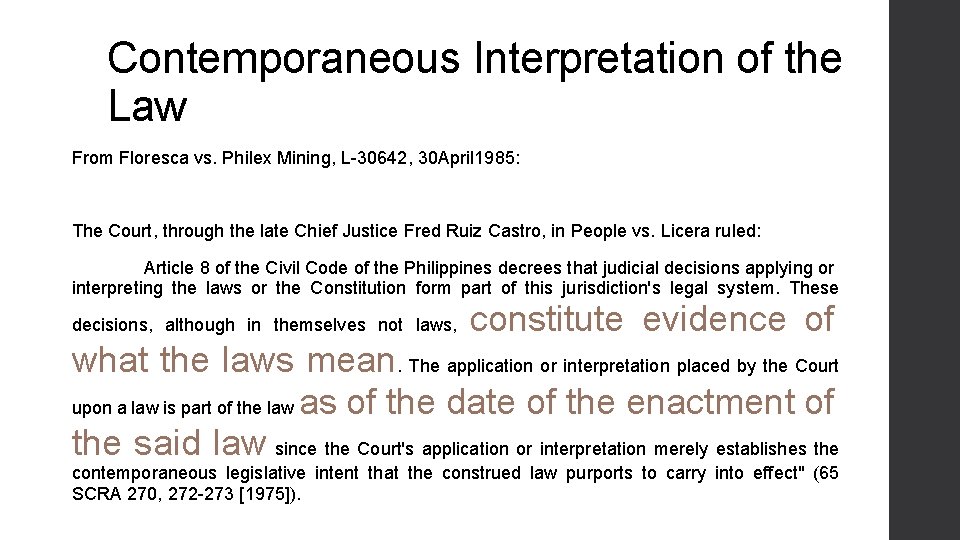
Contemporaneous Interpretation of the Law From Floresca vs. Philex Mining, L-30642, 30 April 1985: The Court, through the late Chief Justice Fred Ruiz Castro, in People vs. Licera ruled: Article 8 of the Civil Code of the Philippines decrees that judicial decisions applying or interpreting the laws or the Constitution form part of this jurisdiction's legal system. These decisions, although in themselves not laws, constitute evidence of what the laws mean. The application or interpretation placed by the Court upon a law is part of the law as of the date of the enactment of the said law since the Court's application or interpretation merely establishes the contemporaneous legislative intent that the construed law purports to carry into effect" (65 SCRA 270, 272 -273 [1975]).
Contemporaneous Interpretation of the Law • The contemporaneous interpretation assume the authority as the statutes themselves. • The doctrine, once laid down, is almost always followed.
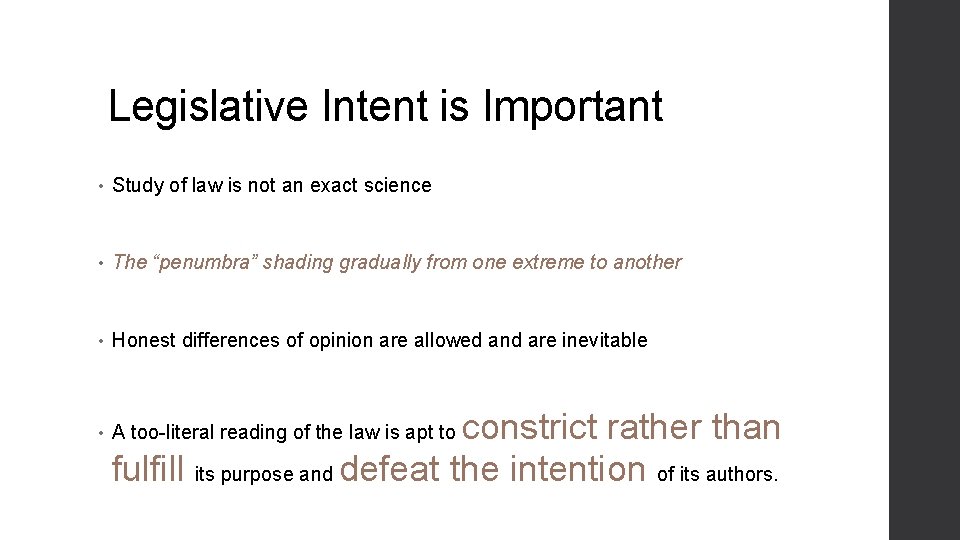
Legislative Intent is Important • Study of law is not an exact science • The “penumbra” shading gradually from one extreme to another • Honest differences of opinion are allowed and are inevitable • A too-literal reading of the law is apt to constrict rather than fulfill its purpose and defeat the intention of its authors.
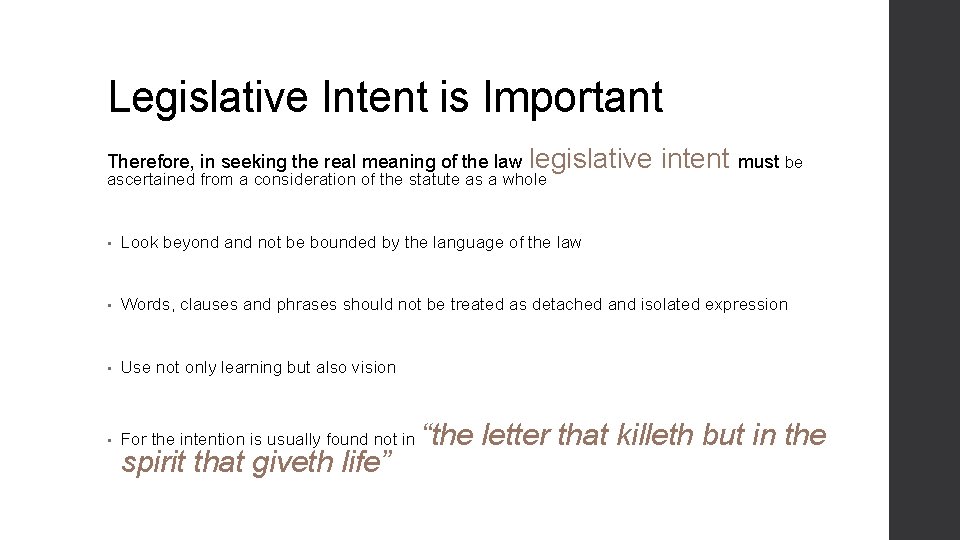
Legislative Intent is Important Therefore, in seeking the real meaning of the law legislative intent must be ascertained from a consideration of the statute as a whole • Look beyond and not be bounded by the language of the law • Words, clauses and phrases should not be treated as detached and isolated expression • Use not only learning but also vision • For the intention is usually found not in spirit that giveth life” “the letter that killeth but in the
Administrative Interpretation of Law Administrative regulations: Provides the details for carrying out policy and enforcing it Sets forth specific requirements May list do’s and don’ts May include step by step procedures May assign specific responsibility In other words, “they tell how, by whom, where and when things are to be done”. (https: //www. cabe. org/uploaded/Policy/Regulation. pdf) •
Administrative Interpretation of Law Principle of contemporaneous construction of a statute by the executive officers of the government is entitled to great respect. Ordinarily controls the construction of law by the courts, unless such interpretation is clearly erroneous. Must be in harmony with the law and should be for the sole purpose of carrying into effect its general provisions. If conflict exists between the basic law and a rule or regulation, the basic law prevails. The law itself cannot be extended. Rules and regulations cannot go beyond the terms and provisions of the basic law.
-END-