
Article 25 A SDG 4 and the Role
- Slides: 17
Article 25 A, SDG 4 and the Role of the Legal Fraternity
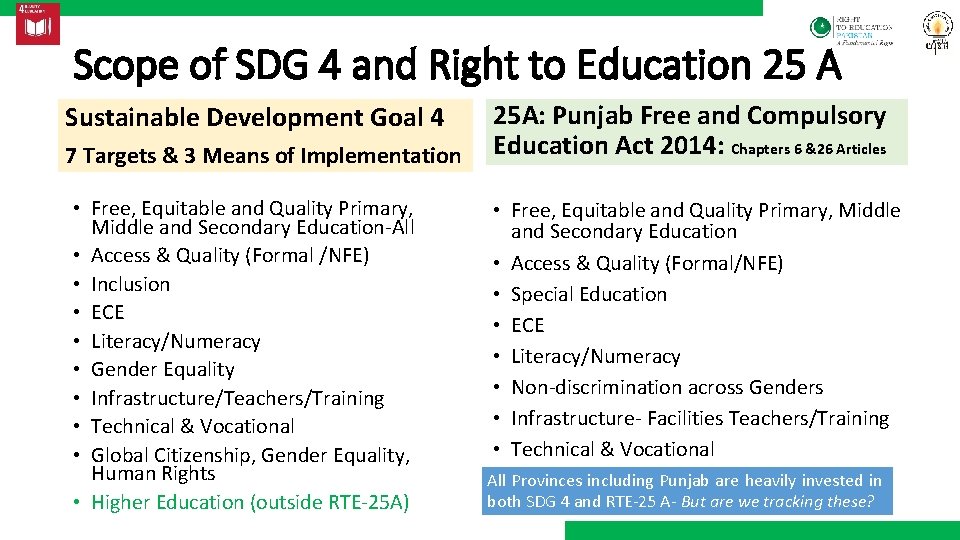
Scope of SDG 4 and Right to Education 25 A Sustainable Development Goal 4 7 Targets & 3 Means of Implementation • Free, Equitable and Quality Primary, Middle and Secondary Education-All • Access & Quality (Formal /NFE) • Inclusion • ECE • Literacy/Numeracy • Gender Equality • Infrastructure/Teachers/Training • Technical & Vocational • Global Citizenship, Gender Equality, Human Rights • Higher Education (outside RTE-25 A) 25 A: Punjab Free and Compulsory Education Act 2014: Chapters 6 &26 Articles • Free, Equitable and Quality Primary, Middle and Secondary Education • Access & Quality (Formal/NFE) • Special Education • ECE • Literacy/Numeracy • Non-discrimination across Genders • Infrastructure- Facilities Teachers/Training • Technical & Vocational All Provinces including Punjab are heavily invested in both SDG 4 and RTE-25 A- But are we tracking these?
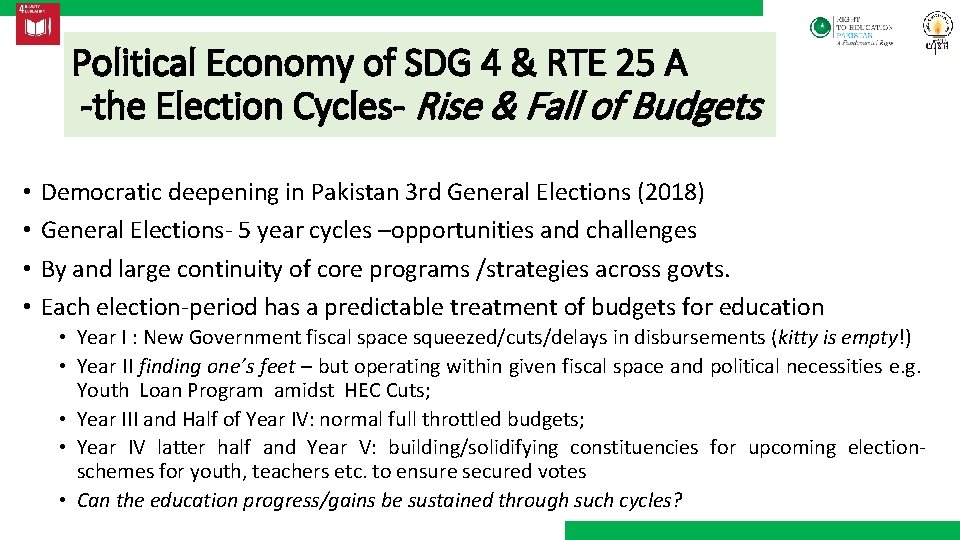
Political Economy of SDG 4 & RTE 25 A -the Election Cycles- Rise & Fall of Budgets • • Democratic deepening in Pakistan 3 rd General Elections (2018) General Elections- 5 year cycles –opportunities and challenges By and large continuity of core programs /strategies across govts. Each election-period has a predictable treatment of budgets for education • Year I : New Government fiscal space squeezed/cuts/delays in disbursements (kitty is empty!) • Year II finding one’s feet – but operating within given fiscal space and political necessities e. g. Youth Loan Program amidst HEC Cuts; • Year III and Half of Year IV: normal full throttled budgets; • Year IV latter half and Year V: building/solidifying constituencies for upcoming electionschemes for youth, teachers etc. to ensure secured votes • Can the education progress/gains be sustained through such cycles?
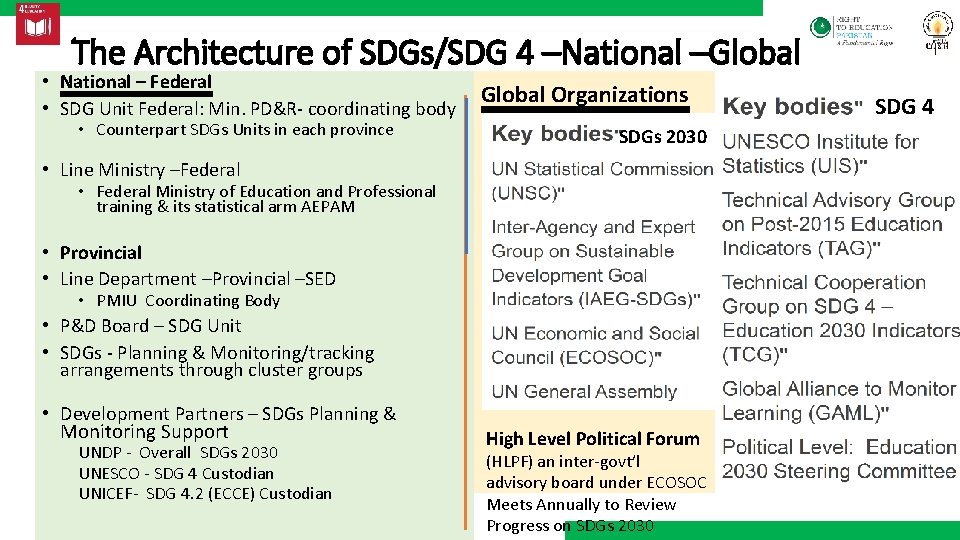
The Architecture of SDGs/SDG 4 –National –Global • National – Federal • SDG Unit Federal: Min. PD&R- coordinating body • Counterpart SDGs Units in each province Global Organizations SDGs 2030 • Line Ministry –Federal • Federal Ministry of Education and Professional training & its statistical arm AEPAM • Provincial • Line Department –Provincial –SED • PMIU Coordinating Body • P&D Board – SDG Unit • SDGs - Planning & Monitoring/tracking arrangements through cluster groups • Development Partners – SDGs Planning & Monitoring Support UNDP - Overall SDGs 2030 UNESCO - SDG 4 Custodian UNICEF- SDG 4. 2 (ECCE) Custodian High Level Political Forum (HLPF) an inter-govt’l advisory board under ECOSOC Meets Annually to Review Progress on SDGs 2030 SDG 4
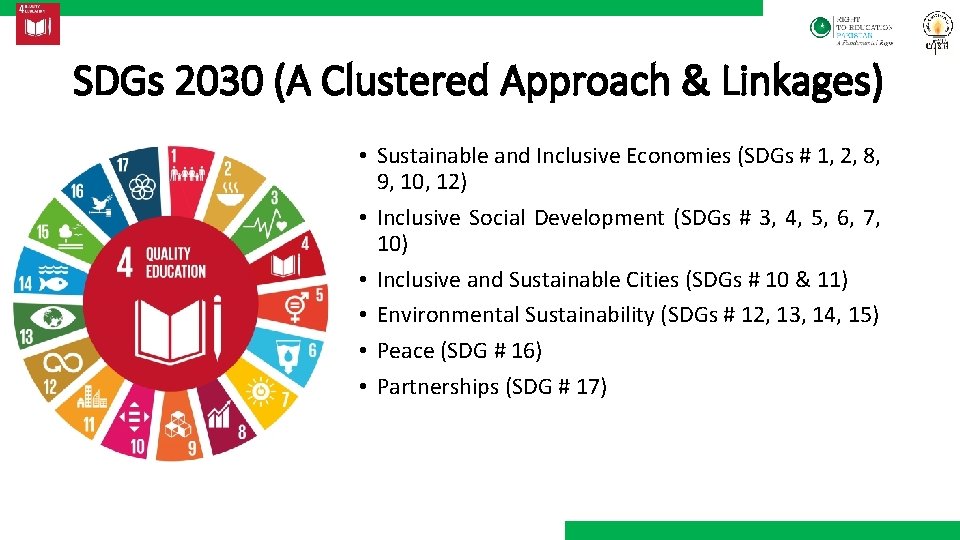
SDGs 2030 (A Clustered Approach & Linkages) • Sustainable and Inclusive Economies (SDGs # 1, 2, 8, 9, 10, 12) • Inclusive Social Development (SDGs # 3, 4, 5, 6, 7, 10) • Inclusive and Sustainable Cities (SDGs # 10 & 11) • Environmental Sustainability (SDGs # 12, 13, 14, 15) • Peace (SDG # 16) • Partnerships (SDG # 17)
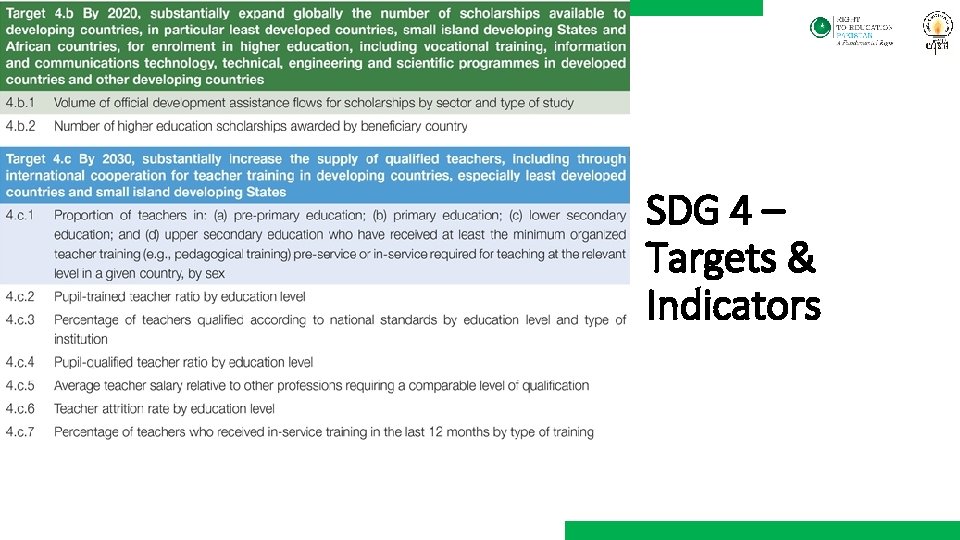
SDG 4 – Targets & Indicators tracking Global: 11 Indicators (Colored Bands ) Thematic : 43 indicators (incl. 11 global) Thematic indicators in the UNESCO Framework For Action (FFA/Nov. 2015) Thematic : 32 indicators (Clear bands) Provinces to produce evidence on indicators – consolidated at national level Current focus by SDG Units on Global Indicators
SDG 4 – Targets & Indicators
SDG 4 – Targets & Indicators
SDG 4 – Targets & Indicators
Court Cases Settled by the High Courts and the Supreme Court
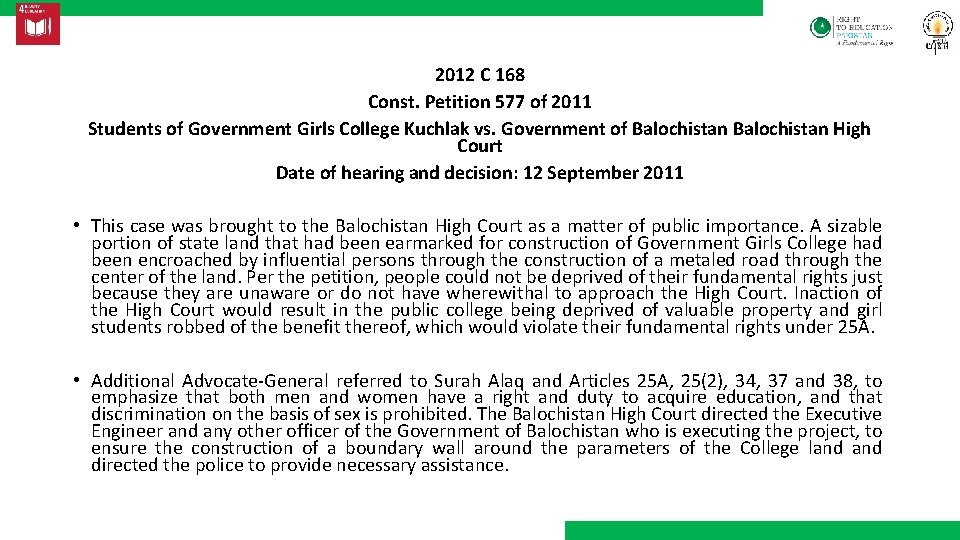
2012 C 168 Const. Petition 577 of 2011 Students of Government Girls College Kuchlak vs. Government of Balochistan High Court Date of hearing and decision: 12 September 2011 • This case was brought to the Balochistan High Court as a matter of public importance. A sizable portion of state land that had been earmarked for construction of Government Girls College had been encroached by influential persons through the construction of a metaled road through the center of the land. Per the petition, people could not be deprived of their fundamental rights just because they are unaware or do not have wherewithal to approach the High Court. Inaction of the High Court would result in the public college being deprived of valuable property and girl students robbed of the benefit thereof, which would violate their fundamental rights under 25 A. • Additional Advocate-General referred to Surah Alaq and Articles 25 A, 25(2), 34, 37 and 38, to emphasize that both men and women have a right and duty to acquire education, and that discrimination on the basis of sex is prohibited. The Balochistan High Court directed the Executive Engineer and any other officer of the Government of Balochistan who is executing the project, to ensure the construction of a boundary wall around the parameters of the College land directed the police to provide necessary assistance.
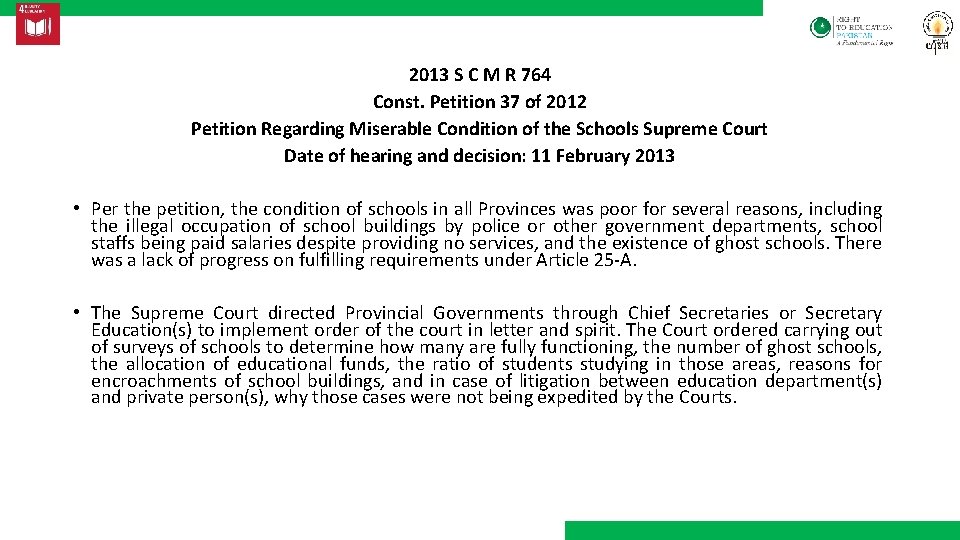
2013 S C M R 764 Const. Petition 37 of 2012 Petition Regarding Miserable Condition of the Schools Supreme Court Date of hearing and decision: 11 February 2013 • Per the petition, the condition of schools in all Provinces was poor for several reasons, including the illegal occupation of school buildings by police or other government departments, school staffs being paid salaries despite providing no services, and the existence of ghost schools. There was a lack of progress on fulfilling requirements under Article 25 -A. • The Supreme Court directed Provincial Governments through Chief Secretaries or Secretary Education(s) to implement order of the court in letter and spirit. The Court ordered carrying out of surveys of schools to determine how many are fully functioning, the number of ghost schools, the allocation of educational funds, the ratio of students studying in those areas, reasons for encroachments of school buildings, and in case of litigation between education department(s) and private person(s), why those cases were not being expedited by the Courts.
2013 S C MR 54 Human Rights Case 19360 -P of 2012 Regarding grant of increment and increase in salaries of teachers in District Public School Sargodha Supreme Court Date of hearing and decision: 3 October 2012 • The Supreme Court observed that Federal and Provincial Governments were required to ensure implementation of Article 25(A). The Chairman of the Board of Governors of the school in question submitted that in compliance with Supreme Court directions: 1) the salaries of school staff increased by more than 100%, 2) the Provincial Government granted Rs. 15 million as grant-in-aid for infrastructure development of the school, and 3) other administrative problems of the school were addressed.
2015 P L C (C. S. ) 1503 Writ Petition 15320 of 2014 Muhammad Iqbal vs Government of Punjab Lahore High Court Decided on 19 March 2015 • Per Article 25 A, the State is bound to provide free and compulsory education to all children from age 5 to 16. The Punjab Government School Education Department directed action against heads of school whose 9 th Class Secondary School Certificate Examination 2013 results were below 25% to maintain the standard of education and remove illiteracy, in the spirit of Article 25 A. The petitioner sought to challenge the show cause notice and have it squashed by the Court. • Lahore High Court declined to entertain the petition, as it would amount to a stifling of disciplinary proceedings.
P L D 2018 Lahore 509 Writ Petition 29724 of 2015 City School Private Limited vs Government of the Punjab Lahore High Court Date of final hearing: 15 March 2018. Decided on 5 April 2018 • The petitioner questioned whether the Government could regulate the fee structure of unaided private schools, and whether it could lay down a specific cap on increase in fees for any academic year. Arguments on both sides included the following: 1) The State has a responsibility to see that private educational institutions set up with Government permission were not involved in profiteering, capitation or exploitation of parents. 2) Private institutions being businesses were covered under the definition of “trade” and could thus be regulated by a licensing system. 3) The fee structure could be regulated under Article 18; however, any restrictions/regulations must be reasonable and should not impinge on the fundamental rights of the institutions. • Lahore Court found that private schools could fix the fees and charges payable by students, as long as the increase in fees was not exploitive and did not ravel into the arena of commercialization. The High Court directed that the Provincial Government notify The Punjab Free and Compulsory Act (2014) to ensure enforcement of the Fundamental Right of Education under Article 25 A, and that the Government frame a uniform regulatory regime through rules to determine the increase claimed by schools in fees by considering certain factors.
Teenagers sue government for Climate Crisis Lahore High Court November 4, 2019 In the petition, the three students said the government had been downplaying the scale of environmental crisis because its standards of measurement differ from what is used in other countries and accepted internationally. An AQI of 185, the petition adds, at the Meteorological Department station in Lahore is classified as “satisfactory” on the EPD website but counts as “Moderately Polluted” in China and India, and “Unhealthy” in Singapore, South Korea and the United States.
Thank you!