
Article 1 By Luna and Josh What is

Article 1 By: Luna and Josh
What is Article 1? ● It is all about Congress (The Legislative Branch) ● Article 1 grants Congress its powers and limits and creates two parts of Congress: ■ ■ House of Representatives (2 years) Senate (6 years)
10 Clauses 1. 2. 3. 4. 5. 6. 7. 8. 9. 10. Congress can make laws House of reps. 2 years Senate 6 years Congress must meet once a year/how their elections take place Qualification of members and how meeting will be run Rules, payment, and Congress members cannot be arrested unless it is a felony How bills are passed and made Powers of congress (ex. taxes) Limits to congress (ex. Cannot make anyone king) Limits the power of states (ex. Cannot create money)
Created Opportunities ● Splits up Congress into 2 seperate powers (Bicameral Legislature) ○ ○ House of Representatives Senate ● Senate is made up of 2 senators from each state (elected every 6 years) ○ States are held accountable for electing those who continually make decisions for the greater good throughout a longer term ● House of Representatives has representatives from every state based off of its population (elected every 2 years) ○ Continuously elected for shorter terms so voters are always engaged for decision making
Founders Intentions ● Separation of Powers ○ Split up into separate parties for decision making, separation of executive branch ans state government ● Ability to Vote ○ Representatives in both sections of congress are voted in ● Federalism ○ Determines elections and how they are held
Article II The Executive Branch
Article II - Section 1 - Executive power Electoral College - - State representatives Formal job requirements - “The executive Power shall be vested in a President of the United States of America. ” Born citizen 35 yrs old Paid position “The President shall, at stated Times, receive for his Services, a Compensation, which shall neither be increased nor diminished during the Period for which he shall have been elected”
Article II - Section 2 The President is Commander and Chief of the Military “He requires the opinion, in writing, of the principal Officer in each of the executive Departments. ” Before making any major decisions With consent from the Senate, he can appoint ambassadors, and create treaties
Article II - Section 3 The President should present the State of The Union publicly “From time to time” In extreme cases he can convene both Congress and Senate to work out a disagreement between them.
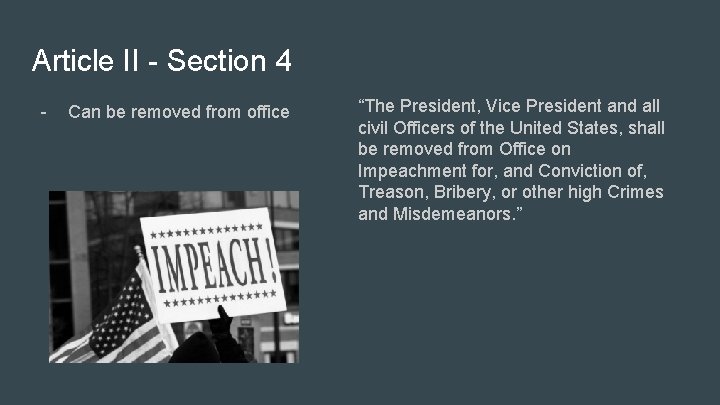
Article II - Section 4 - Can be removed from office “The President, Vice President and all civil Officers of the United States, shall be removed from Office on Impeachment for, and Conviction of, Treason, Bribery, or other high Crimes and Misdemeanors. ”
Articles 3 and 4 Mason Marotta and Kobe Pole
Article III -Article 3 is about the position of diversifying power to make the supreme court a power instead of the idea of one central ruler with no opposition or process -First mention of chief justice -It doesn’t whatsoever create opportunities for representative decision making -If you are perceived as committing treason there must be 2 or more witnesses to attest to this. Which makes it hard for the government to imprison anyone -Judicial power extended to all cases. Maritime, Ambassadors, and other public ministers and consuls

Article IV -Article IV sought to unify the individual states without destroying their power, as well as ensuring that no single state had more power than the others -Ensures that citizens of states have an opportunity for representative decision making under both state and federal governments -States protected from another state overpowering it -Justice unified across all states (commit a crime in one state and they can persecute you even if you run to another state) -Constitution does not give one state preference over another
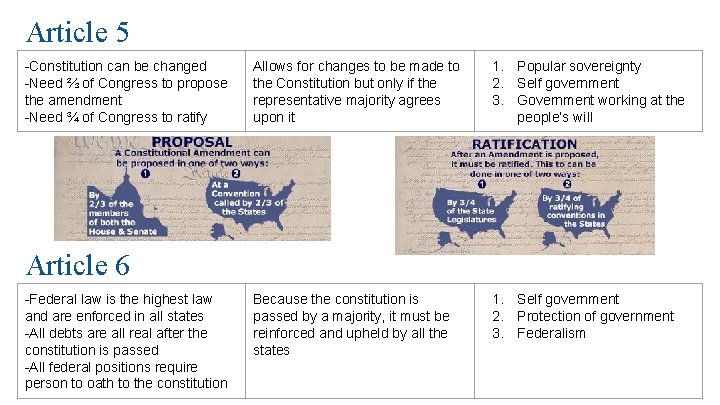
Article 5 -Constitution can be changed -Need ⅔ of Congress to propose the amendment -Need ¾ of Congress to ratify Allows for changes to be made to the Constitution but only if the representative majority agrees upon it 1. Popular sovereignty 2. Self government 3. Government working at the people’s will Because the constitution is passed by a majority, it must be reinforced and upheld by all the states 1. Self government 2. Protection of government 3. Federalism Article 6 -Federal law is the highest law and are enforced in all states -All debts are all real after the constitution is passed -All federal positions require person to oath to the constitution
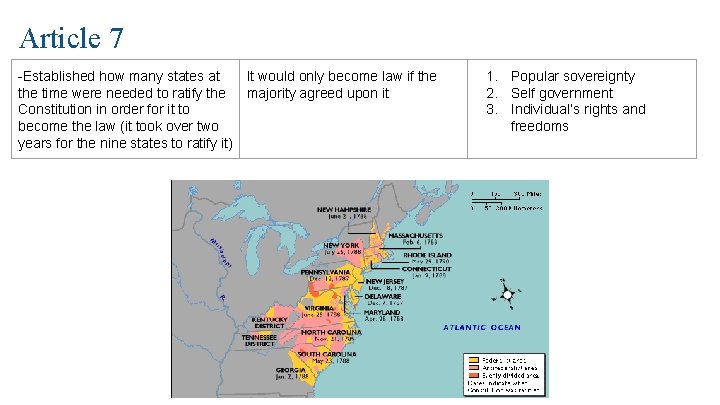
Article 7 -Established how many states at It would only become law if the time were needed to ratify the majority agreed upon it Constitution in order for it to become the law (it took over two years for the nine states to ratify it) 1. Popular sovereignty 2. Self government 3. Individual’s rights and freedoms
Amendments 1 -7 By TJ and Kelly
● Amendment I ○ Freedom of religion, speech, petition, and assembly ● Amendment II ○ Right to bear arms ● Amendment III ○ Prohibits soldiers from staying in private homes during peace and war time without owner's consent ● Amendment IV ○ Protection against illegal search and seizure
● Amendment V ○ Protects individuals from being compelled to be witnessed against themselves in criminal cases and double jeopardy ● Amendment VI ○ Right to speedy public trial, impartial jury, right to counsel and cross examine witness ● Amendment VII ○ Right to trial by jury in common-law cases
Amendments 8 -14 Jake Hanssen
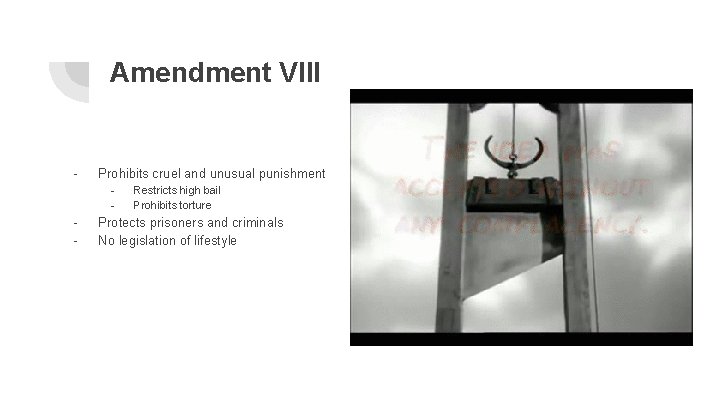
Amendment VIII - Prohibits cruel and unusual punishment - - Restricts high bail Prohibits torture Protects prisoners and criminals No legislation of lifestyle
Amendment IX - - States that nothing in the Constitution can be used to take people’s rights away Provides legal protection to everyone/individuals Not important to lifestyle
Amendment X - Structures the principle of federalism and states’ rights - - Expands rights to states No relation to day-to-day life IS
Amendment XI - Protects the rights of states by giving them sovereign immunity - - States are mostly immune from being sued in federal courts No relation to day-to-day life
Amendment XII - Provides procedure for electing the President and the Vice President - - Before the amendment, the person with the second-highest number of votes in the Presidential Election became the Vice President Allowed candidates to choose their own VPs No relation to day-to-day life
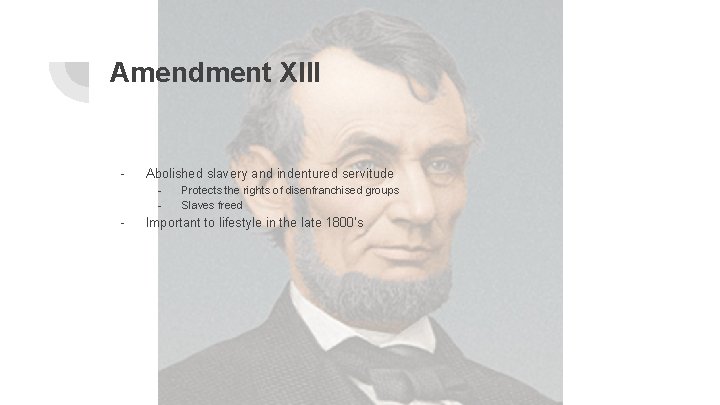
Amendment XIII - Abolished slavery and indentured servitude - - Protects the rights of disenfranchised groups Slaves freed Important to lifestyle in the late 1800’s
Amendment XIV - Provides citizenship rights and equal protection under laws - - Protects former slaves and marginalized groups Some relation to lifestyle
Amendments 15 -21 Zoe Grandy
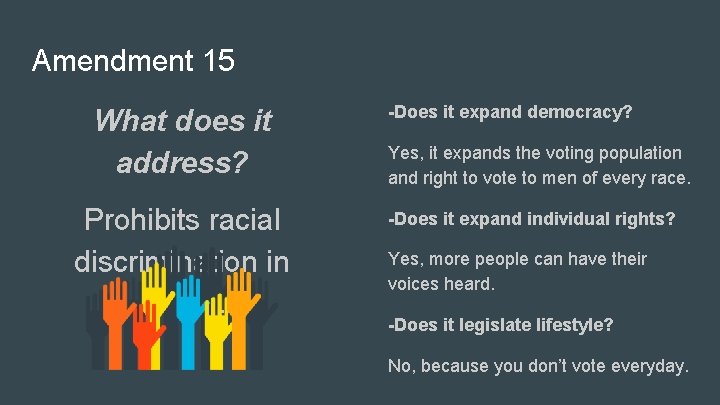
Amendment 15 What does it address? Prohibits racial discrimination in voting. -Does it expand democracy? Yes, it expands the voting population and right to vote to men of every race. -Does it expand individual rights? Yes, more people can have their voices heard. -Does it legislate lifestyle? No, because you don’t vote everyday.
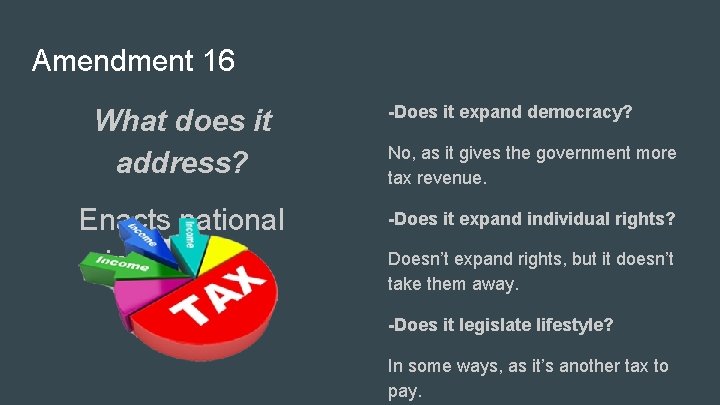
Amendment 16 What does it address? Enacts national income tax. -Does it expand democracy? No, as it gives the government more tax revenue. -Does it expand individual rights? Doesn’t expand rights, but it doesn’t take them away. -Does it legislate lifestyle? In some ways, as it’s another tax to pay.
Amendment 17 What does it address? Senators elected by popular vote. (2 for each state) -Does it expand democracy? Yes, it makes representatives in Congress better representatives for the people. -Does it expand individual rights? Yes, gives people choice over who represents them. -Does it legislate lifestyle? Not really, as voting doesn’t happen
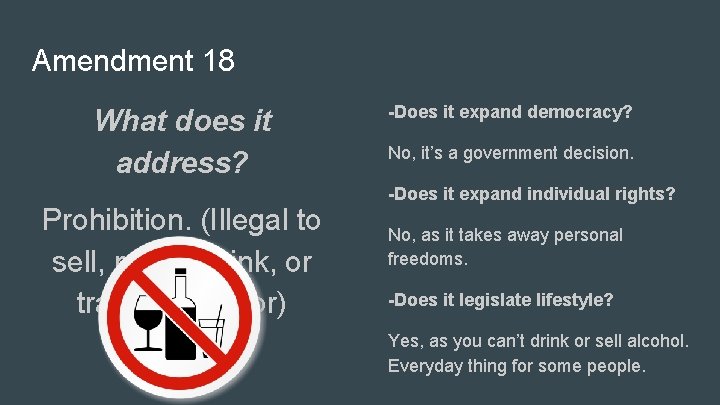
Amendment 18 What does it address? Prohibition. (Illegal to sell, make, drink, or transport liquor) -Does it expand democracy? No, it’s a government decision. -Does it expand individual rights? No, as it takes away personal freedoms. -Does it legislate lifestyle? Yes, as you can’t drink or sell alcohol. Everyday thing for some people.
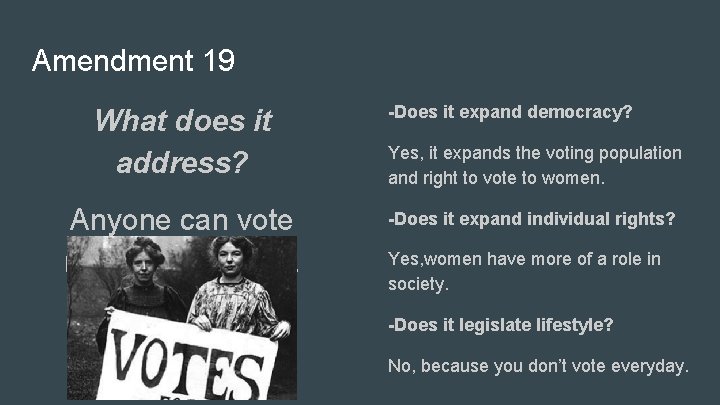
Amendment 19 What does it address? Anyone can vote regardless of sex. -Does it expand democracy? Yes, it expands the voting population and right to vote to women. -Does it expand individual rights? Yes, women have more of a role in society. -Does it legislate lifestyle? No, because you don’t vote everyday.
Amendment 20 What does it address? Presidential terms end on Jan 20 th. Senator terms end on Jan 3 rd. -Does it expand democracy? Not really as it’s more technical. -Does it expand individual rights? No -Does it legislate lifestyle? No it has no effect on how people live.
Amendment 21 What does it address? Repealed 18 th Amendment. (Prohibition) -Does it expand democracy? To a degree as it doesn’t let a amendment dictate an aspect of people’s lives. -Does it expand individual rights? Yes, they have the freedom to drink, make, and sell alcohol. -Does it legislate lifestyle? No, no more restrictions.
Amendments 22 -27 By: Jacob Rubenstein
Amendment 22 ● ● Amendment 22 states that a President can not hold power for more than two terms This amendment does not expand upon democracy, individual rights or legislative lifestyle
Amendment 23 ● ● Amendment 23 talks about how Washington D. C. is allowed to have a representative, although they have no impact when it comes to voting This amendment does not expand upon democracy, individual rights or legislative lifestyle
Amendment 24 ● ● Amendment 24 give citizens the right to vote in an election It does expand democracy for it allows people to vote for more things It expands upon individual rights through allowing us to vote for more Although it does affect legislative lifestyle, it is quit minute
Amendment 25 ● ● Amendment 25 talks about what if something happens to the President who would take his place, which is the Vice President, ect. . . This amendment does not expand upon democracy, individual rights or legislative lifestyle
Amendment 26 ● ● Amendment 26 allows all United States Citizens the right to vote once they turn 18 This expands democracy because it allows everyone to vote earlier It expands individual rights because now people can vote at 18 It does not change legislate lifestyle
Amendment 27 ● ● Amendment 27 does not allow congress to raise their salaries until after an election This amendment does not expand upon democracy, individual rights or legislative lifestyle
- Slides: 41