
Arthur Miller The Crucible Setting and Context The
Arthur Miller The Crucible
Setting and Context The play is set in the Puritan community of Salem, Massachusetts in the late 17 th century (1690 s) The play focuses on paranoia and hysteria and the ability of fear to cause basic human emotions to take over Although set in the 1690 s, Miller intended the play to be a criticism of the paranoia over Communism in the USA during the 1950 s (also known as 'Mc. Carthyism')
Background – historical context The end of the 17 th century was a period of strong religious belief throughout the Christian world. One of the strictest groups of these was the Puritans who believed that true religion was shown through acts and deeds (and particularly through hard work. ) Puritans felt that selfsacrifice was the route to religious salvation. They wore only simple-coloured clothes and worked hard with little rest their entire life. They rejected things such as dancing and music as being evidence of leisure time (and therefore time wasted!) The Puritan community was semi-independent and able to govern itself in many areas. At the time the play is set, Massachusetts was a theocracy (where religious law and political law are the same) INSERT CLIP FROM HORRIBLE HISTORIES HERE
Background – historical context Salem was an isolated community within Massachusetts. The belief in witches was common at the time and witchcraft was seen as a means of communicating with the devil. Many aspects of everyday life were attributed to witchcraft and black magic, and not believing in witches was said to mean that one didn't believe in God. The lack of medical knowledge and understanding meant that illness and disease were frequently linked to witches. Salem as a town was divided by a social rivalry between families and this, combined with its isolation, meant it was a ticking timebomb. When girls in Salem began to experience epileptic fits and other medical problems, accusations flew across the social divide. Many of the characters in the play are based on their reallife counterparts (even names are the same!)
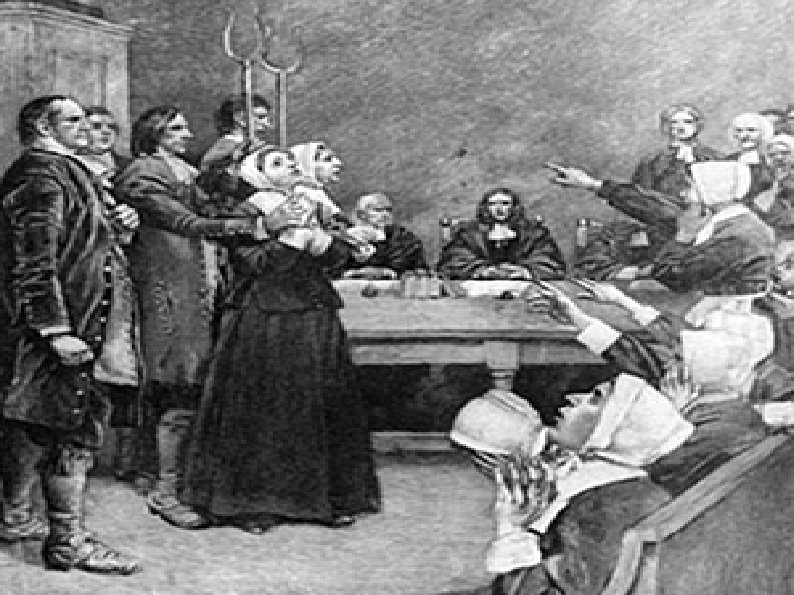
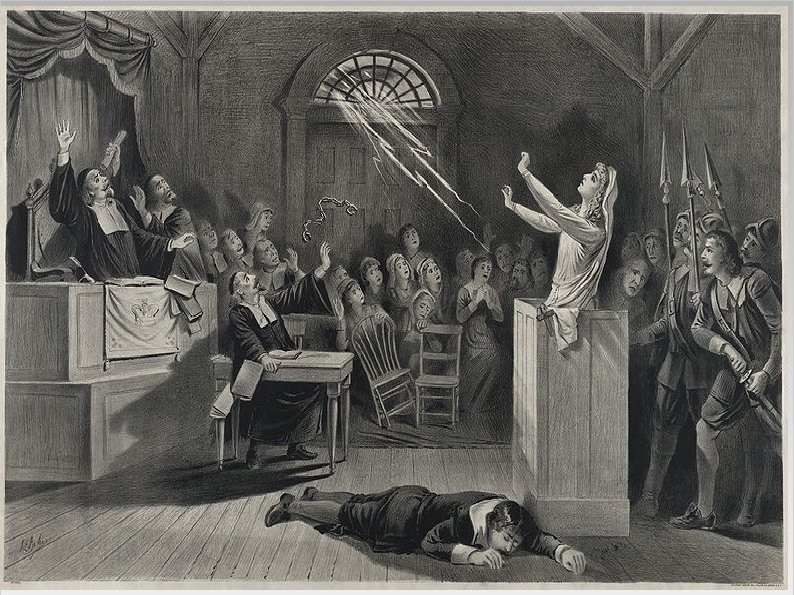
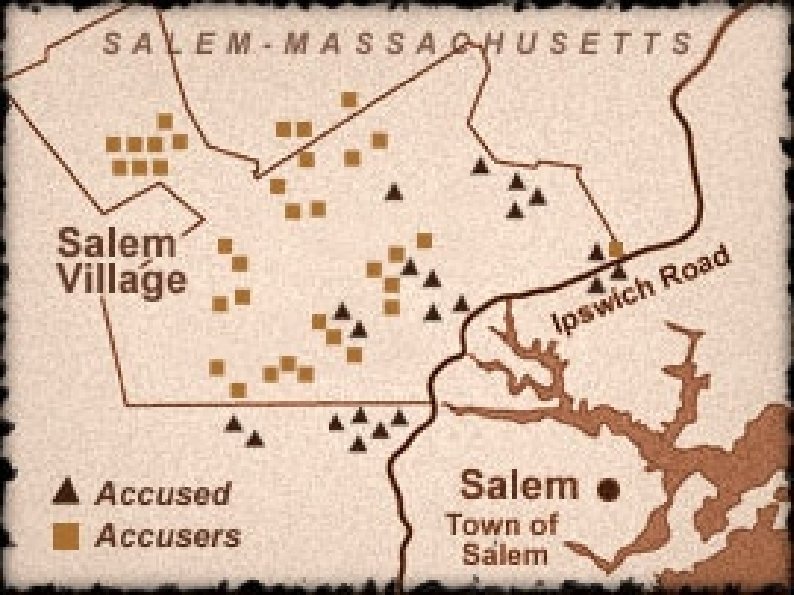
Real life events depicted in the play A number of young girls, led initially by Betty Parris and Abigail Williams, started a series of claims of witchcraft against adults. These were believed by others to be true. All the trials were brought about by an accusation made against a suspect (no proof needed!) Specially convened courts investigated the accusations. This resulted in around 150 imprisonments, 19 hangings and one death by pressing
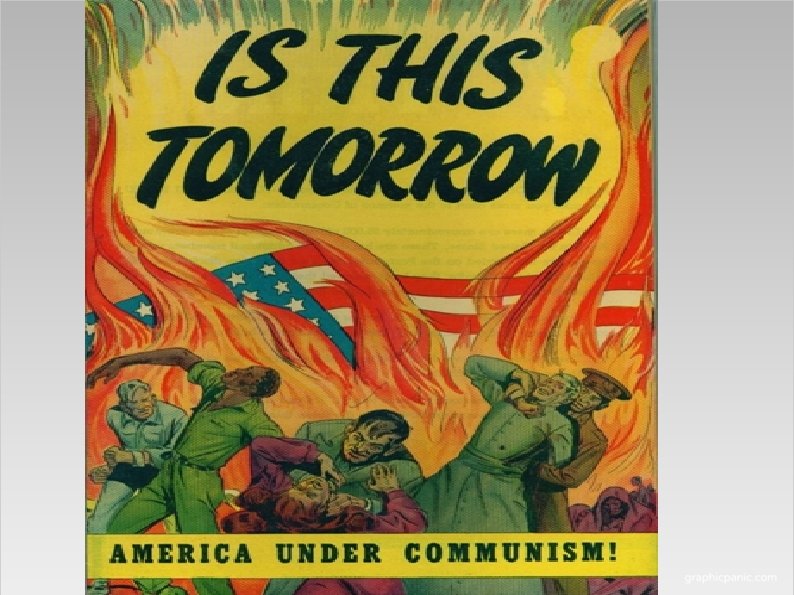
Background – 1950 s context During the Cold War (so called because it never broke out into actual fighting), Communism began to spread throughout the world and the USA feared it would take over. Many Americans even began to worry that there were Communists working within the US government. Senator Joseph Mc. Carthy said that he knew of Communists working with the US Department of State (responsible foreign policy). The fear of Communism was so great at the time that many Americans believed Mc. Carthy and the period became known as Mc. Carthyism. During this period, a number of playwrights and Hollywood figures were called in front of the House of Un-American Activities Committee, where they were asked to give the names of Communists working in Hollywood (many people gave names to avoid being seen as anti. American). Miller wrote the play because he thought Mc. Carthyism was a “witchhunt”. Ironically, the play then came to the attention of the House of Un -American Activities Committee and he was denied a passport to watch the opening of the play in London in 1954.

Act 1 Summary Reverend Parris prays beside the bedside of Betty, his daughter, who has fallen into a trance. We learn from Abigail Williams, his niece, that the girls have been dancing (naked) in the woods. Ann and Thomas Putnam arrive and claim that it is witchcraft, as their daughter, Ruth, has also fallen into a trance. Abigail warns the other girls to agree to a story to avoid accusations of witchcraft. Abigail's affair with John Proctor is revealed. Betty cries out upon hearing Jesus' name sung. Rebecca Nurse, a respected figure in the village, warns others not to be frightened into believing the claims of witchcraft. Reverend Hale arrives and questions Betty and Abigail and appears suspicious of their stories. Abigail then begins to denounce women in the village whom she claims to have seen with the devil and the other girls join in.
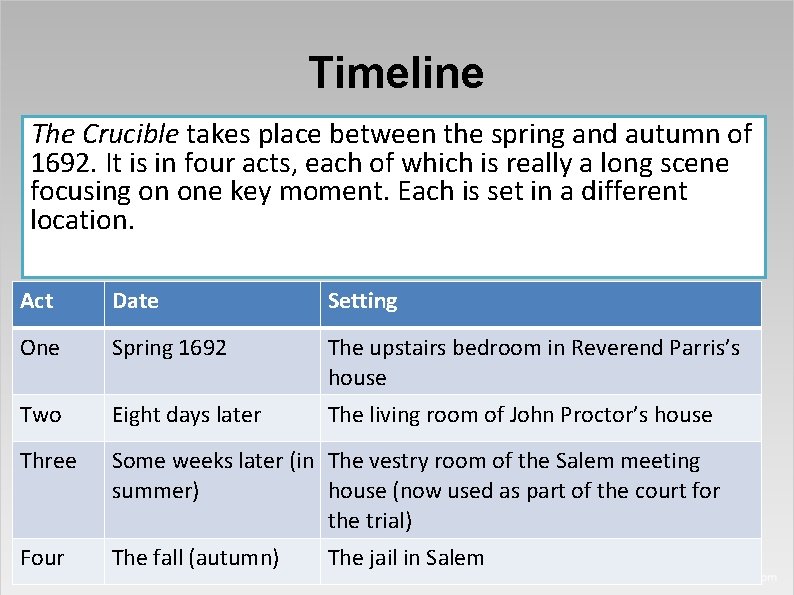
Timeline The Crucible takes place between the spring and autumn of 1692. It is in four acts, each of which is really a long scene focusing on one key moment. Each is set in a different location. Act Date Setting One Spring 1692 The upstairs bedroom in Reverend Parris’s house Two Eight days later The living room of John Proctor’s house Three Some weeks later (in The vestry room of the Salem meeting summer) house (now used as part of the court for the trial) Four The fall (autumn) The jail in Salem
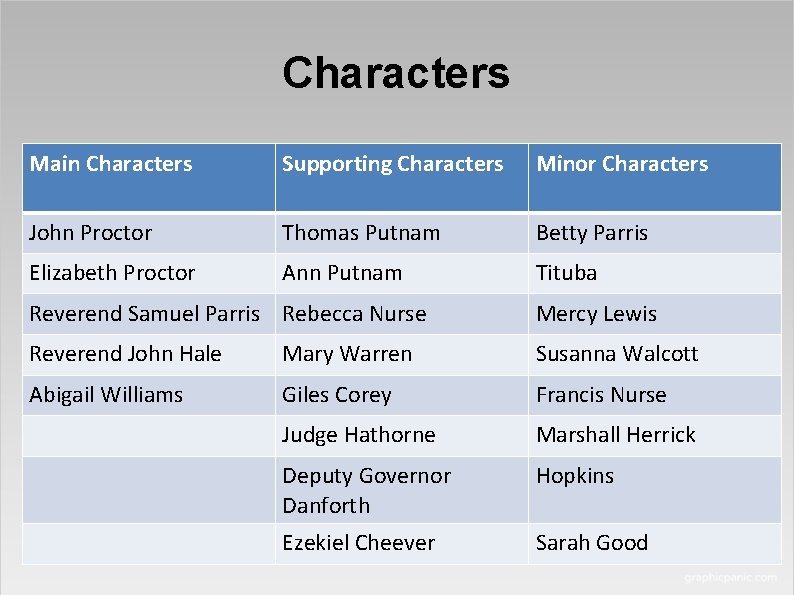
Characters Main Characters Supporting Characters Minor Characters John Proctor Thomas Putnam Betty Parris Elizabeth Proctor Ann Putnam Tituba Reverend Samuel Parris Rebecca Nurse Mercy Lewis Reverend John Hale Mary Warren Susanna Walcott Abigail Williams Giles Corey Francis Nurse Judge Hathorne Marshall Herrick Deputy Governor Danforth Hopkins Ezekiel Cheever Sarah Good
What happens to these characters in each act? John Proctor Elizabeth Proctor Reverend Hale Abigail Williams
Contrasting characters Which characters contrast in the play? How do they contrast? How does this conflict between contrasting characters shape the events of the play?
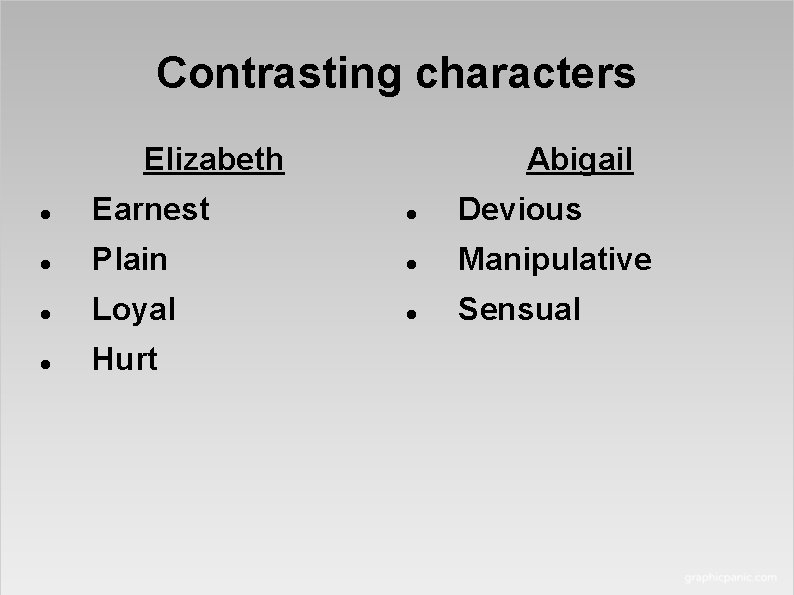
Contrasting characters Elizabeth Abigail Earnest Devious Plain Manipulative Loyal Sensual Hurt
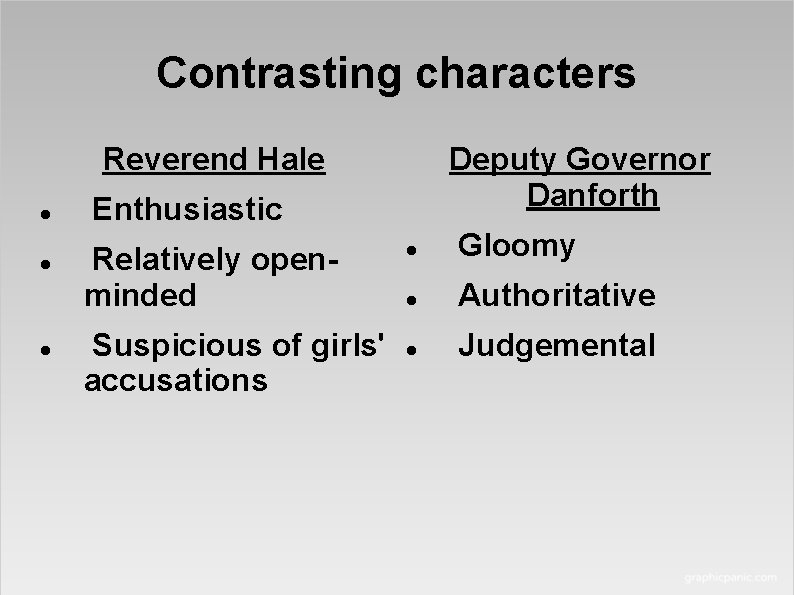
Contrasting characters Reverend Hale Deputy Governor Danforth Enthusiastic Relatively openminded Suspicious of girls' accusations Gloomy Authoritative Judgemental
Contrasting characters John Proctor Honest Willing to admit flaws in his character Respected in the village Reverend Parris Unpopular Uses his position to exploit the villagers, to an extent Naïve
John Proctor The tragic protagonist (hero) who acts as the moral voice of the play. He highlights the failings of other characters and the community as a whole: “I've heard you to be a sensible man, Mr Hale. I hope you leave some of it in Salem. ” As a tragic hero, Proctor has a flaw/weakness that leads to his affair with Abigail Williams. This then leads to the tragic outcome of the play. Blunt, straight-talking, honest, regretful, filled with remorse, values his reputation, moral voice
Abigail Williams Abigail is the antagonist (the villain) of the play (or is she the victim? ) She operates in a ruthless and Machiavellian (someone who acquires and uses power through unethical means) manner and is unconcerned about the fate of others. It is her vindictiveness that leads to the tragic events of the play as she enticed the other girls and Tituba to conjure spirits to harm Elizabeth Proctor (the dancing incident referred to at the very start of the play) Malicious, vindictive, spiteful, jealous, scheming, rebellious, lustful, Jezebel (a Biblical character; term used to describe a shameless or immoral woman who uses her sexuality to manipulate and control), fully aware of her power
Reverend Parris A miserable, harsh man who thinks that everyone else should be as serious as he is. This extends to young children, whom Parris does not understand at all. The Putnams resent Parris as Thomas Putnam wanted his brother-in-law to have the position of reverend in Salem. They are delighted that Parris is in trouble (the girls' dancing in the woods) He is fully aware of the dark cloud that now hangs over his household and the damage that allegations of witchcraft will do to his reputation.
Reverend Hale Believes himself to be an educated witch-finder. He thinks he has all the devil's ways accounted for in his books and sees the people of Salem as naïve in their interpretations of evil. Takes the proceedings (trials etc. ) very seriously He is a more rational thinker and is suspicious of the girls' accusations
Quotes to support characterisation Find quotes from the start of the play (Act 1) to support: Parris (as harsh, bitter, unpleasant, fearful) Abigail (lustful, manipulative) Proctor (straight-talking, honest)
Act One 1. In what state of mind is Parris in when we first meet him? 2. What condition is Betty in? 3. What has brought about Betty's condition? 4. Why is Parris so concerned that the villagers should not find out what Abigail and Betty have been doing? 5. What did Parris actually see going on in the forest? 6. What is Abigail's explanation for leaving the Proctors' service and finding no work since then? 7. What is Ruth Putnam's condition? 8. How was Mrs Putnam involved in the events in the forest? 9. What do we learn about what the girls have been doing after the adults leave the room? 10. How does Abigail threaten the other girls to make them keep silent? 11. What do we gather about Abigail and Proctor's relationship?
12. What explanation does Rebecca Nurse give for the children's strange behaviour? 13. What reasons does John Proctor give for staying away from church? 14. What more do we learn about the events of the forest from Hale's questioning of Abigail? 15. What role does Tituba play in the story? 16. Why does Tituba confess to witchcraft and dealing with the devil? What does this tell us about how she might be treated in Salem?
End of Act One – mass hysteria Abigail uses Tituba's confession to divert attention away from her own actions. She is soon caught up in the hysteria of the moment, although she is just pretending. At this point, Abigail realises the impact that strong emotions can have on a group of weak-minded people. It is here that she witnesses the unusual behaviour of several people who are carried along on a tide of hysteria and it becomes clear in Act 3 that her actions reflect this knowledge.
Act Two What are the main events of this act?
Act Two John and Elizabeth argue about the affair There are now active witch trials in Salem. Mary arrives from court and gives a doll (a poppet) to Elizabeth Hale arrives and questions the Proctors about their knowledge of the scriptures and attendance at church. Elizabeth is named as a suspect Giles Corey and Francis Nurse report their wives' arrest Cheever arrives with a warrant, which John tears up Elizabeth is taken away. Proctor leads Giles and Francis in a bid to fight the growing madness in the village.
Act Two Questions 1. How much time has passed since the end of Act One? 2. What is Elizabeth doing, off stage, when John gets home? 3. Why does John put extra salt in the stew? 4. How does John mean to 'please' Elizabeth? 5. What was Mary Warren's explanation for leaving the house and going into Salem that day? 6. Why does Elizabeth think John should go to Ezekiel Cheever? 7. What makes her suspicious about John's behaviour? 8. Why does John regret that he told Elizabeth about his affair with Abigail? 9. How was Mary Warren involved in the accusing of Goody Osburn? 10. What makes Reverend Hale suspicious that John and Elizabeth are not good Christians?
11. John cannot remember the commandment about adultery. Explain the significance of the stage direction: 'as though a secret arrow has pained his heart. ' 12. What happened to Abigail while she was at dinner? 13. What does Proctor particularly object to about the way the women are arrested and held?
The end of Act Two At this point in the play there is a great deal of confusion. The only characters who realise what is actually happening are the Proctors and Abigail. This is ironic as Abigail is now thinking of a way to hurt Elizabeth. The other characters are involved but are extremely confused: - Hale is confused by the Proctors' seemingly good nature but still believes the girls are telling the truth - The Putnams are exploiting the confusion in order to settle old scores (land disputes and the number of their children who have died) - The judges firmly believe the testimony of the girls and have allowed themselves to be tricked - The villagers are divided between wanting to stop the arrests and fearing the power of the court and the church - Mary Warren is so confused she believes she is actually doing good work in the court (or does she? Do you believe her? )
Themes Intolerance Courage Hysteria Envy Reputation Deception Integrity Loyalty Revenge Conflict Purification
Intolerance In the Puritanical society depicted in the play, sin and the status of an individual's soul are matters for public concern There is no room for deviation from social norms, since any individual whose private life doesn't conform to the established moral laws represents a threat to the public good and the rule of God and true religion Dissent is not just unlawful, it is associated with Satanic activity This dichotomy functions as the underlying logic behind the witch trials The witch trials are the ultimate expression of intolerance (hanging witches seen as the means of restoring the community's purity) The trials brand all social deviants with the taint of devilworship and enable them to be eliminated from the community
Hysteria How is the community torn apart by hysteria? Hysteria allows people to believe others are committing absurd and unbelievable crimes The villagers accept and become active in the hysterical climate out of genuine religious piety and because it allows them to express repressed sentiments and act on long-held grudges The most obvious case is Abigail, who accuses Elizabeth Proctor of witchcraft. However, Reverend Parris also strengthens his position in the village temporarily (he has been battling unpopularity); Thomas Putnam gains revenge on Francis Nurse by accusing Rebecaa Nurse of the supernatural murder of Ann Putnam's babies Hysteria thrives in the play because people benefit from it It suspends the rules of every day life and allows the acting out of every dark desire and hateful urge under the cover of righteousness
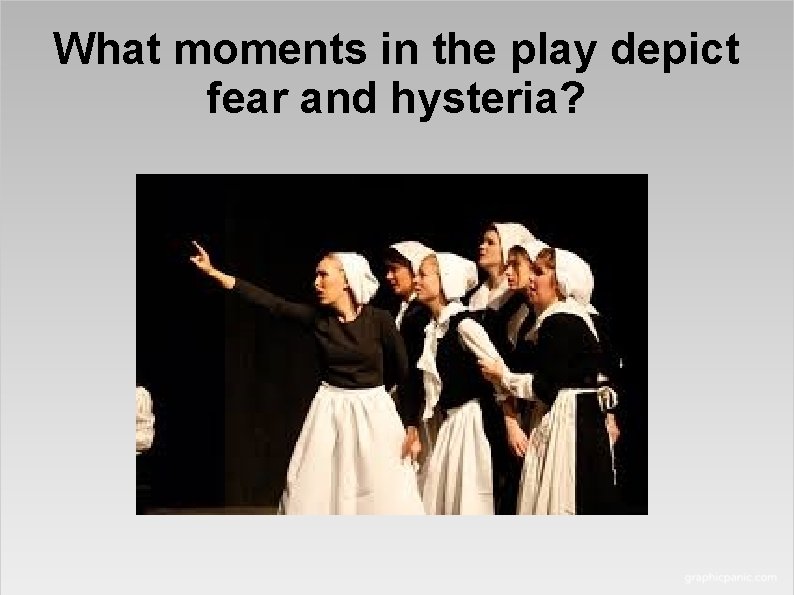
What moments in the play depict fear and hysteria?
Reputation An individual's reputation is vitally important in Salem, where public and private moralities are the same. This then leads to a fear of association and helps to explain why the villagers turn against each other Various characters base their actions on their desire to protect their reputations: at the beginning of the play, Parris fears Abigail's actions and his daughter's 'trance' will result in claims of witchcraft. This would threaten his reputation and force him from the pulpit;
Part of introduction 1. What do we learn about Reverend Parris? 2. What do we learn about the Puritan community? 3. How does the community deal with jokers and slackers? 4. What impact do the Native Americans have on the puritan community? 5. How had the Puritans been treated in England? 6. How had the Puritans been treated USA (by Virginia) 7. How does this explain why they might have such a rigid attitude?
1. House is small, has a 10 year old daughter who is possibly very ill (“Inert”), devoutly religious, not liked in the village, he believes he is being treated unfairly by everyone, “best efforts to win people and God to his side” surely, God should be on his side!? , not interested in children, his attitude and views towards children suggest that he isn’t good at dealing with them, he doesn’t understand them, and he believes they should be grateful for everything adults do for them
2. don’t celebrate Christmas, holidays don’t exist for them, constant prayer, only really celebrate hard work done (“raising the roof”), happiness in hard work (more so than the bible etc. ), harsh life (land not ideal for farming) 3. questioned, then sent to the courts and it is up to the courts to decide the punishment, this would provide the community with gossip 4. Puritans have tried to convert Native Americans, unsuccessfully. So Puritans look down on NA (“heathens”) Native Americans have killed members of the community
5. Hadn’t been accepted as a group in England, treated harshly 6. In America, the settlement in Virginia tried to wipe out the Puritans in Salem 7. Wherever they go they aren’t accepted Their distaste for those who don’t fit into their own society mirrors how they have been treated by other communities
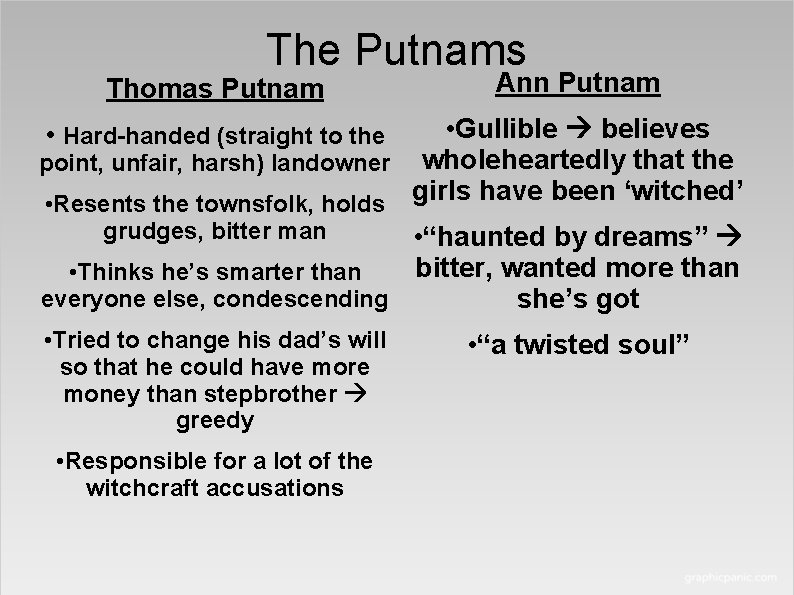
The Putnams Thomas Putnam Ann Putnam • Gullible believes point, unfair, harsh) landowner wholeheartedly that the • Resents the townsfolk, holds girls have been ‘witched’ • Hard-handed (straight to the grudges, bitter man • “haunted by dreams” bitter, wanted more than • Thinks he’s smarter than everyone else, condescending she’s got • Tried to change his dad’s will so that he could have more money than stepbrother greedy • Responsible for a lot of the witchcraft accusations • “a twisted soul”
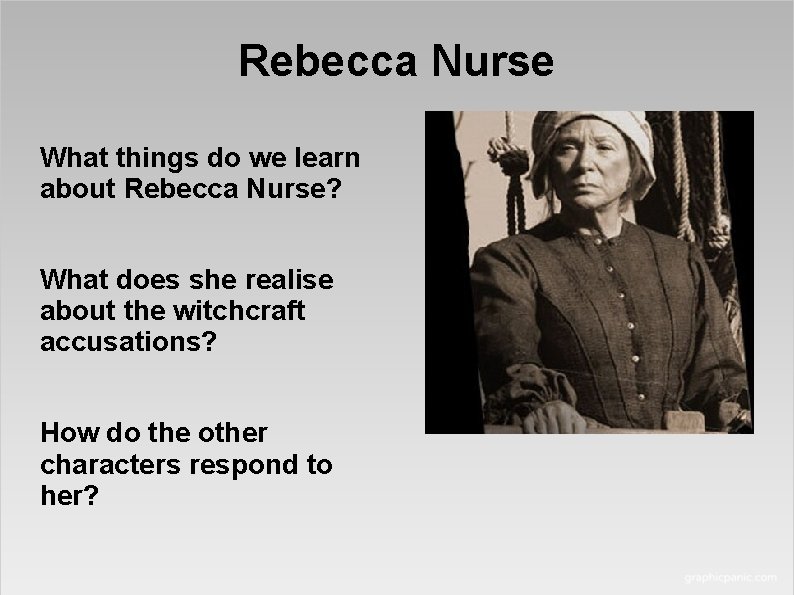
Rebecca Nurse What things do we learn about Rebecca Nurse? What does she realise about the witchcraft accusations? How do the other characters respond to her?
Rebecca Nurse She thinks it’s just the children pretending (doesn’t buy into the witchcraft allegations) “I have seen them through all of their silly seasons, and when it come on them they will run the Devil bow-legged with their mischief” 1. Ann Putnam has strong dislike for her jealousy “You think it’s God’s work you should never lose a child, nor grandchild either, and I bury all but one” Parris values her advice, asks her to wake his daughter, Betty. Proctor seems to have a friendly relationship with her.
Compare and Contrast Rebecca Nurse Ann Putnam
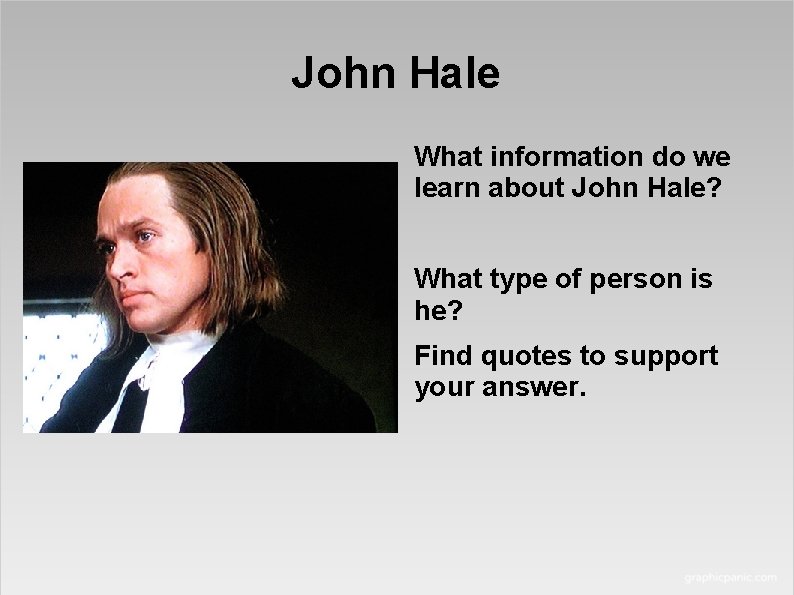
John Hale What information do we learn about John Hale? What type of person is he? Find quotes to support your answer.

- Slides: 46