
Arthur and the Golden Rope By Joe Todd
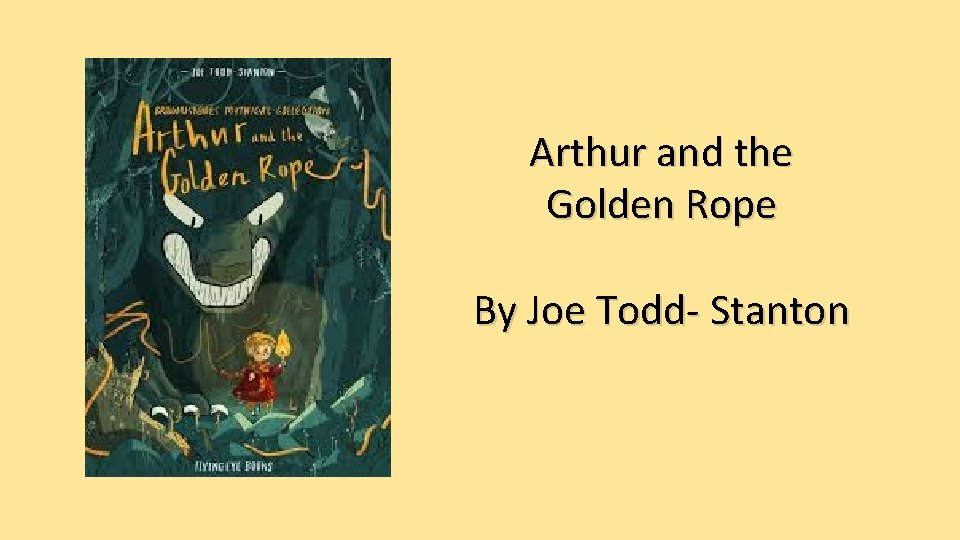
Arthur and the Golden Rope By Joe Todd- Stanton
Week 3: Plan and write your own Norse Myth Week 3 This week you are going to use your information and planning from last week to write your own Myth. On the Home Learning there are examples of work to help you along with word mats for your vocabulary. Monday: Lesson 1 Plan and design the other characters in your story. 1. 2. 3. 4. You now have a main character which is a god, demi-god or a person with super-natural powers. You now need a mythical creature who has a weakness. Objects that will help your hero save the day Obstacles that the hero will need to over come – usually put in the way by the mythical creature
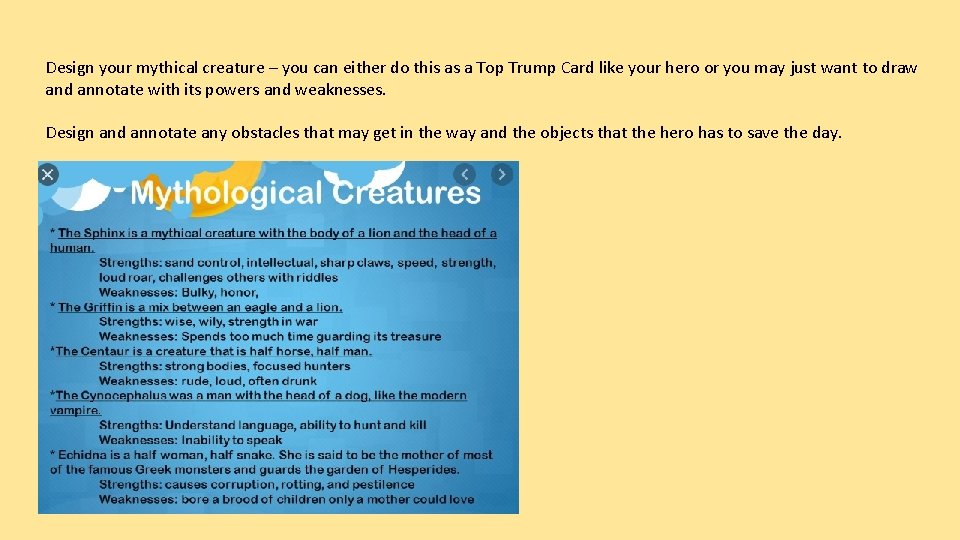
Design your mythical creature – you can either do this as a Top Trump Card like your hero or you may just want to draw and annotate with its powers and weaknesses. Design and annotate any obstacles that may get in the way and the objects that the hero has to save the day.
Tuesday: Lesson 2 Look at your story map and plan from last week and now improve this. Use a different colour pen or pencil so that your new words stand out. Look at the following slides to see what you could include to help you with your writing and to jog your memory about what you need to describe. Think about the vocabulary you could use in your writing – try and up level your vocabulary – use a thesaurus if you have one. e. g. small – miniature, pint sized, tiny, petit, Slowly – calmly, gently, casually Make sure you use the correct word when up levelling your vocabulary and that your sentence will still make sense.
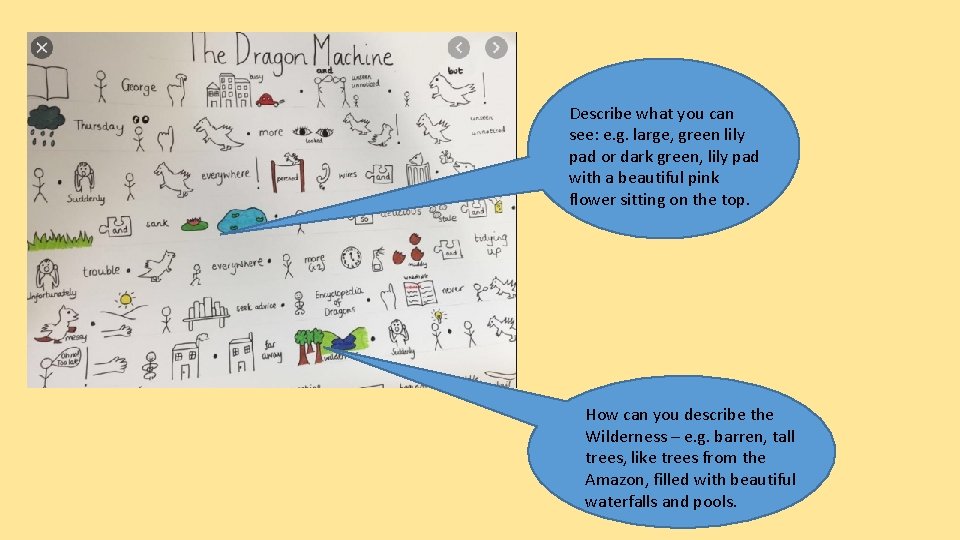
Describe what you can see: e. g. large, green lily pad or dark green, lily pad with a beautiful pink flower sitting on the top. How can you describe the Wilderness – e. g. barren, tall trees, like trees from the Amazon, filled with beautiful waterfalls and pools.
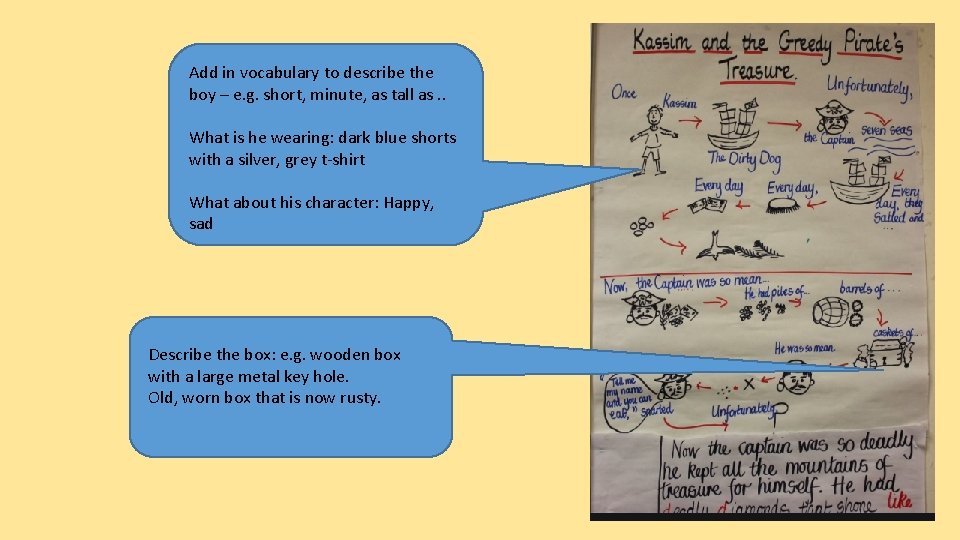
Add in vocabulary to describe the boy – e. g. short, minute, as tall as. . What is he wearing: dark blue shorts with a silver, grey t-shirt What about his character: Happy, sad Describe the box: e. g. wooden box with a large metal key hole. Old, worn box that is now rusty.
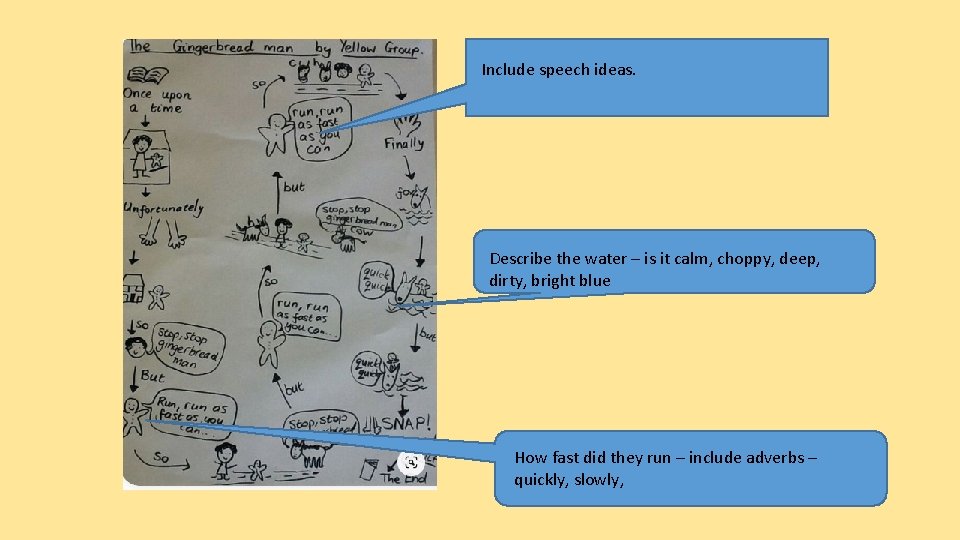
Include speech ideas. Describe the water – is it calm, choppy, deep, dirty, bright blue How fast did they run – include adverbs – quickly, slowly,
Boxing up your ideas Wednesday: Lesson 3 So that your plan can now be finalised you need to box up your ideas so that your story flows. You will have done this before in year 3. Boxing up explained: It acts as a paragraph planner for writers as well as adding a structure or plot which can be worked in any order and adapted where necessary. When boxing up forget about the detail but plan your paragraphs around a specific theme or basic ideas e. g. basic events, characters, settings, build up, problem, dilemma, solution and ending. It is another planning tool to help with writing.
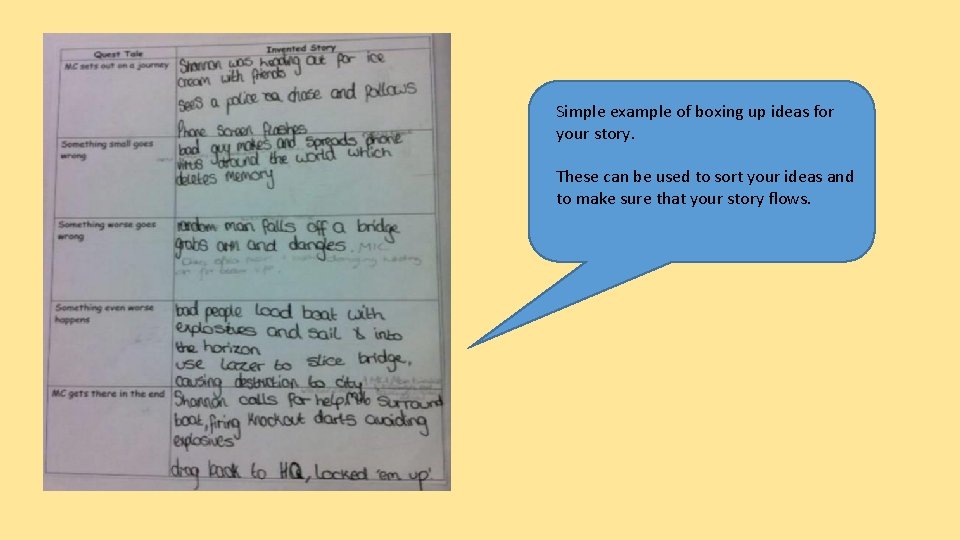
Simple example of boxing up ideas for your story. These can be used to sort your ideas and to make sure that your story flows.
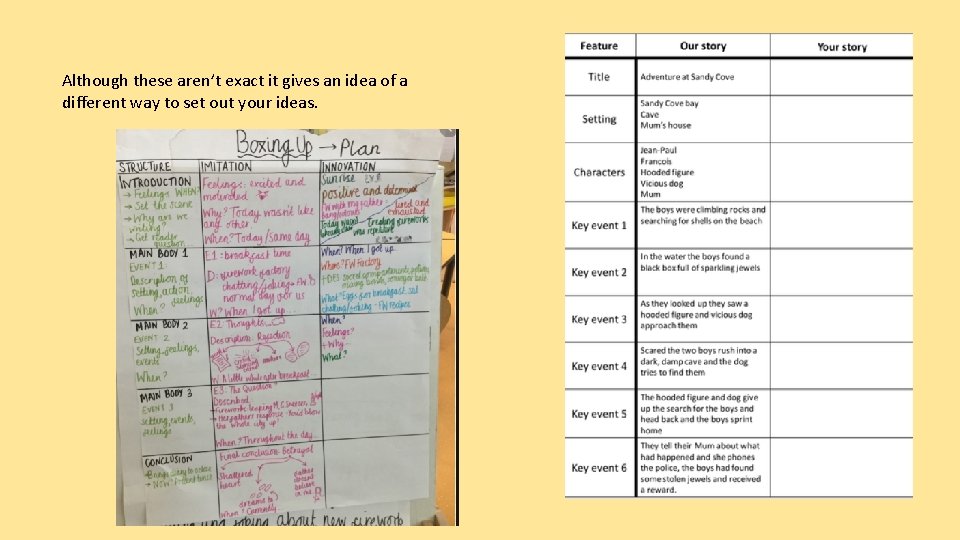
Although these aren’t exact it gives an idea of a different way to set out your ideas.
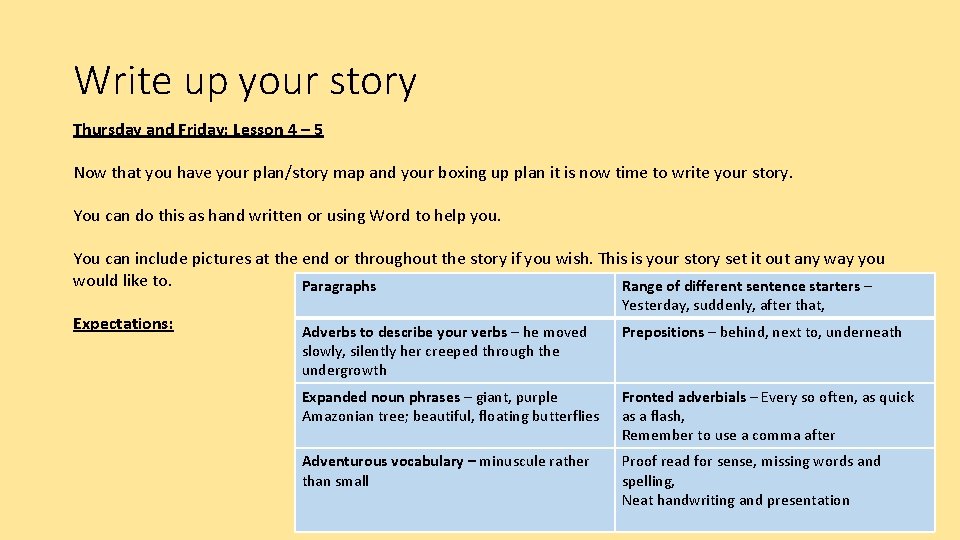
Write up your story Thursday and Friday: Lesson 4 – 5 Now that you have your plan/story map and your boxing up plan it is now time to write your story. You can do this as hand written or using Word to help you. You can include pictures at the end or throughout the story if you wish. This is your story set it out any way you would like to. Paragraphs Range of different sentence starters – Expectations: Yesterday, suddenly, after that, Adverbs to describe your verbs – he moved slowly, silently her creeped through the undergrowth Prepositions – behind, next to, underneath Expanded noun phrases – giant, purple Amazonian tree; beautiful, floating butterflies Fronted adverbials – Every so often, as quick as a flash, Remember to use a comma after Adventurous vocabulary – minuscule rather than small Proof read for sense, missing words and spelling, Neat handwriting and presentation
- Slides: 11