
ARTHUR ADAMOV By Kara Gordon and Alli Bahmer
ARTHUR ADAMOV By: Kara Gordon and Alli Bahmer
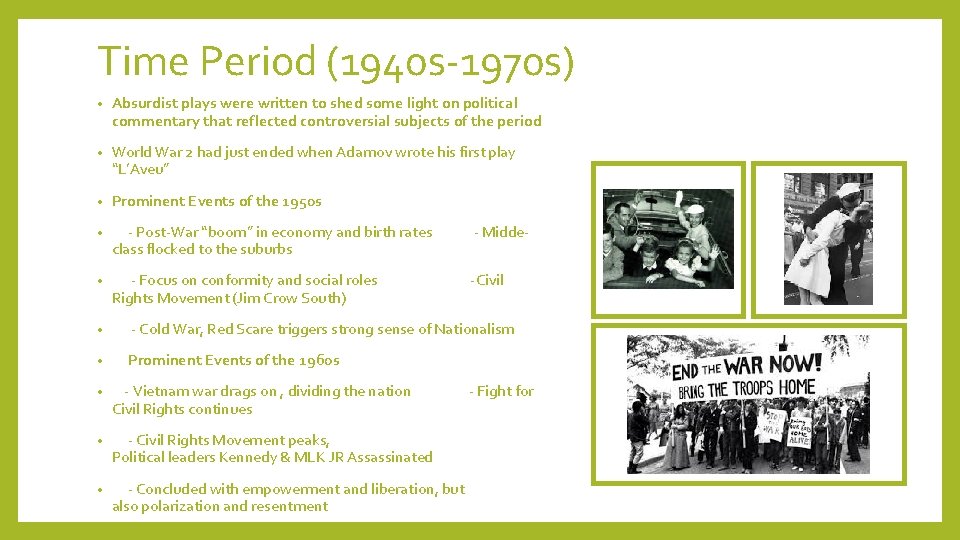
Time Period (1940 s-1970 s) • Absurdist plays were written to shed some light on political commentary that reflected controversial subjects of the period • World War 2 had just ended when Adamov wrote his first play “L’Aveu” • Prominent Events of the 1950 s • - Post-War “boom” in economy and birth rates - Middeclass flocked to the suburbs • - Focus on conformity and social roles -Civil Rights Movement (Jim Crow South) • - Cold War, Red Scare triggers strong sense of Nationalism • Prominent Events of the 1960 s • - Vietnam war drags on , dividing the nation - Fight for Civil Rights continues • - Civil Rights Movement peaks, Political leaders Kennedy & MLK JR Assassinated • - Concluded with empowerment and liberation, but also polarization and resentment
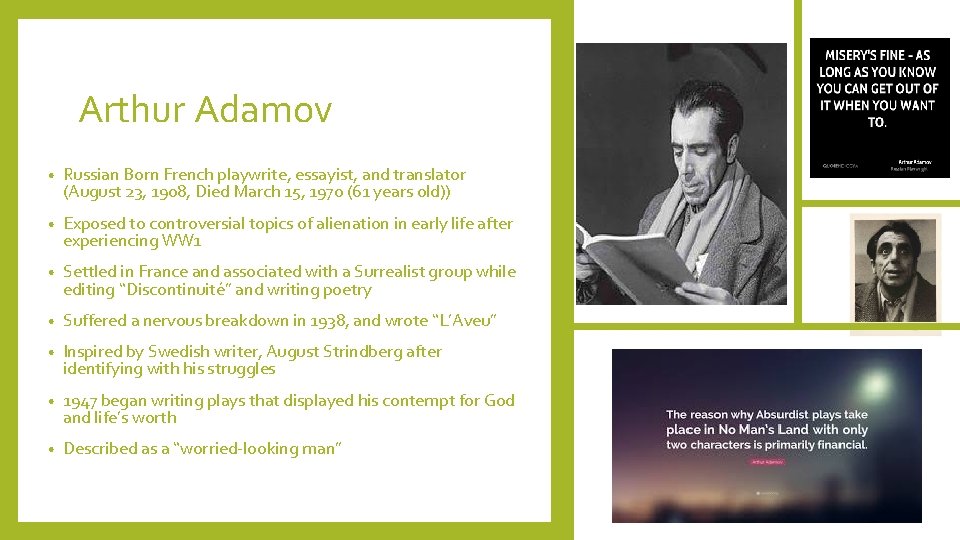
Arthur Adamov • Russian Born French playwrite, essayist, and translator (August 23, 1908, Died March 15, 1970 (61 years old)) • Exposed to controversial topics of alienation in early life after experiencing WW 1 • Settled in France and associated with a Surrealist group while editing “Discontinuité” and writing poetry • Suffered a nervous breakdown in 1938, and wrote “L’Aveu” • Inspired by Swedish writer, August Strindberg after identifying with his struggles • 1947 began writing plays that displayed his contempt for God and life’s worth • Described as a “worried-looking man”
Most Important Plays • The Confession: autobiographical play inspired by his own nervous breakdown • The Invasion: A writer is unable to write due to the “invasion” of his family & friends • La Parodie: Takes place in front of a giant clock with no hands and addresses issues of time • Le Ping-Pong: Uses symbolism of a pinball machine to criticize capitalism as a “game of chance” • Professor Taranne : About a professor unable to live up to society’s expectations
Common Themes • “Shaped the idiom of the stage” • Adamov’s style relied heavily on a physical and visual focus to bring the meaning of the story to the audience • Plays stressed the intensity of isolation and communication • Minimal plots, focused on the importance of characters • Characters served as symbols; unrealistic people who were victims to uncontrolled forces bringing • Influenced by August Strindberg, and Antonin Artaud (a theoretician of “theatre of cruelty”) • Three “Phases of Adamov” • -Plays revolved around universal issues with little stress on setting, reflecting mostly on Adamov’s personal struggles/fears • - Plays shifted to realism, displaying the outrages of social injustices. These usually had a “strident tone” • - Plays showed a blend of previous phases. Often showing his disappointment in the effectiveness of social action and his lack of faith in human connection
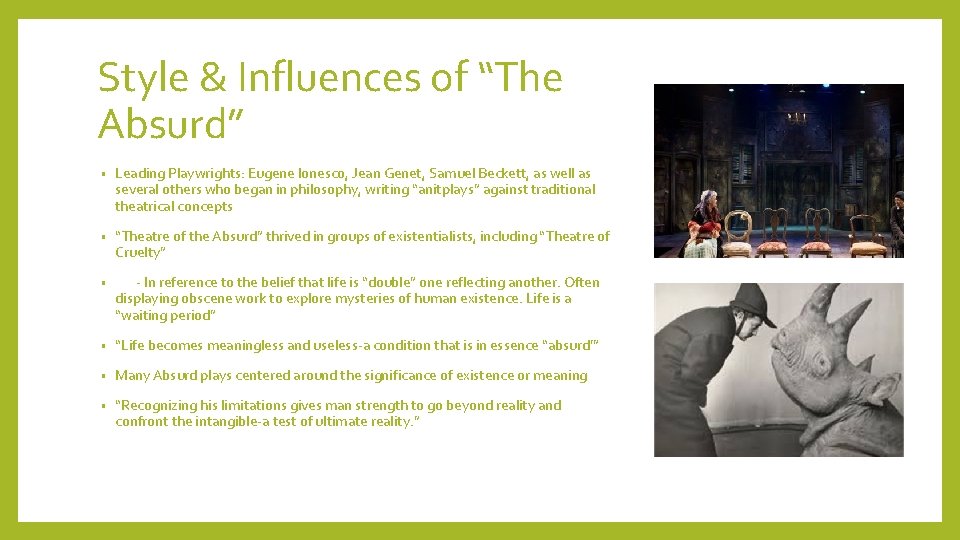
Style & Influences of “The Absurd” • Leading Playwrights: Eugene Ionesco, Jean Genet, Samuel Beckett, as well as several others who began in philosophy, writing “anitplays” against traditional theatrical concepts • “Theatre of the Absurd” thrived in groups of existentialists, including “Theatre of Cruelty” • - In reference to the belief that life is “double” one reflecting another. Often displaying obscene work to explore mysteries of human existence. Life is a “waiting period” • “Life becomes meaningless and useless-a condition that is in essence “absurd’” • Many Absurd plays centered around the significance of existence or meaning • “Recognizing his limitations gives man strength to go beyond reality and confront the intangible-a test of ultimate reality. ”
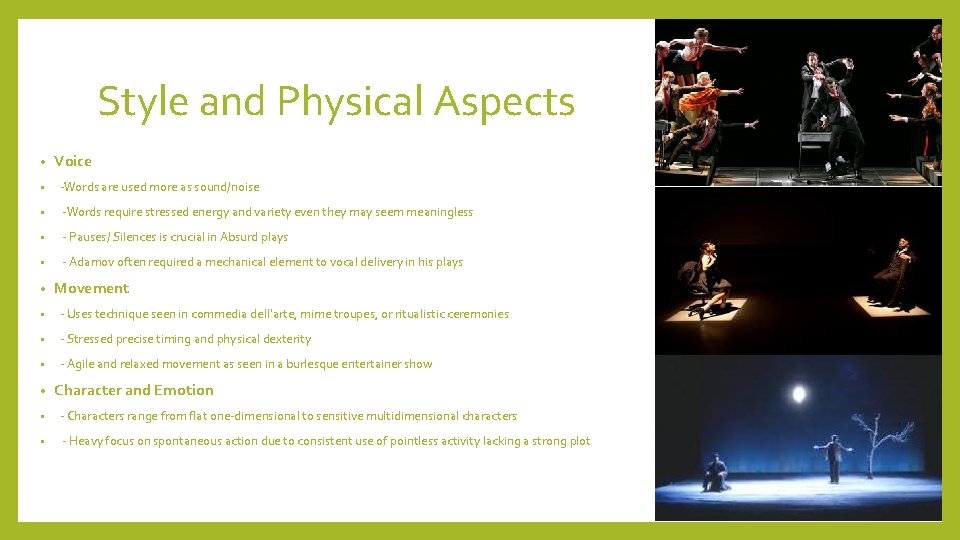
Style and Physical Aspects • Voice • -Words are used more as sound/noise • -Words require stressed energy and variety even they may seem meaningless • - Pauses/ Silences is crucial in Absurd plays • - Adamov often required a mechanical element to vocal delivery in his plays • Movement • - Uses technique seen in commedia dell’arte, mime troupes, or ritualistic ceremonies • - Stressed precise timing and physical dexterity • - Agile and relaxed movement as seen in a burlesque entertainer show • Character and Emotion • - Characters range from flat one-dimensional to sensitive multidimensional characters • - Heavy focus on spontaneous action due to consistent use of pointless activity lacking a strong plot
Description/Sample of Plays and Writing Style • His early plays were typical of the Absurdist movement • The defining characteristic of these early plays was that situations began realistically, but progressed into absurdity as the plays went on (Ex: Professor Taranne) • His plays are largely driven by symbolism (Ex: the clock in La Parodie and the pinball machine in Le Ping Pong) • Adamov’s early plays are considered metaphysical, but his later works reflect his involvement in Marxism because they focus on the social status of his characters • His later works are very political and more realistic than his earlier works
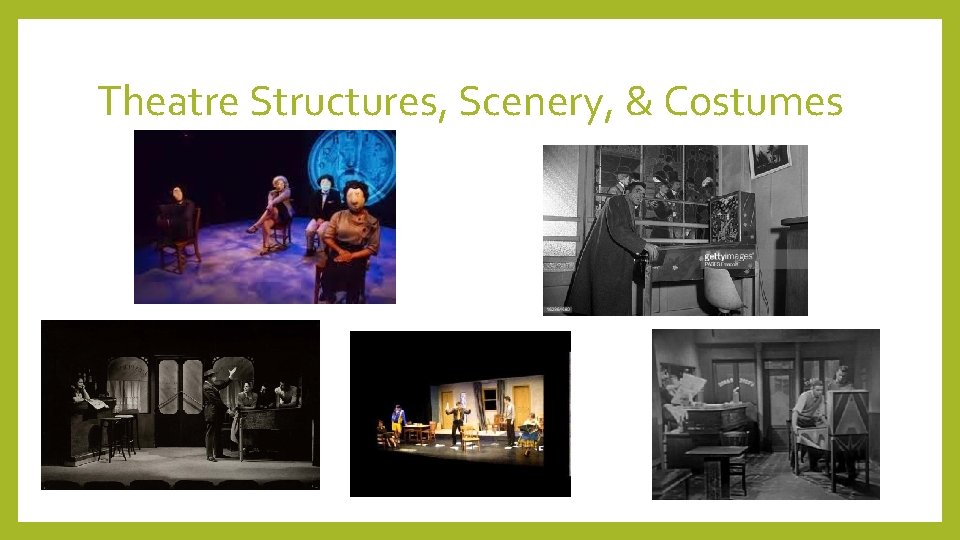
Theatre Structures, Scenery, & Costumes
New/Unique Vocabulary of the Era • Existentialism: “existentialism is a philosophy concerned with finding self and the meaning of life through free will, choice, and personal responsibility”; “An existentialist believes that a person should be forced to choose and be responsible without the help of laws, ethnic rules, or traditions” • Epic Theatre: “form of didactic drama presenting a series of loosely connected scenes that avoid illusion and often interrupt the story line to address the audience directly with analysis, argument, or documentation”; associated with playwright Brecht; heavily influenced Adamov • Metatheatre: convention in theatre that draws attention to the fact that the events are in a play (Ex: play within a play, breaking the 4 th wall) • Surrealism: theatrical movement that influenced absurdism; rejected realistic characters & plot; focused on symbolism; often included caricatures, nonsensical dialogue, elements of fantasy, & heavy satire • Dadaism: “A European artistic and literary movement (1916 -1923) that flouted conventional aesthetic and cultural values by producing works marked by nonsense, travesty, and incongruity”; precursor to Absurdism; Questioned the definition of art and its role in society
Bibliography • Britannica, The Editors of Encyclopaedia. “Arthur Adamov. ” Encyclopædia Britannica, Inc. , 9 Mar. 2018, www. britannica. com/biography/Arthur-Adamov • “Arthur Adamov. ” Oxford Reference, 16 June 2017, www. oxfordreference. com/view/10. 1093/oi/authority. 20110803095350774 • Valentine, Antonia. “The Theater of Arthur Adamov. ” Academia. edu, www. academia. edu/30794214/The_Theater_of_Arthur_Adamov. • “Existentialism. ” All. About. Philosophy. org, www. allaboutphilosophy. org/existentialism. htm • Britannica, The Editors of Encyclopaedia. “Epic Theatre. ” Encyclopædia Britannica, Inc. , 25 Apr. 2017, www. britannica. com/art/epic-theatre • “Metatheatre | Definition of Metatheatre in English by Oxford Dictionaries. ” Oxford Dictionaries | English, Oxford Dictionaries, en. oxforddictionaries. com/definition/metatheatre. • “Surrealism: Theatre Conventions. ” The Drama Teacher • “Dadaism. ” The Free Dictionary, Farlex, www. thefreedictionary. com/dadaism. • Acting: In Person and In Style by Jerry L. Crawford
Continued… • Jerry L. Crawford. “Acting in Person and in Style. ” Fourth Edition. Wm C. Brown Publishers. 1976. University of Nevada, Las Vegas. • History. com Staff. “The 1960 s. ” History. com, A&E Television Networks, 2010, www. history. com/topics/1960 s. • Rockabilly Quotes and Retro Phrases of the 1950's. ” Cats Like Us, catslikeus. com/pages/retro-style-rockabilly-quotes. • Special To the New York Times. “Arthur Adamov, 61, Playwright Of Alienation, Is Dead in Paris. ” The New York Times, 17 Mar. 1970, www. nytimes. com/1970/03/17/archives/arthur-adamov-61 -playwright-ofalienation-is-dead-in-paris. html • Arthur Adamov, Arthur (Vol. 25). ” Enotes. com, www. enotes. com/topics/arthur-adamov/critical-essays/adamov-arthur-vol-25
- Slides: 12