
ARTHROLOGIA o Joint articulation is the connection point




- Slides: 14
ARTHROLOGIA o Joint (articulation) is the connection point between the bones that forms the skeleton. Joints are mainly classified functionally, structurally and anatomically. o Arthron (Gr. = Joint) o Arthroscopy (imaging) o Arthropathy (disorder) o Arthritis (inflammation) Coto
Anatomical classification o Anatomical classification is determined according to the number of bones that form the joint. Three main parts anatomically; o Simple joints have two articulating bones and surfaces o Compound joints have three or more articulating bones and surfaces o Complex joints have articular discs or meniscus Coto
Functional classification o Functional classification is determined according to the type and degree of movement between the articulating bones that they allow. o Synarthroses (immovable) o Amphiarthroses (Slightly mobile) o Diarthroses (Freely movable) Coto
Functional classification o Synarthroses is a type of joint which permits very little or no movement under normal conditions. Because of the fixed tight union, it has great strength. Coto
Functional classification o Amphiarthroses is a type of joint allowing very limited movement because the bones are connected by FIBROCARTILAGE. Such joints occur between adjacent vertebrae or between the ribs and the breast bone. Coto
Functional classification o Diarthroses is the most common and most movable type of joint in the body of a mammal. Coto
Structural classification o Structural classification is determined by how the bones connect to each other. The joints are named and divided according to the type of binding tissue that connects the bones to each other. o There are three structural classifications of joints; o Articulatio Fibrosa o Articulatio Cartilaginea o Articulatio Synovialis Coto
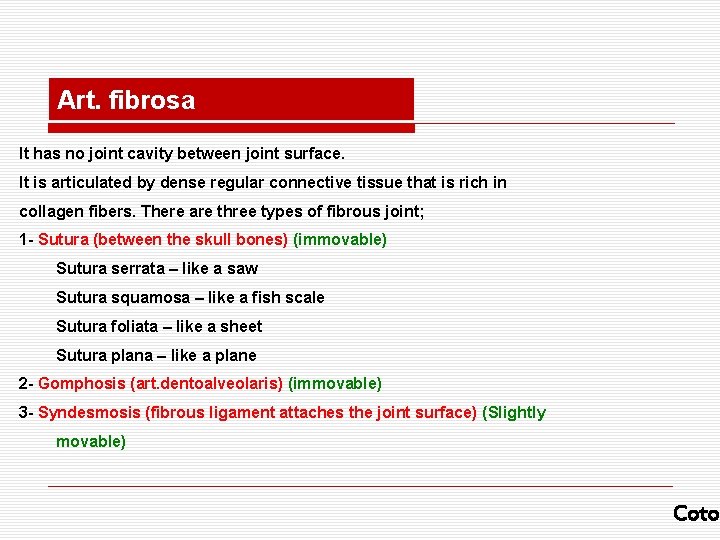
Art. fibrosa It has no joint cavity between joint surface. It is articulated by dense regular connective tissue that is rich in collagen fibers. There are three types of fibrous joint; 1 - Sutura (between the skull bones) (immovable) Sutura serrata – like a saw Sutura squamosa – like a fish scale Sutura foliata – like a sheet Sutura plana – like a plane 2 - Gomphosis (art. dentoalveolaris) (immovable) 3 - Syndesmosis (fibrous ligament attaches the joint surface) (Slightly movable) Coto
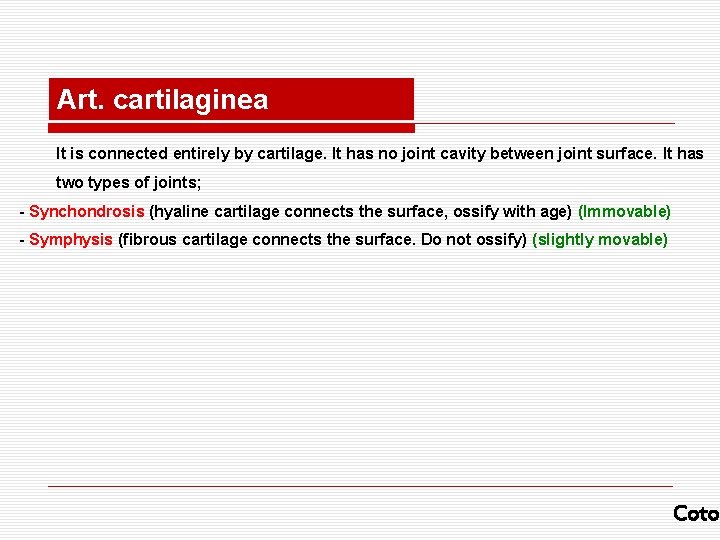
Art. cartilaginea It is connected entirely by cartilage. It has no joint cavity between joint surface. It has two types of joints; - Synchondrosis (hyaline cartilage connects the surface, ossify with age) (Immovable) - Symphysis (fibrous cartilage connects the surface. Do not ossify) (slightly movable) Coto
Art. synovialis o The type of joint covered by hyaline cartilage, surround by fibrous capsule and has joint cavity that is filled by synovial fluid. (Movable) Coto
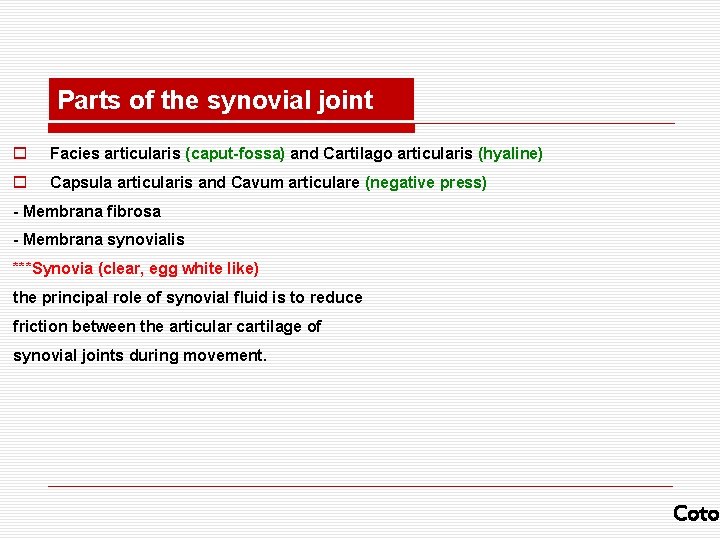
Parts of the synovial joint o Facies articularis (caput-fossa) and Cartilago articularis (hyaline) o Capsula articularis and Cavum articulare (negative press) - Membrana fibrosa - Membrana synovialis ***Synovia (clear, egg white like) the principal role of synovial fluid is to reduce friction between the articular cartilage of synovial joints during movement. Coto
Parts of the synovial joint o Supporting structures; o Ligamenta - extracapsular - intracapsular o Discus articularis o Meniscus articularis o Labrum articulare Coto
Movements of Joints o Angular movements - Flexion (decreasing angle) - Extension (increasing angle) - Abduction (away from the midline) - Adduction (toward the midline) o Rotation -Pronation (internal rotation) -Supination (external rotation) o Circumdiction Coto
Types of the synovial joint o Art. spheroidea (socket): allows all motion o Art. ellipsoidea (condylaris) : flexion and extension o Art. sellaris (saddle): flexion and extension o Art. trochoidea (pivot): rotation o Ginglymus (hinge): flexion and extension o Art. bicondylaris : flexion, extension, rotation o Art. plana (gliding) : no movement o Art. delabens (sledge) : Coto