
Arthritis Medications Part II Dr Sherry Rohekar June










- Slides: 57
Arthritis Medications Part II Dr. Sherry Rohekar June 24, 2010
Overview n n Acknowledgement: Dr. Andrew Thompson for his kind use of his slides! Wealth of information on his website (mentioned later in presentation) DMARDS n Traditional Methotrexate n Sulfasalazine n Plaquenil n Leflunomide TNF Inhibitors (infliximab, adalimumab, etancercept) Newer biologics (abatacept, rituximab) n n n
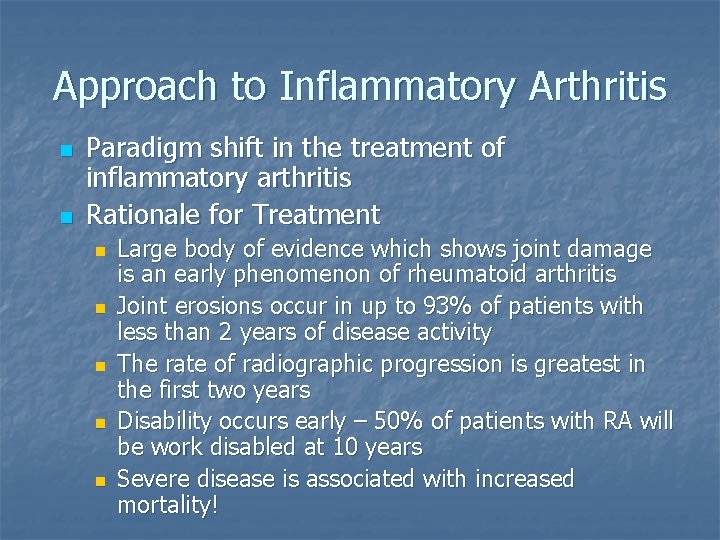
Approach to Inflammatory Arthritis n n Paradigm shift in the treatment of inflammatory arthritis Rationale for Treatment n n n Large body of evidence which shows joint damage is an early phenomenon of rheumatoid arthritis Joint erosions occur in up to 93% of patients with less than 2 years of disease activity The rate of radiographic progression is greatest in the first two years Disability occurs early – 50% of patients with RA will be work disabled at 10 years Severe disease is associated with increased mortality!
It’s like an Iceberg
It’s what you don’t see!
Approach to Inflammatory Arthritis n “Window of Opportunity” n n Early and aggressive treatment may have long -term benefits Principles of Treatment Treat Early n Treat Appropriately n
A Fire in the Joints If there’s a fire in the kitchen do you wait until it spreads to the living room or do you try and put it out?
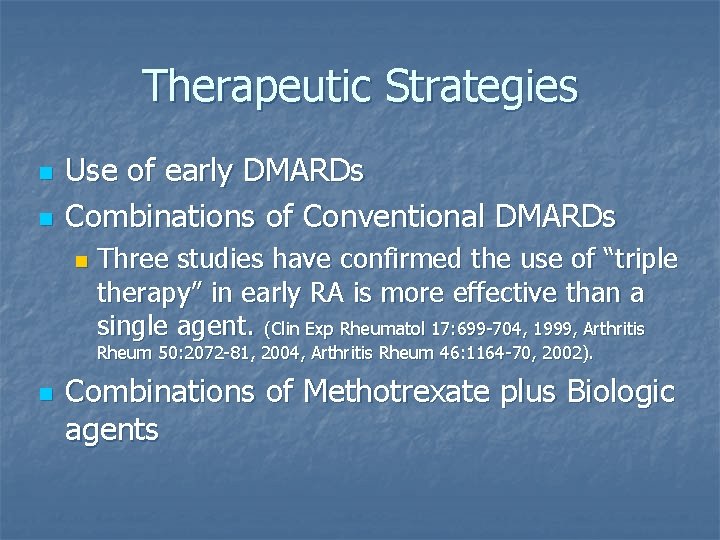
Therapeutic Strategies n n Use of early DMARDs Combinations of Conventional DMARDs n Three studies have confirmed the use of “triple therapy” in early RA is more effective than a single agent. (Clin Exp Rheumatol 17: 699 -704, 1999, Arthritis Rheum 50: 2072 -81, 2004, Arthritis Rheum 46: 1164 -70, 2002). n Combinations of Methotrexate plus Biologic agents
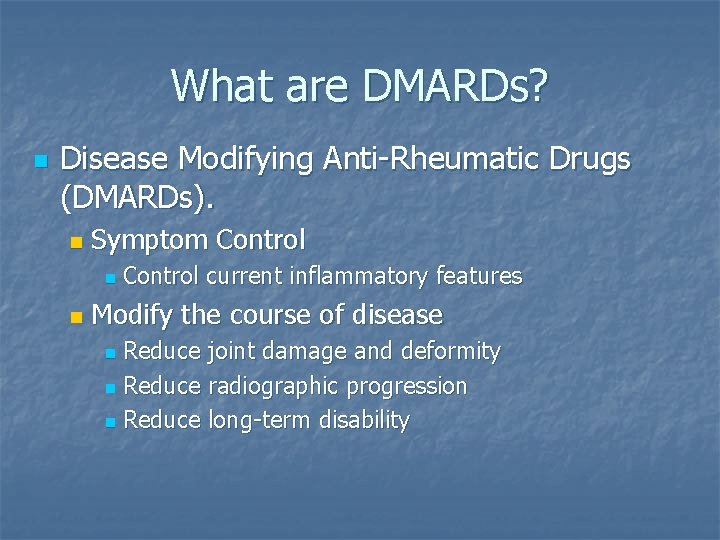
What are DMARDs? n Disease Modifying Anti-Rheumatic Drugs (DMARDs). n Symptom Control n n Control current inflammatory features Modify the course of disease Reduce joint damage and deformity n Reduce radiographic progression n Reduce long-term disability n
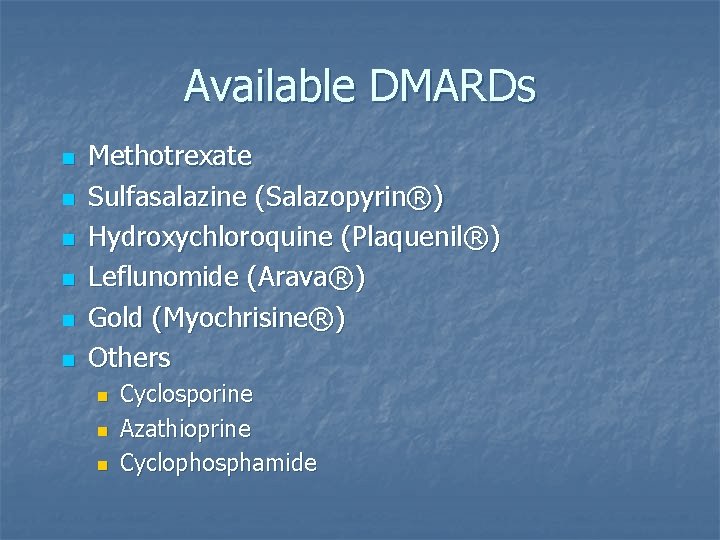
Available DMARDs n n n Methotrexate Sulfasalazine (Salazopyrin®) Hydroxychloroquine (Plaquenil®) Leflunomide (Arava®) Gold (Myochrisine®) Others n n n Cyclosporine Azathioprine Cyclophosphamide
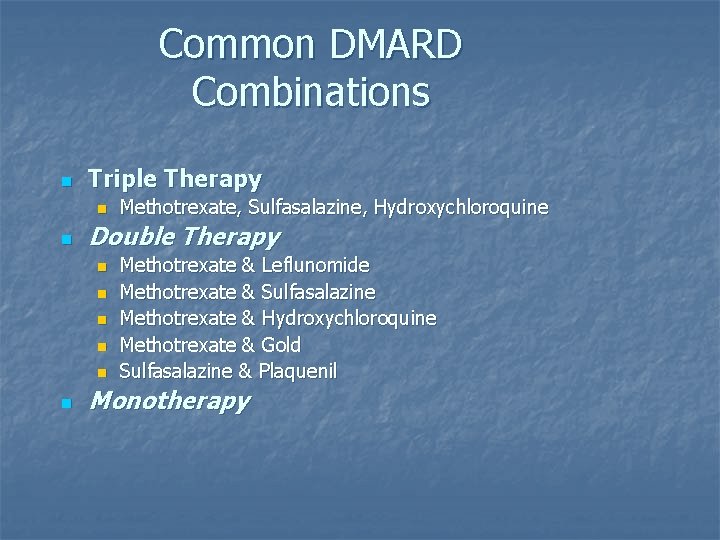
Common DMARD Combinations n Triple Therapy n n Double Therapy n n n Methotrexate, Sulfasalazine, Hydroxychloroquine Methotrexate & Leflunomide Methotrexate & Sulfasalazine Methotrexate & Hydroxychloroquine Methotrexate & Gold Sulfasalazine & Plaquenil Monotherapy
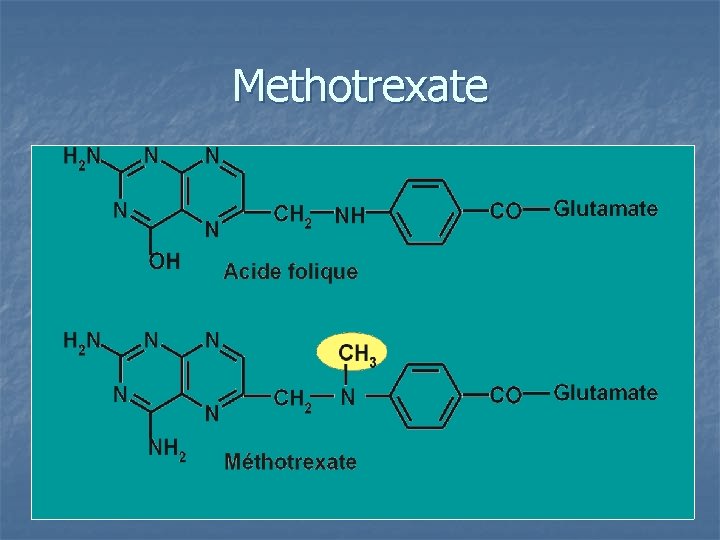
Methotrexate Tetrahydrofolate is an important cofactor in the production of purines transferring a carbon atom.
Methotrexate
Methotrexate n Substitutes as Folic Acid Interferes with the production of Tetrahydrofolate n Interferes with the de novo synthesis of purines n Affects cells that rapidly turn over n Immune cells n Mucosal cells n Hair follicles n
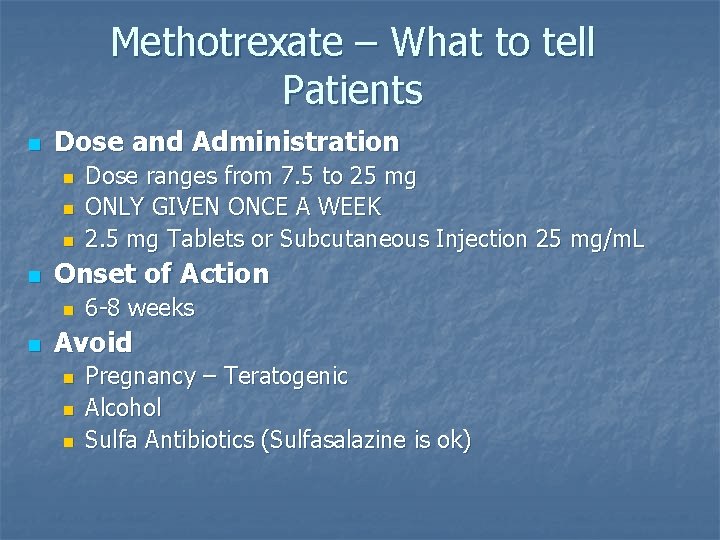
Methotrexate – What to tell Patients n Dose and Administration n n Onset of Action n n Dose ranges from 7. 5 to 25 mg ONLY GIVEN ONCE A WEEK 2. 5 mg Tablets or Subcutaneous Injection 25 mg/m. L 6 -8 weeks Avoid n n n Pregnancy – Teratogenic Alcohol Sulfa Antibiotics (Sulfasalazine is ok)
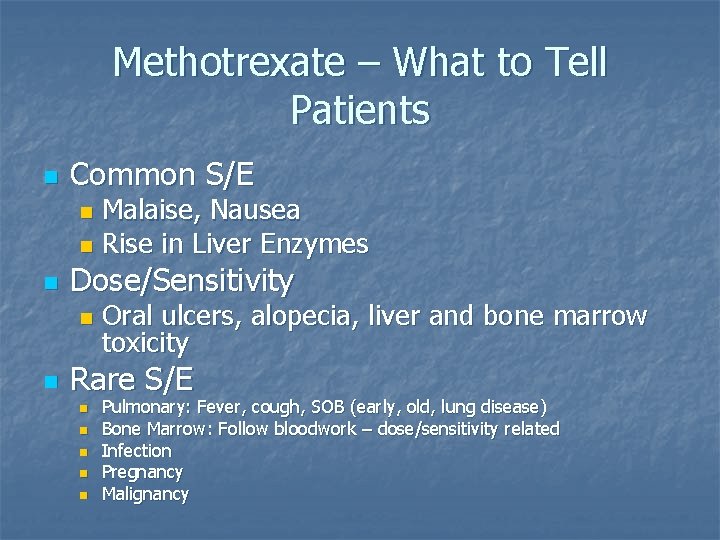
Methotrexate – What to Tell Patients n Common S/E Malaise, Nausea n Rise in Liver Enzymes n n Dose/Sensitivity n n Oral ulcers, alopecia, liver and bone marrow toxicity Rare S/E n n n Pulmonary: Fever, cough, SOB (early, old, lung disease) Bone Marrow: Follow bloodwork – dose/sensitivity related Infection Pregnancy Malignancy
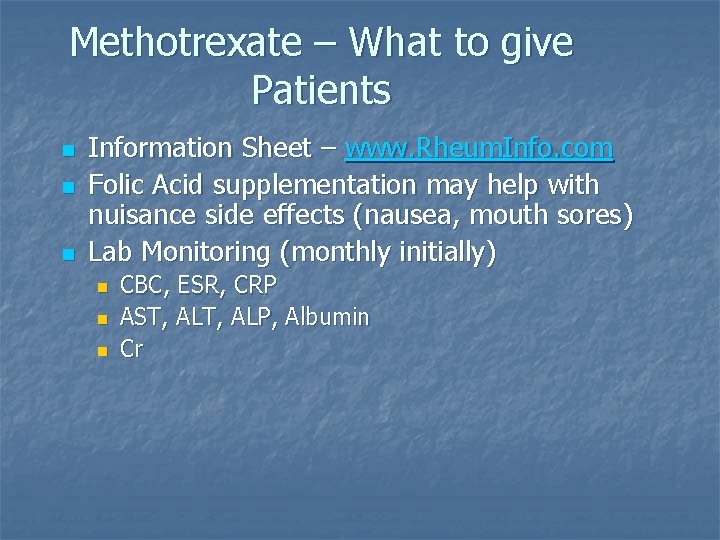
Methotrexate – What to give Patients n n n Information Sheet – www. Rheum. Info. com Folic Acid supplementation may help with nuisance side effects (nausea, mouth sores) Lab Monitoring (monthly initially) n n n CBC, ESR, CRP AST, ALP, Albumin Cr
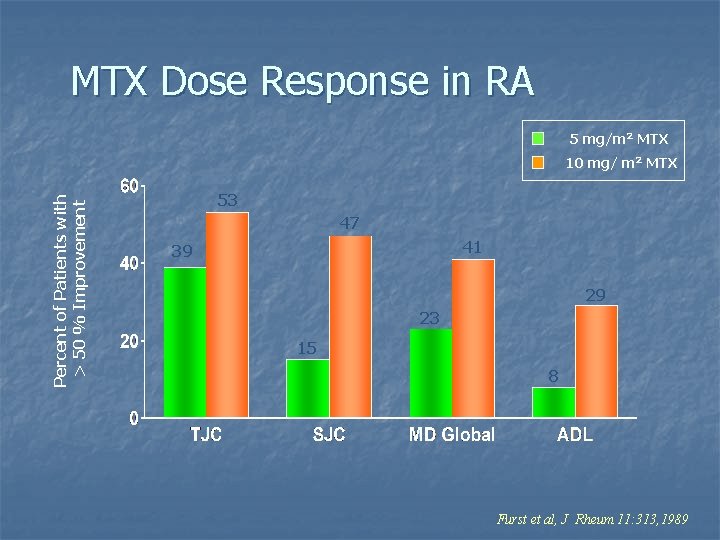
MTX Dose Response in RA 5 mg/m 2 MTX Percent of Patients with > 50 % Improvement 10 mg/ m 2 MTX 53 47 41 39 29 23 15 8 Furst et al, J Rheum 11: 313, 1989
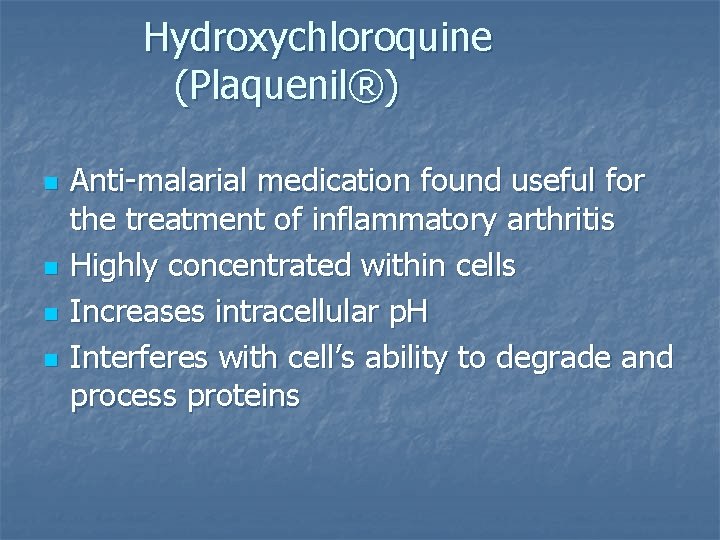
Hydroxychloroquine (Plaquenil®) n n Anti-malarial medication found useful for the treatment of inflammatory arthritis Highly concentrated within cells Increases intracellular p. H Interferes with cell’s ability to degrade and process proteins
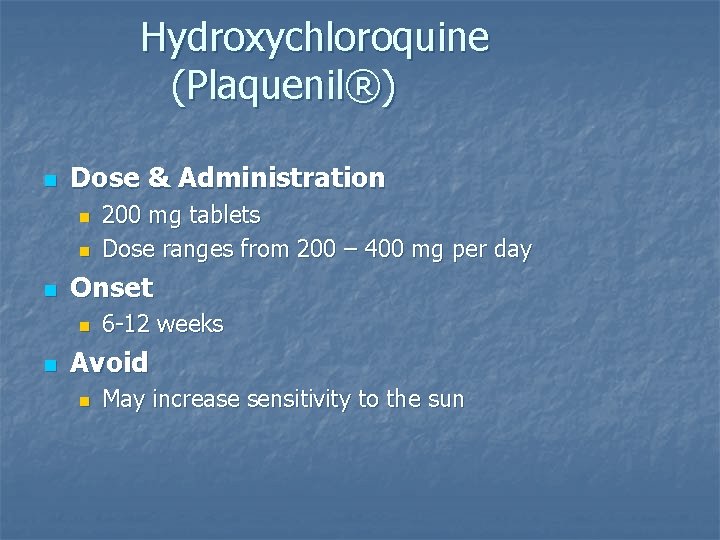
Hydroxychloroquine (Plaquenil®) n Dose & Administration n Onset n n 200 mg tablets Dose ranges from 200 – 400 mg per day 6 -12 weeks Avoid n May increase sensitivity to the sun
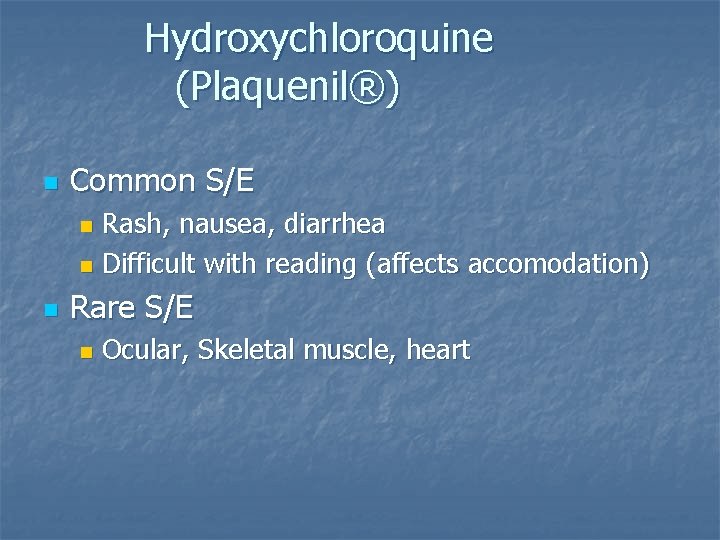
Hydroxychloroquine (Plaquenil®) n Common S/E Rash, nausea, diarrhea n Difficult with reading (affects accomodation) n n Rare S/E n Ocular, Skeletal muscle, heart
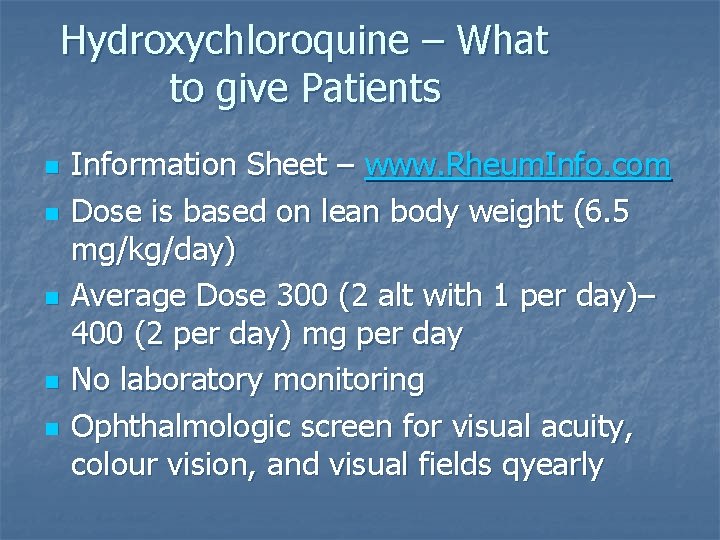
Hydroxychloroquine – What to give Patients n n n Information Sheet – www. Rheum. Info. com Dose is based on lean body weight (6. 5 mg/kg/day) Average Dose 300 (2 alt with 1 per day)– 400 (2 per day) mg per day No laboratory monitoring Ophthalmologic screen for visual acuity, colour vision, and visual fields qyearly
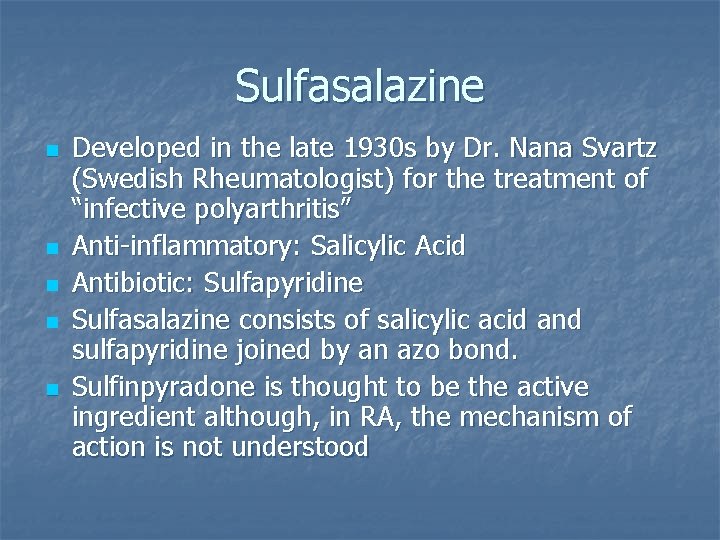
Sulfasalazine n n n Developed in the late 1930 s by Dr. Nana Svartz (Swedish Rheumatologist) for the treatment of “infective polyarthritis” Anti-inflammatory: Salicylic Acid Antibiotic: Sulfapyridine Sulfasalazine consists of salicylic acid and sulfapyridine joined by an azo bond. Sulfinpyradone is thought to be the active ingredient although, in RA, the mechanism of action is not understood
Sulfasalazine Salicylate Sulfinpyradone
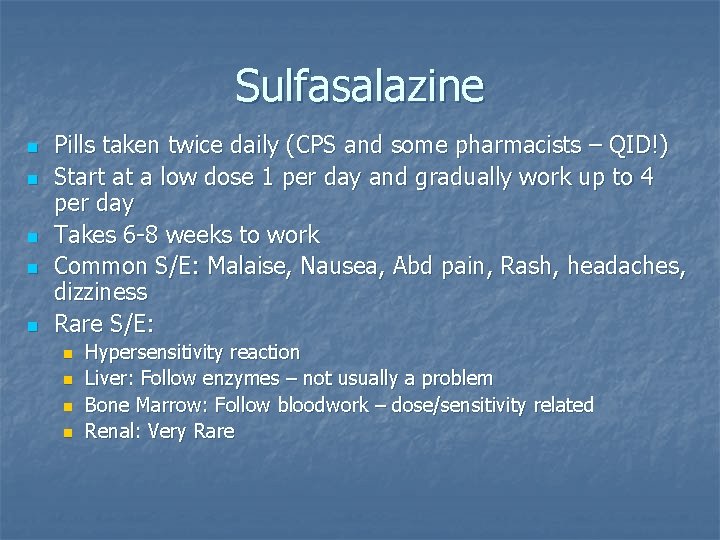
Sulfasalazine n n n Pills taken twice daily (CPS and some pharmacists – QID!) Start at a low dose 1 per day and gradually work up to 4 per day Takes 6 -8 weeks to work Common S/E: Malaise, Nausea, Abd pain, Rash, headaches, dizziness Rare S/E: n n Hypersensitivity reaction Liver: Follow enzymes – not usually a problem Bone Marrow: Follow bloodwork – dose/sensitivity related Renal: Very Rare
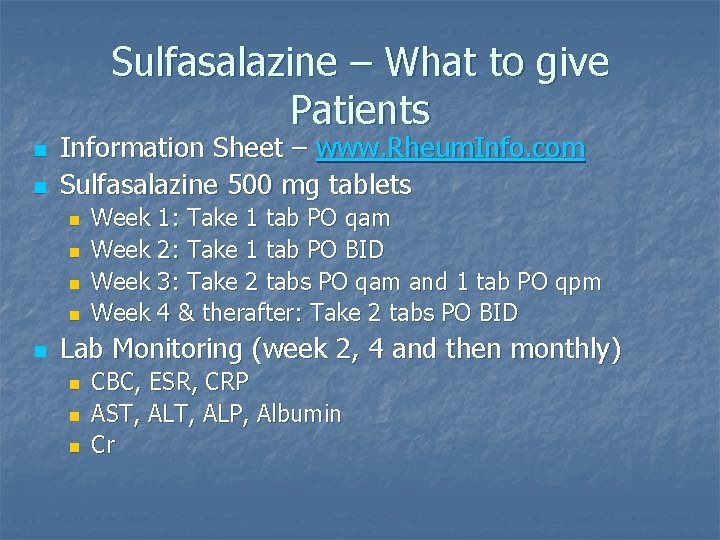
Sulfasalazine – What to give Patients n n Information Sheet – www. Rheum. Info. com Sulfasalazine 500 mg tablets n n n Week 1: Take 1 tab PO qam Week 2: Take 1 tab PO BID Week 3: Take 2 tabs PO qam and 1 tab PO qpm Week 4 & therafter: Take 2 tabs PO BID Lab Monitoring (week 2, 4 and then monthly) n n n CBC, ESR, CRP AST, ALP, Albumin Cr
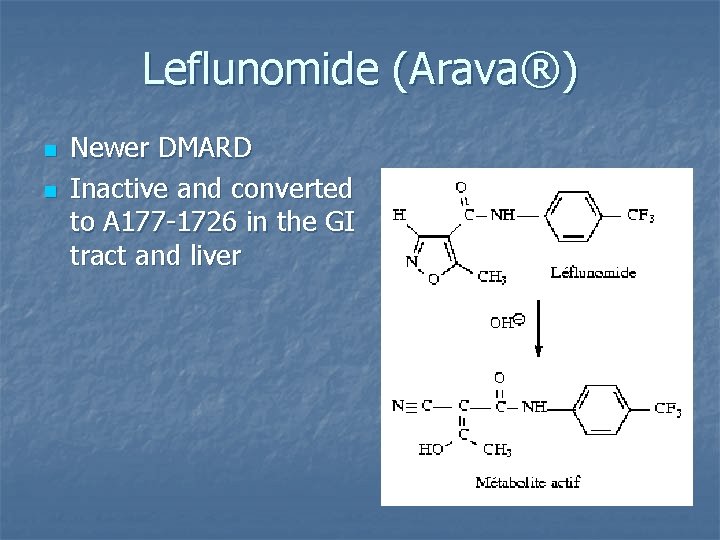
Leflunomide (Arava®) n n Newer DMARD Inactive and converted to A 177 -1726 in the GI tract and liver
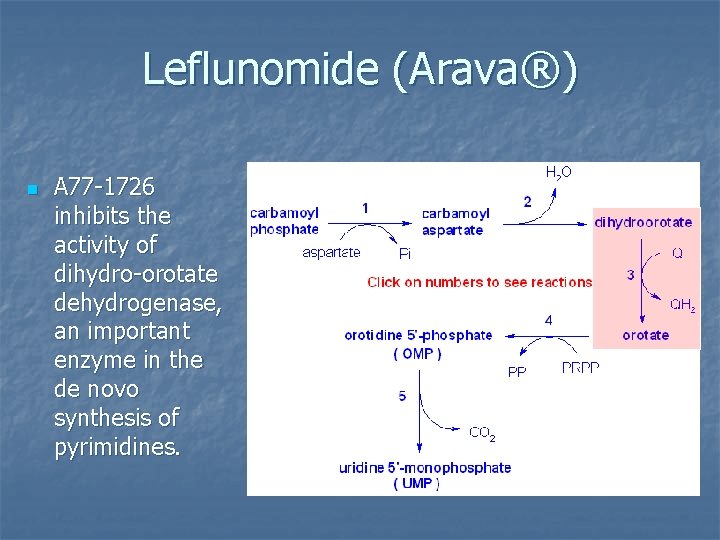
Leflunomide (Arava®) n A 77 -1726 inhibits the activity of dihydro-orotate dehydrogenase, an important enzyme in the de novo synthesis of pyrimidines.
Leflunomide (Arava®) n Dose and Administration 10 & 20 mg Tablets n Given daily – ranges from 10 -20 mg per day n n Onset of Action n n 6 -8 weeks Avoid Pregnancy – Teratogenic n Alcohol n
Leflunomide (Arava®) n Common S/E n n Diarrhea, nausea, malaise, hypertension, alopecia, rash Rare S/E n n n Liver: Follow enzymes – not usually a problem Bone Marrow: Follow bloodwork – dose/sensitivity related Infection Pregnancy Malignancy
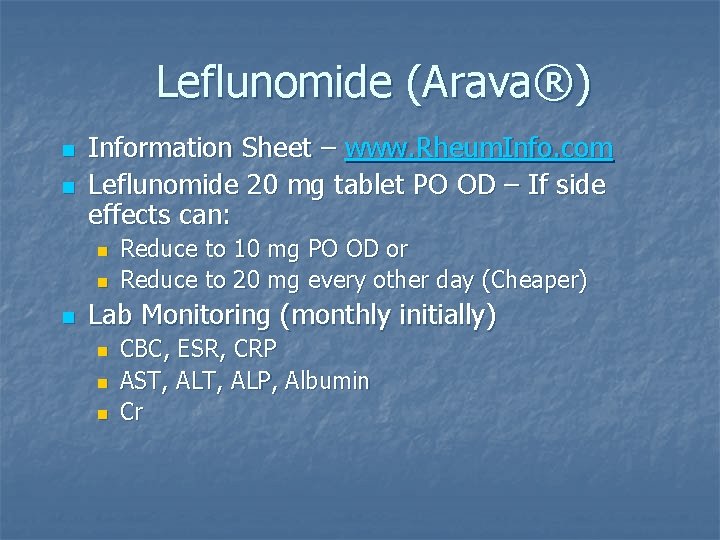
Leflunomide (Arava®) n n Information Sheet – www. Rheum. Info. com Leflunomide 20 mg tablet PO OD – If side effects can: n n n Reduce to 10 mg PO OD or Reduce to 20 mg every other day (Cheaper) Lab Monitoring (monthly initially) n n n CBC, ESR, CRP AST, ALP, Albumin Cr
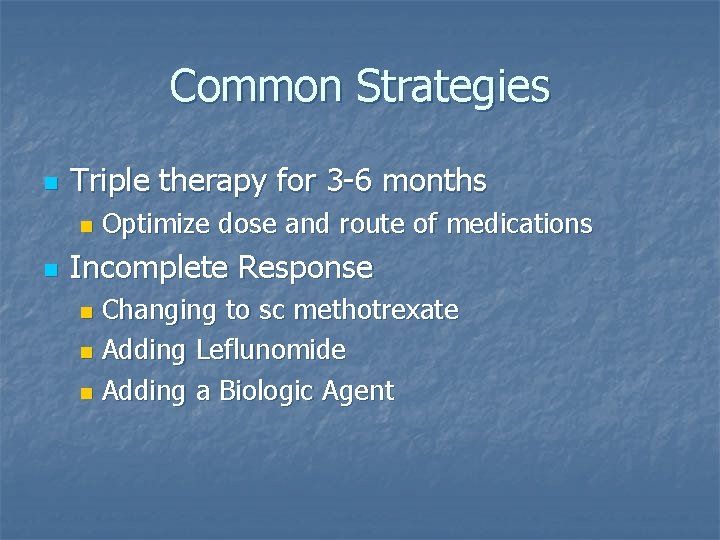
Common Strategies n Triple therapy for 3 -6 months n n Optimize dose and route of medications Incomplete Response Changing to sc methotrexate n Adding Leflunomide n Adding a Biologic Agent n
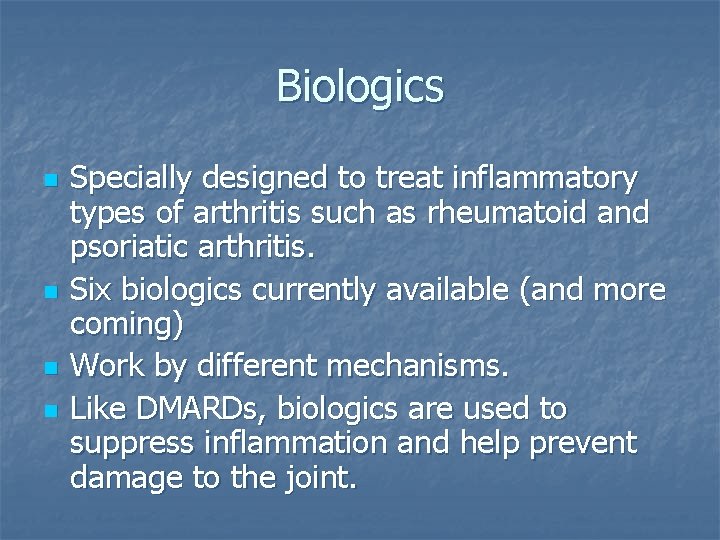
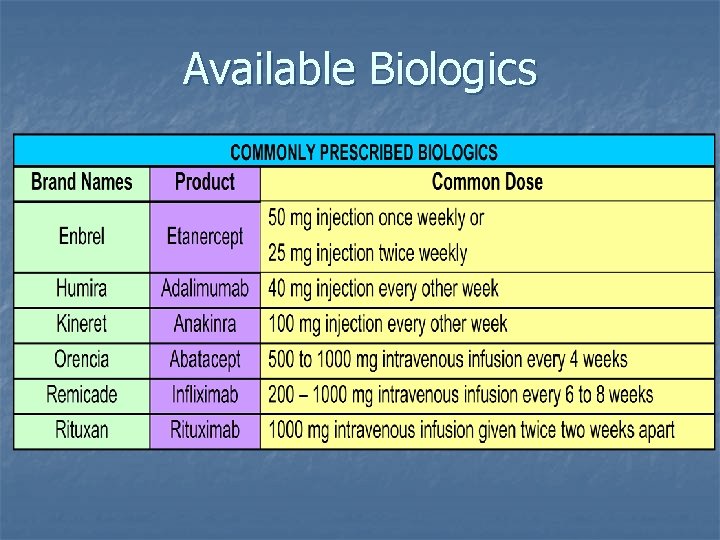
Biologics n n Specially designed to treat inflammatory types of arthritis such as rheumatoid and psoriatic arthritis. Six biologics currently available (and more coming) Work by different mechanisms. Like DMARDs, biologics are used to suppress inflammation and help prevent damage to the joint.
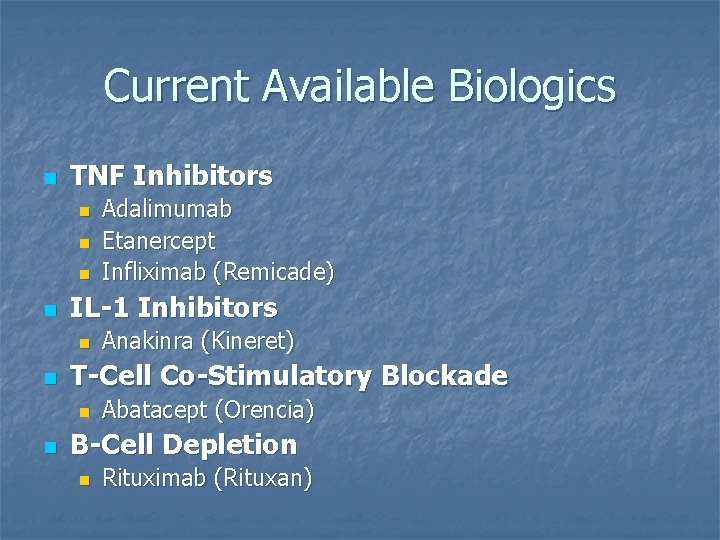
Current Available Biologics n TNF Inhibitors n n IL-1 Inhibitors n n Anakinra (Kineret) T-Cell Co-Stimulatory Blockade n n Adalimumab Etanercept Infliximab (Remicade) Abatacept (Orencia) B-Cell Depletion n Rituximab (Rituxan)
Available Biologics
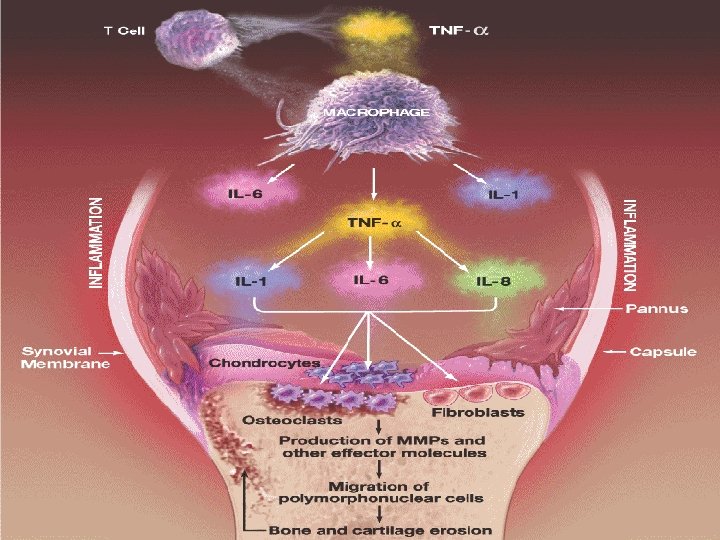
TNF Inhibitors n In some people with arthritis, a protein called Tumour Necrosis Factor (TNF) is present in the blood and joints in excessive amounts where it increases inflammation (pain & swelling).
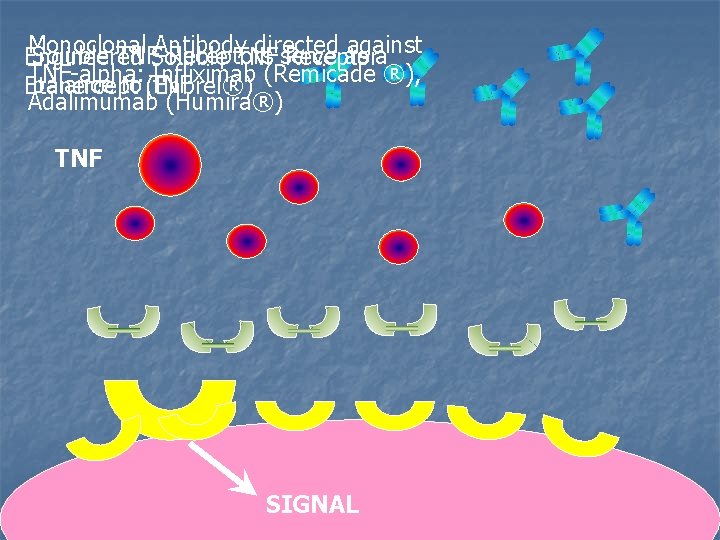
Monoclonal Antibody directed against Soluble TNF-Receptors serve as a Engineered Soluble TNF Receptor TNF-alpha: Infliximab (Remicade ®), balance to (Enbrel®) TNF Etanercept Adalimumab (Humira®) TNF SIGNAL
TNF-Inhibitors n Mechanism of Action Infliximab and Adalimumab are antibodies directed against TNF n Etanercept is a soluble receptor decoy n n Administration Infliximab is given intravenously n Etanercept and Adalimumab are given by subcutaneous injection n
Side Effects of TNF Inhibition n n Infusion Reactions with Infliximab, Injection Site Reactions with Adalimumab and Etanercept Infection n Malignancy n n n Multiple Sclerosis, seizures, inflammation of the ocular nerve Autoimmune n n Increased risk of lymphoma – early data Solid tumors? Neurologic n n Tuberculosis Serious resulting in death Antibody formation – SLE like illness Worsening of Congestive Heart Failure
When to Stop TNF-Inhibitors n n STOP if develop a fever, have an infection, or have been prescribed antibiotics Tell your doctor about any upcoming surgeries
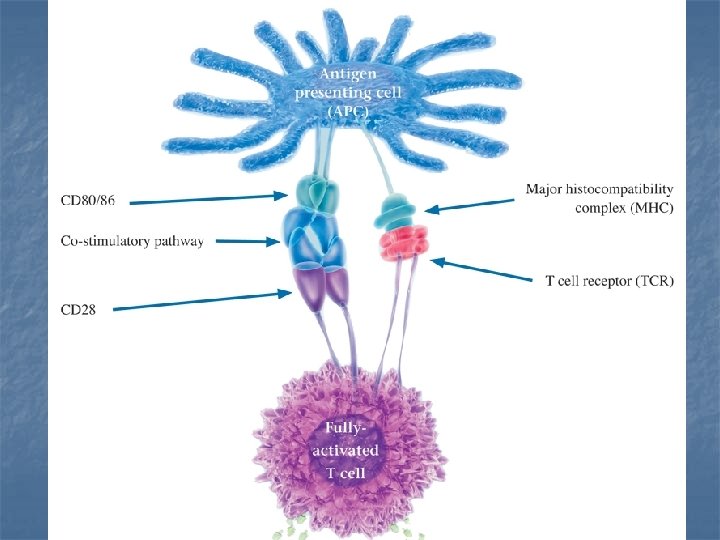
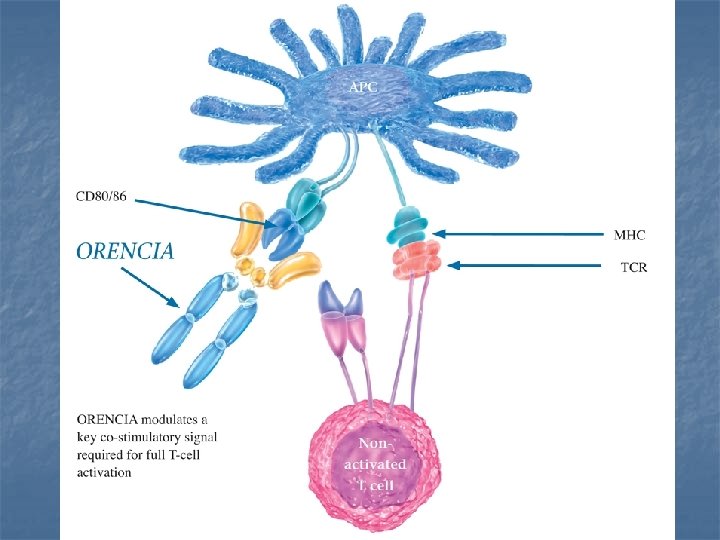
T-Cell Co-Stimulatory Blockade (Abatacept)
Practical Aspects n n Given on week 0, 2, and 4 then every 4 weeks Quick infusions over 30 minutes Well tolerated Home infusion program
Practical Aspects n Side Effects INFECTION n COPD Exacerbation n MALIGNANCY – Lung Cancer n Infusion Reactions – Rare n
B-Cell Depletion (Rituximab)
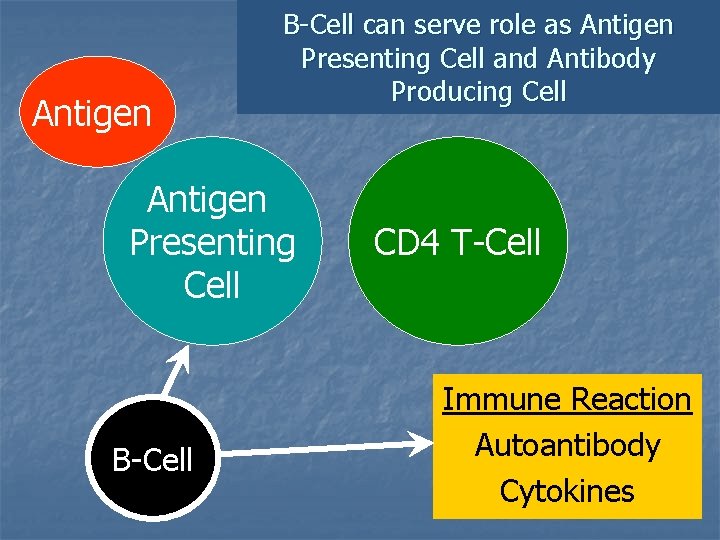
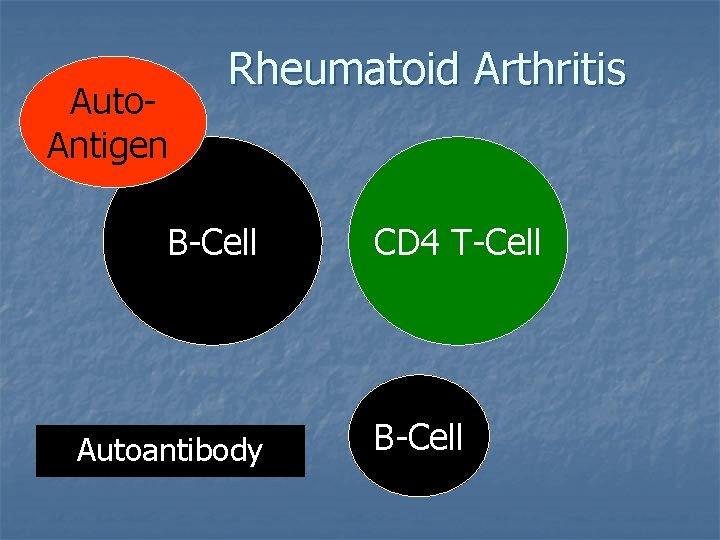
Rheumatoid Arthritis (RA) n n RA was thought to be T-Cell mediated Most widely accepted hypothesis: Professional Antigen Presenting Cell encounters some “unknown” antigen n It presents this “unknown” antigen to a CD 4 T -helper Cell n In a genetically predisposed individual, this starts an immune chain reaction n Immune system is confused and targets healthy tissue n
Antigen B-Cell can serve role as Antigen Presenting Cell and Antibody Producing Cell Antigen Presenting Cell B-Cell CD 4 T-Cell Immune Reaction Autoantibody Cytokines
Auto. Antigen Rheumatoid Arthritis B-Cell Autoantibody CD 4 T-Cell B-Cell
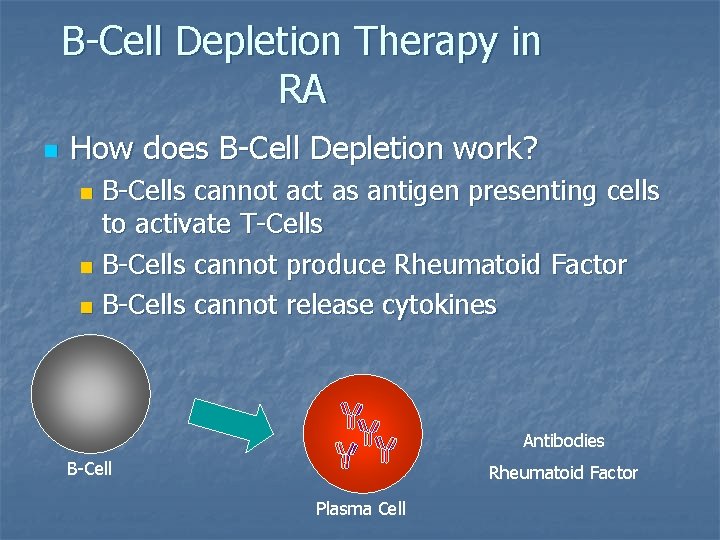
B-Cell Depletion Therapy in RA n How does B-Cell Depletion work? B-Cells cannot act as antigen presenting cells to activate T-Cells n B-Cells cannot produce Rheumatoid Factor n B-Cells cannot release cytokines n Antibodies B-Cell Rheumatoid Factor Plasma Cell
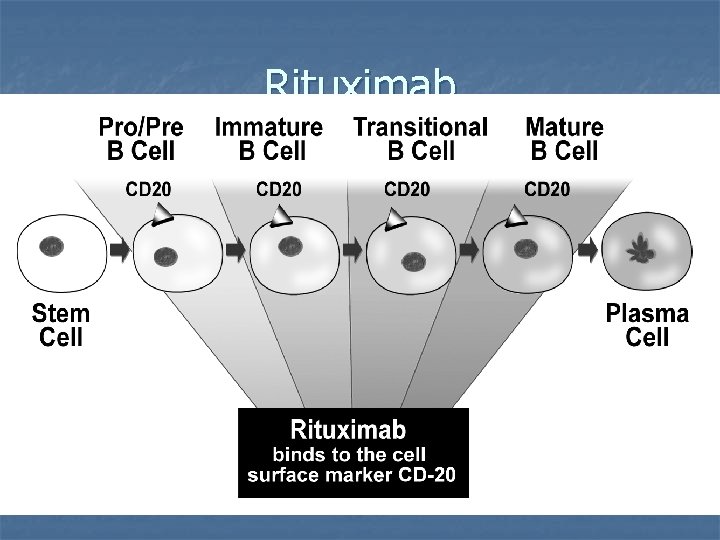
Rituximab
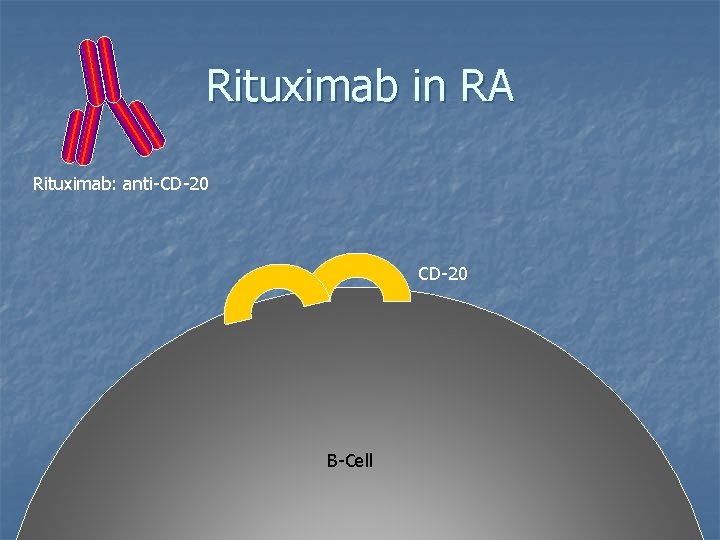
Rituximab in RA Rituximab: anti-CD-20 B-Cell
Initial Studies n n n Professor J. C. Edwards at University College in London England Treated 5 patients with Rituximab Based on the premise of reducing autoantibodies All 5 responded Since then multiple large trials have confirmed these results
Practical Aspects n n Given as two (2) infusions of 1000 mg spaced two weeks apart All patients given 100 mg of solumedrol with each infusion Takes about 3 -4 months to kick in Time to re-treatment – 6 to 9 months
Practical Aspects n Side Effects INFECTION n INFUSION REACTIONS n Other rare things – severe skin reactions, arrhythmia, drop in blood counts n
Any questions?