
ARTERIOVENOUS MALFORMATION AVMIntroduction Vascular malformation AVM Venous malformation


- Slides: 38
ARTERIOVENOUS MALFORMATION
AVM-Introduction Vascular malformation: ► AVM ► Venous malformation ► Cavernous malformation ► Capillary telangiectasia ► AVF
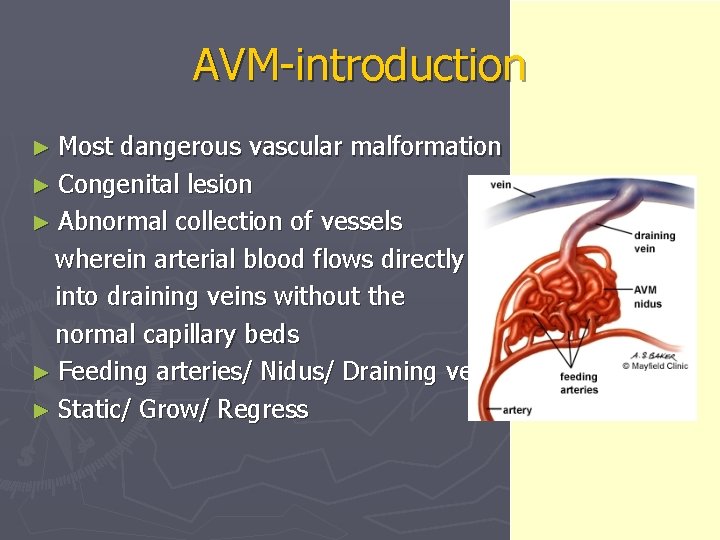
AVM-introduction ► Most dangerous vascular malformation ► Congenital lesion ► Abnormal collection of vessels wherein arterial blood flows directly into draining veins without the normal capillary beds ► Feeding arteries/ Nidus/ Draining veins ► Static/ Grow/ Regress
AVM-Presentation ► Hemorrhage(50%) ► Seizure ► Mass effect ► Ischemia; steal phenomenon ► Headache ► Bruit ► HCP ► Peds: hydrocephalus, heart failure
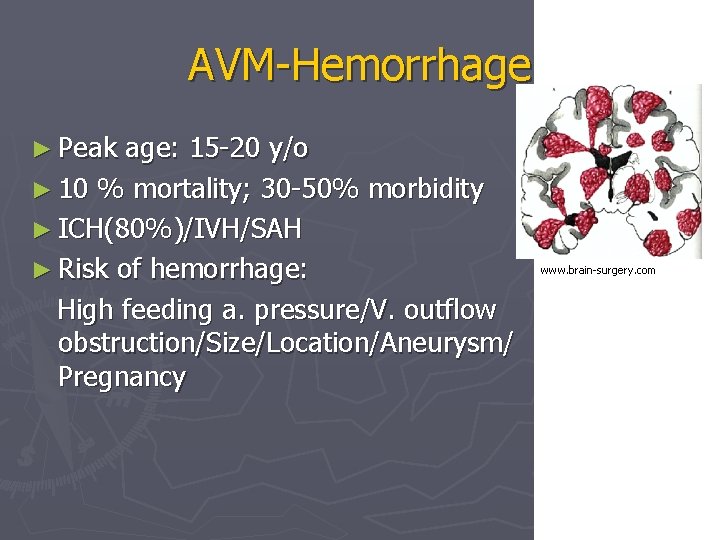
AVM-Hemorrhage ► Peak age: 15 -20 y/o ► 10 % mortality; 30 -50% morbidity ► ICH(80%)/IVH/SAH ► Risk of hemorrhage: High feeding a. pressure/V. outflow obstruction/Size/Location/Aneurysm/ Pregnancy www. brain-surgery. com
Hemorrhage related to AVM size Small AVMs are more lethal than larger ones Small AVMs tends to present more often as hemorrhage than do larger ones 1 ► Small AVMs are thought to have much higher pressure in feeding artery 1, 2 ► ► 1. 2. Crawford P M, West C R, et al: Arteriovenous Malformation: Natural History in Unoperated Patients. J Neurol Neurosuurg Psy 49: 1 -10, 1986 Spetzler R F, Hargraves R W, et al: Relationship of Perfusion Pressure and Size to Risk of Hemorrhage from Arteriovenous Malformations. Neurosurgery 37: 851 -5, 1995
Annual & Lifetime risk of Hemorrhage Lifelong risk of bleeding: 2 -4% per yr ► A study of 166 symptomatic AVMs with 24 year follow-up found the risk of major bleeding was constant at 4% per year, independent of whether the AVM presented with or without hemorrhage 3 ► The AVM Study Group: Annual rate of rehemorrhage was 18% among pts who had hemorrhage at presentation; 2% among pts with no history of bleeding (306 cases) 4 ► Rebleeding rate significantly lower than aneurysms. ► 3. Ondra SL, Troupp H, et al: The natural history of symptomatic cerebral arteriovenous malformation: A 24 -year follow-up assessment. J Neurosurg 25: 387 -91, 1990
AVMs & Associated Aneurysms ► 7% of pts with AVMs have aneurysms ► 75% are located on major feeding artery; probably from increased flow 1 ► The symptomatic one is treated first ► Although 66% of related aneurysms will regress following AVM removal, this does not always occur 4 4. Cunha M J, Stein B M, et al: The Treatment of Associated Intracranial Aneurysm and Arteriovenous Malformations. J Neurosurg 77: 853 -9, 1992.
Hemodynamic Effects of AVM Pre-op effects: ► Steal phenomenon ► AVM & aneurysm ► High-flow angiopathy 7 Post-op effects: ► Normal perfusion pressure breakthrough ► Occlusive hyperemia 7. Pile Spellman JM, Baker KF, et al: High flow angiopathy: cerebral blood vessel changes in chronic arteriovenous malformation. Am J Neuroradiol 1986; 7: 811 -5
Cerebral Steal Phenomenon ► Autoregulation curve shifts to left ► Despite cerebral arterial hypotension, focal neurological deficits are rare(<10%) ► More likely to be local mass effect
Normal perfusion pressure breakthrough (NPPB) Peri-/Post-op swelling or hemorrhage ► Loss of autoregulation 4 ? 5 ► Less than 5% ► Should be diagnosis of exclusion ► Mx: prevent post-op hypertension ► 4. Spetzler R F, Wilson C B, et al: Normal perfusion breakthrough theory. Clin Neurosurg 25: 651 -72, 1978 5. Young W L, Kader A, et al: Pressure autoregulation is intact after arteriovenous malformation resection. Neurosurgery 32: 491 -7, 1993
Evaluation-MRI ► Flow void on T 1 WI or T 2 WI ► Feeding arteries ► Nidus ► Draining veins
Evaluation-Angiography ► Tangle of vessels ► Large feeding artery ► Large draining veins ► Not all AVMs show up on angiography! Angiographically occult vascular malformation (AOVM)
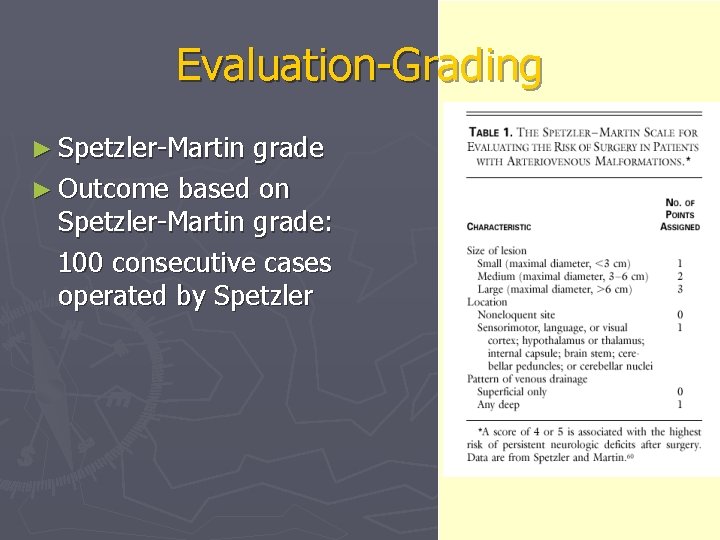
Evaluation-Grading ► Spetzler-Martin grade ► Outcome based on Spetzler-Martin grade: 100 consecutive cases operated by Spetzler
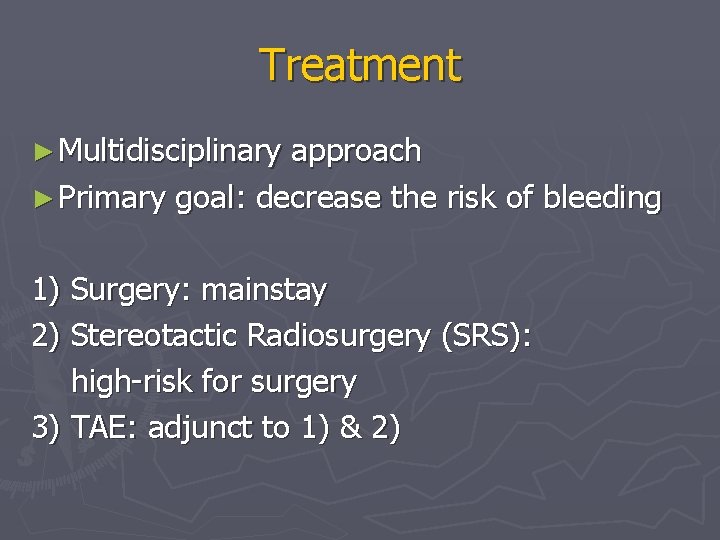
Treatment ► Multidisciplinary approach ► Primary goal: decrease the risk of bleeding 1) Surgery: mainstay 2) Stereotactic Radiosurgery (SRS): high-risk for surgery 3) TAE: adjunct to 1) & 2)
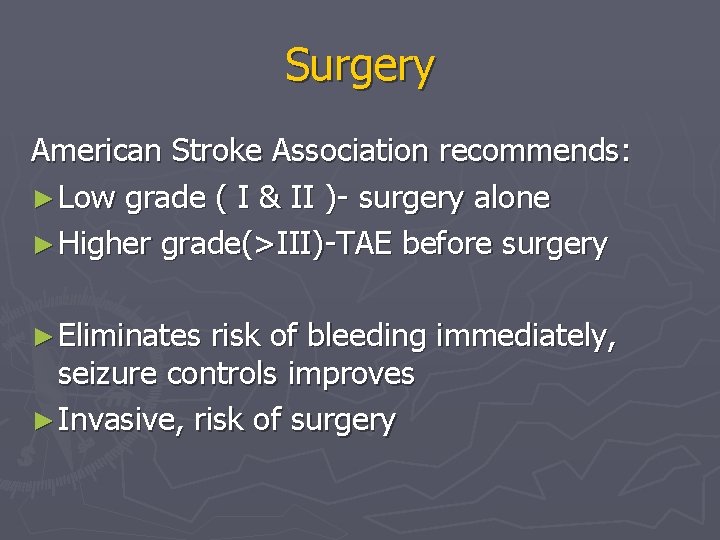
Surgery American Stroke Association recommends: ► Low grade ( I & II )- surgery alone ► Higher grade(>III)-TAE before surgery ► Eliminates risk of bleeding immediately, seizure controls improves ► Invasive, risk of surgery
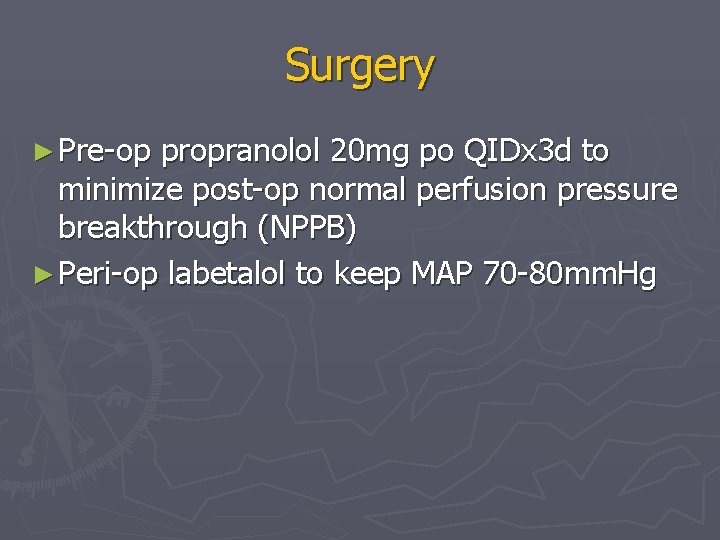
Surgery ► Pre-op propranolol 20 mg po QIDx 3 d to minimize post-op normal perfusion pressure breakthrough (NPPB) ► Peri-op labetalol to keep MAP 70 -80 mm. Hg
Surgery ► Craniotomy ► Dural opening ► Identify the borders ► Cautery of feeding arteries
Surgery ► Deep dissection of the nidus ► Securing the ventricle ► Obliterate the draining veins ► Final removal of AVM ► Post-resection BP challenge Hemostasis/ Residual nidus/ Areas prone to NPPB ► Immediate post-op/ Peri-op angiography
Intra-Op Complication ► Premature division of venous drainage ► Extensive bleeding along the deep margin ► Post-resection NPPB/ Residual AVM ► Pack the wall with Avitene & Gelfoam ► Immediate removal of the entire AVM
Post-Op Complications ► Subgaleal fluid collection ► Sterile meningitis ► Wound infection ► Intracerebral hematoma
Post-op Deterioration ► Normal Perfusion Pressure Breakthrough 4 post-op swelling or hemorrhage loss of autoregulation 4 ? 5 Mx: prevent post-op hypertension ► Occlusive Hyperemia 6 immediate: obstruction of venous outflow delayed: venous or sinus thrombosis Mx: adequate post-op hydration ► Rebleeding from a retained nidus ► Seizures
Radiation treatment Conventional radiation: effective in< 20% of cases ► SRS: for small (Nidus<3 cm) & deep AVMs ► Radiation-induced endothelial cell proliferation→Obliteration, thrombosis ► Gamma knife/ Linac ► Non-invasive, gradual reduction of flow ► Takes 1 -3 yrs to work, limited to small lesion ►
Endovascular Approach (TAE) ► Op inaccessible deep or dural feeding a. ► Usually inadequate if used alone for AVM; may recanalize ► Facilitates OP (less bleeding) & possibly SRS ► Can’t be used alone, acute hemodynamic change, multiple procedures
Endovascular Approach (TAE) ► Glue: N-butyl cyanoacrylate (n. BCA), Lipiodol, tantalum powder, D 5 W ► Embolization of the nidus through the feeders without any significant glue entering the draining veins ► In general, only 2 -3 vessels are embolized per session.
Endovascular Approach (TAE) ► Anesthesia: MAC/ GA ► Induced hypotension with vasoactive agents, general anesthesia, or even brief adenosine-induced cardiac pause at the time of embolization to allows the glue to set ► Provocation test: Sodium amytal & cardiac lidocaine injection to determine that embolization will not result in neurologic deficit
Anesthesia-related Considerations for Cerebral AVMs ► Extensive blood loss ► Pharmacological brain protection ► Non-pharmacological brain protection Anesthesia-related considerations for cerebral arteriovenous malformations Hashimoto T, Young W L, et al Departments of Anesthesia and Perioperative Care, Neurosurgery, and Neurology, Center for Cerebrovascular Research, UCSF Neurosurg Focus 11 (5): Article 5, 2001
Monitor ► EKG/Sp. O 2/ETCO 2/BT/CVP ► Measurement of vascular pressure differentiate a. from v. decision of whether a vein can be sacrificed
Anesthetic Technique Choice of Agents ► Avoid cerebral vasodilators!!! ► General condition ► Isoflurane/N 20 ► Additional Barbiturate loading ► Metabolic suppression- propofol, etomidate
Brain Relaxation ► Good head position ► CSF drainage ► Diuretics/Osmotherapy ► Avoid excessive cerebral vasodilator!!! ► Modest hypocapnia with hyperventilation
Euvolemia & Pressure Control ► Euvolemia ► Optimal cerebral perfusion pressure
Induced Hypotension ► Aneurysm/ AVM ► Large AVMs with deep a. supply ► Barbiturate therapy
Fluid and Electrolyte Management ► Isotonicity Stable cardiovascular status Prevention of cerebral edema Aggressive isotonic crystalloids may worsen brain edema by decreasing colloid oncotic pressure. 6 ► Euglycemia less than 200 mg/dl 6. Drummond JC, Patel PM, et al: The effect of the reduction of colloid oncotic pressure, with and without reduction of osmolarity, on post-traumatic cerebral edema. Anesthesiology 88: 993 -1002, 1998
Toleration of Modest Hypothermia ► Mild hypothermia(34 -35° C); cerebral protection ► SE: drug metabolism increased rate of myocardial ischemia infection arrhythmia coagulopathy
Emergence & Recovery ► Post-resection BP challenge; Hemostasis/ Residual nidus/ Areas prone to NPPB ► BP ► NE control: most important
Postoperative Management ► BP control SBP< 120 mm. Hg x 2 d ► BT control
Any Comment or Question?
Thanks for Your Attention & Have a Good Day!!!